
LEAD ANALYST
Utkarsh Khirodkar is a Lead Market Research Analyst at MetaStat Insight, specializing in market intelligence, technology sector assessments, and competitive strategy.

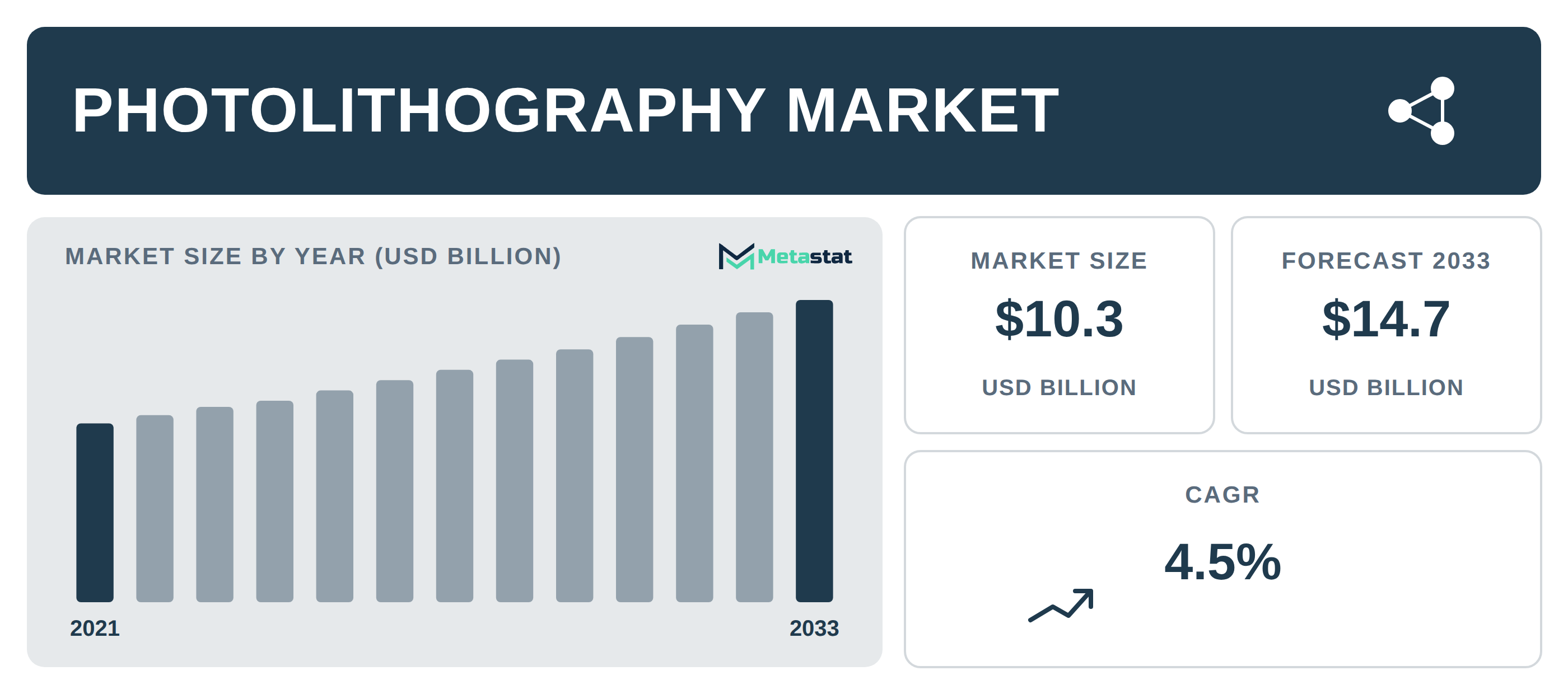
Metastat Insights reports that the global Photolithography market is expected to grow from USD 10.3 billion in 2025 to USD 14.7 billion by 2033, at a CAGR of 4.5%. Key drivers include demand for advanced semiconductors and technological advancements in the industry.
Metastat Insights has published "Global Photolithography Market Size, Share, By Technology (Deep Ultraviolet (DUV), Extreme Ultraviolet (EUV), Ultraviolet (UV), I-Line, Krypton Fluoride (KrF), and Argon Fluoride (ArF) Dry), By Light Source (Mercury Lamps, Excimer Lasers, Fluorine Lasers, and Laser-Produced Plasma), By Application (Front-End and Back-End), By End User (Integrated Device Manufacturers (IDMs), Foundries, Printed Circuit Board Manufacturers, and Microelectronics & Semiconductor Device Manufacturers), Industry Analysis, Growth, Trends, and Forecast, 2026-2033", followed by the headline figures (USD 10.3 billion in 2025, USD 14.7 billion by 2033, 4.5% CAGR).
The Photolithography market experiences substantial growth due to the increasing demand for advanced semiconductors. The rise of digital transformation and the proliferation of smart devices lead to significant investments in semiconductor manufacturing. Industries including automotive, telecommunications, and consumer electronics drive this demand, resulting from their reliance on sophisticated chips for enhanced functionality. This trend aligns with broader technological integration across sectors, pushing manufacturers to invest in advanced photolithography technologies that enhance production efficiency and precision.
Regulatory compliance poses significant challenges within the Photolithography market. Stricter environmental regulations compel manufacturers to adopt sustainable practices, which often leads to increased capital expenditures. These financial burdens disproportionately impact smaller companies, limiting their competitive capabilities. Macroeconomic factors including inflationary pressures and currency volatility affect the overall operational landscape. Manufacturers navigate these challenges while striving to maintain profitability and ensure compliance with evolving regulations.
The market segments into technology, light source, application, and end user. The technology segment shows notable growth in Deep Ultraviolet (DUV) and Extreme Ultraviolet (EUV) technologies, with DUV projected to expand from USD 4.7 billion in 2026 to USD 6.2 billion by 2033. Meanwhile, EUV technology is set to reach USD 5.6 billion in the same period. Regional dynamics reveal that Asia Pacific holds the largest market share at 53.4%, driven by a strong presence of semiconductor manufacturers in countries including China, Japan, and South Korea. North America and Europe contribute significantly due to established technology firms and research institutions.
Prominent companies operating in the Photolithography market include ASML, Canon U.S.A., Inc., Nikon Corporation, Applied Materials, Inc., IMT MASKEN UND TEILUNGEN AG, and Tokyo Electron Limited. These firms focus on advancing their technologies and expanding their market reach through strategic partnerships and collaborations. Their investments in research and development ensure that they remain competitive in the evolving landscape of semiconductor manufacturing technologies.
For a comprehensive analysis and insights into the Photolithography market, visit the full report: Global Photolithography Market.
Related Report
Global Photolithography MarketLEAD ANALYST
Utkarsh Khirodkar is a Lead Market Research Analyst at MetaStat Insight, specializing in market intelligence, technology sector assessments, and competitive strategy.

PRINCIPAL CONSULTANT - ENTERPRISE AI & EMERGING TECHNOLOGIES
Banking & Finance · Electronics and Semiconductor · Energy and Power · Healthcare IT · Information & Technology · Professional Services
Vijay Gunti is a Principal Consultant at MetaStat Insight, bringing over two decades of experience across enterprise digital transformation, technology strategy, and intelligent systems.

PRINCIPAL CONSULTANT - QUALITY SYSTEMS & COMPLIANCE
Electronics and Semiconductor · Machinery & Equipment · Professional Services
Omkar Phadtare is an Industry Consultant at MetaStat Insight, specializing in quality systems, regulatory compliance, and standards benchmarking to drive data-driven market intelligence and strategic industry research.

ENERGY & INFRASTRUCTURE INDUSTRY CONSULTANT
Automotive and Transportation · Electronics and Semiconductor · Energy and Power · Machinery & Equipment
Saurabh Vasant Ganvir consults for Energy & Infrastructure Industry at MetaStat Insight, specializing in renewable energy, solar EPC, and electric vehicle (EV) infrastructure markets.

LEAD CONSULTANT - COMMUNICATION, TELECOM, AND IT
Electronics and Semiconductor · Information & Technology · Machinery & Equipment · Professional Services
Ravindra Sathe Consultants for Communication, Telecom, and IT at MetaStat Insight. He leads the firm's industry research initiatives across telecommunications infrastructure, digital connectivity, enterprise networking, and emerging information technology domains.