
LEAD ANALYST
Utkarsh Khirodkar is a Lead Market Research Analyst at MetaStat Insight, specializing in market intelligence, technology sector assessments, and competitive strategy.

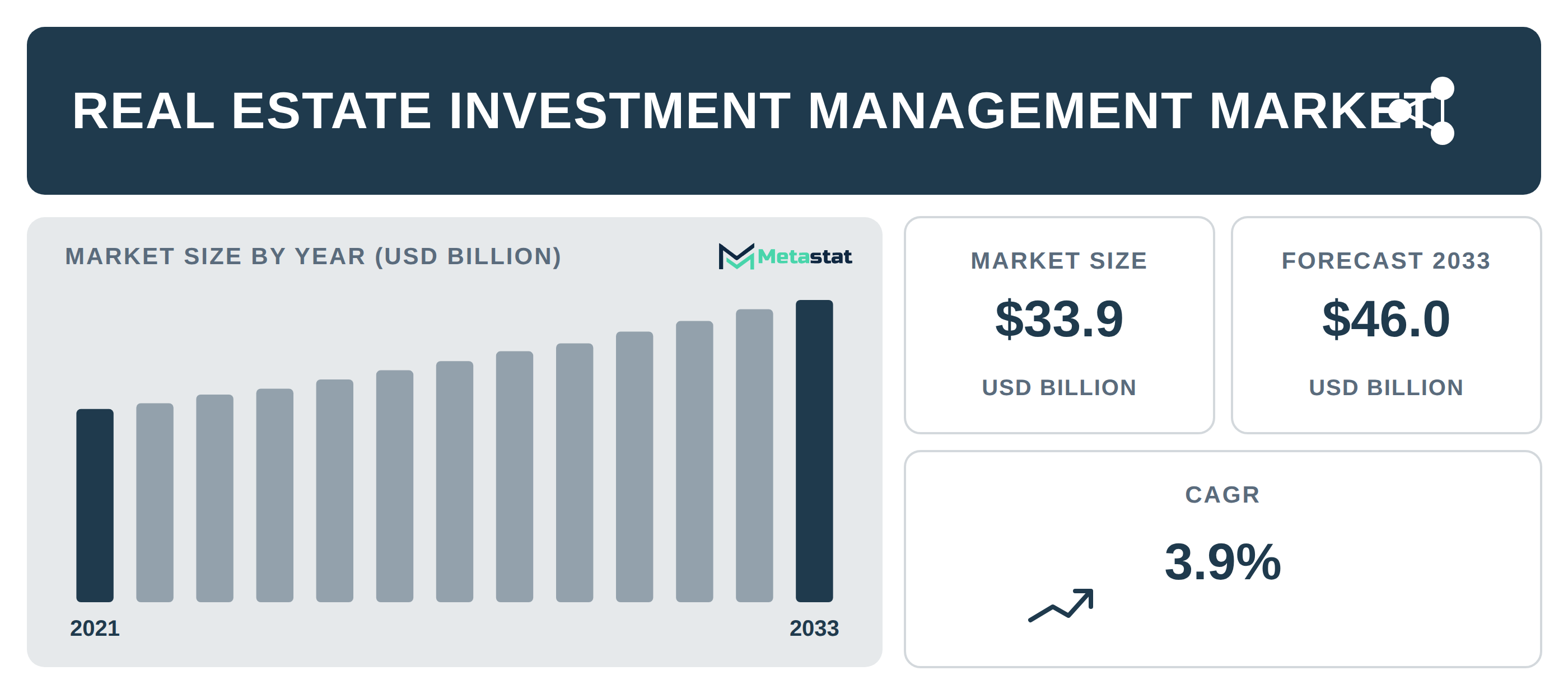
Metastat Insights announces the release of a new report detailing the Global Real Estate Investment Management market, projected to grow from USD 33.9 billion in 2025 to USD 46 billion by 2033 at a CAGR of 3.9%. The report covers investment strategies, property types, investor types, and key market dynamics.
Metastat Insights has published "Global Real Estate Investment Management Market Size, Share, By Investment Strategy (Core, Core Plus, Value-Add, Opportunistic), By Property Type (Industrial & Logistics, Residential & Multifamily, Office, Retail, Hospitality, Data Centers, Healthcare & Life Sciences, Student Housing, Others (Self-Storage, Mixed-Use, Specialty Real Estate)), By Investor Type (Pension Funds, Insurance Companies, Sovereign Wealth Funds, Endowments & Foundations, Banks & Financial Institutions, Asset Managers & Fund-of-Funds, Family Offices & Private Wealth, Others (Corporate Investors, Charitable Institutions)), Industry Analysis, Growth, Trends, and Forecast, 2026-2033", indicating that the market was valued at USD 33.9 billion in 2025 and is projected to reach USD 46 billion by 2033, growing at a CAGR of 3.9%.
Increased institutional allocation to real estate significantly drives demand within the Real Estate Investment Management market. Investors are drawn to the asset class's resilience and potential for long-term returns, leading to strategic portfolio rebalancing. This trend has resulted in enhanced capital influx across various property types, strengthening market stability. The shift in cross-border capital flows reflects a growing interest from foreign investors seeking diversified portfolios in North American and European markets, enhancing investment strategies.
Despite promising growth, regulatory pressures and compliance hurdles pose significant challenges to the Real Estate Investment Management market. Increasing regulatory demands lead to heightened operational costs, particularly affecting smaller firms striving to maintain compliance. Macroeconomic factors, including inflation and rising interest rates, further complicate investment strategies by diminishing investor appetite for real estate. Geopolitical instability and resource scarcity introduce additional uncertainties, impacting project timelines and operational costs.
The Real Estate Investment Management market is segmented by investment strategy, encompassing Core, Core Plus, Value-Add, and Opportunistic approaches. Each segment exhibits distinct growth trajectories based on investor preferences. For instance, the Core strategy, projected to reach USD 15.6 billion by 2033, appeals to institutional investors looking for stable income streams. In contrast, the Opportunistic segment, focusing on high-risk, high-reward investments, is anticipated to grow at a CAGR of 4.7% during the forecast period.
Several key players operate within the Real Estate Investment Management market, including Blackstone Inc., Brookfield Asset Management Ltd., CBRE Investment Management, and PGIM Real Estate. These firms focus on innovative investment strategies and competitive performance metrics to attract capital. The market experiences trends in manager consolidation, where firms pursue mergers and acquisitions to enhance capabilities and expand their investment platforms.
For more detailed insights and analysis, readers access the full report on the Global Real Estate Investment Management Market.
Related Report
Global Real Estate Investment Management MarketLEAD ANALYST
Utkarsh Khirodkar is a Lead Market Research Analyst at MetaStat Insight, specializing in market intelligence, technology sector assessments, and competitive strategy.

PRINCIPAL CONSULTANT - ENTERPRISE AI & EMERGING TECHNOLOGIES
Banking & Finance · Electronics and Semiconductor · Energy and Power · Healthcare IT · Information & Technology · Professional Services
Vijay Gunti is a Principal Consultant at MetaStat Insight, bringing over two decades of experience across enterprise digital transformation, technology strategy, and intelligent systems.