
LEAD ANALYST
Utkarsh Khirodkar is a Lead Market Research Analyst at MetaStat Insight, specializing in market intelligence, technology sector assessments, and competitive strategy.

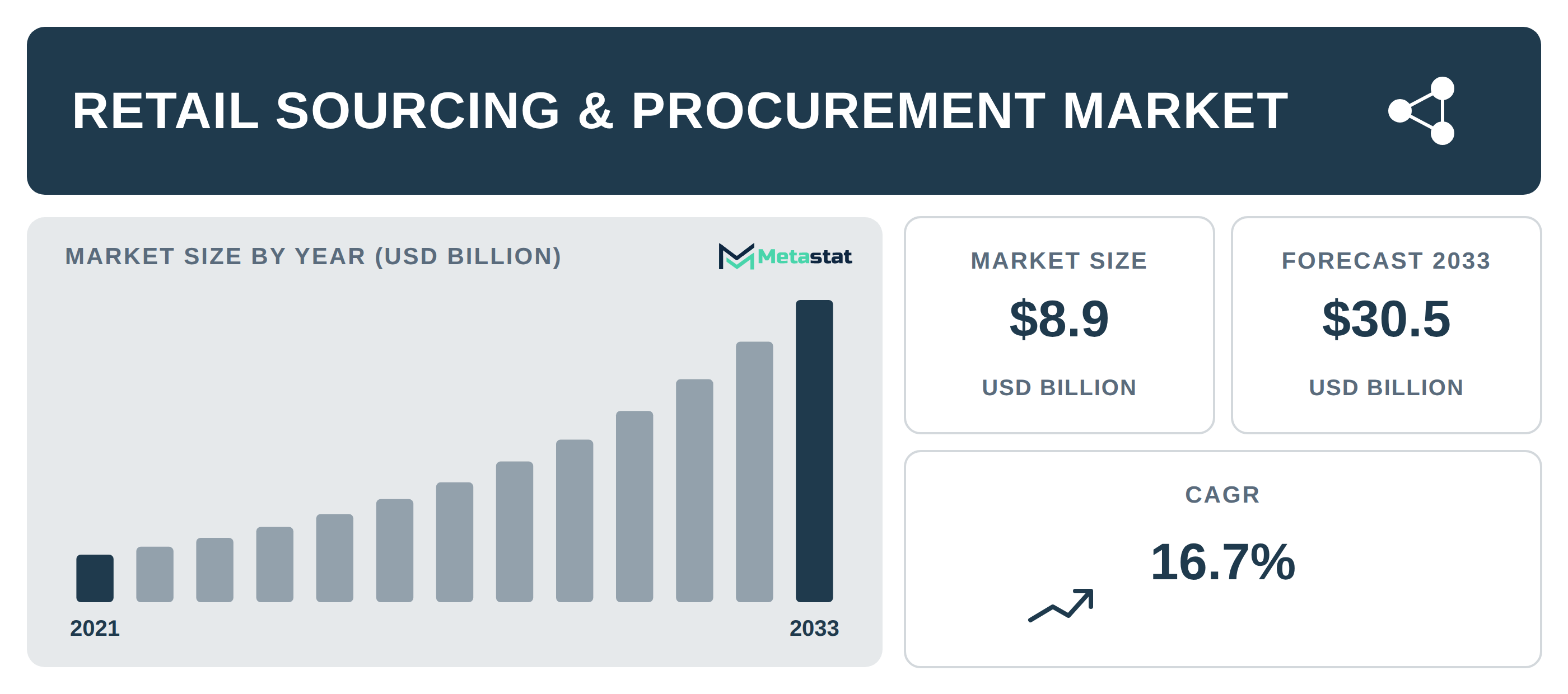
Metastat Insights has published a comprehensive report detailing the Retail Sourcing & Procurement market, projected to grow from USD 8.9 billion in 2025 to USD 30.5 billion by 2033, with a CAGR of 16.7%. The report outlines key drivers, challenges, and market segmentation.
Metastat Insights has published "Global Retail Sourcing & Procurement Market Size, Share, By Procurement Type (Direct Procurement, Indirect Procurement and Services Procurement), By Solution Type (Strategic Sourcing, Supplier Management, Contract Management, Procure-to-Pay, Spend Analytics and Others), By Deployment Model (Cloud, On-Premise and Hybrid), By End User (Supermarkets & Hypermarkets, Department Stores, Specialty Stores, Online Retailers, Convenience & Discount Stores and Others), Industry Analysis, Growth, Trends, and Forecast, 2026-2033", highlighting a market value of USD 8.9 billion in 2025 and a projection of USD 30.5 billion by 2033, with a compound annual growth rate (CAGR) of 16.7%.
The growing need for efficient procurement solutions significantly fuels the Retail Sourcing & Procurement market. Companies prioritize enhancing supply chain performance and optimizing costs, resulting in increased investments in digital transformation and automation technologies. This trend is evident across sectors including supermarkets, department stores, and online retailers, which aim to streamline their procurement operations. Incorporating advanced technologies, including artificial intelligence and machine learning, improves decision-making and supplier management, further enhancing market growth.
Regulatory challenges and compliance issues pose significant obstacles within the Retail Sourcing & Procurement market. Stricter regulations introduce complexities that raise operational costs and extend procurement timelines, thereby limiting agility. Macroeconomic factors, including inflation and geopolitical tensions, disrupt supply chains, compelling companies to reevaluate their sourcing strategies. These challenges hinder investments in new technologies and solutions designed to improve procurement efficiency.
The Retail Sourcing & Procurement market segments into procurement type, solution type, deployment model, and end user. North America dominates the market with a 35.7% share, followed by Europe at 26.4% and Asia Pacific at 24.6%. The direct procurement segment is anticipated to grow from USD 5.7 billion in 2026 to USD 16.3 billion by 2033, while indirect procurement is projected to reach USD 9.5 billion by 2033. Each segment illustrates distinct growth patterns driven by market demands and technological advancements.
Market fragmentation is apparent, with numerous players including Cegid, Epicor Software Corporation, GEP, Infor, IBM, Ivalua Inc., Blue Yonder Group, Inc., Oracle, and SAP SE. This competitive environment stimulates innovation and enhances value propositions across the Retail Sourcing & Procurement market. Companies distinguish themselves through specialized services and solutions tailored to the unique requirements of various sectors.
For further insights, readers access the full report at Global Retail Sourcing & Procurement Market.
Related Report
Global Retail Sourcing & Procurement MarketLEAD ANALYST
Utkarsh Khirodkar is a Lead Market Research Analyst at MetaStat Insight, specializing in market intelligence, technology sector assessments, and competitive strategy.