
LEAD ANALYST
Utkarsh Khirodkar is a Lead Market Research Analyst at MetaStat Insight, specializing in market intelligence, technology sector assessments, and competitive strategy.

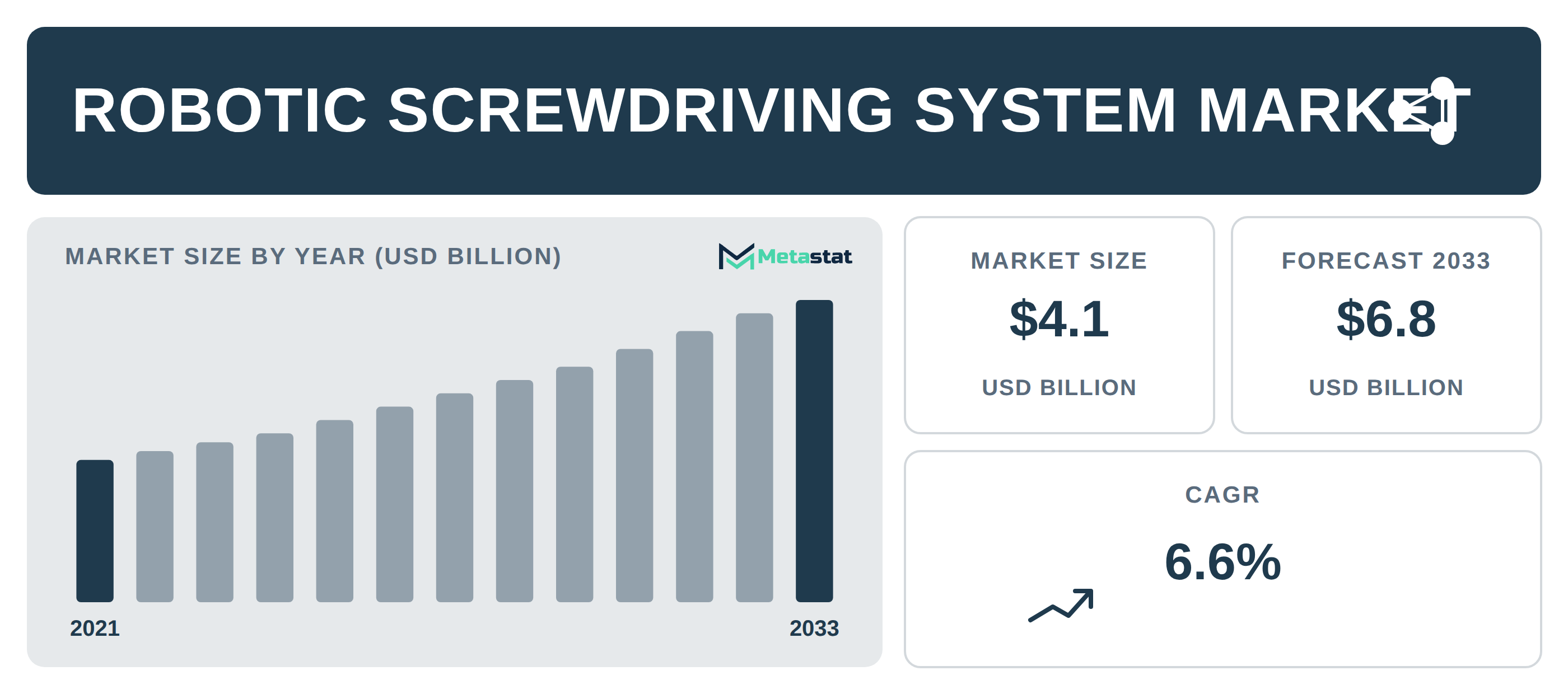
Metastat Insights has published a new report on the Robotic Screwdriving System market, predicting growth from USD 4.1 billion in 2025 to USD 6.8 billion by 2033, with a CAGR of 6.6%. Key drivers include increased automation and demand for efficiency across industries.
Metastat Insights has published "Global Robotic Screwdriving System Market Size, Share, By Robot Type (Articulated Robots, SCARA Robots, Collaborative Robots (Cobots), Cartesian/Gantry Robots, Delta/Parallel Robots and Others (Polar, Cylindrical and Specialty Robotic Configurations)), By Screwdriving Technology (Electric Screwdriving Systems, Pneumatic Screwdriving Systems and Others (Hybrid and Specialized Drive Technologies)), By Torque Range (Up to 1 Nm, Above 1-5 Nm, Above 5-20 Nm, Above 20-50 Nm, Above 50-100 Nm and Above 100 Nm), By End-Use Industry (Automotive and Automotive Components, Electronics and Electrical, Consumer Appliances, Aerospace and Defense, Industrial Machinery and Equipment, Medical Devices, New Energy and Battery Manufacturing and Others (Furniture, Telecommunications, Precision Instruments)), Industry Analysis, Growth, Trends, and Forecast, 2026-2033", followed by the headline figures (USD 4.1 billion in 2025, USD 6.8 billion by 2033, 6.6% CAGR).
Growth in the Robotic Screwdriving System market stems from increasing automation across various sectors. The push for digital transformation encourages organizations to adopt advanced technologies that enhance productivity and operational efficiency. Key sectors including automotive, electronics, and consumer appliances are implementing these systems to streamline assembly processes, reduce labor costs, and improve accuracy. Investments in automation technologies reflect a broader economic trend, indicating a growing demand for high-volume production capabilities across industries.
Significant challenges arise from high capital investment requirements in the Robotic Screwdriving System market. Manufacturers face considerable upfront costs when adopting advanced robotic technologies, which restrict access for smaller companies. This financial burden influences decision-making processes, causing delays in the implementation of robotic systems. The market grapples with risks tied to technological obsolescence, necessitating ongoing investment to remain competitive. These factors contribute to a slower-than-expected adoption rate, ultimately affecting the overall market trajectory.
Market segmentation reveals diverse dynamics within the Robotic Screwdriving System landscape. North America leads the market with a 39.3% share, followed by Europe at 28% and the Asia Pacific region at 21.9%. Among different types of robots, articulated robots are projected to grow from USD 1.7 billion in 2026 to USD 2.6 billion by 2033. The electric screwdriving systems segment is expected to witness significant growth, reaching USD 3.9 billion by 2033, while pneumatic systems will achieve USD 2.4 billion. The market comprises various end-use industries, including automotive, electronics, and medical devices, each with unique demands that drive the adoption of robotic screwdriving solutions.
A variety of players actively shape the competitive landscape of the Robotic Screwdriving System market, including ABB, FANUC Corporation, Yaskawa Electric Corporation, and Kawasaki Heavy Industries, Ltd. These companies focus on enhancing their product offerings and expanding their geographic reach to capture market share. Mergers and acquisitions play a crucial role in consolidating capabilities and delivering innovative solutions. Significant investments in research and development are essential for addressing evolving customer needs and maintaining competitiveness in a fragmented market.
For a comprehensive analysis and insights, readers access the full report: Global Robotic Screwdriving System Market.
Related Report
Global Robotic Screwdriving System MarketLEAD ANALYST
Utkarsh Khirodkar is a Lead Market Research Analyst at MetaStat Insight, specializing in market intelligence, technology sector assessments, and competitive strategy.

INDUSTRY CONSULTANT - CHEMICALS & ADVANCED MATERIALS
Chemicals and Materials · Machinery & Equipment · Packaging
Amit Gadhekar Consultant for Chemicals and Materials at MetaStat Insight, directing sector-specific intelligence, research, and strategic consulting across global chemical and processing markets.

PRINCIPAL CONSULTANT - QUALITY SYSTEMS & COMPLIANCE
Electronics and Semiconductor · Machinery & Equipment · Professional Services
Omkar Phadtare is an Industry Consultant at MetaStat Insight, specializing in quality systems, regulatory compliance, and standards benchmarking to drive data-driven market intelligence and strategic industry research.

ENERGY & INFRASTRUCTURE INDUSTRY CONSULTANT
Automotive and Transportation · Electronics and Semiconductor · Energy and Power · Machinery & Equipment
Saurabh Vasant Ganvir consults for Energy & Infrastructure Industry at MetaStat Insight, specializing in renewable energy, solar EPC, and electric vehicle (EV) infrastructure markets.

LEAD CONSULTANT - COMMUNICATION, TELECOM, AND IT
Electronics and Semiconductor · Information & Technology · Machinery & Equipment · Professional Services
Ravindra Sathe Consultants for Communication, Telecom, and IT at MetaStat Insight. He leads the firm's industry research initiatives across telecommunications infrastructure, digital connectivity, enterprise networking, and emerging information technology domains.