
LEAD ANALYST
Utkarsh Khirodkar is a Lead Market Research Analyst at MetaStat Insight, specializing in market intelligence, technology sector assessments, and competitive strategy.

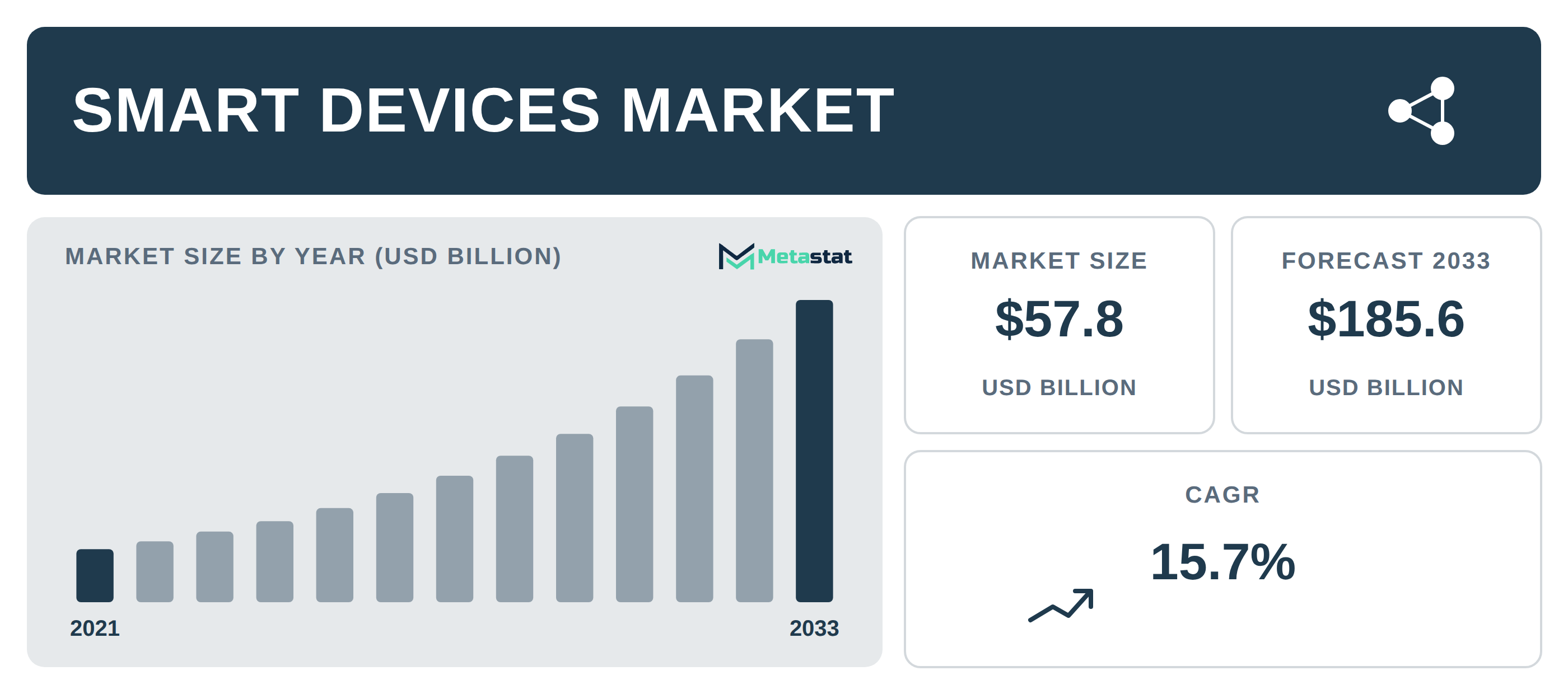
Metastat Insights reveals the Smart Devices market will grow from USD 57.8 billion in 2025 to USD 185.6 billion by 2033, driven by digital transformation and increasing consumer demand.
Metastat Insights has published "Global Smart Devices Market Size, Share, By Product Type (Smart Thermostats, Smart Humidifiers, Smart Dehumidifiers, Smart Air Purifiers, and Others), By Connectivity (Wi-Fi, Zigbee, Z-Wave, Bluetooth, and Others), By Application (Residential, Commercial Buildings, Healthcare Facilities, Educational Institutions, Hospitality, Industrial Facilities, and Others), By Distribution Channel (HVAC Contractors & System Integrators, Direct Sales, Retail Stores, E-commerce, and Others), Industry Analysis, Growth, Trends, and Forecast, 2026-2033". The market value stood at USD 57.8 billion in 2025 and is set to increase to USD 185.6 billion by 2033, reflecting a compound annual growth rate (CAGR) of 15.7%.
Several macroeconomic factors are fueling the growth of the Smart Devices market. Rising capital investments, combined with favorable interest rates and robust GDP growth, enhance consumer purchasing power. Organizations are focusing on digital transformation by integrating advanced technologies including automation and artificial intelligence into their operations. This shift towards digitization leads to improved operational efficiency, benefiting sectors including healthcare and commercial buildings. Demographic changes, including aging populations and urbanization, are increasing the demand for smart devices that aim to enhance quality of life.
Regulatory compliance presents notable challenges for the Smart Devices market, affecting the pace of adoption across various sectors. Stricter regulations necessitate that manufacturers allocate significant resources to compliance efforts, diverting funds away from innovation initiatives. Increased operational costs disproportionately impact smaller players in the market, limiting their ability to compete effectively. Macroeconomic pressures including inflation and geopolitical instability further impede market growth, creating a cautious environment that hinders expansion.
The Smart Devices market is classified into distinct segments based on product type, connectivity, application, and distribution channel. Notably, the product segments encompass Smart Thermostats, Smart Humidifiers, Smart Dehumidifiers, and Smart Air Purifiers. Connectivity options include Wi-Fi, Zigbee, Z-Wave, and Bluetooth, catering to various consumer preferences. Regionally, North America leads the market with a 42.6% share, followed closely by Europe and Asia Pacific, which account for 23.3% and 23.7% respectively. This distribution highlights strong demand for smart technologies across both residential and commercial sectors.
Key players in the Smart Devices market comprise AprilAire, Honeywell Home (Resideo Technologies), ecobee, and Emerson Smart. These companies operate in a highly competitive environment influenced by technological advancements and shifting consumer preferences. Strategic investments in innovation and adherence to regulatory standards are crucial for these firms to sustain their market presence and seize growth opportunities.
For a comprehensive analysis, readers access the full report titled Global Smart Devices Market.
Related Report
Global Smart Devices MarketLEAD ANALYST
Utkarsh Khirodkar is a Lead Market Research Analyst at MetaStat Insight, specializing in market intelligence, technology sector assessments, and competitive strategy.

PRINCIPAL CONSULTANT - ENTERPRISE AI & EMERGING TECHNOLOGIES
Banking & Finance · Electronics and Semiconductor · Energy and Power · Healthcare IT · Information & Technology · Professional Services
Vijay Gunti is a Principal Consultant at MetaStat Insight, bringing over two decades of experience across enterprise digital transformation, technology strategy, and intelligent systems.

PRINCIPAL CONSULTANT - QUALITY SYSTEMS & COMPLIANCE
Electronics and Semiconductor · Machinery & Equipment · Professional Services
Omkar Phadtare is an Industry Consultant at MetaStat Insight, specializing in quality systems, regulatory compliance, and standards benchmarking to drive data-driven market intelligence and strategic industry research.

ENERGY & INFRASTRUCTURE INDUSTRY CONSULTANT
Automotive and Transportation · Electronics and Semiconductor · Energy and Power · Machinery & Equipment
Saurabh Vasant Ganvir consults for Energy & Infrastructure Industry at MetaStat Insight, specializing in renewable energy, solar EPC, and electric vehicle (EV) infrastructure markets.

LEAD CONSULTANT - COMMUNICATION, TELECOM, AND IT
Electronics and Semiconductor · Information & Technology · Machinery & Equipment · Professional Services
Ravindra Sathe Consultants for Communication, Telecom, and IT at MetaStat Insight. He leads the firm's industry research initiatives across telecommunications infrastructure, digital connectivity, enterprise networking, and emerging information technology domains.