
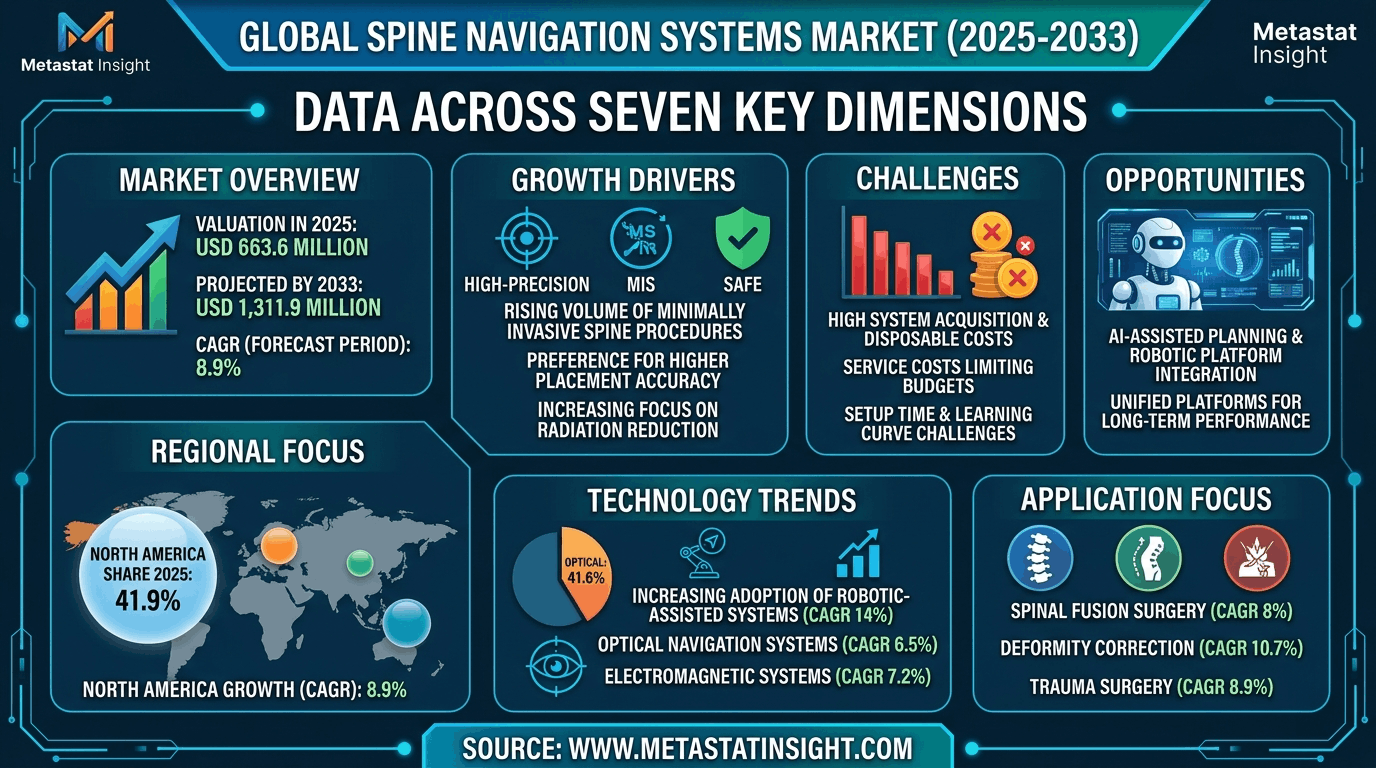
According to a comprehensive market study released by Metastat Insight, the Global Spine Navigation Systems Market is entering a transformative era of digital surgery. Valued at USD 663.6 million in 2025, the industry is projected to grow at a compound annual growth rate (CAGR) of 8.9%, reaching a significant valuation of USD 1,311.9 million by 2033.
The report highlights a fundamental shift in the surgical landscape, where conventional operating rooms are evolving into connected healthcare ecosystems. As surgeons demand higher placement accuracy for complex spinal cases, advanced navigation platforms are becoming the command centers of modern surgical imaging, coordinating real-time spatial mapping and predictive modeling.
Key Market Drivers and Technological Evolution
The rapid adoption of spine navigation is primarily fueled by the rising volume of minimally invasive spine procedures. These interventions prioritize reduced tissue trauma and faster recovery times, necessitating the sub-millimeter precision that only advanced navigation can provide.
-
Precision and Safety: Increasing focus on radiation reduction for surgical teams is encouraging the transition from traditional fluoroscopy to navigation-guided workflows.
-
Robotic Convergence: The integration of AI-assisted planning with robotic platforms is creating a high-value upgrade cycle. Robotic-Assisted Navigation Systems are identified as the fastest-growing segment, with an impressive CAGR of 14%.
-
Optical Dominance:Optical Navigation Systems currently lead the market, accounting for 41.6% of the global share in 2025, valued at approximately USD 300.1 million.
Segmentation Highlights
-
Application Excellence:Spinal Fusion Surgery remains the largest application segment, projected to reach USD 630.8 million by 2033. Meanwhile, Trauma Surgery and deformity correction are seeing increased utilization of 3D visualization for balanced reconstructions.
-
End-User Trends: While hospitals remain the primary adopters, Ambulatory Surgical Centers (ASCs) are emerging as a high-growth vertical, expected to expand at a CAGR of 11.4% as they adopt compact, workflow-optimized systems.
-
Regional Leadership:North America maintains its stronghold with a 41.9% market share in 2025, supported by advanced healthcare infrastructure in the U.S. and favorable reimbursement for minimally invasive spine procedures.
Competitive Landscape
The market is characterized by strategic innovation from global leaders and specialized technology firms. Key industry players identified in the report include Medtronic Plc, Stryker Corporation, Zimmer Biomet, Brainlab SE, and Globus Medical, among others. These organizations are increasingly focusing on interoperability, allowing navigation platforms to communicate seamlessly with intraoperative imaging systems and AI-driven planning software.
Future Outlook
The future of the Spine Navigation Systems Market lies in intelligent surgical orchestration. Metastat Insight predicts that the industry will move beyond standalone hardware sales toward integrated digital suites that leverage procedural metrics and surgical performance analytics to improve longitudinal patient care.
About Metastat Insight:
Metastat Insight is a leading global market research and consulting firm specializing in high-growth industries. We provide data-driven insights and strategic outlooks to help organizations navigate complex market dynamics and achieve sustainable growth.
Related Report
View full market research reportAbout the Authors

LEAD ANALYST
Utkarsh Khirodkar is a Lead Market Research Analyst at MetaStat Insight, specializing in market intelligence, technology sector assessments, and competitive strategy.

LEAD PRINCIPAL ANALYST, PHARMA AND HEALTHCARE
Food and Beverages · Healthcare · Healthcare IT · Medical Devices
Ajay Devgire is the Lead Healthcare Analyst at MetaStat Insight, leading strategic research and market intelligence initiatives across the global healthcare domain.

SENIOR RESEARCH ANALYST
Biotechnology · Food and Beverages · Medical Devices · Packaging
Snehal Pasalkar is a Research Analyst at MetaStat Insight, operating at the intersection of life sciences research, competitive strategy, and market intelligence.