
LEAD ANALYST
Utkarsh Khirodkar is a Lead Market Research Analyst at MetaStat Insight, specializing in market intelligence, technology sector assessments, and competitive strategy.

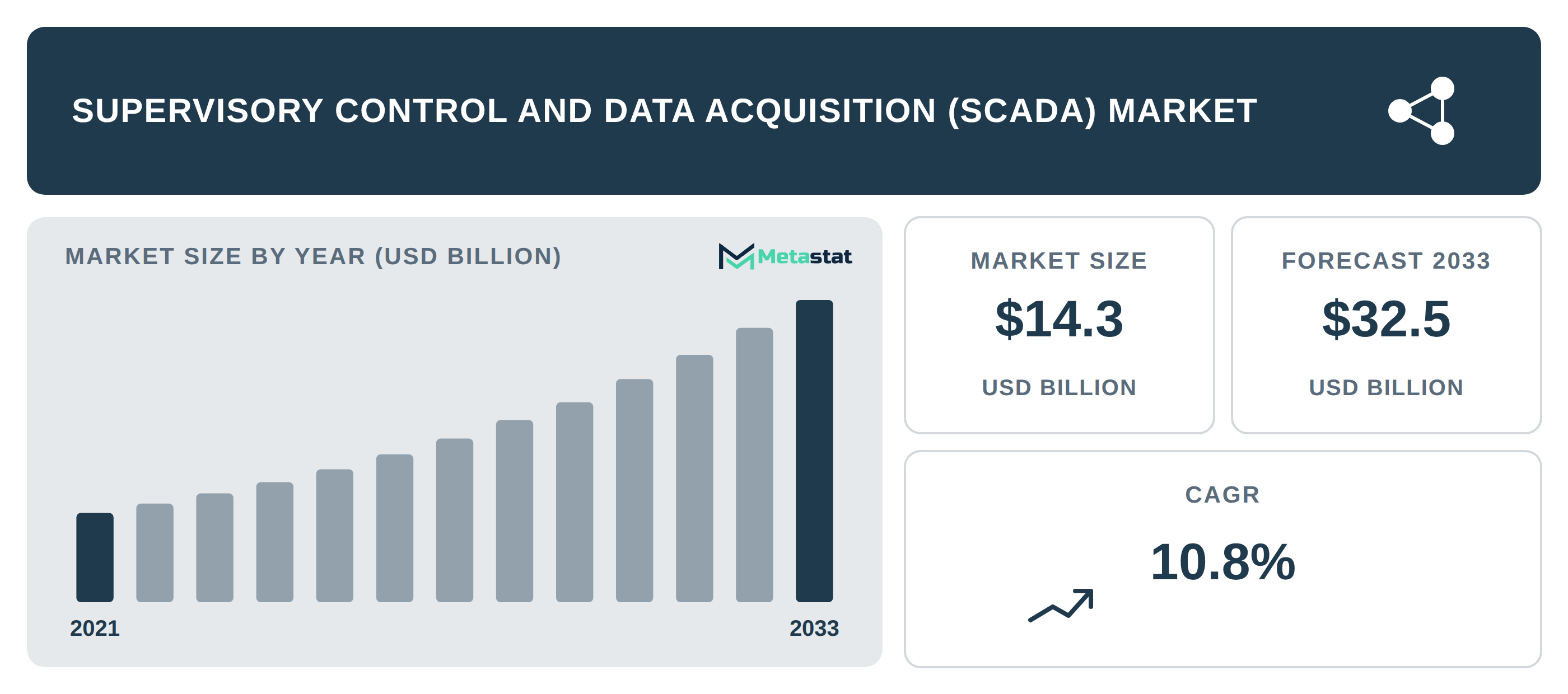
Metastat Insights reveals the Supervisory Control and Data Acquisition (SCADA) market is valued at USD 14.3 billion in 2025 and expected to grow at a CAGR of 10.8%, reaching USD 32.5 billion by 2033. Key drivers include rising automation demand and regulatory compliance.
Metastat Insights has published "Global Supervisory Control and Data Acquisition (SCADA) Market Size, Share, By Offering (Hardware, Software, Services), By Component (Human-machine Interface (HMI), Programmable Logic Unit (PLC), Remote Terminal Units (RTU)), By Process Monitoring & Visualization (Alarm Management, Energy & Power Management, Historian / Time-Series Data), By End-User Industry (Automotive and Transportation, Chemicals and Petrochemicals, Electric Power and Utilities, Food & Beverages, Manufacturing, Mining and Metals, Oil & Gas, Pharmaceuticals, Telecommunication, and Water, Wastewater), Industry Analysis, Growth, Trends, and Forecast, 2026-2033", followed by the headline figures (USD 14.3 billion in 2025, USD 32.5 billion by 2033, 10.8% CAGR).
The Supervisory Control and Data Acquisition (SCADA) market is experiencing significant growth driven by the increasing demand for automation across various industries. This demand enhances operational efficiency and minimizes downtime, particularly in sectors including electric power, manufacturing, and oil and gas. Companies seek improved data collection and real-time monitoring capabilities to streamline their processes, contributing significantly to the market's expansion. Investment in advanced technologies enables organizations to optimize their operations, support regulatory compliance, and improve overall productivity.
High capital investment requirements pose a challenge to the Supervisory Control and Data Acquisition (SCADA) market. Organizations, particularly small to medium enterprises (SMEs), face substantial upfront costs for implementing SCADA systems. This financial burden leads to delayed deployments and limits the adoption of advanced technologies in industries that could benefit from them. Economic uncertainties further complicate investment decisions, negatively impacting overall market growth. Addressing these challenges requires strategic approaches to financing and resource allocation.
The global SCADA market is segmented by offering, component, process monitoring and visualization, and end-user industry. By offering, the market includes hardware, software, and services segments, with hardware projected to grow from USD 7.2 billion in 2026 to USD 13.7 billion by 2033. The software segment is anticipated to reach USD 12 billion in the same timeframe. Regionally, North America leads with a 33.8% market share in 2025, driven by significant investments in infrastructure and technology. Europe and Asia Pacific follow closely, capturing 26.6% and 28.7% of the market, respectively, amidst increasing regulatory compliance and smart technology adoption.
The Supervisory Control and Data Acquisition (SCADA) market features a competitive landscape with key players including ABB Ltd, Emerson Electric Co, Honeywell International Inc., and Siemens AG actively participating in various segments. These companies focus on innovation and investment in research and development to enhance their product offerings, ensuring they meet the evolving demands of industries. Strategic mergers and acquisitions among these players are observed to enhance market positioning and broaden technological capabilities.
For comprehensive insights and detailed analysis, readers are invited to access the full report: Global Supervisory Control and Data Acquisition (SCADA) Market.
LEAD ANALYST
Utkarsh Khirodkar is a Lead Market Research Analyst at MetaStat Insight, specializing in market intelligence, technology sector assessments, and competitive strategy.

PRINCIPAL CONSULTANT - ENTERPRISE AI & EMERGING TECHNOLOGIES
Banking & Finance · Electronics and Semiconductor · Energy and Power · Healthcare IT · Information & Technology · Professional Services
Vijay Gunti is a Principal Consultant at MetaStat Insight, bringing over two decades of experience across enterprise digital transformation, technology strategy, and intelligent systems.

LEAD CONSULTANT - COMMUNICATION, TELECOM, AND IT
Electronics and Semiconductor · Information & Technology · Machinery & Equipment · Professional Services
Ravindra Sathe Consultants for Communication, Telecom, and IT at MetaStat Insight. He leads the firm's industry research initiatives across telecommunications infrastructure, digital connectivity, enterprise networking, and emerging information technology domains.