
A newly published comprehensive analysis by Metastat Insight reveals that the global surgical 3D printing market is experiencing an era of massive expansion. Valued at USD 3369.9 million in 2025, the market is projected to reach an impressive USD 12496.3 million by 2033. This robust growth trajectory represents a compound annual growth rate (CAGR) of 17.8% during the forecast period, driven by widespread integration across specialized surgical procedures and point-of-care advancements.
Redefining Operative Care Through Precision Technology
At its core, the 3D printing medical system transforms direct patient imaging data into customized medical devices right at the point of care. Surgeons increasingly rely on patient-matched anatomical models, specialized prosthetics, and precision surgical guides to map out and navigate highly intricate operations.
Technological evolution stands as the primary catalyst pushing the industry forward. Market innovators are successfully shifting boundaries by creating targeted, highly sophisticated printing systems designed for intense surgical applications. Notable industry breakthroughs include the engineering of the world-first 3D-printed titanium sternum and rib implant by Anatomics, specifically tailored for chest cancer patients dealing with sarcoma a malignancy attacking bone, cartilage, vascular, fat, muscle, or hematopoietic tissues. These customizable systems adjust precisely to complex body structures and are anchored securely with screws.
Concurrently, manufacturing experts like TRUMPF are supplying industrial 3D printers that enable surgeons to cut and contour personalized craniomaxillofacial implants directly from perforated titanium plates during surgical procedures. Strategic product introductions are also gathering regulatory speed. For instance, Renovis Surgical secured key 510(k) clearance from the U.S. Food and Drug Administration (FDA) to market its porous titanium posterior lumbar Tesera interbody fusion systems.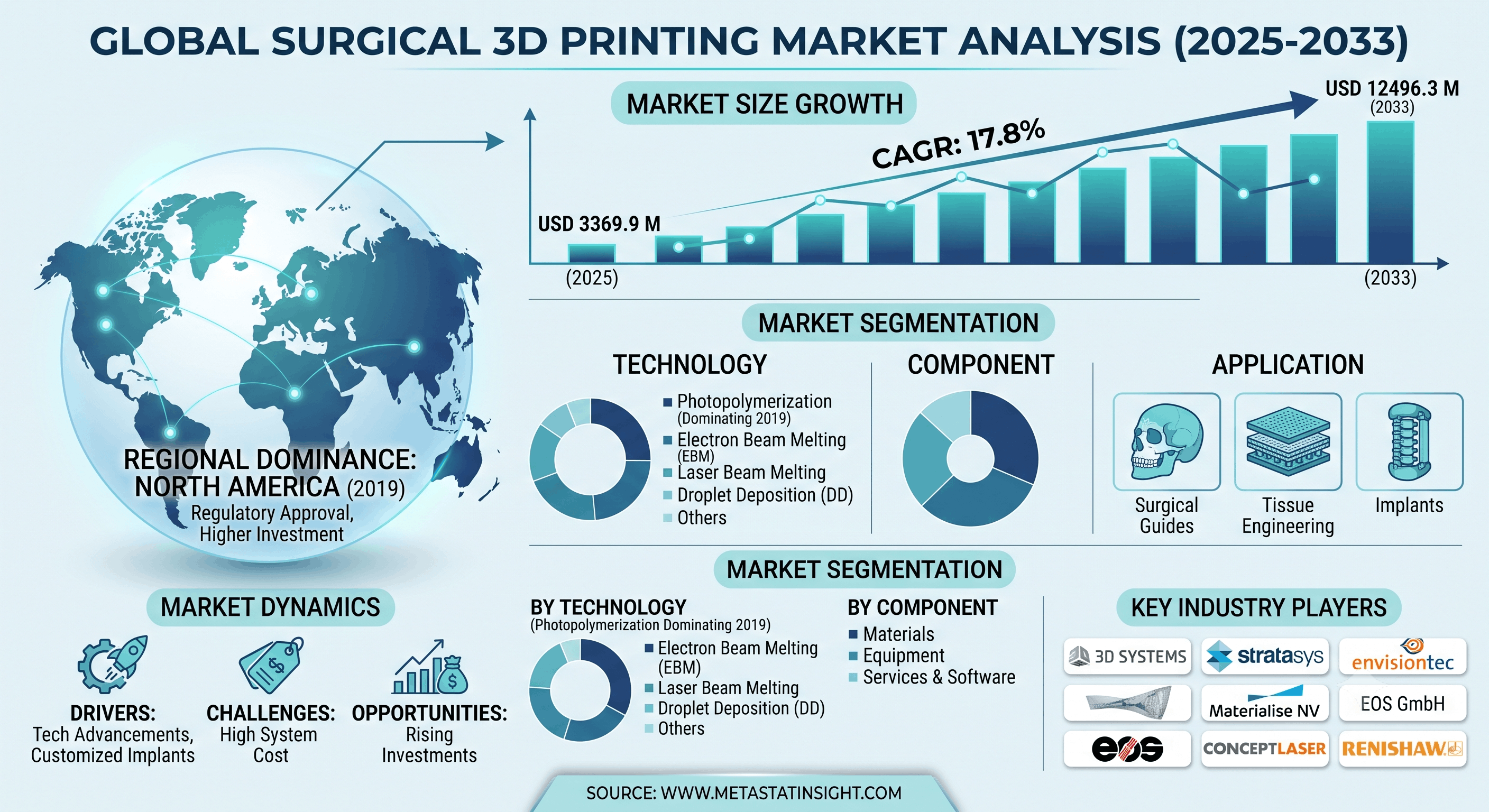
Decoding Market Segments and Regional Powerhouses
The global surgical 3D printing landscape is thoroughly categorized across three key axes:
-
Technology: Photopolymerization, Electronic Beam Melting (EBM), Laser Beam Melting, Droplet Deposition (DD), and others.
-
Component: Equipment, Materials, and Services & Software.
-
Application: External Wearable Devices, Tissue Engineering, Implants, and Clinical Study Devices.
Photopolymerization captured the dominant market share in 2019. Its widespread adoption is tied directly to its versatility in fabricating high-precision porous scaffolds, dental restorations, prosthetics, implants, and vital surgical guides across orthopedic, dental, and craniomaxillofacial (CMF) specialties. Industry alliances are further cementing this technology's footprint. A primary example is the partnership between dental solutions provider Structo and the specialized materials company pro3dure, granting Velox desktop system users direct access to advanced photopolymer resins optimized for medical, dental, and audiology practices.
From a geographic standpoint, North America spearheaded the global market in 2019. The region's dominant stance is fueled by rapid commercialization of regulatory-approved devices, expanded development facilities, and highly strategic corporate collaborations. High-profile initiatives, such as GE Healthcare partnering with Formlabs to supply advanced desktop 3D printers, are directly empowering clinicians to generate rapid anatomical models at the point of care. These visual tools drastically improve case-based teaching, clinical team communication, and overall patient education.
Expanding past North America, the global footprint covers crucial territories including Europe (the UK, Germany, France, Italy), Asia-Pacific (China, India, Japan, South Korea), South America (Brazil, Argentina), and the Middle East & Africa (GCC Countries, Egypt, South Africa).
Balancing High Structural Costs against Strategic Innovations
Despite immense momentum, economic barriers persist. The elevated expenditure linked to specialized hardware and media remains a notable constraint. Standard FDM filaments cost roughly $25 per kilogram, whereas advanced SLA resins demand $50-60 per kilogram, causing the price of material-heavy or time-intensive large components to escalate quickly.
Nevertheless, rising investment inflows and dedicated funding pools are poised to open lucrative opportunities. On the competitive front, market leaders including 3D Systems Corporation, Stratasys Ltd., Envisiontec GmbH, Renishaw plc, Materialise NV, 3T Additive Manufacturing Ltd., Arcam AB, EOS GmbH Electro Optical Systems, Prodways Group, and Concept Laser GmbH are relying heavily on regulatory approvals and facility expansions. Notably, Materialise NV achieved CE Marking Certification for its custom orthopedic and CMF portfolio, making personalized anatomical models and patient-matched implants significantly more accessible to surgeons across Europe.
About Metastat Insight
Metastat Insight is a premier global market research and consulting firm. We deliver actionable market intelligence, in-depth sector evaluations, and comprehensive growth analytics across high-tech fields, supporting business leaders worldwide in executing confident, data-driven decisions.
Related Report
View full market research reportAbout the Authors

LEAD ANALYST
Utkarsh Khirodkar is a Lead Market Research Analyst at MetaStat Insight, specializing in market intelligence, technology sector assessments, and competitive strategy.

LEAD PRINCIPAL ANALYST, PHARMA AND HEALTHCARE
Food and Beverages · Healthcare · Healthcare IT · Medical Devices
Ajay Devgire is the Lead Healthcare Analyst at MetaStat Insight, leading strategic research and market intelligence initiatives across the global healthcare domain.

SENIOR RESEARCH ANALYST
Biotechnology · Food and Beverages · Medical Devices · Packaging
Snehal Pasalkar is a Research Analyst at MetaStat Insight, operating at the intersection of life sciences research, competitive strategy, and market intelligence.