
LEAD ANALYST
Utkarsh Khirodkar is a Lead Market Research Analyst at MetaStat Insight, specializing in market intelligence, technology sector assessments, and competitive strategy.

Surgical 3D Printing Market Size, Share, By Component (Equipment, Materials, Services & Software), By Application (External Wearable Devices, Tissue Engineering, Implants, and Clinical Study Devices), By Technology (Electronic Beam Melting (EBM), Laser Beam Melting, Photopolymerization, Droplet Deposition (DD), and Others), Industry Analysis, Growth, Trends, and Forecast, 2026-2033
Report ID
MSI-2298
Published
February, 2026
Pages
312 Pages
Format
Report Details
Choose Your License
Surgical 3D Printing Market
3D Printing medical system is based on a patient's imaging data.Medical devices that are printed at the point of care include patient-matched anatomical models, prosthetics, and surgical guides, which are used to guide surgeons during an operation.
Technological advancements in surgical 3D printing is a key driving factor of the market. Companies are focusing on developing advanced and innovative 3D printing system for surgery. For instance, Anatomics has designed and developed world-first 3D printed titanium sternum and rib implant for the patient in suffering from cancer in the chest. The customizable implant can be adjusted to fit into the affected area and secured in place with screws. The people suffering from sarcoma use 3D printed titanium sternum and rib implant. Sarcoma cancer occurs in bone, cartilage, fat, muscle, vascular, or hematopoietic tissues. Further, TRUMPF has offered TRUMPF 3D printer to produce craniomaxillofacial implants. The surgeon use TRUMPF 3D printer to cut the craniomaxillofacial implant from perforated titanium plate during the procedure and then shape it to the size. Additionally, Renovis Surgical has introduced 3D-printed Posterior Lumbar Interbody Fusion Systems. The company has received 510(k) clearance from the U.S. Food and Drug Administration (FDA) to market posterior lumbar Tesera porous titanium interbody fusion systems. However, the high cost associated with surgical 3D printing might hamper market growth. The cost of the standard 3D printing material varies by process from approximately $25 per kilogram for FDM filaments, to $50-60 per kilogram of SLA resin. Larger parts of the 3D printed system need more material and will take longer to print, which leads to increasing cost. Moreover, Rising investment and funding for surgical 3D printing would provide lucrative opportunities for the market in the coming years.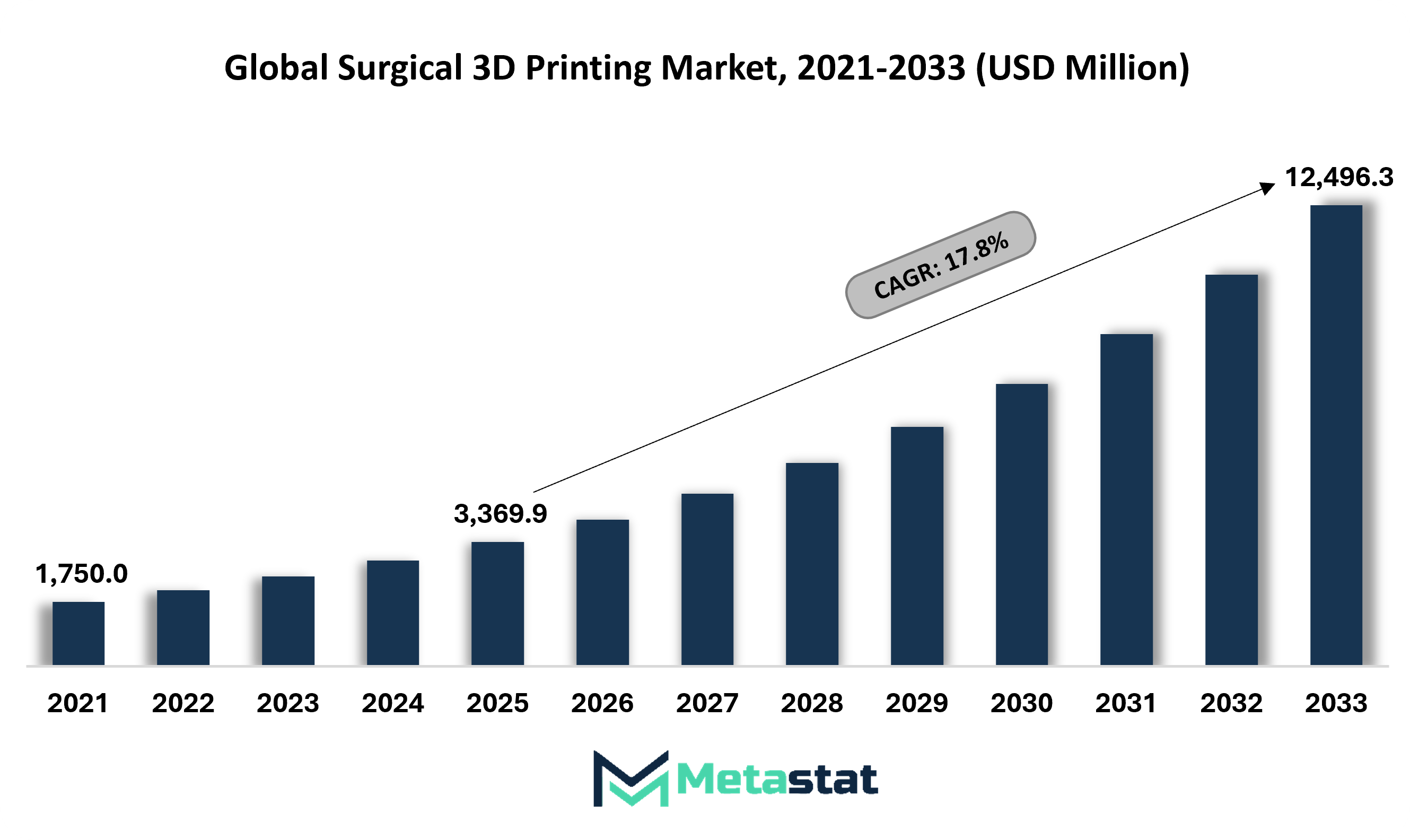
The global surgical 3D printing market is mainly classified based on technology, component, and application. Technology is further segmented into Electronic Beam Melting (EBM), Laser Beam Melting, Photopolymerization, Droplet Deposition (DD), and Others. By component, the market is divided into Equipment, Materials, and Services & Software. By application, the market is further divided into External Wearable Devices, Tissue Engineering, Implants, and Clinical Study Devices.
Equipment segment is valued at USD 688.8 million in 2026 and is projected to reach USD 2249.3 million by 2033, at a CAGR of 18.4% during the forecast period.
Based on technology, Photopolymerization was dominating the global surgical 3D printing market in 2019, owing to the widespread application of photopolymerization technology across various medical applications such as for manufacturing surgical guides including orthopedic, dental, and CMF guides; prosthetics and implants; porous scaffolds; and dental restorations.
External Wearable Devices segment is projected to reach USD 7210.4 million by 2033, at a CAGR of 16.4% during the forecast period.
The partnership between companies to extend the range of applications for surgical 3D printing system is driving the market demand. For instance, Structo, a dental 3D printing solutions provider and the manufacturer has partnered with German 3D printing materials company, pro3dure. The partnership will help Velox users gain access to pro3dure’s range of dental 3D printing materials. Velox is an all-in-one desktop 3D printer with autonomous post-processing aimed at spearheading the adoption of 3D printing in dental practices. pro3dure manufactures various photopolymer materials for dental, audiology and medical applications.
Based on geography, the global surgical 3D printing market is divided into North America, Europe, Asia-Pacific, South America, and Middle East & Africa. North America is further divided in the U.S., Canada, and Mexico, whereas Europe consists of the UK, Germany, France, Italy, and Rest of Europe. Asia-Pacific is segmented into India, China, Japan, South Korea, and Rest of Asia-Pacific. The South America region includes Brazil, Argentina, and the Rest of South America, while the Middle East & Africa is categorized into GCC Countries, Egypt, South Africa, and Rest of Middle East & Africa.
North America was dominating the global surgical 3D printing market in 2019, due to the commercialization of regulatory approved surgical 3D printing system, rising investment and expanding the development facility for the surgical 3D printing system, and strategic collaboration between companies to develop surgical 3D printing system. For instance, GE Healthcare has collaborated with Formlabs, a Massachusetts-based manufacturer of advanced 3D-printers that can help clinicians quickly print anatomical models at the point of care. These models visualize patient anatomy and disease for improved communication within the medical team, case-based teaching models and enhanced patient education.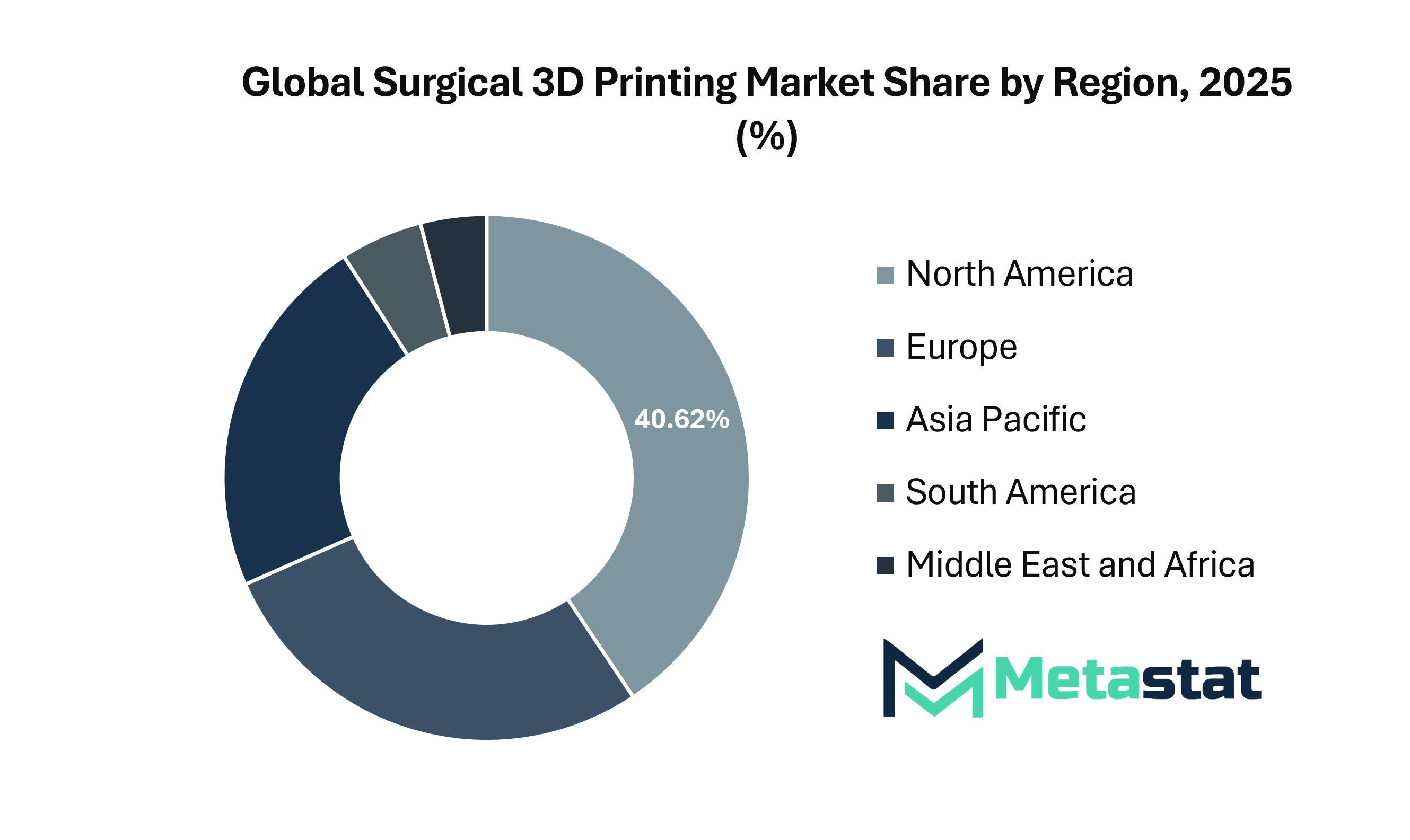
Key players operating in the surgical 3D printing industry include 3D Systems Corporation, Stratasys Ltd., Envisiontec GmbH, Renishaw plc, Materialise NV, 3T Additive Manufacturing Ltd., Arcam AB, EOS GmbH Electro Optical Systems, Prodways Group, and Concept Laser GmbH.
The companies are commercializing technologically advanced surgical 3D printing system, the partnership between companies to develop 3D printing system for the medical industry, rising investment, facility expansion to manufacture 3D printing system for medical applications, and regulatory approval of surgical 3D printing system are some of the strategies adopted by the major companies. For instance, Materialise NV, a leading company in 3D technology solutions has received CE Marking Certification for its personalized orthopaedic and cranio-maxillofacial (CMF) solutions, which includes 3D-printed anatomical models and patient-matched surgical guides and implants. Materialise is one of the first company to acquire CE certification for personalized, 3D-printed medical device portfolio. The CE approval will make the technology more accessible for surgeons.
|
Report Attributes |
Details |
|
Study Period |
2021-2033 |
|
Base Year |
2025 |
|
Estimated Year |
2026 |
|
Forecast Period |
2026-2033 |
|
Historical Period |
2021-2025 |
|
Growth Rate |
CAGR 17.8% from 2026 to 2033 |
|
Revenue Unit |
USD million |
|
Sales Volume Unit |
Thousand Units |
|
Segmentation |
By Component, Application, Technology, and Region |
|
By Region |
North America (By Component, Application, Technology, and Country)
|
|
|
Europe (By Component, Application, Technology, and Country)
|
|
|
Asia Pacific (By Component, Application, Technology, and Country)
|
|
|
South America (By Component, Application, Technology, and Country)
|
|
|
Middle East and Africa (By Component, Application, Technology, and Country)
|
Find answers to common questions about this report
Top players operating in the Surgical 3D Printing industry includes 3D Systems Corporation, Stratasys Ltd., Envisiontec GmbH, Renishaw plc, EOS GmbH Electro Optical Systems, Materialise NV, 3T Additive Manufacturing Ltd., Arcam AB, Prodways Group, and Concept Laser GmbH
The Surgical 3D Printing market is projected to grow at a CAGR of 17.8% during the forecast period from 2026 to 2033.
According to Metastat Insights analysis, the North America Surgical 3D Printing market size is estimated to reach USD 4623.6 million by 2033.
The Metastat Insights study reveals that the Surgical 3D Printing market size was valued at USD 3369.9 million in 2025.
The analysts below cover Medical Devices research at Metastat Insights.
LEAD ANALYST
Utkarsh Khirodkar is a Lead Market Research Analyst at MetaStat Insight, specializing in market intelligence, technology sector assessments, and competitive strategy.

LEAD PRINCIPAL ANALYST, PHARMA AND HEALTHCARE
Food and Beverages · Healthcare · Healthcare IT · Medical Devices
Ajay Devgire is the Lead Healthcare Analyst at MetaStat Insight, leading strategic research and market intelligence initiatives across the global healthcare domain.

SENIOR RESEARCH ANALYST
Biotechnology · Food and Beverages · Medical Devices · Packaging
Snehal Pasalkar is a Research Analyst at MetaStat Insight, operating at the intersection of life sciences research, competitive strategy, and market intelligence.
Analyzing the transition from natural gas to green hydrogen in iron ore reduction requires realistic infrastructure timelines. Meta stat insight supplied a detailed regional assessment of DRI plant conversion costs and scrap metal availability in North America and Western Europe. Their report carefully examined pellet quality specs and electrical grid access constraints without making oversimplified market assumptions. The research material served as a practical reference during internal technology roadmap discussions.
Integrating zero-trust access controls across legacy electronic health record systems involves complex compliance overhead. Team produced an analysis that clearly separated identity governance and administration tools from privileged access management platforms. Their evaluation of HIPAA and GDPR compliance features across cloud native solutions gave our architecture group clear baseline criteria. The custom data request regarding biometric authentication adoption in hospital networks was returned promptly with clear documentation.
Evaluating calorific value requirements and air permit compliance across municipal waste facilities requires localized data. Metastat Insight structured their analysis around operational throughput capacity and feedstock composition variations in Latin America and Eastern Europe. Their competitive mapping of sorting equipment vendors helped clarify technology differences between optical separators and heavy media systems. The study provided an objective baseline during our capital expenditure reviews.
Explore related market intelligence reports worth reading alongside this one.