
LEAD ANALYST
Utkarsh Khirodkar is a Lead Market Research Analyst at MetaStat Insight, specializing in market intelligence, technology sector assessments, and competitive strategy.

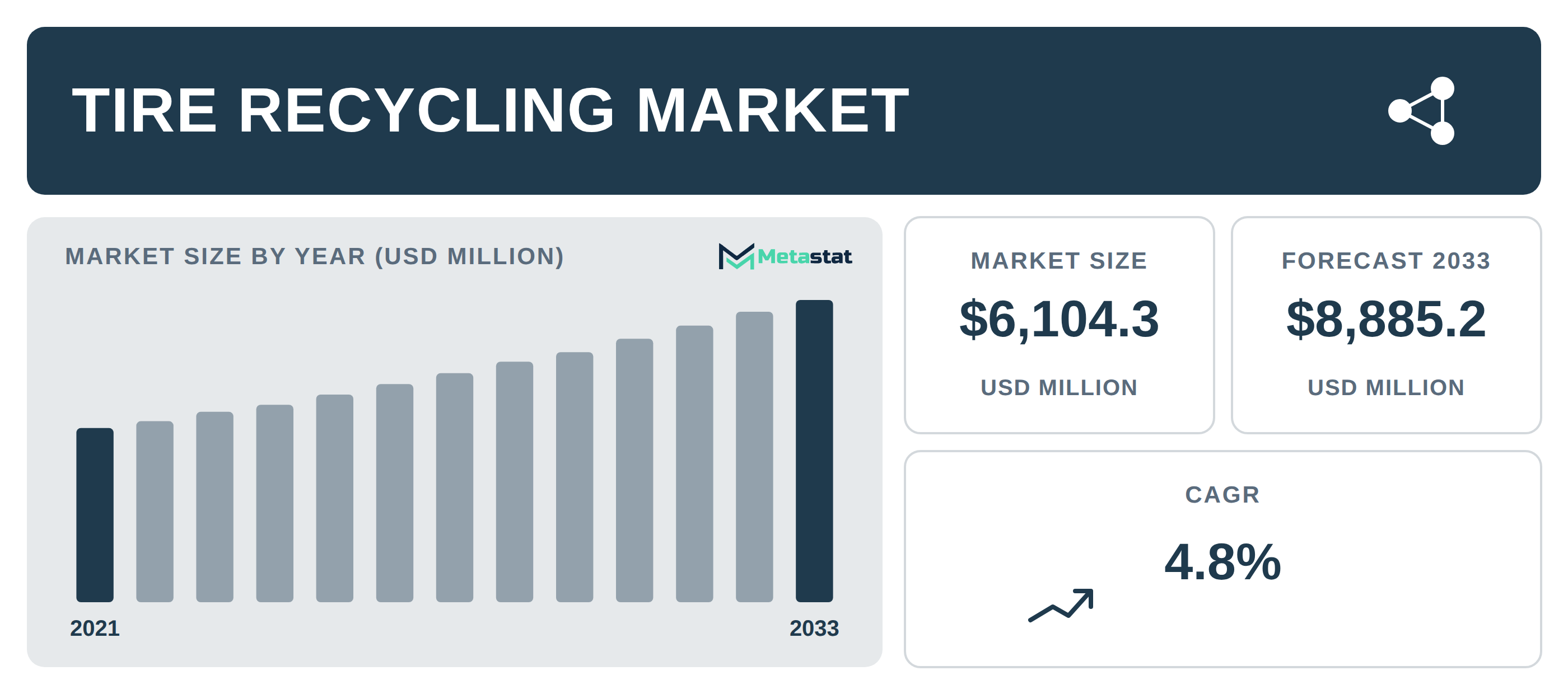
Metastat Insights announces the release of a comprehensive report on the Tire Recycling market, forecasting a growth from USD 6,104.3 million in 2025 to USD 8,885.2 million by 2033, at a CAGR of 4.8%.
Metastat Insights has published "Global Tire Recycling Market Size, Share, By Technology (Ambient Mechanical Shredding, Granulation, Cryogenic Grinding, Thermochemical Recycling (Pyrolysis/Thermolysis), Devulcanization, Rubber Reclaiming, Other Advanced Recycling Technologies), By Recovered Product (Rubber Crumb, Granulate, Micronized Rubber Powder, Reclaimed Rubber, Devulcanized Rubber, Recovered Carbon Black (rCB), Tire Pyrolysis Oil (TPO), Recovered Steel, Recovered Textile Fiber, Tire-Derived Aggregate (TDA), Tire-Derived Fuel (TDF)), By Source (Passenger Car Tires, Light Commercial Vehicle Tires, Medium and Heavy Commercial Vehicle Tires, Off-the-Road (OTR) Tires, Agricultural Tires, Two-Wheeler Tires, Aircraft Tires), By End-Use Industry (Tire Manufacturing, Non-Tire Rubber Products, Road Construction, Building and Civil Engineering, Sports and Recreational Surfaces, Automotive and Transportation, Chemical and Petrochemical, Cement and Industrial Energy, Plastics and Polymer Compounding), Industry Analysis, Growth, Trends, and Forecast, 2026-2033", highlighting significant growth in the Tire Recycling market. The market was valued at USD 6,104.3 million in 2025 and is projected to reach USD 8,885.2 million by 2033, reflecting a compound annual growth rate (CAGR) of 4.8%.
The Tire Recycling market is expanding primarily due to the increasing generation of end-of-life tires. The rising demand for sustainable recycling practices aligns with the adoption of circular economy principles across various industries. This trend influences consumer behavior and regulatory frameworks, driving demand for tire recycling solutions. The need for recovered carbon black is gaining traction, because it is used in the production of new tires and various industrial applications.
Regulatory constraints significantly impact the Tire Recycling market, presenting operational challenges for recycling facilities. Compliance with stringent environmental and safety standards necessitates substantial investments in technology and infrastructure. These compliance requirements increase operational costs, affecting the financial viability of recycling projects. Macroeconomic headwinds, including inflationary pressures, complicate the market landscape, deterring new entrants and limiting competition.
The global Tire Recycling market is segmented by technology, recovered product, source, and end-use industry. Each segment demonstrates unique growth trajectories influenced by technological advancements and changing consumer preferences. Regions including North America and Europe lead recycling initiatives, emphasizing their commitment to sustainability. Emerging markets in Asia Pacific are witnessing growth, driven by increasing demand for sustainable materials and technologies.
Several companies actively operate in the Tire Recycling market, driving innovation and growth. Key players include Apollo Tyres Ltd., Bridgestone Corporation, and Continental AG, among others. These companies engage in strategic partnerships and invest in advanced recycling technologies to enhance their competitive positioning.
For more in-depth insights, visit the full report: Global Tire Recycling Market
Related Report
Global Tire Recycling MarketLEAD ANALYST
Utkarsh Khirodkar is a Lead Market Research Analyst at MetaStat Insight, specializing in market intelligence, technology sector assessments, and competitive strategy.

ENERGY & INFRASTRUCTURE INDUSTRY CONSULTANT
Automotive and Transportation · Electronics and Semiconductor · Energy and Power · Machinery & Equipment
Saurabh Vasant Ganvir consults for Energy & Infrastructure Industry at MetaStat Insight, specializing in renewable energy, solar EPC, and electric vehicle (EV) infrastructure markets.