
Metastat Insights has released a comprehensive market research study detailing the trajectory of the Global Tumor Ablation Market. Valued at USD 652.2 million in 2020, the market is projected to expand at a strong Compound Annual Growth Rate (CAGR) of 11.6% from 2021 to 2027.
Tumor ablation has emerged as a fundamental, needle-based, minimally invasive intervention designed specifically to destroy malignant or abnormal tissues. As global healthcare systems transition toward procedures that mitigate patient trauma, tumor ablation technologies are gaining substantial traction across major medical applications, including the treatment of liver, kidney, bone, and lung tumors.
Key Market Dynamics & Driving Factors
The upward momentum of the global tumor ablation sector is primarily underpinned by a stark, escalating incidence of various oncological conditions worldwide:
-
Prostate Cancer: In 2020, the United States alone witnessed approximately 191,930 new cases alongside 33,330 recorded fatalities.
-
Lung Cancer: The World Health Organization (WHO) documented 2.09 million global cases in 2018. By 2020, the American Cancer Society tracked around 228,820 newly diagnosed lung cancer cases within the U.S.
-
Colorectal Cancer: Responding to a global burden of 1.80 million cases in 2018 (per WHO data), the U.S. registered roughly 147,950 adult diagnoses in 2020.
-
Breast Cancer: Ranking as the second most prevalent cancer globally according to the American Institute for Cancer Research, breast cancer saw approximately 2 million new diagnoses and 627,000 female deaths in 2018.
Beyond epidemiological shifts, a profound surge in patient preference for minimally invasive treatments continues to accelerate market adoption. Conversely, the market faces constraints from potential side effects such as abdominal pain, liver infections, post-procedural fever, and abnormal liver tests. Nevertheless, growing global awareness regarding the distinct clinical benefits of ablation over traditional therapeutic and open surgical workflows presents significant commercial opportunities.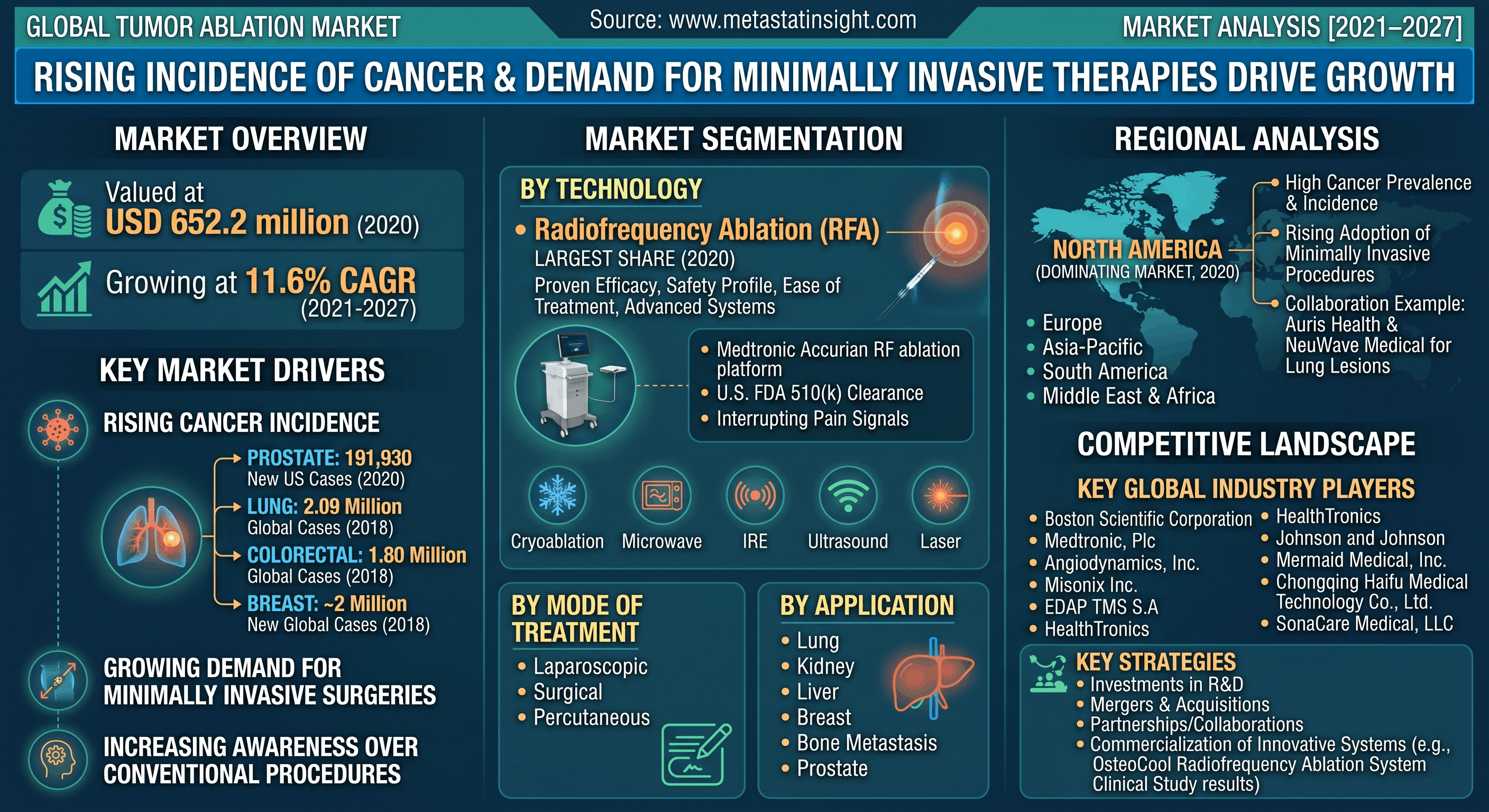
Core Market Segmentation Matrix
The research report comprehensively categorizes the global industry landscape into three specialized pillars:
-
By Technology: Radiofrequency Ablation (RFA) held the largest market share in 2020 due to its clinical safety, safety profile, ease of use, and regulatory clearances (e.g., U.S. FDA 510(k) clearance for Medtronic's Accurian RF ablation platform). Additional segments include Cryoablation, Microwave, Irreversible Electroporation (IRE), Ultrasound, and Laser.
-
By Mode of Treatment: Laparoscopic, Surgical, and Percutaneous workflows.
-
By Application: Lung, Kidney, Liver, Breast, Bone Metastasis, and Prostate.
Regional Landscapes and Competitive Realities
Geographically, North America commanded the dominant global market position in 2020. This leadership is supported by an elevated baseline of cancer prevalence, rapid clinical integration of minimally invasive workflows, robust government funding for research, and targeted corporate alliances, such as the collaborative development agreement between Auris Health, Inc. and NeuWave Medical, Inc. (a subsidiary of Ethicon, Inc.).
Key industry innovators include Boston Scientific Corporation, Medtronic, Plc, Angiodynamics, Inc., Misonix Inc., EDAP TMS S.A, HealthTronics, Johnson and Johnson, Mermaid Medical, Inc., Chongqing Haifu Medical Technology Co., Ltd., and SonaCare Medical, LLC. Market participants are actively engaging in continuous R&D investments, strategic mergers, acquisitions, and joint commercialization agreements to fortify their portfolios.
Related Report
View full market research reportAbout the Authors

LEAD ANALYST
Utkarsh Khirodkar is a Lead Market Research Analyst at MetaStat Insight, specializing in market intelligence, technology sector assessments, and competitive strategy.

LEAD PRINCIPAL ANALYST, PHARMA AND HEALTHCARE
Food and Beverages · Healthcare · Healthcare IT · Medical Devices
Ajay Devgire is the Lead Healthcare Analyst at MetaStat Insight, leading strategic research and market intelligence initiatives across the global healthcare domain.