
LEAD ANALYST
Utkarsh Khirodkar is a Lead Market Research Analyst at MetaStat Insight, specializing in market intelligence, technology sector assessments, and competitive strategy.

Metastat Insights announces the release of its report on the Global Vertical Farming Market, highlighting significant growth driven by urban food demand, projected to reach USD 3,780.2 million by 2033.
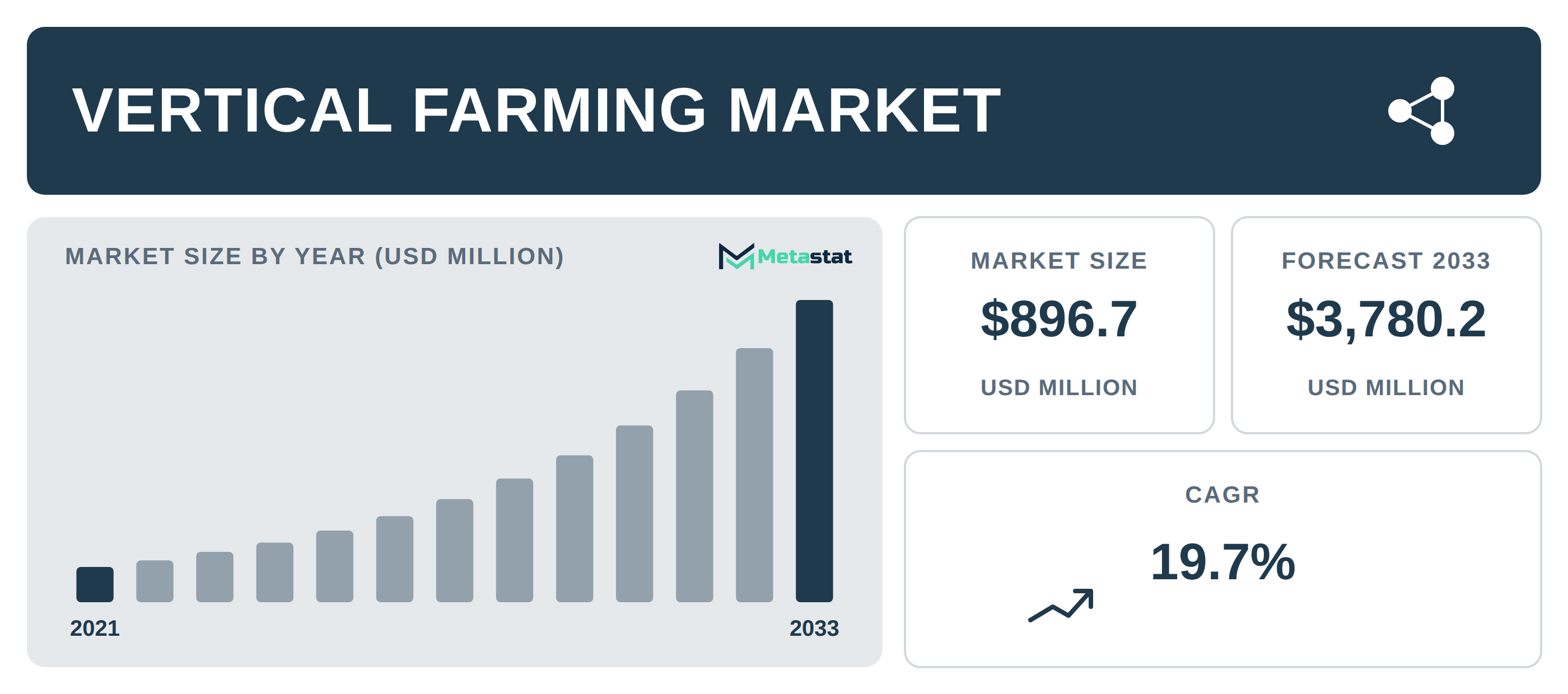
Metastat Insights has published "Global Vertical Farming Market Size, Share, By Type (Hydroponics, Aeroponics, Aquaponics), By Structure (Building-Based Vertical Farms and Shipping-Container Vertical Farms), By Component (Lighting, Hydroponic Components, Climate Control, Sensors, Software, System Integration and Consulting, Managed Services, Assisted Professional Services), By Crop Type (Tomato, Lettuce, Bell and Chili Peppers, Strawberry, Cucumber, Leafy Greens, Herbs, Flowers and Ornamentals, Perennials, Annuals), Industry Analysis, Growth, Trends, and Forecast, 2026-2033", stating that the market was valued at USD 896.7 million in 2025 and is projected to reach USD 3,780.2 million by 2033, reflecting a compound annual growth rate (CAGR) of 19.7%.
Increasing urban food demand significantly drives the Vertical Farming market. Rapid urbanization and population growth prompt cities to seek sustainable agricultural solutions, fostering the adoption of vertical farming methods. These practices address food security issues while meeting consumer expectations for fresh, local produce. Hydroponic and aeroponic systems play essential roles in this transformation, enhancing crop yields and conserving water, appealing to commercial growers and environmentally-conscious consumers alike. Integrating these systems within urban environments allows for the swift establishment of vertical farms, further contributing to market expansion.
High capital investment requirements create notable challenges for growth in the Vertical Farming market. Establishing vertical farms necessitates considerable upfront costs for infrastructure and technology, which deters smaller enterprises or startups from entering the market. Rising energy expenses associated with lighting and climate control systems complicate profitability. Operators actively pursue innovative energy-efficient solutions to mitigate these costs while ensuring product quality, influencing investment strategies throughout the sector.
The Global Vertical Farming market is segmented by type, structure, component, and crop type. The hydroponics segment is expected to lead with a projected value of USD 612.6 million in 2026, while aeroponics and aquaponics are witnessing rapid growth driven by technological innovations and increasing consumer interest in sustainable practices. Regionally, North America leads in investment and adoption, while Europe and Asia Pacific exhibit strong growth potential due to urbanization and a growing consumer preference for locally sourced food.
Numerous companies are active in the Vertical Farming market, including AeroFarms, LLC, AGEYE Technologies, and Freight Farms, Inc. These organizations focus on innovative practices that enhance crop production and operational efficiency. The presence of these key players indicates a competitive atmosphere that fosters continuous technological advancement and improved practices, ultimately benefiting the overall market.
To explore more insights and analysis, readers access the full report on the Global Vertical Farming Market.
Related Report
Global Vertical Farming MarketLEAD ANALYST
Utkarsh Khirodkar is a Lead Market Research Analyst at MetaStat Insight, specializing in market intelligence, technology sector assessments, and competitive strategy.