
LEAD ANALYST
Utkarsh Khirodkar is a Lead Market Research Analyst at MetaStat Insight, specializing in market intelligence, technology sector assessments, and competitive strategy.

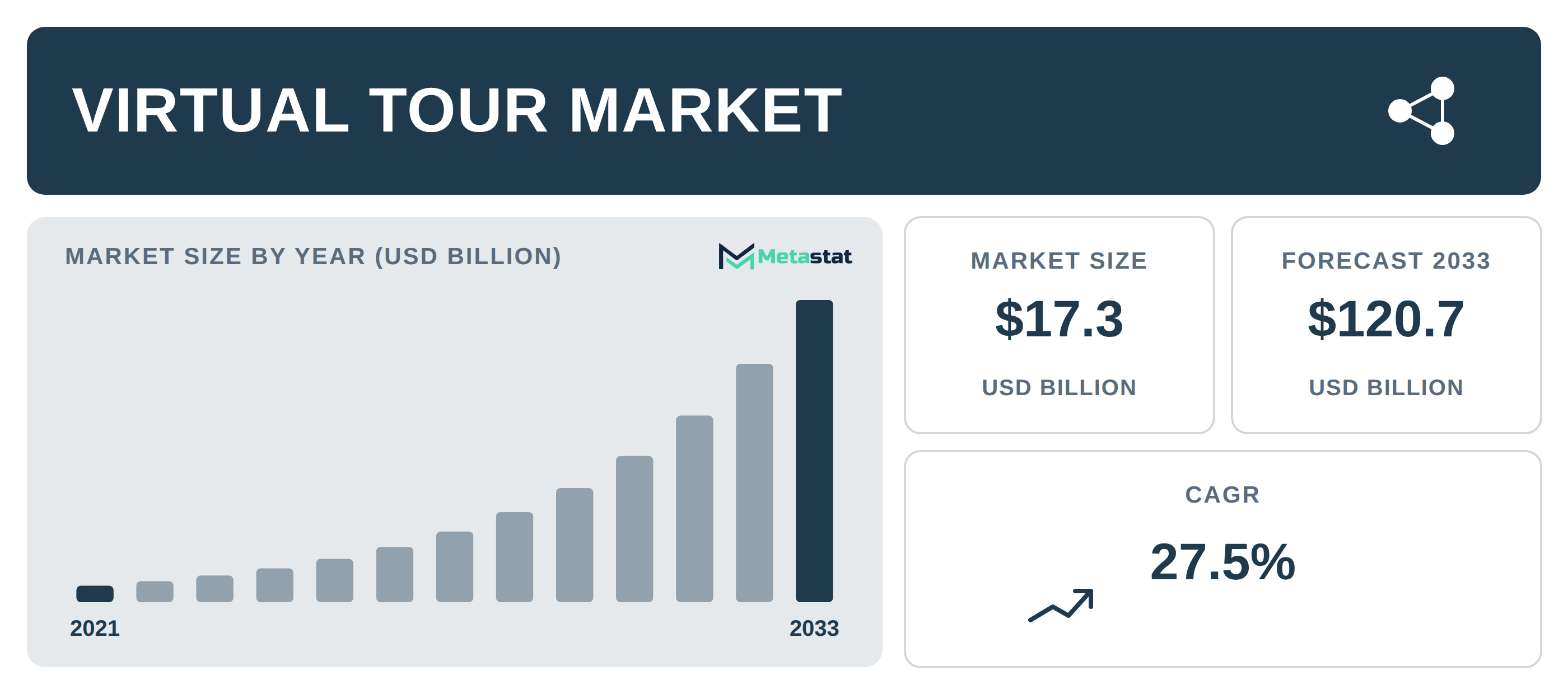
Metastat Insights reveals the Global Virtual Tour market will grow from USD 17.3 billion in 2025 to USD 120.7 billion by 2033, with a CAGR of 27.5%. Key trends, challenges, and competitive dynamics are analyzed.
Metastat Insights has published "Global Virtual Tour Market Size, Share, By Offering Type (Virtual Tour Software and Platforms, Turnkey Virtual Tour Capture and Production Services, Managed Hosting, Publishing and Tour Management Services, Spatial Data and Derived Asset Services), By Type (360° Panoramic Virtual Tours, 3D Digital Twin Virtual Tours, Interactive 3D Walkthroughs, 360° Video-Based Tours, VR-Enabled Virtual Tours), By Application (Residential Real Estate, Commercial Real Estate, Hospitality and Tourism, Retail and Showrooms, Education and Training, Healthcare and Healthcare Facilities, Corporate Offices and Workspaces, Others), Industry Analysis, Growth, Trends, and Forecast, 2026-2033", followed by the headline figures (USD 17.3 billion in 2025, USD 120.7 billion by 2033, 27.5% CAGR).
The increasing focus on digital transformation across multiple sectors significantly boosts the Virtual Tour market. Organizations seek innovative methods to engage consumers, leading to a rise in demand for immersive digital solutions. This trend aligns with broader economic indicators including GDP growth and enhanced capital investment, prompting businesses to adopt advanced technologies. Companies are investing in automation and artificial intelligence, facilitating more efficient virtual tour offerings that enhance user engagement.
High capital investment requirements pose a considerable challenge for the Virtual Tour market, limiting access for smaller enterprises. Initial setup costs for software and hardware create financial barriers, particularly affecting startups and smaller firms. Ongoing expenses related to software updates and the need for skilled labor complicate recruitment and operational sustainability. Insufficient internet access in several regions restricts the ability of potential customers to experience high-quality virtual tours, hindering overall market growth.
The Virtual Tour market exhibits significant regional dynamics, with North America holding the largest share at 38.7%. Europe and Asia Pacific follow with shares of 27.7% and 22.5%, respectively. The market is segmented into various applications, including residential and commercial real estate, hospitality, retail, and education, among others. The segment focused on 3D Digital Twin Virtual Tours is anticipated to experience substantial growth, projected to reach USD 36.2 billion by 2033, driven by advancements in technology and user demand.
The competitive environment of the Virtual Tour market includes numerous entities offering diverse solutions. Key companies include Matterport, LLC, 3DVista, 3D 360, RICOH, Kuula Inc., and Cupix, among others. These organizations continually innovate to differentiate their offerings and meet the evolving needs of consumers. Their strategic investments in technology and infrastructure enhance their competitive positioning within the market, ensuring they remain relevant in this rapidly changing sector.
For an in-depth analysis and further insights, readers are invited to explore the full report: Global Virtual Tour Market.
Related Report
Global Virtual Tour MarketLEAD ANALYST
Utkarsh Khirodkar is a Lead Market Research Analyst at MetaStat Insight, specializing in market intelligence, technology sector assessments, and competitive strategy.

PRINCIPAL CONSULTANT - ENTERPRISE AI & EMERGING TECHNOLOGIES
Banking & Finance · Electronics and Semiconductor · Energy and Power · Healthcare IT · Information & Technology · Professional Services
Vijay Gunti is a Principal Consultant at MetaStat Insight, bringing over two decades of experience across enterprise digital transformation, technology strategy, and intelligent systems.

LEAD CONSULTANT - COMMUNICATION, TELECOM, AND IT
Electronics and Semiconductor · Information & Technology · Machinery & Equipment · Professional Services
Ravindra Sathe Consultants for Communication, Telecom, and IT at MetaStat Insight. He leads the firm's industry research initiatives across telecommunications infrastructure, digital connectivity, enterprise networking, and emerging information technology domains.