
LEAD ANALYST
Utkarsh Khirodkar is a Lead Market Research Analyst at MetaStat Insight, specializing in market intelligence, technology sector assessments, and competitive strategy.

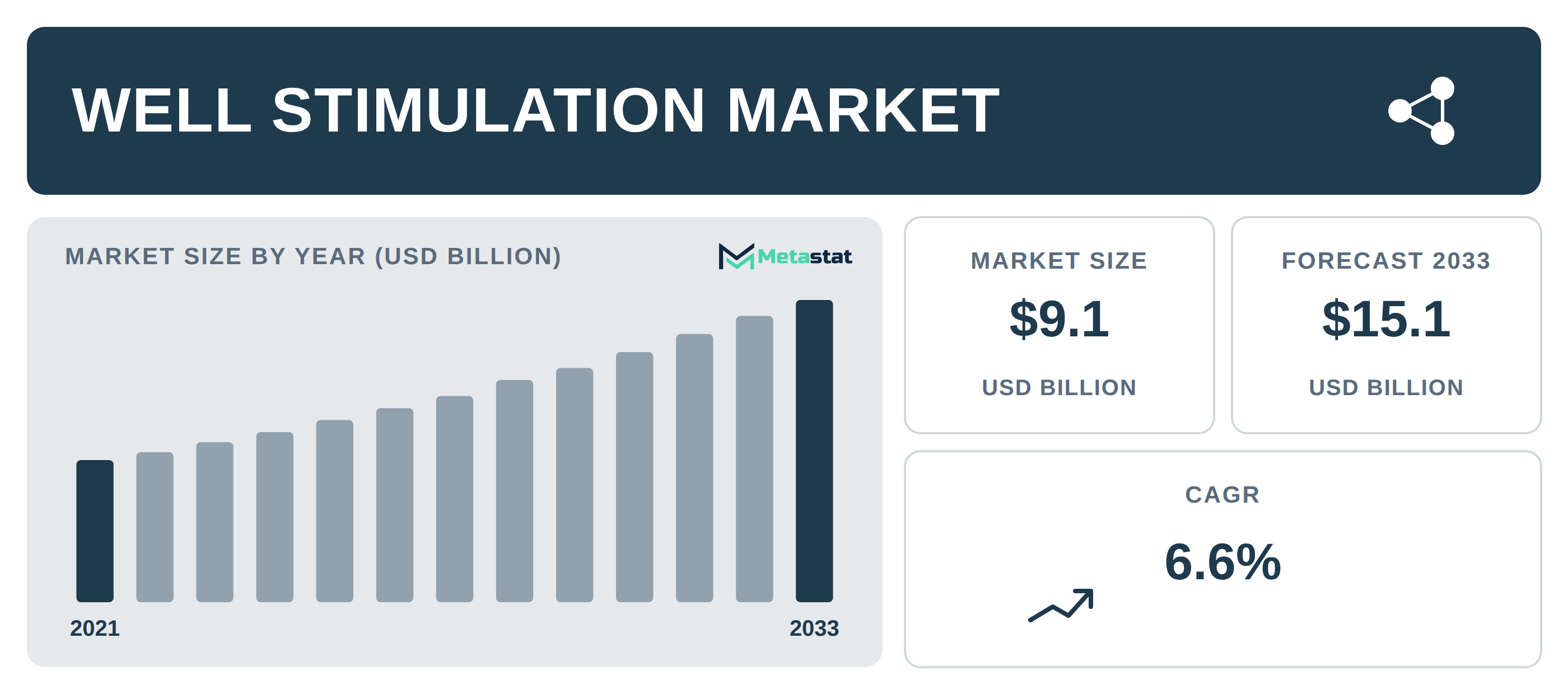
Metastat Insights has released a comprehensive report on the Well Stimulation market, forecasting significant growth from USD 9.1 billion in 2025 to USD 15.1 billion by 2033, driven by increasing energy demands and technological advancements.
Metastat Insights has published "Global Well Stimulation Market Size, Share, By Stimulation Technique (Hydraulic Fracturing, Matrix Acidizing, Acid Fracturing, and Refracturing), By Reservoir / Formation Type (Shale, Tight Oil and Gas, Carbonate, Sandstone, and Coalbed Methane), By Customer Type (International Oil Companies (IOCs), National Oil Companies (NOCs), Independent Oil & Gas Operators, and Oilfield Service Companies), By Deployment Environment (Onshore and Offshore), Industry Analysis, Growth, Trends, and Forecast, 2026-2033," reporting a market size of USD 9.1 billion in 2025, projected to reach USD 15.1 billion by 2033, with a compound annual growth rate (CAGR) of 6.6%.
Infrastructure development significantly fuels growth in the Well Stimulation market. Investments aimed at upgrading drilling and extraction facilities improve operational efficiency and production capabilities. This trend aligns with rising global energy demands, especially from emerging economies. Capital investments in drilling rigs and advanced processing facilities fortify the market's structure and enable companies to incorporate cutting-edge technologies. Enhanced operational capabilities further optimize extraction processes, minimizing costs and improving resource management.
Regulatory challenges impose constraints on the Well Stimulation market. Stricter environmental regulations lead to increased operational costs, compelling companies to invest in advanced technologies to comply with standards. These financial burdens disproportionately affect smaller players, limiting their competitive abilities. Geopolitical tensions and economic uncertainties further complicate the market, impacting supply chains and raising project costs. Significant capital investments in new technologies present barriers to entry for potential new participants.
The Well Stimulation market segments by stimulation technique include hydraulic fracturing, matrix acidizing, acid fracturing, and refracturing. Hydraulic fracturing stands out, valued at USD 6 billion in 2026 and projected to reach USD 9.2 billion by 2033, with a CAGR of 6.3%. North America dominates the market, accounting for 41.7% of total revenue, while Asia Pacific follows with a 23.8% share, reflecting the growing adoption of advanced extraction methods. Europe, South America, and the Middle East and Africa contribute 14%, 8%, and 12.4%, respectively.
Key players in the Well Stimulation market include SLB (Schlumberger Limited), Halliburton, and Baker Hughes Company. These companies actively pursue strategic opportunities to enhance supply chain resilience and address the evolving demands of the market. Despite the fragmented competitive landscape, numerous players operate across various segments, seeking to consolidate capabilities and expand market share. Investment strategies focus on balancing operational expenditures and infrastructure improvements to ensure long-term viability.
For a detailed analysis, insights, and forecasts, readers access the full report on the Global Well Stimulation Market.
Related Report
Global Well Stimulation MarketLEAD ANALYST
Utkarsh Khirodkar is a Lead Market Research Analyst at MetaStat Insight, specializing in market intelligence, technology sector assessments, and competitive strategy.

PRINCIPAL CONSULTANT - ENTERPRISE AI & EMERGING TECHNOLOGIES
Banking & Finance · Electronics and Semiconductor · Energy and Power · Healthcare IT · Information & Technology · Professional Services
Vijay Gunti is a Principal Consultant at MetaStat Insight, bringing over two decades of experience across enterprise digital transformation, technology strategy, and intelligent systems.

ENERGY & INFRASTRUCTURE INDUSTRY CONSULTANT
Automotive and Transportation · Electronics and Semiconductor · Energy and Power · Machinery & Equipment
Saurabh Vasant Ganvir consults for Energy & Infrastructure Industry at MetaStat Insight, specializing in renewable energy, solar EPC, and electric vehicle (EV) infrastructure markets.