
LEAD ANALYST
Utkarsh Khirodkar is a Lead Market Research Analyst at MetaStat Insight, specializing in market intelligence, technology sector assessments, and competitive strategy.

The Wireless Gas Detectors market is set to grow from USD 1.8 billion in 2025 to USD 3 billion by 2033, driven by safety regulations and technological advancements.
Metastat Insights has published "Global Wireless Gas Detectors Market Size, Share, By Detector Type (including Fixed/Stationary Wireless Gas Detectors, Portable Wireless Gas Detectors, Transportable/Area Wireless Gas Detectors, Wearable/Connected Personal Gas Detectors, and Wireless Residential/Commercial Gas Detectors), By Gas Type (covering Combustible/Flammable Gases, Toxic Gases, Oxygen, Multi-Gas, Carbon Dioxide, and VOCs), By Sensing Technology (including Electrochemical, NDIR, Catalytic Bead/Pellistor, PID, Metal Oxide Semiconductor, Ultrasonic/Acoustic, Laser/Optical, and Others including Thermal Conductivity, Semiconductor, Colorimetric), By End-Use Industry (spanning Oil & Gas, Chemical & Petrochemical, Mining, Power & Utilities, Manufacturing & Industrial Processing, Water & Wastewater, Commercial & Residential, Food & Beverage, and Pharmaceuticals & Life Sciences), Industry Analysis, Growth, Trends, and Forecast, 2026-2033", highlighting key market figures of USD 1.8 billion in 2025 and projected growth to USD 3 billion by 2033, reflecting a CAGR of 6.6%.
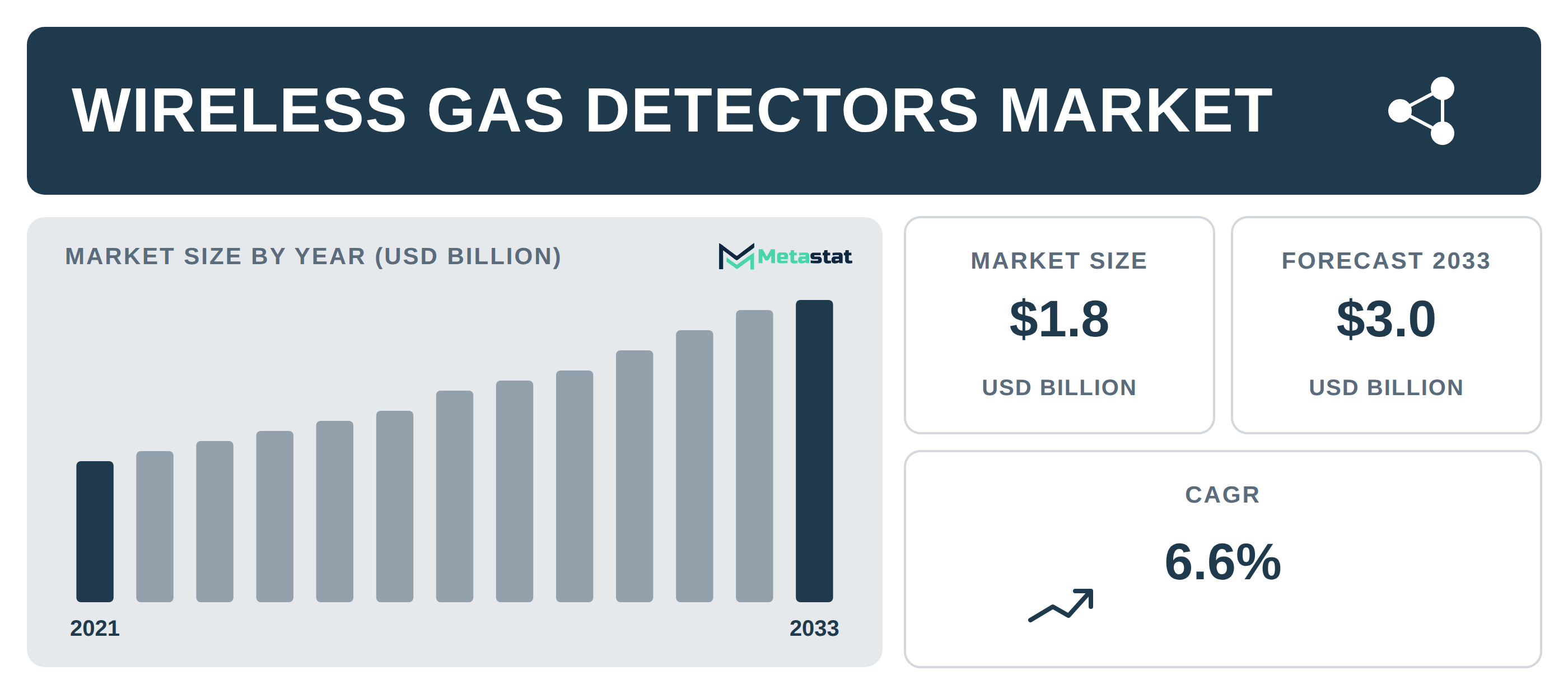
Increasing demand for wireless gas detectors stems from stricter regulatory compliance across various sectors, especially in oil and gas and chemical industries. Companies are emphasizing the need for safety and are investing in advanced monitoring technologies to address the risks connected to hazardous gases. This intensified focus on safety, coupled with the necessity for adherence to stringent regulations, propels significant growth within the market.
Challenges affecting the Wireless Gas Detectors market include stringent regulatory compliance and economic pressures that impact market dynamics. Rising operational costs and inflation hinder smaller companies from making necessary investments in gas detection technologies. Supply chain disruptions and geopolitical tensions complicate the procurement of vital components, affecting manufacturers’ ability to fulfill market demand. These elements collectively shape the market's trajectory.
The Wireless Gas Detectors market is segmented based on detector type, gas type, sensing technology, and end-use industry. The market encompasses a variety of detector types including fixed, portable, and wearable devices. The gas type segmentation includes combustible gases, toxic gases, oxygen, and multi-gas systems. Each segment demonstrates distinct growth patterns influenced by specific regulatory demands and technological advancements.
The competitive landscape of the Wireless Gas Detectors market features several key players, including Honeywell International Inc, Drägerwerk AG & Co. KGaA, MSA, and Industrial Scientific. These companies focus on innovation and strategic partnerships to strengthen their market presence. Competitive pressures promote ongoing technological enhancements, ensuring these firms meet emerging customer needs and regulatory standards.
For more detailed insights, readers are invited to access the full report on the Global Wireless Gas Detectors Market.
Related Report
Global Wireless Gas Detectors MarketLEAD ANALYST
Utkarsh Khirodkar is a Lead Market Research Analyst at MetaStat Insight, specializing in market intelligence, technology sector assessments, and competitive strategy.

PRINCIPAL CONSULTANT - ENTERPRISE AI & EMERGING TECHNOLOGIES
Banking & Finance · Electronics and Semiconductor · Energy and Power · Healthcare IT · Information & Technology · Professional Services
Vijay Gunti is a Principal Consultant at MetaStat Insight, bringing over two decades of experience across enterprise digital transformation, technology strategy, and intelligent systems.

PRINCIPAL CONSULTANT - QUALITY SYSTEMS & COMPLIANCE
Electronics and Semiconductor · Machinery & Equipment · Professional Services
Omkar Phadtare is an Industry Consultant at MetaStat Insight, specializing in quality systems, regulatory compliance, and standards benchmarking to drive data-driven market intelligence and strategic industry research.

ENERGY & INFRASTRUCTURE INDUSTRY CONSULTANT
Automotive and Transportation · Electronics and Semiconductor · Energy and Power · Machinery & Equipment
Saurabh Vasant Ganvir consults for Energy & Infrastructure Industry at MetaStat Insight, specializing in renewable energy, solar EPC, and electric vehicle (EV) infrastructure markets.

LEAD CONSULTANT - COMMUNICATION, TELECOM, AND IT
Electronics and Semiconductor · Information & Technology · Machinery & Equipment · Professional Services
Ravindra Sathe Consultants for Communication, Telecom, and IT at MetaStat Insight. He leads the firm's industry research initiatives across telecommunications infrastructure, digital connectivity, enterprise networking, and emerging information technology domains.