
LEAD ANALYST
Utkarsh Khirodkar is a Lead Market Research Analyst at MetaStat Insight, specializing in market intelligence, technology sector assessments, and competitive strategy.

Air Quality Monitoring System Market By Product (Indoor Air Quality Monitoring Systems, Outdoor Air Quality Monitoring Systems), By Sampling Method (Active/Continuous Monitoring, Manual Monitoring, Passive Monitoring, Intermittent Monitoring, Stack Monitoring), By Pollutant (Chemical Pollutants, Nitrogen Oxides, Sulfur Oxides, Carbon Oxides, Volatile Organic Compounds, Other Chemical Pollutants, Physical Pollutants, Biological Pollutants), By End User (Government Agencies and Academic Institutes, Commercial and Residential Users, Petrochemical Industry, Power Generation Plants, Pharmaceutical Industry, Smart City Authorities, Other), Industry Analysis, Size, Share, Growth, Trends, and Forecasts 2025-2032
Report ID
MSI-4217
Published
October, 2025
Pages
255 Pages
Format
Report Details
Choose Your License
Air Quality Monitoring System Market
The global air quality monitoring system market in the environmental technology sector will have an interesting ride as it continues to evolve in the years ahead. Its beginning was in the mid-20th century when urbanization and industrial growth started to make a serious dent in air purity. Initial monitoring was primitive, with much of it being manual sampling and laboratory testing. These early systems were limited to local snapshots, but they did represent the first systematic attempt at monitoring pollution levels and estimating its impact on public health. During the late 1970s, increased public concern and the establishment of environmental protection agencies in many nations led to the installation of automatic air quality monitoring stations. These stations enabled monitoring day and night, which was simple to conduct for observing pollutants like sulfur dioxide, nitrogen oxides, and particulate matter in cities.
The market will yet develop in the 1990s when digital technologies begin to converge with monitoring equipment. Real-time data transmission and collection by IoT-enabled sensors and early remote sensing will bring in increased geographical reach as well as more accurate pollution mapping.
At roughly the same time, global treaties to reduce emissions and stricter air quality requirements will require governments and industry to put in more advanced monitoring systems, pushing the market toward compliance-based and innovation solutions. Market demand will eventually follow these advances, calling for not only precise measurement but also usable and readable information. Mobile devices and web platforms will be central to it all, cutting into complicated information to make it usable intelligence for city planners, medical professionals, and citizens. New economies will play an increasingly larger role, utilizing low-cost and scalable monitoring systems to address fast industrialization and urban growth. As the global air quality monitoring system market keeps expanding, it will incorporate artificial intelligence, machine learning, and cloud analytics to forecast pollution patterns, streamline sensor networks, and improve public safety. It will go beyond the conventional government-driven programs to smart cities, industrial compliance, and even personal Air Quality Monitoring Systems.
The evolution of simple lab measurements into advanced, networked systems will drive the direction of the market and become a sought-after device for solving environmental and human health problems.
The global air quality monitoring system market is mainly classified based on Product, Sampling Method, Pollutant, End User.
|
Forecast Period |
2025-2032 |
|
Market Size in 2025 |
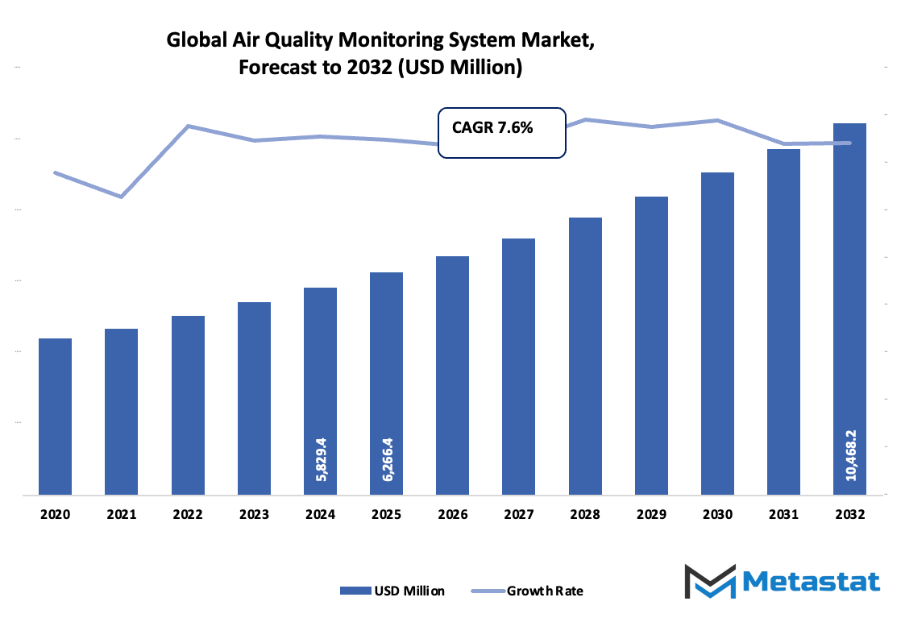
$6266.4 Million |
|
Market Size by 2032 |
$10468.2 Million |
|
Growth Rate from 2025 to 2032 |
7.6% |
|
Base Year |
2024 |
|
Regions Covered |
North America, Europe, Asia-Pacific, South America, Middle East & Africa |
The global air quality monitoring system market features a mix of well-established international companies and emerging regional players, creating a competitive environment that will shape future technological developments and market strategies. Key industry participants such as Thermo Fisher Scientific Inc., Teledyne Technologies Incorporated, Aeroqual Ltd., Siemens AG, Horiba, Ltd., TSI Incorporated, 3M Company, Emerson Electric Co., Testo SE & Co. KGaA, Honeywell International Inc., EPA, Opsis AB, Ecotech Pty Ltd., Merck KGaA, PerkinElmer, Inc., Hangzhou Zetian Technology Co., Ltd., Synspec BV, SICK AG, and Tisch Environmental Inc. play significant roles in driving innovation and expanding market reach. Each competitor brings a unique set of strengths, whether it is advanced sensor technology, robust data analytics, or extensive distribution networks, allowing them to capture specific segments of the market.
The competitive landscape will become increasingly dynamic as companies continue to invest in research and development to meet stricter environmental regulations and growing demand for real-time air quality data. Emerging players will introduce flexible and cost-effective solutions that challenge the dominance of larger organizations, creating opportunities for collaboration, strategic partnerships, and technological integration. Companies that can combine data accuracy, scalability, and ease of deployment will gain a strong advantage, particularly in urban centers facing rapid industrial growth and rising pollution concerns.
From a strategic insights perspective, companies will need to focus on integrating artificial intelligence, cloud-based analytics, and Internet of Things (IoT) connectivity into their offerings. These technologies will not only improve the precision of air quality measurements but also provide predictive capabilities that allow policymakers and industries to respond proactively to pollution events. Additionally, global expansion into emerging markets will become a critical strategy, as increasing urbanization and industrialization in these regions will drive demand for efficient monitoring systems. Strategic collaborations with local authorities and technology providers will support faster adoption and provide competitive differentiation.
Market size is forecast to rise from USD 6266.4 million in 2025 to over USD 10468.2 million by 2032. Air Quality Monitoring System will maintain dominance but face growing competition from emerging formats.
In the future, the market will witness an emphasis on sustainability-driven innovation, where products will be designed to minimize energy consumption and reduce environmental impact. Companies will invest in smart, adaptive systems capable of self-calibration and remote operation, reducing maintenance costs while enhancing reliability. Those that can anticipate shifts in environmental regulations and respond with tailored solutions will maintain leadership positions and continue to influence the market trajectory. The integration of advanced analytics, international partnerships, and emerging technologies will ultimately define the direction of growth, offering insights into areas that promise high returns and long-term value.
suggest that the global air quality monitoring system market will continue to evolve with increasing technological sophistication, regional expansion, and strategic innovation, creating a landscape where both established leaders and emerging players can thrive through careful planning and forward-looking approaches.
This research report categorizes the global air quality monitoring system market based on various segments and regions, forecasts revenue growth, and analyzes trends in each submarket. The report analyses the key growth drivers, opportunities, and challenges influencing the global air quality monitoring system market. Recent market developments and competitive strategies such as expansion, type launch, development, partnership, merger, and acquisition have been included to draw the competitive landscape in the market. The report strategically identifies and profiles the key market players and analyses their core competencies in each sub-segment of the global air quality monitoring system market.
Find answers to common questions about this report
Global Air Quality Monitoring System market is valued at $6266.4 million in 2025.
Global Air Quality Monitoring System market is estimated to grow with a CAGR of 7.6% from 2025 to 2032.
Global Air Quality Monitoring System market is estimated to reach $10468.2 million by 2032.
Top players operating in the Air Quality Monitoring System industry includes Thermo Fisher Scientific Inc., Teledyne Technologies Incorporated, Aeroqu
The analysts below cover Information & Technology research at Metastat Insights.
LEAD ANALYST
Utkarsh Khirodkar is a Lead Market Research Analyst at MetaStat Insight, specializing in market intelligence, technology sector assessments, and competitive strategy.

PRINCIPAL CONSULTANT - ENTERPRISE AI & EMERGING TECHNOLOGIES
Banking & Finance · Electronics and Semiconductor · Energy and Power · Healthcare IT · Information & Technology · Professional Services
Vijay Gunti is a Principal Consultant at MetaStat Insight, bringing over two decades of experience across enterprise digital transformation, technology strategy, and intelligent systems.

LEAD CONSULTANT - COMMUNICATION, TELECOM, AND IT
Electronics and Semiconductor · Information & Technology · Machinery & Equipment · Professional Services
Ravindra Sathe Consultants for Communication, Telecom, and IT at MetaStat Insight. He leads the firm's industry research initiatives across telecommunications infrastructure, digital connectivity, enterprise networking, and emerging information technology domains.
Tracking maintenance cycle demand for secondary flight display units and terrain collision avoidance systems across regional jet fleets involves complex aftermarket dynamics. MetaStat Insight provided practical analysis separating airline retrofit programs from OEM forward-fit production schedules in North America and Southeast Asia. The supplier matrix highlighted component obsolescence timelines without resorting to vague generalizations. The dataset served as a dependable reference during our annual program review meetings.
Evaluating secondary resin quality across post-consumer packaging streams requires reliable technical segmentation. MetaStat Insight delivered an objective assessment that distinguished between extrusion-grade flake pricing and optical sorting throughput limitations across Western Europe. The competitive positioning breakdown for licensed depolymerization technology providers answered several questions during our feedstock feasibility audit. Their team clarified regional trade restrictions on mixed plastic scrap quickly when our team submitted follow-up requests.
Evaluating sovereign cloud deployments for core banking platforms demands a clear view of data residency regulations and migration exit strategies. MetaStat Insight delivered an exhaustive review of regional latency tolerances, mainframe decommission milestones, and third-party vendor concentration risk. The regulatory compliance mapping across European and Asian financial jurisdictions gave our team a dependable baseline for multi-cloud infrastructure discussions.
Explore related market intelligence reports worth reading alongside this one.
Starting from
$2950