
LEAD ANALYST
Utkarsh Khirodkar is a Lead Market Research Analyst at MetaStat Insight, specializing in market intelligence, technology sector assessments, and competitive strategy.

Global Brand Management Services Market Size, Share, By Service Type (Brand Strategy & Positioning, Brand Architecture & Portfolio Strategy, Brand Identity & Design, Naming & Verbal Branding, Brand Research & Insights, Brand Activation & Implementation, Brand Governance & Management, Brand Measurement & Valuation, Internal Brand & Employee Engagement), By Engagement Model (Project-Based Engagements, Retainer-Based Engagements, Managed Brand Services and Performance/Outcome-Based Engagements), By Organization Size (Large Enterprises and Small & Medium Enterprises), By End-Use Industry (BFSI, Consumer Goods, Retail & E-commerce, Technology & Telecommunications, Healthcare & Life Sciences, Automotive & Mobility, Travel, Hospitality & Leisure, Media & Entertainment, Industrial, Energy & Utilities and Others (Public Sector, Education, Nonprofit Organizations)), Industry Analysis, Growth, Trends, and Forecast, 2026-2033
Report ID
MSI-5419
Published
October, 2026
Pages
263 Pages
Format
Historical
Base year
Forecast
Forecast period
Report Details
Market Valuation: Valued at $17.2 Billion in 2025, projected to reach $32.8 Billion by 2033 at a 8.4% CAGR.
Dominant Segment: Project-based engagements hold the largest share among service models, projected to reach USD 12.8 billion by 2033, as organizations prioritize flexible, targeted branding initiatives.
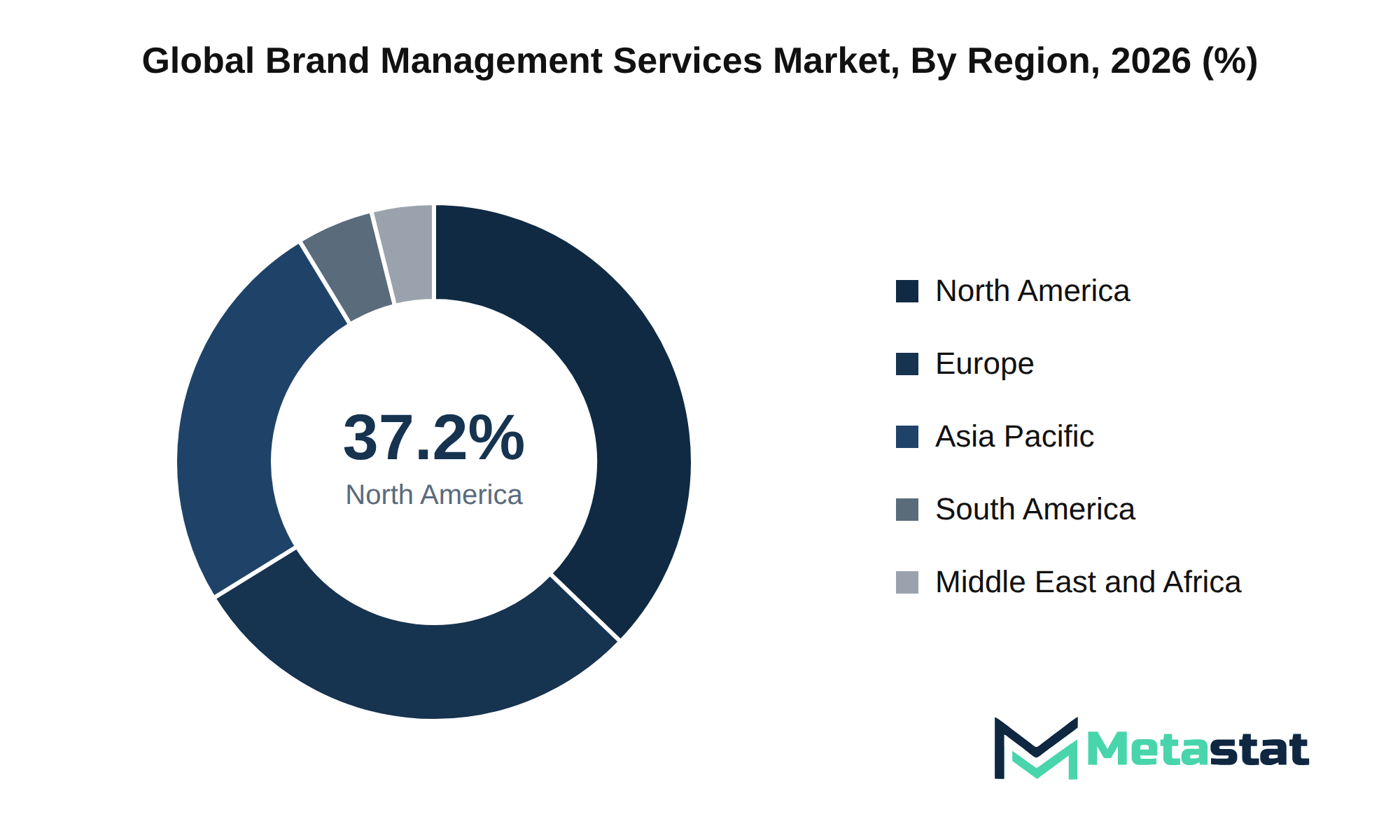
Geographic Lead: North America leads the market with a 37.2% share in 2025, driven by a mature brand ecosystem, higher marketing budgets, and advanced adoption of branding techniques.
Key Buyer: Large enterprises account for the highest value among organization sizes, with projected spending of USD 20.7 billion by 2033, fueled by frequent rebranding cycles and complex brand architectures.
What's Inside: The report provides detailed segmentation by service type, engagement model, organization size, and end-use industry, with competitive analysis, market dynamics, and forecasts through 2033.
Choose Your License
Global Brand Management Services Market
The global Brand Management Services market was valued at USD 17.2 billion in 2025 and is projected to reach USD 32.8 billion by 2033, growing at a CAGR of 8.4% over the forecast period.
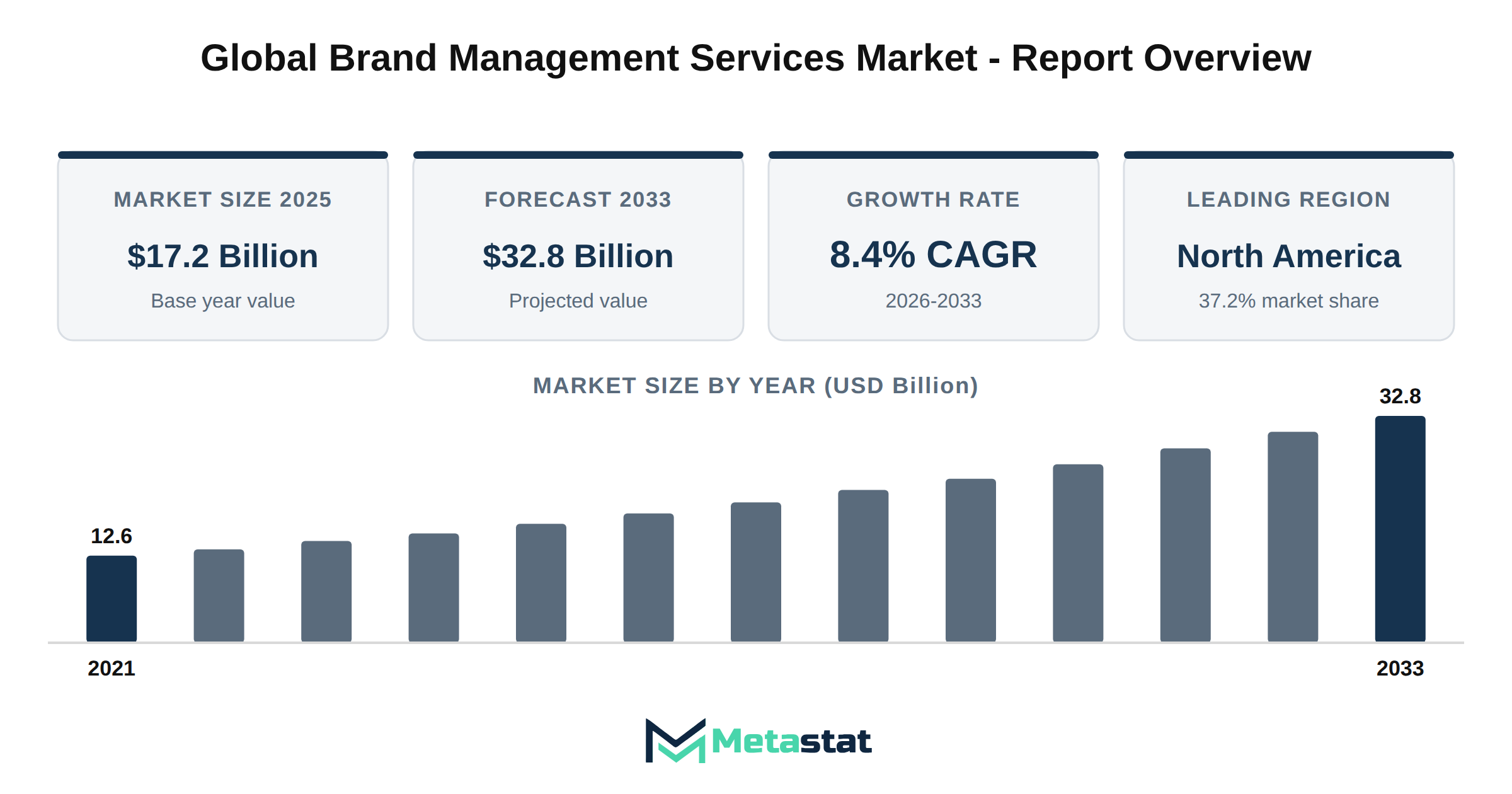
The Brand Management Services market covers a suite of professional services designed to create, develop, and maintain brand value for organizations across sectors. These services replace fragmented in-house brand efforts with specialized strategy, design, and portfolio management solutions. Buyers include large enterprises seeking cohesive brand direction, consumer goods companies aiming to differentiate in crowded markets, and technology providers working to strengthen market presence. Demand concentrates in services that deliver measurable business outcomes. Buyers are drawn to expertise in strategic positioning, identity development, and multi-channel engagement models.
Project-based engagements hold the largest share among service models. Clients prefer flexible, outcome-oriented partnerships. North America holds 37.2% in 2025 with US leading the market share in 2026. This concentration reflects the region’s mature brand ecosystem, deeper marketing budgets, and higher adoption of advanced branding techniques. Large enterprises account for the highest value among organization sizes, driven by frequent rebranding cycles, global expansion, and the manage complex brand architectures.
Digital transformation stands out as the primary growth driver. Organizations invest to ensure consistent brand experience across physical and digital touchpoints. The market benefits from rising demand for integrated solutions that address not only visual identity but strategic alignment and portfolio optimization. This multichannel alignment frequently complements investments in Digital Marketing and Social Media Agency Services to activate brand assets across modern touchpoints. Suppliers compete by offering specialized expertise and scalable solutions that address evolving client needs in branding, engagement, and measurement.
Service offerings in the Brand Management Services market span brand strategy, architecture, identity, design, and governance, serving organizations seeking to differentiate and strengthen their market presence. Buyers invest in these services to drive customer engagement, clarify brand messaging, and support expansion into new markets, which is especially relevant for large enterprises and fast-scaling consumer brands. Such engagements often integrate broader Strategy Consulting to coordinate brand architecture with long-term enterprise growth objectives. Project-based engagements hold the largest share among delivery models, reflecting the demand for specialized, targeted support on discrete branding initiatives.
Within the Brand Management Services market, project-based engagements are projected to reach USD 12.8 billion by 2033, outpacing other models including retainers and managed services. This preference aligns with organizations' focus on defined branding campaigns and strategic repositioning efforts. Large enterprises act as a key buyer segment, with projected spending of USD 20.7 billion by 2033, while small and medium enterprises accelerate adoption, driven by a heightened emphasis on digital presence and competitive differentiation. Industry verticals including consumer goods, BFSI, and retail and e-commerce demonstrate strong utilization, often leveraging specialized Retail Marketing Consulting Services to adapt to shifting consumer expectations and rapid technological change.
Growth in the sector is driven primarily by the intensifying importance of brand differentiation in crowded markets. Organizations prioritize comprehensive brand management to build long-term loyalty and enhance customer trust. This dynamic continues to shape both the competitive strategies of established firms and the entry of new providers offering specialized or integrated brand management solutions.
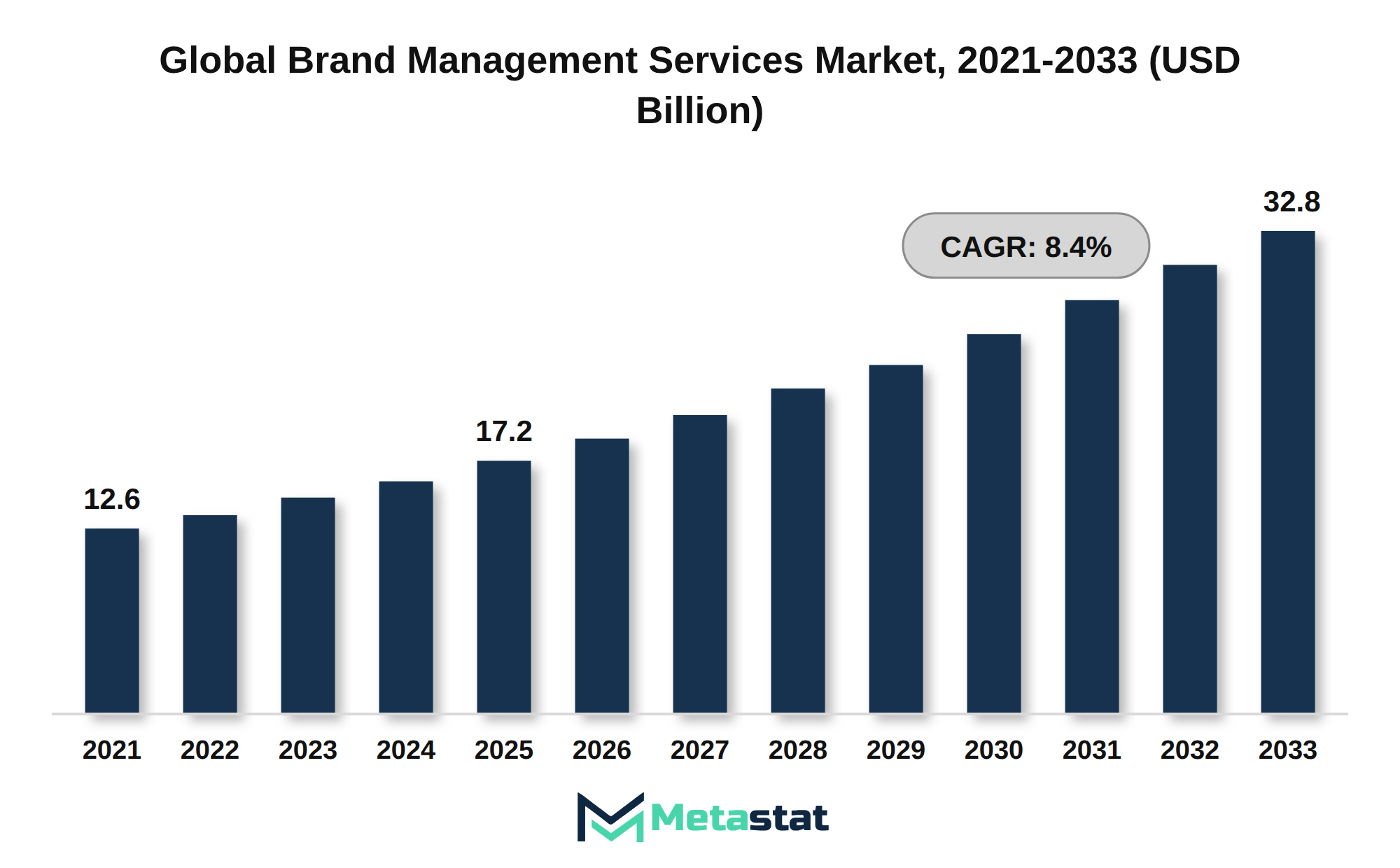
AI-driven research and broader enterprise Digital Transformation are reshaping how brands structure their strategies and allocate investment within the Brand Management Services market. Buyers increasingly demand granular insights into consumer behavior, sentiment, and emerging trends, seeking to differentiate their brands in crowded sectors. Investment in advanced analytics and machine learning solutions now supports greater precision in brand positioning, enabling service providers to deliver tailored recommendations that outpace traditional qualitative approaches. Companies pursue higher returns on their brand spend, and data-centric strategy and real-time consumer feedback have become key selection criteria for buyers evaluating brand management partners. These data streams increasingly rely on specialized Product Analytics Software to measure real-time digital engagement and feature sentiment.
The trend is supported by the growing allocation of budgets to Brand Strategy & Positioning, which is projected to reach USD 5.6 billion by 2033. This segment’s expansion signals a shift toward evidence-based decision-making, where AI-led tools are standard components for project delivery and ongoing advisory. Buyers in sectors including consumer goods and retail prioritize providers with sophisticated data and analytics capabilities, resulting in greater differentiation and higher contract values for agencies leveraging these technologies. This evolution is driving deeper integration of AI solutions, intensifying competition based on technological depth and measurable business outcomes.
Growing demand for integrated brand governance is reshaping decision-making across enterprise portfolios. Multi-brand organizations pursue greater consistency and control over brand assets. Enterprises with diverse business units increase their investment in unified governance frameworks to protect brand equity and streamline management processes. This shift appears in the growing adoption of services including brand architecture and portfolio strategy, which are projected to reach USD 4.4 billion by 2033. Coherent narratives and standardized practices across global operations drive this investment, particularly among large enterprises managing complexity at scale.
Integrated brand governance serves as a strategic lever for companies facing a proliferation of sub-brands, digital channels and cross-regional campaigns. Brand Management Services market providers respond by expanding offerings that facilitate portfolio audits, unified toolkits and centralized oversight. Integrated governance is positioned as a premium service, reflecting the operational savings and risk mitigation it delivers to clients managing multiple brands. Buyers benefit from improved compliance, reduced reputational risk and more agile brand adaptation in dynamic markets, supporting stronger portfolio-level value and increased long-term competitiveness.
Large enterprises are shifting their procurement preferences in the Brand Management Services market toward outcome-based and managed brand service models. This transition reflects growing demand for accountability, measurable returns, and continuous optimization in brand investment. While project-based engagements comprise a significant volume, the segment for retainer-based engagements is projected to reach USD 10.7 billion by 2033, supported by a robust CAGR of 8.7 percent through the forecast period. Managed brand services, expected to account for USD 7 billion by 2033, appeal to larger organizations seeking consistent support and integrated solutions that align with evolving brand strategies over time.
Outcome-based models, which link provider compensation to performance metrics including brand equity growth or customer engagement, are attracting enterprise buyers who want service partners with shared incentives. The performance/outcome-based engagement model is expected to expand at a CAGR of 9.6 percent, outpacing more traditional models. This indicates a strategic pivot among buyers who now require providers to deliver lasting business value rather than discrete campaign deliverables.
Suppliers in this market respond to these preferences by investing in data analytics, real-time measurement, and scalable support platforms. Large organizations value these capabilities for their ability to facilitate agile brand governance, drive better campaign performance, and reduce procurement complexity. This structural change is raising provider barriers to entry and increasing contract values, shaping a market environment where long-term, performance-driven relationships define supplier competitiveness and growth.
Artificial intelligence and digital channels are accelerating fundamental changes in how organizations approach branding, with buyers expecting higher personalisation and faster response cycles from service providers. In the Brand Management Services market, these shifts are influencing both the scope and delivery of services. Many large enterprises and small and medium enterprises are reallocating spend toward digital-first brand experiences, contributing to the segment's projected expansion. The Small & Medium Enterprises segment is expected to reach USD 12.1 billion by 2033, reflecting a 9.8 percent compound annual growth rate, as these organizations invest in scalable tools for brand engagement and analytics.
Service providers increasingly integrate AI-driven analytics to monitor brand performance in real time and automate content adaptation across diverse digital channels. This evolution responds to rising client demand for evidence-based decision-making and dynamic, always-on brand management. These expectations are altering the commercial models used by suppliers, with performance or outcome-based engagements projected to outpace other models at a 9.6 percent compound annual growth rate. Buyers are now demanding transparency in campaign performance and greater accountability for results, driving providers to adopt technology platforms that support rapid insights and measurable value delivery.
These developments are increasing competitive pressure across the Brand Management Services market. Providers that invest in AI and digital infrastructure differentiate through speed, data integration, and the ability to align with evolving client expectations. This intensifies competition for talent and accelerates innovation cycles, supporting higher value-added service offerings and enabling suppliers to command premium pricing with demonstrable business impact.
Organizations are accelerating the frequency of rebranding and repositioning initiatives in response to shifting consumer expectations and increased competitive intensity. Companies across sectors now treat their brand identities as strategic assets that require regular refreshment to remain relevant in crowded markets. This dynamic has driven a higher volume of project-based and retainer-based engagements, supporting the Brand Management Services market’s expansion from USD 17.2 billion in 2025 toward a projected USD 32.8 billion by 2033.
Shorter product life cycles and evolving digital touchpoints require brands to refresh visual assets, messaging frameworks, and portfolio strategies more often than in previous cycles. Demand is strongest from industries with rapidly changing customer demographics and high innovation rates, including technology, consumer goods, and retail. Increased demand for brand strategy, identity design, and architecture services is generating a recurring revenue stream for suppliers, strengthening long-term commercial adoption.
Small and medium enterprises encounter significant barriers from the relatively high cost structure associated with specialized brand management services. Budget constraints within this segment restrict access to premium offerings, resulting in fewer comprehensive engagements and a preference for project-based or ad hoc solutions over long-term, retainer-based partnerships. While large enterprises allocate substantial resources for brand strategy, smaller organizations delay or scale down investment, which limits the breadth of brand-building campaigns and slows overall market penetration in this cohort. Higher pricing in this market contributes to slower adoption rates among cost-sensitive buyers, directly impacting volume growth across emerging sectors and geographies. This dynamic reduces addressable market size and dampens the pace of new client onboarding for service providers.
Specialized talent requirements generate sustained cost pressure for providers in the Brand Management Services market. Agencies compete for a limited pool of experienced strategists, designers, and digital branding professionals, driving up salaries and increasing total compensation expectations. Established firms pursuing high-value projects with global enterprises intensify recruitment and retention efforts, particularly in top metropolitan centers where brand management expertise clusters. Higher labor costs directly impact profitability, especially when client budgets remain conservative or competitive bidding restricts the ability to pass on these expenses. In response, several service providers restructure teams, invest in automation for routine tasks, and expand remote or offshore delivery models. These steps aim to balance high-quality client outcomes with cost efficiency, yet the challenge of maintaining service quality while controlling talent costs persists across the Brand Management Services market.
Performance and outcome-based engagement models represent the strongest growth opportunity in the Brand Management Services market. This segment shows a compound annual growth rate of 9.6 percent through 2033, outpacing all other engagement categories. Growth reflects a shift among large and mid-sized clients toward risk-sharing contracts that tie compensation to measurable brand outcomes rather than time or deliverables. Companies seeking enhanced accountability and transparency increasingly select service partners that deliver on specific brand health or revenue targets instead of traditional fee structures. Providers investing in advanced analytics, real-time measurement, and integrated delivery platforms emerge as preferred partners for organizations prioritizing return on investment. Competitive differentiation and pricing power are expected to accrue to firms capable of demonstrating tangible client impact, supporting a sustained shift in contracting models toward performance-based terms.
The global Brand Management Services market is segmented based on Service Type, Engagement Model, Organization Size, and End-Use Industry.
Valued at USD 3.4 billion in 2026 and projected to reach USD 5.6 billion by 2033, Brand Strategy & Positioning delivers a 7.4% CAGR over the forecast period. Large enterprises and high-growth consumer sectors drive investment in this segment, seeking to clarify market differentiation and long-term brand equity. Companies in retail, e-commerce, and technology sectors prioritize strategy and positioning to address accelerated competition and frequent shifts in consumer loyalty. Unlike Brand Architecture & Portfolio Strategy, which has a slightly lower projected value at USD 4.4 billion by 2033, Brand Strategy & Positioning attracts higher spending from organizations facing rapid market disruption and high stakes for brand relevance. Providers in this segment charge premium rates due to the complexity and impact of projects, a trend reflected in the Brand Management Services market's expanding value pool. Buyers pursue Brand Strategy & Positioning when launching new offerings or repositioning established assets to sustain market share in response to evolving consumer dynamics across regions in the Brand Management Services market.
Brand Architecture & Portfolio Strategy is estimated to reach USD 4.4 billion by 2033, advancing at a CAGR of 7.7% across the forecast period. This segment aligns multi-brand portfolios and clarifies the relationships among products, sub-brands, and business units for enterprises seeking to streamline their brand ecosystems. Large conglomerates and consumer-facing industries drive demand, using these services to rationalize complex portfolios after mergers or rapid expansion. Compared with faster-growing areas like Performance/Outcome-Based Engagements, Brand Architecture & Portfolio Strategy draws steady investment from organizations prioritizing clarity and coherence in their market-facing structure over direct short-term ROI measurement. Buyers in this segment frequently select these services when internal restructuring or market repositioning creates risks of brand confusion or dilution. Pricing remains relatively resilient, with the strategic complexity and stakeholder involvement required for successful portfolio realignment commanding premium consultancy fees. Strong brand architecture supports both operational efficiency and long-term brand value protection for diversified organizations.
Expected to reach USD 5 billion by 2033, this segment addresses demand for visually distinctive and cohesive brand presentation across physical and digital touchpoints. Brand Identity & Design services are engaged by organizations aiming to refresh or establish their visual language, including logos, color palettes, typography, and packaging. Buyers in consumer goods, retail, and technology sectors prioritize this segment to strengthen customer recognition and drive differentiation in saturated markets. The adoption of advanced design tools and digital prototyping streamlines collaboration and accelerates delivery, supporting higher project throughput relative to traditional brand strategy services. Compared to Brand Strategy & Positioning, the Brand Identity & Design segment sees more direct procurement from product teams and marketing departments, often tied to product launches or market entry cycles. Demand is influenced by the shift toward omnichannel engagement and increased competition for consumer attention, which drive investment in distinctive and adaptable brand assets. These offerings translate strategic positioning into tangible brand experiences that connect across channels.
Projected to grow at a CAGR of 7% during the forecast period, naming and verbal branding enables organizations to establish distinct brand language, tone, and nomenclature that reinforce competitive differentiation. Professional services in this segment are commonly adopted by consumer-facing industries, where effective naming strategies support product launches and repositioning efforts. Heightened competition in sectors including technology, consumer goods, and retail increases demand for tailored naming and verbal branding solutions that achieve broad appeal across diverse markets. This segment’s growth rate trails behind performance/outcome-based engagements and technology-driven service types, reflecting its mature role within the broader Brand Management Services market. While cost pressure remains an ongoing constraint, organizations allocate spending to naming and verbal branding to reduce market confusion and safeguard intellectual property. Enhanced brand recall and legal defensibility continue to drive uptake, particularly among enterprises expanding into new geographies. Sustained investment in this segment signals its ongoing strategic relevance for marketers seeking rapid and scalable impact in the Brand Management Services market.
Research and insights services deliver core intelligence on consumer perception, market positioning, and competitive benchmarking for organizations investing in brand development. Adoption is strongest among large enterprises and multi-brand corporations seeking to validate brand direction and justify strategic investment to internal stakeholders. In contrast to creative or design-led segments, this area demands rigorous data collection and advanced analytics, often commanding higher price points for specialized expertise. Demand intensifies when organizations enter new markets or face disruptive competition, driving investment in consumer sentiment analysis and trend forecasting. Compared to brand identity and design, research and insights work is less likely to be commoditized, with buyers prioritizing accuracy and specific, business-focused recommendations over aesthetic output. Buyers increasingly rely on robust insights to minimize rebranding risk and optimize campaign spend, expecting a demonstrable link between research deliverables and measurable business outcomes. Among brand owners and leadership teams, this segment serves as a benchmark for evidence-based decision making.
Brand activation and implementation refers to the execution of strategies that translate brand concepts into tangible experiences, ranging from product launches and promotional campaigns to retail activations and cross-channel engagement. Demand for these services is driven by organizations seeking to create direct, measurable connections with their target audiences through immersive and interactive brand experiences. Companies in sectors including consumer goods, retail, and entertainment act as primary buyers, aiming to accelerate awareness and influence purchase behavior. Compared to sibling segments in the Brand Management Services market, activation and implementation deliver a higher proportion of short-term measurable outcomes rather than long-term strategic positioning. This segment differentiates itself through rapid deployment and adaptability to fast-changing consumer trends, which often increases service costs compared to strategy or design-focused offerings. Buyers prioritize partners with demonstrated expertise in both creative execution and analytics, reflecting the expectation for campaigns to deliver measurable business results.
Brand governance and management encompasses the systems, processes, and controls that organizations establish to maintain brand consistency, compliance, and reputation across touchpoints. This segment is critical for enterprises operating in regulated industries, including financial services, healthcare, and pharmaceuticals, where adherence to corporate guidelines and external regulatory requirements directly influences risk exposure and stakeholder trust. Adoption is shaped by the complexity of multi-brand portfolios and heightened scrutiny of brand use in digital environments. In the Brand Management Services market, brand governance and management is distinguished by an emphasis on compliance monitoring, centralized asset control, and policy enforcement, which places it in higher demand among large, geographically distributed companies compared to segments focused on creative or strategic development. This focus on operational discipline contrasts with the design or activation-oriented priorities that characterize other service types in the Brand Management Services market.
Quantifying brand equity, financial valuation, and performance benchmarking, brand measurement and valuation services supply organizations with metrics that support decision-making by senior marketing, finance, and executive leadership teams. Buyers in the Brand Management Services market increasingly request data-driven assessments to support M&A transactions, justify investment in brand-building, and monitor brand health over time. Demand for these services grows when organizations seek to link intangible brand assets to balance sheet value or defend brand spend to stakeholders, a dynamic that distinguishes it from creative or activation-focused service types. This sub-segment attracts buyers in regulated industries and large enterprises that operate multiple brands or face public scrutiny. Adoption requires tailored analytics and specialized methodologies, which supports higher price points compared to implementation or design services within the market. Competitive differentiation stems from proprietary measurement frameworks and the ability to integrate findings into strategic decision cycles.
Employee engagement initiatives drive alignment between workforce behavior and brand values, translating organizational vision into everyday performance. Human resources leaders and internal communications teams procure these services to strengthen retention and support cultural transformation in competitive sectors. Demand for internal brand engagement intensifies with organizations focusing on unifying global teams, building brand advocacy, and developing purpose-driven culture across distributed workforces. Unlike the more externally oriented service lines including brand identity or digital activation, internal brand and employee engagement solutions address the hidden cost of disengagement. Buyers seek proven frameworks that improve staff loyalty and reinforce strategic change, particularly during mergers or restructuring. North America and Europe account for the highest adoption, reflecting increased investment in employee experience programs across large enterprises. Differentiated offerings in this segment appeal to organizations aiming to link brand promise with operational reality, supporting sustained commercial performance and reputation resilience.
Project-Based Engagements segment is valued at USD 7.9 billion in 2026 and is projected to reach USD 12.8 billion by 2033, at a CAGR of 7.1% during the forecast period. Organizations with time-bound branding initiatives or those requiring concentrated support for specific campaigns drive this segment’s use, especially within sectors experiencing product launches or market entry. This project-centric model appeals to buyers preferring defined scope and deliverables without long-term commitments, contrasting with retainer-based engagements that attract clients seeking continuous brand oversight. Project-Based Engagements often involve higher short-term investment per project, but deliver flexibility to businesses managing fluctuating branding needs. Compared to performance or outcome-based models, which are identified as the fastest-growing, project-based services expand steadily but attract a distinct buyer profile, including large enterprises and established mid-sized firms balancing internal resources and external expertise for tailored branding solutions.
Estimated to reach USD 10.7 billion by 2033, retainer-based engagements are projected to expand at a CAGR of 8.7% over the forecast period. This model delivers recurring strategic and creative support to clients seeking continuity in brand stewardship, often favored by large enterprises and established brands with complex, multi-channel needs. Demand for retainer-based partnerships is influenced by the preference for ongoing advisory relationships that ensure consistency and agility in navigating evolving consumer expectations. Compared to project-based engagements, this segment achieves faster growth - an 8.7% CAGR versus 7.1% - reflecting a shift toward year-round, integrated brand management rather than episodic interventions. Pricing in the retainer-based model often reflects long-term value and the depth of service integration, making it attractive for organizations prioritizing sustained competitive differentiation. In contrast, performance or outcome-based models, while growing rapidly, focus on results-linked compensation and appeal to clients with specific, measurable brand objectives rather than continuous support.
Managed Brand Services segment is expected to reach USD 7 billion by 2033. Integrated outsourcing of brand management attracts large enterprises and multinational organizations seeking end-to-end oversight and continuity, enabling them to unify messaging, visual identity, and brand governance across regions and platforms. In this segment, buyers delegate not only strategy but execution, preferring bundled, long-term contracts over intermittent projects. This approach appeals to organizations seeking stability and scalability, especially those with complex brand portfolios or regular global campaigns. Compared with project-based or retainer-based models, Managed Brand Services offers greater operational control and accountability, which appeals to risk-averse industries that prioritize compliance and consistency. However, higher engagement costs and the complexity of transitioning to an outsourced model result in slower adoption among small and medium enterprises and limit penetration into markets dominated by price-sensitive buyers. This segment serves as a benchmark for integrated delivery and strategic value creation among large-scale clients.
Projected to grow at a CAGR of 9.6% through 2033, performance and outcome-based engagements outpace other models in the Brand Management Services market. This model ties compensation to the achievement of client-defined brand objectives, appealing to organizations seeking accountability and measurable results. Adoption is accelerating among technology and digitally driven sectors, where data-driven KPIs and transparent ROI tracking influence procurement decisions. Pricing for these engagements typically commands a premium over project-based or retainer arrangements, reflecting the risk-sharing inherent in the model. Buyers increasingly demand quantifiable brand value and expect service providers to align incentives with business outcomes, driving a structural shift in engagement preferences. This shift distinguishes performance and outcome-based engagements from traditional models, attracting clients prioritizing demonstrable impact over standard deliverable-based contracts.
Valued at USD 12.4 billion in 2026 and projected to reach USD 20.7 billion by 2033, large enterprises drive the highest absolute spending in the Brand Management Services market. Multinational corporations and diversified industry leaders invest in comprehensive brand programs to align global operations and communicate strategic differentiation across regions. Growth in this segment is underpinned by the willingness of large organizations to commit multi-year budgets to brand strategy, design, and governance, enabling broader and more consistent deployment of high-value services compared to smaller firms. Price sensitivity is lower for these buyers, supporting premium pricing for complex solutions. In contrast to small and medium enterprises, where budget constraints shape shorter engagement cycles, large enterprises serve as a benchmark client group whose projects carry higher average value and longer duration. This segment’s sustained expansion, at a 7.6% CAGR, reflects the structural role of enterprise-scale brand investment and the distinct buying behavior of leading corporate clients.
Small & Medium Enterprises segment is estimated to reach USD 12.1 billion by 2033, at a CAGR of 9.8% during the forecast period. Rapid digitalization and accessible cloud-based branding tools lower entry barriers for smaller firms, enabling them to compete for consumer attention and credibility in crowded markets. These organizations rely on external brand management services to establish differentiated identities and build trust, often with limited internal marketing resources. The segment’s 9.8% CAGR outpaces the large enterprise segment, reflecting higher adoption rates among new ventures, startups, and regional brands seeking structured positioning and professional design. Unlike larger enterprises with in-house expertise, these buyers channel demand toward packaged or modular solutions that deliver measurable brand impact within constrained budgets. This dynamic supports robust volume growth, with agile providers tailoring services to meet cost sensitivity and rapid time-to-market requirements unique to this customer group. Adoption is driven by the imperative for visibility across digital channels and the need for scalable services that align with the operational realities of small and medium enterprises.
Valued at USD 2.6 billion in 2026 and projected to reach USD 4.3 billion by 2033, this sub-segment records a CAGR of 7.8% through the forecast period. Financial institutions in banking, insurance, and capital markets commission brand management services to differentiate in a sector shaped by regulatory scrutiny and digital disruption. Heightened competition from fintech and evolving customer expectations force established BFSI players to invest in reputation management, identity refresh, and customer trust initiatives. Regulatory requirements specific to the BFSI sector drive more structured brand governance and compliance-focused communication than in industries including consumer goods or retail. BFSI buyers show lower price sensitivity, since brand credibility directly influences customer acquisition and retention. Compared to sibling segments, BFSI demonstrates above-average demand for risk mitigation and long-term brand stewardship, supporting sustained engagement for agencies operating in this segment. This dynamic results in higher-value, multi-year contracts, reinforcing the strategic importance of brand investment for financial services organizations.
Estimated to reach USD 4.9 billion by 2033, this segment advances at a CAGR of 7.8%, reflecting sustained marketing investment across the Consumer Goods industry. Branding services support companies in differentiating products, responding to rapidly shifting consumer preferences, and defending market share in crowded categories. Fast-moving consumer goods manufacturers, food and beverage producers, and home care brands act as primary buyers, seeking to refresh brand identity and accelerate response to digital commerce trends. Higher brand management spending in this segment results from the emergence of new entrants and the frequency of product launches, prompting established players to strengthen recognition and customer loyalty. Compared to slower-growing categories, Consumer Goods providers face intense pressure to adapt brand positioning to evolving retail channels and regulatory scrutiny around labeling and sustainability. Higher campaign turnover, frequent rebranding, and the necessity to reach global audiences distinguish Consumer Goods, making it a dynamic and competitively sensitive segment.
Expected to reach USD 5.2 billion by 2033, retail and e-commerce companies invest in advanced brand management services to capture consumer loyalty in fragmented digital and physical environments. Intense competition and rapid product cycles in this segment drive demand for tailored brand positioning solutions that connect effectively with shoppers through multiple channels. Retailers and e-commerce platforms increasingly commission specialized projects to enhance identity, unify messaging, and differentiate in a crowded environment where price and product alone no longer secure repeat business. The market sees particularly strong interest from omnichannel retailers and direct-to-consumer brands seeking to streamline customer experience and boost trust. Compared to segments including BFSI or consumer goods, retail and e-commerce buyers more frequently prioritize digital-first strategies and rapid execution, leading to higher demand for scalable, tech-enabled service models. This shift highlights the segment’s role in driving growth, fueled by evolving consumer expectations and fast-adapting business models.
Technology and telecommunications drives the fastest expansion among end-use industries in the Brand Management Services market, projected at a CAGR of 9.7% during the forecast period. Intense competition and rapid product cycles push technology providers and telecom operators to invest in distinctive brand positioning and digital experience strategies. These organizations use brand management solutions to differentiate their offerings in crowded markets, strengthen trust, and accelerate the launch of new services. Digital transformation and the proliferation of cloud-based and connected solutions generate frequent rebranding and portfolio restructuring, setting this segment apart from established sectors with slower brand lifecycle demands. Compared with consumer goods or BFSI, technology and telecommunications buyers demand advanced brand analytics, agile implementation, and expertise in omnichannel engagement, supporting premium pricing in this segment. Demand in this segment is further influenced by the pressure to address data privacy, regulatory compliance, and cross-border brand consistency while technology firms expand across regions.
Healthcare and life sciences organizations pursue brand management services to build trust, differentiate offerings, and address heightened stakeholder scrutiny. Hospitals, pharmaceutical firms, and biotech companies invest in these services to clarify patient value, navigate regulatory complexity around communications, and update their visual and verbal identity in response to evolving expectations. Demand in this sub-segment is influenced by the sector’s strict compliance environment, where brand communications require careful alignment with legal and ethical guidelines. Compared with retail and consumer goods, healthcare and life sciences buyers often face longer decision cycles, with risk aversion impacting the adoption of innovative branding approaches. Projects in this segment command a premium tied to the expertise required for regulatory nuance, which distinguishes healthcare and life sciences from segments driven by volume-led consumer engagement. Increasing digital patient engagement and the need for multi-channel brand consistency further intensify spending, making healthcare and life sciences a distinctive contributor to the service mix.
Automotive and mobility companies engage brand management services to differentiate offerings in a sector shaped by rapid technological change and heightened consumer expectations. Car manufacturers, mobility startups, and component suppliers use the Brand Management Services market to reposition legacy identities or launch digital-first brands, especially with electric, autonomous, and connected vehicles changing value propositions. Demand intensifies with the proliferation of direct-to-consumer sales models and the push for global brand consistency across diverse regulatory and cultural environments. Compared to segments like consumer goods and BFSI, automotive brands face longer product cycles and higher reputational stakes, driving more complex requirements for strategic positioning and brand architecture. Integration of digital channels, in-vehicle experiences, and cross-platform touchpoints creates unique challenges not shared by retail or technology end-users. Suppliers operating in the Brand Management Services market for this segment respond with tailored campaigns that address high-value purchases and regulatory scrutiny, supporting a distinct demand profile within the market.
Improving guest perception remains a core objective for travel, hospitality, and leisure operators deploying brand management services. This segment is driven by operators ranging from global hotel chains to boutique travel providers responding to shifting guest expectations fueled by digital engagement and comparison platforms. These buyers prioritize highly differentiated brand positioning to attract experience-driven clientele, seeking guidance on cohesive visual identity, storytelling, and cross-channel engagement strategies. Regulatory compliance around advertising claims and transparency in guest communications influences how brands are articulated and maintained, distinguishing this segment from sectors with less consumer-facing scrutiny. Compared to technology-driven industries in the Brand Management Services market, travel and hospitality clients focus less on technical differentiation and more on emotional connection, reputation management, and service consistency. Demand is further shaped by the sector’s cyclical exposure to economic downturns, which pressures buyers to balance investment in brand development with the need for agile, cost-effective campaigns. High guest touchpoints and seasonally variable budgets create a unique adoption curve for brand management services in this segment.
Entertainment companies, streaming platforms, and media conglomerates turn to sophisticated brand management solutions to compete for audience attention in crowded digital and broadcast spaces. In this segment, services support differentiation across diverse channels, with a focus on unifying brand identity and strengthening consumer engagement. Demand rises due to rapid content proliferation and the shift to multi-platform distribution, where fragmented audiences and accelerating release cycles drive higher investment in strategic brand positioning. Compared to other end-use industries, media and entertainment brands place distinct emphasis on narrative consistency and real-time audience analytics. Providers respond with offerings tailored to influencer partnerships and content-driven brand experiences, setting this segment apart from those primarily oriented toward product or service branding. Regulatory sensitivity around content standards and intellectual property adds complexity and shapes adoption patterns, requiring suppliers to integrate compliance expertise. These dynamics create a competitive environment for agencies specializing in entertainment and media branding.
Utilities, power producers, and industrial operators turn to structured branding services to demonstrate reliability, regulatory compliance, and environmental responsibility. In this space, brand positioning helps address public scrutiny on sustainability and safety, with a focus on differentiating in markets often dominated by legacy players and long-standing reputations. Buyers in this segment prioritize strategic communications and reputation risk mitigation over consumer-facing brand campaigns, setting it apart from retail and consumer goods where brand loyalty and mass market appeal drive investment. Heightened regulatory oversight and energy transition policies drive brand management spend, prompting industrial and utilities firms to articulate value propositions aligned with ESG commitments. Compared to technology and telecommunications, where rapid innovation and disruption dictate branding priorities, industrial and utility organizations adopt more measured and compliance-driven brand management strategies. This segment’s unique requirements ensure suppliers adapt offerings to address sector-specific regulatory and stakeholder pressures, supporting both risk management and long-term credibility objectives. Demand for tailored solutions reflects the need for industry expertise and a deep understanding of operational complexity.
Public sector agencies, educational institutions, and nonprofit organizations turn to specialized branding approaches to build transparency, credibility, and sustained engagement with stakeholders. Unlike commercial enterprises, these organizations often operate with distinct governance structures, budgetary oversight, and societal missions that shape their branding priorities. In this segment, demand is influenced by the growing emphasis on public trust, accountability, and donor relationships, which drives organizations to invest in clear messaging and values-based identity systems. Adoption cycles in this segment tend to be longer and more deliberative, reflecting the scrutiny of multiple stakeholders and compliance requirements. Pricing sensitivity remains pronounced, with procurement processes and budget approval cycles shaping the scope of service uptake. Compared to faster-growing commercial segments, public and nonprofit buyers remain conservative adopters, seeking long-term reputational value over short-term performance metrics. This distinctive buyer behavior influences project duration, contractual structure, and the role of outcome measurement in service selection across the segment.
Based on geography, the Global Brand Management Services market is divided into North America, Europe, Asia-Pacific, South America, Middle East, and Africa.
Demand in North America reflects the region’s concentration of high-value brands and mature consumer markets, where United States-based multinationals and Canadian enterprises prioritize reputation management and brand consistency across diverse channels. Investment surges in digital brand experience and omnichannel integration, driven by competitive pressure and a premium on customer loyalty in sectors where brand recall directly influences margins. The United States leads in both spend and innovation, with a robust ecosystem of agencies and consultancies supporting complex brand architecture projects. Canada demonstrates rising demand from technology-driven firms and cross-border consumer brands seeking to align digital and physical touchpoints. Mexico reports increased adoption among upper mid-market companies aiming for regional differentiation. North America holds 37.2% of the global share in 2025, setting the benchmark for sophistication in the Brand Management Services market. The market in this region is projected to reach USD 11.4 billion by 2033, reflecting persistent strategic investment in brand equity and customer engagement initiatives.
European demand draws strength from a mature base of multinational headquarters and a regulatory environment that emphasizes transparency and reputation management. Major countries including Germany, France, and the UK serve brand-intensive sectors where differentiation through strategic brand positioning drives sustained investment. Consumer-facing industries and B2B service providers both contribute to higher spending, with cross-border competition in the region driving robust identity and design initiatives. The Brand Management Services market in Europe accounted for 29.00% of global revenue in 2025, reflecting the high concentration of established brands requiring consistent governance and measurement practices. Markets in Italy and Spain reinforce this position through a blend of heritage brands and new entrants seeking credibility in crowded categories. Regulatory emphasis on responsible communication standards and data privacy further shapes supplier offerings, driving demand for integrated portfolio management and compliance-focused consulting services across the region.
In Asia Pacific, demand in the Brand Management Services market is shaped by the rapid expansion of digital-native brands and intensifying competition among local and multinational consumer businesses. China, India, and Southeast Asia act centers of brand investment, drawing global agencies and regional specialists to meet evolving preferences in urban and digitally connected populations. Rising advertising spend and the proliferation of new product launches in these economies drive higher engagement for brand strategy and design services. The region has emerged a critical growth engine, with increasing revenue share reflecting its expanding influence. Technology adoption and mobile commerce trends in countries including South Korea, Japan, and Australia further contribute to service diversification and demand for advanced brand stewardship. The combination of technology adoption, mobile commerce, and evolving consumer preferences is driving a more sophisticated and multi-channel approach to brand building, positioning Asia Pacific as an increasingly influential region.
In South America, a distinctive demand profile shapes investment in the Brand Management Services market, with Brazil and Argentina acting as principal buyers due to their sizable consumer populations and the presence of regional headquarters for multinational brands. The region demonstrates a moderate but stable appetite for brand management solutions, reflecting steady engagement from both established and emerging businesses. In Brazil, rising competition among local and international consumer brands drives spending on professional brand architecture and design, particularly where companies seek to build trust in fluctuating economic conditions. Argentina’s marketing sector emphasizes creative identity development and portfolio optimization, supporting exporters and domestic retailers aiming to differentiate in crowded segments. Across Rest of South America, localized brand engagement strategies remain critical, with service providers tailoring offerings to address language, regulatory, and cultural nuances unique to each country. This regional focus supports specialized growth patterns for brand management services in South America.
Brand Management Services market activity in the Middle East and Africa reflects a distinct blend of emerging brand investment and intensifying regional competition among domestic players. Saudi Arabia and the UAE stand out for their ambitious efforts to strengthen corporate identity and reputation, with family-owned conglomerates increasingly turning to specialized partners to modernize legacy brands and align with global standards. South African companies, operating in a mature but price-sensitive environment, emphasize measurable brand outcomes when engaging external providers. The region's demand is driven by a growing cohort of financial, hospitality, and diversified holding groups seeking to attract international partners and consumers. Industry verticals in the Gulf states expand their brand spending to support economic diversification, while public and private sector clients in Rest of Middle East and Africa focus on building trust and visibility in crowded markets. These conditions shape ongoing demand for brand management services market solutions tailored to local nuances and evolving business ambitions.
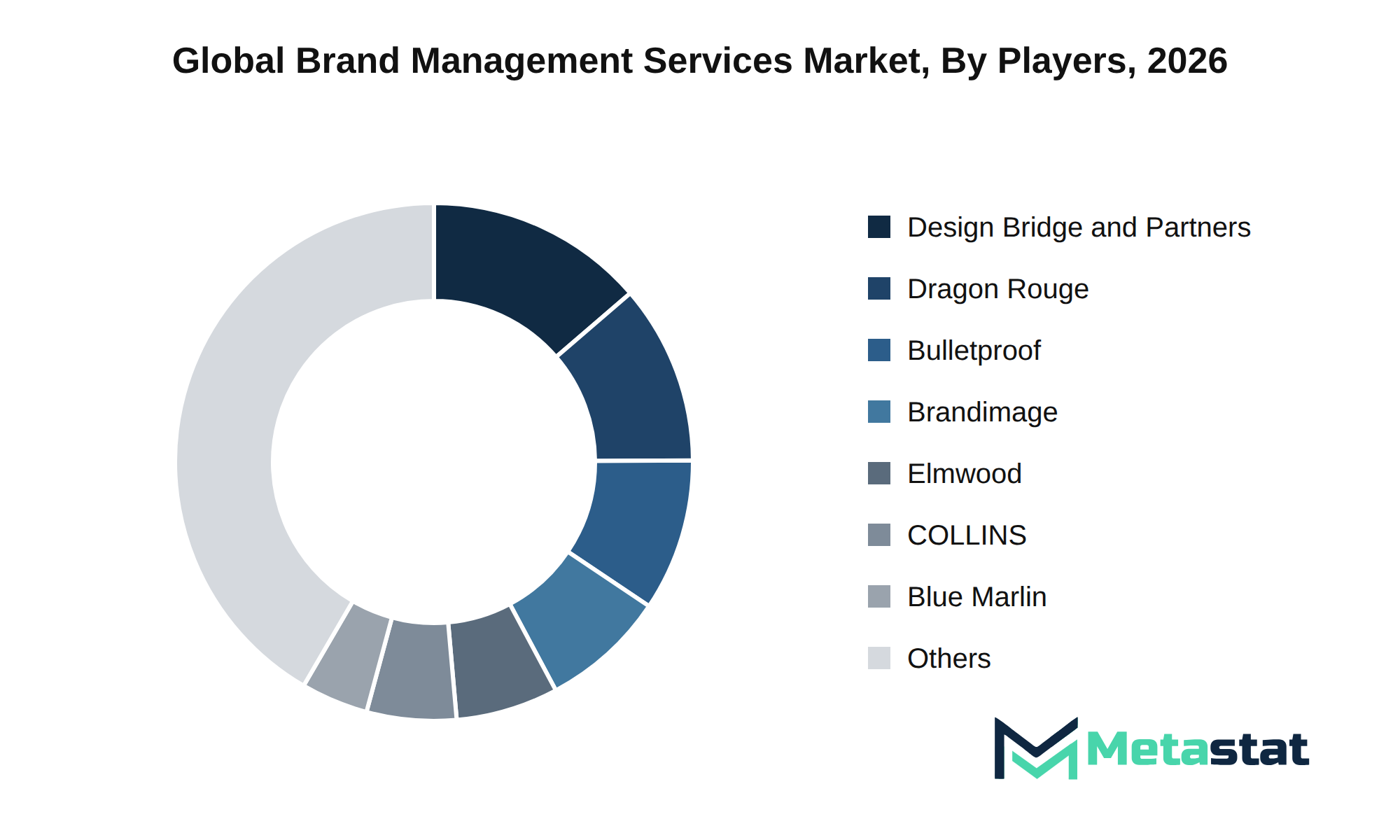
The Brand Management Services market features a diverse field of global consultancies and creative agencies seeking to differentiate through service breadth, sector specialization, and engagement flexibility. Firms address buyer requirements for brand strategy, identity development, design, and activation, with competition centering on capabilities for tailored solutions, ongoing advisory support, and multi-market execution. Clients select providers based on demonstrated expertise in complex rebranding projects, integrated service portfolios, and the ability to deliver measurable business impact at scale.
Leading firms including Landor, Interbrand, and Siegel+Gale emphasize comprehensive brand transformation strategies, serving large enterprises with complex portfolio needs. Others, including Blue Marlin and Pearlfisher, distinguish themselves through award-winning creative design and a focus on brand identity and packaging innovation. Agencies including Prophet and Dragon Rouge have expanded advisory services to cover digital experience, employee engagement, and measurement, responding to demand for full-lifecycle brand management. Buyers in this market frequently weigh provider track record, sector familiarity, and the flexibility of engagement models, including project-based versus retainer-based contracts, when awarding mandates.
Achieving this level of expansion will depend on sustained investment by large enterprises and the continued acceleration of retainer-based and performance-based engagement models. The large enterprise segment is projected to increase from USD 12.4 billion in 2026 to USD 20.7 billion in 2033, reflecting strong adoption of comprehensive branding solutions that integrate strategy, identity, and ongoing measurement. In parallel, growth in retainer-based and performance/outcome-based engagements, supported by a 9.6% CAGR for the latter, is expected to strengthen recurring revenue and deepen client relationships, particularly in North America and Europe where brand maturity is high.
However, a key risk to the outlook arises from budget constraints among small and medium enterprises, which face rising costs for advanced brand solutions. If these organizations slow adoption, growth in regions including Asia Pacific could lag, reducing total market expansion below the projected 8.4% CAGR. The forecast anticipates continued digital transformation and demand for strategic brand oversight, but pressure on smaller organizations could temper the projected gains if economic or competitive headwinds intensify.
By Service Type: Brand Strategy & Positioning, Brand Architecture & Portfolio Strategy, Brand Identity & Design, Naming & Verbal Branding, Brand Research & Insights, Brand Activation & Implementation, Brand Governance & Management, Brand Measurement & Valuation, Internal Brand & Employee Engagement
By Engagement Model: Project-Based Engagements, Retainer-Based Engagements, Managed Brand Services, Performance/Outcome-Based Engagements
By Organization Size: Large Enterprises, Small & Medium Enterprises
By End-Use Industry: BFSI, Consumer Goods, Retail & E-commerce, Technology & Telecommunications, Healthcare & Life Sciences, Automotive & Mobility, Travel, Hospitality & Leisure, Media & Entertainment, Industrial, Energy & Utilities, Others (Public Sector, Education, Nonprofit Organizations)
The report strategically identifies and profiles the key market players and analyses their core competencies in each sub-segment of the Brand Management Services market.
|
Report Attributes |
Details |
|
Study Period |
2021-2033 |
|
Base Year |
2025 |
|
Estimated Year |
2026 |
|
Forecast Period |
2026-2033 |
|
Historical Period |
2021-2025 |
|
Growth Rate |
CAGR 8.4% from 2026 to 2033 |
|
Revenue Unit |
USD billion |
|
Segmentation |
|
|
By Region |
North America (By Service Type, Engagement Model, Organization Size, End-Use Industry, and Country)
|
|
|
|
Asia Pacific (By Service Type, Engagement Model, Organization Size, End-Use Industry, and Country)
|
|
|
|
|
Middle East and Africa (By Service Type, Engagement Model, Organization Size, End-Use Industry, and Country)
|
Find answers to common questions about this report
The market size was valued at USD 17.2 billion in 2025. This figure is based on findings from the Metastat Insights study.
The projected CAGR is 8.4% for the forecast period from 2026 to 2033.
By 2033, the North America market is estimated to reach USD 11.4 billion.
Brand Strategy & Positioning leads by value among service types, reaching USD 5.6 billion in 2033, the highest figure provided for any type segment.
Organizations are increasing the frequency of rebranding and repositioning initiatives to address shifting consumer expectations and rising competitive intensity. Shorter product life cycles and evolving digital touchpoints require brands to refresh assets and strategies more often, supporting higher demand for brand management services.
North America holds the dominant share with 37.2 percent of global revenue. This region leads on the basis of its share compared to other regions.
High cost structures restrict access to specialized brand management services for small and medium enterprises, limiting market penetration within this segment. Sustained talent shortages and rising labor expenses challenge providers’ profitability and constrain their ability to scale high-quality offerings.
Performance and outcome-based engagement models are supporting product adoption, as clients increasingly favor contracts that link compensation to measurable brand results. Providers delivering advanced analytics and real-time measurement attract organizations seeking greater accountability and return on investment.
The Brand Management Services market is estimated to reach a valuation of USD 32.8 billion by 2033.
Leading players in the sector include Interbrand, Landor, Siegel+Gale, Prophet, FutureBrand, Pentagram, Blue Marlin, and Dragon Rouge.
The analysts below cover Professional Services research at Metastat Insights.
LEAD ANALYST
Utkarsh Khirodkar is a Lead Market Research Analyst at MetaStat Insight, specializing in market intelligence, technology sector assessments, and competitive strategy.

PRINCIPAL CONSULTANT - ENTERPRISE AI & EMERGING TECHNOLOGIES
Banking & Finance · Electronics and Semiconductor · Energy and Power · Healthcare IT · Information & Technology · Professional Services
Vijay Gunti is a Principal Consultant at MetaStat Insight, bringing over two decades of experience across enterprise digital transformation, technology strategy, and intelligent systems.

PRINCIPAL CONSULTANT - QUALITY SYSTEMS & COMPLIANCE
Electronics and Semiconductor · Machinery & Equipment · Professional Services
Omkar Phadtare is an Industry Consultant at MetaStat Insight, specializing in quality systems, regulatory compliance, and standards benchmarking to drive data-driven market intelligence and strategic industry research.

LEAD CONSULTANT - COMMUNICATION, TELECOM, AND IT
Electronics and Semiconductor · Information & Technology · Machinery & Equipment · Professional Services
Ravindra Sathe Consultants for Communication, Telecom, and IT at MetaStat Insight. He leads the firm's industry research initiatives across telecommunications infrastructure, digital connectivity, enterprise networking, and emerging information technology domains.
Assessing commercial microgrid software adoption requires looking past top-level installation numbers and examining utility interconnection queues. The research provided verifiable data on average permitting timelines, tariff structures, and battery storage integration costs across regional utility territories. That grounded perspective was valuable for our team when building five-year demand projections for industrial microgrid controllers.
Ambulatory surgical centers have very different purchasing cycles for robotic-assisted surgery platforms than major hospital networks. The MetaStat Insight study focused squarely on capital expenditure depreciation, procedural reimbursement pathways, and surgeon training overhead. That operational clarity made it much simpler to validate multi-year procedure growth forecasts against actual ambulatory center adoption patterns.
When planning edge sensor rollouts across refinery environments, generic IoT reports typically miss the harsh-environment certification bottlenecks. MetaStat Insight gave an objective evaluation of ATEX and Class 1 Division 2 hardware availability, along with realistic five-year maintenance cycle cost projections. The comparison of wireless mesh versus private cellular backhaul helped our team pressure-test network reliability models for remote processing facilities.
Explore related market intelligence reports worth reading alongside this one.
Starting from
$2950