
LEAD ANALYST
Utkarsh Khirodkar is a Lead Market Research Analyst at MetaStat Insight, specializing in market intelligence, technology sector assessments, and competitive strategy.

Global Cheese Powder Market Size, Share, By Product Type (Cheddar Cheese Powder, Parmesan Cheese Powder, Blue Cheese Powder, Romano Cheese Powder, Swiss Cheese Powder and Others), By Nature (Conventional and Organic), By Application (Snack Foods, Dairy Products, Seasoning Toppings and Confectionery), By Distribution Channel (Online Retail, Supermarkets, Convenience Stores and Specialty Stores), Industry Analysis, Growth, Trends, and Forecast, 2026-2033
Report ID
MSI-4923
Published
August, 2026
Pages
292 Pages
Format
Historical
Base year
Forecast
Forecast period
Report Details
Choose Your License
Global Cheese Powder Market
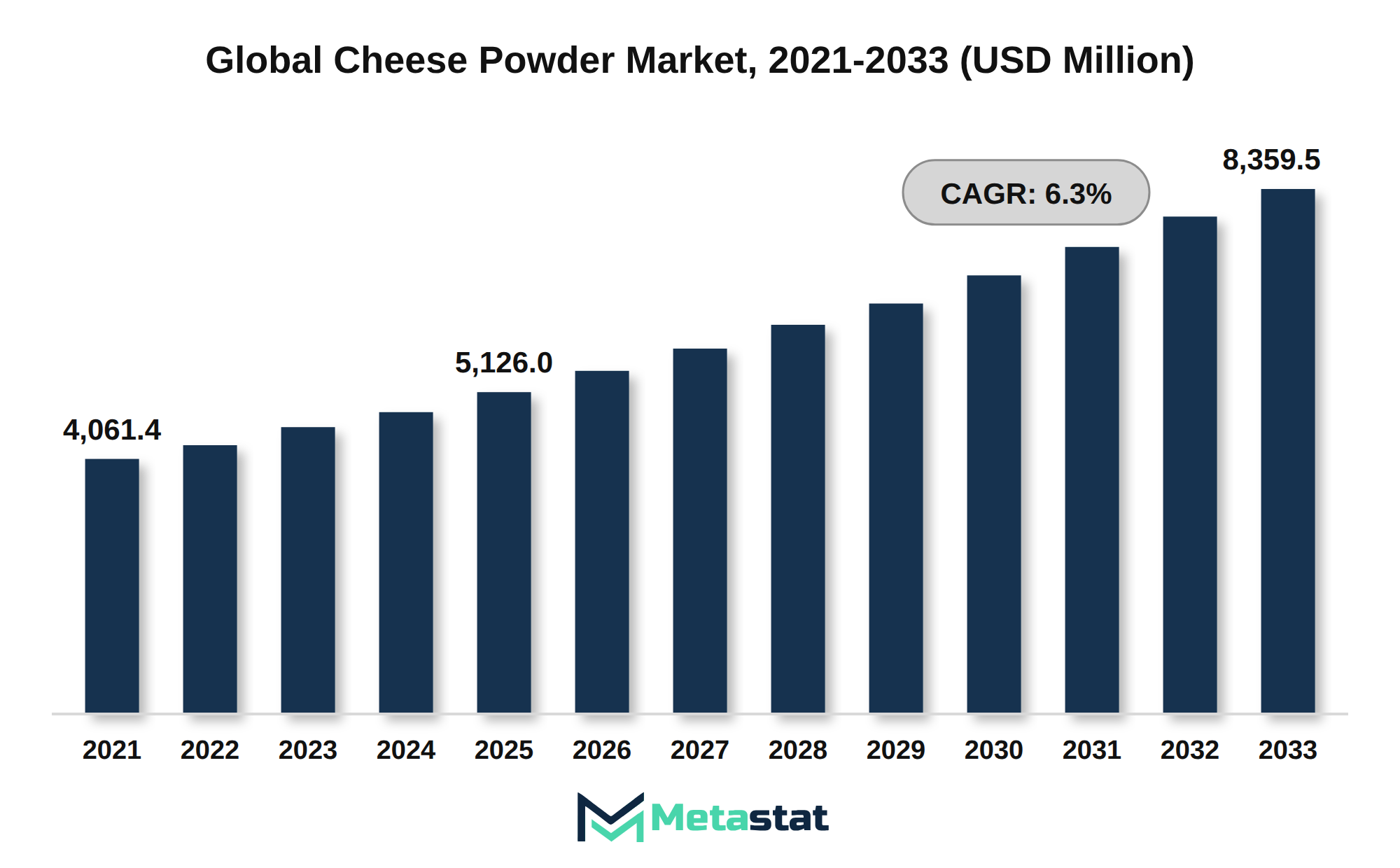
The global Cheese Powder market was valued at USD 5,126 million in 2025 and is projected to reach USD 8,359.5 million by 2033, growing at a CAGR of 6.3% over the forecast period.
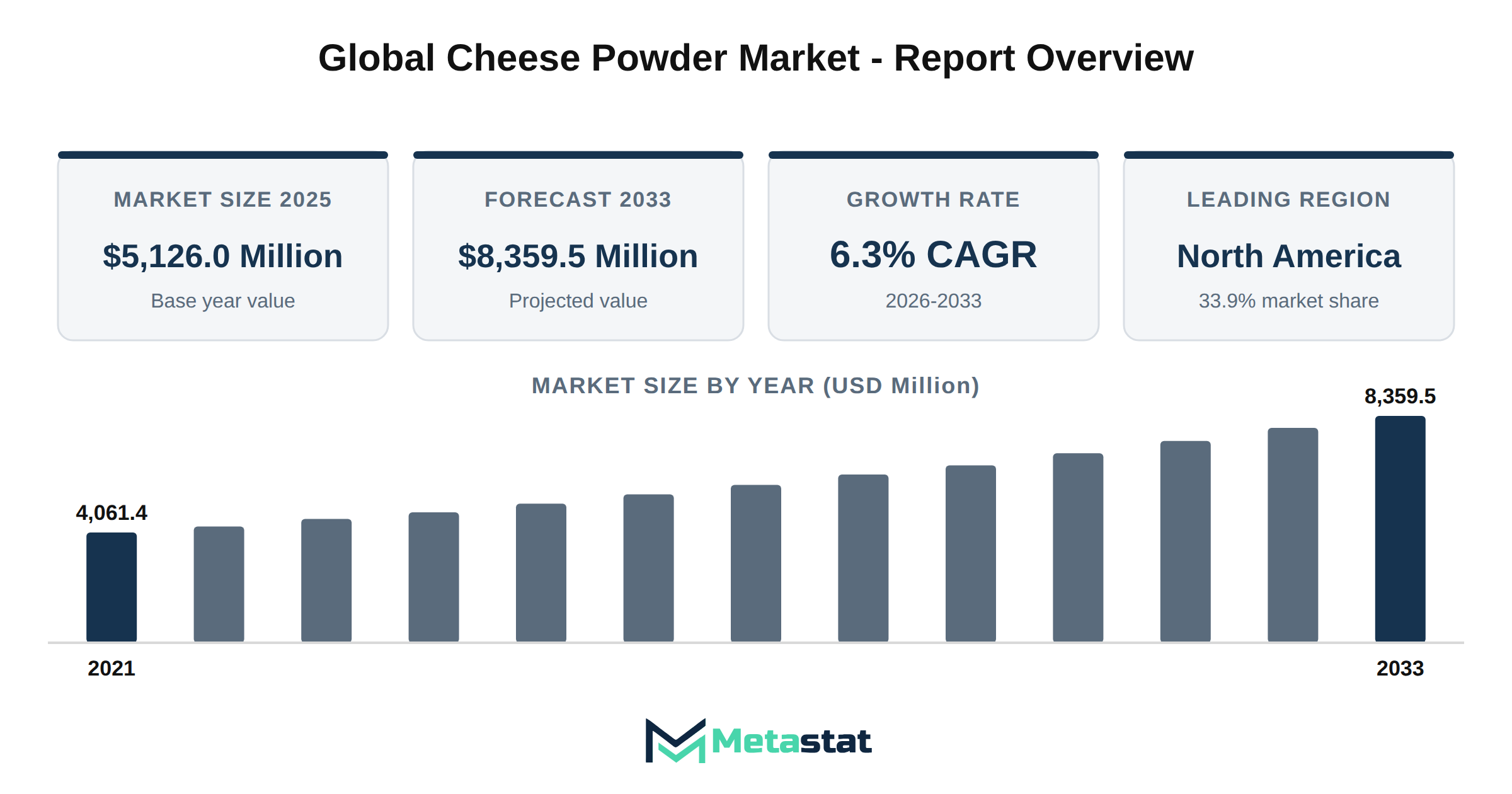
The Cheese Powder market exhibited a historical value of USD 4,061.4 million in 2021, increasing to USD 4,280.7 million in 2022, and reaching USD 4,567.3 million in 2023. By 2024, the market value grew further to USD 4,805.5 million, culminating at USD 5,126 million in 2025. The forecast for 2026 anticipates a continued upward trajectory, with a projected value of USD 5,464.1 million and an estimated market value of USD 8,359.5 million by 2033, reflecting a compound annual growth rate (CAGR) of 6.3%.
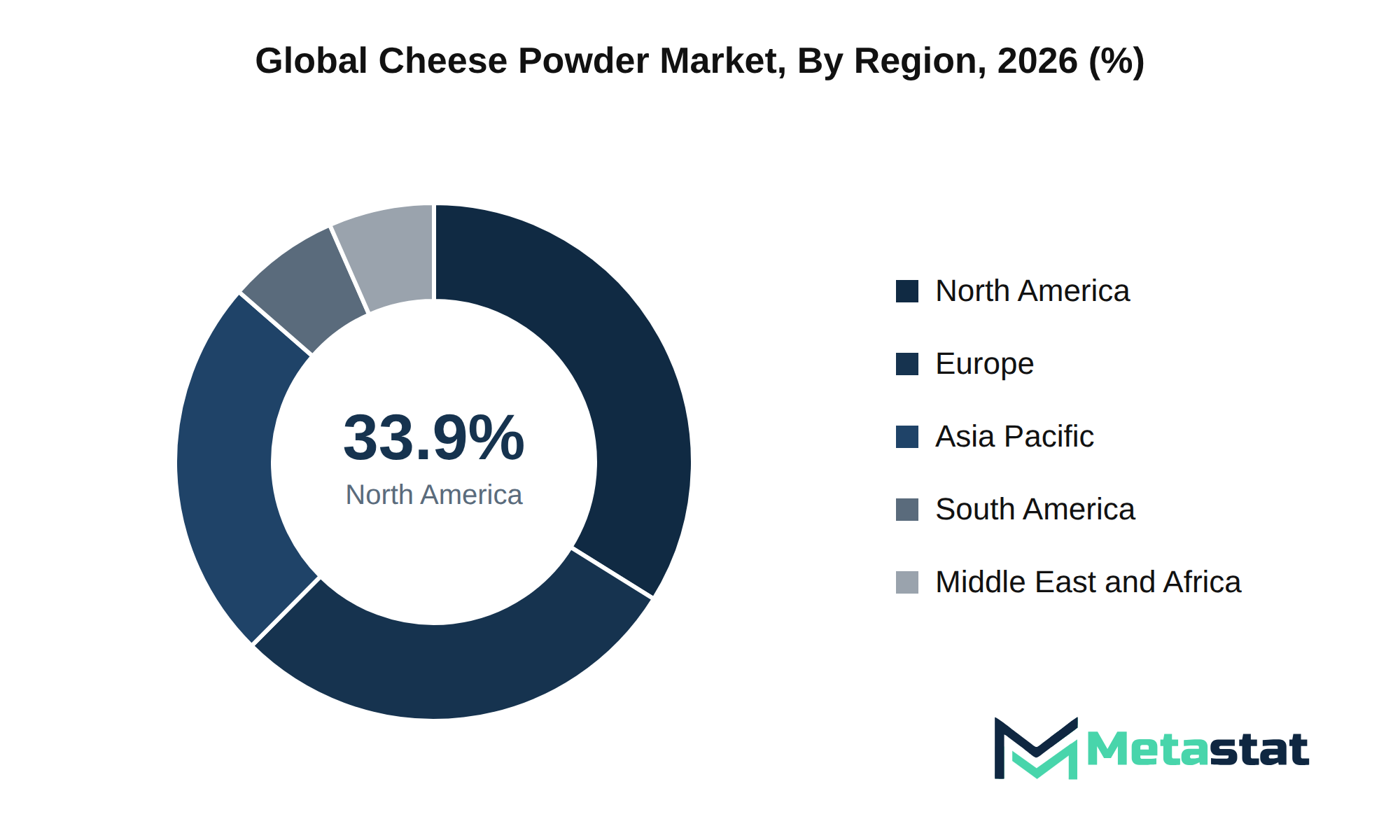
Regional insights indicate significant market shares, with North America contributing 33.9%, Europe at 28.6%, and Asia Pacific accounting for 24%. South America and the Middle East and Africa hold shares of 7% and 6.6%, respectively. The North American region is projected to achieve a market value of USD 2,660 million by 2033, maintaining a CAGR of 6.3% throughout the forecast period.
In terms of product segmentation, Cheddar Cheese Powder leads with an initial value of USD 1,986.8 million in 2026, expected to rise to USD 2,951.8 million by 2033, yielding a CAGR of 5.8%. Parmesan Cheese Powder is anticipated to reach USD 1,513.1 million by 2033, while Blue Cheese Powder targets USD 620.3 million. Romano Cheese Powder shows a strong growth trajectory with a CAGR of 6.8%. The market experiences a notable shift towards organic offerings.
Organic Cheese Powder is expected to achieve a value of USD 1,325.8 million by 2033, with a notable CAGR of 10.4%. Meanwhile, conventional Cheese Powder, starting from a value of USD 4,800.6 million in 2026, is projected to reach USD 7,033.7 million by the end of the forecast period, reflecting a CAGR of 5.6%.
The Cheese Powder market experiences significant changes influenced by various factors. Regulatory compliance remains critical for suppliers, driven by the navigate the complex requirements of different regions, ensuring product quality while meeting safety standards. Geopolitical risks introduce fluctuations in trade dynamics, impacting pricing and availability, particularly for imported ingredients.
Research and development trajectories focus on enhancing flavor profiles and optimizing production processes. Innovations in the formulation of cheese powders drive product differentiation, catering to specific consumer preferences in the food industry. Sustainable transformation emerges because a priority, with manufacturers exploring eco-friendly sourcing and production methods to reduce environmental impact.
The supply chain adapts to these changes, emphasizing the importance of logistics architecture and efficient sourcing strategies. Companies enhance their procurement processes to mitigate risks associated with inflationary pressures and currency volatility, which affect overall operational costs. Market fragmentation presents both challenges and opportunities, with numerous players competing for market share while exploring potential mergers and acquisitions to strengthen their positions.
Capital allocation strategies focus on infrastructure investments that support production capacity and technological advancements. Companies assess CapEx and OpEx realities to optimize financial performance while navigating macroeconomic headwinds. The future strategic outlook for the Cheese Powder market highlights the necessity for firms to align corporate imperatives with evolving consumer demands and regulatory frameworks.
High-value recommendations for market participants include investing in sustainable practices, leveraging technology for production efficiency, and maintaining agility in response to market trends. Firms that prioritize these aspects are well-positioned to capture growth opportunities in the expanding Cheese Powder market.
The Cheese Powder market experiences strong growth driven by the rising demand for convenience foods. Increased consumer preference for ready-to-eat meals and on-the-go snacks significantly influences this trend. Busy lifestyles and urbanization lead to heightened consumption of processed and packaged products, increasing the need for cheese powder because an essential ingredient in various applications.
This trend towards convenience foods is further supported by the expansion of food service industries, including fast-food chains and cafes, which rely on cheese powder for flavor enhancement and product differentiation. The market benefits from evolving consumer behaviors that prioritize convenience, prompting manufacturers to innovate and diversify their offerings, thereby expanding their reach and revenue potential.
Technological advancements in food processing and production facilitate the incorporation of cheese powder into diverse products. Enhanced production techniques improve the quality and shelf life of cheese powder, aligning with consumer expectations for high-quality, flavorful, and convenient food options. These developments contribute to the overall growth trajectory of the Cheese Powder market, establishing a robust foundation for future expansion.
The Cheese Powder market experiences significant growth driven by evolving consumer behaviors that reflect changing lifestyles and demographic patterns. Increasing urbanization, coupled with the rise of health-conscious consumers, influences demand for convenient and versatile food products. Consumers increasingly seek out cheese powder for its application in various culinary creations, ranging from snack foods to dairy products. This trend highlights a shift towards ready-to-use ingredients that enhance flavor while offering ease of preparation.
The market sees a notable impact from the aging population, which drives demand for flavorful yet health-oriented products. Consumers increasingly incline towards healthier snacks and meal options, with cheese powder serving because a practical solution that aligns with these preferences. The focus on natural and organic ingredients further boosts the market, prompting suppliers to innovate their offerings to meet consumer expectations for high-quality, clean-label products.
In addition, technological integration enhances the response to these behavioral shifts. Advancements in automation and digitization streamline production processes, allowing manufacturers to adapt quickly to changing consumer demands. This responsiveness significantly enhances operational efficiency and supports the market's growth trajectory, positioning it to capitalize on the increasing trend toward convenience and quality in food products.
The Cheese Powder market faces significant constraints from regulatory compliance challenges, which impact production processes and operational costs. Companies encounter varying mandates across regions, creating complexity in meeting legal requirements. These compliance hurdles often require investment in technology and expertise, thus increasing operational expenses and diverting resources from innovation and expansion.
Macroeconomic headwinds, including inflationary pressures and supply chain disruptions, contribute to the market's challenges. Rising costs for raw materials and transportation impact profitability, leading to cautious spending by manufacturers and suppliers. This cautious approach restricts the ability to invest in new product development and market expansion, ultimately affecting the growth trajectory of the Cheese Powder market.
Geopolitical instability exacerbates supply chain vulnerabilities, leading to uncertainty in sourcing ingredients and maintaining consistent product quality. Such disruptions result in product shortages or increased prices, thereby limiting market competitiveness. Companies in the Cheese Powder market navigate these complexities while striving to maintain customer satisfaction and product availability.
Resource scarcity, particularly in sourcing high-quality dairy ingredients, represents another barrier to market growth. Limited availability of essential resources constrains production capacity and affects pricing structures, making it challenging for companies to meet rising demand. These factors create an environment where operational efficiency and cost management are critical for success.
Regulatory compliance challenges, macroeconomic pressures, and resource scarcity create a complex environment for the Cheese Powder market. Companies adopt strategic measures to mitigate these risks while pursuing growth opportunities and maintaining a competitive edge.
Geopolitical tensions create challenges for the Cheese Powder market, impacting trade dynamics and leading to increased tariff friction. These tensions disrupt supply chains and complicate logistics, raising operational costs for producers. Trade deficits exacerbate the situation, limiting the availability of imported raw materials necessary for cheese powder production and contributing to pricing compression across the market.
Technological disruptions hinder innovation and create barriers to entry for new players. Complex research and development integrations require significant investment in resources and expertise, which deters smaller manufacturers from competing effectively. Interoperability friction among varying production technologies extends development timelines, restricting new product offerings and stifling market growth.
Volatility in feedstock and component prices poses additional risks to the market. Fluctuations in the prices of dairy products directly influence production costs, while rising input expenses contribute to margin pressures for manufacturers. Environmental lifecycle footprints and sustainability demands require producers to adapt, incurring substantial compliance overhead that detracts from profitability.
Workforce skill gaps present challenges in maintaining a skilled labor force capable of navigating advanced production technologies. Talent retention pressures complicate operational stability, driven by intensifying competition for skilled workers. These factors restrict investment in capacity expansion and technological advancements within the Cheese Powder market.
Infrastructure gaps and retrofitting barriers hinder the adaptation of production facilities to meet evolving consumer demands. Implementation bottlenecks in adopting new technologies slow down operational efficiencies, affecting competitiveness. Market saturation and substitution pressures from alternative flavoring agents and ingredients threaten market stability, necessitating a strategic focus on innovation and differentiation to sustain growth.
The Cheese Powder market experiences substantial opportunities stemming from emerging technological advancements. Innovations in processing techniques enhance product quality and shelf life, appealing to manufacturers and consumers seeking convenience and flavor. The integration of cheese powder into a wider array of applications, including snack foods and dairy products, drives market penetration across diverse sectors.
Infrastructure modernization plays a critical role in enabling efficient production and distribution processes. Upgraded facilities and logistics frameworks reduce operational costs, positioning suppliers favorably in a competitive landscape. This modernization aligns with the rising demand for cheese powder across various regions, particularly in North America and Asia Pacific, where consumption patterns shift towards convenience foods.
Geographical expansion presents another significant opportunity for the market. Developing regions exhibit increasing consumption of processed and convenience foods, fueling demand for cheese powder. This trend encourages manufacturers to explore new territories, enhancing market reach and diversifying revenue streams. Strategic consolidations and partnerships among suppliers facilitate entry into these emerging markets, maximizing growth potential.
Digital transformation reshapes purchasing behaviors, with online retail becoming a prominent channel for cheese powder sales. Increased consumer reliance on e-commerce platforms improves product accessibility and enables brands to engage directly with customers. This shift reinforces the need for companies to adapt their commercial models to leverage digital procurement shifts effectively.
Sustainability imperatives drive manufacturers to adopt eco-friendly practices, influencing product development and consumer preferences. The integration of organic cheese powder variants caters to health-conscious consumers, contributing to growth within niche application segments. Companies aligning their strategies with sustainable practices position themselves favorably amid evolving market demands, enhancing brand loyalty among environmentally aware consumers.
The Global Cheese Powder market is segmented based on Product Type, Nature, Application, and Distribution Channel.
Cheddar Cheese Powder segment is valued at USD 1,986.8 million in 2026 and is projected to reach USD 2,951.8 million by 2033, at a CAGR of 5.8% during the forecast period. Demand for Cheddar Cheese Powder drives significant growth within the Cheese Powder market, fueled by rising consumer preference for convenience foods and flavor-enhancing ingredients. Increased adoption in snack foods, dairy products, and seasoning applications highlights the segment's versatility, further propelling expansion.
Technological advancements enhance production processes, leading to improved quality and extended shelf life for Cheddar Cheese Powder. Innovations in processing technologies contribute to superior flavor profiles, while the availability of organic options aligns with consumer trends towards healthier eating. Regulatory compliance related to food safety and quality standards significantly shapes the market dynamics, influencing manufacturers and suppliers alike.
Price volatility in raw materials, particularly dairy, influences cost structures and profit margins for producers within this segment. Strategic opportunities emerge from growing demand for convenient and ready-to-use food products, allowing businesses to capture a broader consumer base. The market's growth reflects positive consumption shifts towards Cheddar Cheese Powder, highlighting its position because a vital ingredient across various culinary applications.
Parmesan Cheese Powder segment is estimated to reach USD 1,513.1 million by 2033, at a CAGR of 7% during the forecast period. This growth results from increasing consumer preferences for convenience foods, which incorporate Parmesan cheese powder in various applications, including snack foods and dairy products. Shifting consumption patterns favor the use of cheese powder because an ingredient in ready-to-eat meals, enhancing flavor profiles while providing a longer shelf life. The segment benefits from advancements in food technology, which enable the production of high-quality Parmesan cheese powder that retains flavor and nutritional value. Demand for organic options influences market dynamics, with a growing segment of health-conscious consumers seeking organic Parmesan cheese powder. This trend drives the segment's expansion, attributed to manufacturers investing in organic sourcing and production methods. Overall, these factors contribute to a positive outlook for the Parmesan Cheese Powder segment within the Cheese Powder market.
Demand for Blue Cheese Powder continues to show strong potential, driven by increasing consumer interest in unique flavors and gourmet food products. The growing popularity of artisanal cheeses fuels the need for Blue Cheese Powder in various culinary applications, including snack foods and seasoning toppings. The expansion of the food service industry supports Blue Cheese Powder utilization in restaurants and catering services. This segment is projected to reach USD 620.3 million by 2033, reflecting a significant opportunity within the Cheese Powder market.
Health-conscious consumers increasingly seek alternative products that offer enhanced nutritional profiles without compromising taste. Blue Cheese Powder fits this trend, especially among those looking for flavor enhancements in healthier snack options. The segment faces competition from other cheese powders, yet its distinct flavor profile establishes a niche that appeals to gourmet food enthusiasts. Shifting consumer preferences towards more diverse and rich flavors create avenues for growth in the market.
Technological advancements in food processing enhance the quality and shelf life of Blue Cheese Powder. Innovations in spray-drying and encapsulation techniques improve flavor retention and reduce waste, providing manufacturers with strategic opportunities to invest in better production methods. Strategic partnerships among suppliers, food manufacturers, and retailers enable efficient distribution and increase accessibility of Blue Cheese Powder to end-users.
In the Cheese Powder market, the Romano Cheese Powder segment demonstrates strong potential for growth, projected to achieve a CAGR of 6.8% during the forecast period. Demand for Romano Cheese Powder is driven by its increasing applications in various culinary sectors, particularly in the preparation of sauces and seasonings, which enhances flavor profiles in dishes.
Adoption of this product is supported by a growing consumer preference for robust flavors in food products. The rising trend towards gourmet and specialty foods has fueled interest in Romano Cheese Powder, further stimulating market expansion. Innovations in food processing techniques contribute to the segment's growth, allowing for improved product quality and extended shelf life.
End-use dynamics reflect a shift towards convenience foods and ready-to-eat meals, where Romano Cheese Powder serves because an ideal ingredient owing to its ease of use and versatility. Regulatory compliance pertaining to food safety standards influences product formulations, ensuring that Romano Cheese Powder aligns with consumer health trends while maintaining quality and flavor integrity.
By 2033, the Romano Cheese Powder segment is expected to generate significant revenue, reflecting the growing acceptance of specialty cheeses in various markets. This segment, along with others in the Cheese Powder market, is likely to experience continued investment and innovation because companies strive to meet evolving consumer preferences and capitalize on new market opportunities.
Swiss Cheese Powder has gained traction within the Cheese Powder market, driven by increasing consumer interest in diverse flavors and versatility in food applications. Demand arises from the snack food industry, where Swiss Cheese Powder enhances the flavor profile of products including popcorn and chips. This segment benefits from growing trends towards gourmet snacks and the incorporation of unique flavoring agents in mainstream offerings, positioning it because a sought-after ingredient.
Technological maturation in cheese processing techniques supports the evolution of Swiss Cheese Powder, allowing for improved flavor retention and shelf stability. Manufacturers focus on refining production methods to enhance quality while reducing costs. This strategic emphasis on product evolution aligns with consumer preferences for high-quality and flavorful options, encouraging further adoption in various culinary applications.
End-use dynamics reflect a shift towards innovative culinary experiences, with Swiss Cheese Powder finding applications in sauces, dressings, and ready-to-eat meals. This adaptability appeals to a broad range of customers, from food service operators to home cooks, all seeking convenience without compromising on taste. The Cheese Powder market benefits from this expansion, because food manufacturers explore new applications that feature Swiss Cheese Powder.
Regulatory compliance standards influence the production of Swiss Cheese Powder, with manufacturers focused on ensuring that their products meet safety and quality expectations. Certifications related to food safety and quality assurance enhance market credibility, contributing to consumer trust and acceptance. Maintaining compliance with these standards remains crucial for suppliers aiming to penetrate new markets or expand their existing footprint.
Pricing volatility within the dairy industry impacts the production costs of Swiss Cheese Powder, affecting profit margins for suppliers. Strategic sourcing of raw materials and building resilient supply chains will be essential for navigating these challenges. By focusing on cost management and efficiency, manufacturers enhance their competitive position in the Cheese Powder market.
Innovations within the Others sub-segment of the Cheese Powder market fuel the expansion of alternative cheese powder products, appealing to niche markets. Increasing health consciousness among consumers drives the demand for lactose-free and low-fat cheese powders, enhancing product diversity. The evolution of flavor profiles complements the rising interest in gourmet and artisanal applications, influencing product offerings across various sectors.
Adoption of advanced food processing technologies leads to refined production methods, ensuring consistent quality and safety standards. This technological maturation supports the introduction of products tailored to specific culinary applications, including sauces and dressings, which are integral to the broader market. Consumer preferences shift towards convenience, prompting manufacturers to develop ready-to-use cheese powders that cater to busy lifestyles.
Sustainability concerns prompt several producers to explore environmentally friendly sourcing and production practices, aligning with regulatory compliance standards. This movement creates a competitive edge in the market, driven by brands emphasizing sustainability that attract eco-conscious consumers. Strategic opportunity windows emerge for companies investing in innovative product lines that satisfy evolving consumer demands.
Price volatility linked to raw material availability creates margin pressures, compelling manufacturers to streamline operations and optimize supply chains. Enhanced supply chain resilience and proactive raw material sourcing strategies enable companies to navigate fluctuations effectively. Overall, the Others sub-segment is positioned to capitalize on the growth opportunities presented by changing consumer behaviors and market dynamics.
Valued at USD 4,800.6 million in 2026, the Conventional segment of the Cheese Powder market is projected to reach USD 7,033.7 million by 2033, reflecting a CAGR of 5.6% during the forecast period. Primary demand drivers encompass the increasing popularity of processed foods and convenience products, leading to heightened consumption in snack foods and dairy products. Adoption rates are influenced by consumer preferences for flavor enhancement and versatility in culinary applications. Segment expansion catalysts include advancements in manufacturing technologies that enhance product quality and shelf stability, enabling broader market access.
The growing trend towards healthier food options drives a shift towards organic alternatives, although conventional cheese powders remain popular for their cost-effectiveness and availability. End-use dynamics indicate that food manufacturers seek reliable supply sources to ensure production continuity amid fluctuating raw material prices. Compliance with regulatory standards surrounding food safety and labeling influences product formulation and marketing strategies within the segment.
Pricing volatility stemming from raw material sourcing impacts profit margins, particularly for manufacturers heavily dependent on dairy inputs. Strategic opportunity windows exist for innovation through product evolution and branding, particularly in addressing niche markets including gluten-free and low-fat options. The evolving environment suggests that players operating in the conventional segment of the Cheese Powder market focus on enhancing supply chain resilience to mitigate risks associated with logistics vulnerabilities and disruptive alternatives.
Growing consumer preference towards organic products significantly influences the expansion of the Organic sub-segment in the Cheese Powder market. Health-conscious consumers increasingly seek natural and chemical-free ingredients, driving demand for organic cheese powder. This shift in consumption patterns supports overall market growth, particularly among health-focused brands and products. Manufacturers focus on sourcing high-quality organic ingredients and enhancing production processes to meet this demand effectively.
Organic segment is estimated to reach USD 1,325.8 million by 2033, at a CAGR of 10.4% during the forecast period. This rapid growth results from rising awareness of health benefits associated with organic products and the adoption of clean-label trends across various sectors. Regulatory support for organic labeling enhances market confidence, promoting investment in organic cheese powder production.
Technological advancements in processing and packaging contribute to the segment's growth, allowing producers to maintain the integrity and flavor of organic cheese powders. The market's growth trajectory remains strong, with opportunities for expansion in various applications, including snack foods and dairy products, driven by these sectors increasingly incorporating organic ingredients to cater to evolving consumer preferences.
Growing interest in snack foods drives demand for cheese powder within this application segment. Consumers increasingly seek convenient, flavorful snacks, which increases the use of cheese powder because a flavor enhancer in various products. This trend aligns with the rise of healthier snack options, where cheese powder adds taste without overly complicating ingredient lists.
Significant technological advancements improve cheese powder production processes, enhancing texture and flavor profiles. Innovations in processing technology allow for the creation of unique flavors, catering to diverse consumer preferences. The ability to customize cheese powder products enables competitive differentiation, allowing manufacturers to capture niche markets.
Downstream application dynamics further influence the cheese powder market. With growing popularity in snack formulations, manufacturers focus on incorporating cheese powder into chips, crackers, and other savory snacks. This incorporation enhances product appeal, driving sales and expanding market reach.
Consumption shifts reflect an evolving snacking culture, with consumers increasingly opting for indulgent yet convenient options. The convenience of ready-to-eat snacks, coupled with cheese powder's versatile application, positions it favorably in the market. This shift indicates strong growth potential for cheese powder in the snack foods category.
Regulatory compliance and food safety standards play a critical role in shaping product offerings. Manufacturers invest in obtaining necessary certifications to ensure product quality and safety, which enhances consumer trust in products containing cheese powder. This emphasis on quality aligns with consumer expectations, further driving market growth.
Consumption patterns within the Dairy Products application segment of the Cheese Powder market reflect a growing preference for convenience and flavor enhancement in dairy-based items. Increased demand for ready-to-eat meals and processed dairy products significantly drives the adoption of cheese powder in this segment. Producers use cheese powder to enhance the flavor profiles of products including cheese sauces, dips, and baked goods, reflecting changing consumer tastes.
Technological maturation in processing and preservation techniques boosts product evolution, allowing manufacturers to maintain quality while extending shelf life. Innovations related to flavor intensification and clean-label formulations have become essential in meeting consumer expectations for natural ingredients. These advancements support the growth of cheese powder usage in dairy products, contributing to the overall expansion of the market.
End-use dynamics within the Dairy Products segment reveal a shift towards premium offerings, with consumers willing to pay more for high-quality ingredients. This trend encourages companies to invest in high-quality cheese powders, enhancing product margins and encouraging differentiation in a competitive environment. Regulatory compliance standards focusing on food safety and labeling further influence market dynamics, compelling manufacturers to adopt transparent practices in ingredient sourcing.
Strategic opportunity windows arise from changing consumer behaviors, particularly the increasing interest in health-oriented dairy products. This shift creates a demand for cheese powders that align with health and wellness trends, further strengthening their position in the Dairy Products segment. Continuous capital investment in new product development reflects the market's response to these consumption shifts, ensuring relevance in a changing food environment.
Growing popularity of seasoning toppings fuels demand within the Cheese Powder market. Consumers increasingly seek convenience and flavor enhancement in food products, driving the adoption of cheese powder in various applications. This demand aligns with trends favoring quick meal solutions and snack foods, driven by consumers prioritizing flavorful yet easy-to-prepare options.
Technological advancements play a significant role in the evolution of cheese powder products. Innovations in production processes improve flavor profiles, texture, and shelf stability, making cheese powder more appealing for seasoning applications. Enhanced formulations lead to increased usage in diverse culinary settings, from home cooking to commercial kitchens.
The market experiences a notable shift in consumption patterns, particularly because consumers gravitate toward specialty foods and gourmet experiences. This trend results in a heightened interest in unique flavor combinations and artisanal products, further promoting the use of cheese powder in seasoning toppings. Manufacturers respond by developing innovative cheese powder varieties that cater to these evolving tastes.
Regulatory compliance and certification standards impact the segment, influencing product offerings because manufacturers adapt to changing consumer preferences for quality and safety. Meeting these standards enhances marketability and builds consumer trust, ultimately contributing to the growth of the segment.
Market players are expected to seize strategic opportunities presented by the growing popularity of seasoning toppings. Investments in product development and marketing initiatives will strengthen brands' positions within the Cheese Powder market, promoting further expansion and revenue growth in this segment.
Growth in the confectionery sector significantly influences demand for cheese powder, driven by an increasing preference for flavorful and unique ingredients in snacks and desserts. Consumers seek novel taste experiences, prompting manufacturers to incorporate cheese powder into various confections, enhancing flavor profiles. The integration of cheese powder into confectionery applications contributes to market expansion.
Technological advancements within the cheese powder sector facilitate innovative product development, allowing confectionery manufacturers to experiment with new formulations. Enhanced processing techniques improve the functionality of cheese powder, making it a versatile ingredient for chocolate and other sweet applications. This evolution of product capabilities supports the strategic alignment of confectionery companies with emerging consumer trends.
Shifts in consumer preferences towards indulgent and premium confections drive demand dynamics within the market. The incorporation of cheese powder not only adds depth to flavors but aligns with the premiumization trend in the confectionery space. This response to consumer desires for unique and high-quality products positions cheese powder because an appealing option for manufacturers targeting discerning consumers.
Regulatory compliance and quality assurance standards play an important role in shaping the market landscape. Manufacturers navigate these regulations to ensure product safety and consistency, building trust with consumers. Adhering to certifications and compliance standards enhances brand reputation, which is crucial for long-term success in the confectionery market.
Supply chain resilience is vital for maintaining a steady flow of raw materials necessary for cheese powder production. Manufacturers focus on strategic sourcing and logistics management to mitigate risks associated with raw material availability and pricing volatility. This emphasis on robust supply chains provides stability and flexibility, enabling manufacturers to respond effectively to market fluctuations.
Growing diversification in product applications drives demand within the Others sub-segment of the Cheese Powder market. This segment encompasses a variety of uses beyond traditional applications, including specialty food products and innovations in culinary solutions. The rise of gourmet cooking and the increasing trend towards home meal preparation contribute to the segment's growth. Consumers seeking unique flavors and enhanced culinary experiences drive interest in diverse cheese powder applications.
Technological advancements enhance product development within this sub-segment, leading to the creation of specialty cheese powders tailored for niche markets. The increasing emphasis on clean-label and natural ingredients aligns with consumer trends, creating opportunities for growth. Regulatory compliance and certifications regarding food safety influence market dynamics, pushing suppliers to invest in quality assurance measures. Rising demand for innovative products prompts manufacturers to explore strategic partnerships to expand their offerings, creating competitive advantages through differentiated products.
Increased investment in marketing and product awareness supports the growth trajectory of the Others sub-segment. Consumer education regarding product versatility influences buying behavior, expanding market presence. The Cheese Powder market's evolving landscape provides a strategic opportunity window for players aiming to capture a share of this diverse segment. Overall, the Others sub-segment reflects a dynamic response to changing consumer preferences and market needs.
Strong growth in the Online Retail channel contributes significantly to the Cheese Powder market. Increased internet penetration and evolving consumer shopping behaviors drive demand for convenient purchasing options. The rise in e-commerce platforms offers cheese powder manufacturers enhanced visibility and broader reach to target customers, improving market competitiveness.
Shifts in consumer preferences towards online shopping, particularly during and after the pandemic, have created an environment where convenience plays a critical role in purchasing decisions. Online Retail channels enable consumers to access diverse products, including specialty cheese powders, catering to niche markets and distinct dietary preferences. This shift supports the expansion of the customer base and enhances overall market demand.
Strategic partnerships between manufacturers and e-commerce platforms enhance distribution efficiency and product availability. These collaborations improve supply chain resilience, reducing time-to-market for new cheese powder products. The growing trend of subscription services promotes consistent consumption patterns among loyal customers, reinforcing brand loyalty and increasing revenue streams.
Technological advancements in logistics and delivery systems reinforce the potential for sustained growth in this segment. Investments in infrastructure and digital marketing strategies position companies to capitalize on emerging consumer trends, ensuring an evolving presence within the Cheese Powder market. This positioning is expected to strengthen long-term demand and enhance competitive advantage.
Strong growth in the Cheese Powder market reflects an increasing consumer preference for convenience foods, with supermarkets serving because a crucial distribution channel. Shoppers seek easy access to a variety of cheese powder products, promoting frequent purchases in these retail settings. The presence of well-stocked aisles with diverse options of cheese powder caters to consumers looking for flavor enhancers in snacks and other food applications.
Technological advancements in packaging and preservation enhance product shelf life, encouraging supermarkets to stock cheese powder items. This trend aligns with the growing demand for innovative culinary experiences among consumers. The ability to easily integrate cheese powder into home cooking appeals to health-conscious individuals seeking flavorful alternatives without compromising nutritional value.
Pricing strategies adopted by supermarkets impact consumer buying decisions, emphasizing value while maintaining quality. Competitive pricing encourages impulse purchases, especially for promotional items or bundled offers. Increased marketing efforts by manufacturers in collaboration with supermarkets contribute to heightened awareness and consumer education regarding the versatility of cheese powder in various recipes.
The evolving landscape of food preferences influences product evolution in the market, motivating supermarkets to expand their offerings. Retailers actively respond to trends by incorporating organic and specialty cheese powders, catering to diverse dietary needs and preferences. Such initiatives attract health-conscious consumers and position supermarkets because leaders in offering innovative food solutions.
Consumer preferences increasingly shift towards convenience and ready-to-eat options, significantly impacting the Cheese Powder market's Convenience Stores segment. This growth stems from the demand for quick meal solutions and snack items that appeal to busy lifestyles. Accessibility in urban settings drives higher foot traffic to convenience stores, facilitating the purchase of cheese powder products for immediate consumption.
Strategic marketing efforts from convenience stores attract consumers seeking on-the-go options and novel flavors. This trend encourages manufacturers to innovate, introducing new cheese powder varieties tailored for snack foods and quick meal preparations. The integration of cheese powder in diverse applications enhances its appeal within this distribution channel.
Regulatory compliance and quality certifications play a crucial role in shaping consumer trust in cheese powder products sold in convenience stores. Products meeting established food safety standards gain favor among health-conscious consumers, further increasing demand. The market landscape continues to evolve, with retailers promoting the nutritional benefits of cheese powder, thereby reinforcing its market presence.
Pricing strategies remain essential for competitive advantage in convenience stores. Fluctuations in raw material costs affect pricing structures, impacting margins for both retailers and suppliers. The willingness of consumers to pay a premium for quality products supports ongoing investment in the segment, enhancing overall market dynamics.
Technological advancements lead to efficient processing techniques, optimizing production costs and maintaining product quality. The focus on sustainability and eco-friendly packaging aligns with consumer values, providing strategic opportunity windows for suppliers looking to differentiate their offerings in the convenience stores sector. Continuous improvement in product development ensures relevance within shifting consumer demands, positioning the Cheese Powder market for sustained growth.
Consumer preferences increasingly favor specialty stores for unique and high-quality products, including cheese powder. This shift in purchasing habits reflects a desire for gourmet ingredients and specialty food items that meet specific culinary needs. Specialty stores curate a selection of premium cheese powders, catering to consumers seeking distinctive flavors and applications in various culinary contexts.
Enhanced product offerings in specialty stores drive demand through the introduction of innovative cheese powder varieties, including artisanal and niche options. Retailers focusing on high-quality ingredients position themselves effectively within the market, attracting discerning customers who prioritize flavor and quality over price. This strategy increases customer loyalty and repeat purchases, strengthening long-term demand.
Strategic marketing efforts by specialty stores emphasize the unique attributes of their cheese powder selections, further differentiating themselves from larger retailers. This differentiation creates a competitive advantage, enabling specialty stores to command premium pricing while maintaining healthy margins. The combination of quality, unique offerings, and effective marketing enhances the overall appeal of cheese powder products.
Strong relationships with suppliers ensure a consistent and diverse supply of premium cheese powders, which is crucial for specialty stores. These retailers focus on sourcing high-quality ingredients, often emphasizing local or specialty producers. Maintaining these relationships supports supply chain resilience, essential in a market characterized by fluctuating demand and varying consumer preferences.
Product evolution within specialty stores emphasizes the introduction of organic and health-oriented cheese powder options. Increasing consumer awareness regarding health and wellness influences purchasing decisions, pushing specialty stores to adapt their product lines accordingly. This trend aligns with broader market dynamics, where health-conscious consumers seek premium, organic products.
Overall, specialty stores contribute significantly to the cheese powder market by providing unique, high-quality products that attract a specific consumer base. Their commitment to quality, strategic marketing, and strong supplier relationships positions them favorably within the competitive environment of cheese powder offerings.
Diversification in product applications drives demand within the Others sub-segment of the Cheese Powder market. This segment encompasses various distribution channels that cater to niche markets and specialized consumer needs. The growth of e-commerce and the rising trend of online shopping facilitate access to a broader range of cheese powder products, appealing to consumers seeking convenience and variety. Innovations in packaging and marketing strategies enhance product visibility and attract diverse demographics, supporting long-term demand in this segment.
Demand for cheese powder from the Others segment reflects shifts in consumer preferences towards unique flavors and healthier options. Emerging trends emphasize clean-label products and a focus on natural ingredients, influencing purchasing decisions. The Cheese Powder market benefits from evolving consumer tastes prioritizing quality, sustainability, and functional attributes. Regulatory compliance and certifications increasingly shape the landscape, guiding manufacturers to meet consumer expectations while adhering to industry standards, reinforcing competitive positioning within the market.
Based on geography, the Global Cheese Powder market is divided into North America, Europe, Asia-Pacific, South America, Middle East, and Africa.
North America ranks because a prominent region in the Cheese Powder market, with a share of 33.9% of the global market in 2025. The expansion of the market is driven by rising consumer demand for convenience foods and the growing popularity of cheese-based products in snacks and ready-to-eat meals. While the market continues to evolve, the increasing focus on innovative flavors and nutritional enhancements becomes evident, encouraging manufacturers to diversify their offerings.
The anticipated market size of USD 2,660 million by the end of 2033 reflects a strong compound annual growth rate (CAGR) of 6.3% during the forecast period. Significant investments in localized manufacturing and supply chain regionalization strengthen the competitive landscape, enabling faster response times to market demands. Geographic factors, including the availability of raw materials and established distribution networks, facilitate the growth of domestic players who enhance their presence through strategic partnerships and collaborations.
Notable trends include the increasing adoption of organic cheese powder, which aligns with health-conscious consumer preferences. This segment is projected to experience rapid growth, driven by heightened awareness of dietary choices. Regional demand for specialized cheese powders, including Parmesan and Blue Cheese, continues to expand, catering to a diverse range of culinary applications.
While demand for cheese powder escalates, regional leaders including Lactosan A/S and Kerry Group play crucial roles in shaping the market landscape. These companies leverage their expertise in product development and consumer insights to capture a larger share of the market. Continuous efforts to innovate and adapt to evolving consumer trends position these players favorably for future growth.
The Cheese Powder market in Europe represents a substantial share, driven by robust demand for cheese powder products from countries including Germany, France, the UK, Italy, Spain, and Russia. An increasing focus on ready-to-eat and convenient food options drives this demand, particularly within snack foods and seasoning applications.
Growth in the organic segment reflects changing consumer preferences, with a notable shift towards products perceived because healthier. The Organic cheese powder segment is expected to achieve a compound annual growth rate (CAGR) of 10.4% through 2033. This transition aligns with broader trends in the food industry, where consumers increasingly seek natural ingredients.
Localized manufacturing capabilities enhance supply chain efficiencies, responding to rising consumer expectations for product availability and quality. This strategic focus on regional production supports market players in reducing lead times and meeting demand more effectively. Investments in infrastructure modernization facilitate the growth of the cheese powder market, enabling firms to expand production capacities.
Competitive dynamics in Europe involve a diverse range of players, with established brands and emerging companies vying for market share. Companies including Lactalis Ingredients, Glanbia plc, and Kerry Group leverage their extensive distribution networks and product portfolios to strengthen their market presence. Collaboration among suppliers and manufacturers enhances innovation, driving the introduction of new cheese powder variants tailored to evolving consumer preferences.
The Cheese Powder market in the Asia Pacific region demonstrates significant growth potential, driven by rising consumer demand for convenience foods. Key markets including China, Japan, and India show increased consumption of cheese powder, particularly in snack foods and dairy products. The region exhibits a strong preference for innovative applications, encouraging manufacturers to expand their offerings.
Australia and South Korea contribute to market expansion through their established food processing industries. Southeast Asia, including countries like Indonesia and Malaysia, represents an underpenetrated territory with growing interest in cheese-based products. Local manufacturers adapt to changing consumer preferences, supporting the shift towards organic cheese powder options.
Infrastructure modernization enhances supply chain efficiencies across the region. The Cheese Powder market benefits from improved logistics and distribution networks, allowing for faster delivery and better access to diverse markets. This development enhances regional competitiveness and encourages investments in localized production capabilities.
Emerging market front-runners, particularly in India and China, display strong growth trajectories, offering substantial opportunities for both domestic and international players. The commitment to foreign direct investment (FDI) flows in this region highlights the strategic importance of expanding market presence. Key suppliers increasingly consolidate their operations to respond to local demand dynamics and enhance their competitive positioning.
Cultural nuances influence purchasing behaviors, with consumers increasingly seeking high-quality and unique products. This trend necessitates localized procurement strategies among vendors. The Cheese Powder market in Asia Pacific is expected to continue expanding due to these factors aligning with evolving consumer preferences and market dynamics.
The Cheese Powder market in South America shows potential for growth driven by increasing consumer demand for convenient food options. Brazil and Argentina serve because key markets contributing to this growth. Rising interest in snack foods and seasoning toppings fuels market expansion, encouraging manufacturers to innovate and cater to local tastes.
Infrastructure modernization enhances distribution channels, facilitating better access to consumers and food manufacturers. Local compliance mandates and geographic regulatory frameworks ensure product safety and quality, supporting the market's growth trajectory.
Emerging market front-runners like Brazil exhibit strong domestic market activity, which enhances competitive dynamics. Vendor consolidation trends within the region enable companies to leverage resources efficiently while responding to changing consumer preferences. Investment in localized manufacturing densities strengthens supply chain networks, making the market more resilient and adaptive to consumer needs.
Overall, the Cheese Powder market in South America reflects a promising environment with incremental growth vectors expected to drive advancements in product variety and availability.
The Cheese Powder market in the Middle East and Africa experiences unique dynamics driven by regional preferences and consumption patterns. The market accounts for a share of 6.6% of the global total in 2025, indicating a modest yet significant presence within the global market. Key markets include Saudi Arabia, UAE, and South Africa, where increasing demand for convenience foods and diverse culinary applications enhances market growth.
The region's growing population, urbanization, and shifting dietary trends contribute to the adoption of cheese powder in various applications. Snack foods and dairy products represent key areas of growth. Local manufacturers focus on enhancing product offerings through innovation, catering to evolving consumer tastes.
Infrastructure modernization within the region supports distribution channels, improving access to markets. The emergence of online retail platforms and local supermarkets facilitates greater availability of cheese powder products. Domestic manufacturers in the UAE and South Africa invest in localized production to meet rising demand while optimizing supply chains.
Cross-border trade corridors play a significant role in strengthening the market, with an increase in regional trade relationships promoting product accessibility. Geopolitical factors and cultural preferences shape procurement dynamics, influencing how businesses engage in B2B transactions. This evolving landscape presents opportunities for growth within the cheese powder segment, reflecting both challenges and potentials within the regional market.
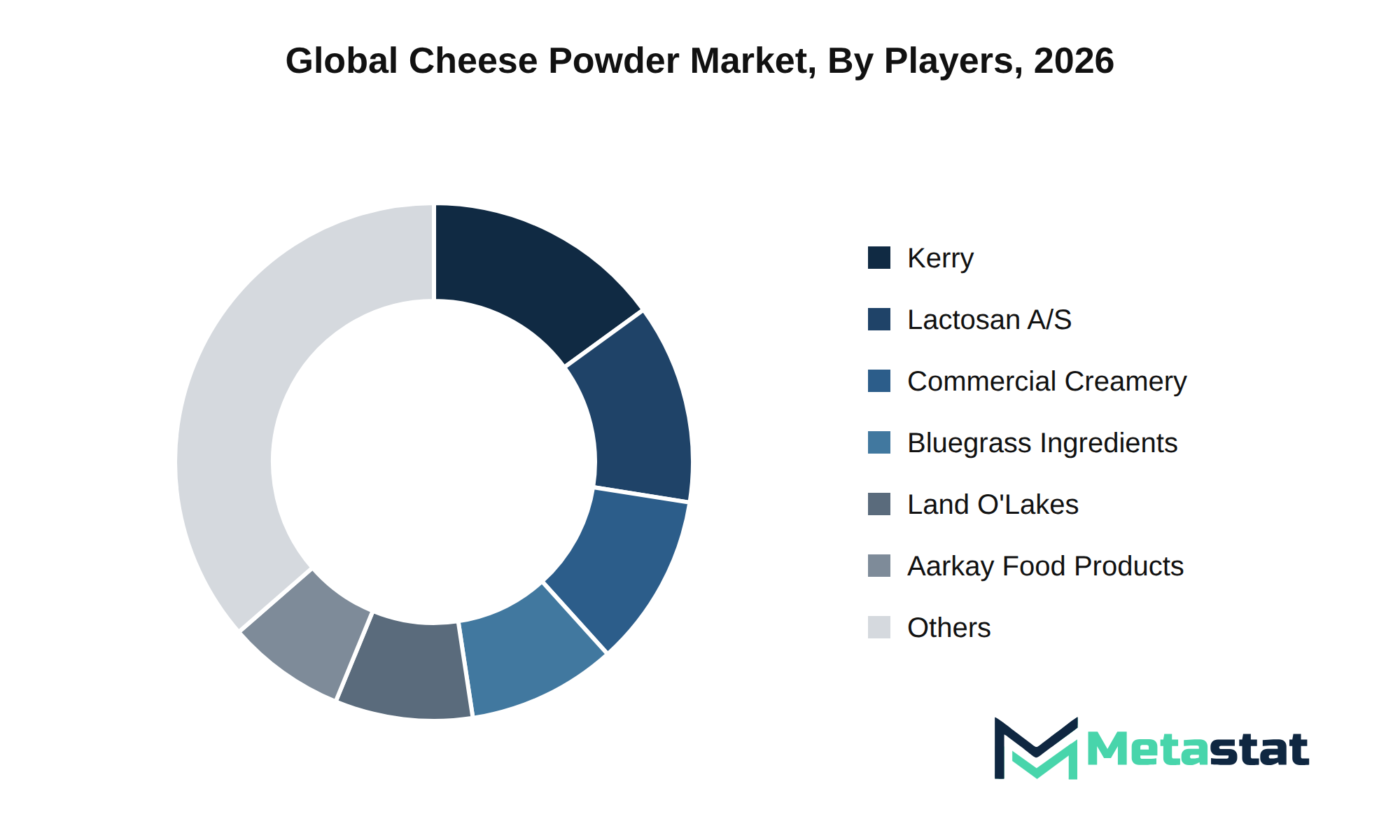
The Cheese Powder market features a dynamic competitive environment where companies engage in strategic consolidation and partnerships to strengthen their positions. Key players, including Lactosan A/S, Kerry Group, and All American Foods, explore mergers and acquisitions to enhance product offerings and expand market reach.
Product differentiation remains a critical focus, with firms investing in R&D pipelines and proprietary technologies. Companies including Glanbia plc and Fonterra Co-operative Group Limited prioritize innovation to develop unique formulations that cater to evolving consumer preferences. Strategic alliances and joint ventures enable players to leverage complementary strengths and access new customer segments.
Barriers to entry for new entrants into the Cheese Powder market include established brand equity and customer retention strategies employed by existing players. Management of switching costs further enhances the competitive positions of seasoned firms like Land O'Lakes, Inc. and Lactalis Ingredients. The future competitive outlook indicates continued emphasis on value chain integration and supply chain dominance, shaping the market for years to come.
Market size is forecast to rise from USD 5,126 million in 2025 to over USD 8,359.5 million by 2033. This growth trajectory reflects a base case of USD 5,126 million in 2025 to USD 8,359.5 million by 2033 at a 6.3% CAGR. Bull cases depict stronger expansion driven by increased adoption in food processing industries, while bear cases suggest potential slowdowns due to regulatory constraints and economic fluctuations.
Macroeconomic factors influence demand for cheese powder, with rising consumer preferences for convenience foods and health-oriented products contributing to heightened usage across various applications. The market experiences structural shifts driven by technology integration that improves product quality and production efficiency. Innovations in next-generation processing techniques support the growth of organic and specialty cheese powders, catering to evolving consumer tastes.
Geopolitical realignments and shifting trade corridors impact the supply chain dynamics within the cheese powder market. Companies adapting to these changes ensure resilient operations, driving strategic capital allocation towards infrastructure commitments and innovative product development. Compliance with regulatory standards forms an essential component of operational planning, guiding firms in their development timelines.
Emerging white-space opportunities present avenues for market participants to expand their offerings. Addressing unmet enterprise needs, particularly in organic and specialized segments, creates high-growth pockets that offer enhanced profitability. Strategic imperatives centered on sustainability and health-conscious formulations align with future growth recommendations, positioning companies favorably within the cheese powder market.
The report strategically identifies and profiles the key market players and analyses their core competencies in each sub-segment of the Cheese Powder market.
Report Attributes | Details |
Study Period | 2021-2033 |
Base Year | 2025 |
Estimated Year | 2026 |
Forecast Period | 2026-2033 |
Historical Period | 2021-2025 |
Growth Rate | CAGR 6.3% from 2026 to 2033 |
Revenue Unit | USD million |
Segmentation | By Product Type, Nature, Application, Distribution Channel, and Region |
By Region | North America (By Product Type, Nature, Application, Distribution Channel, and Country)
|
Europe (By Product Type, Nature, Application, Distribution Channel, and Country)
| |
Asia Pacific (By Product Type, Nature, Application, Distribution Channel, and Country)
| |
South America (By Product Type, Nature, Application, Distribution Channel, and Country)
| |
Middle East and Africa (By Product Type, Nature, Application, Distribution Channel, and Country)
|
Find answers to common questions about this report
The Cheese Powder market size was valued at USD 5,126 million in 2025.
The Cheese Powder market is projected to grow at a CAGR of 6.3% during the forecast period from 2026 to 2033.
The North America Cheese Powder market size is estimated to reach USD 2,660 million by 2033.
Cheddar Cheese Powder leads the Cheese Powder market with a projected value of USD 2,951.8 million by 2033, based on its significant share compared to other product types.
The Cheese Powder market experiences strong growth driven by rising demand for convenience foods, influenced by consumer preferences for ready-to-eat meals and on-the-go snacks. Urbanization and busy lifestyles heighten the consumption of processed products, while technological advancements enhance production quality, supporting the market's expansion.
North America holds the dominant share of the Cheese Powder market, with a projected value of USD 2,660 million by 2033, representing 33.9 percent of the total market.
The Cheese Powder market faces significant constraints from regulatory compliance challenges, macroeconomic pressures, and resource scarcity. These factors increase operational costs and complicate production processes, limiting manufacturers' ability to invest in innovation and expansion. Geopolitical tensions further disrupt supply chains and contribute to pricing compression across the market.
Evolving consumer behaviors favor product adoption in the Cheese Powder market, driven by a preference for convenience foods and ready-to-eat meals. The aging population and health-conscious consumers increasingly seek versatile ingredients that enhance flavor while offering ease of preparation, further supporting market growth. Technological advancements in production facilitate the incorporation of cheese powder into diverse applications.
The Cheese Powder market is estimated to reach a valuation of USD 8,359.5 million by 2033.
Key players operating in the Cheese Powder market include Lactosan A/S, Kerry Group, Commercial Creamery, Bluegrass Ingredients, Inc., Land O'Lakes, Inc., Fonterra Co-operative Group Limited, and Glanbia plc.
The analysts below cover Food and Beverages research at Metastat Insights.
LEAD ANALYST
Utkarsh Khirodkar is a Lead Market Research Analyst at MetaStat Insight, specializing in market intelligence, technology sector assessments, and competitive strategy.

LEAD PRINCIPAL ANALYST, PHARMA AND HEALTHCARE
Food and Beverages · Healthcare · Healthcare IT · Medical Devices
Ajay Devgire is the Lead Healthcare Analyst at MetaStat Insight, leading strategic research and market intelligence initiatives across the global healthcare domain.

SENIOR RESEARCH ANALYST
Biotechnology · Food and Beverages · Medical Devices · Packaging
Snehal Pasalkar is a Research Analyst at MetaStat Insight, operating at the intersection of life sciences research, competitive strategy, and market intelligence.
In the biological seed treatment space, registration timelines vary drastically between the European Union, Brazil, and North America. The MetaStat Insight research handled these cross-border regulatory barriers with genuine nuance, mapping commercialization pathways alongside historical field adoption rates. The segmentation between microbial strains and biochemical active ingredients was particularly well structured.
Our team was tracking whether regional recycling infrastructure could realistically absorb the growing volume of lithium iron phosphate batteries over the next decade. The report did a solid job separating announced hydrometallurgical plant capacity from active, permitted operational throughput. That distinction made the feedstock availability projections and regional recovery rate models far more credible than standard commercial overviews.
Tracking capacity expansion in single-use bioprocessing requires dependable data on raw material availability and cleanroom-grade polymer supply chains. The competitive landscape chapter gave a grounded evaluation of secondary component suppliers across North America and Asia-Pacific rather than simply reprinting press releases. Having that level of supplier benchmarking helped clarify dual-sourcing considerations for our clinical pipeline planning.
Explore related market intelligence reports worth reading alongside this one.