Global Advertising Services Market Size, Share, By Advertising Type (Television Advertising, Social Media Advertising, Internet Advertising, Digital Advertising, Mobile Advertising, Content Marketing, and Others), By Advertising Channel (Digital Advertising, Television Advertising, Out-of-Home Advertising, Print Advertising, Radio & Audio Advertising, Social Media Advertising, Cinema Advertising, Retail Media & Commerce Advertising, Connected TV & Streaming Advertising, and Other Channels), By Client Type (Large Enterprises, Mid-Sized Enterprises, Small & Medium-Sized Enterprises, Public Sector & Government Organizations, and Nonprofit & Association Organizations), By End-User Industry (Retail, Ecommerce and DTC Brands, Consumer Goods and Retail, IT and Telecom, Government and Public Sector, BFSI, and Others), Industry Analysis, Growth, Trends, and Forecast, 2026-2033
Report ID
MSI-4942
Published
August 17, 2026
Pages
309 Pages
Format
Market Size 2021
$505.4 Billion
Historical
Market Size 2025
$642.6 Billion
Base year
Market Size 2033
$1,063.9 Billion
Forecast
CAGR 2025-2033
6.5%
Forecast period
Report Details
Comprehensive Market Analysis And Insights
Market Overview
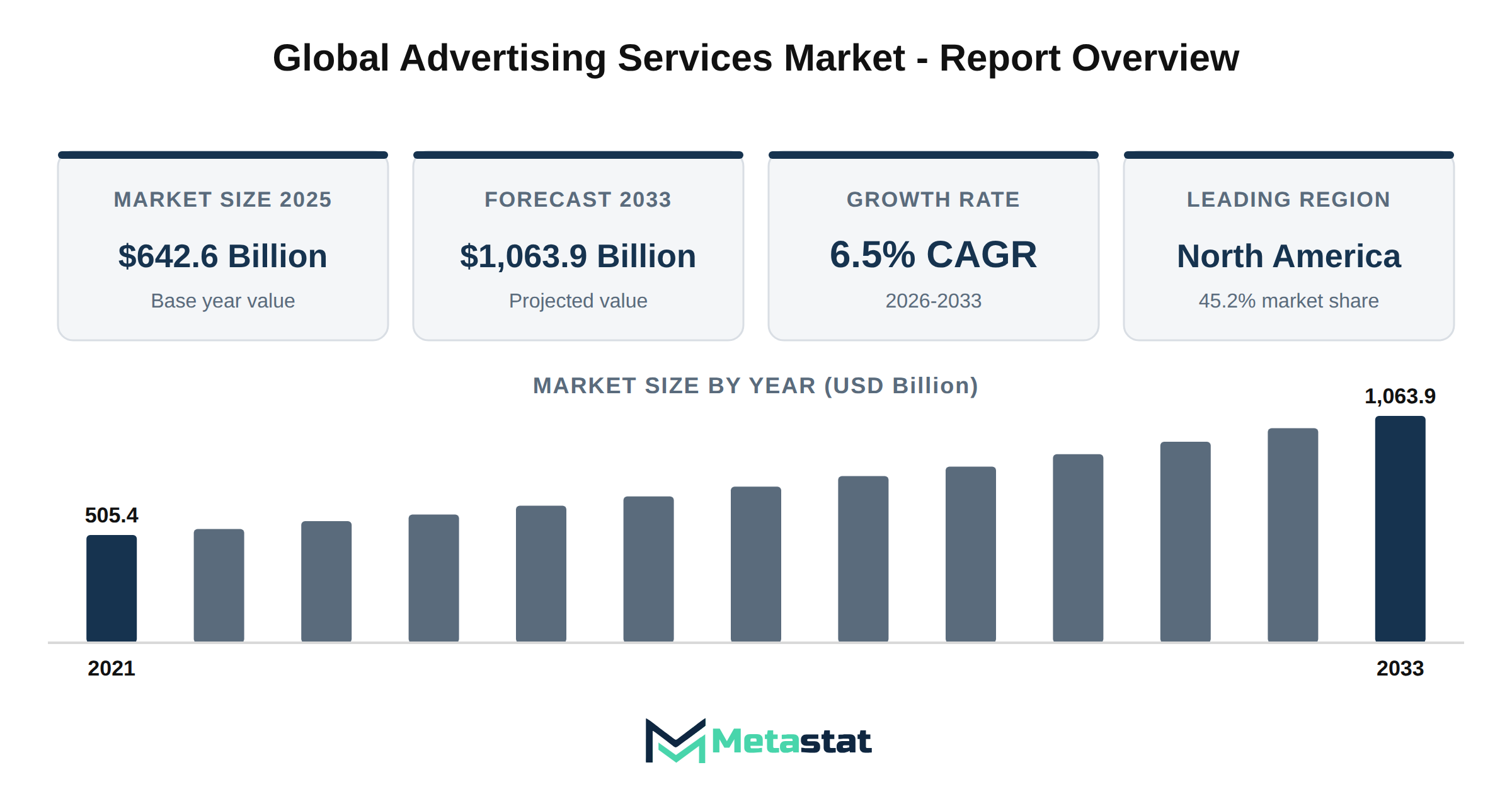
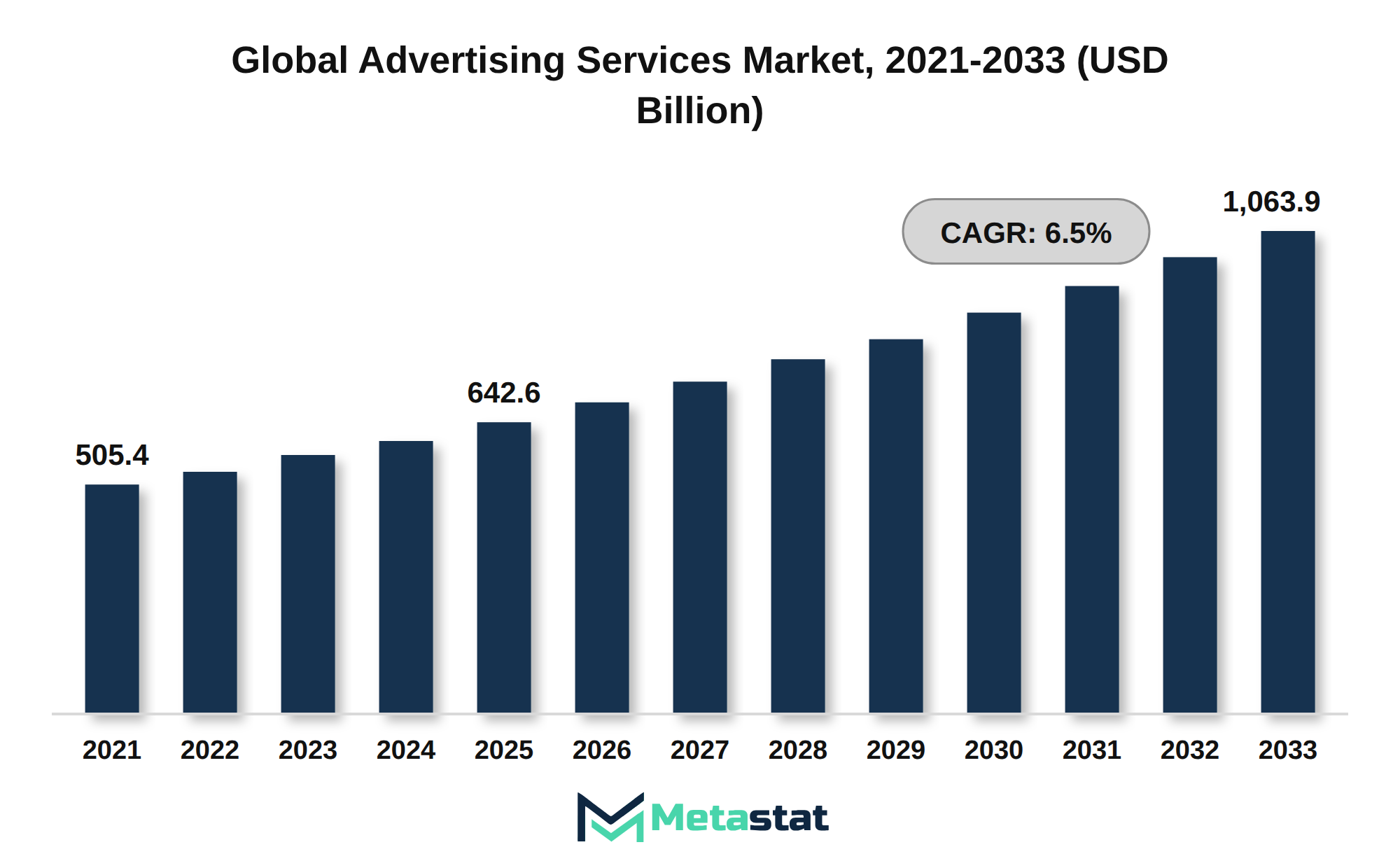
The global Advertising Services market was valued at USD 642.6 billion in 2025 and is projected to reach USD 1,063.9 billion by 2033, growing at a CAGR of 6.5% over the forecast period.
The global Advertising Services market reached a valuation of USD 642.6 billion in 2025, with a projected increase to USD 1,063.9 billion by 2033. This growth represents a compound annual growth rate (CAGR) of 6.5% during the forecast period from 2026 to 2033. Historical data indicates that the market expanded from USD 505.4 billion in 2021 to USD 601.3 billion in 2024.
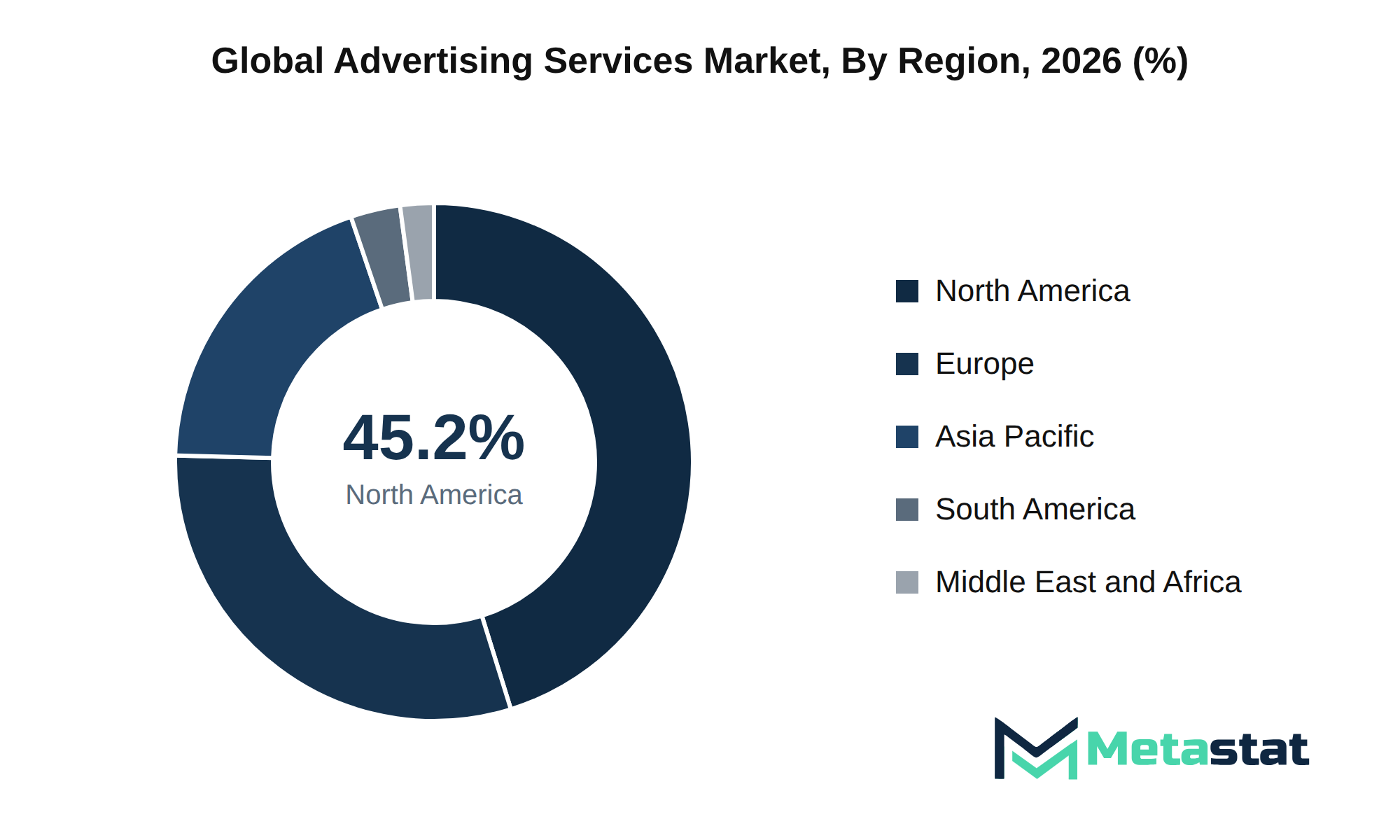
North America dominates the market, accounting for a significant 45.2% share, followed by Europe at 30.2% and Asia Pacific at 19.4%. The shares of South America and the Middle East and Africa stand at 3.1% and 2.1%, respectively. In terms of future growth, North America is expected to maintain its leadership position, with a projected value of USD 478.8 billion by 2033, reflecting a CAGR of 6.5%.
The Advertising Services market comprises various segments, with television advertising showing a strong growth trajectory. The segment is anticipated to grow from USD 188.3 billion in 2026 to USD 430.9 billion by 2033, culminating in a CAGR of 12.6%. Social media advertising is on an upward path, projected to reach USD 133 billion by 2033, with a growth rate of 9.1%.
Digital advertising contributes significantly to market dynamics, with an expected CAGR of 7.6%. This segment is anticipated to expand from USD 271.5 billion in 2026 to USD 454.6 billion by 2033. In contrast, traditional advertising channels, including print and television, face challenges, with growth rates stagnating in comparison.
The Advertising Services market faces various dynamics that impact its growth trajectory. The current landscape involves significant disruption driven by technological advancements and changing consumer behavior. Businesses increasingly invest in innovative advertising solutions to capture audience attention across multiple platforms. This trend results in a surge in demand for digital and social media advertising, reflecting a shift from traditional methods.
Regulatory compliance plays a critical role in shaping the market. Companies navigate complex advertising regulations across different regions, influencing their strategies and operational practices. This compliance framework affects advertising expenditures and campaign strategies, particularly for large enterprises that operate globally.
Macroeconomic headwinds, including inflationary pressures and currency volatility, create challenges for advertisers. Inflationary pressures and currency volatility influence budget allocation and impact the overall spending capacity of businesses. Companies prioritize cost-effective advertising solutions while striving to maintain brand visibility and market presence.
Next-gen innovation drives the evolution of advertising channels. Emerging technologies, including artificial intelligence and machine learning, enable more targeted and personalized advertising experiences. This technological integration enhances consumer engagement and improves conversion rates, driving growth within the market.
Future strategic outlooks emphasize the importance of sustainable transformation and circular economy dynamics. Advertisers increasingly focus on environmentally friendly practices, aligning their campaigns with consumer preferences for sustainability. This shift not only addresses consumer demands but enhances brand reputation.
The competitive landscape demonstrates fragmentation within the Advertising Services market. Numerous players, ranging from established firms to new entrants, contribute to a diverse ecosystem. Companies pursue mergers and acquisitions to strengthen their market positions and expand service offerings, shaping the future dynamics of the industry.
Market Dynamics
Macro-economic factors drive advertising growth
The Advertising Services market benefits significantly from favorable macro-economic conditions, including GDP growth and increased capital investment. Rising GDP encourages higher consumer spending, which drives businesses to enhance advertising efforts to capture greater market share. Increased venture funding supports startups and established companies alike, enabling them to invest in advertising campaigns. Public-private spending power fuels demand for advertising services, driven by organizations aiming to promote their offerings effectively in an expanding economy.
Digital transformation plays a critical role in shaping the market by facilitating the adoption of advanced technologies. Automation and artificial intelligence improve advertising processes, enabling more efficient targeting and engagement with consumers. The integration of these technologies allows for better data analysis, improving campaign effectiveness. While businesses recognize the value of digital platforms, the shift towards online and social media advertising becomes evident.
Changing consumer behaviors and demographic patterns further influence the Advertising Services market. The growing urban population, coupled with lifestyle changes, leads to evolving buying preferences and increased demand for personalized advertising. Brands adapt to these shifts by employing innovative strategies to maintain consumer engagement, which drives growth in advertising spending.
Overall, robust macro-economic factors combined with digital transformation and shifting consumer dynamics create a favorable environment for growth in the Advertising Services market. Businesses that successfully leverage these trends stand to gain a competitive edge and capture a larger share of the expanding market.
The Advertising Services market experiences accelerated growth driven by technological integration, particularly through advancements in automation and artificial intelligence. These technologies streamline advertising processes, enhancing the efficiency of campaign execution and targeting. Automation enables real-time data analysis, allowing advertisers to adjust strategies promptly and optimize their return on investment.
The increasing adoption of software solutions for campaign management further supports this trend. Digital transformation has reshaped how businesses engage with their audiences, driving demand for innovative advertising strategies that leverage data insights. This shift leads to improved consumer targeting and engagement, which enhances overall market growth.
Investment in technology infrastructure enables advertisers to digitize legacy processes. By modernizing their approaches, firms better meet evolving consumer preferences and behaviors. The integration of new technologies leads to increased operational productivity and cost-efficiency initiatives, contributing to the competitive landscape of the Advertising Services market.
While companies adopt these technologies, the market is expected to see a broader range of advertising formats and channels, providing opportunities for diversification of service offerings. This evolution enhances market reach and enables more tailored advertising solutions, influencing growth trajectories during the forecast period.
Regulatory and Economic Challenges Restrain Growth
The Advertising Services market encounters significant challenges stemming from regulatory tightening and economic pressures. Increased compliance hurdles complicate market entry for new providers, while established players face rising operational costs tied to legal mandates. These factors restrict growth, particularly for mid-sized and smaller enterprises that lack the resources to remain compliant.
Macroeconomic headwinds, including inflationary pressures, hinder consumer spending and impact advertising budgets. Rising inflation leads businesses to reduce marketing expenditures, which directly affects demand for advertising services. Supply chain disruptions exacerbate these issues, delaying campaigns and increasing costs for agencies reliant on timely delivery of services.
Geopolitical instability further complicates the landscape, generating uncertainties that discourage investment in advertising initiatives. Fragmentation arises from varying regional regulations and cultural barriers, complicating the implementation of unified advertising strategies. Such fragmentation leads to inefficiencies, increasing costs and slowing adoption rates.
High capital investment requirements and escalating operating costs challenge new entrants and existing providers alike. The need for advanced technology and skilled labor intensifies competition for resources, creating talent gaps that slow service delivery. Data security vulnerabilities and privacy concerns introduce additional risks, prompting businesses to invest heavily in safeguarding consumer information, diverting funds from marketing efforts.
The Advertising Services market faces a complex set of challenges that stifle growth and innovation. Understanding these restraints is essential for stakeholders aiming to navigate the evolving landscape effectively.
The Advertising Services market experiences significant challenges due to geopolitical fragmentation and trade deficits. Heightened trade friction results in increased tariffs, impacting cross-border advertising initiatives. This fragmentation complicates market access for players, leading to increased operational costs and uncertainties that affect strategic planning.
Technological disruptions further exacerbate these challenges. Rapid advancements in advertising technologies necessitate complex R&D integrations, which strain resources and delay product launches. The competition for talent intensifies, creating skill gaps that hinder innovation and effectiveness within advertising campaigns. Talent retention pressures result in additional hiring costs, impacting overall profitability.
Logistics disruptions and supply chain instability contribute to volatility in feedstock and component availability. This instability raises costs for firms operating within the Advertising Services market, forcing them to adjust pricing strategies and potentially reduce profit margins. Evolving legal liabilities and tightening global regulatory standards create compliance overhead, adding complexity to operations.
Market saturation and changing downstream demands strain the capacity of advertising firms to maintain growth. New entrants and substitute products dilute market share, compelling established players to innovate continuously. Without strategic measures to address these pressures, significant obstacles could hinder long-term growth and profitability in the market.
Emerging regional demands drive market potential
The Advertising Services market stands poised for growth driven by emerging regional demands. Increasing economic activities in various regions contribute to heightened advertising expenditure, particularly in Asia Pacific and South America. These markets represent untapped opportunities for service providers, encouraging competition and innovation.
Infrastructure modernization plays a critical role in enhancing advertising capabilities. Regions investing in advanced technological frameworks enable more effective targeting and engagement, leading to improved ROI for advertisers. This progression encourages advertisers to explore diverse channels and platforms, catering to evolving consumer preferences.
Geographical expansion into new markets fuels demand for tailored advertising solutions. Targeting specific demographics and cultural nuances allows service providers to create more effective campaigns, thereby enhancing brand recognition and customer loyalty. Companies expanding into these regions benefit from first-mover advantages, capitalizing on the growing appetite for localized content.
Technological disruptions, particularly in digital transformation, change strategies within the Advertising Services market. Innovations in data analytics and programmatic advertising systems enhance targeting precision, enabling advertisers to achieve better results. Companies leveraging these technologies gain a competitive edge, ensuring sustainable growth and profitability.
Next-generation innovations, including augmented reality and immersive advertising experiences, present new avenues for engagement. Brands embracing these advanced techniques capture consumer attention in increasingly crowded markets. The Advertising Services market, therefore, stands to gain from investments in innovative advertising formats that appeal to tech-savvy consumers.
Sustainability imperatives and ESG-driven alignments shape the future of advertising strategies. Increasing consumer awareness regarding environmental responsibility prompts advertisers to adopt greener practices. This shift not only appeals to conscious consumers but strengthens brand reputation, leading to enhanced market penetration.
Market participants focusing on downstream diversification and niche application growth create additional revenue streams. By catering to specific consumer needs and emerging trends, companies capture market share in underserved segments. This strategic pivot enhances overall market competitiveness and resilience.
The Advertising Services market thrives on emerging regional demands, infrastructure modernization, and technological advancements. By capitalizing on these opportunities, companies ensure sustained growth, increased adaptability, and enhanced consumer engagement.
Market Segmentation Analysis
The Global Advertising Services market is segmented based on Advertising Type, Advertising Channel, Client Type, and End-User Industry.
By Advertising Type, the market is further segmented into:
Television Advertising
Social Media Advertising
Internet Advertising
Digital Advertising
Mobile Advertising
Content Marketing
Television Advertising
Television Advertising segment is valued at USD 188.3 billion in 2026 and is projected to reach USD 430.9 billion by 2033, at a CAGR of 12.6% during the forecast period. Growth within this segment is driven by increasing viewership and evolving consumer preferences towards engaging content. Advertisers invest heavily in television to capture the attention of large audiences, particularly during peak events including sports and award shows. This preference for television advertising, supported by its broad reach and emotional impact, enhances demand in the Advertising Services market.
Technological advancements in broadcasting and viewer analytics further fuel this segment's expansion. Innovations including smart TVs and streaming platforms provide advertisers with new possibilities for targeted campaigns, maximizing engagement. This shift towards advanced technology enables customized advertising experiences that align with consumer interests and behavior, thereby increasing effectiveness.
While competition intensifies among advertisers to secure prime airtime, pricing dynamics evolve. Higher demand for prime slots leads to increased costs, while advertisers strategize to optimize their advertising spend. Balancing traditional television with emerging digital platforms creates challenges in maintaining effective budget allocation. The ability to measure advertising effectiveness accurately influences future investment decisions significantly.
Overall, the Television Advertising segment remains a vital component of the Advertising Services market, reflecting resilience amid changing consumer behavior and technological advancements. Continuous investment in innovative advertising strategies and ad placements is essential to capitalize on growth opportunities within the segment.
Social Media Advertising
Social media platforms increasingly serve critical channels for brand engagement and customer interaction, driving growth in the social media advertising segment. Advertisers focus on leveraging user-generated content and data analytics to create targeted campaigns that connect with audiences. Enhanced targeting capabilities deliver measurable results, attracting substantial investment from brands seeking to optimize their marketing strategies.
The social media advertising segment is estimated to reach USD 133 billion by 2033, at a CAGR of 9.1% during the forecast period. With the rise in mobile device usage and the expansion of internet penetration, brands capitalize on the dynamic nature of social media to communicate with consumers effectively. The shift towards digital consumption patterns accelerates the migration of advertising budgets from traditional media to social platforms.
While social media evolves, new features including augmented reality ads and shoppable posts enhance user experience and engagement. Businesses increasingly adopt these innovations, improving conversion rates and overall campaign performance. Continuous advancements in algorithmic targeting and personalization further enrich the advertising landscape, creating new opportunities for brands to connect with their target audiences.
The ongoing integration of artificial intelligence in advertising strategies facilitates real-time data analysis and audience segmentation. This optimization results in more efficient allocation of advertising resources and improved return on investment for businesses. Growing reliance on data-driven insights reinforces the significance of social media advertising in the broader advertising services market.
Internet Advertising
Sub-segment Internet Advertising (By Advertising Type)
Significant growth in the Internet Advertising segment is evident, with expectations to reach USD 101.1 billion by 2033. The increasing prevalence of digital content consumption drives demand for targeted online advertising, allowing businesses to engage consumers effectively. E-commerce expansion contributes to this trend, with brands seeking to enhance their online presence and reach potential customers through various platforms.
Technological maturation in data analytics and artificial intelligence facilitates more precise targeting and personalization in advertising campaigns. Advertisers leverage these advancements to optimize their campaigns, ensuring higher returns on investment. The rising use of social media platforms because advertising channels further accelerates the shift toward Internet Advertising, attracting a diverse range of businesses from small startups to large enterprises.
Price pressures in traditional media push advertisers to allocate budgets toward digital solutions, enhancing the overall appeal of the Internet Advertising segment. Industry-wide acceptance of digital metrics enables better measurement of campaign effectiveness, building confidence among brands in their advertising strategies. This alignment between advertising spend and measurable outcomes encourages businesses to invest more heavily in digital channels.
Evolving consumer preferences reflect a shift toward online engagement, with audiences increasingly favoring interactive and personalized content. Brands responding to this consumption shift find success through innovative digital campaigns that connect with target demographics. The adoption of next-generation advertising technologies, including programmatic buying and real-time bidding, further enhances the efficiency and effectiveness of Internet Advertising.
The Internet Advertising segment represents a significant growth area within the Advertising Services market, driven by demand for digital engagement, technological advancements, and changing consumer behaviors. With expected revenues reaching USD 101.1 billion by 2033, this segment influences the future of advertising strategies across various industries.
Digital Advertising
Growth in the Digital Advertising segment reflects shifts in consumer behavior towards online platforms and increasing investments from businesses seeking enhanced targeting capabilities. Companies recognize the effectiveness of digital channels for reaching specific demographics, driving substantial allocations of their marketing budgets toward these platforms. This segment is projected to grow at a CAGR of 2.6% during the forecast period.
Emerging technologies play a crucial role in shaping the evolution of digital advertising. Innovations including artificial intelligence and machine learning enhance capabilities in ad targeting and personalization, leading to improved user engagement. Advancements in analytics enable businesses to better assess the return on investment from their digital campaigns, influencing spending patterns in favor of digital platforms.
While e-commerce continues to thrive, the demand for digital advertising will further accelerate. Retailers increasingly prioritize online visibility, driving competition among digital advertising channels. Consequently, this trend positions the Digital Advertising segment because a vital component of the overall Advertising Services market, ensuring its relevance and growth potential in the coming years.
Mobile Advertising
Growing smartphone usage drives demand for mobile advertising, enhancing engagement with target audiences. Advertisers increasingly seek to leverage mobile platforms for reaching consumers in real time, creating personalized marketing strategies that connect with individual preferences.
The rising prevalence of social media applications on mobile devices acts because a catalyst for segment expansion. Increased social media usage facilitates direct interaction between brands and consumers, leading to enhanced advertising effectiveness. Advertisers recognize the value of mobile-optimized content in capturing consumer attention and driving conversions.
Technological maturation contributes to the evolution of mobile advertising solutions, with advancements in data analytics and artificial intelligence enabling advertisers to optimize campaigns. Enhanced targeting capabilities lead to improved return on investment for advertising efforts, encouraging greater adoption of these strategies across various industries.
Certain industries, including retail and e-commerce, experience heightened benefits from mobile advertising due to their customer-centric approaches. The ability to reach consumers at critical decision-making moments enhances the effectiveness of marketing campaigns, driving revenue growth for businesses.
Cost structures within mobile advertising reflect ongoing investments in evolving technologies and platforms. While initial costs are significant, long-term savings from improved targeting and reduced wastage create favorable margins, making the segment attractive for advertisers.
Emerging trends in mobile device usage, including the integration of augmented reality and location-based services, present additional strategic opportunities. Advertisers seeking to capture consumer interest leverage these innovations, expanding their reach and improving user experiences.
The Advertising Services market continues to evolve alongside these trends, reflecting shifts in consumer behaviors and preferences. Advertisers remain vigilant in adapting to the changing landscape, ensuring that mobile advertising strategies align with the dynamic nature of the market.
Content Marketing
Content marketing drives engagement and builds customer relationships in the Advertising Services market. Tailored content strategies enhance brand visibility, making it essential for businesses to focus on storytelling and relevant messaging. The evolution of digital platforms facilitates a broader audience reach, significantly influencing consumer preferences and purchasing decisions.
Technological advancements in analytics and data-driven marketing enable companies to refine their content strategies. Enhanced targeting capabilities lead to improved engagement rates and higher return on investment. Businesses leverage next-generation tools to create interactive content, pushing the boundaries of traditional marketing and adapting to consumer demands.
Growing trends in e-commerce and online shopping create a strong foundation for content marketing. With more consumers relying on digital channels for purchases, brands develop compelling content that connects with targeted demographics. This shift towards digital consumption influences advertising strategies, prompting organizations to invest in high-quality content that builds customer loyalty and drives sales.
Regulatory compliance standards and data privacy laws shape content marketing strategies. Organizations navigate these regulations while maintaining consumer trust, ensuring transparency in data usage. Balancing compliance with effective marketing tactics presents opportunities for innovation, encouraging brands to adopt ethical content marketing practices that align with consumer expectations.
Investment in content marketing continues to expand, reflecting its integral role in overall marketing strategies. Companies seek to capitalize on strategic opportunity windows, emphasizing the importance of content in driving brand recognition and customer engagement. This increased focus on content highlights its significance for long-term growth and success within the Advertising Services market.
By Advertising Channel, the market is further segmented into:
Digital Advertising
Television Advertising
Out-of-Home Advertising
Print Advertising
Radio & Audio Advertising
Social Media Advertising
Cinema Advertising
Retail Media & Commerce Advertising
Connected TV & Streaming Advertising
Other Channels (In-Game Advertising, Podcast Advertising, Emerging Media)
Valued at USD 271.5 billion in 2026, the Digital Advertising segment is projected to reach USD 454.6 billion by 2033, achieving a CAGR of 7.6% during the forecast period. Shifting consumer preferences towards online platforms drive demand, with brands prioritizing digital channels for advertising efforts. The proliferation of mobile devices enhances accessibility, enabling greater engagement with audiences across various demographics.
Innovative technologies, including artificial intelligence and data analytics, streamline targeting strategies, allowing advertisers to reach specific consumer segments effectively. The market experiences segment expansion, fueled by the rise of social media and e-commerce, which encourages brands to invest more in digital advertising methodologies. Evolving privacy regulations impact tracking capabilities, necessitating adjustments in strategies to ensure compliance while maintaining effective marketing outreach.
Pricing volatility characterized by fluctuating ad space costs impacts budgeting decisions for companies in the sector. Increased competition prompts providers to differentiate services, investing in creative content and user experience enhancements to attract clients. Strategic investments focus on leveraging emerging platforms and technologies, positioning the advertising services market for continued growth driven by digital transformation across industries.
Valued at USD 188.3 billion in 2026, the Television Advertising segment is anticipated to reach USD 157.5 billion by 2033, at a CAGR of 2.7% during the forecast period. This segment experiences growth driven by the increasing integration of advanced technologies in advertising strategies. Enhanced targeting capabilities through data analytics and viewer segmentation significantly improve ad effectiveness, prompting more firms to allocate budget towards television campaigns.
Consumer behavior shifts towards personalized content drive demand for this segment. Advertisers leverage viewer habits and preferences to tailor advertisements, leading to higher engagement rates. The transition towards hybrid advertising models, which blend traditional television with digital platforms, contributes to the evolution of television advertising. This hybrid approach allows for more flexible and dynamic advertising strategies.
Regulatory compliance standards surrounding advertising content have sharpened focus on ethical advertising practices within the market. Adherence to these standards enhances brand reputation and consumer trust, ultimately influencing purchasing decisions. Cost structures in the segment involve substantial investments in high-quality production and strategic placement, which impact overall profitability.
Pricing volatility remains a concern, influenced by fluctuations in audience ratings and advertising demand. This volatility necessitates careful planning and strategic investment to optimize ad spend and maximize return on investment. Competition within the market intensifies owing to new players entering, leading to a dynamic environment that requires continuous innovation and adaptation from existing players.
Strategic opportunities arise from the ongoing evolution of media consumption patterns. An increase in streaming services and on-demand content creates avenues for advertising expansion, allowing firms to explore new advertising formats and reach diverse audiences. The Television Advertising segment continues to adapt to changing consumer preferences and technological advancements, positioning itself for sustainable growth within the Advertising Services market.
Out-of-Home Advertising
Out-of-Home Advertising stands positioned for substantial growth within the Advertising Services market, projected to reach USD 56 billion by 2033. Increased urbanization and shifts in consumer behavior drive demand for this advertising channel, where brands seek to engage consumers in high-traffic areas effectively. The rise of digital billboards and interactive displays enhances the effectiveness of these advertisements, allowing for real-time updates and targeted messaging.
Technological advancements in data analytics and geolocation improve advertising precision, enabling advertisers to tailor messages according to the audience's demographics and preferences. This segment benefits from the increasing integration of mobile technology, allowing connections between outdoor ads and mobile devices. Brands leverage Out-of-Home Advertising to create multi-channel campaigns that reinforce their presence across various platforms.
Companies within the market are focusing on innovative strategies to enhance visibility and engagement through Out-of-Home Advertising. This approach aligns with trends towards sustainability, with many firms adopting eco-friendly materials and practices in their advertising efforts. Enhanced regulatory compliance further supports market integrity, ensuring that advertisements adhere to established standards and build consumer trust.
Competitive dynamics within the Advertising Services market intensify owing to more players recognizing the potential of Out-of-Home Advertising. Strategic partnerships and collaborations are common, facilitating the development of more effective advertising solutions. Overall, the projected growth reflects an evolution in advertising strategies that prioritize consumer engagement and technological integration.
Print Advertising
Shifts in consumer behavior towards digital platforms have adversely impacted the Print Advertising segment. This segment is projected to grow at a CAGR of -0.5% during the forecast period. The decline stems from increasing preferences for digital media over traditional print formats. Advertisers allocate budgets toward more dynamic channels, leading to reduced investment in print media. This transition reflects broader trends where brands seek real-time engagement and measurable outcomes, often lacking in print advertising. Print faces competition from digital formats that offer enhanced targeting capabilities and immediate feedback metrics.
Print advertising remains relevant for specific industries, including local businesses and niche markets, where tangible materials appeal to consumers. The overall market experiences challenges due to technological advancements and evolving consumer preferences. Cost structures within the print sector reflect ongoing pressures, with increased raw material costs and distribution expenses impacting profitability. Despite these hurdles, targeted campaigns in print still yield effective results, particularly when integrated with digital strategies. The Advertising Services market continues to adapt, but print's share is expected to decline owing to brands prioritizing digital channels.
Radio & Audio Advertising
Growth in the Radio & Audio Advertising segment is supported by increasing consumer engagement with audio content across various platforms, including traditional radio and digital streaming services. This shift reflects broader trends in media consumption, where listeners prioritize audio formats for both entertainment and information. Advertisers recognize the value of targeting specific demographics through audio channels, making this segment attractive for brands seeking to enhance reach and effectiveness.
Technological advancements in audio streaming and podcasting provide advertisers with innovative ways to engage users. The rise of smart speakers and mobile applications allows for integration of advertising within audio content, facilitating higher retention rates among audiences. This evolution contributes to a more changing environment, driven by brands leveraging these technologies to refine their advertising strategies and optimize consumer interactions.
End-user industries increasingly invest in radio and audio advertising, recognizing its effectiveness in driving consumer awareness and brand loyalty. Sectors including retail and ecommerce actively use audio channels to communicate promotional messages, resulting in enhanced customer engagement. The market responds positively to these trends, enabling brands to capture consumer attention in a competitive environment.
Consumption shifts toward personalized and on-demand audio content create opportunities for targeted advertising strategies. Advertisers leverage data analytics to understand listener preferences, tailoring messages that connect with specific audiences. This strategic approach enhances the relevance of advertisements, driving higher conversion rates and reinforcing the position of radio and audio advertising within the broader Advertising Services market.
Social media advertising experiences robust demand driven by the increasing reliance on digital platforms for brand visibility and engagement. High user engagement rates on social media channels contribute to the segment's expansion, with businesses recognizing the importance of targeting specific demographics through tailored advertising strategies. The shift towards mobile-first consumption patterns further increases investments in social media advertising, allowing brands to reach consumers where they spend significant time online.
Technological maturation in social media platforms enhances advertising capabilities, enabling advanced data analytics and targeted advertisements. The evolution of features including augmented reality and interactive content provides new avenues for brands to engage consumers creatively. This product evolution creates deeper connections with audiences and drives higher conversion rates, resulting in increased adoption of social media advertising across various industries.
Downstream application of social media advertising spans various sectors, from retail to technology, allowing brands to present products directly and interactively. Retail brands, in particular, leverage social media channels to promote e-commerce initiatives, driving substantial revenue growth. The rise of influencer partnerships further strengthens brand messages, creating opportunities for engagement and community building.
Regulatory compliance standards play a significant role in shaping advertising strategies on social media. Brands navigate evolving privacy regulations and platform policies to ensure compliance while maximizing their advertising reach. This dynamic environment compels businesses to adopt agile strategies that adapt to regulatory changes and consumer expectations.
Pricing volatility in social media advertising arises from fluctuations in demand, competition, and platform algorithm changes. Advertisers encounter challenges in maintaining consistent return on investment, driving the need for strategic planning and budget management. Companies that invest in data-driven strategies and analytics effectively mitigate margin pressures, ensuring sustained growth within the market.
Strategic opportunity windows emerge owing to brands exploring innovative advertising formats and emerging trends within social media. The integration of advanced targeting capabilities and personalized messaging positions brands to capitalize on engagement opportunities. Continuous investment in social media advertising will likely reflect the evolving landscape of consumer preferences and technological advancements.
Consumer preferences increasingly shift towards immersive experiences, driving interest in Cinema Advertising within the Advertising Services market. This segment benefits from the unique emotional engagement cinema provides, differentiating it from other advertising channels. The ability to reach audiences before film screenings facilitates memorable brand exposure, particularly for large enterprises targeting diverse demographics.
Technological advancements contribute to segment expansion, particularly through enhanced visual and sound quality that captivates viewers. The evolution of digital projection and the integration of interactive elements offer advertisers innovative ways to engage audiences. Strategic partnerships between cinema chains and brands create co-marketing opportunities, resulting in increased visibility and audience reach.
Regulatory compliance and industry standards play significant roles in shaping advertising strategies within cinemas. Advertisers adhere to content guidelines ensuring brand messages align with audience expectations and cinematic experiences. This focus on brand integrity enhances trust and builds loyalty among consumers.
Market dynamics indicate a growing interest in Cinema Advertising, particularly within sectors including retail and e-commerce. Brands leverage cinematic storytelling to build emotional connections, transforming traditional advertising into compelling narratives. This evolution highlights the segment's potential for sustainable growth within the broader Advertising Services market.
Retail Media & Commerce Advertising
Demand for Retail Media & Commerce Advertising aligns with the increasing emphasis on targeted advertising strategies. Retailers seek to enhance customer engagement through personalized experiences, leveraging data analytics to drive effective campaigns. Brands prioritize reaching consumers at the moment of purchase, increasing conversion rates and maximizing marketing ROI.
Growing investment in e-commerce platforms accelerates segment expansion, enabling brands to integrate advertising directly within retail environments. This approach enables interactions between brands and consumers, enhancing brand visibility and engagement. The market benefits from technological advancements that enable real-time data collection and analytics, allowing advertisers to refine their strategies based on consumer behavior.
Digital transformation within retail environments continues to evolve, with businesses adopting innovative tools to enhance customer experiences. Increased adoption of mobile devices further supports this transition, enabling consumers to engage with brands from various touchpoints. The segment experiences increased relevance due to shifting consumer preferences towards online shopping, emphasizing the importance of effective advertising strategies in the Advertising Services market.
Regulatory compliance remains essential in navigating advertising standards across different regions. Brands adapt their strategies to align with evolving policies and consumer privacy regulations. This emphasis on compliance influences advertising approaches and necessitates investment in data protection measures.
Market dynamics reflect a shift towards value-driven advertising, where brands seek measurable outcomes from their campaigns. This trend leads to increased competition among advertisers, placing pressure on pricing structures and margins. Strategic partnerships with tech companies and data providers become crucial for brands to enhance data capabilities and optimize advertising spend.
In the Advertising Services market, Retail Media & Commerce Advertising captures attention driven by brands exploring new avenues for consumer engagement. The segment presents strategic opportunity windows for advertisers to leverage data-driven insights, ultimately enhancing customer loyalty and driving growth.
Connected TV & Streaming Advertising
Connected TV & Streaming Advertising reflects a shift in consumer preferences towards more interactive and personalized viewing experiences. This segment gains traction owing to the growing popularity of streaming services and the increasing penetration of smart TVs. Advertisers leverage these platforms to engage audiences with targeted content, enhancing brand visibility and customer interaction.
Technological maturation drives the adoption of connected TV advertising, enabling sophisticated data analytics and audience segmentation. While advertisers capitalize on the capabilities of advanced targeting, ad spend allocation toward this channel is expected to increase significantly. The proliferation of next-gen upgrades in streaming technology facilitates effective ad integration, further promoting the efficiency of advertising efforts.
End-user dynamics illustrate a shift towards on-demand content consumption, aligning with the habits of younger demographics. Retail, ecommerce, and consumer goods sectors actively invest in connected TV advertising to reach audiences effectively. Public sector organizations explore this channel for community engagement and information dissemination. Consumption shifts toward streaming platforms impact traditional advertising channels, compelling advertisers to adapt strategies accordingly.
Competition intensifies, prompting brands to seek innovative ways to enhance their messaging through immersive formats. Regulatory compliance standards concerning data privacy and consumer protection shape the advertising approach on these platforms, necessitating adherence while maximizing campaign effectiveness. The market for Connected TV & Streaming Advertising contributes significantly to the overall growth of the Advertising Services market, positioning this segment because a vital component in advertisers' media mix.
Other Channels (In-Game Advertising, Podcast Advertising, Emerging Media)
Integration of in-game advertising, podcast advertising, and emerging media into the Advertising Services market demonstrates significant evolution in advertising strategies. The growing popularity of gaming and podcast formats presents unique opportunities for brands to engage with audiences in interactive and authentic environments. This trend is primarily driven by younger demographics who exhibit strong preferences for these channels, leading to increased engagement levels and brand loyalty.
Technological maturation supports the expansion of in-game advertising, enabling more sophisticated targeting and measurement capabilities. Advancements in augmented and virtual reality further enhance the potential of in-game ad placements, allowing for immersive experiences that connect with consumers. Podcast advertising benefits from similar advancements, driven by improved analytics that provide insights into listener behavior, making it easier for brands to tailor their messages effectively.
Adoption of these channels accelerates owing to their alignment with changing consumption habits. Audiences increasingly seek personalized content that aligns with their interests, making in-game and podcast advertising particularly relevant. Brands adapting their strategies to capitalize on these trends stand to gain competitive advantages within the market.
Regulatory compliance and certification standards play vital roles in shaping the environment of these advertising channels. Ensuring adherence to guidelines builds trust and credibility, essential for both advertisers and consumers. Emerging policies surrounding data privacy will influence the methods by which brands engage with audiences through these channels, requiring ongoing adjustments to strategies.
Strategic opportunity windows emerge for brands willing to invest in innovative formats within in-game advertising, podcast advertising, and emerging media. Companies that leverage these opportunities effectively drive consumer engagement and enhance brand visibility. The Advertising Services market continues to evolve, reflecting the dynamic relationship between technological advancement and shifting consumer preferences.
By Client Type, the market is further segmented into:
Large Enterprises
Mid-Sized Enterprises
Small & Medium-Sized Enterprises
Public Sector & Government Organizations
Nonprofit & Association Organizations
Large Enterprises
Valued at USD 296.5 billion in 2026, the Large Enterprises segment is projected to reach USD 461.5 billion by 2033, at a CAGR of 6.5% during the forecast period. This substantial growth reflects increasing investments in advertising services, driven by large enterprises' efforts to enhance brand visibility and customer engagement across various channels. Enhanced digital capabilities and the rise of data analytics enable these enterprises to tailor their advertising strategies, thereby optimizing return on investment.
Large enterprises exhibit a strong inclination towards integrating advanced technologies including artificial intelligence and machine learning into their advertising strategies, facilitating more effective targeting and personalization. The shift towards digital platforms, coupled with evolving consumer preferences, necessitates innovative marketing approaches to capture audience attention. This segment's expansion creates a higher demand for comprehensive advertising solutions, encompassing both traditional and digital media.
Investment in social media and digital advertising channels has surged, aligning with shifts in consumer behavior and media consumption patterns. The increasing importance of online presence compels large enterprises to allocate significant budgets towards effective advertising campaigns. Heightened competition within the Advertising Services market compels enterprises to leverage new technologies and creative strategies to maintain market share and drive growth.
Strategic partnerships with technology providers and advertising agencies enhance capabilities, offering robust solutions tailored to diverse consumer segments. Large enterprises increasingly focus on measurable outcomes, leading to a demand for analytics-driven strategies that refine advertising efforts. This focus on data-driven decision-making within the market highlights the segment's potential for sustained growth and innovation.
Mid-Sized Enterprises
Mid-Sized Enterprises in the Advertising Services market shows significant growth potential, driven by the increasing digital transformation across industries. Businesses focusing on digital marketing strategies enhance their outreach and customer engagement, resulting in a compelling demand for advertising services tailored to mid-sized firms.
Technological advancements, including improved data analytics and targeted advertising capabilities, drive growth within this segment. The ability to leverage data for personalized marketing strategies proves essential for mid-sized enterprises striving to compete effectively. Consequently, these organizations invest in next-gen upgrades, improving their marketing effectiveness and optimizing customer acquisition costs.
Mid-Sized Enterprises segment is estimated to reach USD 246.8 billion by 2033, at a CAGR of 5.6% during the forecast period. This growth reflects an ongoing trend of increased advertising expenditure among mid-sized firms, driven by their desire to enhance brand visibility and reach broader audiences.
End-user dynamics significantly influence advertising strategies, with mid-sized enterprises adapting their approaches to align with shifting consumer preferences. This adaptability facilitates resilience against competition from larger corporations, positioning mid-sized firms because agile players in the market.
Investment in digital advertising channels, particularly social media and internet advertising, highlights the strategic opportunity windows available for mid-sized enterprises. By capitalizing on these channels, firms improve their brand presence and connect with targeted demographics, enhancing overall market penetration.
While regulatory compliance standards evolve, mid-sized enterprises remain vigilant in navigating these changes to maintain operational integrity. Incorporating robust compliance measures into their advertising strategies ensures these firms respond effectively to policy headwinds, further facilitating their growth in the advertising services market.
Small & Medium-Sized Enterprises
Sub-segment Small & Medium-Sized Enterprises (By Client Type)
Growth in the Small & Medium-Sized Enterprises segment reflects strong demand for advertising services tailored to these businesses. Digital transformation accelerates, prompting these enterprises to adopt innovative advertising strategies to enhance visibility and competitiveness. The evolving landscape of consumer preferences emphasizes digital platforms, driving small and medium-sized enterprises to invest in targeted advertising solutions, particularly on social media and digital channels.
Valued at USD 252.1 billion by 2033, this segment experiences expansion driven by the necessity for effective brand engagement and customer acquisition. Increased investment in marketing technologies and analytics supports precision targeting and performance tracking, optimizing return on advertising spend. The market benefits from a growing emphasis on data-driven decision-making, enabling these enterprises to refine their advertising strategies and achieve measurable results.
Industry trends demonstrate a marked shift in advertising budgets towards online platforms, with small and medium-sized enterprises seeking to leverage cost-effective solutions that deliver high engagement. The Advertising Services market continues to evolve, accommodating the specific needs of this segment through tailored offerings and scalable solutions. Projected growth highlights the significant role these enterprises play in driving demand within the broader advertising landscape.
Public Sector & Government Organizations
Investment in advertising by Public Sector & Government Organizations experiences steady demand driven by increasing emphasis on public outreach and engagement. Digital platforms facilitate effective communication strategies, allowing government entities to reach diverse audiences efficiently. In addition, advancements in technology enhance the ability to assess campaign effectiveness, leading to improved targeting and resource allocation. This segment is projected to grow at a CAGR of 4.5% during the forecast period.
A focus on regulatory compliance and standards influences advertising strategies within this segment. Agencies prioritize transparency and accountability, necessitating adherence to guidelines that govern advertising practices. Consequently, investments in compliance-related tools and services become essential for effective campaign execution. Collaboration with specialized marketing agencies ensures that public sector organizations maintain brand integrity while effectively communicating with constituents.
Increased competition among government entities for public attention encourages innovation in advertising approaches. Utilization of data analytics and emerging technologies allows for real-time adjustments to campaigns, improving responsiveness to public sentiment. The overall growth of the Advertising Services market supports the expansion of this segment, driven by evolving consumer preferences that dictate shifts in advertising techniques and channels. Enhanced digital interactions and community engagement strategies position the Public Sector & Government Organizations segment because a vital contributor to the evolving landscape of advertising.
Nonprofit & Association Organizations
Investment in advertising services among nonprofit and association organizations reflects changing dynamics in funding and outreach strategies. Increasing reliance on digital platforms enhances visibility and engagement with target audiences, allowing these organizations to effectively communicate their missions and drive support. Emphasis on social media advertising has surged, offering innovative pathways for connecting with diverse demographics. Such platforms enable nonprofits to engage in storytelling and create emotional connections, significantly influencing donor behavior.
Adoption of digital tools and analytics continues to refine marketing strategies within this segment, highlighting the importance of data-driven decision-making. Organizations leverage technological advancements to optimize campaign performance, maximizing resource allocation while minimizing costs. The intersection of technology and marketing allows nonprofits to reach wider audiences, thus positioning them to adapt to evolving consumer preferences.
Increased competition for donor contributions necessitates heightened strategic focus on value propositions. Nonprofit organizations explore collaborations and partnerships to enhance offerings and expand reach. This collaborative approach leads to shared resources, enabling organizations to achieve greater results without proportionate increases in expenditure. The Advertising Services market serves because a vital component in this evolving landscape, allowing nonprofits to navigate challenges and capitalize on opportunities.
Regulatory compliance plays a critical role in shaping marketing strategies, particularly in relation to fundraising and outreach. Adhering to established guidelines ensures that organizations maintain donor trust and integrity in their messaging. This adherence not only protects organizational reputation but reinforces commitment to transparency and accountability. Strategic investments in marketing adaptations, aligned with compliance requirements, create a pathway for sustainable growth in the segment.
Changing consumption patterns among donors and stakeholders highlight the necessity for nonprofits to remain agile and responsive. Organizations increasingly focus on creating meaningful narratives that align with the values and aspirations of potential supporters. By effectively employing marketing channels within the Advertising Services market, nonprofits create deeper connections and cultivate long-term relationships, ultimately driving growth and mission fulfillment.
By End-User Industry, the market is further segmented into:
Retail
Ecommerce and DTC Brands
Consumer Goods and Retail
IT and Telecom
Government and Public Sector
BFSI
Retail
Retail experiences significant growth within the Advertising Services market, with a valuation of USD 128.5 billion in 2026, projected to reach USD 202.8 billion by 2033, at a CAGR of 6.7% during the forecast period. Several factors drive demand in this segment. The shift towards online shopping and digital engagement has heightened competition among retail brands, prompting them to invest in advertising services to capture consumer attention effectively.
Technological advancements facilitate this growth, allowing retailers to leverage data analytics for targeted advertising. Enhanced capabilities in audience segmentation and personalized marketing strategies enable retailers to allocate resources efficiently, enhancing return on investment. These factors contribute to broader adoption across various retail formats, including e-commerce platforms and brick-and-mortar stores.
Brands recognize the importance of establishing a robust online presence, leading to increased investment in digital advertising. This trend aligns with the dominance of social media and online channels in shaping consumer preferences. Retailers are expected to enhance their advertising strategies, leveraging innovative formats and channels to optimize engagement and drive sales.
Competitive pressures in the market necessitate continuous adaptation to evolving consumer behaviors. Retailers focus on integrating multi-channel advertising strategies, ensuring a cohesive customer experience across platforms. This integration is critical for maintaining brand visibility and relevance in a rapidly changing retail environment.
Ecommerce and DTC Brands
Increased investment by Ecommerce and DTC Brands reflects a strategic shift towards digital marketing channels. Brands recognize the necessity of connecting with consumers across various online platforms, driving demand for tailored advertising solutions. This segment is projected to reach USD 157.4 billion by 2033, at a CAGR of 9% during the forecast period. The growth trajectory demonstrates a robust response to evolving consumer expectations and the competitive landscape of the Advertising Services market.
Adoption of advanced technologies, including artificial intelligence and data analytics, enhances targeting and personalization capabilities, significantly influencing advertising effectiveness. Brands seek to optimize marketing outcomes, and this technological maturation supports stronger engagement and conversion rates. The emergence of new channels, including social media and mobile advertising, provides fresh opportunities for brands to expand their reach and reinforce brand loyalty.
Consumer behavior increasingly favors online shopping experiences, further propelling demand for effective advertising campaigns. Brands prioritize strategies that align with changing consumption patterns, ensuring that messaging connects with potential customers. Such dynamics reinforce the necessity for innovative advertising solutions within the Advertising Services market, driving ongoing investment and expansion in this segment.
Consumer Goods and Retail
Investment in the Consumer Goods and Retail segment is expected to reach USD 172.4 billion by 2033. Rising demand for personalized marketing strategies drives brands to enhance engagement with consumers. While digital channels expand, companies increasingly allocate budgets toward targeted advertising campaigns that connect with specific audiences.
Technological advancements contribute to the growth of this segment. Enhanced analytics and data-driven insights enable companies to make informed decisions regarding advertising strategies. These developments optimize advertising spend and increase return on investment.
Shifts in consumer purchasing behavior significantly impact demand dynamics within the Advertising Services market. Online shopping and direct-to-consumer (DTC) models necessitate innovative advertising approaches to capture attention and drive sales. Companies are adapting by investing in social media and digital advertising to maintain competitiveness.
The market encounters various challenges, including pricing volatility and margin pressures. Fluctuations in raw material costs affect promotional budgets, prompting companies to reassess their advertising strategies. Nevertheless, investment in advertising services remains a priority for brands aiming to secure market share.
Strategic opportunities arise from the increasing focus on sustainability and ethical consumerism. Brands prioritizing environmentally friendly practices in their advertising messages position themselves favorably among increasingly conscious consumers. This trend provides a significant avenue for growth within the Consumer Goods and Retail segment.
IT and Telecom
Demand for advertising services in the IT and Telecom sector is supported by the expanding digital transformation across industries. Companies invest significantly in advanced technologies, enhancing their marketing strategies through digital platforms. This trend leads to increased competition among advertisers, pushing firms to adopt innovative approaches. The IT and Telecom segment is projected to grow at a CAGR of 6.8% during the forecast period. The arrival of next-generation upgrades, including 5G technology, reshapes how businesses engage with customers, driving further demand for targeted advertising campaigns. Such advancements create strategic opportunity windows for firms aiming to leverage new technologies in their marketing efforts.
Changes in consumer behavior, particularly towards online services, drive consumption shifts. The increasing reliance on mobile devices and digital channels for communication influences advertising strategies within this segment. Regulatory compliance standards related to data privacy and advertising practices shape how organizations approach their marketing initiatives. Firms continuously adapt to meet these standards while optimizing their cost structures and addressing pricing volatility in the market. Effective allocation of resources and capital investment into strategic advertising avenues enhance overall margins, promoting growth in the IT and Telecom sector within the broader advertising services market.
Government and Public Sector
Advertising services within the Government and Public Sector leverage targeted strategies to enhance communication and awareness of public initiatives. Increasing digital engagement drives agencies to adopt innovative advertising solutions that reach diverse audiences across multiple platforms. Investment in advertising services emphasizes transparency and accountability, ensuring that government messages effectively connect with the public. Recognizing the importance of reputation management, government entities focus on building trust through consistent and informative advertising strategies. The prioritization of regulatory compliance and adherence to public policy standards further shapes advertising practices, driving agencies to maintain alignment with evolving regulations.
Investment in technology facilitates next-generation upgrades, enhancing capabilities for data-driven decision-making and audience segmentation. This technological maturation contributes to improved efficiency and effectiveness in advertising campaigns. By adopting advanced analytics and reporting tools, government and public sector organizations optimize their outreach efforts, ensuring a robust return on investment. The advertising services market supports these entities in navigating the complexities of public communication, promoting community engagement and participation in governmental initiatives.
BFSI
Financial institutions increasingly invest in advertising services to enhance brand visibility and customer engagement. The primary drivers of demand encompass a growing emphasis on digital marketing strategies and the necessity for personalized customer outreach. Regulatory compliance remains a critical aspect, influencing advertising strategies tailored to meet industry standards.
Adoption of advanced analytics and data-driven insights significantly enhances targeting capabilities, allowing firms to optimize their advertising spends effectively. The market experiences an influx of innovative marketing technologies, including automation and artificial intelligence, which streamline campaign management and performance tracking.
Investment in next-gen upgrades facilitates improved customer experiences through tailored messaging and interactive content delivery. This aligns with a broader trend towards enhancing customer relationships and loyalty, which is crucial for financial service providers.
While clients increasingly shift their consumption preferences towards digital platforms, firms adapt their advertising strategies to engage audiences effectively. Ensuring compliance with evolving regulations significantly influences promotional strategies, impacting how institutions communicate with their client base.
In addition, technological obsolescence presents challenges that institutions navigate by investing in modern advertising solutions. Strategic opportunity windows arise from increasing demand for innovative marketing approaches designed to connect with target demographics.
Overall, the Advertising Services market reflects a dynamic environment where financial institutions continually seek to improve their advertising efforts through technology and strategic investments.
By Region
Based on geography, the Global Advertising Services market is divided into North America, Europe, Asia-Pacific, South America, Middle East, and Africa.
North America
North America ranks because the largest region within the Advertising Services market, holding a market share of USD 478.8 billion. The market is set to expand at a CAGR of 6.5% within the forecast period, reaching a market size (TAM) of USD 478.8 billion by the end of 2033. This growth stems from various factors, including strong consumer spending and an inclination towards innovative advertising strategies across industries.
The United States, Canada, and Mexico represent key players in driving market dynamics. The presence of leading technology firms and advertising agencies boosts competition, encouraging innovation in advertising solutions. Investment in digital infrastructure enhances the effectiveness of advertising campaigns, enabling better targeting and engagement with audiences.
High demand for television and social media advertising forms a critical growth vector. Television advertising, with a projected value of USD 430.9 billion by 2033, indicates substantial growth potential. Social media advertising follows closely, demonstrating an anticipated value of USD 133 billion within the same timeframe. These segments reflect a broader trend towards digitalization and personalized marketing approaches.
Established brands prioritize localized strategies to connect with regional audiences. Cultural nuances shape advertising content, influencing consumer behavior. Advertisers increasingly tailor campaigns to reflect local preferences, enhancing engagement and driving conversion rates. This trend signifies a shift towards more targeted and relevant advertising efforts within the region.
The North America Advertising Services market exhibits strong growth dynamics driven by technological advancements, evolving consumer preferences, and a competitive landscape characterized by innovation. The concerted focus on digital transformation and localized strategies positions this market for continued expansion in the coming years.
Europe
Europe holds a share of the global Advertising Services market. This region benefits from a diverse cultural landscape, which influences advertising strategies and consumer behavior across Germany, France, the UK, Italy, Spain, Russia, and the rest of Europe. The growth of digital platforms fuels increased expenditures in social media and internet advertising, allowing brands to engage effectively with target audiences.
Regulatory frameworks in European countries shape advertising practices, with compliance requirements driving investment in localized strategies. High-value replacement cycles within mature markets contribute to steady revenue streams, while emerging market front-runners explore innovative advertising solutions. Enhanced infrastructure readiness supports the increasing penetration of digital advertising channels, which are crucial for attracting modern consumers.
Competition among domestic market participants intensifies, with companies focusing on cross-border trade corridors to optimize regional supply chains. Foreign direct investment flows into the region enhance localized manufacturing densities, increasing the capacity to meet rising demand. The Advertising Services market in Europe reflects an adaptive approach to changing consumer preferences and technological advancements, ensuring sustained growth throughout the forecast period.
Asia-Pacific
Asia-Pacific represents a dynamic region within the Advertising Services market, accounting for a share of 19.4% of the global market in 2025. Countries like China, Japan, India, South Korea, and Australia drive significant demand due to their large consumer bases and growing digital landscapes. Increasing penetration of internet access and mobile devices facilitates more targeted advertising strategies, enhancing engagement for brands.
Emerging markets within Southeast Asia exhibit impressive growth trajectories, fueled by rising disposable incomes and expanding middle-class populations. These factors create a fertile ground for innovative advertising techniques, especially in digital and social media channels, where advertisers observe rising return on investment. The trend toward localized content and culturally relevant messaging strengthens connections with diverse consumer segments.
Infrastructure modernization across the region supports efficient advertising distribution channels. Improved logistics and communication networks enhance the effectiveness of promotional campaigns, thereby increasing market penetration. Local compliance mandates and regulations shape advertising strategies, requiring businesses to adapt their approaches to consumer preferences and cultural sensibilities.
Domestic market participants, including Google (Alphabet) and Meta, maintain a strong presence due to their advanced advertising technologies and extensive analytics capabilities. Increased foreign direct investment (FDI) in advertising services drives competition among local firms, resulting in innovation and service diversification. This competitive environment encourages continuous improvement in advertising effectiveness.
The market is expected to experience incremental growth driven by high-value replacement cycles and emerging advertising channels, including connected TV and streaming platforms. The focus on data-driven advertising strategies enables businesses to optimize their campaigns based on real-time insights, aligning marketing efforts with evolving consumer behavior.
South America
South America demonstrates a growing interest in the Advertising Services market, with Brazil and Argentina leading the regional market. The adoption of digital marketing strategies in these countries reflects increasing internet penetration and the rise of mobile device usage.
Investment in targeted advertising campaigns supports local businesses, particularly in the retail and ecommerce sectors. The region's unique cultural nuances significantly influence advertising strategies, requiring companies to tailor their messages effectively to engage consumers.
Emerging market front-runners including Brazil capitalize on expanding internet access, allowing for greater engagement through social media and digital platforms. Infrastructure modernization contributes to enhanced advertising reach across diverse consumer demographics.
The Advertising Services market in South America benefits from ongoing foreign direct investment (FDI) flows, which enhance the capabilities of local firms and attract international players. This influx of capital supports the development of innovative marketing solutions that align with regional consumer preferences.
Localized procurement dynamics shape advertising strategies. Companies prioritize partnerships with local vendors to enhance brand resonance. The competitive environment within South America consists of a mix of domestic market participants and foreign entrants, each vying for a share of the expanding market.
While the region progresses towards greater digital adoption and infrastructure improvements, the Advertising Services market is expected to experience growth. Companies that leverage localized insights and adapt to changing consumer behaviors find opportunities for expansion and increased market presence.
Middle East and Africa
The Middle East and Africa region presents unique opportunities within the Advertising Services market, driven by increasing digital adoption and mobile penetration. The demand for innovative advertising solutions grows, primarily fueled by the expansion of social media platforms and the rising influence of digital content creators. Countries like Saudi Arabia and the UAE lead in digital transformation efforts, enhancing local businesses' visibility and engagement with consumers.
In South Africa, a notable push towards integrating advertising strategies emphasizes local culture and connects with diverse demographics. This adaptation builds brand loyalty and improves the effectiveness of advertising initiatives. The market in this region demonstrates significant potential for growth, with companies investing in localized content to better connect with audiences.
Infrastructure modernization plays a critical role in shaping the advertising landscape, with improvements in internet connectivity and mobile networks facilitating access to advanced advertising platforms. The underpenetrated territories of the Middle East and Africa represent incremental growth vectors, offering opportunities for international and local firms to establish their presence. Diminishing strategic entry barriers allow for increased foreign direct investment (FDI) and competitive participation in the market.
Regional competitive dynamics show a mix of established players and emerging companies, creating an environment conducive to innovation and collaboration. The Advertising Services market in this region is projected to evolve rapidly, reflecting changing consumer preferences and the growing significance of digital advertising channels.
Competitive Landscape and Strategic Insights
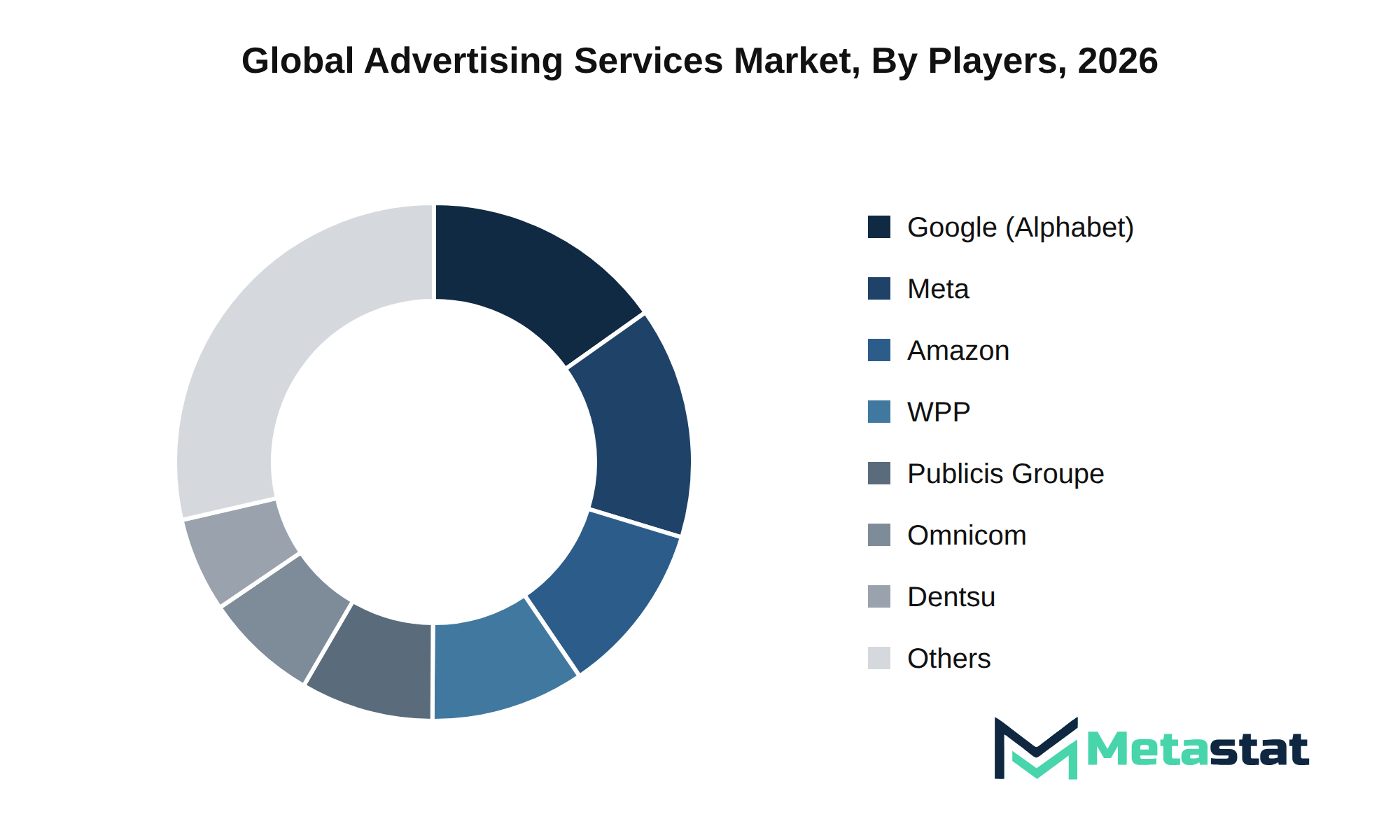
The competitive landscape of the Advertising Services market features significant activity in mergers and acquisitions, strategic alliances, and product differentiation. Companies including Google (Alphabet), Meta, and Amazon engage in strategic consolidation, leveraging extensive resources to enhance market positions. The Trade Desk and WPP focus on advancing proprietary technology, establishing strong barriers to entry for potential new entrants. These companies invest heavily in research and development to maintain technological defensibility and create unique offerings that meet diverse client needs.
Market strategies and competitive dynamics
Commercial models in the Advertising Services market emphasize customer retention strategies and brand equity dynamics. Omnicom and Publicis Groupe prioritize client relationships, which fortify competitive edges. Densu Group, Havas, and Snap Inc. pursue strategic partnerships across industries, augmenting service portfolios and expanding reach. The emphasis on value chain integration enhances procurement leverage, allowing these companies to optimize costs and streamline operations.
The future competitive outlook in the market reflects a focus on innovation and adaptability. Companies like Apple Inc., Microsoft, and Spotify AB emphasize cross-industry collaborations, ensuring relevance in a changing environment. Such strategic growth vectors position these firms to navigate potential disruptions and maintain market presence.
Forecast and Future Outlook
Market size is forecast to rise from USD 642.6 billion in 2025 to over USD 1,063.9 billion by 2033. The base case projects a compound annual growth rate (CAGR) of 6.5% during this period. The bull case involves accelerated growth driven by advancements in next-generation technologies and increasing integration of digital advertising solutions, potentially leading to higher demand from various industries. Conversely, the bear case factors in economic downturns and regulatory challenges that could limit growth, posing risks to downstream demand.
Macroeconomic conditions play a crucial role in shaping the Advertising Services market. Economic cycles influence advertising budgets, with companies adjusting spending based on financial performance. In periods of economic expansion, demand for advertising services typically increases, while recessions often lead to spending cuts. The maturity of core industries creates both challenges and opportunities. While traditional sectors stabilize, emerging industries offer new avenues for growth, driving demand for innovative advertising strategies.
Integration of next-generation technologies, including artificial intelligence and data analytics, enhances operational efficiencies and delivers personalized advertising experiences. Investments in research and development facilitate the commercialization of these technologies, enabling businesses to meet evolving consumer preferences. Regulatory evolution influences market dynamics, with compliance milestones impacting advertising strategies and expenditures.
Geopolitical realignments and shifting trade corridors affect global supply chains, causing businesses to adapt their advertising strategies to new market conditions. Strategic capital allocation and infrastructure commitments shape the landscape, influencing where advertising investments occur. Emerging white-space opportunities arise in underserved markets, presenting high-growth pockets for companies willing to innovate and adapt.
Executive-level strategic imperatives focus on defensibility roadmaps and growth recommendations, emphasizing the importance of agility in responding to market changes. Organizations that successfully navigate these dynamics position themselves for sustained growth in the advertising services sector.
The report strategically identifies and profiles the key market players and analyses their core competencies in each sub-segment of the Advertising Services market.
Report Attributes
Details
Study Period
2021-2033
Base Year
2025
Estimated Year
2026
Forecast Period
2026-2033
Historical Period
2021-2025
Growth Rate
CAGR 6.5% from 2026 to 2033
Revenue Unit
USD billion
Segmentation
By Advertising Type, Advertising Channel, Client Type, End-User Industry, and Region
By Region
North America (By Advertising Type, Advertising Channel, Client Type, End-User Industry, and Country)
United States
Canada
Mexico
Europe (By Advertising Type, Advertising Channel, Client Type, End-User Industry, and Country)
Germany
France
UK
Italy
Spain
Russia
Rest of the Europe
Asia Pacific (By Advertising Type, Advertising Channel, Client Type, End-User Industry, and Country)
China
Japan
India
South Korea
Australia
Southeast Asia
Rest of Asia Pacific
South America (By Advertising Type, Advertising Channel, Client Type, End-User Industry, and Country)
Brazil
Argentina
Rest of South America
Middle East and Africa (By Advertising Type, Advertising Channel, Client Type, End-User Industry, and Country)
Saudi Arabia
UAE
South Africa
Rest of Middle East and Africa
What Report Provides
Key Company Market Share, Revenue and Ranking for the Advertising Services Market
Key Market Leaders and Their Competitive Positioning
Full In-Depth Analysis of the Advertising Services Industry
Industry Statistics and Market Dynamics Overview
Segmentation Details of the Advertising Services Market
Historical, Ongoing, and Projected Market Analysis
Assessment of Niche Developments in Advertising Services
Key Strategies of Major Players in the Market
Company Profiles of Key Players in Advertising Services
Unique Selling Propositions of Leading Market Players
End of Report Overview
Frequently Asked Questions
Find answers to common questions about this report
The Advertising Services market size was valued at USD 642.6 billion in 2025, according to the Metastat Insights study.
The Advertising Services market is projected to grow at a CAGR of 6.5% during the forecast period from 2026 to 2033.
The North America Advertising Services market size is estimated to reach USD 478.8 billion by 2033.
Television Advertising leads the Advertising Services market with a projected value of USD 430.9 billion by 2033, reflecting a compound annual growth rate of 12.6%. This segment outpaces others in growth potential and revenue generation.
Key drivers for the Advertising Services market include favorable macroeconomic conditions, including GDP growth and increased capital investment, which enhance consumer spending. technological integration, particularly through automation and artificial intelligence, streamlines advertising processes, improving targeting and engagement with consumers, thereby propelling market growth.
North America holds the dominant share of the Advertising Services market, with a projected value of USD 478.8 billion in 2033, representing 45.2 percent of the total market.
The Advertising Services market growth faces significant challenges from regulatory tightening, economic pressures, and geopolitical fragmentation. Increased compliance hurdles and rising operational costs limit market entry for new providers, while inflationary pressures and supply chain disruptions hinder consumer spending and advertising budgets. These factors create a complex environment that stifles growth and innovation.
Favorable macro-economic conditions, including GDP growth and increased capital investment, enhance product adoption in the Advertising Services market. Digital transformation, driven by automation and artificial intelligence, streamlines advertising processes, enabling more effective targeting and engagement with consumers. These factors collectively create a conducive environment for businesses to invest in innovative advertising strategies.
The Advertising Services market is estimated to reach a valuation of USD 1,063.9 billion by 2033.
Key players in the Advertising Services market include Google (Alphabet), Meta, Amazon, The Trade Desk, WPP, Publicis Groupe, and Omnicom.
Global B2B Event market size was USD 52.5 billion in 2025 and is projected to reach USD 103.9 billion by 2033, growing at a CAGR of 8.9%. Segment analysis.
Executive B2B Conferences and Curated Business Events Market
Executive B2B Conferences and Curated Business Events market size is valued at USD 1,004.1 billion in 2025 and projected to reach USD 1,516.3 billion by.
Executive B2B Conferences and Curated Business Events market, Executive B2B Conferences and Curated Business Events Market Size, Executive B2B Conferences and Curated Business Events Market Share, Executive B2B Conferences and Curated Business Events Market Analysis, Executive B2B Conferences and Curated Business Events Market Growth, Executive B2B Conferences and Curated Business Events Market Trends, Executive B2B Conferences and Curated Business Events Market Research Report, Executive B2B Conferences and Curated Business Events Market Forecast, Executive B2B Conferences and Curated Business Events, Executive B2B Conferences and Curated Business Events Market Research, Executive B2B Conferences and Curated Business Events Industry, Executive B2B Conferences and Curated Business Events Industry Report, Executive B2B Conferences and Curated Business Events Market Data, Executive B2B Conferences and Curated Business Events Statistics, Executive B2B Conferences and Curated Business Events Market Statistics, Executive B2B Conferences and Curated Business Events Industry Trends, Executive B2B Conferences and Curated Business Events Market Report, Executive B2B Conferences and Curated Business Events Market Trends, Executive B2B Conferences and Curated Business Events Market News, Executive B2B Conferences and Curated Business Events Forecasts, Executive B2B Conferences and Curated Business Events Market Intelligence Report, Executive B2B Conferences and Curated Business Events Market Outlook, Executive B2B Conferences and Curated Business Events Market Segmentation, Executive B2B Conferences and Curated Business Events Market Drivers, Executive B2B Conferences and Curated Business Events Market Restraints, Executive B2B Conferences and Curated Business Events Market Opportunities, Executive B2B Conferences and Curated Business Events Market CAGR, Executive B2B Conferences and Curated Business Events Suppliers, Executive B2B Conferences and Curated Business Events Manufacturers, Executive B2B Conferences and Curated Business Events Market by Region, North America Executive B2B Conferences and Curated Business Events Market, Asia Pacific Executive B2B Conferences and Curated Business Events Market, Europe Executive B2B Conferences and Curated Business Events Market, Executive B2B Conferences and Curated Business Events Market Competitive Landscape, Executive B2B Conferences and Curated Business Events Market Key Players, Executive Conferences & Summits Market, Leadership Forums & Roundtables Market, Corporate Meetings & Leadership Retreats Market, Industry Congresses & Professional Conferences Market, Workshops & Masterclasses Market, Networking & Peer-Exchange Events Market, Awards & Recognition Events Market, Open Registration Executive B2B Conferences and Curated Business Events, Invitation-Only Executive B2B Conferences and Curated Business Events, In-Person Executive B2B Conferences and Curated Business Events, Virtual Executive B2B Conferences and Curated Business Events, Technology & Telecommunications Executive B2B Conferences and Curated Business Events Market, BFSI Executive B2B Conferences and Curated Business Events Market.
Industrial Inspection and Technical Services Outsourcing
Industrial Inspection and Technical Services Outsourcing market size is valued at USD 35.2 billion in 2025 and projected to reach USD 60.1 billion by 2033.
Industrial Inspection and Technical Services Outsourcing market, Industrial Inspection and Technical Services Outsourcing Market Size, Industrial Inspection and Technical Services Outsourcing Market Share, Industrial Inspection and Technical Services Outsourcing Market Analysis, Industrial Inspection and Technical Services Outsourcing Market Growth, Industrial Inspection and Technical Services Outsourcing Market Trends, Industrial Inspection and Technical Services Outsourcing Market Research Report, Industrial Inspection and Technical Services Outsourcing Market Forecast, Industrial Inspection and Technical Services Outsourcing, Industrial Inspection and Technical Services Outsourcing Market Research, Industrial Inspection and Technical Services Outsourcing Industry, Industrial Inspection and Technical Services Outsourcing Industry Report, Industrial Inspection and Technical Services Outsourcing Market Data, Industrial Inspection and Technical Services Outsourcing Statistics, Industrial Inspection and Technical Services Outsourcing Market Statistics, Industrial Inspection and Technical Services Outsourcing Industry Trends, Industrial Inspection and Technical Services Outsourcing Market Report, Industrial Inspection and Technical Services Outsourcing Market Trends, Industrial Inspection and Technical Services Outsourcing Market News, Industrial Inspection and Technical Services Outsourcing Forecasts, Industrial Inspection and Technical Services Outsourcing Market Intelligence Report, Industrial Inspection and Technical Services Outsourcing market outlook, Industrial Inspection and Technical Services Outsourcing market segmentation, Industrial Inspection and Technical Services Outsourcing market drivers, Industrial Inspection and Technical Services Outsourcing market restraints, Industrial Inspection and Technical Services Outsourcing market opportunities, Industrial Inspection and Technical Services Outsourcing market CAGR, Industrial Inspection and Technical Services Outsourcing suppliers, Industrial Inspection and Technical Services Outsourcing manufacturers, North America Industrial Inspection and Technical Services Outsourcing market, Asia Pacific Industrial Inspection and Technical Services Outsourcing market, Europe Industrial Inspection and Technical Services Outsourcing market, Industrial Inspection and Technical Services Outsourcing market competitive landscape, Industrial Inspection and Technical Services Outsourcing market key players, Third-Party Inspection and Vendor Surveillance market, Non-Destructive Testing and Examination market, Asset Integrity and Mechanical Integrity Management market, Quality Assurance and Quality Control market, Oil and Gas Industrial Inspection and Technical Services Outsourcing market, Power Generation and Utilities Industrial Inspection and Technical Services Outsourcing market.
Language Services Market Size, Share, Trends, 2033
Global Language Services market size: USD 79.7 billion in 2025, forecast USD 146.5 billion by 2033 at a 7.9% CAGR, with segment and regional analysis.
Language Services market, Language Services Market Size, Language Services Market Share, Language Services Market Analysis, Language Services Market Growth, Language Services Market Trends, Language Services Market Research Report, Language Services Market Forecast, Language Services, Language Services Market Research, Language Services Industry, Language Services Industry Report, Language Services Market Data, Language Services Statistics, Language Services Market Statistics, Language Services Industry Trends, Language Services Market Report, Language Services Market Trends, Language Services Market News, Language Services Forecasts, Language Services Market Intelligence Report, Language Services market 2033, Language Services market outlook, Language Services market segmentation, Language Services market drivers, Language Services market restraints, Language Services market opportunities, Language Services market CAGR, Language Services suppliers, Language Services manufacturers, Language Services market by region, North America Language Services market, Asia Pacific Language Services market, Europe Language Services market, Language Services market competitive landscape, Language Services market key players, Translation Services market, Localization Services market, Interpretation Services market, Multilingual Content Management Services market, Cloud-based Language Services market, Machine Translation market, Generative AI Translation market, Healthcare Language Services market.