Global B2B Event Market Size, Share, By Event Type (Conferences and Congresses, Trade Shows and Exhibitions, Corporate Meetings, Seminars and Workshops, Webinars and Virtual Conferences, and Product Launches and Roadshows), By Event Format (In-Person, Virtual, and Hybrid), By Event Sizes (Small Events, Medium Events, Large Events, and Mega Events), By End-User Industry (Information Technology and Telecommunications, Healthcare and Life Sciences, Manufacturing and Industrial, Financial Services, Energy and Utilities, Automotive and Transportation, Media and Entertainment, Retail and Consumer Goods, Government and Public Sector, and Others), Industry Analysis, Growth, Trends, and Forecast, 2026-2033
Report ID
MSI-4928
Published
August 14, 2026
Pages
305 Pages
Format
Market Size 2021
$37.8 Billion
Historical
Market Size 2025
$52.5 Billion
Base year
Market Size 2033
$103.9 Billion
Forecast
CAGR 2025-2033
8.9%
Forecast period
Report Details
Comprehensive Market Analysis And Insights
Market Overview
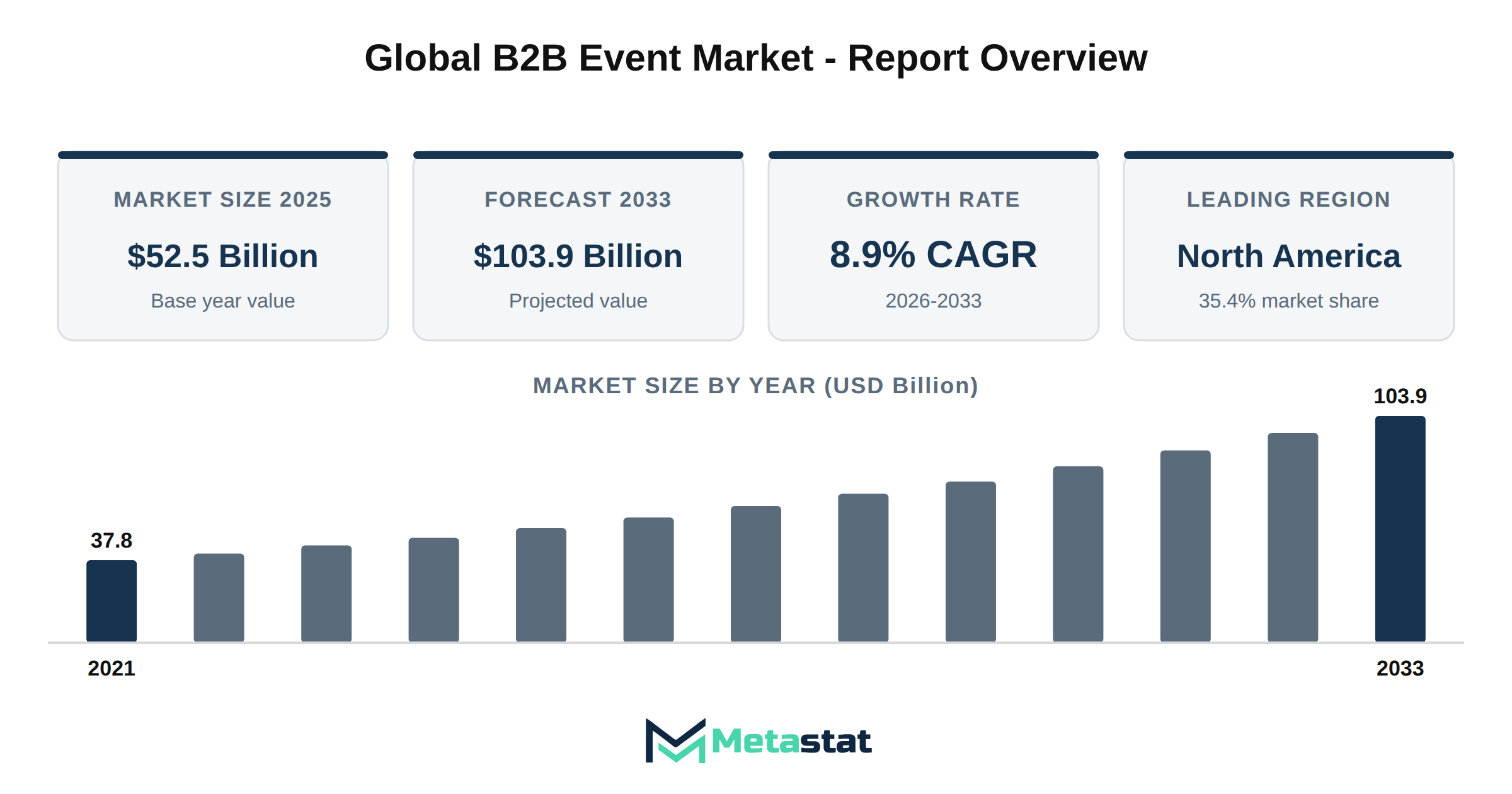
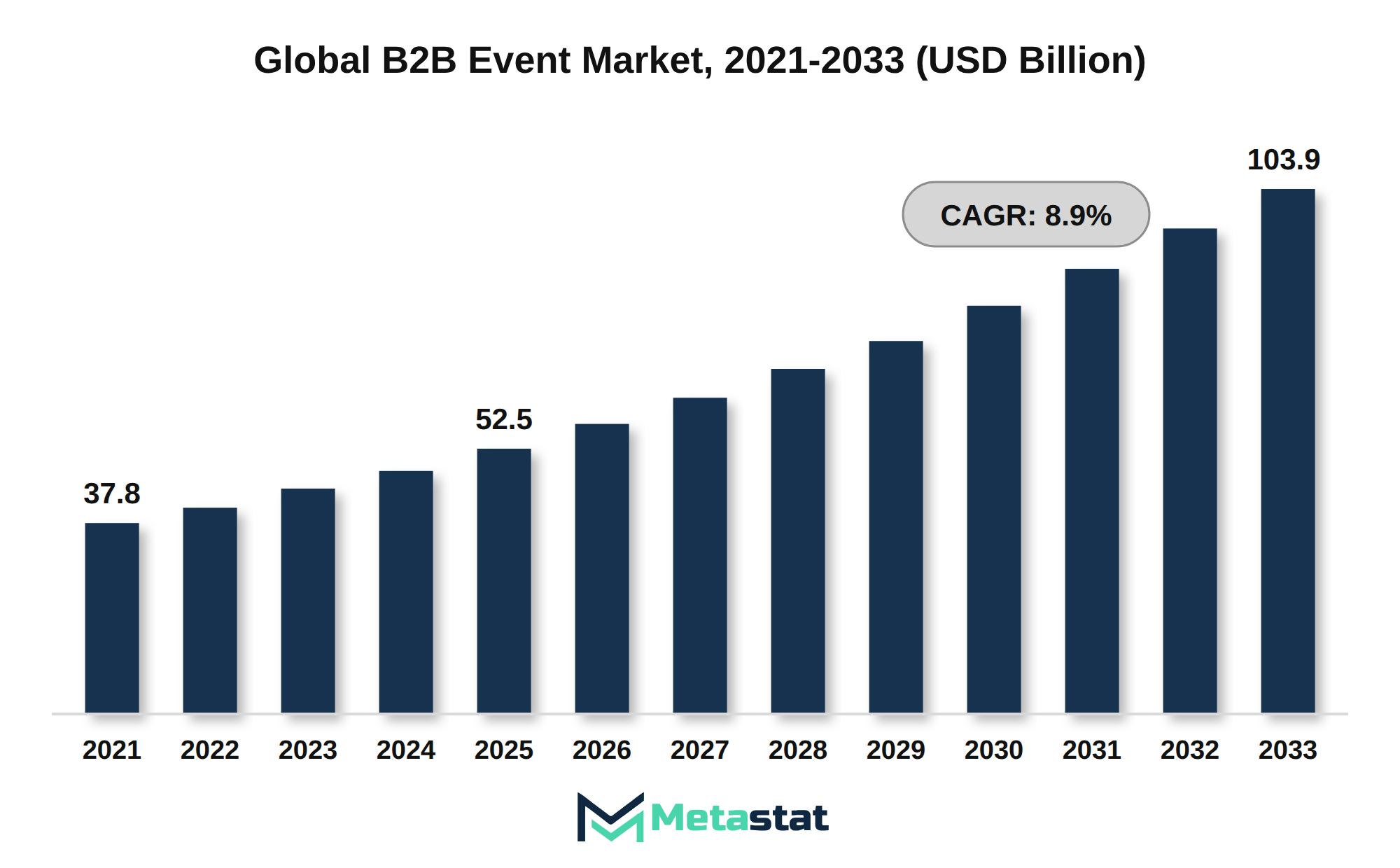
The global B2B Event market was valued at USD 52.5 billion in 2025 and is projected to reach USD 103.9 billion by 2033, growing at a CAGR of 8.9% over the forecast period.
The B2B Event market reached a value of USD 52.5 billion in 2025, reflecting significant growth from USD 37.8 billion in 2021. The market is projected to expand to USD 103.9 billion by 2033, with a compound annual growth rate (CAGR) of 8.9% over the forecast period from 2026 to 2033. This growth trajectory highlights increasing investments in event organization and participation across various sectors.
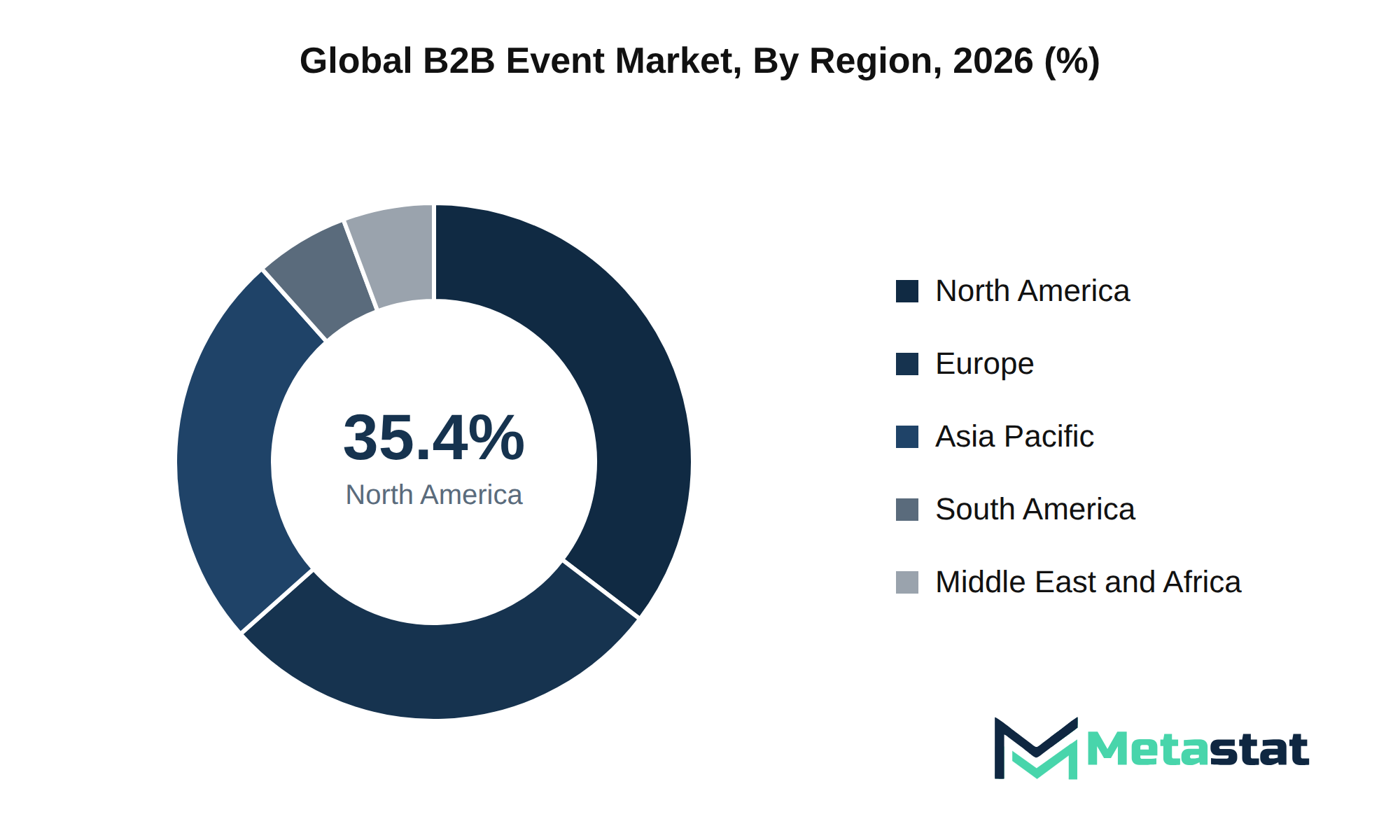
North America holds the largest share of the market at 35.4%, followed by Europe at 28.1% and Asia Pacific at 25%. The expected value of the North American market alone is USD 35.3 billion by 2033, maintaining a CAGR of 8.9%. This regional dominance reflects strong demand for B2B events, driven by robust corporate engagement and investment in networking opportunities.
In terms of event types, conferences and congresses are anticipated to grow from USD 17.1 billion in 2026 to USD 29.2 billion in 2033, with a CAGR of 7.9%. Trade shows and exhibitions are projected to reach USD 27 billion by 2033, highlighting their critical role in facilitating business interactions. Corporate meetings and seminars will contribute to the growth, with the market for corporate meetings expected to reach USD 15.6 billion by 2033.
The transition towards hybrid and virtual formats is reshaping the event landscape. The in-person segment is projected to increase from USD 41.1 billion in 2026 to USD 72.8 billion by 2033, demonstrating a strong preference for face-to-face interactions. Virtual events are expected to reach USD 17.7 billion by 2033, while hybrid events will account for USD 13.5 billion, reflecting the shift in how businesses engage and connect.
The B2B Event market faces significant challenges from inflationary pressures and currency volatility, impacting pricing strategies and operational costs. Companies within the market navigate these economic headwinds, which influence investment decisions and overall profitability. Ongoing fluctuations in currency exchange rates lead to unpredictable financial outcomes, necessitating agile financial management and strategic planning.
Corporate imperatives increasingly focus on sustainable transformation and decarbonization efforts. Stakeholders demand environmentally responsible practices within the market, prompting organizations to adopt circular economy dynamics. This shift not only aligns with global sustainability goals but enhances brand reputation, attracting environmentally conscious clients and partners.
Next-gen innovation drives competitive advantage, with firms investing in advanced technologies to enhance event experiences. The integration of digital tools and platforms streamlines processes, improves engagement, and optimizes resource allocation. Such innovations are expected to shape the customer journey dynamics, influencing future expectations and interactions within the market.
Market fragmentation presents both challenges and opportunities for players in the B2B Event landscape. Diverse event types, formats, and end-user industries create a complex environment where tailored strategies become essential. M&A dynamics emerge because companies pursue consolidation to enhance market share and operational efficiencies, influenced by evolving customer needs.
Capital allocation trends indicate a strong emphasis on infrastructure investments, essential for supporting growth in the B2B Event market. Companies allocate resources towards developing innovative venues and enhancing logistical capabilities to meet increasing demand. Investments in technology and infrastructure are anticipated to drive improved operational efficiency and customer satisfaction.
Overall, the B2B Event market exhibits a strong growth trajectory, fueled by structural changes and evolving market dynamics. Firms that adapt to these trends while maintaining a strong focus on sustainability and innovation are expected to secure a competitive edge and achieve long-term success.
Market Dynamics
Capital investment environments drive B2B Event growth
The growth of the B2B Event market relies significantly on capital investment environments, characterized by favorable interest rates and robust GDP growth. These conditions stimulate increased spending power among both public and private sectors, facilitating the organization of more events and enhancing event-related activities. Strong economic indicators create a climate conducive to investment in event infrastructure and technology, allowing companies to allocate greater budgets for conferences, trade shows, and corporate meetings. This expansion is expected to strengthen long-term demand within the market.
Growing venture funding further supports innovation within the market, enabling new solutions to emerge that enhance attendee engagement and operational efficiency. Increased venture capital investment in event technology companies drives the development of advanced digital platforms and tools, contributing to the overall growth of the B2B Event market. Organizations adopting these innovative solutions streamline event planning and execution, resulting in higher productivity rates and improved cost management. This trend is anticipated to widen commercial adoption of event technologies.
The positive economic climate encourages businesses to explore new networking opportunities through events, expanding their reach and market presence. This trend increases demand for various event types, including seminars and workshops, thus driving growth across the market. Overall, a solid capital investment environment promotes expansion in the B2B Event market, resulting in enhanced experiences for attendees and increased revenue generation for organizers. This dynamic is projected to reinforce the segment's position in the coming years.
The B2B Event market experiences growth driven by shifting consumer behaviors. Changes in lifestyle and urbanization patterns influence how companies interact with their clients and stakeholders. Increasing demand for personalized experiences leads businesses to invest in tailored events that prioritize engagement and connection.
Aging populations contribute to evolving buying preferences, particularly in sectors like healthcare and technology. Organizations adapt their event strategies to cater to the interests and needs of older demographics, enhancing outreach and participation. This adaptation supports market expansion, driven by companies innovating their approaches to event formats, including hybrid and virtual options.
The emergence of new consumer expectations drives the demand for enhanced digital integration. Businesses leverage technology to streamline processes and improve the attendee experience, thereby improving operational productivity. These advancements not only enhance engagement but attract a diverse audience, reinforcing the market's growth trajectory.
The overall impact of shifting consumer behaviors creates opportunities within the B2B Event market. By aligning event strategies with current trends and preferences, organizations strengthen their market presence and drive revenue growth. Consequently, building deeper connections with their target audiences ensures long-term success and sustainability in this competitive environment.
Regulatory challenges restrict B2B Event growth
The B2B Event market experiences constraints stemming from various regulatory challenges, which heighten compliance hurdles for event organizers. Regulatory tightening creates significant barriers, making it essential for businesses to navigate complex requirements. This landscape involves compliance with legal mandates that vary across regions, adding layers of complexity and operational costs. Such factors directly impact event planning and execution, resulting in increased timelines and expenditures.
Macroeconomic headwinds, including inflationary pressures, contribute to rising costs for organizing events. These pressures affect budgets for marketing, venue selection, and participant engagement, leading to financial constraints for many firms in the market. High operational costs and capital investment requirements deter companies from pursuing large-scale events, resulting in a more cautious approach in event planning.
Supply chain disruptions and geopolitical instability further complicate the situation, impacting the availability of essential resources and materials for event organization. Ongoing uncertainties in global supply chains make securing the necessary infrastructure for physical events increasingly challenging. This disruption leads to delays and additional costs, limiting the ability to deliver successful events.
The market confronts technological obsolescence, which increases the risk of outdated event formats and platforms. Companies invest in new technologies and tools to remain competitive, diverting funds from other critical areas. This need for continuous investment creates a burden for smaller players, who find it difficult to keep pace with larger competitors.
Overall, these regulatory and economic challenges pose significant restraints on the growth potential of the B2B Event market. The cumulative effect of compliance requirements, rising operating costs, and technological demands necessitates a strategic approach for companies looking to maintain their market positions and ensure successful event delivery.
The B2B Event market encounters significant challenges owing to geopolitical fragmentation, which disrupts international collaboration and leads to inconsistent regulatory environments. Heightened trade deficits and tariff friction create uncertainty, affecting cross-border participation in events and limiting access to critical resources. Stakeholders face increased operational costs that arise from navigating complex compliance landscapes, with compliance overhead straining budgets and impacting overall profitability.
Technological disruptions play a crucial role, because firms grapple with the integration of new technologies while evolving legal liabilities. This complexity hinders the ability to adopt innovative solutions that enhance event experiences, thereby reducing competitive advantages. Concurrently, supply chain instability and logistics disruptions contribute to rising input costs, exacerbating financial pressures on companies operating within the market.
Tight labor markets present workforce skill gaps, creating difficulties in sourcing talent equipped to manage modern event formats and technologies. Automation displacements further complicate this issue, because businesses transition to newer operational models while seeking to retain skilled personnel. Environmental considerations, including decarbonization mandates and sustainability demands, necessitate adjustments in event planning and execution, placing additional burdens on resources.
These myriad challenges necessitate strategic adjustments within the B2B Event market. Firms navigate a landscape marked by shifting geopolitical dynamics, rising costs, and evolving participant expectations, all while striving to maintain competitive positioning and drive growth.
The B2B Event market is positioned for substantial growth driven by emerging technological innovations that reshape how events are conceptualized, managed, and experienced. Innovations in virtual and hybrid event formats enhance accessibility, allowing organizers to attract a wider audience while maintaining engagement. Enhanced digital tools streamline event planning and execution, improving operational efficiency and attendee satisfaction.
Geographical expansion further contributes to market dynamics. Regions including Asia Pacific and South America exhibit increasing demand for B2B events due to growing economies and a rising number of businesses looking to network and collaborate. This geographical diversification attracts investments and drives infrastructure modernization, reinforcing the market's growth trajectory.
The integration of advanced technologies, including artificial intelligence and data analytics, provides organizers with valuable insights into attendee behaviors and preferences. Such data-driven approaches enable targeted marketing strategies and personalized experiences, strengthening connections between businesses and their audiences. The B2B Event market benefits directly from this enhanced engagement, leading to increased attendance and participation rates.
Sustainability initiatives increasingly influence market dynamics, driven by companies seeking to align their events with environmentally responsible practices. Adopting eco-friendly solutions not only fulfills corporate social responsibility commitments but attracts environmentally conscious participants. The market's adaptability in addressing sustainability imperatives enhances its reputation and broadens its appeal among stakeholders.
The emergence of niche applications within the market further supports growth. Specialized events targeting specific industries or interests attract dedicated audiences, creating deeper connections and collaboration opportunities. This trend allows event organizers to capture untapped market segments and drive value for both exhibitors and attendees.
Technological advancements and shifting consumer behaviors create a fertile environment for the B2B Event market. Businesses that leverage these innovations and adapt to evolving demands are well-positioned to thrive in a rapidly changing environment.
Market Segmentation Analysis
The Global B2B Event market is segmented based on Event Type, Event Format, Event Sizes, and End-User Industry.
By Event Type, the market is further segmented into:
Conferences and Congresses
Trade Shows and Exhibitions
Corporate Meetings
Seminars and Workshops
Webinars and Virtual Conferences
Symposiums and Industry Forums
Product Launches and Roadshows
Conferences and Congresses
Valued at USD 17.1 billion in 2026, the Conferences and Congresses segment is projected to reach USD 29.2 billion by 2033, at a CAGR of 7.9% during the forecast period. This sub-segment experiences growth driven by increasing corporate investment in knowledge sharing and networking opportunities among professionals. Organizations actively pursue conferences to enhance industry knowledge and create valuable partnerships, fueling demand within the B2B Event market.
Segment expansion stems from the rise of virtual and hybrid formats, which broaden the audience reach and enable participation without geographical constraints. This shift accommodates diverse schedules and preferences, attracting attendees who prioritize flexibility. Consequently, businesses capitalize on this trend, participating in conferences to gain insights across various sectors, further driving market demand.
Technological advancements play a significant role in shaping this segment, with innovations enhancing attendee experiences and engagement. Tools including event management software streamline the planning process, while data analytics provide insights to organizers. These technological enhancements lead to improved event outcomes and higher satisfaction rates among participants, driving continued investment in conferences and congresses.
End-user industries, including Information Technology, Healthcare, and Automotive, actively participate in this segment to stay competitive. These sectors recognize the importance of knowledge transfer and collaboration, engaging in conferences to remain informed of industry trends and regulatory changes. The growing emphasis on professional development within these industries further fuels the demand for conferences and congresses.
Overall, the Conferences and Congresses segment stands because a vital component of the B2B Event market, driven by evolving business practices, technological maturation, and the quest for continuous improvement within various industries.
Trade Shows and Exhibitions
Sub-segment Trade Shows and Exhibitions (By Event Type)
Trade Shows and Exhibitions segment is estimated to reach USD 27 billion by 2033, at a CAGR of 8.4% during the forecast period. Rising demand for face-to-face interactions in business continues to fuel growth within the B2B Event market. Companies seek to build relationships through in-person engagements, creating opportunities for networking and collaboration. This trend aligns with the ongoing emphasis on creating immersive experiences that enhance brand visibility and customer engagement.
Technological advancements play a crucial role in shaping trade shows and exhibitions. Digital solutions, including event management platforms and virtual event technology, enhance attendee experiences and streamline operations. This evolution encourages companies to adopt innovative formats, integrating both physical and digital elements to reach broader audiences. The B2B Event market benefits from this integration, driving interest and participation in events.
Consumer behavior shifts significantly influence the dynamics of the segment. Organizations prioritize events that offer value, including targeted networking opportunities and educational content. This shift necessitates a focus on delivering high-quality experiences that engage attendees. While companies adapt to these evolving expectations, demand for tailored events rises, contributing to overall market expansion.
Regulatory compliance and health considerations remain critical factors impacting the segment. Adherence to local regulations and safety protocols shapes event planning and execution. These considerations ensure that events maintain a safe environment for all participants, which is essential for sustaining trust and engagement. Consequently, companies invest in developing robust safety measures to enhance attendee confidence, directly affecting participation rates and business outcomes.
Overall, the interaction of demand drivers, technological advancements, and regulatory factors positions the Trade Shows and Exhibitions segment for continued growth within the B2B Event market. Organizations that leverage these dynamics effectively capitalize on emerging opportunities and enhance their market presence.
Corporate Meetings
Sub-segment Corporate Meetings (By Event Type)
Growth within the Corporate Meetings segment aligns with increasing organizational needs for effective internal and external communication strategies. Companies recognize the value of face-to-face engagements for relationship building and decision-making, driving demand across various industries. This segment is projected to reach USD 15.6 billion by 2033.
Technological advancements play a critical role in transforming how corporate meetings occur. Enhanced virtual platforms facilitate effective connections, broadening participation opportunities regardless of geographical constraints. This shift towards hybrid formats strengthens audience engagement while optimizing costs associated with travel and logistics.
End-user industries including Information Technology, Healthcare, and Manufacturing increasingly prioritize corporate meetings to drive strategic initiatives. These sectors particularly benefit from targeted discussions, encouraging innovation and collaboration. While companies continue adapting to remote work trends, the demand for structured corporate meetings is expected to rise, reinforcing the B2B Event market's trajectory.
Cost structures associated with organizing corporate meetings pose challenges, especially for smaller enterprises. However, investment in technology and streamlined processes enhances efficiency and reduces overall expenses. The focus on maximizing the return on investment during corporate meetings influences spending patterns and shapes the competitive environment.
Seminars and Workshops
The growth trajectory of seminars and workshops within the B2B Event market reflects a robust interest in interactive learning and networking opportunities. Increasing demand for knowledge sharing and professional development drives this segment forward. Organizations prioritize skill enhancement and collaboration, leading to a rise in investment toward these events.
Seminars and workshops remain essential for various industries, particularly in sectors including information technology, healthcare, and education, where continuous learning is critical. The segment benefits from advancements in technology, facilitating virtual and hybrid formats that expand reach and accessibility.
The seminars and workshops segment is projected to grow at a CAGR of 7.7% during the forecast period. This growth aligns with the ongoing trend of digital transformation, enabling organizations to host events that engage participants regardless of location.
With an increased focus on real-time feedback and interactive participation, companies investing in high-quality content and expert facilitators experience enhanced attendee satisfaction and retention. Heightened engagement leads to better networking opportunities and the establishment of valuable connections.
The evolving regulatory landscape influences the structure and content of these events, prompting organizers to adapt and comply with new standards. The B2B Event market, particularly in the seminars and workshops segment, thrives on continuous adaptation and innovation, addressing the dynamic needs of its audience.
Webinars and Virtual Conferences
Increasing acceptance of digital platforms drives growth in the Webinars and Virtual Conferences sub-segment of the B2B Event market. Organizations seek cost-effective and flexible alternatives to traditional events, enabling broader participation across diverse geographical locations. Enhanced interactivity and engagement features in virtual formats provide opportunities for effective networking and collaboration, attracting a range of industries including Information Technology, Healthcare, and Financial Services.
Technological advancements and the maturation of webinar software enable integration with various business tools, improving user experience and operational efficiency. These innovations lead to higher adoption rates and prompt organizations to explore advanced features, including artificial intelligence and data analytics, which enhance event effectiveness. Increased emphasis on sustainability and reduced travel needs further drives the shift toward virtual formats, aligning with corporate social responsibility initiatives.
Companies within the B2B Event market recognize the necessity of adapting to consumer preferences, prompting significant investment in platform development and marketing strategies. An increasing number of enterprises prioritize virtual and hybrid events, ensuring they remain competitive in an evolving market. The ability to collect real-time feedback and analytics during virtual events contributes to ongoing improvements in content delivery and audience engagement strategies.
Regulatory requirements and compliance standards associated with digital events influence the adoption of webinars and virtual conferences. Organizations strive to meet industry-specific certification demands, ensuring a robust and legally compliant framework for their online offerings. These factors shape future investments and strategies within the market, positioning businesses to capitalize on emerging opportunities while maintaining operational integrity.
Symposiums and Industry Forums
Sub-segment Symposiums and Industry Forums (By Event Type)
Growing interest in specialized knowledge-sharing and networking opportunities drives demand for symposiums and industry forums within the B2B Event market. These events enable the exchange of ideas among professionals across various sectors, enhancing collaboration and encouraging innovation.
Adoption of technology in event planning and execution supports the growth of symposiums and industry forums. Advanced digital platforms streamline registration, enhance attendee engagement, and provide analytics that inform future event strategies. This technological maturation positions organizers to create more engaging experiences, attracting a wider audience.
Evolution of industry standards influences the structure and format of symposiums and industry forums. Regulatory compliance and certification requirements shape the content and quality of these events, ensuring they meet the expectations of attendees and stakeholders. This focus on quality enhances the perceived value of participation, encouraging increased attendance.
Shifts in consumption patterns towards more personalized experiences impact the structure of symposiums and industry forums. Customization of event agendas and interactive formats aligns with attendee preferences, making these gatherings more appealing. This trend contributes to the growth within the segment, driven by organizations seeking to provide tailored experiences that address specific industry challenges.
Strategic investment in symposiums and industry forums opens new avenues for engagement and knowledge dissemination. Industry leaders recognize the potential of these events to highlight innovations and establish expertise. Heightened focus on strategic opportunity windows allows organizations to leverage industry forums for networking, collaboration, and brand promotion.
Product Launches and Roadshows
Product launches and roadshows within the B2B Event market represent critical opportunities for companies to present innovations and engage key stakeholders. Organizations recognize the importance of these events in generating awareness, driving sales, and building relationships. The demand for product launches often stems from the need for direct engagement with target audiences, allowing brands to convey their value propositions effectively.
Technological maturation influences these events, enabling enhanced presentation techniques and interactivity. Advances in virtual and hybrid formats have expanded the scope of product launches, allowing companies to reach wider audiences without geographical constraints. This shift towards integrated event formats is influencing the overall strategy of firms seeking to maximize visibility and engagement during launches.
Downstream applications of products introduced in these events significantly affect various end-user industries, including technology, healthcare, and consumer goods. Successful product launches lead to increased adoption rates, thereby enhancing market penetration for new offerings. Consumption shifts towards experiential and interactive formats increase the importance of creating memorable launch experiences.
While competition intensifies, organizations face pressures related to cost structures and pricing volatility when planning product launches. Firms increasingly seek to optimize budgeting for these events while ensuring substantial returns on investment. Strategic opportunity windows emerge owing to businesses aiming to align product launches with market trends and consumer preferences.
Product launches and roadshows comprise a vital segment of the B2B Event market, characterized by their emphasis on direct engagement and technological integration. Companies that strategically leverage these opportunities position themselves for enhanced growth and competitive advantage.
By Event Format, the market is further segmented into:
In-Person
Virtual
Hybrid
In-Person
Valued at USD 41.1 billion in 2026, the In-Person segment is projected to reach USD 72.8 billion by 2033, at a CAGR of 8.5% during the forecast period. Growth in this segment stems from the increasing importance of face-to-face interactions in business relationships, with organizations prioritizing in-person events to enhance networking and collaboration. The demand for quality engagements, particularly in sectors including information technology and healthcare, drives a preference for in-person formats, driven by participants seeking immersive experiences that virtual alternatives struggle to replicate.
Technological maturation facilitates enhancements in the planning and execution of in-person events, boosting overall attendee satisfaction. Innovations in event management technologies streamline logistics, enhance personalization, and improve engagement, leading to higher participant retention rates. The availability of real-time data analytics enables event organizers to refine their strategies based on attendee behavior and preferences, supporting further segment expansion.
Shifts in consumption patterns reflect a growing inclination towards in-person experiences because businesses recognize the value of in-person networking and collaboration. This trend indicates a robust demand for venues capable of hosting large-scale events and catering to diverse audiences. Strategic opportunity windows are emerging for industry players that focus on delivering high-quality, engaging experiences tailored to specific audience segments.
Pricing volatility remains a consideration, particularly in relation to venue costs and service provisions. However, overall margins within the segment are strengthened by a robust demand for unique and engaging experiences that justify premium pricing. The evolving landscape of the B2B Event market positions the In-Person segment for continued resilience and growth, supported by ongoing investment in quality event offerings.
Virtual
Growth in the Virtual segment of the B2B Event market reflects the increasing preference for remote accessibility and flexible participation. Continued advancements in technology enhance user experience and engagement, driving adoption across various industries. Organizations recognize the cost-effectiveness of virtual events, with the ability to reach wider audiences without geographical constraints. The shift from traditional in-person gatherings to online formats is supported by convenience and scalability, which play significant roles.
Virtual segment is estimated to reach USD 17.7 billion by 2033, at a CAGR of 8.2% during the forecast period. The demand for virtual events expands due to organizations seeking innovative solutions to engage stakeholders effectively. Strategic investments in digital infrastructure facilitate effective interactions, contributing to overall market growth. This segment's evolution results from increasing investments in online platforms and tools that enhance the virtual experience, aligning with the broader trends observed in the B2B Event market.
While businesses adapt to changing expectations, the Virtual segment captures attention due to its potential for cost savings and increased reach. Industries including Information Technology, Healthcare, and Education actively adopt virtual formats to host conferences, workshops, and training sessions. This adaptability strengthens the market's position, creating new opportunities for specialized providers to deliver tailored solutions.
The growth trajectory of the Virtual segment reflects the shift towards digital engagement in the B2B Event market. Organizations leveraging this trend benefit from broader outreach while maintaining operational efficiency. The emphasis on technology-driven solutions positions the market for sustained expansion in the coming years.
Hybrid
Continuous growth in the Hybrid segment reflects increasing demand for flexible event formats that combine the benefits of in-person and virtual interactions. This trend results from evolving consumer preferences for personalized engagement, allowing participants to choose their preferred way of attending. Industries that adopt hybrid events include information technology, healthcare, and education, because these sectors benefit from enhanced reach and accessibility.
Investment in next-generation technologies, including virtual reality and advanced streaming solutions, facilitates immersive experiences, encouraging wider adoption of hybrid events. Organizations prioritize creating connections, thus driving the need for innovative formats that accommodate diverse audiences. The B2B Event market aligns with this shift, enabling companies to cater to different audience preferences while maximizing participation.
Hybrid segment is expected to reach USD 13.5 billion by 2033. This growth correlates with increased focus on sustainability, because hybrid events often reduce the carbon footprint associated with travel and logistics. Companies actively seek cost-effective solutions that ensure higher return on investment while expanding their reach. The flexibility of hybrid formats allows businesses to adapt to changing market conditions and audience needs.
While the market evolves, competition intensifies among event organizers and technology providers. Market players invest in better tools and platforms to enhance user experiences, thereby improving overall engagement. The continued development of robust digital infrastructure supports the expansion of hybrid events, making them a crucial component of the B2B Event ecosystem.
By Event Sizes, the market is further segmented into:
Small Events
Medium Events
Large Events
Mega Events
Small Events
In the B2B Event market, the sub-segment of small events features a unique characteristic of enabling personalized interactions and targeted networking opportunities. This segment thrives on rising demand for tailored experiences that cater to niche audiences, promoting engagement and meaningful connections among participants. The trend toward smaller gatherings aligns with companies seeking to create intimate discussions and focused agendas, particularly in industries including healthcare and technology.
Adoption of small events is influenced by flexibility in planning and execution, allowing organizers to create cost-effective solutions that drive attendance. The segment benefits from technological enhancements, with advancements in event management platforms enabling efficient registration, attendee engagement, and feedback collection. This technological maturation supports growth of small events, enhancing the overall experience for both organizers and participants.
Consumption shifts indicate a preference for smaller, more interactive formats, especially in the wake of recent global events that have reshaped how organizations approach gatherings. Businesses increasingly recognize the value of smaller events in building relationships, sharing knowledge, and facilitating collaboration. This evolution in end-use dynamics positions the small events segment favorably within the broader context of the B2B Event market.
Strategic opportunity windows arise from the growing emphasis on customization and personalization in event experiences. Stakeholders have the chance to enhance their offerings by integrating next-gen upgrades that cater to specific audience needs. While competition intensifies within the market, businesses focusing on small events leverage these trends to differentiate themselves and capture a larger share of the market.
Medium Events
Sub-segment Medium Events (By Event Sizes)
Increasing demand for medium-sized events stems from the need for organizations to balance between large-scale events and intimate gatherings. These events create networking opportunities while maintaining a manageable scale for both organizers and attendees. Industries including Information Technology, Healthcare, and Manufacturing actively engage in medium events to build collaborations and share insights within specific sectors. The adoption of hybrid formats enhances accessibility, allowing participants to join remotely while providing options for in-person attendance. This flexibility accommodates diverse preferences and expands the potential audience base.
Technological advancements drive the evolution of medium events, with innovative tools enhancing attendee engagement and interaction. Platforms offering efficient registration, real-time analytics, and post-event follow-ups enable organizers to assess event effectiveness and improve future offerings. The rise of digital marketing strategies and social media promotion transforms how these events attract participants, generating heightened interest and attendance.
Challenges in pricing and cost structures affect the execution of medium events. Budget constraints limit the scope and reach of these gatherings, compelling organizers to seek alternative funding avenues or partnerships. Nevertheless, strategic opportunity windows for medium events remain robust, particularly within industries focused on knowledge exchange and networking. While businesses adapt to the evolving landscape of event formats, the B2B Event market continues to explore innovative solutions to enhance the medium events segment.
Large Events
Large events within the B2B Event market benefit from several primary demand drivers, including the growing need for companies to engage a large audience in a single venue. This format allows for extensive networking opportunities and the presentation of various products and services, attracting both exhibitors and attendees. Adoption of large events thrives in sectors where significant industry gatherings enhance brand visibility and create partnerships, particularly in industries including Information Technology, Healthcare, and Manufacturing.
Factors contributing to expansion in the large events segment include technological maturation and the introduction of next-gen upgrades in event management. Advanced tools and platforms streamline the planning and execution of these events, allowing for enhanced attendee experiences through interactive technologies. Downstream applications, including targeted marketing campaigns and post-event analytics, provide valuable insights that drive future event strategies.
Consumption shifts reflect an increasing preference for immersive experiences at large events, with attendees seeking more engaging formats that facilitate interaction among participants. Regulatory compliance standards play a significant role in shaping event execution, ensuring safety and adherence to local policies. Cost structures for large events involve considerations of venue rental, logistics, and technology integration, with pricing volatility influenced by demand fluctuations and market conditions.
Strategic opportunity windows arise due to companies recognizing the value of large gatherings, prompting investments in innovative event concepts and enhanced attendee engagement strategies. The resilience of supply chains and raw material sourcing impacts event planning, ensuring availability of necessary resources while mitigating risks associated with disruptions. Overall, the large events segment within the B2B Event market presents significant avenues for growth and innovation, supported by dynamic industry trends and consumer expectations.
Mega Events
Sub-segment Mega Events (By Event Sizes)
Significant interest in mega events arises from their ability to gather large audiences and create valuable networking opportunities. These events attract diverse participants, including industry leaders, decision-makers, and innovators, promoting collaboration and knowledge exchange. The scale of mega events often leads to heightened visibility and branding for companies involved, enhancing their market presence and reputation.
Technological advancements play a crucial role in enhancing the experience of mega events. Innovations in event management platforms, digital engagement tools, and immersive technologies create more interactive and engaging environments for participants. These enhancements improve attendee satisfaction and retention, encouraging repeat participation in future events.
Demand for mega events reflects shifts in consumption patterns, with businesses seeking comprehensive experiences that provide value beyond traditional networking. Industries including Information Technology, Healthcare, and Financial Services increasingly recognize the importance of mega events in driving business objectives and promoting strategic partnerships.
While the B2B Event market evolves, investment in mega events is expected to grow, with stakeholders prioritizing high-value experiences. This segment's expansion aligns with the need for companies to present innovations, promote collaboration, and reinforce their industry leadership. Consequently, the focus on mega events presents strategic opportunities for organizers, sponsors, and participants.
By End-User Industry, the market is further segmented into:
Information Technology and Telecommunications
Healthcare and Life Sciences
Manufacturing and Industrial
Financial Services
Energy and Utilities
Automotive and Transportation
Media and Entertainment
Retail and Consumer Goods
Government and Public Sector
Others (Education, Real Estate, and Professional Services)
Information Technology and Telecommunications
Sub-segment Information Technology and Telecommunications (By End-User Industry)
In the B2B Event market, the Information Technology and Telecommunications sector experiences significant growth driven by the rapid advancement of digital transformation initiatives. Organizations in this sector prioritize networking opportunities and knowledge sharing, facilitating increased participation in industry-specific events, conferences, and seminars. High demand for technology-focused gatherings leads to the expansion of corporate meetings and trade shows, enhancing collaboration among industry players.
Technological maturation significantly influences event formats, with many companies adopting hybrid and virtual options to enhance accessibility and engagement. The shift towards these formats allows for broader participation and caters to diverse audience preferences. Companies invest in innovative event technologies, including virtual reality and event management software, enhancing the overall attendee experience and driving further adoption.
Regulatory compliance and industry certifications play crucial roles in shaping event structures and content for the Information Technology and Telecommunications sector. Organizations emphasize adherence to data privacy and security standards, aligning their events with current regulations. This focus on compliance strengthens brand credibility and attracts more participants, driving growth in the market.
Pricing volatility and cost structures reflect the dynamic nature of the events landscape. Companies within this sector navigate fluctuations in costs related to venue selection, technology integration, and marketing strategies. Strategic investment in high-impact events allows firms to optimize their budgets and achieve better returns, positioning themselves favorably in the competitive environment.
Continuous consumption shifts towards remote and hybrid solutions highlight the necessity for the Information Technology and Telecommunications sector to adapt event offerings. Organizations increasingly prioritize flexibility, leading to innovative approaches that cater to changing attendee expectations. Embracing these developments allows companies to capitalize on strategic opportunity windows, ensuring robust participation and engagement in the evolving market.
Healthcare and Life Sciences
Increasing focus on healthcare innovation significantly drives demand within the B2B Event market. Industry players seek to highlight advancements in medical technology, pharmaceuticals, and healthcare services through events including conferences and workshops. Events facilitate networking opportunities among professionals in the healthcare and life sciences sectors, enabling knowledge exchange and collaboration aimed at improving patient outcomes.
The adoption of virtual and hybrid formats enhances accessibility, allowing stakeholders from diverse geographical locations to participate in events without the constraints of travel. This trend aligns with the growing emphasis on cost-effectiveness in the healthcare industry, where budgets often require careful management. Virtual events provide a solution, reducing the costs associated with venue rentals and other logistical challenges.
Technological maturation continues to transform the healthcare event landscape, with advancements in event management software and digital marketing tools streamlining the planning process. Enhanced data analytics capabilities allow organizers to measure attendee engagement and satisfaction effectively, providing insights that drive future event strategies. Advancements in technology enhance the market's ability to adapt to changing consumer preferences and regulatory requirements.
Regulatory compliance standards increasingly influence event planning in the healthcare sector. Organizers prioritize adherence to guidelines related to continuing medical education (CME) and industry regulations, ensuring that events align with best practices and ethical considerations. Such compliance builds trust among attendees and industry stakeholders, enhancing the overall reputation of the events within the B2B Event market.
Strategic opportunity windows exist for companies looking to innovate within this segment. Increased investment in digital platforms, coupled with a focus on interactive content, positions organizations to better engage participants and improve overall event experiences. This evolution aligns with shifting consumption patterns, where attendees seek more personalized and engaging formats that cater to their specific interests and professional development needs.
Manufacturing and Industrial
Manufacturing and industrial sectors exhibit strong engagement in the B2B Event market, driven by the necessity for continuous innovation and networking. This segment capitalizes on the need for knowledge sharing and collaboration among industry professionals. Trade shows and exhibitions serve because vital platforms for manufacturers to present their latest technologies, products, and services, creating connections between suppliers, distributors, and end-users.
Technological maturation significantly influences event formats within this segment, with increasing adoption of hybrid and virtual events allowing broader accessibility. Manufacturers benefit from reduced geographical barriers, enabling participation from diverse audiences. Enhanced technologies, including augmented reality and virtual reality, provide innovative ways to interact with products and services during events, further attracting attendees.
Consumption shifts within the manufacturing and industrial market reflect a growing preference for personalized experiences. Customized events, tailored to the specific needs of target audiences, enhance engagement and drive higher attendance rates. This trend creates strategic opportunity windows for event organizers to develop niche offerings that cater to specialized sectors.
Regulatory compliance standards increasingly shape event planning and execution. Manufacturers prioritize compliance to ensure safety and quality, affecting the selection of venues, materials, and processes used during events. Adherence to certifications enhances credibility and builds trust among participants, leading to stronger business relationships.
Operational cost structures and pricing volatility pose challenges within the segment. Fluctuations in raw material prices impact overall event budgets, requiring careful financial planning. Strategic investment in technology and infrastructure mitigates these pressures, enabling organizers to deliver high-quality experiences while maintaining profitability.
Supply chain resilience remains crucial for successful event execution. Manufacturing firms emphasize collaboration with reliable suppliers to ensure timely delivery of materials and services. Disruptive alternatives, including virtual events, provide flexibility, allowing manufacturers to adapt to unforeseen circumstances while maintaining engagement with their audiences.
Overall, the manufacturing and industrial segment within the B2B Event market demonstrates robust potential for growth, driven by technological advancements, evolving consumer preferences, and the need for compliance. Strategic focus on innovation, personalization, and sustainability will further enhance the segment's appeal and effectiveness in the coming years.
Financial Services
Demand for B2B events in the Financial Services sector stems from the need for effective networking, collaboration, and information exchange among industry players. Financial institutions increasingly prioritize events that enhance engagement with clients, stakeholders, and regulators. This focus on interaction enhances operational transparency and builds trust within the industry.
Adoption of innovative event formats represents a significant driver for this sector. Financial Services firms leverage hybrid and virtual event formats to reach a broader audience while controlling costs. This shift supports engagement with geographically dispersed clients and enables real-time interactions, which are crucial in a changing regulatory landscape.
Technological advancements in event management platforms enhance the overall experience for attendees and organizers. The integration of data analytics provides insights into attendee behaviors, preferences, and engagement levels, allowing firms to tailor their offerings effectively. This customization improves retention rates and strengthens relationships with clients and partners.
Changes in regulatory compliance standards further influence the nature of events in the Financial Services sector. Increasing scrutiny on transparency and accountability necessitates events that focus on compliance training and knowledge sharing. This trend positions the sector to address both industry challenges and build a culture of continuous improvement.
The market for B2B events in Financial Services presents strategic opportunities for growth. Firms that invest in next-generation upgrades and innovative event experiences enhance their competitive positions. By aligning event strategies with broader business objectives, financial institutions optimize their engagement and drive sustainable growth.
Energy and Utilities
Increased focus on sustainable energy solutions drives engagement in the Energy and Utilities sector within the B2B Event market. Events in this segment frequently feature discussions about renewable energy technologies, regulatory compliance, and innovative practices. Stakeholders benefit from networking opportunities that enable collaboration on energy efficiency projects and infrastructure development.
The demand for knowledge-sharing platforms highlights the importance of adaptation to changing regulations and technological advancements in energy. Companies invest in attending industry conferences to present new solutions, share best practices, and enhance visibility. This environment creates a competitive landscape where organizations differentiate themselves through innovations and partnerships.
Regulatory compliance standards significantly influence event planning, with increased emphasis on health and safety protocols for in-person gatherings. Companies participating in these events often seek to align their strategies with national and international policies aimed at promoting sustainable practices. Consequently, the Energy and Utilities sector experiences substantial engagement in events that emphasize compliance and innovation.
Strategic investment in next-generation upgrades and product evolution shapes event themes, focusing on smart grid technologies, digital transformation, and sustainable resource management within the market. This segment experiences growth opportunities driven by stakeholders exploring disruptive alternatives and developing resilience strategies that address potential supply chain vulnerabilities.
Automotive and Transportation
Growing interest in the Automotive and Transportation sector within the B2B Event market stems from the industry's focus on innovation and technology integration. This segment experiences heightened engagement due to the introduction of electric vehicles, autonomous driving, and advancements in logistics and supply chain management. The emphasis on sustainability and regulatory compliance drives demand for events that present leading practices and solutions.
Adoption of digital tools and platforms facilitates connections between stakeholders, enhancing networking opportunities and collaboration. Industry conferences and trade shows promote knowledge sharing, allowing firms to demonstrate their latest offerings while addressing challenges and opportunities in the evolving sector. This engagement creates strategic partnerships and accelerates technological advancements.
Downstream applications within the Automotive and Transportation sector highlight an increasing need for efficient transportation solutions, reflecting broader economic trends. The focus on reducing environmental impact aligns with the market's demand for sustainable practices, influencing event themes and topics. This creates opportunities for businesses to position themselves because leaders in eco-friendly initiatives.
Investment in next-generation upgrades focuses on enhancing user experiences through hybrid formats and interactive elements. The shift towards virtual components broadens reach, enabling companies to connect with global audiences beyond geographical limitations. This evolution in event formats supports the segment's expansion by allowing more participants to engage with innovative solutions.
Overall, the Automotive and Transportation segment within the B2B Event market thrives on technological maturation and evolving consumer expectations, driving firms to explore new avenues for collaboration and growth. Continuous engagement with industry trends positions stakeholders to respond effectively to emerging challenges and opportunities in the marketplace.
Media and Entertainment
Growing interest in events within the Media and Entertainment sector reflects a shift towards immersive experiences that engage audiences. This sector's expansion is fueled by rising demand for content creation and distribution across various platforms, including streaming services and social media. Technological advancements in audio-visual tools enhance the production quality of events, driving higher attendance and participation rates.
The integration of hybrid formats has opened new avenues for audience engagement, allowing for broader participation beyond geographical constraints. This shift facilitates access to diverse audiences, enhancing interaction and participation in events, which aligns with the trend of personalization in content delivery. Stakeholders in the industry increasingly recognize the value of data analytics in understanding audience preferences and optimizing event experiences.
Investment in innovative technologies including virtual reality and augmented reality creates new event formats that captivate audiences. These technologies enable the creation of unique experiences, enhancing the market's appeal. Continuous evolution of mobile applications for event management streamlines operations, improving attendee experiences and satisfaction.
Regulatory compliance influences event strategies, particularly concerning data protection and health standards. Adherence to these regulations ensures that organizations maintain stakeholder trust and loyalty. Ongoing shifts in consumption patterns drive demand for tailored events, further emphasizing the importance of the Media and Entertainment sector within the B2B Event market.
Retail and Consumer Goods
Engagement within the Retail and Consumer Goods sector reflects a strong and growing interest in B2B events, driven by the need for brands to connect with consumers and partners effectively. The sector benefits from a transition towards experiential marketing, prompting companies to invest in events that enable direct interaction with their audiences. This demand aligns with broader trends in consumer behavior, where personal connection and brand experience significantly influence purchasing decisions.
Virtual and hybrid event formats gain traction, allowing retailers to broaden their reach while optimizing costs associated with traditional in-person events. Technological advancements enhance event experiences, enabling the integration of interactive elements and virtual engagement tools that appeal to a diverse audience base. Retailers recognize the value of leveraging these innovations to enhance brand visibility and establish deeper connections with customers.
Investment in sustainability initiatives within the sector influences event planning strategies, with companies prioritizing eco-friendly practices in their event executions. This shift aligns with consumer expectations and improves positive brand perception. While businesses strive to meet regulatory compliance standards, adapting to sustainability guidelines becomes a critical aspect of event planning, shaping themes and practices across the B2B Event market.
Challenges including pricing volatility and margin pressures require retailers to adopt strategic approaches in event budgeting and execution. By seeking partnerships and exploring cost-effective solutions, businesses enhance their ability to deliver effective events while maintaining profitability. This strategy builds resilience within the supply chain, allowing retailers to navigate potential disruptions and ensure smooth operations throughout the event lifecycle.
Overall, the Retail and Consumer Goods sector's engagement in the B2B Event market reflects a dynamic relationship between consumer expectations and innovative event strategies. By adapting to evolving market conditions and leveraging technological advancements, businesses position themselves for sustained growth and meaningful interactions in the events they host.
Government and Public Sector
Growing interest in events organized by government entities reflects the need for effective communication and collaboration on policies and initiatives. Increasing investments in civic engagement and public outreach drive the demand for diverse event formats, including seminars, workshops, and conferences tailored to specific audiences. The focus on knowledge sharing and networking among public sector professionals enhances the value of these gatherings, promoting cooperation across various governmental levels.
Technological advancements play a critical role in shaping the B2B Event market, driven by governments leveraging digital platforms to host events that reach wider audiences. Virtual and hybrid formats facilitate greater participation from stakeholders who are unable to attend in person, thereby expanding the potential reach of government-led events. This shift toward digital engagement reflects broader societal trends in connectivity and accessibility.
Regulatory compliance requirements significantly influence the event planning landscape within the public sector. Ensuring adherence to various standards and protocols remains essential, shaping the structure and delivery of events. Increasing scrutiny on public spending necessitates careful budgeting and transparent reporting, leading to greater emphasis on cost-effectiveness and resource allocation.
Strategic partnerships with private-sector players enhance the capability of government organizations to deliver effective events. Collaboration with event management companies and technology providers helps streamline operations and improve participant experiences. These alliances lead to innovative approaches in content delivery and engagement strategies, strengthening the effectiveness of public sector events in achieving their objectives.
While the focus on sustainability grows, public sector organizations increasingly prioritize eco-friendly event practices. Implementing sustainable policies in event planning not only aligns with global environmental goals but connects with the values of constituents. This commitment to sustainability further raises the profile of government events within the B2B Event market and reinforces public trust.
Others (Education, Real Estate, and Professional Services)
Demand for events in the education, real estate, and professional services sectors reflects a growing recognition of the value of in-person and virtual interactions. Educational institutions increasingly rely on events to present innovations, engage students, and build community connections, driving relevance in this segment. Real estate professionals leverage events for networking, promoting properties, and understanding market trends, contributing to heightened engagement. Professional services firms conduct events to enhance visibility, support client relationships, and share industry insights, positioning themselves competitively in the market.
Technological maturation influences this segment. Advances in event technology enable effective virtual and hybrid experiences, enhancing accessibility and participation. The proliferation of digital tools supports effective event management, marketing, and participant engagement, leading to improved outcomes for organizers and attendees alike. Next-generation upgrades in event platforms facilitate data analytics, allowing organizations to tailor experiences based on attendee preferences and behaviors.
Consumer behavior shifts have resulted in increased interest in personalized and interactive experiences. Attendees increasingly seek meaningful interactions that create networking opportunities and knowledge sharing. Events that offer engaging formats and relevant content connect strongly with participants, leading to enhanced satisfaction and loyalty. Regulatory compliance standards influence event planning, particularly within the education and professional services sectors, where adherence to industry guidelines is vital for credibility and trust.
Strategic opportunities arise due to organizations increasingly recognizing the importance of events for branding and relationship-building. Investment in event marketing and sponsorship strategies supports growth, allowing businesses to capture new audiences and reinforce existing connections. The B2B Event market remains dynamic, with stakeholders in education, real estate, and professional services actively exploring innovative approaches to enhance their event offerings and maximize engagement.
By Region
Based on geography, the Global B2B Event market is divided into North America, Europe, Asia-Pacific, South America, Middle East, and Africa.
North America
Expansion within the North America B2B Event market reflects strong growth, driven by a mix of established demand and emerging opportunities. The region's significant share of the global market, accounting for 35.4% in 2025, illustrates its important role in the overall market. The United States, Canada, and Mexico lead in hosting versatile events that enhance networking and business development.
Increased participation in conferences, trade shows, and corporate meetings serves because a catalyst for market growth. Sectors including Information Technology and Telecommunications, Healthcare and Life Sciences, and Manufacturing and Industrial actively seek opportunities to engage stakeholders through targeted events. The market size of USD 35.3 billion by the end of 2033 highlights the region's growth trajectory, projected at a CAGR of 8.9% during the forecast period.
Infrastructure modernization, including advancements in venues and digital capabilities, supports the transition towards hybrid and in-person formats. The region's strong focus on enhancing attendee experiences has resulted in significant investments in technology and logistics, facilitating a smoother flow of events. Localized procurement dynamics and cultural nuances shape the B2B buying behaviors, further influencing the success of events in the market.
North America's competitive landscape features domestic market participants who have consolidated their positions through strategic partnerships and innovative offerings. These players adapt to changing market conditions, enhancing their service portfolios to include virtual and hybrid solutions. This adaptability is crucial in a market characterized by evolving consumer preferences and technological advancements.
The combination of emerging market front-runners, high-value replacement cycles, and incremental growth vectors positions North America because an important region in the B2B Event market. Continued investment in regional resource availability and energy grid resiliency enhances the market's appeal, ensuring sustainable development for future events.
Europe
The B2B Event market in Europe exhibits diverse dynamics influenced by various regional factors. Countries including Germany, France, the UK, Italy, Spain, and Russia contribute significantly to the overall market. The adoption of B2B events aligns with ongoing trends in infrastructure modernization and regional economic recovery. Various industries, including healthcare, information technology, and manufacturing, increasingly engage in event participation to enhance networking and collaboration opportunities.
European countries have established a robust framework for conducting B2B events, leading to increased participation and investment in this sector. Local compliance mandates and regulatory frameworks serve because catalysts for market growth, ensuring that events adhere to high standards of quality and safety. The inclination towards hybrid event formats reflects a strategic response to changing consumer preferences and technological advancements, enhancing reach and engagement.
Emerging market front-runners leverage localized procurement dynamics to strengthen their positions within the market. The cultural nuances and regional B2B buying behaviours significantly shape event strategies, encouraging tailored approaches for effective engagement. Industry leaders actively pursue opportunities for cross-border trade corridors, aiming to capitalize on regional strengths while navigating geopolitical fragmentation. This pursuit enhances market competitiveness.
Competition within the market intensifies due to domestic players innovating and expanding their service offerings. Vendor consolidation trends further enhance the competitive landscape, encouraging collaboration among key stakeholders. With a forecasted increase in market value to USD 103.9 billion by 2033, the B2B Event market in Europe is poised for substantial growth, driven by ongoing investments and strategic development initiatives.
Asia-Pacific
In the Asia-Pacific region, the B2B Event market experiences significant growth, fueled by rising economic activities in countries including China, Japan, India, and South Korea. Increased digitalization across various sectors enhances the demand for events that enable networking and learning opportunities. The region's dynamic business environment encourages investment in trade shows and exhibitions, which serve because platforms for presenting innovations and building partnerships.
Infrastructure modernization initiatives in Asia-Pacific contribute significantly to the growth of the market. Governments prioritize developing venues and facilities that accommodate large-scale events, enhancing the overall experience for attendees and organizers. Emerging market front-runners including India and Southeast Asian nations demonstrate strong potential for expansion, driven by young demographics and increasing disposable incomes.
Localized procurement dynamics and cultural nuances influence B2B buying behaviors in this market. Businesses increasingly seek tailored solutions that align with regional preferences, prompting event organizers to adapt their offerings. The presence of domestic market participants, including established event management companies, supports vendor consolidation trends, creating competitive advantages within the market.
Overall, the Asia-Pacific region stands poised for sustained growth in the B2B Event market, driven by strategic entry barriers that encourage foreign direct investment. While the market evolves, companies that effectively leverage local insights and enhance their operational capabilities are likely to capture significant market share.
South America
The B2B Event market in South America presents unique characteristics influenced by regional dynamics. Brazil and Argentina represent the primary markets, with a combined share of 5.9% of the global market in 2025. The demand for B2B events in these countries is spurred by an increasing focus on networking opportunities and industry-specific forums. In recent years, the region has seen a heightened interest in trade shows and exhibitions, which serve because vital platforms for businesses to connect and present their offerings.
Infrastructure modernization efforts in South America contribute to improved event hosting capabilities. Investments in venues, transportation, and technology enhance the experience for attendees and organizers alike. The rise of hybrid event formats reflects a shift in consumer preferences, allowing for greater flexibility in participation and engagement. This evolution positions the market for incremental growth, particularly in sectors including information technology, healthcare, and manufacturing.
Geopolitical factors and domestic market trends shape the competitive landscape. Localized procurement dynamics influence buying behaviors, with organizations prioritizing regional suppliers and service providers. Vendors focused on strengthening their presence in Brazil and Argentina are likely to experience opportunities for growth and consolidation. Strategic entry barriers continue to exist, but foreign direct investment flows into the region indicate confidence in the long-term potential of the B2B Event market.
Overall, the South American market reflects a blend of emerging opportunities and established practices. With ongoing enhancements in infrastructure and a clear demand for tailored events, the region holds significant promise for future expansion within the B2B Event market.
Middle East and Africa
The B2B Event market in the Middle East and Africa benefits from a blend of evolving market dynamics and cultural influences. Countries including Saudi Arabia and the UAE exhibit increasing investments in infrastructure and modernization, enhancing their appeal because hosts for significant corporate events. South Africa demonstrates a growing appetite for trade shows and exhibitions, driven by its robust industrial base and international trade relationships.
The region's diverse cultural landscape influences B2B buying behaviors, leading to unique event formats and tailored experiences. Local stakeholders emphasize the importance of community engagement and networking, resulting in increased participation in seminars and workshops. The market experiences steady growth owing to regional players adapting to these cultural nuances while addressing emerging industry trends.
Emerging market front-runners within the region include innovative event organizers that leverage technology to enhance attendee experiences. The integration of virtual and hybrid event formats has expanded access, facilitating participation from a broader audience. This adaptability positions the market for continued growth. Stakeholders recognize the potential for increased investment and collaboration across various sectors.
Competitive Landscape and Strategic Insights
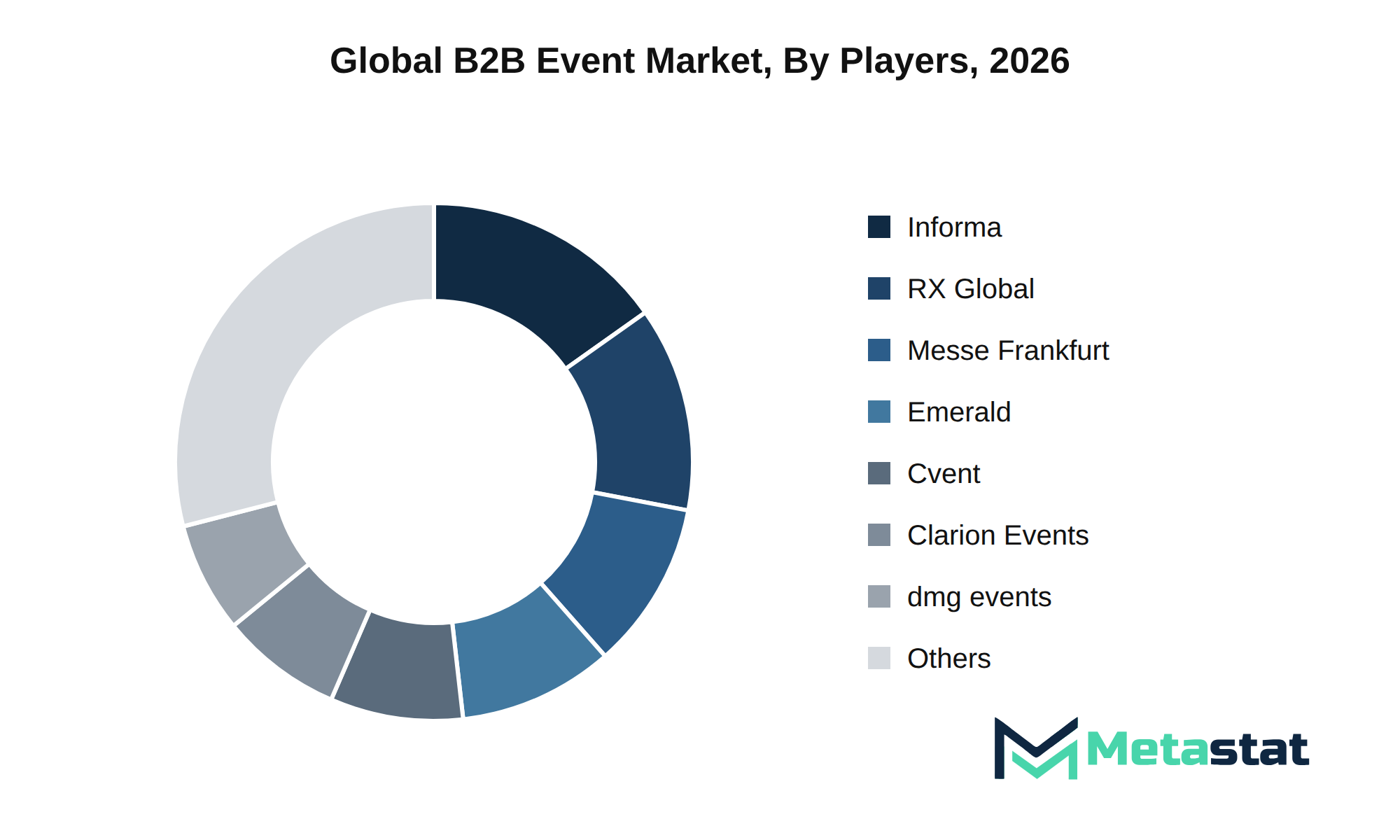
The B2B Event market features a diverse range of players, each employing various strategies to secure competitive advantages. Companies including Informa PLC and RX Global focus on mergers and acquisitions to enhance their market positions, while other firms like Messe Frankfurt GmbH and Emerald Holding, Inc. emphasize product differentiation and proprietary technology to maintain a strong market presence.
Strategic alliances and joint ventures play a significant role in shaping the competitive dynamics of the market. Companies like Bizzabo and Comexposium engage in cross-industry partnerships to expand their reach and enhance service offerings. These collaborative efforts contribute to increased brand equity and customer retention strategies, supporting sustained growth in an evolving market environment.
In response to challenges including barriers to entry and the threat of new entrants, established firms implement robust defensive imperatives. Emphasizing value chain integration and procurement leverage, companies like Cvent Inc. and dmg events strengthen their operational frameworks to maintain market presence. The future competitive outlook focuses on strategic growth vectors that prioritize innovation and adaptability in the B2B Event market.
Forecast and Future Outlook
Forecast and Future Outlook
Market size is forecast to rise from USD 52.5 billion in 2025 to over USD 103.9 billion by 2033. The anticipated growth reflects an 8.9% CAGR driven by several macroeconomic factors and evolving industry dynamics.
The base case scenario highlights that the market will experience continued expansion, supported by increasing demand across various sectors. The bull case suggests even stronger growth, influenced by rapid technology integration and heightened spending on events, driven by companies prioritizing face-to-face interactions. Conversely, the bear case indicates potential challenges from economic downturns, which could result in reduced spending on events and tighter budgets across organizations.
Shifts in downstream demand, particularly in industries including Information Technology, Healthcare, and Manufacturing, will play a critical role in shaping market trajectories. The maturation of core industries and the integration of next-generation technologies in event formats will change engagement strategies. Companies investing in R&D to enhance their event offerings are expected to gain a competitive advantage, driving market evolution.
The regulatory landscape will influence operational frameworks and compliance timelines, impacting event planning and execution. Geopolitical developments and evolving trade corridors affect supply chains, necessitating strategic adaptations by businesses within the market. Capital allocation directives and infrastructure commitments will further shape market dynamics, with organizations focusing on strategic investments to capture emerging opportunities.
Identifying unmet enterprise needs and high-growth pockets within the B2B Event market will be essential for stakeholders aiming to capitalize on future trends. Strategic imperatives established by executives will guide decision-making processes, ensuring alignment with long-term growth objectives. An emphasis on defensibility and resilience will underpin future recommendations for companies navigating this expanding marketplace.
B2B Event Market Key Segments
By Event Type:
Conferences and Congresses
Trade Shows and Exhibitions
Corporate Meetings
Seminars and Workshops
Webinars and Virtual Conferences
Symposiums and Industry Forums
Product Launches and Roadshows
By Event Format:
In-Person
Virtual
Hybrid
By Event Sizes:
Small Events
Medium Events
Large Events
Mega Events
By End-User Industry:
Information Technology and Telecommunications
Healthcare and Life Sciences
Manufacturing and Industrial
Financial Services
Energy and Utilities
Automotive and Transportation
Media and Entertainment
Retail and Consumer Goods
Government and Public Sector
Others (Education, Real Estate, and Professional Services)
The report strategically identifies and profiles the key market players and analyses their core competencies in each sub-segment of the B2B Event market.
Report Attributes
Details
Study Period
2021-2033
Base Year
2025
Estimated Year
2026
Forecast Period
2026-2033
Historical Period
2021-2025
Growth Rate
CAGR 8.9% from 2026 to 2033
Revenue Unit
USD billion
Segmentation
By Event Type, Event Format, Event Sizes, End-User Industry, and Region
By Region
North America (By Event Type, Event Format, Event Sizes, End-User Industry, and Country)
United States
Canada
Mexico
Europe (By Event Type, Event Format, Event Sizes, End-User Industry, and Country)
Germany
France
UK
Italy
Spain
Russia
Rest of the Europe
Asia Pacific (By Event Type, Event Format, Event Sizes, End-User Industry, and Country)
China
Japan
India
South Korea
Australia
Southeast Asia
Rest of Asia Pacific
South America (By Event Type, Event Format, Event Sizes, End-User Industry, and Country)
Brazil
Argentina
Rest of South America
Middle East and Africa (By Event Type, Event Format, Event Sizes, End-User Industry, and Country)
Saudi Arabia
UAE
South Africa
Rest of Middle East and Africa
What Report Provides
Key Company Market Share, Revenue and Ranking for the B2B Event Market
Key Market Leaders in the B2B Event Industry
Full In-Depth Analysis of the Parent Industry
Industry Statistics and Important Market Dynamics
Segmentation Details of the B2B Event Market
Historical, Ongoing, and Projected Market Analysis
Assessment of Niche Industry Developments
Key Strategies of Major Players in the Market
End of Report Overview
Frequently Asked Questions
Find answers to common questions about this report
The Metastat Insights study reveals that the B2B Event market size was valued at USD 52.5 billion in 2025.
The B2B Event market is projected to grow at a CAGR of 8.9% during the forecast period from 2026 to 2033.
The North America B2B Event market size is estimated to reach USD 35.3 billion by 2033.
The leading segment in the B2B Event market is Trade Shows and Exhibitions, projected to reach USD 27 billion by 2033. This segment demonstrates significant growth potential compared to others in the market.
Key drivers for the B2B Event market include favorable capital investment environments characterized by robust GDP growth and venture funding, which enhance spending power for event organization. Shifting consumer behaviors toward personalized experiences and digital integration increase demand for innovative event formats, contributing to overall market expansion.
North America holds the dominant share of the B2B Event market, with a value of USD 35.3 billion projected for 2033, representing 35.4 percent of the total market.
The B2B Event market faces significant constraints from regulatory challenges, rising operational costs, and geopolitical fragmentation. Compliance with varying legal mandates creates barriers for event organizers, while inflationary pressures increase budgets for marketing and logistics. These factors lead to cautious event planning and limit the ability to deliver successful events.
Favorable capital investment environments, characterized by robust GDP growth and low interest rates, enhance spending power, facilitating increased event organization. shifting consumer behaviors drive demand for personalized experiences, prompting businesses to invest in tailored events that prioritize engagement and connection. These factors significantly favor product adoption in the B2B Event market.
The B2B Event market is estimated to reach a valuation of USD 103.9 billion by 2033.
Key players in the B2B Event market include Informa PLC, RX Global, Messe Frankfurt GmbH, Emerald Holding, Inc., Clarion Events Ltd, Cvent Inc., and dmg events.
Executive B2B Conferences and Curated Business Events Market
Executive B2B Conferences and Curated Business Events market size is valued at USD 1,004.1 billion in 2025 and projected to reach USD 1,516.3 billion by.
Executive B2B Conferences and Curated Business Events market, Executive B2B Conferences and Curated Business Events Market Size, Executive B2B Conferences and Curated Business Events Market Share, Executive B2B Conferences and Curated Business Events Market Analysis, Executive B2B Conferences and Curated Business Events Market Growth, Executive B2B Conferences and Curated Business Events Market Trends, Executive B2B Conferences and Curated Business Events Market Research Report, Executive B2B Conferences and Curated Business Events Market Forecast, Executive B2B Conferences and Curated Business Events, Executive B2B Conferences and Curated Business Events Market Research, Executive B2B Conferences and Curated Business Events Industry, Executive B2B Conferences and Curated Business Events Industry Report, Executive B2B Conferences and Curated Business Events Market Data, Executive B2B Conferences and Curated Business Events Statistics, Executive B2B Conferences and Curated Business Events Market Statistics, Executive B2B Conferences and Curated Business Events Industry Trends, Executive B2B Conferences and Curated Business Events Market Report, Executive B2B Conferences and Curated Business Events Market Trends, Executive B2B Conferences and Curated Business Events Market News, Executive B2B Conferences and Curated Business Events Forecasts, Executive B2B Conferences and Curated Business Events Market Intelligence Report, Executive B2B Conferences and Curated Business Events Market Outlook, Executive B2B Conferences and Curated Business Events Market Segmentation, Executive B2B Conferences and Curated Business Events Market Drivers, Executive B2B Conferences and Curated Business Events Market Restraints, Executive B2B Conferences and Curated Business Events Market Opportunities, Executive B2B Conferences and Curated Business Events Market CAGR, Executive B2B Conferences and Curated Business Events Suppliers, Executive B2B Conferences and Curated Business Events Manufacturers, Executive B2B Conferences and Curated Business Events Market by Region, North America Executive B2B Conferences and Curated Business Events Market, Asia Pacific Executive B2B Conferences and Curated Business Events Market, Europe Executive B2B Conferences and Curated Business Events Market, Executive B2B Conferences and Curated Business Events Market Competitive Landscape, Executive B2B Conferences and Curated Business Events Market Key Players, Executive Conferences & Summits Market, Leadership Forums & Roundtables Market, Corporate Meetings & Leadership Retreats Market, Industry Congresses & Professional Conferences Market, Workshops & Masterclasses Market, Networking & Peer-Exchange Events Market, Awards & Recognition Events Market, Open Registration Executive B2B Conferences and Curated Business Events, Invitation-Only Executive B2B Conferences and Curated Business Events, In-Person Executive B2B Conferences and Curated Business Events, Virtual Executive B2B Conferences and Curated Business Events, Technology & Telecommunications Executive B2B Conferences and Curated Business Events Market, BFSI Executive B2B Conferences and Curated Business Events Market.
Industrial Inspection and Technical Services Outsourcing
Industrial Inspection and Technical Services Outsourcing market size is valued at USD 35.2 billion in 2025 and projected to reach USD 60.1 billion by 2033.
Industrial Inspection and Technical Services Outsourcing market, Industrial Inspection and Technical Services Outsourcing Market Size, Industrial Inspection and Technical Services Outsourcing Market Share, Industrial Inspection and Technical Services Outsourcing Market Analysis, Industrial Inspection and Technical Services Outsourcing Market Growth, Industrial Inspection and Technical Services Outsourcing Market Trends, Industrial Inspection and Technical Services Outsourcing Market Research Report, Industrial Inspection and Technical Services Outsourcing Market Forecast, Industrial Inspection and Technical Services Outsourcing, Industrial Inspection and Technical Services Outsourcing Market Research, Industrial Inspection and Technical Services Outsourcing Industry, Industrial Inspection and Technical Services Outsourcing Industry Report, Industrial Inspection and Technical Services Outsourcing Market Data, Industrial Inspection and Technical Services Outsourcing Statistics, Industrial Inspection and Technical Services Outsourcing Market Statistics, Industrial Inspection and Technical Services Outsourcing Industry Trends, Industrial Inspection and Technical Services Outsourcing Market Report, Industrial Inspection and Technical Services Outsourcing Market Trends, Industrial Inspection and Technical Services Outsourcing Market News, Industrial Inspection and Technical Services Outsourcing Forecasts, Industrial Inspection and Technical Services Outsourcing Market Intelligence Report, Industrial Inspection and Technical Services Outsourcing market outlook, Industrial Inspection and Technical Services Outsourcing market segmentation, Industrial Inspection and Technical Services Outsourcing market drivers, Industrial Inspection and Technical Services Outsourcing market restraints, Industrial Inspection and Technical Services Outsourcing market opportunities, Industrial Inspection and Technical Services Outsourcing market CAGR, Industrial Inspection and Technical Services Outsourcing suppliers, Industrial Inspection and Technical Services Outsourcing manufacturers, North America Industrial Inspection and Technical Services Outsourcing market, Asia Pacific Industrial Inspection and Technical Services Outsourcing market, Europe Industrial Inspection and Technical Services Outsourcing market, Industrial Inspection and Technical Services Outsourcing market competitive landscape, Industrial Inspection and Technical Services Outsourcing market key players, Third-Party Inspection and Vendor Surveillance market, Non-Destructive Testing and Examination market, Asset Integrity and Mechanical Integrity Management market, Quality Assurance and Quality Control market, Oil and Gas Industrial Inspection and Technical Services Outsourcing market, Power Generation and Utilities Industrial Inspection and Technical Services Outsourcing market.
Language Services Market Size, Share, Trends, 2033
Global Language Services market size: USD 79.7 billion in 2025, forecast USD 146.5 billion by 2033 at a 7.9% CAGR, with segment and regional analysis.
Language Services market, Language Services Market Size, Language Services Market Share, Language Services Market Analysis, Language Services Market Growth, Language Services Market Trends, Language Services Market Research Report, Language Services Market Forecast, Language Services, Language Services Market Research, Language Services Industry, Language Services Industry Report, Language Services Market Data, Language Services Statistics, Language Services Market Statistics, Language Services Industry Trends, Language Services Market Report, Language Services Market Trends, Language Services Market News, Language Services Forecasts, Language Services Market Intelligence Report, Language Services market 2033, Language Services market outlook, Language Services market segmentation, Language Services market drivers, Language Services market restraints, Language Services market opportunities, Language Services market CAGR, Language Services suppliers, Language Services manufacturers, Language Services market by region, North America Language Services market, Asia Pacific Language Services market, Europe Language Services market, Language Services market competitive landscape, Language Services market key players, Translation Services market, Localization Services market, Interpretation Services market, Multilingual Content Management Services market, Cloud-based Language Services market, Machine Translation market, Generative AI Translation market, Healthcare Language Services market.
Real Estate Valuation Services Market Size, Share, 2033
Real Estate Valuation Services market size is valued at USD 14.2 billion in 2025 and projected to reach USD 21 billion by 2033, growing at a CAGR of 5%.
Real Estate Valuation Services market, Real Estate Valuation Services Market Size, Real Estate Valuation Services Market Share, Real Estate Valuation Services Market Analysis, Real Estate Valuation Services Market Growth, Real Estate Valuation Services Market Trends, Real Estate Valuation Services Market Research Report, Real Estate Valuation Services Market Forecast, Real Estate Valuation Services, Real Estate Valuation Services Market Research, Real Estate Valuation Services Industry, Real Estate Valuation Services Industry Report, Real Estate Valuation Services Market Data, Real Estate Valuation Services Statistics, Real Estate Valuation Services Market Statistics, Real Estate Valuation Services Industry Trends, Real Estate Valuation Services Market Report, Real Estate Valuation Services Market Trends, Real Estate Valuation Services Market News, Real Estate Valuation Services Forecasts, Real Estate Valuation Services Market Intelligence Report, Real Estate Valuation Services Market 2033, Real Estate Valuation Services Market Outlook, Real Estate Valuation Services Market Segmentation, Real Estate Valuation Services Market Drivers, Real Estate Valuation Services Market Restraints, Real Estate Valuation Services Market Opportunities, Real Estate Valuation Services Market CAGR, Real Estate Valuation Services Suppliers, Real Estate Valuation Services Manufacturers, Real Estate Valuation Services Market by Region, North America Real Estate Valuation Services Market, Asia Pacific Real Estate Valuation Services Market, Europe Real Estate Valuation Services Market, Real Estate Valuation Services Market Competitive Landscape, Real Estate Valuation Services Market Key Players, Property Appraisal and Valuation Market, Portfolio and Fund Valuation Services, Financial Reporting and Tax Valuation Market, Lending and Mortgage Security Valuation, Transaction and Due Diligence Valuation, Banks and Financial Institutions Valuation Services, Institutional Investors and Asset Managers Valuation Services, Corporates, REITs and Property Developers Valuation Services