Global Industrial Metaverse Market Size, Share, By Technology (Augmented Reality (AR), Virtual Reality (VR), Mixed Reality (MR), Artificial Intelligence, Digital Twin, and Others), By Component (Software, Hardware, and Services), By Application (Product Design & Development, Virtual Prototyping, Training & Simulation, Remote Collaboration, Maintenance & Repair, Supply Chain Optimization, and Data Visualization & Analytics), By End User (Automotive & Transportation, Electronics, Energy & Power, Oil & Gas, Aerospace & Defense, Healthcare & Life Sciences, Food & Beverages, Industrial Manufacturing, and Others), Industry Analysis, Growth, Trends, and Forecast, 2026-2033
Report ID
MSI-4946
Published
August 17, 2026
Pages
279 Pages
Format
Market Size 2021
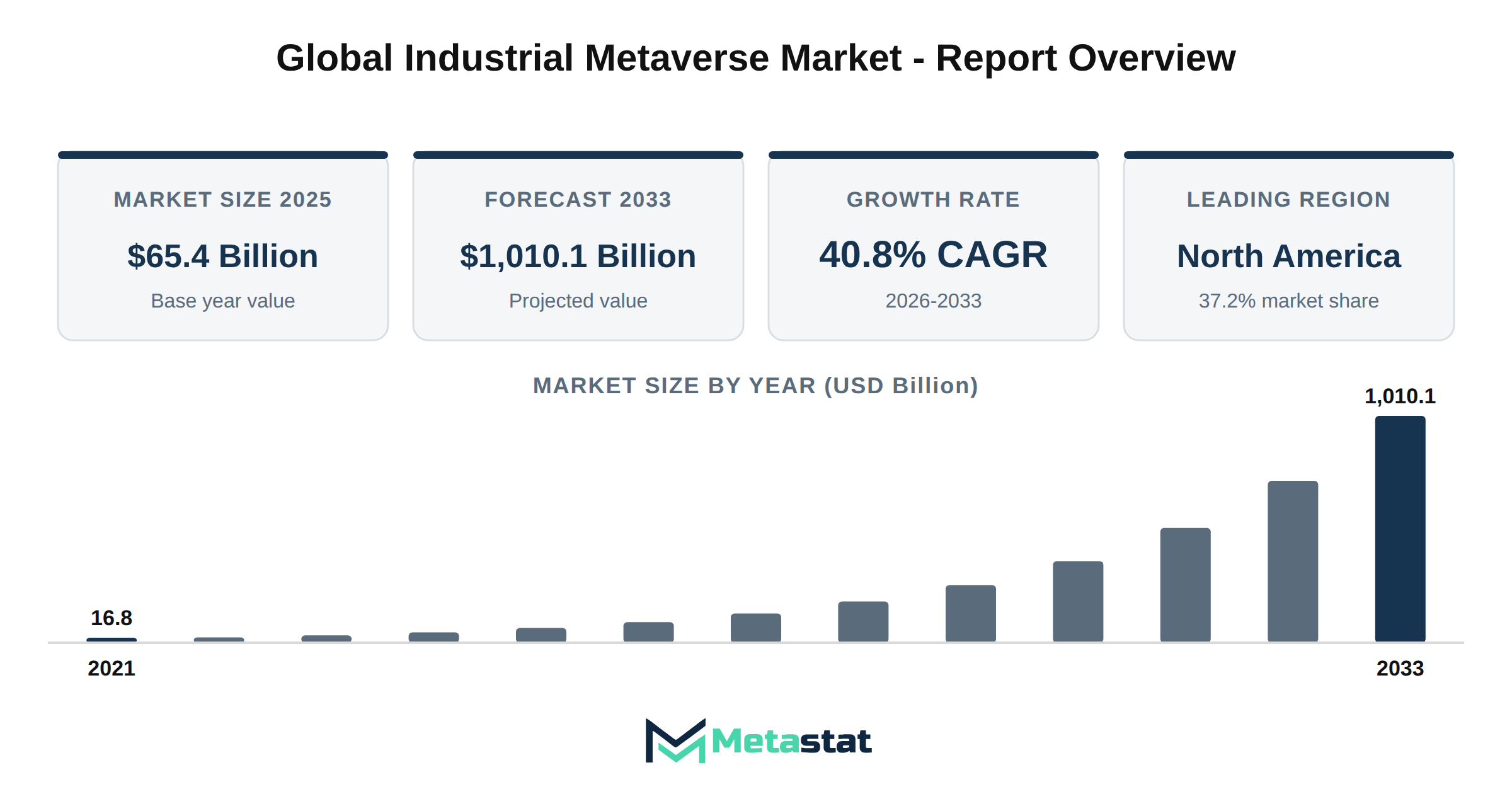
$16.8 Billion
Historical
Market Size 2025
$65.4 Billion
Base year
Market Size 2033
$1,010.1 Billion
Forecast
CAGR 2025-2033
40.8%
Forecast period
Report Details
Comprehensive Market Analysis And Insights
Market Overview
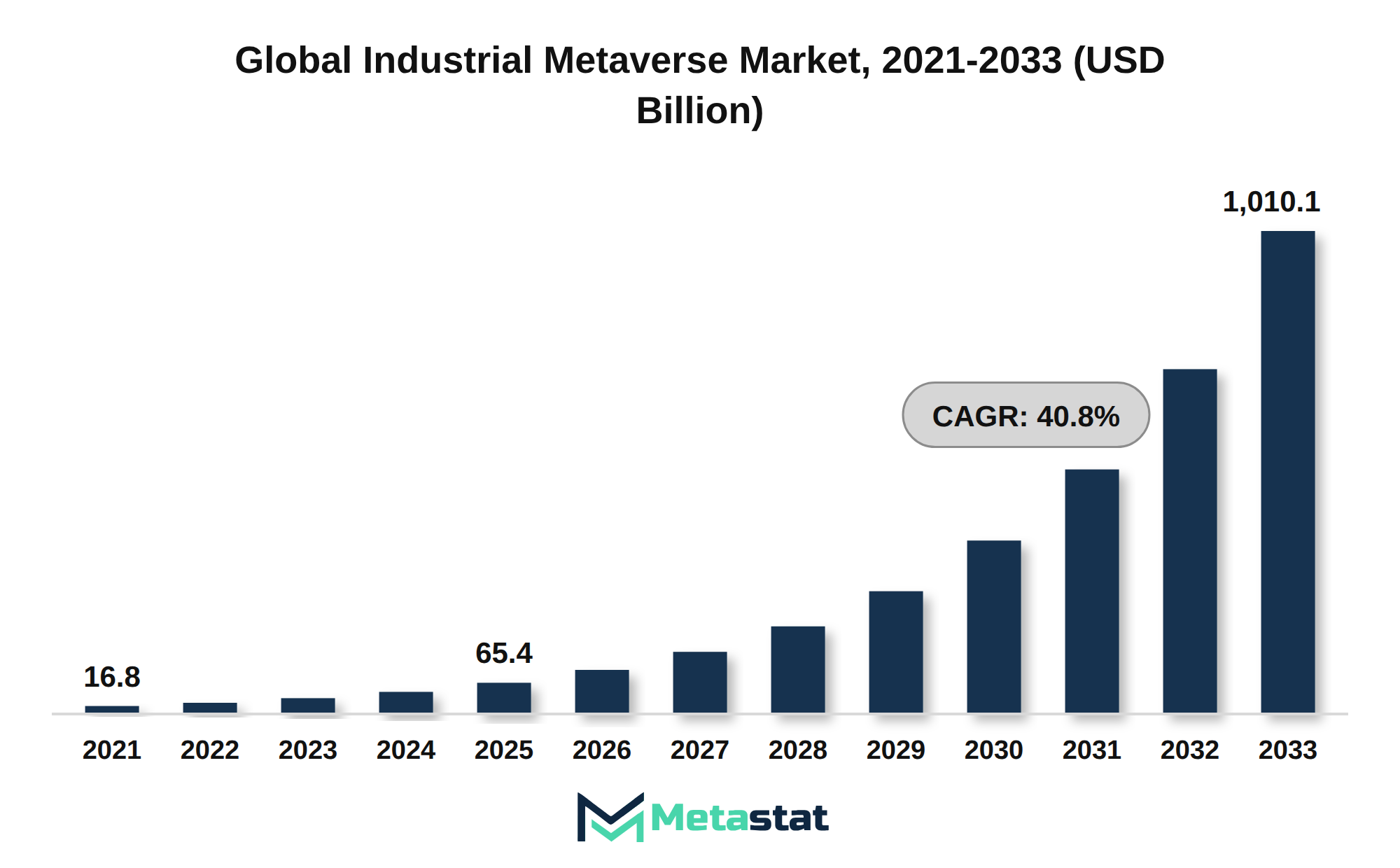
The global Industrial Metaverse market was valued at USD 65.4 billion in 2025 and is projected to reach USD 1,010.1 billion by 2033, growing at a CAGR of 40.8% over the forecast period.
The Industrial Metaverse market reached a base value of USD 65.4 billion in 2025, reflecting significant growth from USD 16.8 billion in 2021. The market is projected to expand to USD 1,010.1 billion by 2033, representing a compound annual growth rate (CAGR) of 40.8%. Increasing adoption of advanced technologies including augmented reality (AR), virtual reality (VR), and artificial intelligence fuels this rapid expansion, driven by various industries seeking innovative solutions for enhanced productivity and efficiency.
In 2025, augmented reality is expected to initiate at a value of USD 13 billion, surging to USD 144 billion by 2033, while virtual reality is set to reach USD 274.6 billion during the same period. The software component within the market starts at USD 29.6 billion in 2026, anticipated to grow to USD 326.9 billion by 2033. This growth is supported by increasing investments in research and development, aimed at enhancing operational advancements across diverse sectors through next-generation innovations.
The Industrial Metaverse market experiences significant disruption driven by rapid technological advancements and shifting consumer preferences. Companies invest heavily in research and development to remain competitive, focusing on next-generation innovations. This emphasis on innovation supports the market's growth trajectory, enabling firms to adapt to changing demands and enhance operational efficiencies.
Sustainable transformation and decarbonization shape the market landscape. Businesses prioritize environmentally friendly practices, influencing product development and supply chain strategies. Adopting circular economy dynamics facilitates resource efficiency while aligning with regulatory compliance and industry standards, which increasingly emphasize sustainability.
The evolving supply chain landscape significantly impacts the Industrial Metaverse market. Companies navigate complex logistics architecture and sourcing challenges, influencing procurement strategies. Market fragmentation results in diverse competitive pressures, prompting mergers and acquisitions that reshape the industry structure and enhance value chains.
Capital allocation strategies reflect the market's growth potential, with firms directing resources toward infrastructure investments and operational expenditures. The current macroeconomic environment presents challenges, including inflationary pressures and currency volatility, complicating financial planning. These factors necessitate agile responses from companies to maintain profitability and competitiveness.
Future strategic outlooks highlight the importance of adapting to corporate imperatives. Firms prioritize high-value recommendations that emphasize innovation, sustainability, and efficiency. This strategic focus positions companies to capitalize on emerging opportunities within the Industrial Metaverse market, ensuring long-term resilience and growth.
Market Dynamics
Capital investment environments foster market growth
Increased capital investment environments significantly influence the Industrial Metaverse market. Favorable conditions, including low interest rates, stimulate venture funding, encouraging businesses to explore advanced technologies including augmented reality and artificial intelligence. High GDP growth rates support consumer and enterprise spending, facilitating investments in digital transformation initiatives across various industries.
The expansion of funding channels, including public-private partnerships, enhances the financial landscape for organizations aiming to adopt Industrial Metaverse solutions. This shift enables companies to upgrade infrastructure, integrate technological advancements, and modernize operational processes, positioning them to capitalize on emerging market opportunities.
Industries including automotive, healthcare, and manufacturing demonstrate heightened interest in the market, driven by improved operational productivity and reduced costs through innovative applications. This emphasis on technological integration leads to a robust adoption trajectory, allowing organizations to streamline workflows and enhance efficiency.
The overall favorable macroeconomic environment promotes a steady rise in investments within the Industrial Metaverse market, supporting sustained growth and increasing market penetration during the forecast period.
The Industrial Metaverse market benefits from rapid technological integration, significantly enhancing operational efficiencies across various industries. Automation, artificial intelligence (AI), and the adoption of advanced software streamline processes, reducing the time and resources required for various tasks. The digital transformation of existing systems allows organizations to digitize legacy processes, resulting in improved productivity and reduced operational costs.
Industries including automotive, healthcare, and manufacturing experience substantial benefits from these integrations, leading to optimized workflows and better resource allocation. Investments in AI technologies facilitate enhanced decision-making and predictive analytics, essential for maintaining competitiveness in the market. Organizations leveraging these technologies provide improved services and products, driving demand in the Industrial Metaverse market.
The shift towards advanced technologies aligns with the growing focus on operational productivity and cost-efficiency initiatives. Firms aiming to enhance their market position prioritize investments in innovative solutions that support sustainable growth. Technological integration enables firms to adapt to evolving market demands and positions them favorably against competitors, reinforcing market expansion and attracting further investments.
Regulatory compliance and legal challenges
The Industrial Metaverse market faces significant constraints stemming from regulatory compliance and legal challenges. Stricter regulations around data privacy and security create hurdles for companies aiming to innovate within this space. Compliance requirements increase the operational burden on businesses, impacting their ability to deploy new technologies rapidly and efficiently.
Macroeconomic headwinds contribute further to these challenges, with inflationary pressures and capital stagnation limiting available funds for investment in the Industrial Metaverse. Companies encounter difficulties securing necessary financing for deployment and expansion, negatively affecting growth potential.
Infrastructure gaps and connectivity deficits present additional barriers to market penetration. Many regions lack the required technological backbone to support advanced applications within the Industrial Metaverse, hindering adoption rates. Deployment bottlenecks arise when companies attempt to implement solutions in areas with insufficient infrastructure, delaying project timelines.
Skilled labor deficiencies further complicate the landscape, limiting the talent pool available to drive innovation in the Industrial Metaverse market. The shortage of qualified personnel increases costs associated with hiring and training, ultimately affecting operational efficiency. Cultural barriers and regional adoption resistors impede broader acceptance of metaverse solutions across various industries.
The combination of these factors creates a complex environment for growth and adoption within the Industrial Metaverse market, necessitating strategic navigation through regulatory, economic, and operational challenges.
Geopolitical tensions and supply chain disruptions
The Industrial Metaverse market encounters significant challenges due to geopolitical fragmentation and trade deficits. These factors contribute to tariff friction, complicating the movement of goods and services across borders. Consequently, companies experience increased operational costs, limiting their ability to invest in innovative technologies that drive market growth.
Technological disruptions pose another challenge, resulting in complex research and development integrations. Firms struggle to keep pace with rapid advancements, which creates interoperability friction among various technologies. This inconsistency hinders manufacturers from fully realizing the benefits of the Industrial Metaverse, affecting overall adoption rates.
Market instability arises from volatility in feedstock and components, leading to unpredictable pricing pressures. Tightening regulatory standards create additional compliance overhead, further impacting operational margins. Companies face the challenge of balancing cost structures while adhering to evolving legal liabilities associated with emerging technologies.
The workforce skill gap continues to impede growth within the market. With the advent of automation and technological advancements, retaining talent poses a significant challenge for organizations. This scenario limits the ability of firms to adapt swiftly to market changes and meet evolving downstream demands.
Environmental concerns have led to increasing demands for sustainability and decarbonization, resulting in higher operational costs. Infrastructure gaps and retrofitting barriers hinder the implementation of necessary upgrades and innovations. Such challenges create bottlenecks that prevent the integration of the Industrial Metaverse into existing industrial frameworks.
Intellectual property protection deficits heighten cybersecurity risks, exposing firms to potential data vulnerabilities. These risks compromise the integrity of critical systems, affecting trust and reliability in the market. Developing robust cybersecurity measures becomes imperative to safeguard sensitive data and maintain competitiveness.
Emerging regional demands drive innovation
The Industrial Metaverse market experiences substantial growth driven by emerging regional demands across various sectors. North America, Europe, and Asia Pacific exhibit increasing investments in advanced technologies to modernize infrastructure and enhance operational capabilities. This regional focus generates opportunities for local players to expand their offerings and cater to specific market needs, promoting innovation.
Technological disruptions, particularly in augmented reality, virtual reality, and artificial intelligence, significantly influence market dynamics. Companies prioritize digital transformation strategies to optimize production processes and improve customer engagement. This shift aligns with sustainability imperatives, resulting from businesses seeking to minimize environmental impact while enhancing product offerings.
Strategic consolidation among key players strengthens market presence and facilitates cross-industry mergers. By integrating diverse capabilities, companies gain a competitive edge, driving product innovation and expanding their service offerings. The evolving buying behaviors and digital procurement shifts highlight the necessity for firms to adapt their commercial models to capture market opportunities effectively.
Supply chain localization strategies, alongside asset life-cycle extensions and maintenance upgrades, enhance operational resilience. Companies invest in retrofitting dynamics and process automation to maximize operational yield, ensuring long-term sustainability. These factors collectively position the Industrial Metaverse market for significant growth, creating a favorable environment for investment and expansion.
Market Segmentation Analysis
The Global Industrial Metaverse market is segmented based on Technology, Component, Application, and End User.
By Technology, the market is further segmented into:
Augmented Reality (AR)
Virtual Reality (VR)
Mixed Reality (MR)
Artificial Intelligence
Digital Twin
Others (Edge Computing, Private 5G, Blockchain)
Augmented Reality (AR)
Valued at USD 13 billion in 2026, the Augmented Reality (AR) segment is projected to reach USD 144 billion by 2033, achieving a CAGR of 41% during the forecast period. Rapid technological maturation drives primary demand, particularly among industries seeking enhanced user experiences and operational efficiencies. Adoption of AR applications expands across various sectors, including automotive, healthcare, and industrial manufacturing. Immersive training and remote collaboration enhance productivity and reduce costs. Increasing investments in next-gen upgrades and product evolution support the segment's growth trajectory.
End-user dynamics highlight a shift towards more interactive and engaging applications, emphasizing data visualization and analytics capabilities. Regulatory compliance standards and certifications play a critical role, ensuring that AR solutions meet safety and effectiveness benchmarks. Pricing volatility and margin pressures influence market strategies, compelling suppliers to optimize cost structures while maintaining quality. Strategic opportunity windows arise from heightened demand for innovative AR solutions, propelling investments and partnerships within the Industrial Metaverse market.
Virtual Reality (VR)
Investment in Virtual Reality (VR) technology within the Industrial Metaverse market expands significantly owing to increasing demand for immersive experiences across various sectors. Industries including automotive, healthcare, and education recognize the potential of VR for applications including training, remote collaboration, and product design. This segment is estimated to reach USD 274.6 billion by 2033, at a CAGR of 39.8% during the forecast period.
Technological maturation serves because a key driver, enhancing advancements in hardware and software capabilities that improve user experiences. The convergence of VR with artificial intelligence and augmented reality leads to innovative applications that enhance training and simulation processes. Businesses leverage these technologies for operational efficiencies, influencing the market trajectory.
Downstream applications contribute to the shift in consumption, with organizations seeking to optimize processes through virtual solutions. Adoption rates accelerate among end-users in industries including aerospace and defense, where VR enables realistic simulations for training and prototyping. The growing acceptance of VR solutions highlights a strategic opportunity window for investment and development within the Industrial Metaverse market.
Pricing volatility and margin pressures stem from the competitive landscape and technological advancements. Companies facing cost challenges adapt by enhancing product offerings and improving supply chain resilience to ensure competitive pricing. Regulatory compliance standards continue to shift, necessitating ongoing investments in certification processes to maintain market relevance.
Mixed Reality (MR)
Mixed Reality (MR) technologies have emerged driven by a key driver within the Industrial Metaverse market. This segment facilitates immersive experiences by blending physical and digital environments, which significantly enhances user interaction and engagement. Industries including automotive, aerospace, and healthcare increasingly adopt MR for applications including training, remote collaboration, and maintenance, reflecting its growing importance.
Advancements in hardware and software underpin the expansion of this segment. Improved processing capabilities and innovative display technologies enhance the effectiveness of MR solutions, driving adoption across various sectors. The demand arises from organizations seeking to improve operational efficiencies and reduce costs through increased productivity and streamlined training processes.
The Mixed Reality (MR) segment is expected to reach USD 75.8 billion by 2033. This growth trajectory aligns with significant investments in MR technologies, because industries explore new applications and functionalities. MR solutions evolve, and their integration with other technologies including Artificial Intelligence and Digital Twins will further enhance their capabilities, leading to broader acceptance in the market.
End-user dynamics play a crucial role in shaping the MR segment. Organizations increasingly prioritize immersive training and simulation environments to prepare employees for real-world tasks. This trend highlights the need for effective MR solutions that deliver practical benefits, reinforcing the segment's relevance in the evolving Industrial Metaverse market.
Artificial Intelligence
Growth in the Artificial Intelligence segment stems from increasing demand for advanced data analytics, predictive modeling, and automation within the Industrial Metaverse market. Industries including healthcare, automotive, and manufacturing heavily invest in AI technologies to improve operational efficiency and enhance decision-making processes. This segment is projected to grow at a CAGR of 40.8% during the forecast period.
Adoption of AI technologies facilitates significant advancements in various applications across the market. Enhanced virtual prototyping, real-time data visualization, and optimized supply chain management emerge from critical areas benefiting from AI innovation. This evolution aligns with market trends that favor integrated solutions capable of delivering higher productivity and reduced time-to-market.
The shift towards AI-driven solutions aligns with the broader trend of digital transformation, driving the need for more sophisticated technologies in the Industrial Metaverse. Companies investing in AI experience improved operational capabilities, resulting in competitive advantages in their respective sectors. This strategic opportunity window encourages capital investment in AI technologies, promising growth and accelerated adoption rates.
Digital Twin
Adoption of Digital Twin technology within the Industrial Metaverse market stems from the increasing need for real-time data-driven decision-making. Industries seek to create virtual replicas of physical assets to enhance operational efficiency and enable predictive maintenance. This technology allows organizations to visualize processes and product lifecycles, thereby improving design and development timelines.
Technological maturation significantly impacts the growth of Digital Twin applications, with advancements in artificial intelligence and machine learning enhancing data analysis capabilities. The potential for next-generation upgrades drives interest, driven by companies striving to integrate more sophisticated simulations and analytics into their operations. This evolution in product capabilities allows for deeper insights into performance, leading to better decision support.
End-use dynamics in sectors including automotive, energy, and manufacturing highlight the importance of Digital Twin implementations. These applications facilitate improved collaboration and data sharing among stakeholders, which enhances project outcomes. Consumption shifts toward more sustainable practices result in companies leveraging Digital Twins for resource optimization, waste reduction, and overall operational sustainability.
Regulatory compliance standards increasingly emphasize transparency and accountability in operations. Digital Twin technology supports adherence to these requirements by providing comprehensive tracking and reporting functionalities. Organizations investing in this technology benefit from streamlined compliance processes and enhanced operational governance.
Investment in Digital Twin capabilities represents a strategic opportunity for firms. By leveraging these tools, businesses improve supply chain resilience and mitigate risks associated with disruptions. The ability to model different scenarios within a digital environment enables companies to identify vulnerabilities and respond proactively to changes in market conditions.
Others (Edge Computing, Private 5G, Blockchain)
Technological advancements in Edge Computing, Private 5G, and Blockchain significantly influence the Industrial Metaverse market. Adoption of these technologies enhances connectivity and data processing capabilities, enabling integration of various applications within the metaverse ecosystem. Industries including automotive, healthcare, and manufacturing increasingly leverage these innovations to improve operational efficiency and reduce downtime.
Edge Computing addresses latency issues by processing data closer to the source, which optimizes response times and enhances user experiences. Meanwhile, Private 5G networks provide robust, secure, and high-speed connectivity that accommodates the growing demand for real-time data transfer. Blockchain technology ensures data integrity and security, facilitating trusted transactions across digital platforms. This combination of technologies creates a more reliable and efficient operational environment.
Investment in these areas continues to expand, driven by the need for enhanced cybersecurity, improved data management strategies, and increased demand for real-time analytics. Companies recognize the potential of these technologies in addressing existing challenges and achieving competitive advantages. The resulting strategic opportunities encourage organizations to pursue next-generation upgrades and product evolution, positioning them favorably within the industrial landscape.
End-use dynamics shift owing to businesses increasingly prioritizing digital transformation initiatives, integrating Edge Computing, Private 5G, and Blockchain into their operational frameworks. Regulatory compliance standards surrounding data privacy and security further drive adoption, motivating organizations to seek innovative solutions that conform to emerging guidelines. These trends highlight the significance of these technologies in shaping the future of the Industrial Metaverse market.
By Component, the market is further segmented into:
Software
Hardware
Services
Software
Valued at USD 29.6 billion in 2026, the Software segment is projected to reach USD 326.9 billion by 2033, at a CAGR of 40.9% during the forecast period. Demand drivers within this segment stem from the increasing need for advanced software solutions that enhance operational efficiency and drive innovation across industries. Significant investments in digital transformation initiatives contribute to the growing adoption of software in the market.
Technological maturation continues to influence the software landscape, with advancements in cloud computing, machine learning, and big data analytics enabling more sophisticated applications. These innovations lead to the development of next-generation software solutions, which boost user experience and operational capabilities for businesses. Companies progressively integrate these technologies into their processes, resulting in increased productivity and improved decision-making.
End-use dynamics demonstrate a growing reliance on software across various applications, including product design, virtual prototyping, and maintenance. Industries including automotive, aerospace, and healthcare increasingly adopt these solutions to enhance competitive edge. This trend signifies a shift towards digitalization, where software plays a critical role in addressing complex challenges and optimizing resource allocation.
Regulatory compliance standards and certifications exert pressure on software vendors to enhance the security and reliability of their products. These standards drive the need for continuous upgrades and risk assessments, ensuring that software solutions align with industry demands. Consequently, businesses face cost structures that incorporate these compliance considerations, driving market participants to innovate while managing pricing volatility.
Strategic opportunity windows arise from the increasing demand for customized software solutions tailored to specific industry needs. Market players explore white-space opportunities to capture growth in underserved sectors, enhancing product offerings to meet diverse customer requirements. Capital investment outlook remains positive, with industry participants directing resources toward research and development to drive ongoing innovation in the software segment.
Hardware
Growing interest in the Industrial Metaverse market drives demand for hardware, essential for supporting immersive experiences, simulations, and advanced digital interactions. Increased adoption of Augmented Reality (AR) and Virtual Reality (VR) technologies drives hardware investments, enabling industries to enhance productivity and efficiency across various applications. The integration of mixed reality systems and artificial intelligence solutions within hardware offers effective user experiences, fueling market growth.
New advancements in hardware technology enhance the capabilities of devices, promoting next-generation upgrades that align with evolving user expectations. Industries including automotive, healthcare, and aerospace actively invest in high-performance hardware to streamline operations and improve end-user experiences. The market's expansion reflects rising demand for immersive training, remote collaboration, and data visualization solutions, demonstrating the significant role hardware plays in the overall development of the Industrial Metaverse.
The hardware segment is estimated to reach USD 382.3 billion by 2033, at a CAGR of 39.9% during the forecast period. Fluctuations in supply chains and pricing pressures challenge manufacturers, emphasizing the importance of strategic material sourcing and cost management. Companies explore opportunities within the hardware segment to ensure resilience against potential disruptions and capitalize on increasing demand for innovative solutions.
Services
Demand for Services within the Industrial Metaverse market arises from various sectors recognizing the need for enhanced virtual collaboration and operational efficiency. Training and simulation applications require robust service solutions to deliver effective learning experiences. This segment benefits significantly from advancements in digital technologies, particularly in software development and integration, driving a surge in demand for training solutions across industries including automotive, healthcare, and aerospace.
The Services segment is expected to reach USD 300.9 billion by 2033. Increased focus on remote collaboration and maintenance solutions leads to an expansion of service offerings tailored to specific industry needs. Companies operating in the market invest in developing innovative service-based solutions that improve productivity and enhance decision-making processes. Such services play a critical role in creating competitive advantages through improved operational insights and data analytics capabilities.
Regulatory compliance and certification standards further influence service demand, driven by industries striving to meet evolving guidelines and best practices. Providers adapt to these regulatory landscapes by offering consultancy and compliance services, ensuring that clients remain aligned with industry specifications. Consequently, this adaptability strengthens the market's resilience and supports sustained growth across various end-user applications.
By Application, the market is further segmented into:
Product Design & Development
Virtual Prototyping
Training & Simulation
Remote Collaboration
Maintenance & Repair
Supply Chain Optimization
Data Visualization & Analytics
Product Design & Development
Product design and development within the Industrial Metaverse market experiences significant growth driven by the increasing complexity of product lifecycles and the demand for innovative solutions. Companies require advanced tools to streamline design processes and enhance collaboration among teams, resulting in a shift towards immersive technologies that facilitate real-time feedback and iterative design. The adoption of virtual and augmented reality tools allows for rapid prototyping and testing, reducing time to market and improving overall product quality.
Technological maturation plays a critical role in this segment, with advancements in computing power and graphics capabilities enabling the development of more sophisticated virtual environments. Next-generation upgrades in software and hardware create opportunities for enhanced visualization and simulation, which further supports product design and development efforts. These improvements lead to increased efficiency, lower costs, and higher quality outcomes in design processes.
End-use dynamics reflect a growing trend among industries including automotive, aerospace, and electronics, which increasingly rely on digital solutions for design and development activities. Manufacturers experience shifts in consumption patterns driven by prioritizing digital-first strategies that integrate product design with manufacturing processes. Regulatory compliance standards influence the adoption of best practices, prompting organizations to invest in training and certification for personnel to maximize the effectiveness of these new technologies.
Cost structures within the market adapt to incorporate the latest technologies, with organizations weighing the benefits of digital tools against traditional methods. Pricing volatility arises due to fluctuations in raw material costs and the competitive landscape, impacting margins and overall profitability. Strategic opportunity windows emerge for companies investing in innovative product design capabilities, allowing differentiation in a crowded marketplace.
Virtual Prototyping
In the context of the Industrial Metaverse market, Virtual Prototyping emerges because a critical application driving innovation and efficiency across various industries. The integration of advanced technologies enhances the ability to create digital representations of products, allowing for real-time simulations and adjustments throughout the development process. This evolution in design methodology significantly reduces the time and costs associated with physical prototyping, making it a preferred choice for manufacturers and designers.
Primary demand drivers for Virtual Prototyping include the increasing need for rapid product development cycles and the quest for improved collaboration among cross-functional teams. Industries including automotive, electronics, and healthcare leverage these capabilities to streamline workflows and enhance product performance. Adoption rates are high, influenced by technological maturation and the availability of next-generation tools that facilitate transitions from concept to market.
Investment in Virtual Prototyping technology aligns with strategic opportunity windows for companies aiming to differentiate their products in competitive landscapes. By implementing these digital solutions, organizations respond swiftly to market changes and consumer feedback, ensuring that their offerings remain relevant and aligned with evolving demands.
End-use dynamics reflect a shift toward more sustainable practices, because Virtual Prototyping minimizes material waste and supports eco-friendly design principles. This trend aligns with regulatory compliance standards, pushing industries to embrace practices that not only drive innovation but meet environmental expectations.
The market's growth trajectory indicates a solid foundation for ongoing capital investments, because companies recognize the long-term benefits of adopting Virtual Prototyping methodologies. With rising margins and enhanced efficiency, the necessity for traditional prototyping methods continues to diminish, positioning Virtual Prototyping because an essential component of the Industrial Metaverse landscape.
Training & Simulation
Investment in training and simulation applications significantly influences the growth of the Industrial Metaverse market. Companies across various industries, including automotive, healthcare, and aerospace, recognize the value of immersive training environments that enhance skill development and operational efficiency. By integrating advanced technologies including virtual reality (VR) and augmented reality (AR), organizations create realistic scenarios that improve decision-making and reduce training costs.
Adoption of training and simulation technologies accelerates due to the demand for effective employee onboarding and skills enhancement. Industries including healthcare and manufacturing increasingly implement these solutions to create safe, controlled environments for training purposes. This shift towards immersive experiences allows organizations to scale training initiatives while minimizing risks associated with traditional training methods.
Technological maturation in mixed reality and artificial intelligence drives the evolution of training and simulation within the market. Innovations in these technologies enable more sophisticated simulations that enhance user engagement and learning outcomes. The incorporation of AI facilitates personalized learning experiences, allowing users to progress at their own pace and reinforcing knowledge retention.
Strategic investment in training and simulation applications represents a significant opportunity for growth within the Industrial Metaverse market. Companies prioritizing these technologies position themselves to benefit from enhanced employee performance and a more skilled workforce. Industries continue to adopt these solutions, contributing to a positive trajectory that reflects the increasing importance of training and simulation in modern organizational frameworks.
Remote Collaboration
Remote collaboration within the Industrial Metaverse market addresses the increasing need for effective communication and teamwork among geographically dispersed teams. Higher connectivity demands drive the adoption of advanced technologies, enabling organizations to engage more efficiently through immersive experiences. Factors including globalization and remote work trends accelerate the implementation of remote collaboration tools, enhancing productivity and reducing operational costs for businesses.
Industry players face a competitive environment characterized by a continuous push for technological maturation. Next-gen upgrades to existing platforms facilitate enhanced user experiences and drive demand for more sophisticated collaboration solutions. Organizations actively seek to integrate technologies that improve real-time interaction, influencing product evolution within the market.
End-use dynamics shift towards prioritizing effective collaboration and knowledge sharing across various sectors, including automotive, healthcare, and industrial manufacturing. This trend highlights the growing significance of remote collaboration in meeting operational requirements and addressing challenges associated with traditional in-person meetings.
Increased regulatory compliance standards for data security and privacy further shape the development of remote collaboration tools. Companies invest in robust platforms that adhere to these standards, ensuring secure communication channels and protecting sensitive information. Such compliance efforts align with heightened consumer expectations regarding data protection, contributing to investment in innovative solutions.
Cost structures and pricing volatility in the market reflect the competitive nature of remote collaboration technologies. Organizations assess their investment strategies carefully, balancing cost efficiency with the need for high-quality solutions. This scenario opens strategic opportunity windows for players looking to differentiate their offerings and capture market share.
Supply chain resilience remains vital owing to businesses navigating logistical vulnerabilities. Disruptive alternatives and technological obsolescence pose challenges that organizations address while seeking advancements in remote collaboration capabilities. Strategic capital investments in this area provide firms with a competitive edge and enhance long-term sustainability.
Maintenance & Repair
Technological advancements drive the demand for Maintenance & Repair applications within the Industrial Metaverse market. This segment benefits from increasing automation and digitization efforts across multiple industries, resulting in enhanced operational efficiency and reduced downtime. Adoption of advanced technologies facilitates predictive maintenance practices, allowing organizations to address potential failures before they occur, minimizing costly repairs and extending equipment lifespan.
The transition to data-driven decision-making models influences the segment's growth, enabling businesses to implement real-time monitoring and analytics tools. This shift enhances the capability to identify maintenance needs promptly and allocate resources efficiently. Enterprises in the automotive, aerospace, and manufacturing sectors leverage these technologies, improving their maintenance strategies and achieving significant cost savings.
Regulatory compliance standards and certifications shape Maintenance & Repair applications. Adherence to safety regulations drives investment in updated technologies and processes. This compliance ensures operational reliability and reduces the risk of penalties associated with non-compliance.
Investment in training programs for personnel on the latest maintenance technologies enhances workforce readiness and effectiveness. This focus on employee development strengthens the overall operational framework and promotes a culture of continuous improvement. The evolving landscape encourages organizations to seek innovative solutions, nurturing a competitive edge in the market.
Supply Chain Optimization
Supply chain optimization within the Industrial Metaverse market enhances operational efficiency and resilience. A key driver includes the increasing complexity of global supply chains, which necessitates advanced technologies to manage logistics effectively. Adoption of digital tools enables companies to gain real-time visibility into their supply chain operations, facilitating improved decision-making and reducing delays.
Growing emphasis on sustainability and efficiency acts because a catalyst for segment expansion. Organizations seek to minimize waste and optimize resource usage, driving demand for technologies that offer predictive analytics and automated processes. These advancements support businesses in adapting to fluctuating market conditions, allowing for greater flexibility and responsiveness.
Technological maturation in areas including Artificial Intelligence and data analytics significantly contributes to optimization efforts. Enhanced algorithms and machine learning models provide insights that help businesses anticipate disruptions and streamline operations. This evolution leads to increased reliance on real-time data, enabling organizations to refine their supply chain strategies.
End-use dynamics indicate a shift toward integrated solutions that enhance collaboration among stakeholders. Companies across various industries, from automotive to healthcare, prioritize supply chain integration to enhance collaboration and innovation. This trend indicates a strategic opportunity window for solution providers to develop comprehensive platforms that address diverse industry needs.
Regulatory compliance standards further influence the landscape, pushing organizations to adopt technologies that ensure adherence to evolving policies. Companies investing in compliance-focused solutions benefit from reduced risk and enhanced credibility in the market. Such measures create a barrier for entry for smaller players with limited resources to invest in advanced technologies.
Overall, strategic investments in supply chain optimization technologies within the Industrial Metaverse market offer significant potential for enhancing efficiency, reducing costs, and improving overall competitiveness. Companies prioritizing these advancements position themselves to navigate the complexities of modern supply chains effectively.
Data Visualization & Analytics
Increasing reliance on data-driven decision-making and operational efficiency drives the demand for Data Visualization & Analytics within the Industrial Metaverse market. Businesses prioritize real-time insights and analytics to enhance their competitive edge. Enhanced visualization tools enable better understanding and interpretation of complex data, increasing investments across various industries.
The segment experiences significant expansion due to advancements in artificial intelligence and machine learning, which enhance data processing capabilities. Integration of these technologies enables businesses to derive insights from large datasets, supporting informed decision-making. Adoption spans sectors including automotive, healthcare, and manufacturing, where data transparency and efficiency remain critical.
Technological maturation in augmented reality and virtual reality further enhances application of analytics, allowing users to interact with data in immersive environments. These next-gen upgrades create opportunities for better training and simulation, optimizing operations and resource management. The focus on user experience shifts consumption patterns, leading to increased adoption of these advanced tools.
Regulatory compliance standards impact the segment's growth, driven by businesses seeking to align with data governance protocols. Organizations investing in analytics capabilities experience improved compliance, which mitigates risks associated with data management. Strategic opportunity windows emerge, particularly in sectors where data analytics drive productivity and innovation.
The evolving nature of the Industrial Metaverse market positions Data Visualization & Analytics because a key component in achieving operational resilience. Companies prioritize investments in this area, recognizing its potential to enhance business intelligence and streamline processes. While organizations increasingly rely on data for strategic insights, the segment is expected to thrive in the changing market environment.
By End User, the market is further segmented into:
Investment in the Automotive & Transportation sector significantly influences the adoption of technologies within the Industrial Metaverse market. Increasing emphasis on automation, efficiency, and sustainability drives demand for solutions that enhance vehicle design, manufacturing processes, and supply chain management. Advanced technologies including Augmented Reality (AR) and Virtual Reality (VR) facilitate immersive training and simulation experiences, allowing industry stakeholders to improve safety, reduce errors, and enhance the overall quality of automotive products.
Technological maturation in this sector opens avenues for next-generation upgrades, enabling manufacturers to integrate innovations like Digital Twins and Artificial Intelligence. These advancements lead to enhanced real-time data analytics, optimizing performance and predictive maintenance. End-use dynamics indicate a shift toward adopting digital solutions that improve vehicle performance and customer experience, aligning with evolving regulatory compliance standards and environmental considerations.
Strategic opportunity windows arise from growing consumer demand for electric and autonomous vehicles, prompting investments in research and development. This trend creates a competitive environment where companies prioritize technological advancements to maintain relevance. Evolving consumption patterns emphasize sustainability, prompting manufacturers to explore disruptive alternatives that align with environmental goals.
In these dynamics, the capital investment outlook for the Automotive & Transportation segment remains robust, with stakeholders increasingly focused on enhancing supply chain resilience and addressing raw material sourcing challenges. This proactive approach ensures that companies remain agile in navigating market fluctuations while capitalizing on opportunities within the Industrial Metaverse market.
Electronics
Technological advancements in the electronics sector drive significant demand within the Industrial Metaverse market. Enhanced capabilities in virtual reality (VR) and augmented reality (AR) technologies contribute to innovative product design, development, and enhanced consumer engagement. The adoption of these technologies enables manufacturers to create immersive experiences that improve user interaction and satisfaction.
Next-generation upgrades in electronics lead to increased investment in automation and digital transformation. Manufacturers seek to enhance operational efficiency and reduce costs through advanced solutions, including digital twins and real-time data analytics. Consequently, businesses in the electronics sector align investments with technological maturation trends, focusing on scalable solutions that cater to evolving market demands.
End-use dynamics illustrate a shift toward integrated systems that support complex product ecosystems. Demand for smart devices and connected technologies rises, and manufacturers face pressure to innovate continuously and maintain competitive advantage. This ongoing evolution influences consumption patterns, pushing for adaptive strategies that leverage emerging technologies effectively.
Regulatory compliance standards and certifications impact operational practices within the electronics segment. Companies prioritize the integration of sustainable practices and compliance with international standards, which drive market participation and influence cost structures. These compliance measures ensure product safety and enhance brand reputation among consumers.
Strategic opportunity windows emerge for businesses seeking to capitalize on the Industrial Metaverse market. Firms focusing on collaboration with technology providers and investing in research and development position themselves to capture market share. Addressing these strategic opportunities strengthens competitive positions and enhances overall market resilience.
Energy & Power
Investment in the Energy & Power sector increasingly integrates Industrial Metaverse technologies, reflecting a shift towards enhanced operational efficiency and safety. Adoption of digital twins and advanced simulation tools drives improvements in asset management and predictive maintenance, enabling operators to optimize performance and reduce downtime.
Technological maturation facilitates the adoption of augmented and virtual reality solutions, which enhance training and safety protocols. Companies in this segment prioritize immersive learning experiences to ensure workforce readiness while mitigating risks in complex environments.
Regulatory compliance standards continue to evolve, encouraging investments in digital solutions that address environmental and safety regulations. Stricter policies emerging globally prompt organizations to recognize that compliance requires advanced monitoring and reporting capabilities, resulting in the integration of advanced analytics and data visualization tools.
Pricing volatility within energy markets influences operational strategies, compelling firms to adopt technologies that enhance cost predictability. This trend stimulates investment in artificial intelligence applications, which support real-time decision-making and resource allocation.
While the market evolves, strategic opportunity windows arise for companies that leverage innovative solutions to meet changing consumer demand and regulatory requirements. Energy and power firms investing in the Industrial Metaverse position themselves favorably for growth amid shifting market dynamics, emphasizing digital transformation to achieve competitive advantage.
Oil & Gas
Significant advancements in technology drive transformations within the Oil & Gas sector, particularly regarding efficiency and safety. Adoption of the Industrial Metaverse supports enhanced data visualization and analytics, allowing companies to optimize operations and reduce risks in hazardous environments. Increased focus on regulatory compliance and sustainability urges industry players to implement innovative solutions that align with environmental standards, resulting in improved operational efficiency and reduced liabilities.
Investment in next-generation upgrades provides a competitive edge, enabling operators to leverage digital twin technologies for real-time monitoring and predictive maintenance. Various applications, including training and simulation, enhance workforce capabilities while ensuring safety in operational processes. The need for effective supply chain management and resilience against market fluctuations further fuels interest in the Industrial Metaverse market among stakeholders in the Oil & Gas industry, leading to increased investment in digital solutions.
Strategic opportunity windows arise from the growing demand for integrated solutions that enhance collaboration and communication among various stakeholders. Adoption of artificial intelligence and machine learning within operational frameworks offers prospects for improved decision-making and enhanced performance metrics. These factors collectively contribute to the overall expansion of the segment, positioning it for growth during the forecast period.
Aerospace & Defense
Technological maturation within the Aerospace & Defense sector drives the adoption of solutions in the Industrial Metaverse market. Advanced simulations and digital twin technologies enhance training and operational efficiencies, addressing the increasing complexity of aerospace systems. Demand for next-gen upgrades arises from the necessity to maintain competitive advantage in an evolving landscape. The integration of augmented reality (AR) and virtual reality (VR) supports training programs, significantly improving retention and practical skills for personnel. Regulatory compliance standards impose rigorous testing and certification processes, influencing investment in technology development and deployment.
Cost structures pose challenges within this segment, owing to high initial investments in technology that deter smaller firms from entering the market. Strategic opportunity windows emerge through partnerships and collaborations, allowing companies to share resources and reduce expenses. The prevalence of disruptive alternatives necessitates constant innovation to avoid technological obsolescence. Investment strategies emphasize resilience across the supply chain, ensuring that raw material sourcing remains stable amid market fluctuations. Downstream applications across maintenance and repair enhance operational resiliency, making the aerospace and defense sectors more adaptive to market shifts.
Healthcare & Life Sciences
Increasing adoption of advanced technologies within the healthcare sector significantly enhances operational efficiency and patient outcomes. The shift towards virtual care and remote patient monitoring accelerates demand for innovative applications, leading to broader implementation of solutions in the Industrial Metaverse market. Enhanced data visualization and analytics enable healthcare professionals to make informed decisions, contributing to improved healthcare delivery and management.
Regulatory compliance standards shape the evolution of applications tailored for healthcare and life sciences. Adherence to stringent regulations supports the development of secure and reliable digital solutions, which heighten trust among stakeholders. The ongoing transformation in data handling and patient privacy necessitates robust compliance, driving investments in next-generation technologies.
Technological maturation within the healthcare industry lays the groundwork for enhanced applications, with significant focus on artificial intelligence and mixed reality tools. These technologies facilitate training and simulation, providing healthcare professionals with immersive experiences that improve skills and preparedness. The continuous evolution of these technologies creates strategic opportunities for companies operating in the market.
Growing interest in telehealth solutions increases the demand for digital platforms designed to support remote consultations and patient engagement. Healthcare providers emphasize the need for integration of technologies to enhance patient care while reducing costs. The trend towards digital transformation and remote healthcare solutions drives investment, positioning the market for substantial growth.
Food & Beverages
Increasing consumer preferences for personalized and immersive experiences drive growth in the Food & Beverages sub-segment of the Industrial Metaverse market. The integration of augmented reality (AR) and virtual reality (VR) technologies enhances marketing efforts, allowing brands to create engaging campaigns that connect with target audiences. Adoption of these technologies facilitates interactive product demonstrations, enabling customers to experience products in a virtual setting before making purchasing decisions.
Segment expansion in the Food & Beverages sub-segment stems from the rise of e-commerce and the demand for enhanced online shopping experiences. Virtual prototyping is essential in product development, allowing companies to design and test food products in simulated environments. Advancements in artificial intelligence (AI) support data analytics, enabling businesses to understand consumer behavior and preferences more effectively.
Regulatory compliance standards impact product development processes, pushing companies to innovate while adhering to safety and quality guidelines. Technologies that streamline compliance processes become essential since companies seek to enhance efficiency and minimize risks associated with regulatory challenges. The evolving landscape encourages investments in next-generation upgrades that enhance operational capabilities and maintain competitiveness within the market.
Consumption shifts toward healthier and sustainable products create strategic opportunity windows for market players. Companies leveraging the Industrial Metaverse to demonstrate their commitments to sustainability and health-conscious offerings engage consumers more effectively. This alignment with consumer values drives sales and strengthens brand loyalty, positioning firms favorably in a competitive environment.
Supply chain resilience poses challenges, particularly in sourcing raw materials and managing logistics. Companies within the Food & Beverages sub-segment navigate risks associated with disruptions while ensuring product availability. Integrating technologies that enhance supply chain visibility enables businesses to mitigate vulnerabilities and respond proactively to changing market conditions.
Industrial Manufacturing
Technological advancements underpin the transformation of the Industrial Metaverse market within the Industrial Manufacturing sector. Increased adoption of augmented reality (AR) and virtual reality (VR) technologies enhances training and simulation processes, allowing manufacturers to improve efficiency and reduce operational risks. The ongoing development of mixed reality (MR) applications facilitates integration of digital and physical environments, streamlining processes and enhancing worker capabilities. This transformation is expected to strengthen long-term demand for innovative solutions in the manufacturing sector.
Investment in artificial intelligence (AI) enables predictive maintenance, optimizing equipment uptime and lowering costs associated with equipment failure. Companies leverage digital twin technology, creating virtual replicas of physical assets that provide real-time insights into performance and operational efficiency. These innovations drive significant demand for digital solutions that enhance production capabilities, reduce lead times, and support agile manufacturing practices, resulting in increased investment across the value chain.
Regulatory compliance standards increasingly shape investment decisions, compelling manufacturers to adopt technologies that ensure adherence to safety and quality guidelines. The shift toward sustainable practices further influences technology adoption, with firms seeking solutions that support energy efficiency and waste reduction. Strategic opportunity windows arise for technology providers that align their offerings with these emerging trends, reinforcing the segment's position in the market.
Supply chain resilience becomes a critical focus, prompting manufacturers to implement robust digital solutions that enhance visibility and adaptability. Companies assess raw material sourcing strategies to mitigate disruption risks and ensure continuity in production. The market's evolution toward digitization presents an opportunity for manufacturers to embrace new technologies, enhancing competitiveness and driving growth, while limiting adoption among price-sensitive buyers.
Investment in the construction and infrastructure sector significantly influences the Industrial Metaverse market. Adoption of digital twins and virtual simulations enhances project planning, execution, and management, leading to operational efficiency and cost savings. Automation and real-time data analytics support better decision-making throughout the project lifecycle, enabling stakeholders to respond swiftly to changes and challenges.
The marine and shipbuilding industries benefit from advancements in virtual prototyping and training solutions. Enhanced simulation tools enable effective crew training and equipment testing, reducing risks associated with traditional methods. Increased safety and efficiency in operations contribute to rising demand within the market.
Mining and metals sectors employ immersive technologies to improve safety and productivity. Virtual environments allow for detailed planning and operational training in hazardous conditions, contributing to enhanced workforce safety. Growing demand for sustainable practices drives investment in technologies that optimize resource use and minimize environmental impact.
Overall, the convergence of multiple technological advancements creates opportunities for growth within the Industrial Metaverse market. Strategic investments in next-generation upgrades and product evolution continue to reshape industry dynamics across these sectors.
By Region
Based on geography, the Global Industrial Metaverse market is divided into North America, Europe, Asia-Pacific, South America, Middle East, and Africa.
North America
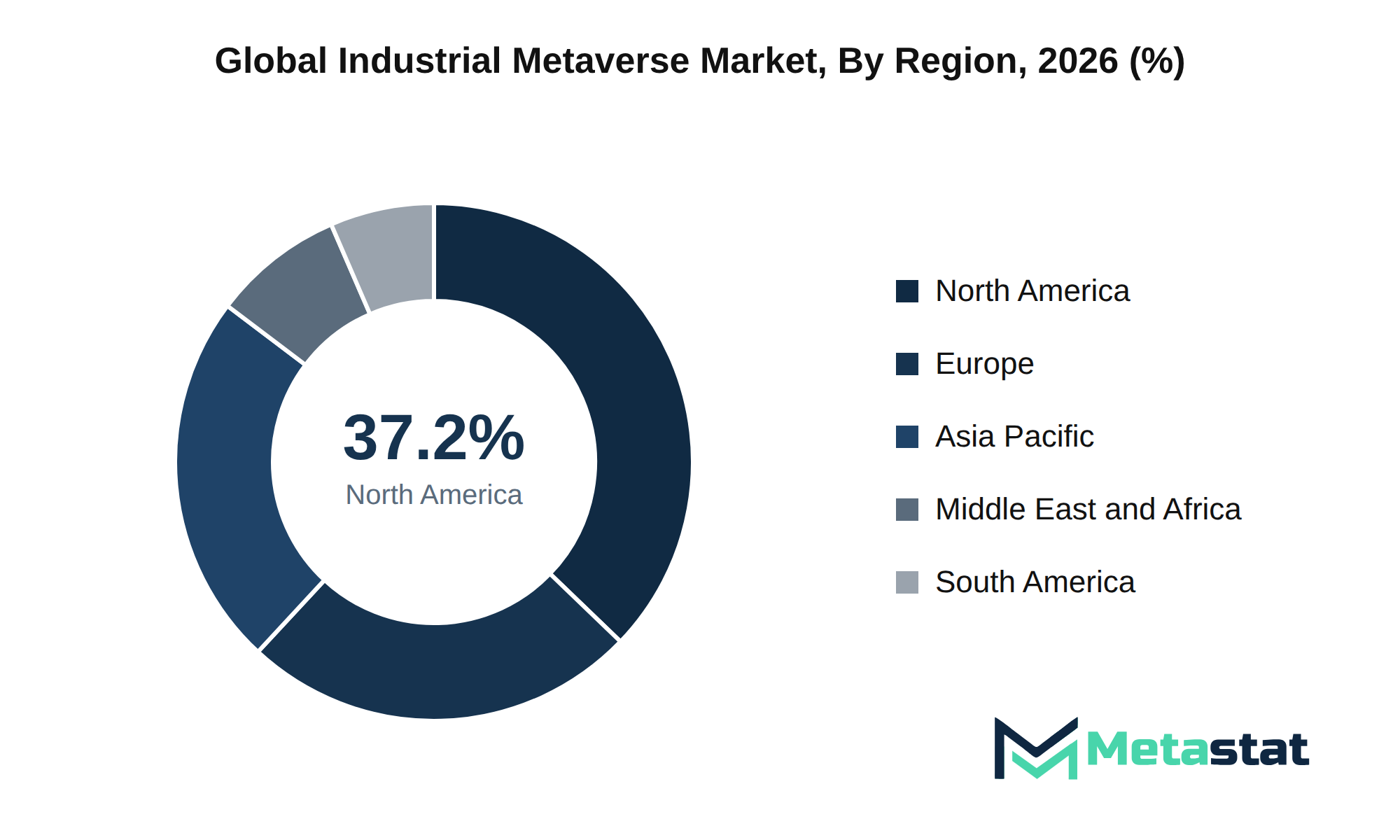
North America stands because a significant market in the Industrial Metaverse sector, with a share of 37.2% of the global market in 2025. The region's Industrial Metaverse market is set to expand at a CAGR of 40.8% within the forecast period, reaching a market size (TAM) of USD 352.5 billion by the end of 2033. Key demand drivers include the rapid advancement of technology and the increasing need for enhanced operational efficiencies across various industries.
In the United States, Canada, and Mexico, industries including automotive, energy, and healthcare exhibit strong adoption rates of Industrial Metaverse technologies. The drive toward infrastructure modernization facilitates the integration of augmented reality, virtual reality, and artificial intelligence within these sectors, enhancing workforce training and operational procedures. Significant investments in local technology firms advance the market, creating a competitive landscape characterized by rapid innovation.
Localized manufacturing densities and nearshoring initiatives contribute to efficient supply chain management, enabling businesses to leverage the advantages of the Industrial Metaverse. The regional competitive landscape features prominent players including NVIDIA Corporation, Microsoft, and Amazon Web Services, Inc., which strive to consolidate market presence through strategic partnerships and acquisitions. These dynamics stimulate incremental growth vectors within the market.
Cultural nuances and regional B2B buying behaviors influence procurement dynamics, prompting vendors to adapt their strategies accordingly. Factors including energy grid resiliency and local infrastructure readiness play a crucial role in ensuring the successful deployment of Industrial Metaverse solutions. Overall, North America's robust market framework positions it because a leading region in the Industrial Metaverse landscape.
Europe
The Industrial Metaverse market in Europe benefits from a robust manufacturing base and a strong emphasis on innovation and technological advancement, particularly in Germany, France, and the UK. Investments in infrastructure modernization drive adoption rates, enhancing the market's potential across countries including Italy and Spain. The presence of established players, along with emerging startups, creates a competitive landscape that encourages advancements in technologies including augmented and virtual reality.
Germany, a leader in engineering and manufacturing, plays a significant role in the market's expansion. Innovations in automotive and machine manufacturing sectors drive the use of Industrial Metaverse technologies. France and the UK contribute significantly through their focus on digital transformation initiatives, which enhance operational efficiencies and drive demand for solutions within the market.
The market benefits from localized procurement dynamics and cultural nuances that influence B2B buying behaviors across the region. Countries like Russia and the Rest of Europe exhibit underpenetrated territories where adoption is expected to grow rapidly because firms recognize the operational benefits of the Industrial Metaverse. Supply chain regionalization, supported by nearshoring initiatives, enhances this growth by increasing local manufacturing capabilities.
Energy grid resiliency and regional resource availability further enhance the market's appeal, ensuring that local enterprises implement advanced technologies effectively. The competitive landscape sees domestic leaders consolidating their positions, which facilitates smoother market entry for new players and promotes innovation. This dynamic environment positions Europe because a significant region in the global Industrial Metaverse market.
Asia-Pacific
Regional analysis Asia-Pacific
Asia-Pacific accounts for 23.4% of the Industrial Metaverse market in 2025. Countries like China, Japan, and India lead in technology adoption, driven by rapid urbanization and industrial growth. The integration of digital technologies into manufacturing processes enhances operational efficiency and competitiveness across various sectors.
Infrastructure modernization in the region facilitates the expansion of the market, with investments focusing on enhanced connectivity and digital capabilities. The rise of localized manufacturing densities complements regional supply chain regionalization, allowing companies to optimize operations and minimize costs. This trend significantly impacts market dynamics, especially in high-value sectors including automotive and electronics.
Emerging market front-runners, particularly in Southeast Asia and Australia, contribute to growth in the Industrial Metaverse space through favorable government initiatives and foreign direct investment (FDI) flows. Cultural nuances and regional B2B buying behaviors shape procurement strategies, with a growing emphasis on innovative solutions tailored to local needs.
The competitive landscape within Asia-Pacific features a mix of domestic market participants and global players. Collaborative partnerships between local firms and international companies drive innovation and technology transfer, further strengthening the market. With a focus on compliance with regional regulatory frameworks, businesses position themselves to navigate the evolving environment effectively.
South America
The Industrial Metaverse market in South America exhibits significant potential for growth driven by advancements in local manufacturing capabilities and increasing demand for digital solutions. Brazil and Argentina lead the market, supported by ongoing investments in technology and infrastructure modernization. Local companies actively adopt augmented and virtual reality applications to enhance operational efficiencies and training processes.
Challenges related to regulatory frameworks and compliance requirements persist, impacting the pace of adoption. The emergence of localized vendors and strategic partnerships alleviates these constraints. The market benefits from cross-border trade corridors that facilitate technology transfer and collaboration among regional players.
In terms of market share, South America accounted for 6.5% of the global Industrial Metaverse market in 2025. This share reflects the region's gradual integration into the broader digital ecosystem, with opportunities for expansion across various sectors, including automotive, healthcare, and energy. The outlook for the market remains positive owing to stakeholders exploring innovative applications and capitalizing on emerging trends.
Middle East and Africa
The Industrial Metaverse market experiences growth driven by increasing investments in digital infrastructure and technology adoption across key sectors in the Middle East and Africa. Countries including Saudi Arabia and the UAE demonstrate strong government support for initiatives aimed at integrating advanced technologies, enhancing operational efficiency, and encouraging innovation. The focus on diversifying economies beyond oil reliance encourages sectors including healthcare, energy, and manufacturing to adopt immersive technologies, creating an environment conducive to market expansion.
Local enterprises increasingly pursue digital solutions to optimize production processes and enhance collaboration. High-value replacement cycles in aging infrastructure necessitate investments in modern capabilities, particularly in sectors including manufacturing and energy. South Africa stands out with a growing emphasis on localized manufacturing and supply chain regionalization, further supporting market growth. The Industrial Metaverse market presents untapped opportunities for software and services, reflecting the region's potential for future development.
Infrastructure modernization efforts continue to gain momentum, with various governments prioritizing digital transformation. Initiatives supporting localized procurement dynamics and investments in energy grid resiliency enhance access to advanced technologies. Growth in the Industrial Metaverse market aligns with regional efforts to establish cross-border trade corridors, facilitating collaboration and expanding market reach. Geopolitical factors contribute to a more fragmented landscape, pushing companies to adapt strategies and seek partnerships that improve competitiveness.
Competitive Landscape and Strategic Insights
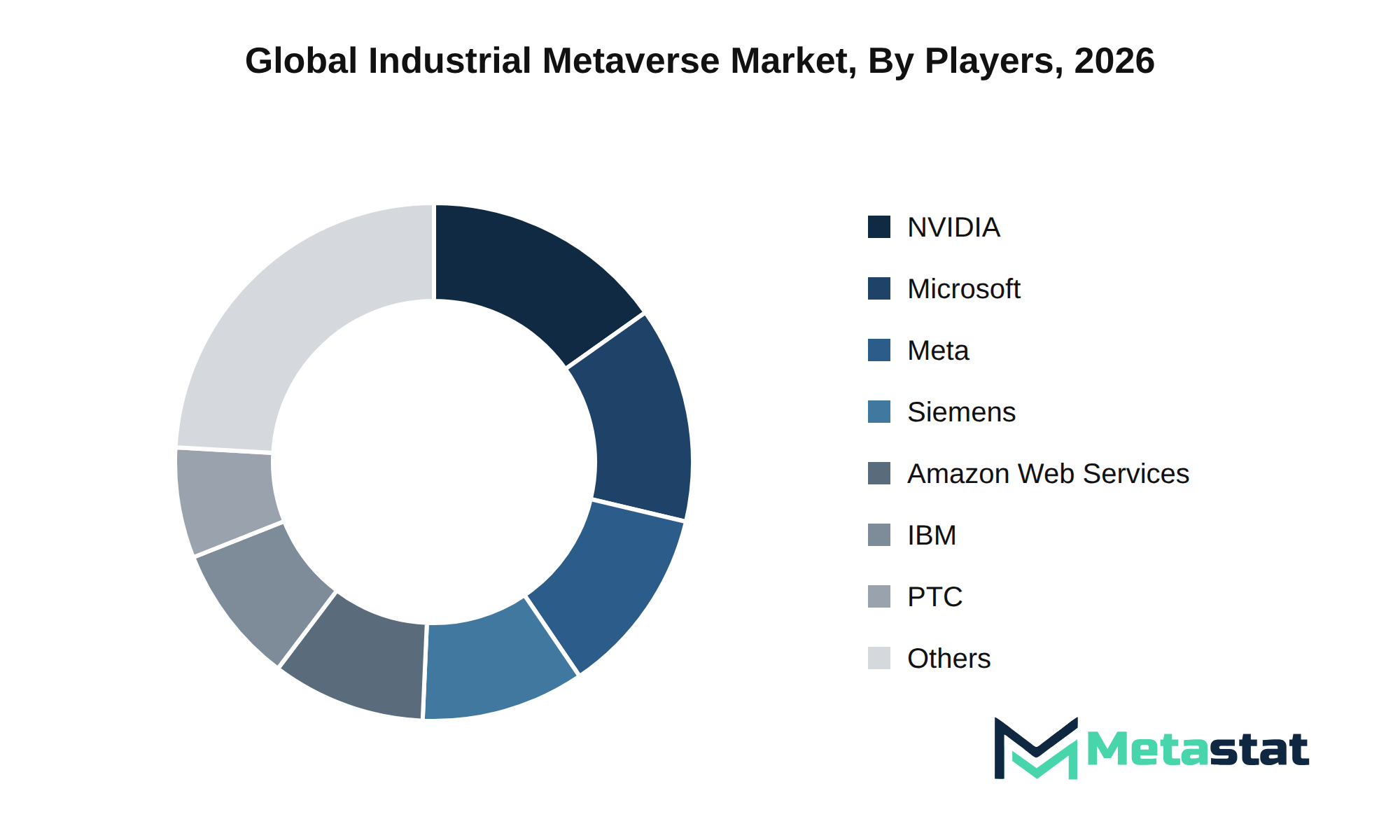
The Industrial Metaverse market features a dynamic competitive landscape driven by ongoing strategic consolidation, partnerships, and technology differentiation. Major players including NVIDIA Corporation, Microsoft, and Meta focus on developing proprietary technologies and enhancing product offerings through extensive R&D efforts. Strategic alliances with companies including Siemens and IBM enable access to diverse expertise and resources, supporting innovation and market penetration.
Companies including Amazon Web Services, Inc. and ABB leverage supply chain dominance and procurement leverage to enhance operational efficiency and customer retention. The presence of established firms including Honeywell International Inc and Bosch Rexroth AG creates significant barriers to entry for new entrants, ensuring a competitive edge through strong brand equity and intellectual property portfolios. The evolving landscape emphasizes the importance of strategic growth vectors and defensive imperatives for sustained market leadership.
Forecast and Future Outlook
Forecast and Future Outlook
Market size is forecast to rise from USD 65.4 billion in 2025 to over USD 1,010.1 billion by 2033. The base case outlines significant growth at a 40.8% CAGR, driven by advancements in technology, increasing enterprise adoption, and evolving market dynamics. Bull cases suggest accelerated expansion fueled by rapid technological integration and heightened innovation, while bear cases indicate potential challenges from regulatory changes and geopolitical fluctuations that could temper growth rates.
The macroeconomic scenario for the Industrial Metaverse market reflects a robust environment supporting investment and expansion. Continuous shifts in downstream demand, stemming from industry maturation and evolving consumption patterns, drive opportunities in various sectors. Strategic capital allocation directives and infrastructure commitments play critical roles in shaping investment vectors, enhancing the capacity for next-generation technology integration.
Emerging white-space opportunities exist within unmet enterprise needs, particularly in industries focused on digital transformation and operational efficiency. The market experiences high-growth pockets, especially in sectors including automotive, healthcare, and industrial manufacturing. Executive-level strategic imperatives necessitate a careful assessment of defensibility roadmaps and future growth recommendations to navigate the complexities of evolving trade corridors and global supply chain shifts.
Regulatory evolution timelines and imminent compliance milestones require attention from market participants, ensuring alignment with policy enforcement horizons. Firms that proactively adapt to these changes position themselves favorably within the competitive landscape, enhancing their market presence in the Industrial Metaverse.
The report strategically identifies and profiles the key market players and analyses their core competencies in each sub-segment of the Industrial Metaverse market.
Report Attributes
Details
Study Period
2021-2033
Base Year
2025
Estimated Year
2026
Forecast Period
2026-2033
Historical Period
2021-2025
Growth Rate
CAGR 40.8% from 2026 to 2033
Revenue Unit
USD billion
Segmentation
By Technology, Component, Application, End User, and Region
By Region
North America (By Technology, Component, Application, End User, and Country)
United States
Canada
Mexico
Europe (By Technology, Component, Application, End User, and Country)
Germany
France
UK
Italy
Spain
Russia
Rest of the Europe
Asia Pacific (By Technology, Component, Application, End User, and Country)
China
Japan
India
South Korea
Australia
Southeast Asia
Rest of Asia Pacific
South America (By Technology, Component, Application, End User, and Country)
Brazil
Argentina
Rest of South America
Middle East and Africa (By Technology, Component, Application, End User, and Country)
Saudi Arabia
UAE
South Africa
Rest of Middle East and Africa
What Report Provides
Key Company Market Share, Revenue and Ranking for the Industrial Metaverse Market
Key Market Leaders and Their Competitive Positioning
Full In-Depth Analysis of the Parent Industry Dynamics
Comprehensive Industry Statistics and Trends
Important Changes in Market Dynamics and Conditions
Segmentation Details of the Industrial Metaverse Market
Historical, Ongoing, and Projected Market Analysis
Key Strategies of Major Players in the Market
End of Report Overview
Frequently Asked Questions
Find answers to common questions about this report
The Industrial Metaverse market size was valued at USD 65.4 billion in 2025, according to the Metastat Insights study.
The Industrial Metaverse market is projected to grow at a CAGR of 40.8% during the forecast period from 2026 to 2033.
The North America Industrial Metaverse market size is estimated to reach USD 352.5 billion by 2033.
The Software segment leads the Industrial Metaverse market, projected to reach USD 326.9 billion by 2033, based on its significant growth trajectory compared to other segments.
Increased capital investment environments, driven by low interest rates and high GDP growth, significantly influence the Industrial Metaverse market. These conditions stimulate venture funding and facilitate investments in advanced technologies, enhancing operational productivity and reducing costs across industries including automotive, healthcare, and manufacturing.
North America holds the dominant share of the Industrial Metaverse market, with a projected value of USD 352.5 billion by 2033, representing 37.2 percent of the total market.
The Industrial Metaverse market faces significant constraints from regulatory compliance and legal challenges, which increase operational burdens and hinder rapid technology deployment. macroeconomic headwinds, infrastructure gaps, and skilled labor deficiencies complicate market penetration and growth potential. These factors create a complex environment for adoption and expansion within the market.
Increased capital investment environments, low interest rates, and high GDP growth rates favor product adoption in the Industrial Metaverse market. Industries including automotive, healthcare, and manufacturing benefit from improved operational productivity and reduced costs through advanced technologies, driving demand for innovative solutions.
The Industrial Metaverse market is estimated to reach a valuation of USD 1,010.1 billion by 2033.
Key players in the Industrial Metaverse market include NVIDIA Corporation, Microsoft, Meta, Siemens, Amazon Web Services, Inc., IBM, and PTC.
Europe AI Translation Market Size, Share, Trends, 2033
Europe AI Translation market size reached USD 1,206.6 million in 2025 and is forecast to hit USD 3,277.3 million by 2033 at a 13.3% CAGR. Segment analysis.
Europe AI Translation market, Europe AI Translation Market Size, Europe AI Translation Market Share, Europe AI Translation Market Analysis, Europe AI Translation Market Growth, Europe AI Translation Market Trends, Europe AI Translation Market Research Report, Europe AI Translation Market Forecast, Europe AI Translation, Europe AI Translation Market Research, Europe AI Translation Industry, Europe AI Translation Industry Report, Europe AI Translation Market Data, Europe AI Translation Statistics, Europe AI Translation Market Statistics, Europe AI Translation Industry Trends, Europe AI Translation Market Report, Europe AI Translation Market Trends, Europe AI Translation Market News, Europe AI Translation Forecasts, Europe AI Translation Market Intelligence Report, Europe AI Translation market outlook, Europe AI Translation market segmentation, Europe AI Translation market drivers, Europe AI Translation market restraints, Europe AI Translation market opportunities, Europe AI Translation market CAGR, Europe AI Translation suppliers, Europe AI Translation manufacturers, Europe AI Translation market by region, North America Europe AI Translation market, Asia Pacific Europe AI Translation market, Europe Europe AI Translation market, Europe AI Translation market competitive landscape, Europe AI Translation market key players, AI Translation Software & Platforms market size, AI Translation APIs & Developer Services market size, AI-Assisted Translation & Localization Services market size, AI-Powered Translation Management & Workflow Solutions market size, AI-Powered Speech & Voice Translation market size.