
Global LegalTech Artificial Intelligence Market
Global LegalTech Artificial Intelligence Market Size, Share, By Deployment Model (Cloud-Based, On-Premises and Hybrid), By Application (Legal Research & Knowledge Intelligence, Legal Drafting & Document Automation, Contract Review, Negotiation & Lifecycle Management, eDiscovery & Evidence Review, Litigation Analytics & Case Strategy, Regulatory Compliance & Risk Intelligence, Legal Operations, Matter & Spend Management, Intellectual Property & Patent Intelligence and Others), By AI Technology (Generative AI, Natural Language Processing and Natural Language Understanding, Machine Learning and Predictive Analytics, Large Language Models, Computer Vision and Optical Character Recognition, Agentic AI and Autonomous Workflows and Others), By End User (Law Firms, Corporate Legal Departments, Government & Regulatory Legal Teams, Courts & Judicial Bodies, Alternative Legal Service Providers and Legal Aid & Nonprofit Legal Organizations), Industry Analysis, Growth, Trends, and Forecast, 2026-2033
MSI-4969
August 19, 2026
Updated
300 Pages
Historical
Base year
Forecast
Forecast period
Report Details
Comprehensive Market Analysis And Insights
Market Overview
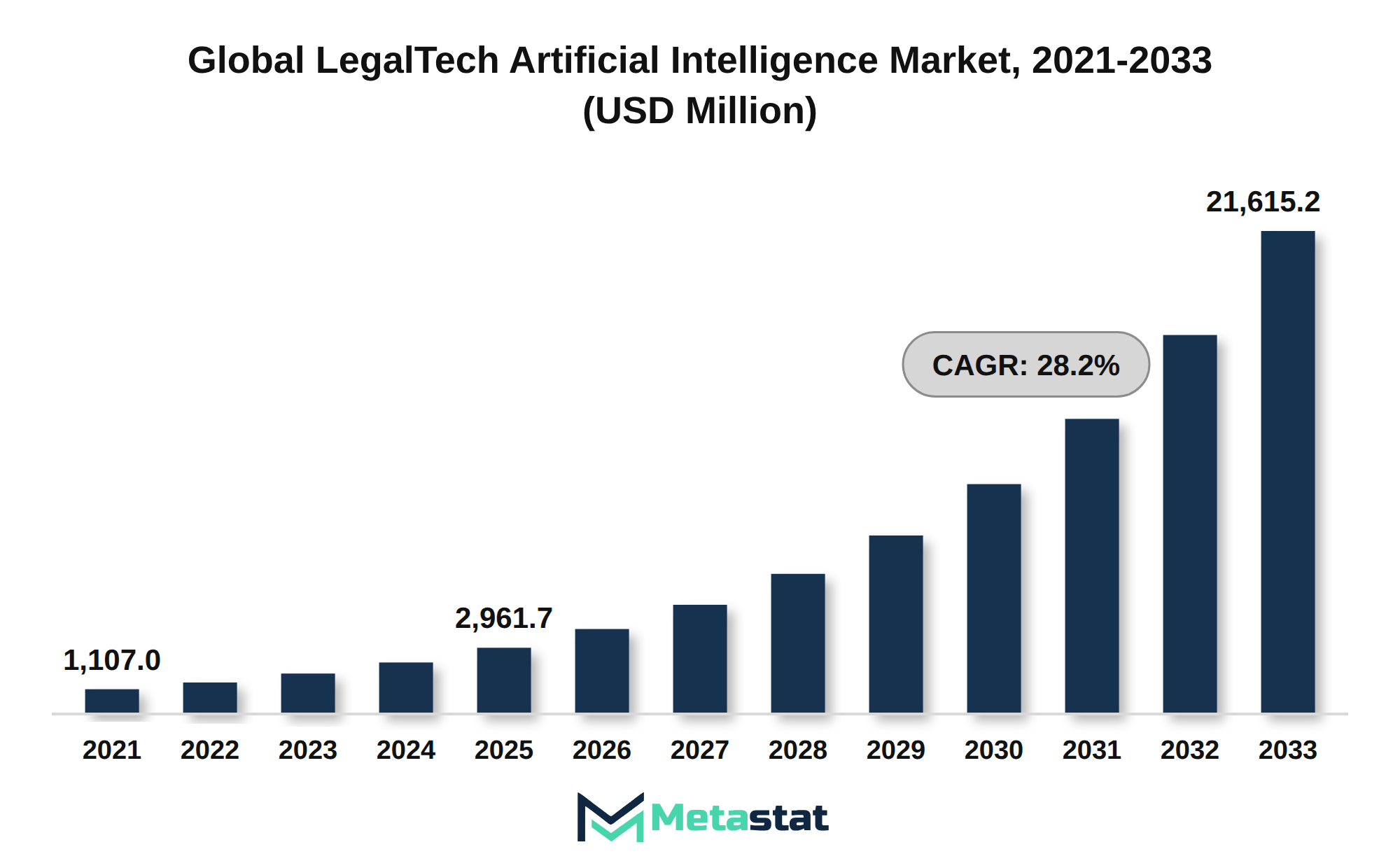
The global LegalTech Artificial Intelligence market was valued at USD 2,961.7 million in 2025 and is projected to reach USD 21,615.2 million by 2033, growing at a CAGR of 28.2% over the forecast period.
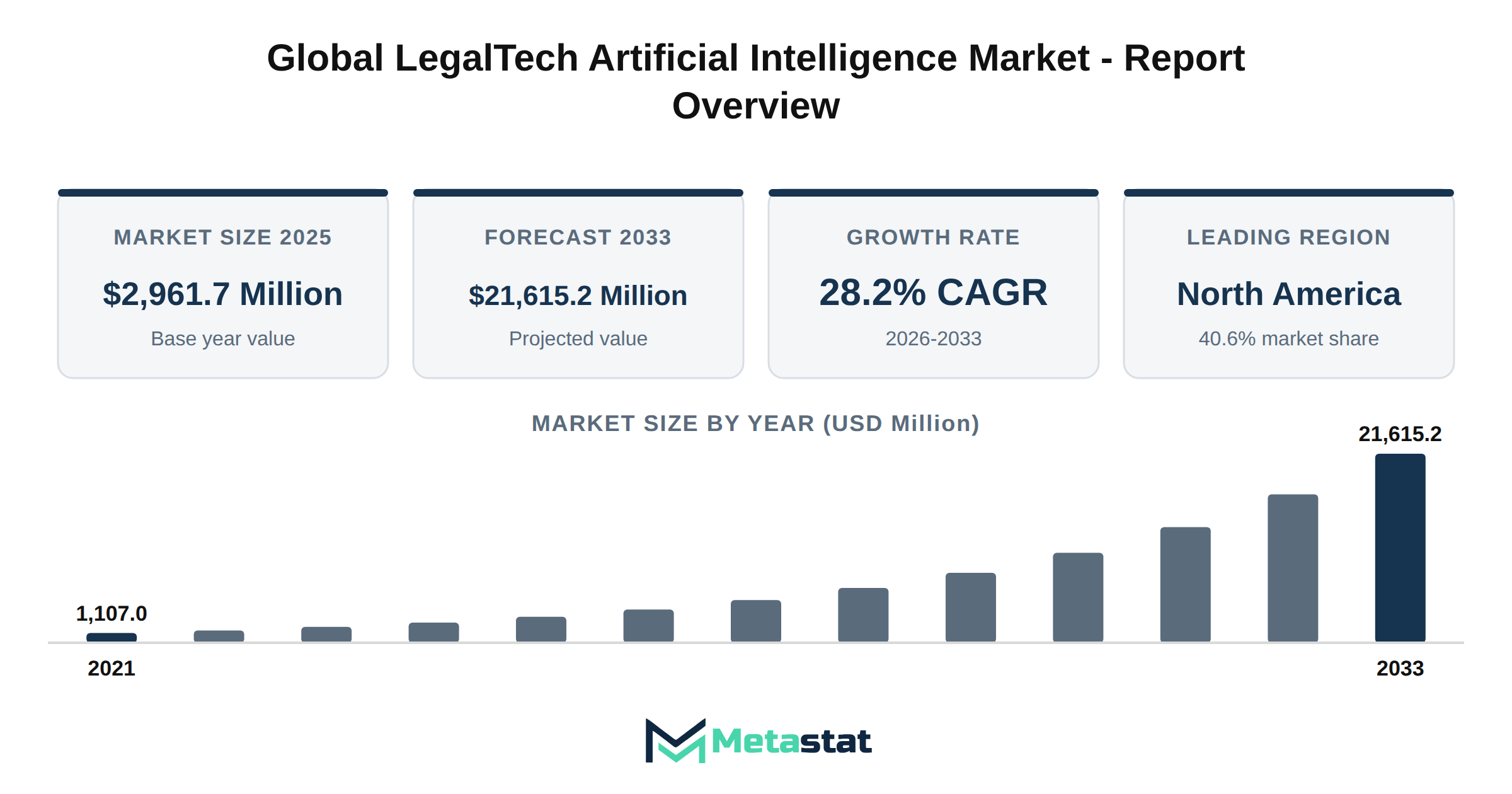
The global LegalTech Artificial Intelligence market is projected to grow from USD 2,961.7 million in 2025 to USD 21,615.2 million by 2033, reflecting a compound annual growth rate (CAGR) of 28.2%. The market experienced significant growth from USD 1,107.0 million in 2021 to USD 2,961.7 million in 2025, driven by increasing adoption of advanced technologies within the legal sector.
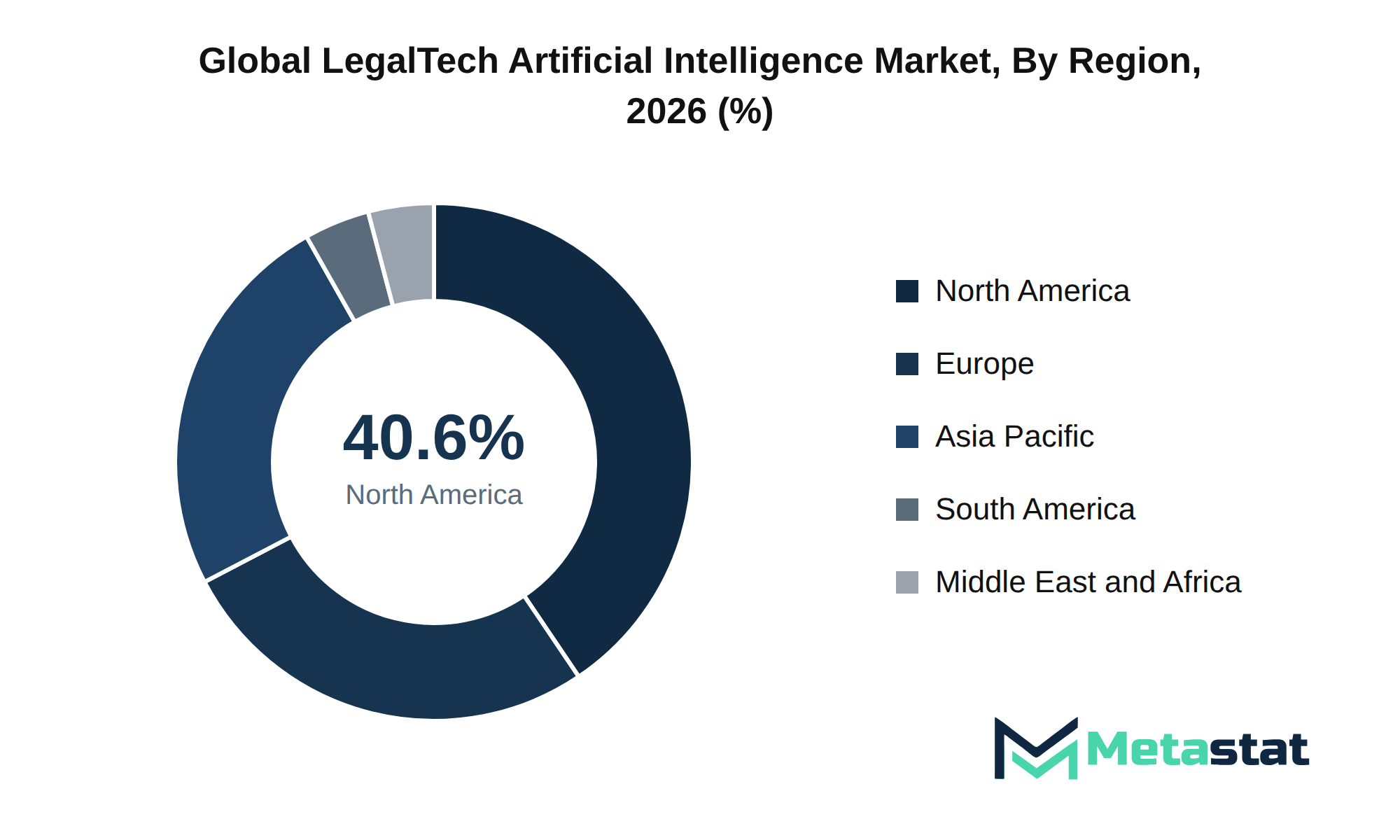
North America holds the largest share of the market, accounting for 40.6% of the total value. This region's dominance stems from high investments in technology and a robust legal framework that encourages innovation. Europe follows with a 26.8% share, supported by growing demand for AI-driven solutions among law firms and corporate legal departments. The Asia Pacific region, capturing 24.5% of the market, witnesses rapid technological advancements and increasing legal service demands. South America and the Middle East and Africa each represent 4.1% of the market, indicating emerging opportunities in these regions.
The deployment model segment highlights a shift towards cloud-based solutions, with anticipated growth from USD 2,792.9 million in 2026 to USD 16,751.7 million by 2033. This transition reflects the need for scalability and flexibility within legal operations. On-premises models are projected to reach USD 3,103.9 million by 2033, while hybrid models will contribute USD 1,759.5 million to the market by the same year.
In terms of applications, the market encompasses various areas, including legal research, document automation, contract management, litigation analytics, and compliance solutions. Demand for these applications is driven by increasing complexity of legal processes and the necessity for efficiency and accuracy in legal operations. The LegalTech Artificial Intelligence market evolves rapidly, with significant investments in research and development aimed at enhancing AI capabilities and integrating new technologies.
The increasing adoption of LegalTech Artificial Intelligence solutions across various sectors drives the demand for innovative regulatory compliance tools. Legal professionals require advanced technologies to navigate complex legal frameworks efficiently, ensuring adherence to evolving laws and regulations. This demand results in significant investment in research and development, allowing firms to enhance their offerings and remain competitive.
Disruption within traditional legal frameworks has accelerated the integration of next-generation technologies. The market experiences a surge in the development of generative AI, machine learning, and natural language processing capabilities, which enable legal practitioners to automate routine tasks, thereby enhancing productivity and resource allocation. These advancements contribute to a more streamlined customer journey, allowing clients to receive services more efficiently.
Capital allocation is essential for firms aiming to innovate within the LegalTech Artificial Intelligence market. Strategic investments in infrastructure and technology development are crucial for maintaining a competitive edge. Legal firms focus on optimizing their operational expenditures while balancing capital expenditures to support sustainable growth and innovation.
Macroeconomic headwinds, including inflationary pressures and currency volatility, create challenges for stakeholders in the market. These challenges affect pricing strategies and influence investment decisions, prompting firms to adapt their operational and financial strategies. Companies that successfully navigate these challenges position themselves favorably for future growth.
The market fragmentation observed in the LegalTech Artificial Intelligence sector presents both challenges and opportunities. Numerous players compete, each offering unique solutions that cater to specific client needs. This dynamic environment encourages innovation but complicates the procurement process for buyers seeking tailored solutions.
Overall, the LegalTech Artificial Intelligence market is anticipated to experience substantial growth, driven by technological advancements and evolving client demands. Firms that prioritize innovation and effectively manage operational challenges stand to gain significant market share in this evolving landscape.
Market Dynamics
Digital transformation drives adoption of LegalTech AI
The ongoing digital transformation across various industries fuels the adoption of LegalTech Artificial Intelligence solutions. Organizations increasingly prioritize technological integration to enhance operational efficiency, reduce costs, and streamline processes. This shift toward digital solutions stems from the growing emphasis on improving productivity, with firms seeking to leverage AI technologies to automate tasks traditionally performed by human resources.
Law firms, corporate legal departments, and alternative legal service providers invest in AI-driven platforms that support legal research, document automation, and contract management. The integration of advanced technologies, including natural language processing and machine learning, enables organizations to manage large volumes of data while maintaining compliance with regulatory requirements. This operational efficiency affects the overall cost structure, allowing firms to allocate resources more effectively.
The demand for LegalTech Artificial Intelligence solutions emphasizes the importance of adapting to evolving consumer behaviors and industry expectations. Clients expect faster response times, streamlined services, and innovative solutions, prompting legal service providers to invest in technology that meets these demands. Continuous investment in LegalTech AI will contribute to significant market growth throughout the forecast period.
Enhancing Operational Productivity Drives LegalTech AI Growth
The push for enhancing operational productivity significantly advances the LegalTech Artificial Intelligence market. Organizations increasingly seek solutions that streamline workflows, reduce manual intervention, and optimize labor costs. This demand for efficiency necessitates the adoption of AI-driven tools that automate repetitive tasks, enabling legal professionals to focus on higher-value activities. Significant interest in solutions that enhance efficiency arises from navigating growing workloads and complex legal environments.
Many law firms and corporate legal departments are investing in AI technologies to improve productivity. By integrating AI into their processes, these entities reduce overhead costs and respond more effectively to client needs. The market benefits from this trend, driven by firms prioritizing cost-efficiency initiatives that recognize the value AI solutions bring to their operations. In turn, this creates a competitive environment where technological integration becomes essential for success.
The increasing emphasis on operational productivity aligns with broader macro-economic factors. Sustained growth in GDP and favorable capital investment environments contribute to heightened interest in innovative technologies. The LegalTech Artificial Intelligence market is set to thrive, fueled by organizations striving to enhance their productivity, streamline processes, and ultimately achieve better outcomes in a fast-evolving legal landscape.
Regulatory compliance impacts market growth
The LegalTech Artificial Intelligence market faces challenges due to regulatory compliance hurdles. Companies encounter complexities in adhering to various legal mandates, which impacts operational efficiency and increases the cost of compliance. These challenges particularly affect law firms and corporate legal departments that allocate significant resources to maintain compliance with evolving regulations.
Macroeconomic headwinds, including inflationary pressures and capital stagnation, restrict investment in technologies that facilitate legal operations. This constraint hampers the ability to adopt advanced solutions that enhance productivity. High capital investment requirements and escalating operating costs limit access to innovative tools, deterring potential entrants and reducing competitive dynamics in the market.
Infrastructure gaps and connectivity deficits present additional obstacles for widespread adoption of LegalTech Artificial Intelligence solutions. Regions with underdeveloped technological frameworks struggle to implement digital solutions effectively, which affects overall market penetration. Deployment bottlenecks caused by a lack of skilled labor exacerbate these issues, leading to delays in system integrations and technology rollouts.
Data security vulnerabilities and privacy concerns pose significant risks for firms adopting AI-driven legal solutions. The potential for intellectual property theft and exposure to cyber threats creates hesitancy among users, particularly in sensitive legal environments. The need for robust cybersecurity measures adds complexity and cost that firms navigate, impacting the overall growth trajectory of the market.
Market fragmentation, driven by a diverse array of solutions and varying levels of acceptance across regions, complicates the environment for stakeholders. Cultural barriers and regional adoption resistors hinder efforts to standardize technology across jurisdictions, resulting in uneven growth patterns. Such fragmentation slows the momentum of the LegalTech Artificial Intelligence market and challenges the scalability of innovations that could drive efficiencies in legal practices.
Geopolitical factors impact market stability
The LegalTech Artificial Intelligence market encounters challenges stemming from geopolitical fragmentation and trade deficits. These conditions heighten tariff friction, complicating cross-border transactions and inflating costs for suppliers. Such shifts disrupt the supply chain, leading to instability in component sourcing and logistics. This volatility affects operational efficiencies and pricing strategies within the market, limiting growth opportunities.
Technological disruptions, combined with complex research and development integrations, pose significant hurdles for firms aiming to innovate. Interoperability friction between disparate systems leads to inefficiencies, hampering the adoption of LegalTech AI solutions across various sectors. Rising input cost structures and margin pressures create a challenging financial landscape, restricting market expansion potential.
Evolving legal liabilities and tightening global regulatory standards introduce additional compliance overhead for organizations. Increased scrutiny leads to resource allocation challenges, diverting attention from core business functions and innovation efforts. Consequently, market players face pressure to retain talent while managing workforce skill gaps and automation displacements, complicating human resources management.
Environmental lifecycle footprints and sustainability demands further complicate market dynamics. Companies within the LegalTech Artificial Intelligence market balance compliance with decarbonization mandates while striving for operational profitability. These pressures result in a need for strategic adaptations to meet changing downstream demands and navigate potential market saturation.
Emerging technological disruptions drive market growth
The LegalTech Artificial Intelligence market experiences significant opportunities owing to ongoing technological disruptions. Advances in AI technologies including generative AI and natural language processing facilitate the development of innovative solutions tailored for the legal sector. These technologies support law firms and corporate legal departments in enhancing efficiency, streamlining processes, and improving client relations.
Geographical expansion further fuels market growth, driven by firms in emerging regions adopting AI-driven technologies to modernize their legal operations. The increased demand for cloud-based deployment models offers scalability and flexibility, attracting smaller legal firms and alternative legal service providers to the market. Such transformations enable broader access to advanced legal tools, thereby enhancing overall operational capabilities.
Strategic consolidation and cross-industry mergers contribute to a more competitive landscape, allowing players to integrate diverse applications and services. This integration generates new revenue streams and supports the development of niche applications tailored to specific legal needs. Evolving buying behaviors, influenced by digital procurement shifts and the desire for value-added services, further influence market dynamics because organizations seek comprehensive and efficient solutions.
Sustainability imperatives prompt firms to align with eco-friendly practices, incorporating AI technologies that support compliance and regulatory adaptations. The focus on environmentally sustainable operations encourages the adoption of LegalTech Artificial Intelligence solutions that enhance operational yield while meeting emerging environmental standards.
Overall, the convergence of technological advancements, geographical expansion, and sustainability considerations positions the LegalTech Artificial Intelligence market for growth in the coming years.
Market Segmentation Analysis
The Global LegalTech Artificial Intelligence market is segmented based on Deployment Model, Application, AI Technology, and End User.
By Deployment Model, the market is further segmented into:
- Cloud-Based
- On-Premises
- Hybrid
Cloud-Based
Valued at USD 2,792.9 million in 2026, the Cloud-Based segment of the LegalTech Artificial Intelligence market is projected to reach USD 16,751.7 million by 2033, at a CAGR of 29.2% during the forecast period. Primary demand drivers include the rapid shift towards remote work and increased focus on operational efficiency among legal firms. Adoption of cloud-based technologies facilitates easier access to advanced tools and resources for legal research and case management, aligning with evolving client expectations and the need for improved service delivery.
Segment expansion catalysts comprise advancements in machine learning and natural language processing technologies. These innovations enhance the capabilities of cloud-based applications, allowing for more efficient document automation, contract management, and risk assessment. End-use dynamics emphasize that corporate legal departments and alternative legal service providers leverage cloud solutions for their flexibility and scalability. Consumption shifts towards subscription-based models further support the growth of this segment.
Regulatory compliance standards influence the integration of cloud-based solutions, with many jurisdictions implementing stricter data protection measures. LegalTech providers respond by ensuring their offerings meet these standards, which strengthens customer trust and adoption. Cost structures in this segment benefit from reduced overhead expenses associated with traditional IT infrastructure, while pricing volatility remains manageable due to competitive market conditions. Strategic opportunity windows arise from firms seeking to modernize their operations and integrate next-generation upgrades into their workflows.
Investment in cloud-based technologies reflects a positive outlook for the segment, driven by increasing demand for efficient, reliable, and secure legal solutions. Technological obsolescence poses a risk, prompting organizations to remain vigilant in adopting the latest advancements. Overall, the Cloud-Based segment within the LegalTech Artificial Intelligence market demonstrates significant potential for sustained growth and innovation.
On-Premises
Increased focus on data security and client confidentiality has driven significant interest in the On-Premises segment of the LegalTech Artificial Intelligence market. Organizations prioritize in-house control over sensitive data to mitigate risks associated with cloud-based solutions. Law firms and corporate legal departments represent primary end-users of On-Premises solutions, adopting these technologies to ensure compliance and safeguard sensitive client information.
Technological maturation plays a crucial role in segment growth. Advancements in AI technologies enhance the capabilities of On-Premises solutions, allowing firms to execute complex legal processes more efficiently. This evolution contributes to the expanding range of applications, including legal drafting, contract review, and regulatory compliance. Legal professionals recognize the potential of these systems to optimize workflow and reduce operational costs, reinforcing demand for On-Premises deployments.
The On-Premises segment is expected to reach USD 3,103.9 million by 2033, at a CAGR of 23.5% during the forecast period. This growth trajectory reflects ongoing investments in technology and adoption across various legal practices, driven by a desire for enhanced operational efficiency and improved service delivery. The segment's resilience against market fluctuations further strengthens its position within the broader LegalTech Artificial Intelligence market.
Hybrid
Growing interest in the Hybrid deployment model drives acceptance within the LegalTech Artificial Intelligence market. Businesses increasingly recognize the benefits of combining cloud-based and on-premises solutions, enhancing flexibility and operational efficiency. This dual approach allows for optimal resource allocation, catering to diverse organizational needs while enabling scalability. Law firms, corporate legal departments, and government entities are early adopters, capitalizing on the integration of advanced AI technologies to streamline operations and enhance productivity.
The anticipated growth in the Hybrid segment stems from several factors, including technological maturation and an increasing demand for advanced features. Integration of next-gen upgrades, including automation and machine learning, enables improved performance and user experience. These advancements support the evolving requirements of legal professionals and organizations, generating consistent demand for innovative solutions. By 2033, the Hybrid segment is expected to reach USD 1,759.5 million, highlighting its significance in the overall market landscape.
Regulatory compliance standards further influence the adoption of Hybrid solutions, driven by organizations seeking to navigate complex legal environments. The combination of cloud and on-premises models provides enhanced data security and compliance capabilities, addressing the concerns of many stakeholders. The rising need for efficient contract management and litigation analytics fuels demand for this segment, positioning it favorably in the market. Overall, the Hybrid deployment model represents a strategic opportunity for growth and innovation, underlining its critical role in the future of the LegalTech Artificial Intelligence market.
By Application, the market is further segmented into:
- Legal Research & Knowledge Intelligence
- Legal Drafting & Document Automation
- Contract Review, Negotiation & Lifecycle Management
- eDiscovery & Evidence Review
- Litigation Analytics & Case Strategy
- Regulatory Compliance & Risk Intelligence
- Legal Operations, Matter & Spend Management
- Intellectual Property & Patent Intelligence
- Others (Client Intake, Tax Research, Legal Billing Automation)
Legal Research & Knowledge Intelligence
Growing demand for efficient information retrieval and legal research significantly influences the LegalTech Artificial Intelligence market. Law firms and corporate legal departments increasingly rely on advanced tools to improve knowledge management and streamline operations. Enhanced legal research capabilities reduce time spent on document review and case analysis, resulting in improved productivity.
Technological maturation drives the evolution of AI-powered legal research tools. Developments in natural language processing and machine learning enable more accurate interpretation of legal texts and case law. These advancements attract investment and increase competition among providers, creating a dynamic environment for innovation.
Product evolution within this segment focuses on integrating collaborative features and real-time data access. Users benefit from efficient sharing of insights and findings across teams, enhancing decision-making processes. The shift towards cloud-based solutions further supports accessibility and collaboration, reflecting the evolving expectations of legal professionals.
End-use dynamics show a growing interest in integrating knowledge intelligence tools with existing legal practices. Courts and regulatory bodies increasingly adopt AI solutions, promoting compliance and standardization in legal processes. This trend increases the importance of legal research and knowledge intelligence in shaping emerging practices and enhancing overall operational efficiency.
Investments in regulatory compliance standards fuel demand for advanced knowledge intelligence solutions. Legal professionals face heightened scrutiny regarding compliance and risk management, creating opportunities for vendors that offer robust solutions. This focus on compliance translates into a competitive advantage for firms that leverage AI-enhanced knowledge management tools, which streamline processes and mitigate risks.
Legal Drafting & Document Automation
Increased emphasis on efficiency and accuracy within legal operations accelerates the demand for Legal Drafting and Document Automation solutions. These tools streamline the creation and management of legal documents, significantly reducing time spent on repetitive tasks. Adoption of advanced technologies, including natural language processing and machine learning, enhances document accuracy and compliance, allowing legal professionals to focus on higher-value activities. The integration of automation into everyday workflows leads to improved productivity and cost savings, reshaping how legal services are delivered.
Growing trends towards remote work and digital collaboration drive the expansion of this segment, driven by legal firms seeking to provide effective services despite geographical barriers. Enhanced client expectations for faster turnaround times and personalized services drive further investment in automation technologies. Regulatory compliance pressures necessitate the use of automated solutions to ensure adherence to evolving legal standards and policies, reinforcing the value proposition of these technologies within the overall market.
Technological maturation contributes to the rise of next-generation upgrades in legal drafting tools, making them increasingly user-friendly and accessible. Continuous product evolution leads to the introduction of features that address specific needs including contract management and e-signatures. While organizations recognize the strategic advantages of automation, capital investment in these technologies expands, creating a dynamic environment for innovation and market growth.
Contract Review, Negotiation & Lifecycle Management
Increasing reliance on efficient contract management drives the demand for advanced solutions in contract review, negotiation, and lifecycle management within the LegalTech Artificial Intelligence market. Organizations aim to streamline processes, reduce errors, and enhance compliance through automated systems that analyze and manage contracts more effectively. Law firms and corporate legal departments particularly benefit from these technologies, which facilitate faster decision-making and better risk management.
Technological maturation leads to significant advancements in AI capabilities, enabling sophisticated analysis of legal documents. Enhanced natural language processing and machine learning techniques allow systems to understand, interpret, and generate legal content with higher accuracy. The demand for next-generation upgrades influences vendors to continuously improve their offerings, which helps maintain competitive advantages within the market.
End-use dynamics reflect a shift towards more automated solutions among legal professionals. Clients increasingly expect transparency and efficiency, prompting legal teams to adopt technologies that meet these demands. Regulatory compliance standards further compel organizations to seek solutions that ensure adherence to evolving legal frameworks, pushing the industry towards adopting AI-driven tools for contract management.
Strategic opportunity windows emerge due to organizations recognizing the potential of AI in reducing contract negotiation cycles and improving overall efficiency. The competitive landscape encourages the integration of disruptive alternatives that provide significant operational advantages. Firms investing in these technologies position themselves favorably to capture market share and respond to the evolving needs of their clients.
eDiscovery & Evidence Review
Growing reliance on effective discovery processes within legal proceedings drives demand for solutions in eDiscovery and Evidence Review. Legal professionals require advanced tools to facilitate the retrieval and analysis of electronic evidence, which is essential for case strategy formulation. Increased data volumes and the complexity of digital information necessitate the implementation of efficient technologies, enabling firms to streamline workflows and improve accuracy in evidence processing.
Technological maturation of artificial intelligence tools supports enhanced capabilities in eDiscovery. Advanced analytics and machine learning algorithms enhance the identification of relevant documents, significantly reducing time and effort in evidence review. This evolution provides a competitive edge for firms that adopt these technologies, influencing the overall growth trajectory of the LegalTech Artificial Intelligence market.
Regulatory compliance standards significantly impact the adoption of eDiscovery solutions. While legal frameworks evolve to address the challenges posed by digital evidence, firms encounter pressures to adopt compliant technologies to avoid penalties. This factor creates a favorable environment for growth, with heightened demand for solutions that ensure adherence to emerging legal requirements.
Cost structures related to traditional evidence review processes promote the shift toward AI-enabled solutions. High labor costs and lengthy timelines associated with manual review tasks encourage legal entities to seek more cost-effective technologies. Integrating artificial intelligence into eDiscovery enables firms to achieve substantial operational savings, further driving market expansion.
Strategic opportunity windows emerge owing to firms seeking to enhance their competitive positioning through innovation in evidence review processes. Investment in next-gen upgrades enables legal professionals to leverage automation and predictive analytics, leading to improved outcomes in litigation. This strategic focus on technological advancement supports the overall development of the LegalTech Artificial Intelligence market.
Litigation Analytics & Case Strategy
Increased reliance on data-driven insights strengthens demand for Litigation Analytics & Case Strategy solutions within the LegalTech Artificial Intelligence market. Law firms and corporate legal departments pursue these technologies to enhance decision-making processes, improve case strategies, and optimize legal research efforts. The focus on data integration and analytics capabilities highlights the importance of accurate forecasting and performance assessment in litigation outcomes.
Adoption of Litigation Analytics & Case Strategy solutions aligns with a broader shift toward digital transformation in the legal sector. Legal professionals increasingly seek tools that provide comprehensive data analysis, enabling them to identify trends, assess risks, and develop effective litigation strategies. This growing trend reflects a commitment to leveraging technology for competitive advantage in the market.
Investment in next-generation upgrades and technological maturation drives ongoing evolution within the Litigation Analytics & Case Strategy segment. Providers focus on enhancing product offerings through innovative features including machine learning algorithms and predictive analytics, catering to the evolving needs of legal practitioners. These advancements contribute to improved operational efficiencies and cost-effectiveness.
Market dynamics indicate a shift toward regulatory compliance and risk management, which influences the adoption of Litigation Analytics & Case Strategy solutions. Legal teams prioritize tools that ensure adherence to compliance standards and enhance risk assessment capabilities. This trend highlights the necessity for strategic investments in technology that support legal operations within a complex regulatory landscape.
Strategic opportunity windows emerge owing to legal organizations increasingly recognizing the value of data analytics in litigation. Firms that adopt these solutions gain a competitive edge by enhancing their ability to analyze case data, trends, and outcomes. Such capabilities enable informed decision-making, allowing legal teams to allocate resources effectively and streamline case management processes.
The evolving environment of the LegalTech Artificial Intelligence market presents significant potential for growth within the Litigation Analytics & Case Strategy segment. Firms focusing on integrating these technologies into their operations position themselves to address the challenges and demands of modern legal practices. The emphasis on data-driven decision-making aligns with the trend toward innovation and efficiency in the legal sector.
Regulatory Compliance & Risk Intelligence
Regulatory compliance and risk intelligence represent a vital aspect of the LegalTech Artificial Intelligence market. Increasing regulatory scrutiny across legal practices stimulates demand for robust compliance solutions. Organizations face pressure to adhere to evolving regulations and mitigate associated risks, leading to heightened investment in AI-driven compliance tools.
The technological maturation of AI technologies enhances capabilities in this sub-segment. Advanced algorithms facilitate real-time monitoring and analysis of regulatory changes, allowing legal departments to stay informed and responsive. This evolution drives the adoption of solutions that streamline compliance processes, reduce human error, and improve overall efficiency.
Market participants recognize opportunities in the integration of AI technologies into existing compliance frameworks. Enhanced data analytics and predictive capabilities enable legal professionals to assess risk more effectively. Consequently, firms proactively address compliance challenges, leading to improved client trust and operational resilience.
Growing awareness of the importance of risk management increases demand for specialized AI-driven solutions. Legal professionals increasingly seek tools that deliver insights into potential vulnerabilities, enabling informed decision-making. This shift emphasizes a commitment to regulatory adherence and long-term business sustainability.
Investment in next-generation upgrades, including machine learning and natural language processing, provides a competitive edge in the market. Legal firms leveraging these technologies offer enhanced services, attracting clients seeking comprehensive risk management solutions. This strategic focus on innovation positions organizations to navigate the complexities of regulatory landscapes effectively, enabling them to respond to changes efficiently.
Challenges persist in the form of compliance standards that constantly evolve. Firms adapt to these changes, necessitating ongoing investment in compliance training and technology updates. The cost structures associated with implementing and maintaining advanced compliance solutions require careful consideration, impacting overall pricing strategies within the market.
Legal Operations, Matter & Spend Management
Increasing emphasis on efficient resource allocation within legal operations influences demand for advanced solutions in Matter and Spend Management. Organizations recognize the importance of optimizing legal expenditures, which provides a competitive edge in a cost-sensitive environment. Technological advancements in AI enable firms to enhance budgeting, forecasting, and financial reporting, reducing overhead costs while improving operational transparency.
Growing performance expectations from clients drive law firms to adopt comprehensive solutions that enable real-time tracking of matter-related expenses. The demand for granular insights into legal spend prompts firms to invest in intelligent systems that analyze historical data and provide recommendations for future engagements. This shift towards data-driven decision-making reflects a broader trend within the LegalTech Artificial Intelligence market.
The increasing complexity of legal matters results in heightened competition among firms, necessitating efficient allocation of resources. To maintain profitability, legal departments require tools that streamline matter and spend management processes, enhancing overall operational efficiency. This focus on operational excellence aligns with the broader objective of maximizing client satisfaction and retention.
Regulatory compliance standards shape demand for Matter and Spend Management solutions. Firms adhere to increasingly stringent regulations regarding financial reporting and accountability. Advanced technologies facilitate compliance, enabling organizations to maintain accurate records and generate necessary reports with minimal manual intervention.
Intellectual Property & Patent Intelligence
Demand for Intellectual Property & Patent Intelligence is driven by the increasing complexity of patent applications and the need for thorough patent searches. This requirement arises from the rising number of patent filings globally, which necessitates advanced tools for efficient management and analysis. LegalTech Artificial Intelligence market adoption in this segment enhances the ability of law firms and corporate legal departments to navigate intricate patent landscapes effectively.
Technological maturation plays a critical role in the evolution of this segment. Innovations in artificial intelligence, particularly in natural language processing and machine learning, allow for improved analysis of patent data. This advancement supports more accurate predictions regarding patent viability and potential infringement issues, leading to enhanced decision-making processes for intellectual property professionals.
Next-generation upgrades in AI technologies provide deeper insights into patent trends and innovations. Enhanced data analytics capabilities enable stakeholders to identify strategic opportunities and mitigate risks associated with intellectual property. This evolution aligns with the growing need for legal operations to optimize their patent strategies, thereby supporting demand within the market.
End-use dynamics reflect a shift toward more sophisticated tools that enable comprehensive intellectual property management. Corporate legal departments and law firms benefit from automated solutions that streamline the patent lifecycle, from drafting to enforcement. These advancements lead to cost efficiencies and improved service delivery, reinforcing the attractiveness of AI-driven solutions in intellectual property management.
Regulatory compliance standards and certifications specific to intellectual property create additional drivers for adoption. Professionals increasingly rely on compliant solutions that adhere to evolving legal frameworks, ensuring that their processes align with both national and international regulations. This compliance focus heightens the demand for advanced technologies that simplify adherence to these standards.
Strategic opportunity windows arise from businesses recognizing the value of effective patent management in a competitive market. The shift towards proactive intellectual property strategies has heightened the interest in AI solutions that provide predictive analytics and insights. This trend presents significant growth potential for providers within the LegalTech Artificial Intelligence market.
Through continuous innovation and evolving customer needs, the market is well-positioned for expansion in the area of Intellectual Property & Patent Intelligence. Ongoing investment in AI technologies and the pursuit of enhanced capabilities will further strengthen the segment's role in facilitating efficient and effective intellectual property management.
Others (Client Intake, Tax Research, Legal Billing Automation)
Technological advancements in the LegalTech Artificial Intelligence market have spurred the growth of applications related to client intake, tax research, and legal billing automation. These applications enhance efficiency by improving processes that traditionally consume significant time and resources. Law firms and corporate legal departments increasingly adopt these solutions to reduce administrative burdens, optimize workflows, and improve client engagement, resulting in strengthened operational performance.
Growing demand for automation in client intake processes reflects a desire for efficient onboarding experiences. Innovations in tax research applications provide legal professionals with enhanced accuracy and timely information, enabling better decision-making and improving service delivery. Legal billing automation tools facilitate efficient invoicing and payment processes, ensuring timely revenue collection and minimizing disputes, which supports financial stability.
Regulatory compliance standards significantly influence the adoption of these technologies. Legal professionals face pressure to maintain compliance while managing operational costs. Non-compliance with evolving regulations results in substantial penalties, prompting increased investment in solutions that promote compliance and accuracy, thereby reducing potential financial risks.
The strategic opportunity window for the development of these applications remains robust. Firms seek to enhance their competitive edge through investments in next-generation upgrades and product evolution, which will define the market landscape. Legal professionals recognize the long-term benefits of integrating advanced technologies into their practices, supporting sustained growth and expanding their addressable market.
By AI Technology, the market is further segmented into:
- Generative AI
- Natural Language Processing and Natural Language Understanding
- Machine Learning and Predictive Analytics
- Large Language Models
- Computer Vision and Optical Character Recognition
- Agentic AI and Autonomous Workflows
- Others (Speech AI and Robotic Process Automation)
Generative AI
Rapid advancements in Generative AI technology transform the LegalTech Artificial Intelligence market by enhancing legal processes through automation and improved document generation. Adoption of this technology aligns with the industry's demand for increased efficiency, accuracy, and reduced turnaround times in legal operations. Law firms and corporate legal departments implement Generative AI solutions to automate tasks including contract drafting and legal research, significantly reducing manual workloads and enabling professionals to focus on complex legal matters.
Technology maturation and ongoing development in Generative AI contribute to its growing acceptance within the market. Innovations in natural language processing and machine learning techniques improve the accuracy of legal document generation, driving demand among end users. Generative AI facilitates downstream applications, enabling legal practitioners to handle large volumes of data and extract meaningful insights, ultimately enhancing the quality of legal services provided.
Investment in Generative AI capabilities allows legal firms to adapt to changing client expectations and market dynamics. Increased emphasis on digital transformation within the sector supports the expansion of Generative AI applications, enhancing service delivery while ensuring compliance with regulatory standards. Evolving legal operations and integration of Generative AI present strategic opportunity windows for firms looking to differentiate themselves in a competitive environment.
Cost structures associated with implementing Generative AI solutions impact the overall financial performance of firms. Automating repetitive tasks enables organizations to achieve significant cost savings, contributing to improved margins over time. Demand for Generative AI solutions drives increased capital investment in the LegalTech Artificial Intelligence market, facilitating continued innovation and growth.
Natural Language Processing and Natural Language Understanding
Technological advancements in Natural Language Processing and Natural Language Understanding significantly influence the LegalTech Artificial Intelligence market. These technologies facilitate improved communication between humans and machines, enhancing the ability to interpret, analyze, and generate human language. Increased demand for automation within legal processes, particularly in legal research and document analysis, drives the adoption of these technologies across various end-users, including law firms and corporate legal departments.
Next-generation upgrades in Natural Language Processing tools provide more sophisticated capabilities, including contextual understanding and sentiment analysis, which broaden their application scope. The integration of these technologies into legal workflows transforms traditional practices, resulting in enhanced efficiency and productivity. End-user dynamics reflect a shift toward leveraging AI-driven solutions to streamline legal operations and document management.
Consumption shifts toward AI-driven applications within legal sectors highlight the growing reliance on advanced analytical tools. Regulatory compliance standards necessitate the usage of precise language analysis, positioning Natural Language Processing because integral to maintaining adherence to legal requirements. The market experiences continuous investment to enhance product offerings, with strategic opportunities identified in the development of tailored solutions that address specific legal challenges.
Cost structures and pricing volatility associated with the implementation of Natural Language Processing solutions require careful consideration from stakeholders. Companies increasingly prioritize supply chain resilience and the assessment of raw material sourcing to mitigate risks related to technological obsolescence. Disruptive alternatives, including evolving AI technologies, continuously shape market dynamics, compelling players to innovate to maintain competitive advantages.
Capital investment outlook reflects optimism surrounding the expansion of Natural Language Processing capabilities within the LegalTech Artificial Intelligence market. Strategic opportunity windows arise because organizations seek to implement cost-effective solutions that enhance operational efficiency. Overall, the integration of Natural Language Processing and Natural Language Understanding represents a significant development within the market, driving transformation and influencing the future of legal operations.
Machine Learning and Predictive Analytics
Current trends in the LegalTech Artificial Intelligence market emphasize the profound impact of Machine Learning and Predictive Analytics on legal operations. Legal professionals increasingly seek to incorporate advanced data analysis capabilities to enhance decision-making processes and improve overall efficiency. This segment benefits from rapid technological maturation, enabling firms to leverage sophisticated algorithms for better case outcomes and resource allocation.
The evolution of product offerings within this segment aligns with the growing demand for automation in legal tasks, leading to significant shifts in consumption patterns. Enhanced capabilities in predictive analytics enable law firms to anticipate case developments and client needs, creating a more proactive legal environment. Adoption of these technologies facilitates improved legal research, contract management, and compliance monitoring, aligning with the broader objectives of legal practitioners seeking to enhance service delivery.
End-user dynamics reflect a diverse set of requirements across various segments, including law firms, corporate legal departments, and alternative legal service providers. Each group benefits from tailored solutions that leverage Machine Learning and Predictive Analytics, driving demand for flexible and scalable applications. These advancements contribute to strategic opportunity windows, allowing organizations to capitalize on emerging trends within the LegalTech Artificial Intelligence market.
Regulatory compliance increasingly necessitates robust analytics capabilities, prompting legal teams to integrate Machine Learning into their workflows. The emphasis on compliance standards highlights the importance of predictive analysis in risk management, ensuring that firms remain agile in adapting to changing legal landscapes. Overall, the segment presents substantial opportunities for capital investment, focusing on continuous innovation to meet evolving market needs.
Large Language Models
Advancements in Large Language Models significantly enhance various applications within the LegalTech Artificial Intelligence market. These models deliver sophisticated natural language processing capabilities, providing legal professionals with tools to automate routine tasks including document drafting and contract analysis. This evolution in technology aligns with the increasing demand for efficiency and accuracy in legal workflows.
The integration of Large Language Models facilitates improved legal research and knowledge intelligence. Legal practitioners benefit from faster access to relevant information, allowing for better-informed decision-making. The expansion of the market results from enabling law firms and corporate legal departments to streamline operations and reduce time spent on manual processes.
Regulatory compliance standards influence the adoption of Large Language Models in legal settings. Firms leverage these technologies to ensure adherence to evolving regulations, enhancing their ability to mitigate risks associated with non-compliance. This focus on regulatory requirements strengthens the position of Large Language Models within the broader landscape of LegalTech.
Market players invest in developing next-generation upgrades for Large Language Models, further driving innovation. Enhanced algorithms and machine learning techniques improve the accuracy and reliability of outputs, resulting in higher user satisfaction. This ongoing technological maturation establishes a favorable outlook for growth within the segment.
While competition intensifies, law firms and legal service providers increasingly recognize the strategic opportunities presented by Large Language Models. The potential to differentiate services through advanced AI capabilities encourages investment in technology that enhances client engagement and operational efficiency. This strategic focus influences the overall dynamics of the LegalTech Artificial Intelligence market.
Computer Vision and Optical Character Recognition
Advancements in Computer Vision and Optical Character Recognition technologies facilitate the transformation of document handling within the legal sector. Enhanced capabilities in these technologies streamline processes including scanning, recognizing, and processing legal documents, significantly improving operational efficiency. Adoption rates among law firms and corporate legal departments rise due to the increasing necessity for accurate and efficient data extraction from extensive legal texts. These technologies provide critical support for compliance with regulatory standards by ensuring that information retrieval is accurate and timely.
Investment in next-generation upgrades further enhances the capabilities of Computer Vision and Optical Character Recognition solutions, leading to improved user experiences and higher adaptability to various legal scenarios. The integration of artificial intelligence into these processes allows for more sophisticated analysis, transforming how legal professionals interact with vast amounts of data. Consequently, the market is projected to experience growth driven by the demand for smarter legal solutions that reduce manual workloads while maintaining high accuracy.
End-use dynamics reflect a shift, with increased reliance on automated systems in legal research and document management. Firms recognize the strategic opportunity presented by these technologies, prompting capital investments aimed at upgrading existing infrastructures. Regulatory compliance pressures contribute to this trend, with organizations prioritizing tools that enhance their ability to meet evolving legal standards. The adoption of Computer Vision and Optical Character Recognition technologies within the LegalTech Artificial Intelligence market signifies a crucial development, reshaping legal document management.
Agentic AI and Autonomous Workflows
Increased focus on automating routine legal tasks drives adoption of Agentic AI and Autonomous Workflows within the LegalTech Artificial Intelligence market. Legal professionals recognize the value of advanced artificial intelligence solutions that enhance workflows, improve efficiency, and reduce human error. This segment experiences demand from law firms, corporate legal departments, and alternative legal service providers, all seeking to enhance operational capabilities through automation.
The evolution of next-generation technologies fuels the segment's expansion. Innovations in machine learning and predictive analytics enable integration of agentic AI into existing legal processes. This integration allows legal teams to leverage autonomous workflows for tasks including document review, contract management, and compliance monitoring. Heightened operational agility and improved service delivery result from these advancements.
End-use dynamics reflect a growing preference for solutions that minimize manual intervention while maintaining accuracy. Legal organizations enhance productivity through strategic investments in AI-driven technologies. These investments contribute to the continuous evolution of products tailored to meet the specific needs of legal practitioners, ensuring competitiveness in a changing environment.
Regulatory compliance standards significantly influence the deployment of agentic AI. Legal entities implement these technologies to manage compliance-related tasks more efficiently, thereby reducing the risk of potential violations. This aspect of the market highlights the segment's role in promoting adherence to legal requirements while streamlining operations.
Strategic opportunity windows arise from rising demand for AI capabilities that adapt and evolve with fluctuating market conditions. LegalTech firms prioritize capital investments in this segment to develop solutions that address emerging challenges in legal practice. Businesses within the market prepare for a future characterized by increasing reliance on intelligent automation and autonomous workflows.
Others (Speech AI and Robotic Process Automation)
Advancements in Speech AI and Robotic Process Automation technologies enhance the efficiency of legal operations. These technologies streamline document review processes, significantly reducing the time required for analysis and improving overall productivity. Law firms and corporate legal departments increasingly adopt these solutions to automate routine tasks, allowing legal professionals to allocate their time to more complex matters.
Integration of these technologies into existing workflows is essential for firms aiming to enhance operational efficiency. The ability to automate repetitive tasks lowers operational costs while ensuring a higher degree of accuracy. Consequently, legal teams experience improved service delivery, which directly impacts client satisfaction. This trend aligns with the broader objectives of the LegalTech Artificial Intelligence market, where increasing automation plays a critical role in reshaping service offerings.
Investment in research and development drives innovation within this sub-segment. LegalTech companies focus on creating advanced solutions that incorporate AI capabilities, ensuring alignment with evolving market demands. Such innovations fuel competitive dynamics, compelling firms to adopt these technologies to maintain relevance and meet client expectations.
Regulatory compliance considerations influence the deployment of Speech AI and Robotic Process Automation technologies. Legal entities navigate complex compliance landscapes, and these solutions provide essential support in maintaining adherence to regulations. This factor enhances market credibility and drives ongoing investment in technology development.
Overall, the integration of Speech AI and Robotic Process Automation within the LegalTech Artificial Intelligence market signifies a shift towards increased efficiency, cost reduction, and enhanced service delivery. Legal professionals recognize the competitive advantages offered by such technologies, creating a robust environment for future growth and innovation.
By End User, the market is further segmented into:
- Law Firms
- Corporate Legal Departments
- Government & Regulatory Legal Teams
- Courts & Judicial Bodies
- Alternative Legal Service Providers (ALSPs)
- Legal Aid & Nonprofit Legal Organizations
- Others (Law Schools and Professional Legal Education Providers)
Law Firms
Increasing complexity in legal cases drives law firms to adopt advanced solutions within the LegalTech Artificial Intelligence market. A heightened focus on efficiency and cost management influences firms to seek technologies that improve operations, enhance productivity, and elevate client service. Integration of AI into legal research and document automation significantly enhances the quality and speed of legal work. Firms utilize AI-driven analytics to gain insights into case outcomes, allowing for informed strategy development and risk mitigation.
Continued evolution in AI technology fuels the demand for innovative solutions tailored specifically for legal services. Law firms prioritize the integration of AI tools into their existing workflows, enabling real-time collaboration and data sharing among legal teams. Enhanced functionalities, including predictive analytics and natural language processing, support firms in identifying trends and generating valuable insights from large volumes of legal data.
The market's shift towards cloud-based deployment models allows law firms to access advanced capabilities without significant upfront investments in infrastructure. Budget constraints prompt firms to evaluate cost structures associated with AI solutions, balancing technology investments with operational expenditures. Firms that strategically embrace AI technologies position themselves competitively, adapting to the changing environment of legal services while meeting evolving client demands.
Compliance with regulatory standards and data protection laws remains critical for law firms. Ensuring AI technologies align with legal and ethical guidelines influences adoption strategies and operational practices. Firms investing in AI solutions that prioritize compliance and security gain a competitive edge while building trust with clients. Overall, the environment of law firms within the LegalTech Artificial Intelligence market reflects a proactive approach to leveraging technology for enhanced service delivery and operational excellence.
Corporate Legal Departments
Corporate legal departments prioritize efficiency and risk management, driving demand for LegalTech Artificial Intelligence market solutions. The need for streamlined processes in contract review, negotiation, and lifecycle management emerges owing to a key factor in adoption trends. Demand for tools that enhance compliance with regulatory standards influences decision-making within these departments. Legal operations increasingly seek advanced analytics and automation to optimize workflows, allowing legal teams to focus on higher-value tasks.
Technological maturation in AI tools leads to improved accuracy and reliability, encouraging corporate legal departments to invest in next-generation upgrades. Solutions leveraging generative AI and machine learning provide enhanced capabilities for legal research and document automation. Innovations in predictive analytics facilitate better decision-making, contributing to a more strategic approach to legal operations.
Cost structures and pricing volatility pose challenges for corporate legal departments, with pressure to demonstrate value while managing expenses. Effective integration of AI tools improves operational efficiencies and reduces overhead. Strategic opportunity windows arise due to departments increasingly recognizing the long-term benefits of investing in AI-enabled solutions, positioning themselves competitively within the broader legal landscape.
Overall, the Corporate Legal Departments segment within the LegalTech Artificial Intelligence market experiences significant growth driven by the demand for innovative, efficient, and compliant solutions tailored to the evolving needs of legal professionals.
Government & Regulatory Legal Teams
Increasing regulatory requirements and compliance standards significantly influence the adoption of LegalTech Artificial Intelligence solutions among Government and Regulatory Legal Teams. Organizations aim to enhance operational efficiency while ensuring adherence to legal frameworks and standards. The demand for advanced technologies capable of streamlining processes and managing data drives investments in AI applications.
Technological maturation drives a shift towards integrating next-generation upgrades, improving capabilities in areas including legal research, compliance tracking, and evidence management. Such advancements enable Government and Regulatory Legal Teams to leverage AI for analyzing large volumes of data, enhancing decision-making processes. The evolving technology environment supports the ongoing development of innovative solutions tailored to meet the specific needs of these teams.
Strategic opportunities arise from the increasing focus on digital transformation across the public sector, prompting investments in AI that enhance operational workflows. These investments lead to improved outcomes and significant cost savings in the long term, encouraging broader adoption of LegalTech Artificial Intelligence solutions. The market's growth reflects a commitment to modernizing legal operations within government institutions, positioning them to adapt to shifting legal landscapes.
Compliance with regulatory standards and evolving policies shapes the demand dynamics within this segment. Government and Regulatory Legal Teams require tools that facilitate compliance while enhancing transparency and accountability. This alignment with regulatory expectations highlights the strategic importance of AI technologies in achieving operational goals while minimizing risks.
Courts & Judicial Bodies
Judicial bodies increasingly prioritize efficiency and accuracy in legal processes, which drives the adoption of advanced technologies. The implementation of LegalTech Artificial Intelligence solutions supports these entities in managing vast amounts of data and automating routine tasks, ultimately improving case outcomes and operational efficiency. Enhanced data analytics capabilities enable courts to make informed decisions, streamline procedures, and reduce the time required for case management. This growing reliance on AI technologies reflects broader trends in the LegalTech Artificial Intelligence market, where legal practitioners seek innovative tools to address the complexities of modern litigation.
The integration of AI in courts and judicial systems aligns with ongoing efforts to enhance regulatory compliance and uphold legal standards. By leveraging AI-driven solutions, judicial bodies improve transparency and accountability, ensuring adherence to established protocols. The evolution of these technologies enhances the functionality of court systems and prepares them for future developments, creating an environment conducive to continuous improvement. Investment in LegalTech Artificial Intelligence solutions remains a strategic priority for courts, facilitating adaptation to changing legal landscapes.
Alternative Legal Service Providers (ALSPs)
Shifts in the legal landscape are driving demand for Alternative Legal Service Providers (ALSPs) within the LegalTech Artificial Intelligence market. These providers increasingly offer innovative solutions that enhance efficiency and reduce overhead costs, appealing to law firms and corporate legal departments. The trend towards outsourcing legal services creates a competitive environment where ALSPs leverage AI technologies to manage documentation, conduct legal research, and ensure compliance more effectively.
The evolution of AI technology continues to play a significant role in shaping service offerings from ALSPs. Integration of advanced capabilities, including Natural Language Processing and machine learning, improves the ability to automate repetitive tasks, allowing legal professionals to focus on strategic activities. This technological maturation supports ALSPs in differentiating their services and attracting a broader client base.
Regulatory compliance and risk management remain critical aspects driving the adoption of ALSP services. Firms benefit from the ability to navigate complex compliance landscapes through enhanced data analysis and reporting capabilities. Such advancements not only improve service quality but align with evolving regulatory requirements, positioning ALSPs because essential partners in legal operations.
Investment in next-generation upgrades and product evolution reinforces ALSPs' market positioning. Continuous enhancement of technology infrastructure supports scalability, ensuring that these providers adapt to changing client demands and market conditions. The focus on strategic opportunity windows enables ALSPs to capture emerging trends and mitigate potential risks associated with market volatility.
Overall, the dynamics surrounding Alternative Legal Service Providers reflect a strong growth trajectory within the LegalTech Artificial Intelligence market. The confluence of technological advancements, regulatory pressures, and shifting consumer preferences establishes ALSPs because a key element in the ongoing transformation of the legal services landscape.
Legal Aid & Nonprofit Legal Organizations
In the evolving LegalTech Artificial Intelligence market, demand for innovative solutions from Legal Aid and Nonprofit Legal Organizations reflects a strong response to increasing legal complexities and the need for efficient service delivery. These organizations experience pressure to streamline operations while serving diverse communities with limited resources. Technological advancements promote the adoption of AI tools that enhance legal research, document automation, and case management. This enables these organizations to operate more effectively despite financial constraints.
Growing public awareness regarding access to justice fuels the requirement for advanced legal solutions. Legal Aid and Nonprofit Legal Organizations increasingly turn to AI-driven applications to ensure compliance with evolving regulatory frameworks and to enhance service delivery. This shift towards automation reduces operational burdens and allows legal practitioners to focus on case strategy and client interactions. The emphasis on efficiency and effectiveness within these institutions drives significant interest in next-generation legal technologies.
Collaborations with technology providers enable Legal Aid and Nonprofit Legal Organizations to utilize AI capabilities that enhance their service offerings. Investments in robust AI solutions are crucial for these entities, ensuring they remain competitive in an environment where technological adaptation is necessary. The market witnesses a strategic focus on expanding the capabilities of existing tools while exploring new applications that address the specific needs of underserved populations.
With technological maturation occurring rapidly, Legal Aid and Nonprofit Legal Organizations stand at a strategic opportunity window that allows for capital investment in AI solutions. The ability to use predictive analytics and natural language processing enhances operational efficiencies and contributes to improved client outcomes. These advancements are vital for maintaining relevance in a landscape that increasingly prioritizes accessibility and quality in legal services.
Others (Law Schools and Professional Legal Education Providers)
Law schools and professional legal education providers represent a growing segment within the LegalTech Artificial Intelligence market. Increasing demand for improved educational tools and resources drives adoption of AI technologies within academic institutions. These organizations recognize the necessity of incorporating AI to enhance legal research, streamline administrative tasks, and support educational outcomes.
Curriculums increasingly integrate AI-driven tools, preparing students for a technology-driven legal landscape. The rise of online education and remote learning environments encourages the implementation of AI solutions to facilitate interactive learning experiences. Educational institutions seek to improve operational efficiency while providing students with access to innovative resources.
Navigating regulatory compliance standards, law schools and educational providers focus on enhancing their offerings through AI, which improves educational delivery and compliance with evolving legal education requirements. The market presents opportunities for technology providers to develop tailored solutions that address the specific challenges faced by educational institutions.
Investment in AI technologies by law schools and professional legal education providers prompts significant shifts in consumption patterns. Institutions prioritize technology that supports a modernized approach to legal education, allowing them to remain competitive in a rapidly changing environment. This segment is positioned to shape the future of legal education within the broader LegalTech Artificial Intelligence market.
By Region
Based on geography, the Global LegalTech Artificial Intelligence market is divided into North America, Europe, Asia-Pacific, South America, Middle East, and Africa.
North America
North America is projected to experience significant growth in the LegalTech Artificial Intelligence market, expanding at a CAGR of 28.2% within the forecast period, reaching a market size of USD 7,995.4 million by the end of 2033. The region holds a dominant share of 40.6% in the global market in 2025, highlighting its role in the adoption of innovative legal technologies.
Driving factors include increasing demand for efficiency and cost-effectiveness within law firms and corporate legal departments in the United States, Canada, and Mexico. Legal professionals seek tools that streamline operations, enhance decision-making, and support compliance with evolving regulations. This demand creates a robust environment for technological advancements across various applications, including legal research, document automation, and litigation analytics.
Emerging market front-runners within the region exhibit strong potential, driven by ongoing investments in infrastructure modernization and localized initiatives aimed at enhancing service delivery. The LegalTech landscape benefits from a growing base of domestic market participants that focus on addressing unique regional needs and requirements, aligning product offerings with local compliance mandates and customer preferences.
The competitive environment in North America features a diverse array of suppliers and innovators, facilitating collaboration and partnership opportunities that strengthen market dynamics. This environment encourages vendor consolidation trends that enhance the delivery of comprehensive solutions, positioning participants strategically amid heightened competition.
With an emphasis on localized procurement dynamics, cultural nuances significantly influence B2B buying behaviors in the region. Stakeholders prioritize solutions that align with their operational needs, driving demand for tailored offerings that address specific challenges faced by legal professionals. The market's resilience is further supported by advancements in regional resource availability, ensuring continued momentum in LegalTech adoption.
Europe
The European market for LegalTech Artificial Intelligence demonstrates significant growth potential, driven by a combination of regulatory compliance requirements and technological advancements. Countries including Germany, France, the UK, Italy, Spain, and Russia are key players, with their respective legal landscapes necessitating innovative solutions to enhance efficiency and accuracy.
Legal professionals in the region focus on integrating AI technologies to improve legal research, automate document drafting, and streamline contract management processes. This shift is fueled by increasing demand for cost-effective solutions that meet evolving client expectations.
Established players in Europe work to consolidate their market positions through strategic partnerships and product innovations. Domestic participants focus on localized procurement dynamics, catering to specific regional needs while adhering to compliance mandates.
The LegalTech Artificial Intelligence market in Europe is set to benefit from ongoing infrastructure modernization and increased foreign direct investment (FDI). Emerging technologies enhance the capabilities of legal firms and corporate legal departments, allowing for more efficient operations and improved client services.
The European market for LegalTech Artificial Intelligence is experiencing growth, driven by regulatory pressures, technological advancements, and competitive dynamics that create opportunities for innovation and investment.
Asia-Pacific
The Asia-Pacific region represents a significant portion of the LegalTech Artificial Intelligence market, with a projected share of 24.5% in 2025. Rapid growth in this region stems from increasing digital transformation initiatives across various sectors, including legal services, which drive demand for advanced technologies. Countries including China, India, and Japan are leading in adopting these technologies, supported by a robust infrastructure and strong governmental backing for technological innovation.
High adoption rates in Asia-Pacific are fueled by a competitive landscape characterized by numerous domestic market participants. Local vendors, alongside international players, facilitate a diverse range of offerings tailored to regional legal needs. The emphasis on legal operations, matter management, and compliance creates fertile ground for expanding applications of LegalTech Artificial Intelligence, resulting in significant opportunities for investment and growth.
Infrastructure modernization initiatives are essential for enhancing market potential. Countries like South Korea and Australia have made substantial investments in improving technological frameworks, which enhance the capacity for LegalTech solutions. Underpenetrated territories within Southeast Asia present opportunities for growth, driven by local legal service providers seeking to leverage AI technologies to improve efficiency and service delivery.
Geographic regulatory frameworks play a critical role in shaping market dynamics. Compliance mandates unique to individual countries influence adoption rates and the development of localized solutions. Cultural nuances and regional B2B buying behaviors further impact procurement strategies for LegalTech solutions. This complexity necessitates tailored offerings that align with local legal practices, enhancing market penetration.
Overall, the Asia-Pacific region is positioned for significant growth within the LegalTech Artificial Intelligence market. Continued investment in technology, coupled with supportive regulatory environments, is expected to enhance the market's evolution and establish a strong foundation for future expansion.
South America
The growth of the LegalTech Artificial Intelligence market in South America is influenced by the increasing adoption of technology within legal practices. Countries including Brazil and Argentina exhibit rising demand for solutions aimed at enhancing legal operations and compliance. The integration of LegalTech solutions in these markets is supported by ongoing digital transformation initiatives and infrastructure modernization efforts.
Brazil stands out because a front-runner in adopting LegalTech innovations, driven by its large corporate sector and the need for efficient legal processes. Argentina follows closely, with a growing emphasis on legal automation and cost reduction strategies among law firms and corporate legal departments. The overall market share for South America in 2025 is projected to reach 4.1% of the global total.
The presence of domestic vendors and the gradual emergence of startup ecosystems contribute to competitive dynamics within the region. Local compliance mandates and regulatory frameworks influence procurement behaviors, prompting legal entities to seek tailored solutions that align with national regulations. Emerging market players focus on addressing the localized needs of legal professionals, which enhances overall market penetration.
Investment in foreign direct investment (FDI) flows into technology-focused legal services highlights the confidence in the region’s market potential. Cross-border trade corridors and geopolitical considerations further shape market opportunities, promoting collaboration and partnerships that drive technology exchange. This collaborative atmosphere enhances growth prospects for the LegalTech Artificial Intelligence market in South America.
Middle East and Africa
The LegalTech Artificial Intelligence market in the Middle East and Africa experiences gradual expansion, driven by increasing digital transformation initiatives within legal sectors. Countries including Saudi Arabia and the UAE prioritize modernization in their legal frameworks, enhancing the adoption of advanced solutions. The region's share of the global market reflects its emerging potential.
Local compliance mandates and regulatory frameworks influence purchasing decisions, compelling legal entities to adopt technology that ensures adherence to evolving legal standards. Cultural nuances and regional B2B buying behaviors shape the market's dynamics, reflecting firms' needs for tailored solutions that accommodate specific legal environments.
Investment in infrastructure modernization, particularly in South Africa and the broader region, supports the growth of the market. The presence of domestic market participants enhances competition and encourages innovation, driving further adoption of LegalTech solutions.
Increased focus on localized procurement dynamics and strategic entry barriers influences the competitive landscape, allowing firms to establish a stronger foothold in the market. Geopolitical fragmentation and cross-border trade corridors highlight the need for agile legal solutions, further propelling the demand for LegalTech Artificial Intelligence in the region.
Competitive Landscape and Strategic Insights
The LegalTech Artificial Intelligence market features a diverse array of players focusing on strategic consolidation and innovative go-to-market strategies. Key participants, including Thomson Reuters, LexisNexis, and Wolters Kluwer, leverage their strong market positions to enhance customer retention through differentiated product offerings and competitive pricing architectures.
Collaboration among several firms, including Themis Solutions Inc. (Clio) and Harvey, results in strategic alliances that create innovative solutions. This approach strengthens their market presence and enhances technological defensibility through proprietary technology moats. Startups like Robin AI and Legora introduce disruptive dynamics, challenging established players and driving innovation across the value chain.
The presence of established companies in the sector emphasizes barriers to entry, which protect their market positions. Factors like customer switching costs and strong brand equity dynamics contribute to an environment where new entrants face significant challenges. Product differentiation plays a critical role in maintaining competitive advantage, particularly for firms including Litera and Relativity, which invest heavily in R&D pipelines to maintain a leading position in technological advancements.
Overall, the future competitive outlook indicates a market ripe for growth, driven by strategic growth vectors and the evolving demands of legal professionals. The LegalTech Artificial Intelligence market is expected to continue evolving owing to companies adapting to emerging trends and customer needs.
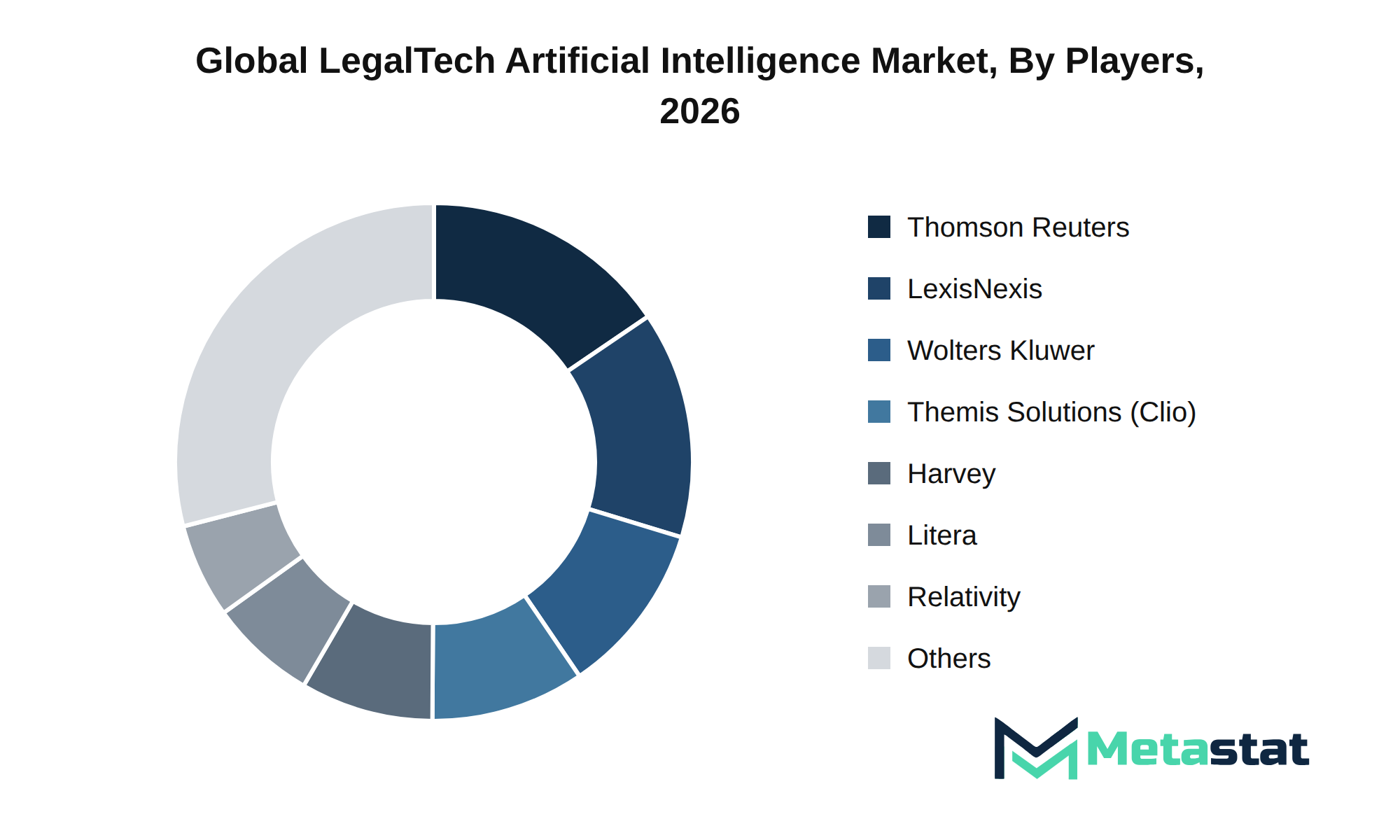
Forecast and Future Outlook
Market size is forecast to rise from USD 2,961.7 million in 2025 to over USD 21,615.2 million by 2033. This growth arises from several macroeconomic factors influencing demand and supply dynamics. The ongoing integration of next-generation technologies within legal practices drives significant advancements in efficiency and service delivery. Continued research and development efforts contribute to the commercialization of innovative solutions, enhancing the competitive edge of firms operating in the market.
Economic cycles impact the demand for LegalTech solutions, with fluctuations in investment priorities affecting capital allocation and growth trajectories. Regulatory evolution remains a critical factor, driven by compliance requirements that push organizations to adopt advanced technologies to meet imminent milestones. Geopolitical realignments and trade corridor shifts create both challenges and opportunities, influencing global supply chains and the strategic positioning of companies within the market.
Executive-level strategic imperatives emphasize the need for robust defensibility roadmaps that align with evolving market conditions. The forecast period identifies emerging white-space opportunities, where unmet enterprise needs present high-growth pockets within various legal sectors. This trajectory reflects a maturation of core industries, which supports sustainable growth and innovation in the LegalTech Artificial Intelligence market.
LegalTech Artificial Intelligence Market Key Segments
By Deployment Model:
- Cloud-Based
- On-Premises
- Hybrid
By Application:
- Legal Research & Knowledge Intelligence
- Legal Drafting & Document Automation
- Contract Review, Negotiation & Lifecycle Management
- eDiscovery & Evidence Review
- Litigation Analytics & Case Strategy
- Regulatory Compliance & Risk Intelligence
- Legal Operations, Matter & Spend Management
- Intellectual Property & Patent Intelligence
- Others (Client Intake, Tax Research, Legal Billing Automation)
By AI Technology:
- Generative AI
- Natural Language Processing and Natural Language Understanding
- Machine Learning and Predictive Analytics
- Large Language Models
- Computer Vision and Optical Character Recognition
- Agentic AI and Autonomous Workflows
- Others (Speech AI and Robotic Process Automation)
By End User:
- Law Firms
- Corporate Legal Departments
- Government & Regulatory Legal Teams
- Courts & Judicial Bodies
- Alternative Legal Service Providers (ALSPs)
- Legal Aid & Nonprofit Legal Organizations
- Others (Law Schools and Professional Legal Education Providers)
By Region:
- North America
- Europe
- Asia-Pacific
- South America
- Middle East and Africa
Key Global LegalTech Artificial Intelligence Industry Players
- Thomson Reuters
- LexisNexis
- Wolters Kluwer
- Themis Solutions Inc. (Clio)
- Harvey
- Litera
- Relativity
- Everlaw
- DISCO
- Reveal Data
- Blue J Legal
- Ironclad
- Icertis
- eBrevia
- Luminance
- Leah
- LegalOn Technologies
- Spellbook
- Robin AI
- Juro
- LinkSquares
- SpotDraft
- Sirion
- Workday
- Ontra, LLC
- Brightflag
- Filevine, Inc.
- Smokeball
- Legora
- General Counsel AI, Inc.
- Paxton AI
- Draftwise
- Clearbrief
- MyCase
Report Coverage
The report strategically identifies and profiles the key market players and analyses their core competencies in each sub-segment of the LegalTech Artificial Intelligence market.
|
Report Attributes |
Details |
|
Study Period |
2021-2033 |
|
Base Year |
2025 |
|
Estimated Year |
2026 |
|
Forecast Period |
2026-2033 |
|
Historical Period |
2021-2025 |
|
Growth Rate |
CAGR 28.2% from 2026 to 2033 |
|
Revenue Unit |
USD million |
|
Segmentation |
By Deployment Model, Application, AI Technology, End User, and Region |
|
By Region |
North America (By Deployment Model, Application, AI Technology, End User, and Country)
|
|
Europe (By Deployment Model, Application, AI Technology, End User, and Country)
|
|
|
Asia Pacific (By Deployment Model, Application, AI Technology, End User, and Country)
|
|
|
South America (By Deployment Model, Application, AI Technology, End User, and Country)
|
|
|
Middle East and Africa (By Deployment Model, Application, AI Technology, End User, and Country)
|
What Report Provides
- Key Company Market Share, Revenue and Ranking for the LegalTech Artificial Intelligence Market
- Key Market Leaders in the LegalTech Artificial Intelligence Sector
- Full In-Depth Analysis of the Parent Industry
- Industry Statistics and Important Changes in Market Dynamics
- Segmentation Details of the LegalTech Artificial Intelligence Market
- Historical, Ongoing and Projected Market Analysis
- Assessment of Niche Industry Developments
- Key Strategic Recommendations for Market Participants
Frequently Asked Questions
Find answers to common questions about this report
The LegalTech Artificial Intelligence market size was valued at USD 2,961.7 million in 2025, according to the Metastat Insights study.
The LegalTech Artificial Intelligence market is projected to grow at a CAGR of 28.2% during the forecast period from 2026 to 2033.
The North America LegalTech Artificial Intelligence market size is estimated to reach USD 7,995.4 million by 2033.
The Cloud-Based segment leads the LegalTech Artificial Intelligence market, with a projected value of USD 16,751.7 million by 2033, reflecting a compound annual growth rate of 29.2%. This growth surpasses other deployment models, indicating strong demand for cloud solutions in the legal sector.
The key drivers for the LegalTech Artificial Intelligence market include the ongoing digital transformation across industries, which enhances operational efficiency and reduces costs. Organizations prioritize AI technologies to automate tasks, improve productivity, and meet evolving client demands for faster, streamlined services.
North America holds the dominant share of the LegalTech Artificial Intelligence market, with a projected value of USD 7,995.4 million in 2033, representing 40.6 percent of the total market.
The LegalTech Artificial Intelligence market faces challenges due to regulatory compliance hurdles and complexities in adhering to legal mandates, which increase operational costs. macroeconomic headwinds, including inflation and high capital investment requirements, restrict investment in innovative technologies, further limiting market growth.
Digital transformation across industries drives the adoption of LegalTech Artificial Intelligence solutions. Organizations prioritize technological integration to enhance operational efficiency, reduce costs, and streamline processes, aligning with evolving consumer demands for faster, innovative legal services. This trend results in significant investment in AI-driven platforms by law firms and corporate legal departments.
The LegalTech Artificial Intelligence market is estimated to reach a valuation of USD 21,615.2 million by 2033.
Key players operating in the LegalTech Artificial Intelligence market include Thomson Reuters, LexisNexis, Wolters Kluwer, Themis Solutions Inc. (Clio), Harvey, and Litera.
Choose Your License
Global LegalTech Artificial Intelligence Market
Related Reports
Explore related market intelligence reports worth reading alongside this one.