
LEAD ANALYST
Utkarsh Khirodkar is a Lead Market Research Analyst at MetaStat Insight, specializing in market intelligence, technology sector assessments, and competitive strategy.

Global Phygital Solutions Market Size, Share, By Offering (Solutions and Services), By Technology (Augmented Reality (AR) Solutions, Virtual Reality (VR) Solutions, Internet of Things (IoT) Solutions, Artificial Intelligence (AI) Solutions, Interactive Kiosks, and Smart Mirrors), By Application (Retail, Healthcare, Entertainment, Education, Real Estate, and Hospitality), Industry Analysis, Growth, Trends, and Forecast, 2026-2033
Report ID
MSI-4751
Published
May, 2026
Pages
314 Pages
Format
Report Details
Choose Your License
Phygital Solutions Market
Global Phygital Solutions market size is valued at USD 25.4 billion in 2025 and projected to grow at a CAGR of 11.0% during the forecast period, reaching USD 58.4 billion by 2033.
North America holds 30.9% in 2025 with US leading the market share in 2025.
Solutions segment account for a market share of 68.1% in 2025.
Key trends driving growth: Increased adoption of omnichannel retail strategies propels demand for seamless physical and digital customer experiences, along with rapid advancement in AR, AI, and IoT technologies enhances interactive engagement and real-time personalization capabilities.
Opportunities include expansion of immersive retail, smart stores, and experience-driven marketing creates strong growth potential for phygital ecosystems
Key insight: AI-powered omnichannel integration is transforming physical locations into digitally connected experience centres.
The Global Phygital Solutions Market is witnessing robust momentum owing to the rising need for seamless integration between physical and digital customer experiences across retail, healthcare, banking, entertainment, hospitality, and education sectors. Businesses are increasingly adopting technologies such as artificial intelligence, augmented reality, virtual reality, IoT, smart kiosks, digital payments, and interactive displays to improve customer engagement and operational efficiency. Retailers are heavily investing in omnichannel infrastructure, smart stores, contactless solutions, and real-time inventory management systems to deliver connected experiences across online and offline channels. The rise of mobile commerce, personalized shopping journeys, and data-driven engagement strategies continues to strengthen market expansion globally.
The market is also benefiting from rapid advancements in AI-powered automation, cloud computing, smart analytics, and immersive technologies that enable brands to create highly interactive customer environments. Companies are redesigning physical stores into experience hubs supported by digital interfaces, AI assistants, smart mirrors, and automated checkout systems. Growing investments in unified commerce platforms and customer data integration are further accelerating adoption. However, high implementation costs, integration complexities with legacy systems, and growing concerns regarding data privacy and cybersecurity remain major restraints to market growth, particularly among small and medium-sized businesses.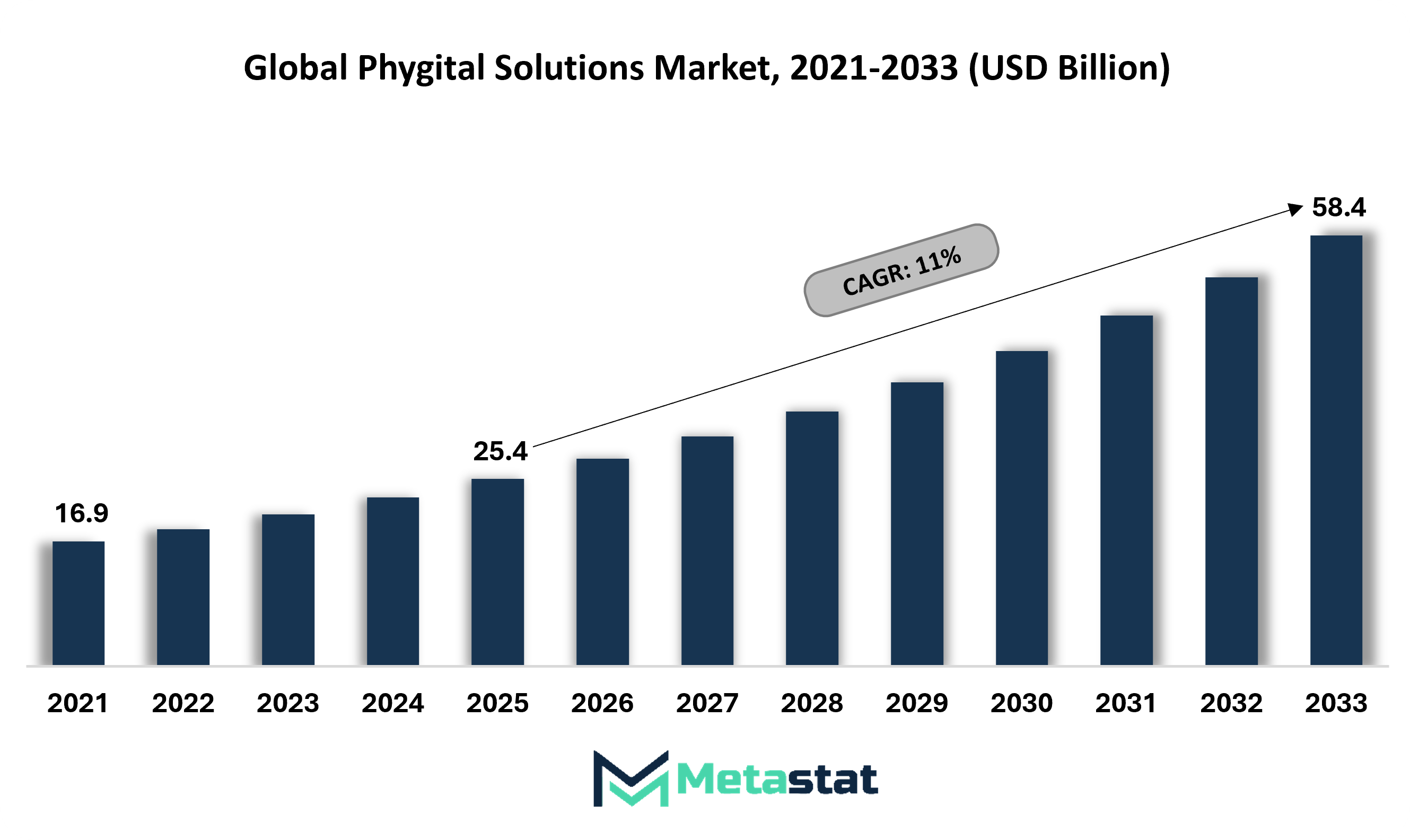
Increased adoption of omnichannel retail strategies propels demand for seamless physical and digital customer experiences.
Retail brands across multiple industries are increasingly integrating digital platforms with physical storefront operations to create stronger engagement across customer touchpoints. The Global Phygital Solutions Market gains momentum from rising investment in connected shopping ecosystems, interactive payment infrastructure, digital kiosks, and synchronized inventory management systems. These solutions support convenience-focused shopping behavior and help retailers deliver consistent customer experiences across stores, mobile apps, websites, and other digital channels.
Rapid advancement in AR, AI, and IoT technologies enhances interactive engagement and real-time personalization capabilities
Technological innovation across artificial intelligence, augmented reality, and connected device ecosystems continues to strengthen immersive customer interaction across retail, hospitality, healthcare, and entertainment sectors. The Global Phygital Solutions Market benefits from advanced analytics platforms, intelligent recommendation engines, smart mirrors, and sensor-based engagement systems. These technologies support predictive customer behavior analysis, real-time personalization, and digitally enabled business environments.
High implementation and integration complexity across legacy systems restricts scalability for traditional enterprises
Large-scale integration requirements across legacy enterprise infrastructure continue creating operational challenges for organizations pursuing phygital transformation projects. The Global Phygital Solutions Market faces barriers from compatibility concerns between traditional software architecture and modern digital engagement platforms. These challenges increase deployment timelines, technical maintenance requirements, and long-term operational expenditure across traditional enterprises.
Data privacy concerns and regulatory compliance requirements limit deployment of customer-centric digital interfaces
Rising consumer awareness regarding digital surveillance and personal data security continues influencing enterprise technology deployment decisions worldwide. The Global Phygital Solutions Market faces operational pressure from stringent compliance frameworks governing biometric authentication, behavioral analytics, location tracking, and personalized recommendation systems. Compliance requirements are especially important for digitally connected customer engagement platforms used across retail, banking, healthcare, hospitality, and education applications.
Expansion of immersive retail, smart stores, and experience-driven marketing creates strong growth potential for phygital ecosystems
Retail transformation initiatives focused on experiential engagement continue generating significant commercial opportunities across global consumer industries. The Global Phygital Solutions Market benefits from the increasing development of smart stores integrating interactive displays, cashierless payment systems, digital navigation tools, and immersive brand communication technologies. These solutions are designed to deliver highly connected shopping experiences and support future retail expansion strategies.
The Global Phygital Solutions market is classified based on Offering, Technology, and Application.
Solutions segment is valued at USD 19.1 billion in 2026 and is projected to reach USD 41.1 billion by 2033, at a CAGR of 11.5% during the forecast period.
The Global Phygital Solutions Market witnesses robust demand for integrated digital platforms that connect physical customer engagement with intelligent digital experiences. Advanced analytics, immersive touchpoints, automated inventory monitoring, personalized recommendations, predictive customer insights, and connected storefront ecosystems are improving operational efficiency. Future growth patterns indicate rising investment in unified customer engagement platforms across retail, healthcare, hospitality, education, and entertainment industries.
Services segment is valued at USD 9.0 billion in 2026 and is projected to reach USD 17.3 billion by 2033, at a CAGR of 9.9% during the forecast period.
Service-based expansion gains momentum through consulting, deployment, maintenance, cloud integration, technical support, employee training, and experience optimization. Organizations are focusing on long-term digital transformation partnerships to support operational continuity. Future business models indicate rising dependence on managed service ecosystems that support continuous innovation, scalable infrastructure development, and improved customer interaction.
Augmented Reality (AR) Solutions segment is projected to reach USD 14.1 billion by 2033, at a CAGR of 14% during the forecast period.
Augmented Reality solutions strengthen consumer interaction through immersive visualization, digital product placement, interactive learning modules, and location-based engagement. The Global Phygital Solutions Market is witnessing wider AR integration across retail stores, healthcare systems, hospitality environments, and educational institutions. Future technological improvements indicate realistic simulations, faster device compatibility, and broader adoption across commercial operations worldwide.
Virtual Reality (VR) Solutions segment is projected to reach USD 7.3 billion by 2033, at a CAGR of 8.9% during the forecast period.
Virtual Reality solutions create immersive digital experiences supporting training programs, entertainment systems, virtual property tours, educational simulations, and remote collaboration environments. The Global Phygital Solutions Market benefits from rising enterprise investment in experiential engagement technologies. Future adoption trends indicate improved hardware affordability, realistic sensory integration, and stronger enterprise usage across multiple commercial applications.
Internet of Things (IoT) Solutions segment is projected to reach USD 10.9 billion by 2033, at a CAGR of 11.1% during the forecast period.
Internet of Things solutions support connected infrastructure through sensor-enabled systems, real-time monitoring, predictive maintenance, smart inventory management, and automated operational tracking. The Global Phygital Solutions Market is recording increasing IoT integration across smart buildings, healthcare monitoring systems, hospitality management platforms, and retail analytics. Future industrial development indicates higher automation, improved connectivity, and intelligent decision-making capabilities.
Artificial Intelligence (AI) Solutions segment is projected to reach USD 12.8 billion by 2033, at a CAGR of 13.8% during the forecast period.
Artificial Intelligence solutions improve operational intelligence through customer behavior analysis, automated recommendations, virtual assistants, fraud detection, demand forecasting, and smart engagement systems. The Global Phygital Solutions Market benefits from rising enterprise preference for data-driven decision systems. Future innovation patterns indicate stronger machine learning accuracy, growth in conversational intelligence, and wider automation across customer-facing industries.
Interactive Kiosks segment is projected to reach USD 9.6 billion by 2033, at a CAGR of 8.4% during the forecast period.
Interactive kiosks improve consumer convenience through self-service ordering, automated check-ins, information access, ticketing systems, digital navigation, and contactless transactions. The Global Phygital Solutions Market is observing growing deployment across retail centers, airports, hospitals, educational campuses, and hospitality environments. Future infrastructure development indicates enhanced touchscreen responsiveness, multilingual accessibility, and seamless integration with cloud-based management platforms.
Smart Mirrors segment is projected to reach USD 3.7 billion by 2033, at a CAGR of 4.9% during the forecast period.
Smart mirrors transform consumer interaction through virtual product trials, personalized recommendations, fitness monitoring features, beauty analysis, and interactive shopping assistance. The Global Phygital Solutions Market is witnessing growing adoption across fashion stores, fitness centers, hotels, and healthcare facilities. Future innovation trends indicate advanced facial recognition, AI-powered customization, and broader integration with connected consumer ecosystems.
Retail segment is projected to reach USD 19.4 billion by 2033.
Retail applications strengthen customer engagement through personalized shopping journeys, digital payment integration, virtual fitting rooms, automated inventory tracking, and connected store experiences. Retail companies are increasingly prioritizing immersive engagement strategies to improve customer retention. Future retail transformation indicates stronger omnichannel integration, predictive buying systems, and intelligent store management technologies.
Healthcare segment is projected to reach USD 9.1 billion by 2033.
Healthcare adoption supports remote consultations, patient engagement platforms, digital diagnostics, smart monitoring systems, and immersive medical training applications. Healthcare providers are focusing on improving operational efficiency and patient communication through digital integration. Future healthcare development indicates stronger connected infrastructure, AI-assisted diagnostics, and improved accessibility for remote patient care services.
Entertainment segment is projected to reach USD 9.6 billion by 2033.
Entertainment applications create immersive audience experiences through virtual concerts, interactive gaming, digital exhibitions, augmented performances, and personalized content delivery platforms. The Global Phygital Solutions Market is recording rising investment from media companies seeking stronger customer engagement. Future entertainment expansion indicates advanced sensory technologies, real-time audience interaction systems, and broader integration of immersive digital environments.
Education segment is projected to reach USD 8.1 billion by 2033.
Educational institutions are adopting phygital technologies for virtual classrooms, interactive learning environments, AI-supported tutoring systems, immersive simulations, and connected campus infrastructure. The Global Phygital Solutions Market benefits from rising digital education investments that support accessible learning experiences. Future educational transformation indicates stronger remote collaboration tools, immersive academic engagement, and intelligent personalized learning platforms.
Real Estate segment is projected to reach USD 5.5 billion by 2033.
Real Estate applications enhance property visualization through virtual tours, smart building management, interactive property displays, digital documentation systems, and AI-supported customer engagement. The Global Phygital Solutions Market is witnessing growing demand from property developers seeking efficient customer interaction strategies. Future real estate development indicates connected infrastructure expansion, immersive property showcasing, and automated facility management integration.
Hospitality segment is projected to reach USD 6.7 billion by 2033.
Hospitality organizations are integrating phygital technologies for contactless check-ins, personalized guest services, smart room controls, digital concierge systems, and immersive travel experiences. The Global Phygital Solutions Market is observing increasing investment from hotels and tourism operators aiming to improve guest satisfaction. Future hospitality trends indicate intelligent automation, predictive customer service platforms, and seamless digital guest engagement systems.
Based on geography, the Global Phygital Solutions market is divided into North America, Europe, Asia-Pacific, South America, Middle East, and Africa.
North America is witnessing strong investments by major retailers and technology companies in AI-enabled smart retail ecosystems. Rapid adoption of contactless payments, automated checkout systems, and customer analytics platforms continues to support market expansion across the region.
European businesses are increasingly focusing on unified commerce strategies, sustainability-driven retail transformation, AI governance frameworks, and customer-centric digital infrastructure. These developments are strengthening phygital engagement models across luxury retail, banking, hospitality, and commercial service sectors.
Asia Pacific markets are witnessing growing investments in smart retail infrastructure, digital payment ecosystems, connected consumer engagement platforms, and experiential commerce models.
Growth is supported by rising smartphone penetration, rapid urbanization, expanding organized retail sectors, and increasing adoption of mobile-first commerce across China, India, Japan, and Southeast Asia.
South America, the Middle East, and Africa are emerging as developing markets for phygital solutions, supported by expanding digital payment adoption, rising smartphone penetration, and increasing modernization of retail, banking, hospitality, and entertainment infrastructure.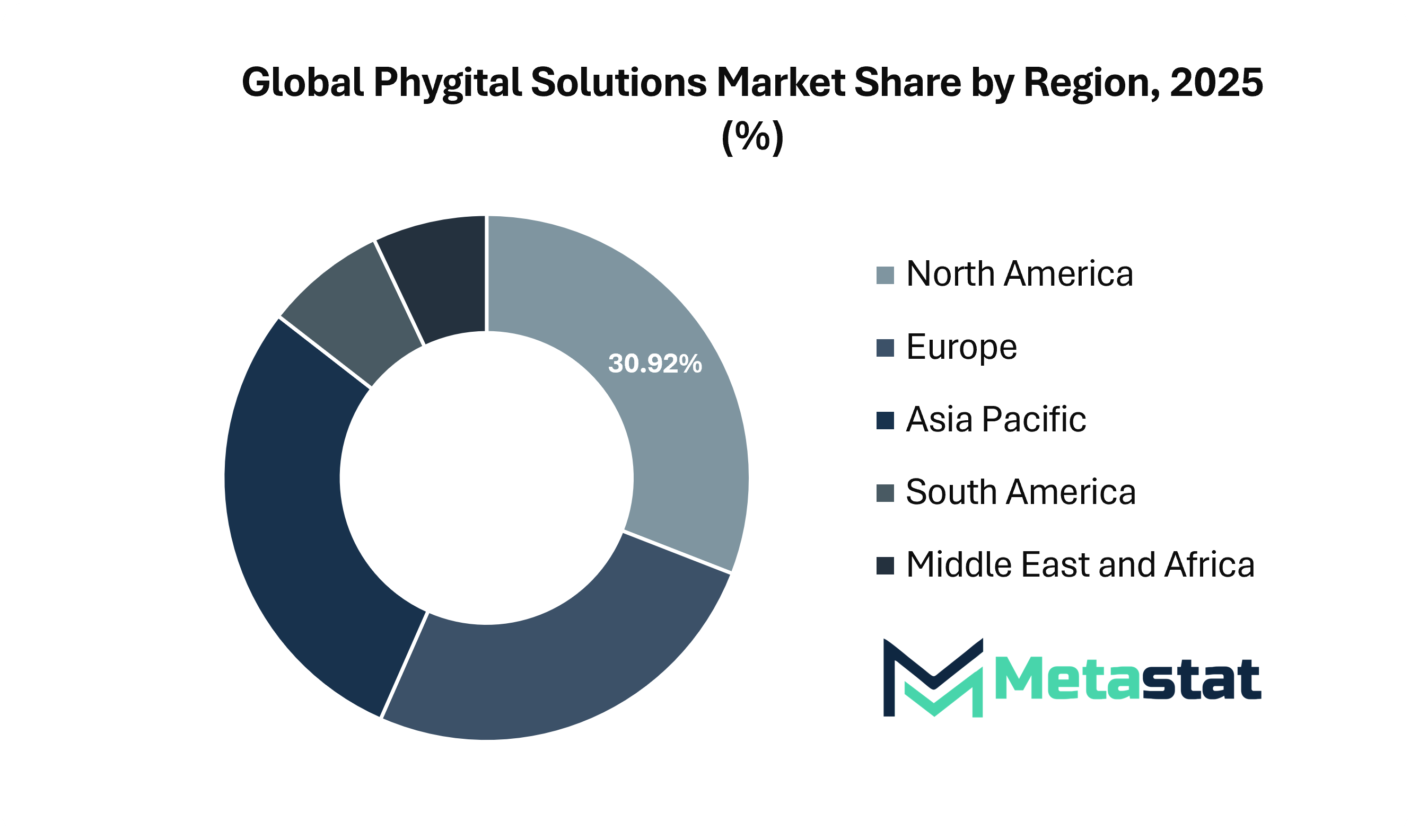
The retail and digital commerce sector is moving toward connected customer experiences, creating strong demand within the Global Phygital Solutions Market. Businesses are combining physical shopping journeys with digital tools to improve customer engagement, simplify payment systems, and deliver seamless buying experiences across stores, mobile apps, websites, and other digital channels. Consumers increasingly expect faster service, personalized recommendations, flexible shopping options, and consistent brand interaction across online and offline touchpoints. Retailers, restaurants, banking institutions, and service providers are adopting advanced platforms to improve customer interaction, inventory visibility, payment processing, and order management. Rising smartphone usage and expanding digital payment adoption are further supporting this transition. Companies are focusing on smooth and connected shopping experiences, strengthening the need for integrated software platforms, smart retail systems, and omnichannel engagement technologies across different industries.
Many companies are using data analytics and artificial intelligence to understand customer behavior, improve decision-making, and deliver personalized engagement. Personalized marketing, automated customer service, smart checkout systems, and cloud-based retail platforms are becoming common across daily business operations. The Global Phygital Solutions Market is gaining traction as businesses aim to reduce operational delays while improving customer satisfaction and operational efficiency. Retail brands are modernizing stores with self-service kiosks, contactless payment systems, interactive displays, smart mirrors, and real-time inventory management tools. These technologies help companies address changing consumer expectations and create stronger links between physical locations and digital platforms.
Major companies operating in this industry are focusing on partnerships, innovation, and platform expansion to strengthen their market position. Key participants include Salesforce, Inc., Shopify Inc., Adobe Inc., Oracle Corporation, SAP SE, NCR Voyix Corporation, Zebra Technologies Corporation, Manhattan Associates, Inc., Aptos, LLC, Lightspeed Commerce Inc., Block, Inc., Adyen N.V., Stripe, Inc., Verifone, Inc., and Diebold Nixdorf, Incorporated. These companies are introducing solutions that improve payment processing, customer communication, supply chain visibility, store operations, and digital engagement. Many companies are also increasing investments in cloud computing, AI-enabled systems, and unified commerce platforms to improve business performance and support enterprise expansion.
Technology companies including Microsoft Corporation, Amazon.com, Inc., Samsung Electronics Co., Ltd., LG Electronics Inc., Panasonic Connect Co., Ltd., Cisco Systems, Inc., Fujitsu Limited, NEC Corporation, Toshiba Global Commerce Solutions, VTEX N.V., commercetools GmbH, BigCommerce Holdings, Inc., NewStore, Inc., Cegid SAS, and LS Retail ehf. are expected to play an important role in future industry development. Rising adoption of connected commerce platforms, digital payment systems, customer analytics tools, interactive engagement solutions, and smart retail infrastructure will create new business opportunities across global markets.
Market size is forecast to rise from USD 25.4 billion in 2025 to over USD 58.4 billion by 2033.
The outlook for the Global Phygital Solutions Market remains highly positive, supported by increasing adoption of AI-driven personalization, agentic AI commerce, unified commerce platforms, and immersive digital engagement technologies. Businesses are expected to prioritize real-time customer analytics, intelligent automation, smart retail infrastructure, and connected ecosystem strategies to improve customer retention, operational efficiency, and cross-channel engagement. Rising investment in interactive kiosks, smart mirrors, contactless payments, digital assistants, AR/VR-based experiences, and cloud-based commerce platforms will further strengthen market expansion during the forecast period.
This research report categorizes the Phygital Solutions market based on key segments and regions, forecasts revenue growth, and analyses trends in each submarket. The report analyses the key growth drivers, opportunities, and challenges influencing the Phygital Solutions market. Recent market developments and competitive strategies such as expansion, product launch, partnership, merger, and acquisition have been included to draw the competitive landscape in the market.
The report strategically identifies and profiles the key market players and analyses their core competencies in each sub-segment of the Phygital Solutions market.
|
Report Attributes |
Details |
|
Study Period |
2021-2033 |
|
Base Year |
2025 |
|
Estimated Year |
2026 |
|
Forecast Period |
2026-2033 |
|
Historical Period |
2021-2025 |
|
Growth Rate |
CAGR 11.0% from 2026 to 2033 |
|
Revenue Unit |
USD billion |
|
Segmentation |
By Offering, Technology, Application, and Region |
|
By Region |
North America (By Offering, Technology, Application, and Country)
|
|
Europe (By Offering, Technology, Application, and Country)
|
|
|
Asia Pacific (By Offering, Technology, Application, and Country)
|
|
|
South America (By Offering, Technology, Application, and Country)
|
|
|
Middle East and Africa (By Offering, Technology, Application, and Country)
|
Find answers to common questions about this report
Top players operating in the Phygital Solutions industry includes Salesforce, Inc., Shopify Inc., Adobe Inc., Oracle Corporation, SAP SE, NCR Voyix Corporation, and Zebra Technologies Corporation.
Global Phygital Solutions market is estimated to reach USD 58.4 billion by 2033.
High implementation and integration complexity across legacy systems restricts scalability for traditional enterprises will hamper the market growth within the forecast period.
North America region dominates the market.
Increased adoption of omnichannel retail strategies propels demand for seamless physical and digital customer experiences and rapid advancement in AR, AI, and IoT technologies enhances interactive engagement, and real-time personalization capabilities are key driving factors, boosting the market.
The Metastat Insights analysis shows that the North America Phygital Solutions market size is estimated to be USD 18.3 billion by 2033.
The Global Phygital Solutions market is expected to grow at a CAGR of 11.0% over the forecast period (2026-2033).
The Metastat Insights study shows that the Global Phygital Solutions market size was USD 25.4 billion in 2025.
The analysts below cover Information & Technology research at Metastat Insights.
LEAD ANALYST
Utkarsh Khirodkar is a Lead Market Research Analyst at MetaStat Insight, specializing in market intelligence, technology sector assessments, and competitive strategy.

PRINCIPAL CONSULTANT - ENTERPRISE AI & EMERGING TECHNOLOGIES
Banking & Finance · Electronics and Semiconductor · Energy and Power · Healthcare IT · Information & Technology · Professional Services
Vijay Gunti is a Principal Consultant at MetaStat Insight, bringing over two decades of experience across enterprise digital transformation, technology strategy, and intelligent systems.

LEAD CONSULTANT - COMMUNICATION, TELECOM, AND IT
Electronics and Semiconductor · Information & Technology · Machinery & Equipment · Professional Services
Ravindra Sathe Consultants for Communication, Telecom, and IT at MetaStat Insight. He leads the firm's industry research initiatives across telecommunications infrastructure, digital connectivity, enterprise networking, and emerging information technology domains.
Ambulatory surgical centers have very different purchasing cycles for robotic-assisted surgery platforms than major hospital networks. The MetaStat Insight study focused squarely on capital expenditure depreciation, procedural reimbursement pathways, and surgeon training overhead. That operational clarity made it much simpler to validate multi-year procedure growth forecasts against actual ambulatory center adoption patterns.
When planning edge sensor rollouts across refinery environments, generic IoT reports typically miss the harsh-environment certification bottlenecks. MetaStat Insight gave an objective evaluation of ATEX and Class 1 Division 2 hardware availability, along with realistic five-year maintenance cycle cost projections. The comparison of wireless mesh versus private cellular backhaul helped our team pressure-test network reliability models for remote processing facilities.
In the biological seed treatment space, registration timelines vary drastically between the European Union, Brazil, and North America. The MetaStat Insight research handled these cross-border regulatory barriers with genuine nuance, mapping commercialization pathways alongside historical field adoption rates. The segmentation between microbial strains and biochemical active ingredients was particularly well structured.
Explore related market intelligence reports worth reading alongside this one.