
Global Material Informatics Market
Global Material Informatics Market Size, Share, By Material Type (Metals & Alloys, Polymers & Elastomers, Ceramics & Glasses, Battery & Electrochemical Materials, Semiconductor & Electronic Materials, Catalysts & Porous Materials, Composites and Specialty Chemicals & Formulated Materials), By Solution Capability (Materials Data Management and Informatics, Materials Simulation and Modeling, Materials Property Prediction, Materials Discovery and Inverse Design, Formulation and Process Optimization, Experimental Design and Active Learning, Materials Knowledge and Collaboration Platforms and Autonomous and Closed-Loop Materials Discovery), By Technology (Artificial Intelligence & Machine Learning, Physics-Based Modeling & Simulation, Hybrid Physics-AI Modeling, Generative AI & Foundation Models, High-Throughput Computational Screening, Multiscale & Digital Twin Modeling and Others (Natural Language Processing, Knowledge Graphs & Quantum Computing)), By End-Use Industry (Chemicals & Specialty Chemicals, Energy & Energy Storage, Semiconductors & Electronics, Automotive & Mobility, Aerospace & Defense, Industrial Manufacturing, Construction & Infrastructure and Healthcare & Biomedical), Industry Analysis, Growth, Trends, and Forecast, 2026-2033
MSI-5042
August 25, 2026
265 Pages
Historical
Base year
Forecast
Forecast period
Report Details
Comprehensive Market Analysis And Insights
Market Overview
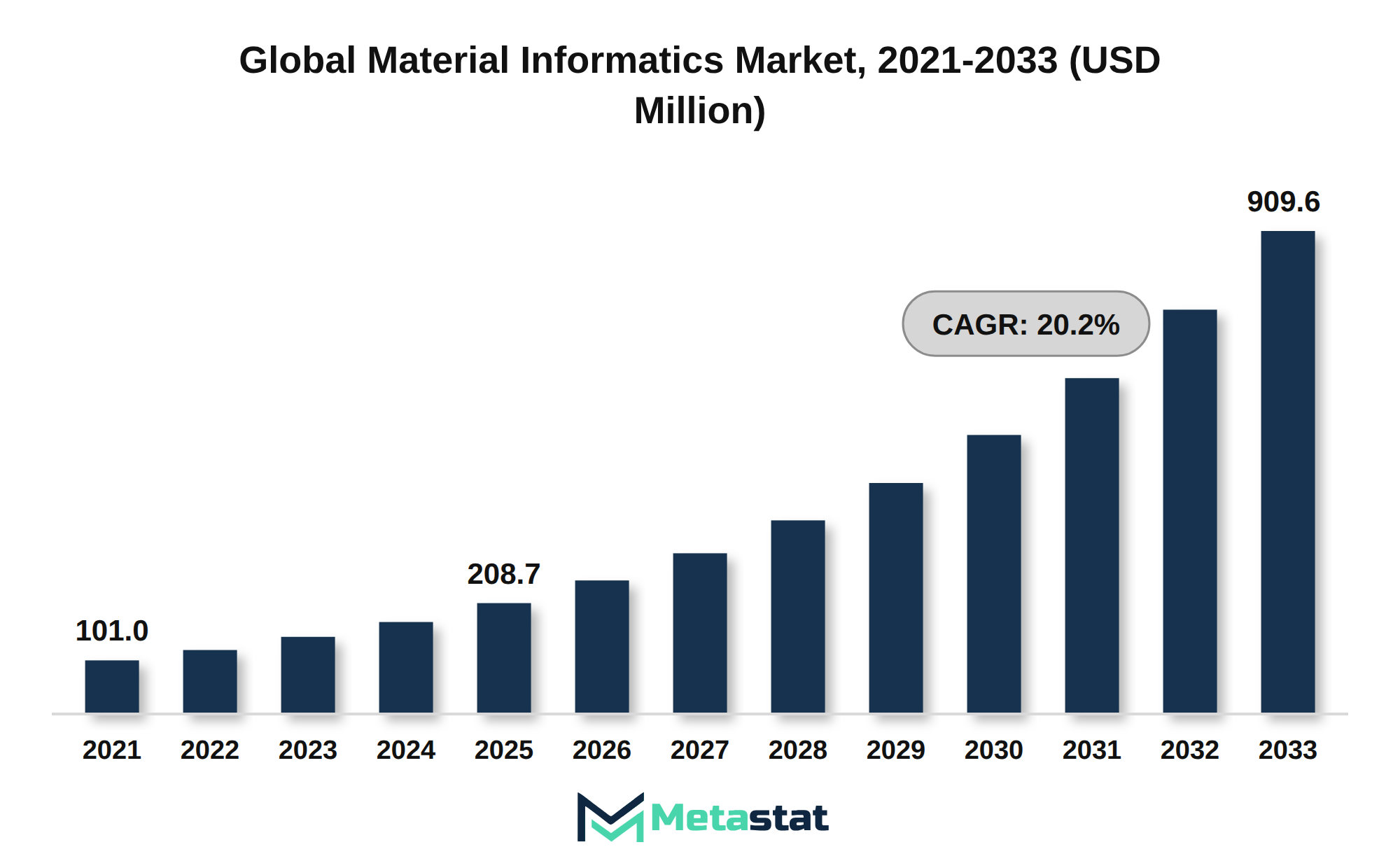
The global Material Informatics market was valued at USD 208.7 million in 2025 and is projected to reach USD 909.6 million by 2033, growing at a CAGR of 20.2% over the forecast period.
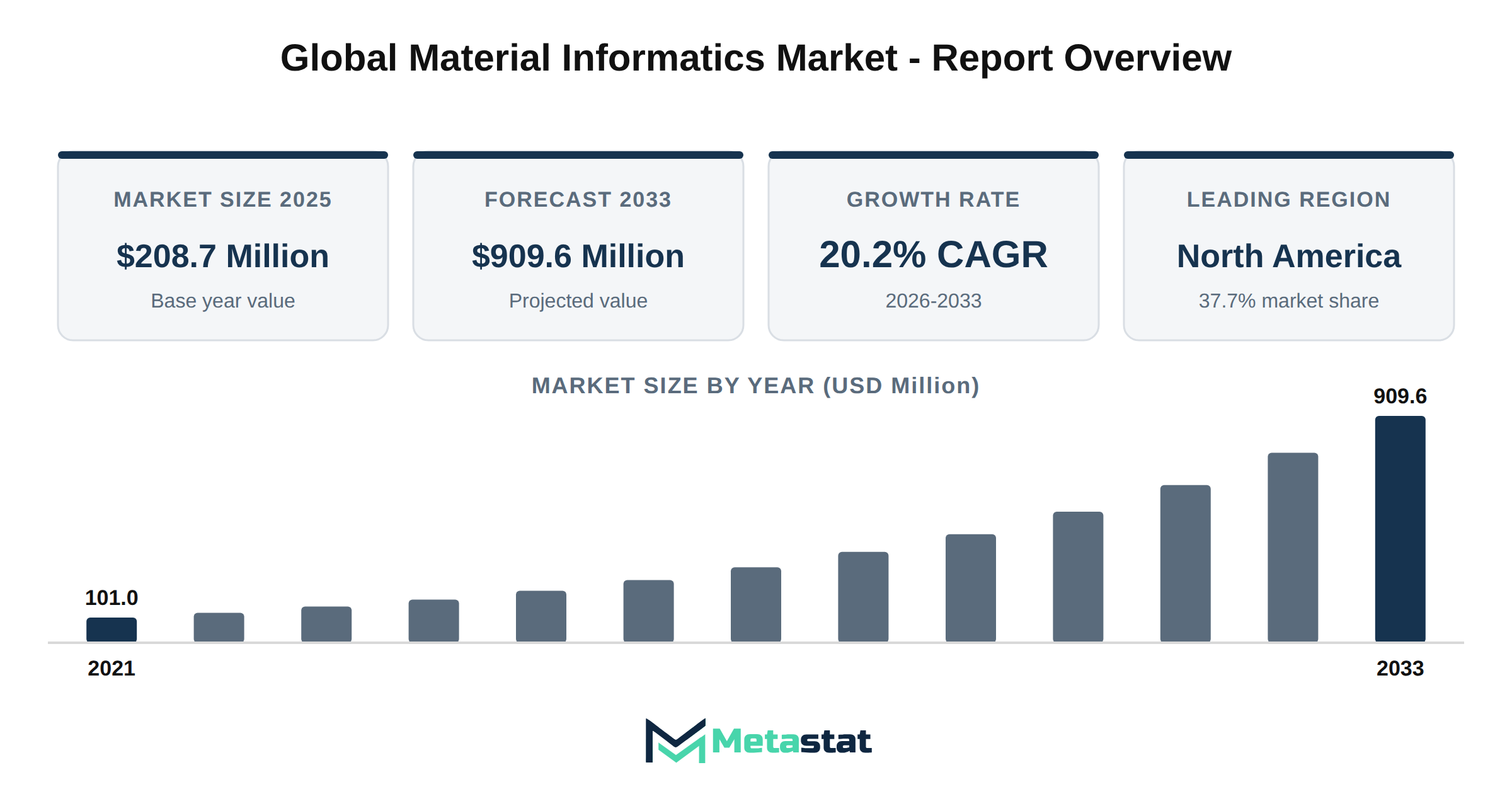
The Material Informatics market reached a value of USD 208.7 million in 2025, reflecting significant growth from USD 101 million in 2021. This upward trend is anticipated to continue, with projections indicating a market value of USD 909.6 million by 2033, resulting in a compound annual growth rate (CAGR) of 20.2% during the forecast period from 2026 to 2033.
Factors driving growth include the increasing adoption of artificial intelligence and physics-based modeling techniques, which streamline materials development processes. Demand for faster and more efficient materials development arises from emerging applications in sectors including energy and advanced manufacturing. Regulatory compliance and standards create a framework that encourages innovation while addressing geopolitical risks.
Market fragmentation remains a challenge owing to numerous players competing in the space, leading to a diverse range of solutions and technologies. Corporate imperatives around sustainable transformation, decarbonization, and circular economy dynamics reshape the landscape, compelling organizations to allocate capital more effectively towards infrastructure investments. The evolving supply chain landscape necessitates reassessment of logistics and sourcing strategies, impacting procurement and customer journey dynamics.
Macroeconomic headwinds, including inflationary pressures and currency volatility, present additional challenges for stakeholders within the market. These challenges influence capital allocation strategies and operational expenditures, shaping future strategic outlooks for companies involved in material informatics.
The Material Informatics market experiences significant growth driven by increasing adoption of artificial intelligence and physics-based modeling. These technologies facilitate faster materials development and support emerging applications across the energy and advanced manufacturing sectors.
Regulatory compliance and standards play a crucial role in shaping market dynamics. Companies navigate geopolitical risk frameworks that influence operational strategies and investment decisions. Disruptions in the market lead to evolving research and development trajectories, generating next-generation innovations that enhance performance and efficiency.
Sustainable transformation initiatives, including decarbonization efforts and circular economy dynamics, gain traction. These strategies align with consumer demand for environmentally friendly products and processes, prompting companies to invest in sustainable practices.
The supply chain landscape undergoes transformation, driven by logistical architecture and sourcing strategies that adapt to changing market conditions. Fragmentation within the market necessitates careful evaluation of mergers and acquisitions, influencing competitive positioning and value chain dynamics.
Capital allocation remains a focal point, with infrastructure investments directed toward enhancing operational capabilities. Companies assess capital expenditures and operational expenditures, balancing short-term needs against long-term growth objectives.
Macroeconomic headwinds, including inflationary pressures and currency volatility, impact market stability. These factors compel organizations to develop robust strategies that address financial uncertainties and ensure resilience in fluctuating economic conditions. This strategic focus is essential for navigating the complexities of the current market environment.
The future strategic outlook for the Material Informatics market emphasizes corporate imperatives that prioritize innovation and sustainability. High-value recommendations focus on leveraging technological advancements and adapting to evolving consumer preferences, ensuring continued growth and competitive advantage.
Market Dynamics
Capital investment environments propel market growth
Robust capital investment environments significantly influence the Material Informatics market, driving growth through increased spending on research and development, technological advancements, and infrastructure upgrades. Rising GDP growth rates and expanding venture funding enhance the financial landscape, benefiting industries reliant on innovation and efficiency. Companies investing in materials informatics experience improved operational productivity and enhanced resource stewardship.
The ongoing digital transformation reshapes traditional manufacturing processes, leading organizations to adopt advanced technologies including artificial intelligence and machine learning. This shift toward automation facilitates the analysis of large datasets, optimizing material properties and accelerating product development. Industries including chemicals, semiconductors, and automotive increasingly rely on data-driven insights to enhance production processes, creating significant demand for material informatics solutions.
Investment in the market aligns with the global trend of optimizing supply chains and enhancing production capabilities. Industries focused on resource efficiency and sustainability prioritize the integration of material informatics to support circular economy initiatives and reduce carbon footprints. This focus on sustainability positions the market favorably for growth, attracting new participants and driving innovation in materials science.
Investment in digital transformation supports market growth
The Material Informatics market benefits from increased investment in digital transformation initiatives across various industries. Companies prioritize modernization efforts, emphasizing the adoption of advanced technologies, including artificial intelligence, machine learning, and automation. This shift enhances operational efficiency and improves data-driven decision-making processes.
Organizations allocate significant resources to digitize legacy systems and streamline workflows, resulting in cost-effective operations. The emphasis on automation reduces labor costs while improving productivity, which aligns with the market's growth trajectory. Businesses experience heightened demand for innovative material solutions, driving revenue growth within the Material Informatics market.
The trend towards digital platforms facilitates the integration of materials data management, simulation, and modeling capabilities. This integration enhances collaboration among stakeholders, enabling faster development cycles and improved product performance. Companies capitalize on these technological advancements, positioning the market for expansion through 2033.
Regulatory compliance hurdles limit market expansion
The Material Informatics market faces significant challenges due to stringent regulatory compliance hurdles that slow adoption. Industries operating within this market encounter complex legal mandates that necessitate extensive documentation, testing, and validation processes. Compliance with these requirements increases the operational burden on firms, leading to higher costs and extended timelines for product development.
Organizations that invest in material informatics solutions experience delays in deployment stemming from the meet regulatory criteria. These delays hinder the ability to capitalize on technological advancements, restricting market growth and innovation. In addition, navigating this regulatory landscape creates barriers to entry for smaller companies, limiting competition and market diversity.
The market contends with macroeconomic headwinds, including inflationary pressures and supply chain disruptions. These factors contribute to elevated operating costs, which affect pricing strategies and profitability for companies involved in material informatics. Consequently, firms struggle to maintain competitive pricing while ensuring compliance with regulations. This situation impacts overall market performance.
The presence of skilled labor deficiencies poses another challenge. The demand for expertise in material informatics technologies outpaces supply, leading to talent gaps that inhibit effective implementation. Without access to qualified professionals, companies experience difficulties in fully leveraging innovative solutions. This limitation restricts the market potential for growth.
Geopolitical tensions challenge market stability
The Material Informatics market encounters challenges stemming from geopolitical fragmentation, which disrupts global trade dynamics. Trade deficits and tariff friction impact cost structures and availability of materials, creating volatility that affects supplier relationships and pricing strategies. Technological disruptions in various regions further complicate the integration of advanced material informatics solutions, hampering collaboration across borders.
Complex research and development integrations present significant obstacles, particularly when firms attempt to align diverse technological standards and methodologies. Interoperability friction between different systems heightens the challenge, leading to inefficiencies and increased compliance overhead resulting from companies navigating varying legal frameworks and tightening global regulatory standards. This environment creates uncertainty, influencing investment decisions and delaying project timelines.
Pricing compression and margin pressures reflect the volatility of feedstock and component costs, which fluctuate due to market saturation and changing downstream demands. Talent retention pressures emerge owing to organizations facing escalating workforce skill gaps, risking the loss of expertise necessary for advancing material informatics capabilities. Automation displacements further complicate the landscape, making it imperative for firms to adapt quickly to maintain competitiveness in the evolving market.
Environmental lifecycle footprints and sustainability demands intensify scrutiny on operational practices, pushing companies to innovate while adhering to decarbonization mandates. Infrastructure gaps and retrofitting barriers hinder the implementation of new technologies, creating additional challenges for organizations seeking to modernize their processes effectively. Weaknesses in intellectual property protection introduce cybersecurity risks and data vulnerabilities, necessitating vigilant measures to safeguard proprietary information.
The Material Informatics market's ability to navigate these multifaceted challenges will determine future growth trajectories and competitive positioning. Addressing the complexities resulting from geopolitical tensions and evolving market dynamics remains crucial for sustaining momentum within this sector.
Emerging technological disruptions enhance market positioning
The Material Informatics market benefits from continuous technological disruptions that drive innovation and operational efficiencies. Advancements in artificial intelligence and machine learning enhance data analytics capabilities, enabling companies to optimize material properties and accelerate product development. These technologies attract increasing investment and interest from various sectors, particularly in the automotive, energy, and electronics industries. Enhanced simulation and modeling techniques support faster decision-making processes and reduce time-to-market for new materials, which significantly impacts competition and revenue generation.
Infrastructure modernization contributes to market growth by facilitating the integration of advanced technologies into existing systems. The transition toward digital procurement practices influences purchasing behaviors, allowing companies to streamline supply chains and improve material sourcing. Geographical expansion into emerging markets further increases opportunities for growth, driven by rising demand for advanced material solutions in regions including Asia Pacific and South America. The market experiences a shift toward sustainability, with companies adopting eco-friendly practices and aligning with environmental, social, and governance (ESG) criteria to meet consumer expectations.
Cross-industry mergers and acquisitions promote strategic consolidation, enabling companies to leverage complementary capabilities and broaden their service offerings. This trend enhances the overall value chain, allowing for innovative product integrations and niche application growth. The focus on asset life-cycle extensions and maintenance upgrades leads to increased demand for advanced material informatics solutions, resulting from organizations seeking to maximize operational efficiency and yield.
The combination of technological advancements and infrastructure modernization drives the Material Informatics market forward, creating diverse opportunities for growth and increased competitiveness across multiple industries.
Market Segmentation Analysis
The Global Material Informatics market is segmented based on Material Type, Solution Capability, Technology, and End-Use Industry.
By Material Type, the market is further segmented into:
- Metals & Alloys
- Polymers & Elastomers
- Ceramics & Glasses
- Battery & Electrochemical Materials
- Semiconductor & Electronic Materials
- Catalysts & Porous Materials
- Composites
- Specialty Chemicals & Formulated Materials
- Others (Magnetic, Optical & Quantum Materials)
Metals & Alloys
Valued at USD 54.4 million in 2026, the Metals & Alloys segment is projected to reach USD 179.9 million by 2033, at a CAGR of 18.7% during the forecast period. This growth results from increasing demand across various industries requiring advanced materials for high-performance applications. The aerospace, automotive, and electronics sectors particularly drive this heightened demand, focusing on lightweight and durable metals and alloys.
Technological advancements in materials characterization, data analysis, and simulation significantly enhance product development processes. These innovations facilitate quicker iterations and reduce time-to-market for new materials. The shift towards sustainable materials and practices influences the market, creating opportunities for recycled and eco-friendly alloys.
End-use dynamics reflect a growing inclination towards the integration of smart materials within manufacturing processes. Adaptive and responsive properties of metals and alloys align with the needs of modern applications, including smart automotive systems and advanced manufacturing techniques. Regulatory compliance regarding material safety and environmental impact strengthens the push for innovation within this segment.
Strategic investments in R&D and a focus on collaborative platforms provide avenues for companies aiming to capture market share. This collaborative ecosystem encourages knowledge sharing and accelerates the development of next-generation materials. Navigating supply chain challenges and ensuring resilience against disruptions remains crucial for sustained growth and competitiveness.
Polymers & Elastomers
Growth in the Polymers & Elastomers segment of the Material Informatics market reflects increasing demand from various industries, particularly in packaging, automotive, and consumer goods. Factors driving this demand include a shift towards lightweight materials and enhanced performance characteristics. Innovations in material properties and processes enable the production of specialized polymers catering to specific applications, including biocompatible materials for healthcare and high-performance elastomers for automotive components.
Market participants focus on technological maturation to enhance the performance and sustainability of polymers and elastomers. Advanced modeling and simulation techniques enable manufacturers to optimize formulations, resulting in improved product characteristics and reduced time-to-market. This strategic emphasis on next-generation upgrades positions the market for sustained growth. Evolving product offerings attract diverse end-use applications.
The Polymers & Elastomers segment is projected to reach USD 150.2 million by 2033, at a CAGR of 19% during the forecast period. Adoption of smart materials and sustainable practices within the industry further drives market expansion. Companies increasingly prioritize compliance with stringent regulatory standards, enhancing product safety and performance while navigating potential market entry barriers.
Investment in raw material sourcing fortifies the segment’s resilience, enabling companies to mitigate risks associated with supply chain vulnerabilities. The move towards recycling and bio-based materials aligns with growing consumer preferences for environmentally friendly options. This trend encourages innovation in product design. Strategic opportunities present avenues for differentiation and market penetration, reinforcing the segment's position within the broader Material Informatics market.
Ceramics & Glasses
Increasing applications of ceramics and glasses across various industries contribute to the growing demand within the Material Informatics market. The adoption of advanced materials in sectors including aerospace, automotive, and healthcare drives the need for enhanced properties and performance, leading to a greater focus on material informatics solutions. Innovations in manufacturing processes and the integration of data analytics facilitate the development of high-performance ceramics and glasses, meeting the evolving requirements of end-use applications.
Investment in research and development advances the ceramics and glasses segment. Enhanced focus on sustainability and regulatory compliance influences the development of eco-friendly materials, further propelling market growth. The increasing demand for lightweight, durable, and high-temperature-resistant materials creates opportunities for ceramics and glasses, which are integral to various high-tech applications.
Technological advancements in simulation and modeling tools enhance the efficiency of material selection and design processes. These tools enable manufacturers to predict material behavior under different conditions, significantly reducing time-to-market. The market for ceramics and glasses is expected to reach USD 73.8 million by 2033, reflecting a robust expansion in response to rising demand across multiple sectors.
Competitive pressure within the market drives manufacturers to invest in innovative technologies that enhance product offerings and reduce costs. Continuous evolution in material properties and performance, coupled with the increasing pace of innovation, positions ceramics and glasses because a vital segment within the Material Informatics market.
Battery & Electrochemical Materials
Projected growth in the Battery & Electrochemical Materials segment reflects a compound annual growth rate (CAGR) of 22.7% during the forecast period. This segment experiences increasing demand based on the rise of electric vehicles and renewable energy storage systems. Advanced battery technologies, including lithium-ion and solid-state batteries, drive market expansion, supported by manufacturers seeking to improve energy density and performance. Regulatory frameworks promoting sustainable energy initiatives further enhance the adoption of battery solutions across various industries.
The need for efficient energy storage solutions in the energy and energy storage sector significantly influences the market. Companies in the automotive and electronics industries prioritize innovative materials that enhance battery performance and longevity, further fueling investment in material informatics. This strategic focus on next-generation upgrades supports the development of advanced battery materials tailored to meet specific end-use requirements.
Investment in research and development drives technological maturation within the segment. Emerging technologies, including artificial intelligence and machine learning, facilitate the design and optimization of battery materials, leading to improved product evolution. These advancements underpin the increasing complexity of battery systems, driving demand for effective informatics solutions to manage material data.
Market dynamics in the Battery & Electrochemical Materials segment are closely tied to consumption shifts toward sustainable solutions. Heightened consumer awareness regarding environmental impacts influences manufacturing processes, prompting companies to explore alternative materials and innovative production methods. This transition aligns with regulatory compliance standards aimed at reducing carbon footprints across the supply chain.
Market resilience hinges on effective raw material sourcing and management strategies. Suppliers adapt to fluctuations in raw material availability and pricing volatility, working to maintain competitive margins while ensuring product quality. Strategic opportunity windows arise from ongoing innovations, enabling companies to capitalize on disruptive alternatives that meet evolving market demands.
Overall, the Battery & Electrochemical Materials segment demonstrates significant potential within the Material Informatics market, driven by technological advancements and evolving end-use dynamics. The projected market value of USD 179.9 million by 2033 reflects the growth trajectory of this specific material type, aligning with broader trends in sustainability and energy efficiency.
Semiconductor & Electronic Materials
Demand for Semiconductor & Electronic Materials continues to rise owing to the growing reliance on advanced electronics across various sectors. This demand stems from increasing consumption in end-use industries including automotive, telecommunications, and consumer electronics, which require sophisticated materials to enhance performance and efficiency. The ongoing transition to electric vehicles significantly drives the need for high-performance semiconductor materials, enabling improved energy efficiency and reduced operational costs.
Adoption of next-generation technologies, including artificial intelligence and machine learning, facilitates the progression of semiconductor applications, leading to enhanced product innovation and development. Competitive pressures within the market encourage manufacturers to invest in advanced materials and processes, further driving segment expansion. Technological maturation plays an essential role in optimizing manufacturing techniques, which enhances product quality and reduces time-to-market for new semiconductor solutions.
Regulatory compliance standards influence demand dynamics, compelling manufacturers to focus on sustainable practices and materials. Adopting environmentally friendly materials aligns with evolving regulations and consumer preferences, supporting market growth. Cost structures within the semiconductor industry experience significant pressures due to fluctuating raw material prices and increased competition, impacting overall profitability.
Strategic opportunity windows arise from the increasing integration of semiconductor technologies into emerging applications, including renewable energy solutions and smart devices. Firms positioned to leverage these opportunities benefit significantly from market expansion. Supply chain resilience becomes critical owing to stakeholders focusing on mitigating risks associated with sourcing raw materials and addressing logistics vulnerabilities, ensuring consistent production capabilities within the market.
Catalysts & Porous Materials
Increasing interest in catalysts and porous materials significantly influences the growth trajectory of the Material Informatics market. Applications across multiple industries, including energy storage, environmental remediation, and chemical processing, drive demand for innovative solutions that enhance material performance and efficiency. Advanced research initiatives focus on optimizing the properties of these materials, creating a wave of product evolution that aligns with sustainability goals.
Adoption of next-generation technologies plays a critical role in the segment's expansion. Emphasis on artificial intelligence and machine learning technology enables improved material property predictions and simulation capabilities, accelerating the development of tailored catalysts and porous materials. This technological maturation supports the creation of innovative solutions that address specific industry challenges, enhancing operational performance and competitiveness in the market.
Strategic opportunities arise from ongoing shifts in consumption patterns and end-use dynamics. Industries increasingly seek high-performance materials that offer greater efficiency and lower environmental impact. Regulatory compliance standards push manufacturers to innovate and adapt, ensuring that products meet stringent requirements while sustaining profitability. Understanding these dynamics allows stakeholders to position themselves effectively within the evolving market.
Capital investment outlooks reflect confidence in the segment's potential for growth. Increased funding toward research and development facilitates the exploration of disruptive alternatives and technological advancements in catalysts and porous materials. This commitment to innovation influences supply chain resilience, ensuring that the segment maintains growth amid fluctuating market conditions.
Composites
Composites represent a significant area within the Material Informatics market, driven by a surge in demand from various industries requiring lightweight and high-strength materials. This increasing demand finds particular application in aerospace, automotive, and industrial sectors, where performance and efficiency are critical. The segment benefits from advancements in material science that enable the development of innovative composite materials tailored for specific applications.
The adoption of composites is supported by ongoing technological maturation in processing techniques and material formulation. Enhanced manufacturing processes, including additive manufacturing and improved resin systems, facilitate the introduction of new composite products into the market. This evolution contributes to expanding applications, particularly in areas like energy storage and structural components.
End-use dynamics play a significant role in shaping the composites segment. Industries increasingly move toward sustainable materials, prompting the exploration of bio-based composites and recyclable options. Regulatory compliance regarding environmental impact further encourages the development of eco-friendly alternatives, positioning composites favorably within the shifting landscape toward sustainability.
The market experiences fluctuations in pricing and cost structures, influenced by raw material sourcing challenges and market volatility. Supply chain resilience becomes crucial, driven by manufacturers navigating these complexities to maintain consistent production levels and meet rising demand. Strategic opportunities arise from identifying white-space areas in composites applications, particularly in emerging sectors that require advanced material solutions.
Investments in research and development continue to support the evolution of composites. While industries seek to enhance performance and reduce weight, the segment captures interest from stakeholders eager to invest in innovative materials that provide competitive advantages. This focus on next-generation upgrades strengthens the position of composites within the broader framework of the Material Informatics market.
Specialty Chemicals & Formulated Materials
Interest in Specialty Chemicals & Formulated Materials drives growth within the Material Informatics market. Key demand drivers include the increasing need for advanced formulations that enhance product performance across various applications. Industries including agriculture, pharmaceuticals, and food processing emphasize the importance of tailored chemical solutions to meet specific regulatory standards and consumer preferences.
Technological maturation in this sector enhances product evolution, facilitating the introduction of innovative materials that offer better performance characteristics. Adoption of next-generation upgrades within the market allows for more efficient production processes, lowering costs and increasing profitability for manufacturers. Enhanced data management and informatics tools streamline operations, supporting more precise formulations.
End-use dynamics play a crucial role in shaping demand, with rising consumer expectations for sustainability influencing manufacturers to adopt greener solutions. Regulatory compliance standards require continuous adaptation, pushing companies to innovate and optimize their offerings. Pricing volatility in raw materials adds pressure, prompting manufacturers to develop resilient supply chains that mitigate risks associated with sourcing and logistics vulnerabilities.
Strategic opportunity windows arise from the shift towards sustainable practices, enabling companies to explore new markets and applications. Investment in research and development remains essential for maintaining competitiveness, ensuring that organizations continue to capture evolving market trends. The market is expected to grow, and investment in new technologies and methodologies facilitates further advancements in the Specialty Chemicals & Formulated Materials segment.
Others (Magnetic, Optical & Quantum Materials)
Demand for magnetic, optical, and quantum materials experiences growth driven by their increasing applications in advanced technologies. Industries focusing on electronics, renewable energy, and telecommunications drive the adoption of these materials, enhancing performance and efficiency in various devices. Technological maturation influences the market, with innovations in material science facilitating the development of next-generation products that meet evolving market needs.
The expansion of this segment benefits from significant investments in research and development, leading to breakthroughs in material properties and applications. End-use dynamics reflect a shift towards more specialized solutions, with manufacturers exploring the potential of these materials to improve product performance. Regulatory compliance standards increasingly emphasize sustainability, prompting companies to seek advanced materials that align with eco-friendly practices.
Supply chain resilience becomes essential, particularly in raw material sourcing, owing to disruptions impacting the availability and pricing of crucial components. Substitution risks arise from the emergence of alternative materials, which challenge established products. Strategic opportunity windows exist for firms that effectively leverage advancements in magnetic, optical, and quantum materials, capturing market share through innovation and superior performance.
By Solution Capability, the market is further segmented into:
- Materials Data Management and Informatics
- Materials Simulation and Modeling
- Materials Property Prediction
- Materials Discovery and Inverse Design
- Formulation and Process Optimization
- Experimental Design and Active Learning
- Materials Knowledge and Collaboration Platforms
- Autonomous and Closed-Loop Materials Discovery
Materials Data Management and Informatics
Valued at USD 51.4 million in 2026, the Materials Data Management and Informatics segment is projected to reach USD 162.2 million by 2033, at a CAGR of 17.8% during the forecast period. The increasing complexity of material data drives demand for efficient management solutions that enable organizations to utilize vast datasets effectively. Industries including chemicals, automotive, and electronics prioritize data management to enhance product development and innovation. The transition towards data-driven decision-making fuels investment in informatics capabilities that streamline processes and improve operational efficiencies.
Technological maturation influences the adoption of materials data management solutions. Advancements in artificial intelligence and machine learning enhance the capabilities of data management systems, allowing for more accurate analysis and predictions. This evolution aligns with the growing trend of integrating data analytics into the product lifecycle, promoting a comprehensive approach to materials development. Leveraging these technologies enables organizations to achieve better resource allocation and optimized material performance, thus impacting growth within the market.
Regulatory compliance standards influence the market significantly. Industries face increasing pressure to meet stringent regulations regarding material safety and environmental impact. Implementing robust data management systems ensures compliance with these regulations while minimizing risks associated with non-compliance. Businesses striving for sustainability and transparency find effective data management essential for meeting both legal and consumer expectations.
Consumption shifts toward sustainable materials drive the need for improved data management practices. Organizations increasingly seek materials that align with environmental goals, requiring comprehensive data to assess performance and sustainability. This trend creates strategic opportunities for companies specializing in materials data management and informatics, enabling expansion of service offerings and catering to evolving market demands.
Materials Simulation and Modeling
Growing adoption of materials simulation and modeling drives efficiency in product development across various industries. This segment enables organizations to apply predictive analytics, refining material properties and performance outcomes through advanced modeling techniques. Enhanced accuracy in simulations leads to reduced time and costs associated with physical testing, appealing to sectors that prioritize innovation and speed, including aerospace, automotive, and consumer electronics.
Investment in next-generation technologies, including artificial intelligence and machine learning, drives advancements in this segment. These technologies support the creation of sophisticated simulation models, allowing for greater customization and optimization of materials. Ongoing technological maturation strengthens the competitive landscape, encouraging players to enhance their offerings continually.
End-use dynamics highlight a shift toward integrated solutions that encompass both simulation and data management capabilities. This trend aligns with regulatory compliance standards that increasingly emphasize sustainability and performance criteria. By adopting materials simulation and modeling, organizations respond proactively to these regulations, ensuring compliance while maximizing product performance.
The materials simulation and modeling segment is estimated to reach USD 136.3 million by 2033, at a CAGR of 18.5% during the forecast period. With significant potential for expansion, this segment attracts substantial capital investment, driving innovation and strategic partnerships among key market players. The increasing focus on sustainability and efficiency positions this segment because a critical component of the broader Material Informatics market.
Materials Property Prediction
Advancements in computational models and data analytics drive significant demand for the Materials Property Prediction segment within the Material Informatics market. The ability to accurately predict material properties accelerates the development of new materials across various industries, including automotive, aerospace, and energy. Increased investments in research and development enhance the capabilities of predictive analytics, supporting efficient material design and selection processes.
Projected growth in this segment reflects a compound annual growth rate (CAGR) of 18.5%, with an anticipated market value of USD 137.1 million by 2033. Innovations in artificial intelligence and machine learning technologies facilitate the extraction of valuable insights from extensive datasets, transforming traditional approaches to material discovery. This technological maturation enables companies to optimize product offerings and respond swiftly to market demands.
End-use industries exhibit a growing reliance on accurate property predictions to enhance product performance and reduce time-to-market. The integration of predictive models within existing workflows streamlines operations, ensuring compliance with regulatory standards. Companies investing in this capability gain a competitive advantage, positioning themselves favorably within the evolving Material Informatics market.
Materials Discovery and Inverse Design
Rapid advancements in the field of materials discovery significantly influence the Material Informatics market. Increasing pressure to innovate and reduce time-to-market drives the adoption of Materials Discovery and Inverse Design methodologies. Companies recognize the potential for these techniques to streamline product development and enhance material performance, leading to projected growth at a CAGR of 22.9% during the forecast period.
Development of smarter algorithms and computational tools enhances the capability of researchers to explore vast material spaces, increasing efficiency in identifying high-performance materials. Various industries, including automotive, aerospace, and energy, actively seek these solutions to improve product offerings, resulting in greater competitive advantages.
Shifts in consumption patterns and end-use dynamics emphasize the necessity for tailored materials that meet specific performance criteria. Regulatory compliance standards compel companies to innovate and adopt advanced design techniques, reinforcing demand for effective materials discovery strategies.
Investments in next-generation upgrades, including AI-driven solutions, continue to grow, indicating strong commitment to technological maturation. The market for Materials Discovery and Inverse Design plays a strategic role in positioning companies to capture emerging opportunities, further propelling growth in the Material Informatics sector.
Formulation and Process Optimization
Rapid advancements in formulation and process optimization are reshaping the Material Informatics market. These developments arise from the increasing complexity of materials and the need for enhanced efficiency in product formulation. Industries including chemicals, specialty chemicals, and energy storage focus on optimizing processes to improve yield and reduce waste, thus driving demand for innovative solutions. The adaptation of advanced data management systems allows for more robust data analysis, facilitating better decision-making in material development.
Technological maturation significantly influences this segment's evolution. Growing integration of artificial intelligence and machine learning offers enhancements in predictive modeling and simulation capabilities. This integration supports the identification of optimal conditions for material synthesis and processing, leading to faster development cycles and reduced time to market. Strategic investment in these technologies strengthens competitive positioning within the market.
Downstream applications reflect shifting consumption patterns that favor sustainable and high-performance materials. Renewable energy technologies, advanced electronics, and automotive innovations increasingly rely on optimized formulations to meet evolving regulatory standards and consumer demands. Companies investing in formulation and process optimization capitalize on these trends, enhancing product offerings that align with market expectations.
Cost structures within this segment are influenced by the increasing demand for high-quality materials and the associated expenses of research and development. Pricing volatility often arises from fluctuations in raw material availability and market dynamics. This situation necessitates a proactive approach to managing supply chain resilience, ensuring consistent access to essential materials while mitigating risks associated with sourcing and logistics.
Strategic opportunity windows exist for companies focusing on disruptive alternatives and next-generation upgrades in formulation and process optimization. Investment in innovative technologies and processes represents a pathway to capturing market share and enhancing profitability. The commitment to ongoing research and development creates a competitive edge, encouraging continuous improvement in product formulations to meet the specific needs of various end-use industries.
Experimental Design and Active Learning
Experimental design and active learning represent critical components of the Material Informatics market, facilitating enhanced methodologies for materials discovery. The emphasis on innovation drives significant demand within various industries, particularly in research and development sectors focused on improving material development processes.
The ongoing technological maturation within computational methods supports the widespread adoption of experimental design frameworks. These frameworks improve experimental efficiency, allowing organizations to optimize material properties and performance through systematic approaches and data-driven insights.
Increasing demand for enhanced product evolution and downstream applications further drives growth in this segment. Industries including chemicals, energy, and aerospace require advanced materials tailored to specific performance metrics, driving the need for precise and predictive experimental frameworks.
Regulatory compliance standards play an important role in shaping market dynamics, necessitating adherence to increasingly stringent guidelines related to material performance and safety. This compliance encourages greater investment in experimental design methodologies, ensuring that new materials meet regulatory expectations while maintaining competitive advantages in the market.
Strategic opportunities arise owing to organizations seeking to use experimental design and active learning to streamline product development cycles. The focus on improving supply chain resilience and sourcing raw materials effectively supports organizations aiming to enhance their competitive positions within the Material Informatics market.
Materials Knowledge and Collaboration Platforms
Adoption of Materials Knowledge and Collaboration Platforms enhances the efficiency of material data management. The need for effective integration of different data sources and collaborative tools drives growth within this segment, benefiting various industries that rely on accurate material information. Enhanced collaboration among stakeholders accelerates innovation and reduces time-to-market for new materials.
Technological maturation continues to influence the segment, with advancements in cloud computing and data analytics enabling better data sharing and collaboration. Businesses invest in platforms that facilitate knowledge exchange and collaboration to streamline product development processes. This evolution supports partnerships between research institutions and industries, providing opportunities to advance material sciences.
End-use dynamics demonstrate a growing focus on sustainable practices, with many organizations prioritizing platforms that promote eco-friendly materials and practices. Regulatory compliance standards drive the demand for comprehensive material tracking and reporting, ensuring organizations meet increasingly stringent requirements. The market benefits from these shifts, driven by businesses seeking solutions that offer transparency and facilitate compliance.
Strategic investment in these platforms enhances supply chain resilience by providing real-time data and insights, enabling companies to respond promptly to market changes. Companies focusing on raw material sourcing gain a competitive advantage through improved collaboration and resource management. This strategic opportunity window indicates a positive outlook for the Materials Knowledge and Collaboration Platforms segment in the Material Informatics market.
Autonomous and Closed-Loop Materials Discovery
Growing attention on Autonomous and Closed-Loop Materials Discovery drives innovation within the Material Informatics market. This segment emphasizes leveraging advanced algorithms and data analytics to enhance material discovery processes. Increasing complexity in material properties necessitates sophisticated methodologies for effective identification and application in various industries.
Technological advancements in artificial intelligence and machine learning contribute significantly to the expansion of this segment. These technologies facilitate automated data analysis, allowing for rapid iterations in material design and optimization. Industries seek to reduce time-to-market for new materials, and the demand for these solutions continues to strengthen.
End-use dynamics play a critical role in shaping the demand for Autonomous and Closed-Loop Materials Discovery. Sectors including chemicals and energy storage require innovative materials that adapt to evolving performance standards. Increased investment in research and development further drives the adoption of these advanced methodologies across various industries.
Compliance with regulatory standards increasingly influences the material discovery landscape. Companies navigate a complex web of certifications and policies that govern material performance and safety. Strategic opportunity windows arise owing to firms adapting their discovery processes to meet these requirements while maintaining competitive advantage in the market.
By Technology, the market is further segmented into:
- Artificial Intelligence & Machine Learning
- Physics-Based Modeling & Simulation
- Hybrid Physics-AI Modeling
- Generative AI & Foundation Models
- High-Throughput Computational Screening
- Multiscale & Digital Twin Modeling
- Others (Natural Language Processing, Knowledge Graphs & Quantum Computing)
Artificial Intelligence & Machine Learning
Valued at USD 60.6 million in 2026, the Artificial Intelligence & Machine Learning segment is projected to reach USD 200.5 million by 2033, at a CAGR of 18.6% during the forecast period. Rapid developments in artificial intelligence and machine learning technologies drive significant demand within the Material Informatics market. These technologies enhance capabilities in data analysis, enabling improved materials discovery and property prediction.
The incorporation of advanced algorithms in the analysis of complex datasets accelerates innovation across multiple industries, including chemicals, energy, and semiconductors. The ability to simulate material properties and performance reduces development time and costs, promoting broader adoption among manufacturers and researchers. The transition to data-driven approaches in material development positions the segment for substantial growth, addressing the rising need for efficiency and accuracy.
Investment in research and development remains crucial for advancements in this segment, with companies focusing on developing next-generation AI solutions. These innovations support strategic opportunities, enabling organizations to streamline processes and enhance product offerings. Consequently, the market for Artificial Intelligence & Machine Learning within the broader Material Informatics market experiences robust expansion, reflecting technological maturation and increased end-use dynamics.
Physics-Based Modeling & Simulation
Growing demand for advanced materials drives significant interest in Physics-Based Modeling & Simulation. This segment enhances material development processes by integrating computational techniques, thereby accelerating the discovery and optimization of materials across various industries. Industries focusing on innovation, including chemicals, electronics, and energy, increasingly adopt physics-based approaches to improve product efficiency and performance.
While organizations strive to meet evolving market requirements, the Physics-Based Modeling & Simulation segment is estimated to reach USD 153.6 million by 2033, at a CAGR of 16.7% during the forecast period. This growth aligns with the increasing need for precise modeling tools that reduce time-to-market for new material applications while ensuring compliance with regulatory standards.
Technological maturation in modeling algorithms and computational capabilities creates opportunities for next-gen upgrades in physics-based methods. Enhanced simulation fidelity and improved data integration support more accurate predictions of material behavior under various conditions. These advancements strengthen the segment's role, reflecting a critical component of the broader Material Informatics market.
Investment in research and development continues to expand within this segment, reflecting confidence in its potential to deliver effective solutions. Emerging technologies, including artificial intelligence and machine learning, complement physics-based modeling efforts, driving further innovation in the development of new materials. The focus on sustainability and efficiency within industries increases the relevance and growth prospects of this segment.
Hybrid Physics-AI Modeling
Demand for Hybrid Physics-AI Modeling exhibits strong momentum, driven by advancements in artificial intelligence and machine learning technologies. These innovations enhance predictive capabilities and modeling accuracy, vital for various applications in the Material Informatics market. Industries including chemicals and energy storage increasingly rely on this technology for efficient material development and optimization.
This segment is projected to reach USD 199.8 million by 2033. The shift towards integrating physics-based models with AI facilitates improved simulation processes, allowing for faster and more accurate material discoveries. Industries strive for greater efficiency, making the need for hybrid modeling approaches more pronounced.
Growing competition across sectors accelerates the push for next-generation upgrades and product evolution. Companies invest in hybrid methodologies to capture market share and meet the evolving demands of end users. Regulatory compliance standards drive the adoption of advanced modeling techniques to streamline development processes.
End-use dynamics indicate substantial consumption shifts towards more sustainable materials. This trend emphasizes the significance of hybrid physics-AI modeling in achieving these goals, positioning it because a strategic opportunity window for innovation in material sciences. Capital investments in this segment reflect the increasing recognition of its potential to transform traditional practices in material development.
Generative AI & Foundation Models
Significant growth in the Generative AI & Foundation Models segment reflects advancements in artificial intelligence technology and its application in material informatics. Generative models enhance the ability to predict material properties and optimize designs, addressing increasing demands for efficiency and innovation across various industries. The segment is projected to grow at a CAGR of 26.3% during the forecast period.
Adoption of generative AI technologies occurs across multiple sectors, including automotive, healthcare, and energy, where rapid prototyping and material optimization are critical. This adoption drives investment in research and development, leading to innovative solutions that improve product performance and reduce time to market. The expanding application of foundation models in these sectors contributes to heightened competition, encouraging firms to invest in advanced computational capabilities.
Technological maturation in AI and machine learning enhances the effectiveness of generative models, reducing operational costs and improving accuracy in material selection processes. Collaboration between generative AI applications and traditional material informatics techniques provides strategic opportunities for companies, enabling efficient resource allocation and enhanced product development. While organizations focus on sustainability and performance, investments in generative AI within the material informatics market will shape future innovations.
High-Throughput Computational Screening
High-throughput computational screening serves because a critical method in the Material Informatics market, enabling rapid assessment of material properties and performance. This technique enhances the efficiency of material discovery processes, significantly accelerating the identification of potential candidates for various applications.
Increasing demand for advanced materials across industries acts because a primary driver for the adoption of high-throughput computational screening. Organizations prioritize this technology to maintain competitive advantages by reducing time-to-market and development costs while improving material performance.
Technological maturation contributes to the expansion of this segment, with continuous improvements in computational approaches and algorithms. Enhanced predictive capabilities enable more accurate results, which boosts confidence in the application of these materials in real-world scenarios.
Next-generation upgrades in hardware and software solutions support the evolution of high-throughput computational screening, allowing researchers to analyze larger datasets with increased precision. Integration with artificial intelligence further strengthens the capability of this segment, optimizing workflows and discovering innovative materials.
Downstream applications across various industries, including energy, automotive, and healthcare, benefit from advancements in high-throughput computational screening. Enhanced material properties lead to improved product performance, driving greater consumer satisfaction and increasing market demand.
Regulatory compliance standards increasingly influence the implementation of high-throughput methods, particularly in sectors with strict safety and performance requirements. Meeting these standards through effective material selection enhances product reliability and reduces risks associated with regulatory penalties.
Capital investment in high-throughput computational screening reflects the strategic opportunity windows available for industry players. Companies investing in this technology position themselves to capture emerging markets and adapt to shifting consumer preferences, ultimately enhancing their market share within the Material Informatics market.
Multiscale & Digital Twin Modeling
Increased focus on multiscale modeling techniques and digital twin applications enhances predictive capabilities across various industries. Industries including aerospace, automotive, and healthcare leverage these advanced methodologies to optimize design processes and reduce time-to-market. The integration of real-time data analytics with simulation tools allows for improved decision-making and drives innovation in material development.
Technological maturation within this sub-segment accelerates the transition from traditional modeling to more sophisticated digital twins, which provide detailed insights into material behavior under varying operational conditions. Adoption of these technologies is evident in sectors aiming for greater efficiency and lower operational costs, significantly impacting end-use dynamics in the market.
Strategic opportunity windows emerge for businesses that invest in multiscale modeling and digital twin technologies, enabling them to address specific challenges including regulatory compliance and product evolution. Firms focusing on developing resilient supply chains and enhanced material properties benefit from insights provided by these advanced modeling techniques, positioning them favorably within the competitive environment of the Material Informatics market. These investments enhance their ability to respond to market demands effectively.
Continuous advancements in computational technologies contribute to overcoming substitution risks and technological obsolescence, ensuring that firms remain competitive. The market evolves in response to consumption shifts, with industries increasingly prioritizing integrated modeling solutions to achieve sustainable growth and effective resource management.
Others (Natural Language Processing, Knowledge Graphs & Quantum Computing)
Increased interest in Natural Language Processing, Knowledge Graphs, and Quantum Computing significantly shapes the Material Informatics market. These technologies enhance data interpretation and decision-making across various applications, promoting a deeper understanding of material properties and behaviors. Continuous advancements in machine learning algorithms and data integration techniques drive the adoption of these technologies, improving efficiency in materials research.
The integration of Natural Language Processing and Knowledge Graphs enables more intuitive data management and retrieval processes, driving improvements in materials data management. These advancements allow organizations to extract valuable insights from extensive datasets quickly, influencing research outcomes and accelerating product development timelines. The emphasis on data-driven methodologies enhances collaboration among stakeholders in the materials domain.
Quantum Computing introduces a new approach to materials science, providing significant computational power for simulating complex material interactions. This capability allows researchers to explore previously inaccessible avenues in materials discovery and development, impacting industries including aerospace, electronics, and healthcare. Increasing investment in these technologies positions the market for evolution, promoting innovation and competitive advantages.
Understanding regulatory compliance and certification standards related to the use of these advanced technologies is crucial for market participants. Effective navigation of these frameworks enables organizations to leverage innovations while adhering to safety and quality requirements. Addressing potential substitution risks from traditional methods enhances the resilience of the supply chain and builds trust among end-users.
Strategic investment in the development and implementation of Natural Language Processing, Knowledge Graphs, and Quantum Computing strengthens competitive positioning within the Material Informatics market. Organizations prioritizing these technologies position themselves advantageously to capture emerging opportunities and respond effectively to evolving market demands.
By End-Use Industry, the market is further segmented into:
- Chemicals & Specialty Chemicals
- Energy & Energy Storage
- Semiconductors & Electronics
- Automotive & Mobility
- Aerospace & Defense
- Industrial Manufacturing
- Construction & Infrastructure
- Healthcare & Biomedical
- Others (Environmental, Agriculture and Emerging Technology Industries)
Chemicals & Specialty Chemicals
Valued at USD 51.8 million in 2026, the Chemicals & Specialty Chemicals segment is projected to reach USD 170.3 million by 2033, at a CAGR of 18.5% during the forecast period. Demand for innovative solutions in the chemicals sector drives growth, supported by the increasing need for advanced materials and formulations. Regulatory compliance and environmental considerations enhance the appeal of material informatics applications, driving investment in data management and predictive modeling capabilities. The integration of machine learning and simulation techniques streamlines the development process, enabling faster and more efficient material discovery and optimization.
This segment's expansion is influenced by a shift towards sustainable practices and the necessity for enhanced performance in specialty chemicals. Companies investing in advanced technologies position themselves for competitive advantage, improving operational efficiency and reducing costs. The focus on next-generation upgrades in formulation techniques supports substantial growth in the market. Notable advancements in materials discovery and analysis techniques facilitate the exploration of novel applications within the chemicals industry, enhancing market penetration and revenue generation opportunities.
Energy & Energy Storage
Significant growth in the Energy & Energy Storage segment reflects increasing global demand for sustainable energy solutions and advanced energy storage systems. This segment is estimated to reach USD 172.1 million by 2033, at a CAGR of 22.4% during the forecast period. Factors driving this expansion include rising investments in renewable energy technologies and the need for efficient energy management systems across various industries. Adoption of innovative materials enhances performance and longevity in energy storage applications, leading to improved product reliability and efficiency.
The shift toward electric vehicles and sustainable energy infrastructures creates robust demand for materials that support high-performance batteries and energy storage solutions. Regulatory compliance standards focused on reducing carbon emissions drive investments in energy-efficient technologies. The market experiences a favorable environment for technological maturation, where next-generation upgrades in material properties significantly enhance energy storage capabilities and application versatility.
Strategic opportunities arise through capital investment in research and development, promoting innovation in energy storage materials and technologies. Supply chain resilience addresses raw material sourcing challenges, ensuring the availability of essential components for energy storage systems. Awareness of environmental impacts and the push for sustainable practices further influence consumption shifts, driving demand for advanced materials in the Energy & Energy Storage segment.
Semiconductors & Electronics
Demand for advanced materials in the Semiconductors & Electronics segment is projected to drive significant growth in the Material Informatics market, with the segment expected to reach USD 144.5 million by 2033. Factors influencing this growth include increased reliance on advanced technologies, including artificial intelligence and machine learning, which enhance data management and materials simulation processes. The integration of these technologies drives innovation and efficiency in semiconductor manufacturing, resulting in improved product quality and reduced time-to-market.
Technological maturation in semiconductor fabrication techniques fuels the expansion of the segment. Manufacturers increasingly adopt next-generation upgrades to meet the rising demand for high-performance materials, enabling enhanced electronic device capabilities. The need for consistent product evolution aligns with the growing complexity of electronic systems, prompting investments in advanced materials research and development.
Downstream applications within the electronics industry drive consumption shifts, particularly in consumer electronics, automotive, and industrial sectors. Regulatory compliance standards regarding material safety and performance stimulate demand for reliable materials. Manufacturers prioritize sourcing materials that meet stringent regulations while ensuring optimal performance in semiconductor applications.
Competitive pressures compel companies to seek supply chain resilience and efficiency. Raw material sourcing remains a critical aspect, with firms exploring alternative suppliers to mitigate risks associated with price volatility and supply disruptions. The emergence of disruptive alternatives in materials science highlights the importance of strategic opportunity windows for manufacturers aiming to remain competitive in the evolving market of Material Informatics.
The overall capital investment outlook remains positive, driven by ongoing advancements in semiconductor technologies. While the market continues to expand, stakeholders within the Semiconductors & Electronics segment will benefit from enhanced collaboration and innovation across the supply chain, reinforcing the crucial role of material informatics in shaping the future of electronic components.
Automotive & Mobility
Growth within the Automotive & Mobility segment reflects increasing demand for innovative materials and solutions that enhance vehicle performance and sustainability. Automotive manufacturers prioritize lightweight materials to improve fuel efficiency and reduce emissions. Adoption of advanced materials, including polymers and composites, contributes to weight reduction and improved safety. Technological evolution accelerates the integration of AI-driven solutions, allowing for more efficient material discovery and optimization processes.
The Automotive & Mobility segment is projected to grow at a CAGR of 20.2% during the forecast period. Major players invest heavily in research and development to enhance product offerings and address the evolving needs of the automotive sector. The push for electric vehicles necessitates the development of materials specifically designed for batteries and energy storage systems, further propelling market growth.
Regulatory compliance and sustainability goals are significant factors influencing market dynamics. Stricter emissions regulations create pressure on manufacturers to adopt more efficient materials and technologies. Consequently, companies explore partnerships and collaborations to leverage expertise and share resources, enhancing competitive positioning in the market. This collaborative approach encourages innovation and accelerates the time-to-market for new solutions, ultimately benefiting end users.
While the Automotive & Mobility segment continues to evolve, investment in next-generation upgrades and advancements in material informatics will drive significant growth. The focus on data-driven decision-making, predictive analytics, and simulation technologies enhances product development, allowing manufacturers to meet market demands effectively. Overall, the segment's expansion opens new avenues for investment and innovation within the Material Informatics market.
Aerospace & Defense
Increased investment in aerospace technologies drives the demand for advanced materials, necessitating high performance and reliability standards. Manufacturers focus on lightweight and durable materials to enhance fuel efficiency and overall performance in aerospace applications. The move towards sustainable practices influences the adoption of innovative materials, aligning with environmental compliance and regulatory standards, which strengthens long-term demand for these solutions. Growing interest in additive manufacturing techniques enables rapid prototyping and production of complex components, enhancing operational flexibility and efficiency. The integration of digital tools and data analytics in design processes accelerates innovation and the development of next-generation aerospace solutions, resulting in increased investment across the value chain. In the defense sector, demands for enhanced security features and advanced materials contribute to significant investment in research and development. The pursuit of superior materials aiming to improve weapon systems, protective gear, and other applications highlights strategic opportunities within the market, reinforcing the segment's position among defense contractors. Collaboration between material scientists and engineers becomes essential in developing materials tailored for specific applications. This dynamic environment supports the evolution of material informatics, optimizing performance while addressing cost structures and pricing volatility specific to this segment, thereby increasing compliance costs for participants.
Industrial Manufacturing
Increased focus on innovation within the Industrial Manufacturing sector drives demand for advanced materials and technologies. Adoption of data-driven solutions enhances operational efficiency, promoting smarter manufacturing processes. This trend directly influences the need for effective materials data management and simulation capabilities, which play a critical role in optimizing production workflows.
Technological maturation in key areas including artificial intelligence and machine learning creates new opportunities for product evolution. Manufacturers increasingly leverage these technologies to enhance material property predictions and streamline design processes. This evolution reflects a broader shift toward integrating advanced analytical tools into manufacturing operations, ultimately resulting in improved product performance and reduced time to market.
Regulatory compliance standards and certification requirements exert pressure on manufacturers to adopt more sustainable practices. Meeting these standards not only enhances brand reputation but creates competitive advantages in the Material Informatics market. Consequently, companies are investing in solutions that support compliance and environmental sustainability, shaping future growth trajectories within the sector.
Cost structures, pricing volatility, and margin pressures represent significant challenges for manufacturers. Fluctuating raw material prices and supply chain disruptions compel organizations to seek innovative alternatives and optimize sourcing strategies. These dynamics highlight the importance of resilience within supply chains and the necessity of developing robust contingency plans to mitigate risks associated with material shortages or price hikes.
Strategic investment in advanced technologies serves because a catalyst for growth within the Industrial Manufacturing segment. Companies are increasingly exploring white-space opportunities, using insights from data analytics to identify unmet needs and drive innovation. This proactive approach enables manufacturers to capitalize on emerging trends and enhance their competitive positioning in the Material Informatics market.
Construction & Infrastructure
Current trends within the Construction & Infrastructure sector highlight an increasing reliance on material informatics to enhance project efficiency and optimize resource management. Advanced data analytics and modeling techniques offer construction firms insights into material performance, lifecycle assessments, and predictive maintenance, enhancing overall project sustainability.
Growing urbanization and infrastructure development necessitate innovative solutions that improve material utilization and ensure compliance with stringent regulatory standards. These factors drive demand for technologies that support effective materials data management and inform decision-making processes throughout project lifecycles.
Stakeholders in the construction industry increasingly recognize the advantages of integrating material informatics into their workflows. This integration influences downstream applications and promotes collaboration among various disciplines, including engineering, design, and construction management, ultimately leading to improved project outcomes.
Investment in smart construction technologies and digital solutions forms a critical pathway to address current challenges within the sector. While the market evolves, ongoing advancements in materials property prediction and simulation capabilities will further support the development of innovative construction methods and materials.
Continued focus on enhancing supply chain resilience and ensuring timely access to raw materials remains vital for firms operating in this sector. These dynamics influence cost structures, pricing volatility, and margin pressures, compelling construction companies to adopt material informatics solutions that promote efficiency and reduce waste.
Strategic opportunity windows emerge owing to firms exploring disruptive alternatives and next-generation upgrades that leverage artificial intelligence and machine learning capabilities. These tools enable enhanced project management and contribute to the broader material informatics market, driving transformation within the construction landscape.
Healthcare & Biomedical
Growing emphasis on personalized medicine and advanced therapies increases demand within the Healthcare & Biomedical sector. Innovations in material informatics provide solutions for drug development, medical devices, and tissue engineering, enhancing efficiency and accuracy in these fields. The increasing prevalence of chronic diseases necessitates rapid advancements in healthcare technologies, driving the market evolution.
Technological maturation in areas including artificial intelligence and machine learning supports the adoption of predictive analytics and data-driven decision-making processes in healthcare. These advancements enable organizations to optimize material selection, reduce time-to-market for new products, and improve patient outcomes. The shift toward precision medicine aligns with the broader goals of the Material Informatics market, emphasizing the importance of data management and analytics in healthcare.
In response to stringent regulatory compliance standards in the healthcare sector, organizations increasingly invest in technologies that facilitate data integrity, traceability, and validation. Regulatory frameworks encourage the integration of advanced materials and informatics into the development of medical products, ensuring safety and efficacy. Such compliance mitigates risks and enhances market credibility.
Research and development investments remain critical for innovation and product evolution within the healthcare industry. Companies focusing on material informatics capitalize on strategic opportunity windows to introduce next-generation materials that meet the evolving needs of healthcare applications. This proactive approach strengthens competitive positioning and aligns with evolving consumer preferences, supporting growth.
The Healthcare & Biomedical segment significantly influences the growth trajectory of the Material Informatics market through advancements in technology, regulatory compliance, and evolving healthcare demands. The intersection of these factors creates a dynamic environment for investment and innovation, reinforcing the strategic value of material informatics in a rapidly changing environment.
Others (Environmental, Agriculture and Emerging Technology Industries)
Growing interest in the Environmental, Agriculture, and Emerging Technology Industries segment reflects evolving consumer preferences and regulatory pressures towards sustainability. Adoption of advanced materials science techniques supports innovative solutions for environmental challenges, enhancing agricultural productivity, and driving technological advancements in emerging sectors. The integration of material informatics into these industries drives efficiency and performance while addressing critical issues including resource optimization and environmental impact mitigation.
Investment in research and development within this segment highlights opportunities for next-generation upgrades and technological maturation. Increased collaboration between material scientists and industry stakeholders fuels product evolution, ensuring compatibility with contemporary sustainability goals. The relationship between demand for sustainable practices and advancements in material informatics creates a conducive environment for strategic opportunity windows, enhancing the overall growth trajectory of the material informatics market.
The focus on regulatory compliance and certification standards within these industries influences product development and market entry strategies. Emphasis on sustainable sourcing and recycling initiatives enhances supply chain resilience, enabling companies to adapt to evolving market dynamics. This segment will continue evolving owing to stakeholders prioritizing sustainable practices and innovative technologies to meet the challenges of the future.
By Region
Based on geography, the Global Material Informatics market is divided into North America, Europe, Asia-Pacific, South America, Middle East, and Africa.
North America
Strong growth in the North America Material Informatics market reflects the increasing demand for advanced materials and technologies. The region's market is set to expand at a CAGR of 20.2% within the forecast period, reaching a market size (TAM) of USD 316.2 million by the end of 2033. The United States, Canada, and Mexico represent significant contributors to this growth, driven by heightened investments in research and development, particularly within the automotive, aerospace, and semiconductor industries.
Infrastructure modernization significantly influences demand, driven by companies investing in advanced data management and simulation capabilities. Localized manufacturing densities and nearshoring initiatives further enhance the market's growth, allowing businesses to respond swiftly to changing consumer demands and regulatory requirements. The establishment of cross-border trade corridors strengthens supply chain efficiency, facilitating smoother transactions across the region.
Domestic market participants actively pursue strategies for vendor consolidation and partnerships, which encourages competition and innovation. The emphasis on localized procurement dynamics reflects cultural nuances and regional B2B buying behaviors, impacting how organizations approach material informatics solutions. The market's strong foundation in domestic resource availability and energy grid resiliency supports sustained growth, positioning North America because a front-runner in the global Material Informatics market.
Europe
Europe represents a significant share of the global Material Informatics market, accounting for 25.8% in 2025. The region's advanced manufacturing capabilities, particularly in Germany, France, and the UK, drive demand for innovative materials and data-driven solutions. The ongoing modernization of infrastructure supports the adoption of material informatics technologies across various industries.
Growing investments in R&D within industries including automotive, aerospace, and chemicals contribute to the expansion of high-value segments, including Polymers & Elastomers and Battery & Electrochemical Materials. The region benefits from a mature market landscape with established players, enhancing competitive dynamics and encouraging innovation.
Localized procurement practices and cultural nuances influence the B2B buying behaviors of European companies, emphasizing the need for tailored solutions that meet specific regulatory frameworks. The increasing trend of nearshoring initiatives supports supply chain regionalization, allowing companies to optimize production processes and align with local compliance mandates.
Geopolitical factors and trade policies shape market dynamics, impacting cross-border trade corridors and creating strategic entry barriers for emerging players. The combination of these factors positions Europe because a critical area for growth within the Material Informatics market, offering opportunities for investment and collaboration among stakeholders.
Asia-Pacific
The Asia-Pacific region demonstrates substantial potential in the Material Informatics market. Nations including China, Japan, and India are experiencing rapid advancements in materials science, driven by increased investment in research and development. The emphasis on innovative solutions enhances the regional capacity for data management, simulation, and predictive analytics, significantly influencing growth dynamics in various end-use industries.
Infrastructure modernization remains a critical factor, enabling improved capabilities for localized manufacturing and supply chain efficiencies. Countries like South Korea and Australia lead in adopting advanced technologies, creating an environment conducive to exploring untapped markets. Regional demand for materials data management and informatics solutions is escalating, with particular interest in applications that enhance productivity and reduce time-to-market for new products.
Adoption rates are accelerating due to favorable government initiatives and increased focus on sustainability across industries. Emerging front-runners, including Southeast Asia and the Rest of Asia Pacific, contribute to the growing recognition of material informatics because a strategic asset, enhancing competitive positioning within global markets. The anticipated compound annual growth rate of 20.2% reflects the region's commitment to utilizing data-driven solutions to address material challenges across sectors.
Local compliance mandates and geographic regulatory frameworks shape the market landscape, influencing procurement strategies and vendor relationships. Domestic market leaders are consolidating their positions through strategic partnerships and investments in technology, further enhancing the market's resilience. The combination of regional resource availability and energy grid resiliency supports the sustained growth of the Material Informatics market, with long-term implications for innovation and market penetration.
South America
The Material Informatics market in South America exhibits notable growth potential, particularly driven by increasing demand for innovative materials across multiple industries. Brazil and Argentina play important roles in shaping the market landscape, with ongoing modernization efforts in infrastructure contributing to enhancements in manufacturing capabilities and research initiatives.
Investment in local production facilities strengthens regional supply chains, allowing for the adaptation of advanced materials technologies. Increased focus on localized manufacturing aligns with global trends in nearshoring, ensuring that companies respond swiftly to shifting market demands while optimizing operational efficiencies.
The South American market benefits from an emerging competitive landscape, with domestic companies striving to establish themselves alongside international players. This competition drives innovation and tailored solutions that align with local procurement dynamics and cultural nuances.
Overall, the combination of strategic investment, infrastructure improvements, and a growing emphasis on advanced materials positions the South American Material Informatics market for significant development, reinforcing its share of the global market.
Middle East and Africa
The Material Informatics market in the Middle East and Africa accounts for a share of 4% of the global market in 2025. Countries including Saudi Arabia, UAE, and South Africa lead in adopting advanced materials technologies, particularly in sectors including energy and chemicals. Increased investment in localized manufacturing capabilities and strategic partnerships facilitates growth opportunities within these nations.
Infrastructure modernization significantly influences market expansion, with governmental initiatives focusing on enhancing energy grid resiliency. Rising demand for innovative solutions is driven by local compliance mandates and the need for advanced materials in various industries. Emerging market front-runners in this region are expected to capitalize on cross-border trade corridors, strengthening their competitive position.
Regional supply chain dynamics influence the market, with localized procurement trends shaping the competitive landscape. Domestic market participants invest in technologies that enhance operational efficiency, aligning with global standards while addressing specific regional challenges. These factors contribute to a strong growth trajectory for the Material Informatics market across the Middle East and Africa.
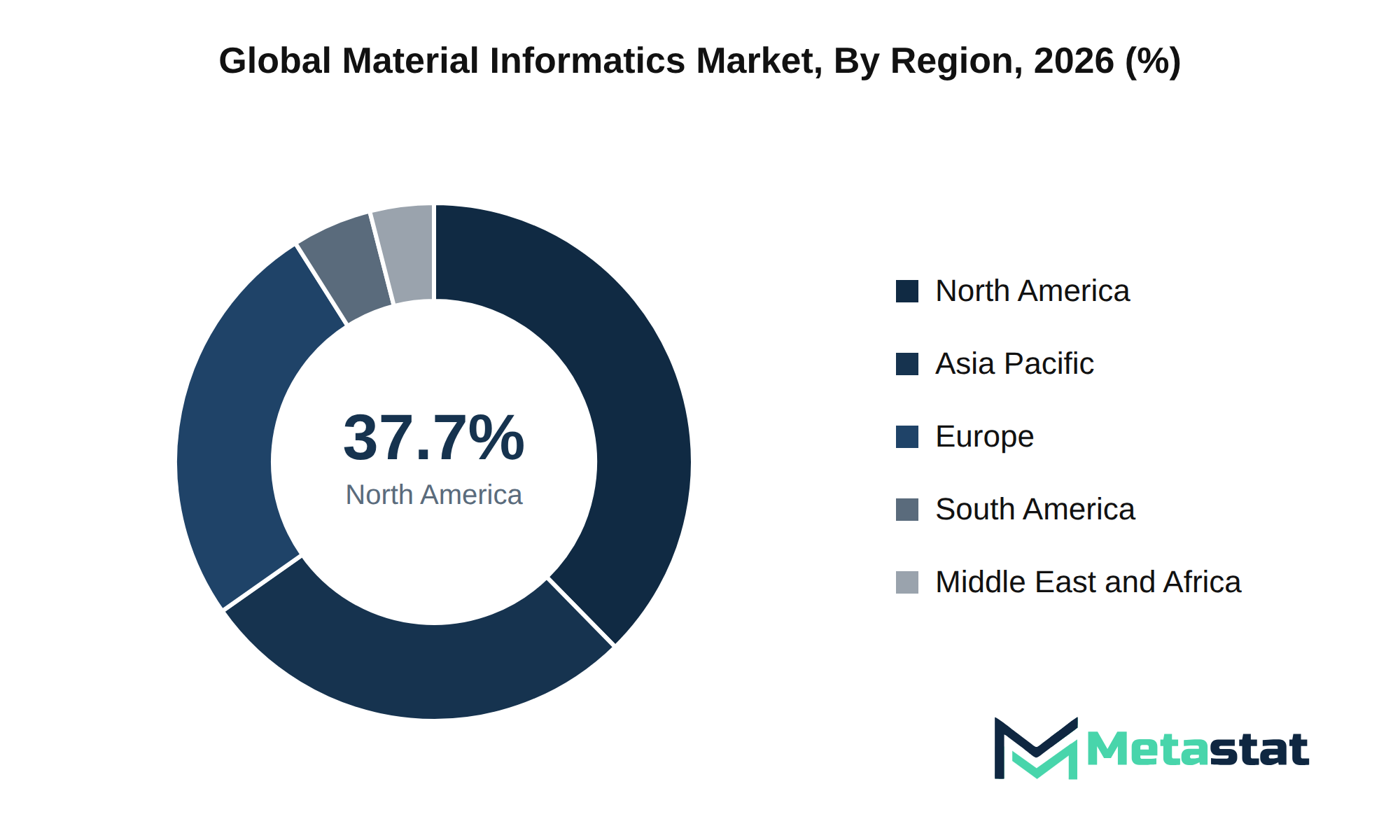
Competitive Landscape and Strategic Insights
The Material Informatics market experiences significant strategic consolidation through mergers and acquisitions among key players. Companies including Citrine Informatics and Kebotix Inc. operate in the market by leveraging proprietary technology moats and R&D pipelines to differentiate their offerings. Strategic alliances and joint ventures enhance competitive advantages, allowing firms to integrate value chains effectively and dominate supply chains. The emphasis on intellectual property portfolios strengthens market positions, enabling companies to defend against new entrants.
Future competitive outlooks indicate a focus on customer retention strategies and brand equity dynamics, with players investing in switching cost barriers to secure market share. Partnerships across industries facilitate broader reach and innovation in the Material Informatics market. Product differentiation and technological defensibility shape the market, encouraging ongoing investment in specialized solutions that meet evolving customer needs.
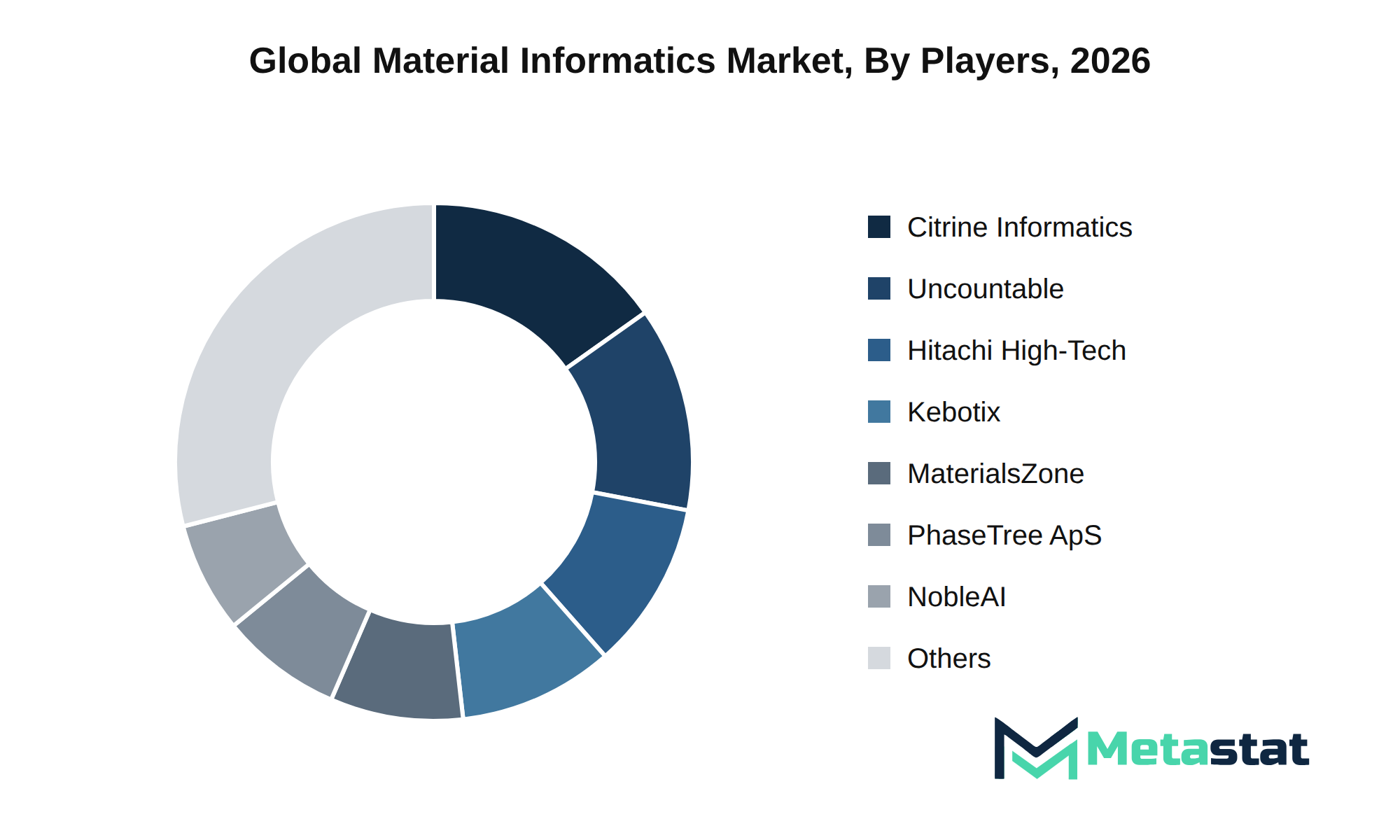
Forecast and Future Outlook
Market size is forecast to rise from USD 208.7 million in 2025 to over USD 909.6 million by 2033, representing a compound annual growth rate (CAGR) of 20.2%. The growth trajectory reflects increasing investments in research and development, alongside advancements in technology integration. The Material Informatics market is expected to experience shifts influenced by macroeconomic factors, evolving regulatory frameworks, and changing downstream demand across various industries.
The bull case highlights accelerated adoption of next-generation technologies and significant R&D commercialization timelines that enhance product life cycles. Organizations focusing on strategic capital allocation and infrastructure commitments drive market expansion, addressing unmet enterprise needs and high-growth pockets. The bear case involves geopolitical realignments and global supply chain shifts, creating uncertainties in demand and investment patterns. The market remains poised for innovation and growth, shaped by evolving trade corridors and an increasing focus on compliance with regulatory milestones.
Executive-level strategic imperatives focus on identifying white-space opportunities and enhancing defensibility roadmaps, positioning stakeholders for success in the Material Informatics market. Proactive engagement with emerging trends and strategic initiatives underpins future growth recommendations, ensuring alignment with industry maturation and structural consumption shifts. This comprehensive approach enables firms to navigate challenges while capitalizing on opportunities in the evolving environment.
Material Informatics Market Key Segments
By Material Type:
- Metals & Alloys
- Polymers & Elastomers
- Ceramics & Glasses
- Battery & Electrochemical Materials
- Semiconductor & Electronic Materials
- Catalysts & Porous Materials
- Composites
- Specialty Chemicals & Formulated Materials
- Others (Magnetic, Optical & Quantum Materials)
By Solution Capability:
- Materials Data Management and Informatics
- Materials Simulation and Modeling
- Materials Property Prediction
- Materials Discovery and Inverse Design
- Formulation and Process Optimization
- Experimental Design and Active Learning
- Materials Knowledge and Collaboration Platforms
- Autonomous and Closed-Loop Materials Discovery
By Technology:
- Artificial Intelligence & Machine Learning
- Physics-Based Modeling & Simulation
- Hybrid Physics-AI Modeling
- Generative AI & Foundation Models
- High-Throughput Computational Screening
- Multiscale & Digital Twin Modeling
- Others (Natural Language Processing, Knowledge Graphs & Quantum Computing)
By End-Use Industry:
- Chemicals & Specialty Chemicals
- Energy & Energy Storage
- Semiconductors & Electronics
- Automotive & Mobility
- Aerospace & Defense
- Industrial Manufacturing
- Construction & Infrastructure
- Healthcare & Biomedical
- Others (Environmental, Agriculture and Emerging Technology Industries)
By Region:
- North America
- Europe
- Asia-Pacific
- South America
- Middle East and Africa
Key Global Material Informatics Industry Players
- Citrine Informatics
- MaterialsZone Ltd.
- PhaseTree ApS
- Intellegens Ltd.
- Uncountable Inc.
- Mat3ra Inc.
- Kebotix Inc.
- NobleAI Inc.
- Polymerize
- Albert Invent Corp.
- Hitachi High-Tech Corporation
- Orbital Industries
- Phaseshift Technologies
- Schrodinger, Inc.
- Aionics Inc.
- SES AI Corporation
- Dassault Systèmes SE
- Exabyte Inc.
- Synopsys, Inc.
- SCM - Software Chemistry & Materials
Report Coverage
The report strategically identifies and profiles the key market players and analyses their core competencies in each sub-segment of the Material Informatics market.
Report Attributes | Details |
Study Period | 2021-2033 |
Base Year | 2025 |
Estimated Year | 2026 |
Forecast Period | 2026-2033 |
Historical Period | 2021-2025 |
Growth Rate | CAGR 20.2% from 2026 to 2033 |
Revenue Unit | USD million |
Segmentation | By Material Type, Solution Capability, Technology, End-Use Industry, and Region |
By Region | North America (By Material Type, Solution Capability, Technology, End-Use Industry, and Country)
|
Europe (By Material Type, Solution Capability, Technology, End-Use Industry, and Country)
| |
Asia Pacific (By Material Type, Solution Capability, Technology, End-Use Industry, and Country)
| |
South America (By Material Type, Solution Capability, Technology, End-Use Industry, and Country)
| |
Middle East and Africa (By Material Type, Solution Capability, Technology, End-Use Industry, and Country)
|
What Report Provides
- Key Company Market Share, Revenue and Ranking for the Material Informatics Market
- Key Market Leaders in the Material Informatics Industry
- Full In-Depth Analysis of the Parent Industry Dynamics
- Comprehensive Industry Statistics and Trends
- Important Changes in Market Dynamics and Structure
- Segmentation Details of the Material Informatics Market
- Historical, Ongoing and Projected Market Analysis
- Key Strategies of Major Players in the Market
Frequently Asked Questions
Find answers to common questions about this report
The Material Informatics market size was valued at USD 208.7 million in 2025, according to the Metastat Insights study.
The Material Informatics market is projected to grow at a CAGR of 20.2% during the forecast period from 2026 to 2033.
The North America Material Informatics market size is estimated to reach USD 316.2 million by 2033.
The segment "Metals & Alloys" leads the Material Informatics market with a projected value of USD 179.9 million by 2033. This segment demonstrates significant growth potential, with a compound annual growth rate of 18.7%.
Robust capital investment environments drive the Material Informatics market through increased spending on research and development, technological advancements, and infrastructure upgrades. The ongoing digital transformation reshapes manufacturing processes, enhancing operational efficiency and resource stewardship, while industries prioritize data-driven insights to optimize production and support sustainability initiatives.
North America holds the dominant share of the Material Informatics market, accounting for 37.7% in 2025. This region is projected to reach USD 316.2 million by 2033.
The Material Informatics market faces challenges from stringent regulatory compliance, which increases operational burdens and delays product development. Macroeconomic factors including inflation and supply chain disruptions raise costs, complicating pricing strategies. A shortage of skilled labor restricts effective implementation of innovative solutions, limiting market growth potential.
Robust capital investment environments, rising GDP growth rates, and expanding venture funding enhance the financial landscape, driving product adoption in the Material Informatics market. The ongoing digital transformation and emphasis on sustainability further support the integration of advanced technologies, optimizing production processes and improving resource efficiency across various industries.
The Material Informatics market is estimated to reach a valuation of USD 909.6 million by 2033.
Key players in the Material Informatics market include Citrine Informatics, MaterialsZone Ltd., PhaseTree ApS, Intellegens Ltd., Uncountable Inc., and Mat3ra Inc. These companies contribute significantly to the industry's development and innovation.
Choose Your License
Global Material Informatics Market
Related Reports
Explore related market intelligence reports worth reading alongside this one.