
LEAD ANALYST
Utkarsh Khirodkar is a Lead Market Research Analyst at MetaStat Insight, specializing in market intelligence, technology sector assessments, and competitive strategy.

India Hydraulics Market Size, Share, By Component Type (Hydraulic Pumps, Hydraulic Valves, Hydraulic Cylinders, Hydraulic Motors, Hydraulic Accumulators, Hydraulic Filters, Hydraulic Manifolds and Integrated Circuits, Hydraulic Power Units, Others), By Application (Mobile Hydraulics and Industrial Hydraulics), By Circuit Type (Open-Circuit Hydraulic Systems and Closed-Circuit Hydraulic Systems), By End-Use Industry (Construction and Earthmoving Equipment, Agriculture and Farm Equipment, Material Handling Equipment, Machine Tools and Industrial Machinery, Automotive and Commercial Vehicles, Mining and Metals, Oil and Gas, Power and Renewable Energy, Marine and Offshore, Others), Industry Analysis, Growth, Trends, and Forecast, 2026-2033
Report ID
MSI-5383
Published
September, 2026
Pages
284 Pages
Format
Historical
Base year
Forecast
Forecast period
Report Details
Market Valuation: Valued at $2,013.5 Million in 2025, projected to reach $3,138.3 Million by 2033 at a 5.7% CAGR.
Dominant Segment: The Hydraulic Valves segment leads the market, driven by the increasing adoption of automation in industries such as construction and agriculture. This segment is projected to reach USD 633.3 million by 2033, reflecting a CAGR of 6.1%.
Geographic Lead: The India Hydraulics market is primarily driven by significant investments in infrastructure development, particularly in urban areas. This focus on enhancing transportation networks and industrial facilities supports robust demand for hydraulic solutions.
What's Inside: The report provides a comprehensive analysis of the India Hydraulics market, including detailed segmentation by component type, application, circuit type, and end-use industry. It covers competitive dynamics, market trends, and forecasts through 2033.
Emerging Applications: Emerging applications in sectors such as construction and agriculture are stimulating demand for advanced hydraulic solutions. The push for modernization and efficiency in these industries presents new growth opportunities within the market.
Choose Your License
India Hydraulics Market
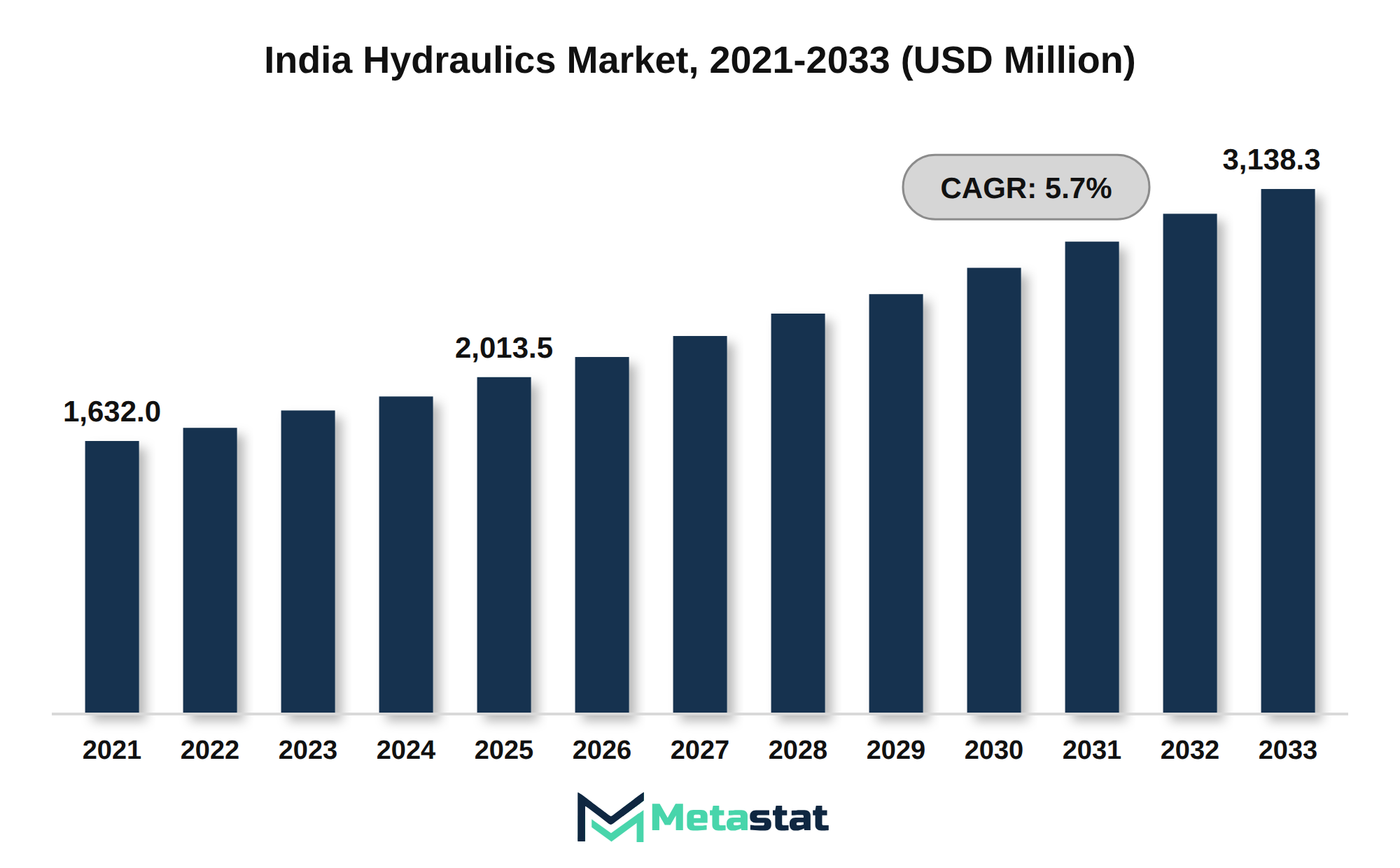
The India Hydraulics market was valued at USD 2,013.5 million in 2025 and is projected to reach USD 3,138.3 million by 2033, growing at a CAGR of 5.7% over the forecast period.
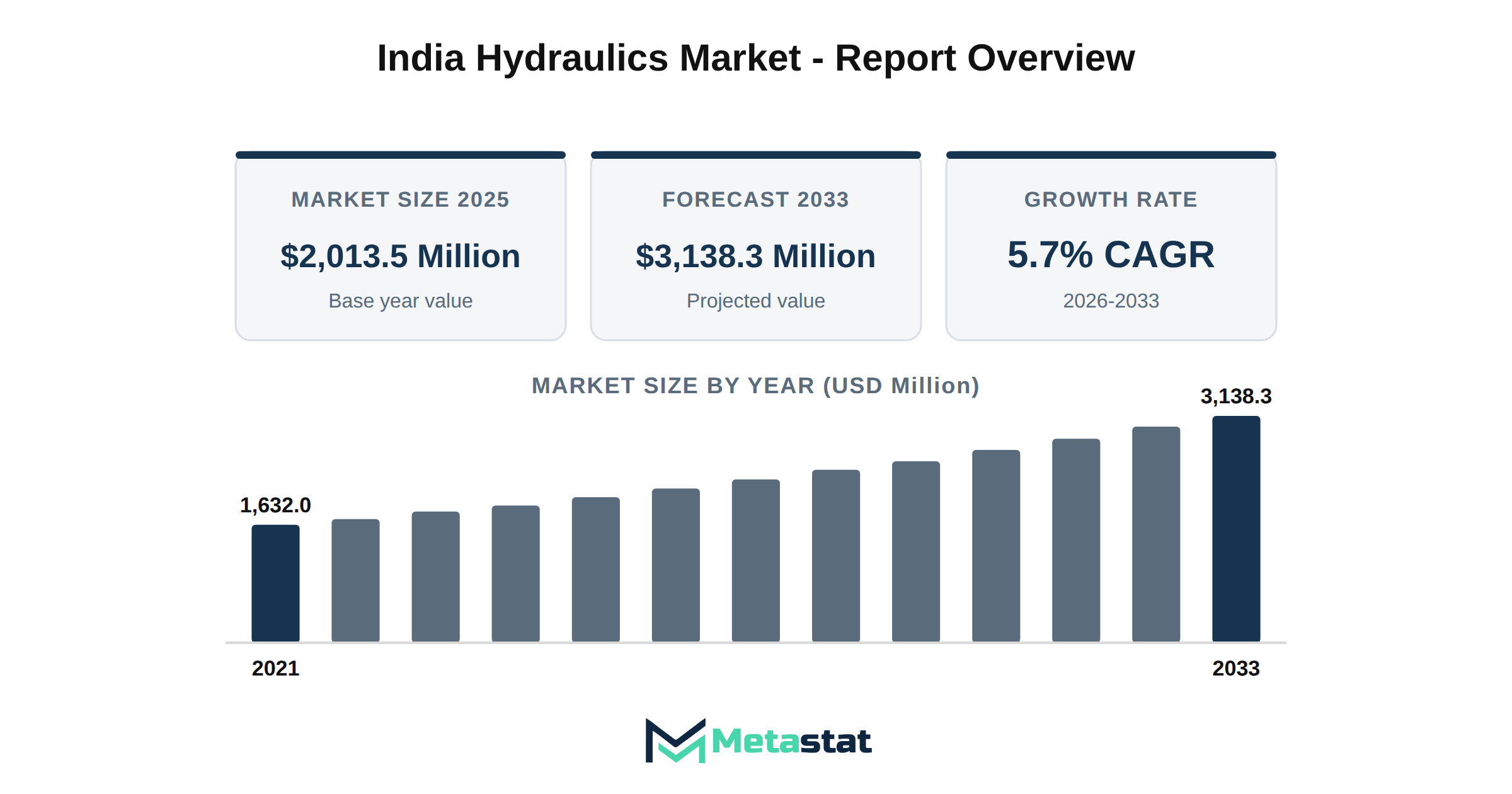
The India Hydraulics market is projected to grow significantly, expanding from a base value of USD 2,013.5 million in 2025 to USD 3,138.3 million by 2033, reflecting a compound annual growth rate (CAGR) of 5.7%. This growth is driven by rising demand for energy-efficient hydraulic systems and the adoption of electrohydraulic and smart hydraulics across diverse applications.
Increased emphasis on energy-efficient hydraulic technology supports modernization efforts in industrial machinery and mobile equipment. The integration of smart hydraulic components and sensor technologies enhances operational efficiency, driving market adoption in sectors including construction, agriculture, and manufacturing.
Localization of hydraulic component manufacturing in India presents opportunities for domestic suppliers, reducing dependency on imports and enhancing the supply chain. This trend aligns with growing demand from original equipment manufacturers (OEMs) seeking reliable and efficient hydraulic solutions.
Mobile equipment electrification reshapes hydraulic system design, necessitating the development of compatible components. Investment in renewable energy applications introduces new hydraulic opportunities, reinforcing the market's potential for growth.
Hydraulic pumps and valves play a crucial role in driving component-level demand, with significant growth in hydraulic cylinders across both mobile and industrial applications. The construction and earthmoving equipment sector significantly influences hydraulic demand, driven by ongoing infrastructure projects and machinery upgrades.
Increasing automation in material handling enhances the requirements for hydraulic systems, contributing to market expansion. Investments in the mining and metals sector support demand for heavy-duty hydraulic solutions, strengthening the market's position in high-performance applications.
Overall, the India Hydraulics market presents a vibrant environment, characterized by technological innovation and emerging opportunities across various industries. With the anticipated growth trajectory, stakeholders in the market expect increased investment and competitive dynamics among both global and Indian hydraulic manufacturers.
The increasing focus on energy-efficient hydraulic technologies drives significant advancements within the India Hydraulics market. Industries prioritize solutions that reduce energy consumption while enhancing performance. This trend reflects modernization efforts across various sectors including manufacturing and construction.
Electrohydraulic and smart hydraulics adoption gains traction, reflecting a shift towards automation and precision control in hydraulic systems. The integration of smart components and sensor technologies allows for improved monitoring and operational efficiency, creating new opportunities for manufacturers to innovate.
Localization of hydraulic component manufacturing in India strengthens the market by reducing dependency on imports and enhancing supply chain resilience. Domestic production enables competitive pricing and accelerates the availability of components, benefiting OEMs and end-users alike.
Rising demand for hydraulic components in construction equipment stems from ongoing infrastructure projects and urban development initiatives. This demand fuels growth in hydraulic pumps and valves, which play a critical role in enhancing the performance and reliability of construction machinery.
Mobile equipment electrification reshapes hydraulic system design, aligning with environmental targets and sustainability goals. Manufacturers increasingly focus on creating systems that integrate seamlessly with electric powertrains, facilitating energy-efficient operations.
Investments in mining and metals support the demand for heavy-duty hydraulics, driven by the requirement for robust and reliable hydraulic systems to operate efficiently in challenging environments. This trend highlights the critical role of hydraulics in supporting industrial activities.
Emerging hydraulic application opportunities arise in the renewable energy sector, where innovative hydraulic solutions contribute to the efficiency of wind and solar energy systems. The market adapts to these evolving requirements, positioning itself because a leader in technological advancements.
Growth in mobile hydraulics across off-highway equipment reflects the increasing need for power and efficiency in various applications, including agriculture and construction. The market responds to these demands with tailored hydraulic solutions that enhance operational capabilities.
Industrial hydraulics demand from manufacturing and machine tools indicates strong growth prospects, driven by automation and increasing production capacities. This segment demonstrates the versatility and reliability of hydraulic systems in enhancing manufacturing processes.
Competitive dynamics among global and Indian hydraulic manufacturers shape the market, encouraging innovation and efficiency. Companies invest in research and development to deliver advanced solutions that meet the diverse needs of customers across various industries.
Future growth opportunities for India hydraulic components and systems lie in sectors including railways, aerospace, and defense. These industries require specialized hydraulic solutions, further expanding the market's potential and driving technological advancements.
Significant investment in infrastructure development fuels expansion within the India Hydraulics market. This investment stems from increased government focus on enhancing transportation networks, urban development, and industrial facilities. Such initiatives create demand for hydraulic equipment in construction and earthmoving activities, directly impacting hydraulic pumps, cylinders, and valves.
Rising urbanization rates and population growth generate further demand for efficient hydraulic systems to support construction and industrial activities. Investment in modernization of aging infrastructure, particularly in urban areas, drives the need for advanced hydraulic solutions that improve operational productivity and enhance overall efficiency.
The market benefits from the alignment of public-private partnerships that promote capital expenditure in hydraulic applications. While private sectors engage in infrastructure projects, collaboration with public entities supports funding for equipment, leading to increased sales of hydraulic technologies. This collaborative approach strengthens the growth trajectory of the India Hydraulics market.
Technological integration, propelled by infrastructure investments, enhances the efficiency of hydraulic systems. Automation and advanced software solutions streamline operations, enabling companies to achieve cost savings and improved performance. The continued emphasis on infrastructure upgrades furthers the market by creating opportunities for innovative hydraulic solutions.
The expansion of the India Hydraulics market aligns with a heightened focus on automation across various industries. This emphasis stems from the need for operational efficiency, cost reduction, and enhanced productivity. Industries including manufacturing, construction, and agriculture increasingly adopt automated hydraulic systems to streamline operations and improve performance.
Integration of advanced technologies, including artificial intelligence and IoT, accelerates the transition towards automated hydraulic solutions. This transition enhances system reliability and accuracy, allowing businesses to optimize resource allocation and reduce downtime. The shift towards automation aligns particularly well with sectors requiring precision and speed, leading to a significant increase in demand for hydraulic components.
The India Hydraulics market benefits from investments in research and development aimed at innovating automated solutions. Companies prioritize developing products that leverage automation to meet evolving consumer expectations and regulatory requirements. This focus on automation improves efficiency and supports sustainability efforts through reduced energy consumption and waste.
Gradual adoption of automated systems across sectors positions the market for consistent growth, driven by technological integration and innovation. The transformation of traditional hydraulic operations into automated processes signifies a significant shift, positioning the market for sustained expansion through the forecast period.
Regulatory compliance poses significant challenges for the India Hydraulics market, creating barriers that hinder adoption and growth. Stringent compliance requirements increase operational complexity and necessitate investments in advanced technologies to meet evolving standards. Smaller players in the market face difficulties in aligning with these regulations, limiting their competitiveness and market entry.
Macroeconomic headwinds, including inflationary pressures and supply chain disruptions, further exacerbate these challenges. Rising costs of raw materials and components impact manufacturers' ability to maintain competitive pricing, which affects overall demand in the market. Inflation creates uncertainty, leading to cautious investments from end-users and stalling project timelines.
Geopolitical instability contributes to resource scarcity, impacting the availability and cost of essential materials needed for hydraulic systems. This scarcity imposes additional constraints on manufacturers, leading to potential delays in production schedules and increased operational costs. The cumulative effect of these factors results in a constrained growth trajectory for the India Hydraulics market.
Infrastructure gaps and connectivity deficits impede the deployment of hydraulic systems in key industries. Insufficient infrastructure limits access to sites where hydraulic equipment is vital, particularly in remote or rural areas. This limitation significantly restricts the market's growth potential, resulting from end-users struggling to implement hydraulic solutions in their operations.
The industry faces talent gaps and skilled labor deficiencies, impacting the workforce's ability to adapt to technological advancements. The lack of adequately trained personnel restricts innovation and the efficient operation of hydraulic systems, stalling the market's progression toward higher efficiency and automation. Addressing these labor-related issues remains crucial for realizing the full potential of the India Hydraulics market.
Geopolitical fragmentation introduces complexities within the India Hydraulics market, affecting supply chains and trade dynamics. Uncertainty surrounding international trade relationships influences pricing strategies and operational decisions across multiple sectors. Fluctuations in trade policies create tariff friction, leading to increased costs for manufacturers and customers alike.
Technological disruptions further complicate market conditions, demanding continuous adaptation from stakeholders. Companies involved in the India Hydraulics market face challenges related to complex research and development integrations, which slow down innovation and increase operational costs. The need for interoperability between various hydraulic systems and components adds another layer of difficulty, hindering efficiency and productivity.
Supply chain instability has emerged because a prominent concern, exacerbated by logistics disruptions and fluctuating feedstock prices. Manufacturers experience margin pressures stemming from rising input costs, which compress profitability. The competitive environment necessitates strategic pricing tactics that align with changing downstream demands.
Skill gaps within the workforce present additional challenges for the India Hydraulics market. A shortage of qualified personnel hampers the potential for growth and innovation, while automation displacements complicate talent retention efforts. Companies invest in employee training programs to enhance skills and address workforce challenges effectively.
Environmental considerations increasingly impact operational strategies, because stakeholders face mounting pressure to align with sustainability demands. Decarbonization mandates and lifecycle footprint assessments influence product development and supply chain practices. The market's ability to adapt to these evolving standards will determine its long-term viability and competitiveness.
The India Hydraulics market benefits from emerging applications that stimulate demand across various sectors. The need for advanced hydraulic solutions in industries including construction, agriculture, and manufacturing enhances market prospects. These sectors increasingly adopt innovative hydraulic technologies to improve efficiency and performance.
Infrastructure modernization initiatives create further opportunities within the market. Upgrading outdated systems and integrating next-generation hydraulic technologies align with the goal of increasing operational efficiency. Investments in sustainable practices and eco-friendly technologies support this transition, reflecting a broader shift towards more responsible manufacturing processes.
Geographical expansion of industrial activities contributes significantly to market growth. Regions experiencing rapid urbanization require efficient hydraulic systems to support construction and infrastructure projects. This trend drives demand for hydraulic components like pumps, valves, and cylinders, creating competitive dynamics among suppliers.
Technological disruptions enhance the capabilities of hydraulic systems, leading to new product developments. Digital transformation initiatives enable companies to optimize operations through automation and data analytics. These advancements facilitate improved maintenance strategies and operational yield maximization, further strengthening the India Hydraulics market's position in the global landscape.
Strategic consolidation efforts, including mergers and acquisitions, increase competitiveness in the market. Companies leverage combined resources and expertise to enhance product offerings and expand market reach. This trend reflects a proactive approach to meeting evolving customer preferences and adapting to shifting market conditions.
Focus on sustainability imperatives drives manufacturers to align with environmental, social, and governance (ESG) standards. Adopting green technologies and practices not only fulfills regulatory expectations but appeals to environmentally conscious consumers. Such alignment positions the India Hydraulics market for sustained growth and relevance in an increasingly eco-aware landscape.
The India Hydraulics market is segmented based on Component Type, Application, Circuit Type, and End-Use Industry.
Valued at USD 482.1 million in 2026, the Hydraulic Pumps segment is projected to reach USD 685.4 million by 2033, at a CAGR of 5.2% during the forecast period. Primary demand drivers include the increasing adoption of hydraulic pumps across various industries including construction, agriculture, and material handling. Growth in these sectors enhances the overall demand for hydraulic solutions, strengthening the segment's position within the India Hydraulics market.
Technological maturation drives product evolution, with manufacturers focusing on the development of more efficient and durable hydraulic pumps. Innovations aimed at reducing energy consumption and improving performance contribute to higher adoption rates among end-users. The shift towards automation across industries enhances the relevance of hydraulic pumps in modern applications, further expanding the segment.
Downstream applications are evolving, with hydraulic pumps becoming integral to various machinery and equipment. Demand for mobile hydraulics, particularly in construction and earthmoving equipment, contributes significantly to the segment's growth. End-use dynamics indicate a shift towards more sophisticated machinery that requires advanced hydraulic systems to ensure optimal performance and productivity.
Regulatory compliance standards regarding energy efficiency and emissions drive the need for next-generation upgrades in hydraulic pumps. Manufacturers face pressures to adapt to these standards while managing cost structures and pricing volatility, impacting margins. Strategic opportunities arise for firms that effectively navigate these challenges and invest in the development of compliant, high-performance hydraulic products.
Overall, the Hydraulic Pumps segment demonstrates strong growth potential within the India Hydraulics market, fueled by technological advancements, evolving end-use applications, and increasing demand across critical industries.
Hydraulic Valves segment is estimated to reach USD 633.3 million by 2033, at a CAGR of 6.1% during the forecast period. Growing demand for hydraulic valves is primarily driven by the increasing adoption of automation in various industries, including construction, agriculture, and manufacturing. The focus on enhancing operational efficiency and reducing environmental impact supports the shift toward advanced hydraulic systems, stimulating market growth.
Technological maturation significantly influences the expansion of this segment. Ongoing innovations in hydraulic valve design and functionality contribute to improved performance and reliability. Next-generation upgrades, including smart valves equipped with integrated sensors for monitoring and control, enhance system capabilities and optimize performance.
End-use dynamics indicate a significant demand for hydraulic valves in mobile hydraulics and industrial applications, with both sectors experiencing strong growth. Industries prioritize productivity and sustainability, leading to an expanding market for hydraulic valves that reflects changing consumption patterns.
Regulatory compliance standards regarding emissions and energy efficiency necessitate the adoption of advanced hydraulic solutions, influencing manufacturers' strategies. Competitive pricing structures, influenced by raw material costs and production efficiencies, impact market dynamics.
Strategic opportunity windows emerge from the demand for hydraulic valves in emerging markets. Investment in infrastructure and industrial projects presents avenues for growth, with manufacturers exploring new applications across diverse sectors. The India Hydraulics market stands poised for expansion, driven by these interlinked factors.
Demand for hydraulic cylinders reflects growth, driven by applications in various sectors, including construction and agriculture. Increasing mechanization in these industries raises the need for efficient hydraulic solutions, resulting in higher adoption rates. Technological advancements enhance the performance and reliability of hydraulic cylinders, making them essential components in modern machinery.
Regulatory compliance regarding safety and efficiency standards further supports demand within the India hydraulics market. Manufacturers invest in innovation, resulting in the development of next-generation hydraulic cylinders that meet stringent requirements, driving market growth. End-use industries recognize the benefits of reliability and energy efficiency, prompting investments to upgrade existing systems.
The hydraulic cylinders segment is projected to reach USD 619.5 million by 2033. Cost structures remain a significant consideration; raw material sourcing and production costs influence pricing strategies. Competitive dynamics within the market encourage companies to optimize supply chains, ensuring timely delivery and quality assurance.
Strategic opportunities arise from increasing investments in infrastructure, particularly in urban development projects. The push for sustainability and reduced environmental impact leads to innovations in hydraulic technologies, reinforcing the significance of hydraulic cylinders in the evolving India hydraulics market.
Growth in the Hydraulic Motors segment aligns with increased demand for high-performance machinery across various industries. This segment is projected to grow at a CAGR of 6.2% during the forecast period, reflecting its critical role in enhancing operational efficiency and performance. Technological maturation and next-generation upgrades in hydraulic systems contribute to this demand, driven by manufacturers seeking to integrate advanced features that optimize functionality and reduce energy consumption.
End-use dynamics play a significant role in shaping the market, particularly within construction, agriculture, and industrial applications. These industries increasingly adopt hydraulic motors to improve productivity and reduce operational costs. The ongoing evolution of machinery and enhanced automation further drives interest in hydraulic motors, encouraging investments in more efficient and reliable systems.
Regulatory compliance standards related to energy efficiency impact product development strategies, pushing manufacturers toward more sustainable solutions. This shift not only meets compliance requirements but attracts environmentally-conscious customers, supporting market growth. Pricing volatility remains a challenge, influenced by fluctuating raw material costs, impacting profit margins for manufacturers. However, strategic opportunity windows exist for companies that innovate and adapt their offerings to meet evolving market needs.
Supply chain resilience and raw material sourcing strategies become increasingly relevant in mitigating risks associated with production disruptions. Manufacturers that effectively manage these aspects enhance their competitive positioning within the market. Overall, the Hydraulic Motors segment within the India Hydraulics market demonstrates robust potential for expansion, driven by technological advancements and increasing adoption across critical industries. This segment's growth reflects the ongoing transformation in machinery and the demand for enhanced operational capabilities.
Technological advancements drive demand for hydraulic accumulators within the India Hydraulics market. These components serve critical roles in stabilizing pressure and storing energy, contributing to operational efficiency across various applications. Key industries, including construction and agriculture, increasingly adopt hydraulic accumulators to enhance equipment performance and reliability.
Next-generation upgrades focus on improving the energy efficiency and performance metrics of hydraulic accumulators. Enhanced materials and design innovations lead to lighter and more compact solutions, which significantly impact overall system efficiency. The growing emphasis on sustainability encourages manufacturers to implement eco-friendly practices in the production of hydraulic components.
Downstream applications increasingly highlight the importance of hydraulic accumulators, particularly in mobile and industrial hydraulics. The agricultural sector, characterized by its need for reliable and efficient machinery, benefits from these components, which assist in optimizing hydraulic systems. Consumption shifts toward equipment that offers better energy management directly influence the demand for advanced hydraulic solutions.
Regulatory compliance mandates for energy efficiency and environmental standards further stimulate market growth. With stringent regulations surrounding industrial operations, manufacturers prioritize compliance through technological advancements in their accumulator products. Strategic opportunity windows arise from these regulations, driving investment in research and development to meet evolving market requirements.
Cost structures influence pricing strategies within the hydraulic accumulator segment, driven by fluctuations in raw material sourcing and production costs. The current market environment warrants careful management of margins, compelling suppliers to optimize their supply chains. Increased competition and pricing volatility challenge manufacturers, necessitating continuous innovation and adaptation to maintain profitability.
Investment in the sector remains robust, with ongoing capital flows directed toward enhancing production facilities and developing new technologies. This investment landscape creates a resilient supply chain capable of addressing challenges related to material sourcing and logistics vulnerabilities. Overall, the growing focus on hydraulic accumulators within the India Hydraulics market presents numerous avenues for expansion and innovation.
Hydraulic Filters play a crucial role in ensuring the efficiency and longevity of hydraulic systems across various applications within the India Hydraulics market. The increasing demand for advanced filtration solutions stems from maintaining system performance, particularly in sectors including construction, agriculture, and manufacturing. Adoption of hydraulic filters leads to reduced wear and tear on hydraulic components, which lowers maintenance costs and downtime. Enhanced filtration technology, including innovations in filter materials and designs, supports this trend by providing better contaminant removal, thus improving hydraulic system reliability.
The expanding use of hydraulic filters aligns with the broader movement towards sustainability in industrial operations. Regulatory compliance regarding emissions and waste management necessitates the implementation of effective filtration systems, compelling manufacturers to invest in high-quality filter products. This trend enhances the market's resilience, driven by its adaptation to changing standards and customer expectations, ensuring a steady growth trajectory. Innovations in filtration technologies, including self-cleaning filters and IoT-enabled monitoring systems, facilitate the evolution of product offerings in the segment, driving competitive differentiation among suppliers.
While businesses increasingly emphasize operational efficiency and environmental responsibility, demand for hydraulic filters continues to rise. Investment in R&D within this segment encourages the development of next-generation products that promise improved performance and lower energy consumption. Overall, the growth of the hydraulic filters segment significantly contributes to the dynamics of the India Hydraulics market, reflecting broader trends in industrial efficiency and sustainability.
Innovations in hydraulic manifolds and integrated circuits contribute significantly to the India Hydraulics market. These components gain traction due to their role in optimizing system performance and enhancing operational efficiency in various applications. Industries seek compact solutions that improve responsiveness and minimize energy consumption.
Technological maturation encourages manufacturers to invest in next-generation upgrades, improving reliability and functionality. The evolution of products within this segment focuses on integrating advanced features that cater to specific end-user requirements, particularly in mobile and industrial hydraulics. Demand dynamics shift toward systems that support higher levels of automation and precision, aligning with broader trends in industrial modernization.
End-use industries, particularly construction and agriculture, increasingly rely on hydraulic manifolds and integrated circuits to achieve robust performance in demanding conditions. Regulatory compliance standards regarding efficiency and emissions influence purchasing decisions, pushing manufacturers to adopt innovative technologies. The competitive landscape reflects a growing emphasis on supply chain resilience and cost management, with firms exploring strategic opportunities to enhance margins within this segment.
Investment in research and development remains critical, enabling players to address substitution risks and technological obsolescence. The market is anticipated to experience continued growth driven by rising demand for hydraulic solutions that meet evolving industry standards and operational needs.
Hydraulic Power Units represent a critical component within the India Hydraulics market, supporting various applications across multiple sectors. Increased industrial automation and the need for efficient power transmission systems drive demand for these units. Industries including construction, agriculture, and manufacturing increasingly adopt hydraulic power units for their reliability and effectiveness in delivering hydraulic power to machinery.
Technological maturation in the hydraulic sector facilitates the development of advanced hydraulic power units, allowing for enhanced efficiency and performance. Next-generation upgrades focus on energy efficiency and integration with smart technologies, further propelling adoption. The evolution of products towards more compact and powerful designs aligns with the growing demand for space-saving solutions in modern machinery.
End-use dynamics show a shift towards increased usage in mobile and industrial hydraulics, driven by the need for greater flexibility and responsiveness in operations. Regulatory compliance standards regarding emissions and energy consumption exert pressure on manufacturers to innovate and improve product offerings. Fluctuations in raw material prices impact cost structures, profitability, and pricing strategies across the market.
While industries strive for sustainability, investment in hydraulic power units aligns with efforts to reduce carbon footprints and enhance operational efficiencies. Supply chain resilience becomes essential, with manufacturers focusing on securing raw material sourcing to mitigate risks associated with disruptions. Overall, the outlook for hydraulic power units remains optimistic, supported by ongoing capital investments and strategic opportunities in the India Hydraulics market.
Growing interest in hydraulic coolers, sensors, and accessories stems from rising demand for efficient thermal management in hydraulic systems. Enhanced performance requirements across various applications drive manufacturers to integrate advanced cooling solutions. Industries including construction, agriculture, and manufacturing rely on these components to optimize system reliability and longevity, thereby supporting overall productivity. The evolution of smart sensors that enable real-time monitoring enhances the operational efficiency of hydraulic systems, leading to improved decision-making and reduced downtime.
Technological maturation facilitates the development of next-generation upgrades that integrate seamlessly into existing systems. The industry's focus on sustainability emphasizes the need for environmentally friendly solutions, presenting opportunities for innovations in this sub-segment. Regulatory compliance standards regarding emissions and energy efficiency compel manufacturers to adopt advanced cooling technologies. Consequently, this demand influences pricing structures and shapes competitive dynamics within the market.
Investment in research and development strengthens supply chain resilience for hydraulic coolers and sensors. Manufacturers emphasize raw material sourcing to ensure quality and performance consistency. Emerging trends including IoT connectivity and automation create strategic opportunity windows, pushing the boundaries of traditional hydraulic systems. End-use dynamics reflect a shift toward integrated solutions, driving greater adoption of hydraulic coolers, sensors, and accessories within the India Hydraulics market.
Valued at USD 1,313.1 million in 2026, the Mobile Hydraulics segment is projected to reach USD 1,877.4 million by 2033, at a CAGR of 5.2% during the forecast period. Increased adoption of mobile machinery in construction and agriculture significantly drives this growth. Innovations in equipment design enhance efficiency and performance, directly impacting the sector's expansion. Rising construction activities and the growing need for efficient agricultural solutions influence demand for mobile hydraulic systems.
Technological maturation within hydraulic systems supports the segment's development. Continuous improvements in hydraulic components ensure better energy efficiency and operational reliability. The evolution of hydraulic systems towards more integrated solutions adds value within the overall India Hydraulics market. Enhanced functionality, including improved load handling and precision control, attracts investments from various end-use industries, leading to increased market penetration.
End-use dynamics shape demand within the Mobile Hydraulics segment. The construction and earthmoving equipment industry represents a substantial portion of this demand, with growth expectations driven by infrastructure projects. Agricultural applications capitalize on advancements in automated machinery, which rely on hydraulic systems for improved productivity. These factors collectively contribute to a robust outlook for the segment, aligning with broader trends in the India Hydraulics market.
Increased investment in industrial machinery fuels growth in the Industrial Hydraulics segment within the India Hydraulics market. Companies pursue efficiency and productivity, driving demand for advanced hydraulic systems. This segment is projected to reach USD 1,261 million by 2033, at a CAGR of 6.3% during the forecast period. Adoption patterns indicate a shift towards integrated hydraulic solutions, which enhance performance across various applications. Regulatory frameworks increasingly promote the use of energy-efficient hydraulic technologies, influencing purchasing decisions among end-users. The integration of smart technologies into hydraulic systems enhances operational efficiency, aligning with industry trends towards automation and IoT. While competition intensifies, manufacturers focus on innovation and product differentiation to capture market share. The ongoing evolution of the Industrial Hydraulics segment is expected to support the overall growth trajectory of the market.
Valued at USD 1,458.1 million in 2026, the Open-Circuit Hydraulic Systems segment is projected to reach USD 2,065.7 million by 2033, at a CAGR of 5.1% during the forecast period. The segment experiences growth driven by strong demand from industries including construction and agriculture. Increased adoption of advanced machinery that requires efficient hydraulic solutions fuels this demand, particularly in mobile applications.
Technological maturation in hydraulic systems enhances performance and energy efficiency, encouraging end-users to switch from traditional systems to open-circuit configurations. This transition aligns with the market's shift towards automation and smarter equipment, enabling operators to achieve higher productivity and lower operational costs.
Regulatory compliance standards increasingly emphasize environmental sustainability, prompting manufacturers to innovate and develop more efficient hydraulic systems. The focus on minimizing energy consumption and emissions drives investments in open-circuit technologies. These systems offer better adaptability to varying operational requirements, aligning with evolving industry standards.
Investment in infrastructure, particularly in urban development and agricultural modernization, directly impacts the segment. The demand for open-circuit hydraulic systems reflects the growing trend of mechanization in agriculture and construction, where efficiency and reliability serve because key performance indicators. This upward trajectory in investment supports the overall growth of the India Hydraulics market.
Pricing volatility in raw materials influences production costs, but the potential for scale and innovation helps mitigate these pressures. Manufacturers leverage advancements in design and materials to maintain competitive pricing while enhancing system capabilities. Strategic opportunity windows emerge because companies explore next-generation upgrades, ensuring the segment remains attractive to investors and manufacturers alike.
Closed-Circuit Hydraulic Systems exhibit significant market potential, projected to reach USD 1,072.7 million by 2033, with a CAGR of 6.8% throughout the forecast period. This growth stems from rising demand for precision and efficiency in various end-use applications, particularly within construction and industrial sectors. The ongoing trend of automation and advanced machinery adoption drives investments in closed-circuit systems that enhance operational efficiencies. While industries increasingly focus on reducing energy consumption and improving performance, closed-circuit hydraulic systems gain traction, fulfilling these requirements.
Technological maturation is essential for expanding market adoption. Innovations in hydraulic components and control systems enable enhanced performance, reliability, and flexibility in closed-circuit applications. This evolution aligns with the rising need for equipment capable of handling complex hydraulic tasks efficiently. Stringent regulatory compliance standards demand higher efficiency and lower emissions, compelling industries to upgrade to advanced closed-circuit technologies.
End-use dynamics significantly influence the closed-circuit hydraulic systems segment. The construction and earthmoving equipment sector drives significant demand because operators seek to enhance productivity and reduce downtime. An emphasis on sustainable practices within the India Hydraulics market drives investments toward closed-circuit solutions that offer improved energy efficiency, contributing to increased profitability for end-users. Overall, the growth trajectory of closed-circuit hydraulic systems reflects a combination of technological advancements, regulatory pressures, and evolving industry requirements.
Hydraulic solutions for construction and earthmoving equipment show significant promise within the India Hydraulics market. This segment is valued at USD 530.5 million in 2026 and is projected to reach USD 797.5 million by 2033, reflecting a CAGR of 6% during the forecast period. Increased investments in infrastructure projects, urban development, and the expansion of the construction sector drive primary demand. These factors contribute to higher utilization of hydraulic systems in machinery including excavators, bulldozers, and cranes.
Technological maturation significantly influences segment expansion. Advances in hydraulic system efficiency, automation, and control mechanisms result in improved performance and lower operational costs. Next-generation upgrades in hydraulic equipment, including enhanced sensors and controls, enable better precision and efficiency, facilitating broader adoption among manufacturers and end-users. Regulatory compliance regarding emissions and safety standards drives demand for innovative hydraulic solutions that meet modern specifications.
Demand dynamics reflect a shift toward high-performance, energy-efficient hydraulic systems. Manufacturers increasingly focus on product evolution to align with these consumption shifts. The increasing frequency of public and private sector investment in large-scale construction projects contributes to market growth. Strategic opportunities exist in expanding product lines and enhancing service offerings to meet diverse customer needs. Overall, the outlook for the construction and earthmoving equipment sector within the India Hydraulics market remains robust, supported by ongoing investments and technological advancements.
Growth within the Agriculture and Farm Equipment segment aligns with increased agricultural mechanization and productivity demands. This segment is estimated to reach USD 543.6 million by 2033, at a CAGR of 4.9% during the forecast period. Rising crop yields and the need for efficient farming practices drive the adoption of hydraulic systems in agricultural machinery. Increasing investments in modern farming technologies enhance the segment's expansion, driven by farmers seeking to improve operational efficiency and reduce manual labor. Innovations in hydraulic components and systems specifically tailored for agriculture facilitate streamlined equipment performance, contributing to enhanced productivity in field operations. The India Hydraulics market reflects these trends, highlighting opportunities for growth and technological advancements in the agriculture sector.
Increasing reliance on advanced technology within the sector drives significant demand for hydraulic solutions in the Material Handling Equipment segment. Innovations in automation and efficiency improvements enhance productivity across various applications, particularly in warehouses and distribution centers. The integration of smart technologies in material handling machinery promotes greater operational efficiency, further propelling the adoption of hydraulic systems.
The segment is projected to reach USD 411.1 million by 2033. Key players contribute to the market's evolution through continuous product upgrades and the introduction of next-generation hydraulic components. Enhanced performance standards and compliance with regulatory frameworks establish a competitive environment that drives growth in the India Hydraulics market.
Cost structures specific to this segment emphasize the importance of sourcing high-quality raw materials while managing pricing volatility. Manufacturers strategically invest in supply chain resilience to mitigate risks associated with logistics vulnerabilities and disruptive alternatives. This proactive approach supports sustained growth and offers strategic opportunity windows for market participants.
Technological obsolescence remains a concern, prompting investments in innovative hydraulic solutions that adapt to changing market demands. While applications evolve, the focus shifts towards more sustainable and efficient hydraulic systems, which aligns with broader industry trends aimed at reducing environmental impact. This situation within the Material Handling Equipment segment reflects the overall growth trajectory of the India Hydraulics market.
Investment in machine tools and industrial machinery represents a significant driver in the India Hydraulics market, contributing to increased demand for hydraulic solutions. This sector is projected to grow at a CAGR of 6.1% during the forecast period, reflecting robust expansion trends. Innovations and advancements in hydraulic technologies enhance the efficiency and effectiveness of machinery, leading to improved productivity across various industries.
Rising automation in production processes supports the demand for hydraulic systems within this segment. Manufacturers prioritize high-performance machinery that handles complex tasks, leading to a shift towards more advanced hydraulic components. This transition enables the adoption of next-generation hydraulic valves and pumps, essential for optimizing operational capabilities.
The machine tools and industrial machinery segment experiences a need for compliance with stringent regulatory standards, influencing investment decisions. Enhanced safety protocols and environmental regulations push manufacturers to upgrade existing machinery, creating a market environment that promotes technological advancements. Such upgrades significantly contribute to the growth of the market, fostering a competitive landscape that encourages innovation.
Cost structures within the segment are influenced by raw material sourcing and pricing volatility, impacting profit margins. Strategic investment in high-quality materials and efficient supply chain management enhances resilience against market fluctuations. Disruptive alternatives, including electric and hybrid solutions, pose challenges for traditional hydraulic systems, requiring manufacturers to adapt to maintain market share.
Overall, the machine tools and industrial machinery segment plays a crucial role in the India Hydraulics market, characterized by its dynamic growth and the continuous evolution of hydraulic technologies. With a projected market value of USD 411.1 million by 2033, this segment's trajectory aligns with broader trends in industrialization and automation.
In the India Hydraulics market, the Automotive and Commercial Vehicles segment reflects a strong demand driven by the increasing production of vehicles and associated equipment. This segment benefits from advancements in hydraulic technology, enhancing vehicle performance and efficiency. Adoption of next-generation hydraulic systems, which provide improved control and responsiveness, supports the competitive positioning of manufacturers within this segment.
Product evolution in hydraulic components aligns with the growing complexity of automotive systems. Enhanced hydraulic solutions offer greater reliability and reduced weight, meeting the specific needs of automotive manufacturers. This responsiveness to market dynamics drives investments in newer technologies and materials, promoting sustainable practices in vehicle production.
Regulatory compliance standards play a significant role in shaping market dynamics. Stringent emissions regulations and safety requirements compel manufacturers to integrate advanced hydraulic solutions that align with these standards. Compliance drives innovation, incentivizing companies to develop hydraulic systems that not only meet regulatory demands but enhance vehicle performance.
Cost structures exhibit pressures resulting from raw material prices fluctuating. Manufacturers in the automotive and commercial vehicle sectors face challenges related to sourcing high-quality materials at competitive prices. Pricing volatility impacts margins, compelling companies to optimize supply chains and explore cost-effective alternatives to maintain profitability.
Strategic opportunity windows arise from the transition to electric vehicles (EVs) and hybrid systems. The shift towards greener technologies necessitates the adaptation of hydraulic systems to support new powertrain architectures. This evolution presents a chance for manufacturers to innovate and capture emerging market segments, ultimately contributing to growth in the India Hydraulics market.
Demand for hydraulic systems within the Mining and Metals sector is influenced by the increasing need for efficient and reliable equipment to support heavy-duty operations. Industry expansion, driven by rising mineral extraction activities, escalates the demand for hydraulic technologies capable of handling rigorous tasks in challenging environments. Adoption of advanced hydraulic solutions enhances operational efficiency and productivity, resulting in improved performance and reduced downtime in mining operations.
The market benefits from the ongoing evolution of hydraulic products that integrate advanced technologies, including automation and smart systems. These advancements streamline processes and enable real-time monitoring, contributing to enhanced safety and operational control. The Mining and Metals industry’s shift towards sustainable practices further emphasizes the need for hydraulic systems that minimize environmental impact while maintaining high performance.
Regulatory compliance standards play a crucial role in shaping equipment specifications and operational practices within the mining sector. Hydraulics manufacturers align product offerings with these compliance requirements, ensuring that systems not only meet industry norms but support responsible mining operations. This focus on compliance drives investment in modern hydraulic solutions, promoting growth in the India Hydraulics market.
Cost structures and pricing strategies within the Mining and Metals segment reflect the competitive landscape and raw material sourcing challenges. Manufacturers strategize to maintain margins amid fluctuations in raw material costs. The resilience of the supply chain remains vital for mitigating potential disruptions, ensuring timely delivery of hydraulic components crucial for mining operations. Strategic investment in infrastructure and technology enhances market positioning and facilitates future growth opportunities.
Investment in the Oil and Gas sector emphasizes the importance of hydraulic systems, enhancing drilling and extraction processes. Rising global energy demands drive increased exploration and production activities, leading to a higher reliance on efficient hydraulic technologies. Growth in the market stems from the need for advanced systems that meet rigorous operational standards and improve efficiency.
Technological maturation within the market facilitates the adoption of next-generation hydraulic solutions, tailored for specific applications in Oil and Gas. Continued focus on product evolution ensures that manufacturers meet the evolving challenges in the sector, particularly concerning environmental regulations and sustainability requirements. Enhanced performance capabilities and efficiency gains support operators aiming to optimize their resource extraction processes.
End-use dynamics within the Oil and Gas segment demonstrate a shift toward automation and digitalization, further driving the integration of advanced hydraulic solutions. This shift aligns with broader trends in the India Hydraulics market, where companies prioritize innovation to remain competitive. Regulatory compliance standards influence operational decisions, reflecting companies' adaptation to increasingly stringent environmental protocols.
Cost structures in the Oil and Gas industry reflect the volatility of raw material prices, impacting hydraulic system pricing and margins. Increased competition within the sector emphasizes the importance of robust supply chain resilience and strategic sourcing of components. Capital investment in hydraulic technologies remains essential for maintaining a competitive edge and meeting industry demands.
Investments in renewable energy initiatives drive demand within the Power and Renewable Energy segment of the India Hydraulics market. Increased focus on sustainability and the transition to cleaner energy sources create opportunities for hydraulic systems in various applications, including wind and solar power generation. Enhanced efficiency, reliability, and performance of hydraulic components contribute to meeting the dynamic requirements of the sector.
Advancements in hydraulic technology enable the integration of smart systems and automation, allowing for improved operational efficiencies and reduced downtime. The ongoing shift towards next-generation hydraulic solutions supports the segment's expansion, driven by industries seeking to optimize their resource utilization and minimize environmental impact.
Regulatory compliance and policies promoting renewable energy adoption further drive segment growth. Manufacturers are compelled to align their product offerings with evolving standards to enhance competitiveness and capture market share. This trend encourages innovation and the development of advanced hydraulic systems tailored for renewable energy applications.
The Power and Renewable Energy segment plays a significant role in the India Hydraulics market, driven by technological advancements, regulatory support, and the growing emphasis on sustainable practices across various end-use industries.
Hydraulic solutions in the Marine and Offshore sub-segment emerge due to vital components that drive productivity in various marine applications. Demand stems from the need for robust systems capable of operating under harsh conditions, ensuring safety and efficiency. Technological advancements enhance system reliability, promoting the adoption of next-generation hydraulic solutions tailored for marine environments.
Investment in offshore energy projects creates a substantial opportunity for growth, driven by expanding exploration and production activities. Regulatory compliance standards and certifications regarding safety and environmental impacts influence procurement decisions, compelling manufacturers to innovate and enhance product offerings. Increasing governmental support for sustainable practices aligns with industry trends toward efficiency and reduced environmental impact.
Price volatility in raw materials poses challenges, impacting cost structures and margin pressures within the segment. Supply chain resilience becomes essential to mitigate logistics vulnerabilities and sourcing disruptions. Manufacturers focus on developing partnerships and diversifying suppliers to stabilize operations and maintain competitive pricing.
Technological obsolescence remains a concern due to advancements occurring rapidly, urging firms to continuously evolve their product offerings. The market for hydraulic applications in the marine sector indicates potential, with ongoing development aimed at improving efficiency and performance across various maritime applications. This dynamic environment presents unique challenges and opportunities, creating a space ripe for innovation and strategic investment in the India Hydraulics market.
Investment in the railways, aerospace, and defense sectors drives demand for hydraulic systems, reflecting a broader trend toward modernization and enhanced operational efficiencies. Increased focus on advanced technologies seeks to improve performance and reliability within these industries. The pursuit of weight reduction in aerospace applications aligns with innovations in hydraulic components, promoting growth while enhancing fuel efficiency. Regulatory compliance regarding safety and environmental standards influences product development, pushing manufacturers to innovate while ensuring adherence to stringent guidelines.
Strategic partnerships within the supply chain establish resilience against disruptions, ensuring consistent delivery of quality hydraulic solutions. Manufacturers emphasize raw material sourcing to mitigate risks associated with price volatility and supply chain vulnerabilities. Investment in research and development leads to technological advancements, resulting in product evolution tailored to the unique needs of the railways, aerospace, and defense sectors. The India Hydraulics market responds to these dynamics through continuous innovation and adaptation, positioning itself because a key player in meeting the diverse demands of these critical industries.
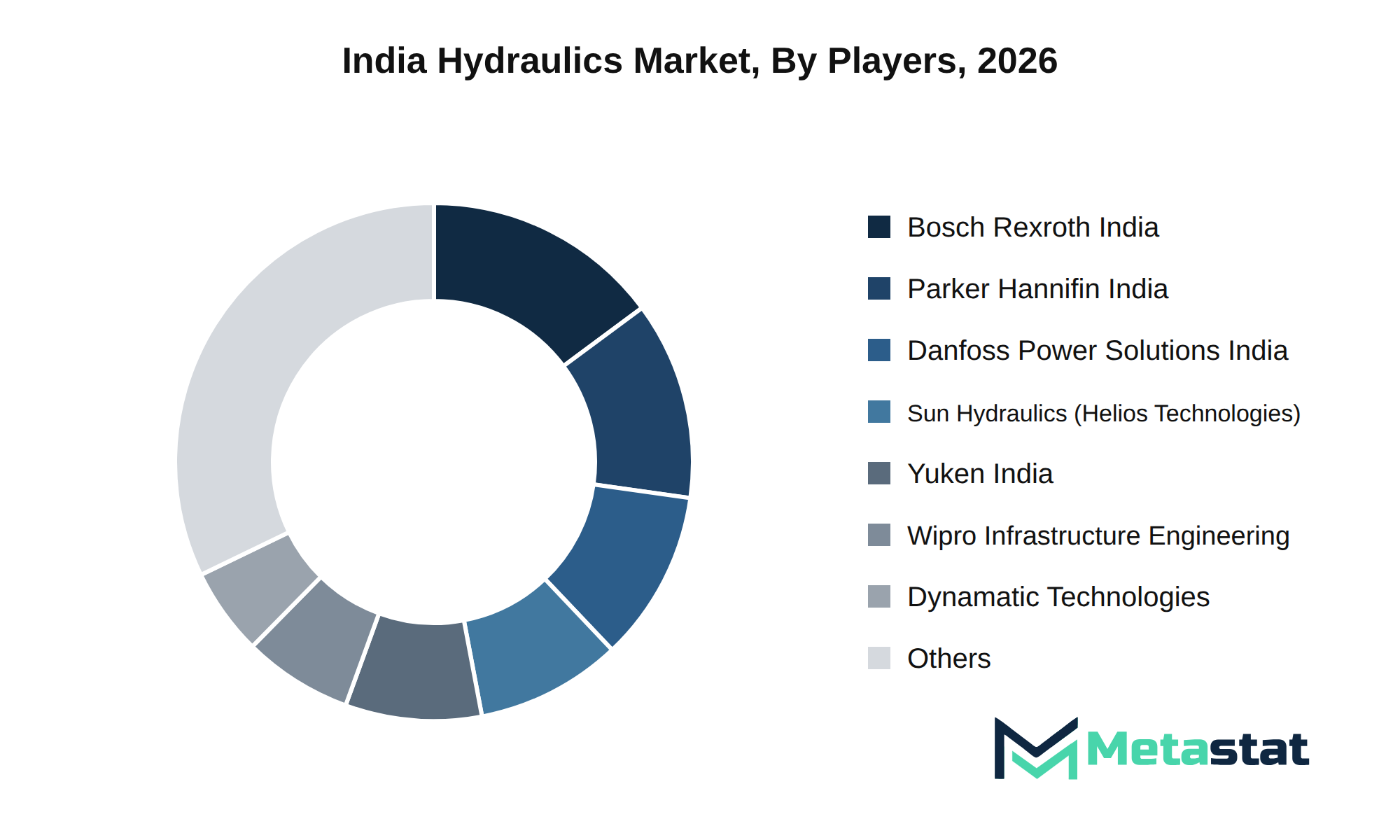
The India Hydraulics market experiences significant activity through mergers, acquisitions, and strategic consolidations. Key players including Bosch Rexroth India Pvt. Ltd., Parker Hannifin India Pvt. Ltd., and Danfoss Power Solutions India Pvt. Ltd. engage in partnerships and alliances to strengthen their market positions. These collaborations enhance product offerings and expand geographic reach.
Product differentiation remains critical in the market, with companies investing in research and development to innovate and deliver unique hydraulic solutions. Firms like Sun Hydraulics LLC (Helios Technologies) and Yuken India Limited focus on proprietary technologies that create competitive advantages. The development of advanced hydraulic pumps and cylinders demonstrates this trend.
Customer retention strategies play a vital role in maintaining brand equity and market share. Wipro Infrastructure Engineering and Dynamatic Technologies Limited implement robust customer support systems to build loyalty. Switching costs associated with hydraulic systems strengthen customer relationships and deter new entrants.
The value chain integration approach adopted by leading players like Eaton Corporation and HYDAC India Pvt. Ltd. enhances supply chain domination and procurement leverage. This strategic focus allows for improved operational efficiencies and cost management across the hydraulic systems sector. Companies excelling in these areas are likely to capture substantial market opportunities in the coming years.
The future competitive outlook for the India Hydraulics market hinges on ongoing innovation, effective customer engagement, and the ability to navigate evolving market dynamics.
Market size is forecast to rise from USD 2,013.5 million in 2025 to over USD 3,138.3 million by 2033. The base case reflects growth from USD 2,013.5 million in 2025 to USD 3,138.3 million by 2033 at a 5.7% CAGR. In a bullish scenario, increased investment in infrastructure and favorable regulatory environments contribute to higher growth rates, enabling the market to exceed projections. Conversely, bearish conditions, including economic downturns or significant regulatory changes, hinder expansion, leading to lower growth rates.
Shifts in downstream demand are influenced by macroeconomic factors, including fluctuations in investment in construction, agriculture, and manufacturing sectors. The maturation of core industries, along with structural consumption shifts, shapes the landscape for the India Hydraulics market. Integration of next-generation technologies and commercialization of R&D enhance operational efficiencies and product life cycles, driving demand and adoption.
Regulatory evolution and compliance milestones affect market dynamics, resulting from industries adapting to new standards and practices. Geopolitical realignments and regional supply chain shifts impact sourcing strategies, leading to potential vulnerabilities or opportunities for growth in the market. Strategic capital allocation directives, combined with infrastructure commitments and CapEx investment vectors, enhance the overall landscape, creating a conducive environment for growth.
Emerging white-space opportunities and unmet enterprise needs create high-growth pockets within the India Hydraulics market. Executives prioritize strategic imperatives and develop defensibility roadmaps to navigate challenges and capitalize on future growth recommendations effectively.
The report strategically identifies and profiles the key market players and analyses their core competencies in each sub-segment of the Hydraulics market.
Report Attributes | Details |
Study Period | 2021-2033 |
Base Year | 2025 |
Estimated Year | 2026 |
Forecast Period | 2026-2033 |
Historical Period | 2021-2025 |
Growth Rate | CAGR 5.7% from 2026 to 2033 |
Revenue Unit | USD million |
Segmentation | By Component Type, Application, Circuit Type, End-Use Industry, and Region |
Find answers to common questions about this report
The India Hydraulics market size was valued at USD 2,013.5 million in 2025.
The Hydraulics market is projected to grow at a CAGR of 5.7% during the forecast period from 2026 to 2033.
The Hydraulic Pumps segment leads the India Hydraulics market with a value of USD 482.1 million in 2026. This segment holds the largest share compared to other component types.
Significant investment in infrastructure development drives the India Hydraulics market, fueled by government initiatives in transportation, urban development, and industrial facilities. Rising urbanization rates and the demand for efficient hydraulic systems further enhance market growth, while public-private partnerships promote capital expenditure in hydraulic applications.
Regulatory compliance poses significant challenges, increasing operational complexity and necessitating investments in advanced technologies. Macroeconomic factors, including inflationary pressures and supply chain disruptions, further hinder growth by raising costs and creating uncertainty in investment. insufficient infrastructure and talent gaps restrict the deployment and innovation of hydraulic systems.
Significant investment in infrastructure development, driven by government initiatives, creates demand for hydraulic equipment in construction and industrial applications. The alignment of public-private partnerships supports funding for hydraulic technologies, while the focus on automation enhances operational efficiency, further favoring product adoption in the India Hydraulics market.
The Hydraulics market is estimated to reach a valuation of USD 3,138.3 million by 2033.
Key players in the India Hydraulics Market include Bosch Rexroth India Pvt. Ltd., Parker Hannifin India Pvt. Ltd., Danfoss Power Solutions India Pvt. Ltd., Yuken India Limited, Wipro Infrastructure Engineering, and Dynamatic Technologies Limited.
Hydraulic systems in India primarily serve construction, agriculture, and industrial sectors. These systems enhance operational efficiency and precision in heavy machinery and equipment.
Hydraulic pumps hold a market share of 22.7% within the India Hydraulics market, making them the leading component type.
The analysts below cover Machinery & Equipment research at Metastat Insights.
LEAD ANALYST
Utkarsh Khirodkar is a Lead Market Research Analyst at MetaStat Insight, specializing in market intelligence, technology sector assessments, and competitive strategy.

INDUSTRY CONSULTANT - CHEMICALS & ADVANCED MATERIALS
Chemicals and Materials · Machinery & Equipment · Packaging
Amit Gadhekar Consultant for Chemicals and Materials at MetaStat Insight, directing sector-specific intelligence, research, and strategic consulting across global chemical and processing markets.

PRINCIPAL CONSULTANT - QUALITY SYSTEMS & COMPLIANCE
Electronics and Semiconductor · Machinery & Equipment · Professional Services
Omkar Phadtare is an Industry Consultant at MetaStat Insight, specializing in quality systems, regulatory compliance, and standards benchmarking to drive data-driven market intelligence and strategic industry research.

ENERGY & INFRASTRUCTURE INDUSTRY CONSULTANT
Automotive and Transportation · Electronics and Semiconductor · Energy and Power · Machinery & Equipment
Saurabh Vasant Ganvir consults for Energy & Infrastructure Industry at MetaStat Insight, specializing in renewable energy, solar EPC, and electric vehicle (EV) infrastructure markets.

LEAD CONSULTANT - COMMUNICATION, TELECOM, AND IT
Electronics and Semiconductor · Information & Technology · Machinery & Equipment · Professional Services
Ravindra Sathe Consultants for Communication, Telecom, and IT at MetaStat Insight. He leads the firm's industry research initiatives across telecommunications infrastructure, digital connectivity, enterprise networking, and emerging information technology domains.
Transitioning ultra-class mining haul trucks to alternative power requires concrete data on remote hydrogen refueling infrastructure economics. The report evaluated megawatt-scale electrolyzer installation expenses, onsite storage safety mandates, and heavy-duty fuel cell stack degradation under continuous duty cycles. That technical rigor helped our engineers benchmark realistic total operating cost horizons for off-highway fleet decarbonization.
Enterprise zero-trust network rollouts are often slowed down by multi-cloud transit latency and proprietary hardware retirement schedules. This study provided realistic total cost of ownership models comparing cloud-delivered security edge solutions against traditional hardware refreshes. The analysis of contract renewal lengths and software maintenance fees gave us clear visibility into enterprise replacement cycles over the next three to five years.
Scaling antibody-drug conjugate manufacturing hinges on contract manufacturing availability for high-potency active ingredients. The MetaStat Insight analysis looked closely at global cleanroom slot constraints, bioconjugation batch failure rates, and supply chain redundancies between the US, Europe, and India. The supplier capability matrix proved genuinely useful for our team when mapping secondary source options across our clinical pipeline.
Explore related market intelligence reports worth reading alongside this one.