Malaysia Car Rental Market Size, Share, By Rental Duration (Short-Term (1-7 Days), Medium-Term (8-30 Days), and Long-Term / Leasing (31+ Days)), By Vehicle Type (Mini & Economy Cars, Compact & Intermediate Cars, Sedans, SUVs, MPVs, Luxury & Premium Cars, and Vans & Commercial Vehicles), By Booking Type (Online Booking and Offline Booking), By Customer Type (Individual - Tourism & Leisure, Individual - Local / Intercity Travel, Corporate / Business, Corporate / Fleet, and Government & Institutional), Industry Analysis, Growth, Trends, and Forecast, 2026-2033
Report ID
MSI-4965
Published
August 18, 2026
Pages
270 Pages
Format
Market Size 2021
$396.4 Million
Historical
Market Size 2025
$547.3 Million
Base year
Market Size 2033
$1,067.9 Million
Forecast
CAGR 2025-2033
8.7%
Forecast period
Report Details
Comprehensive Market Analysis And Insights
Market Overview
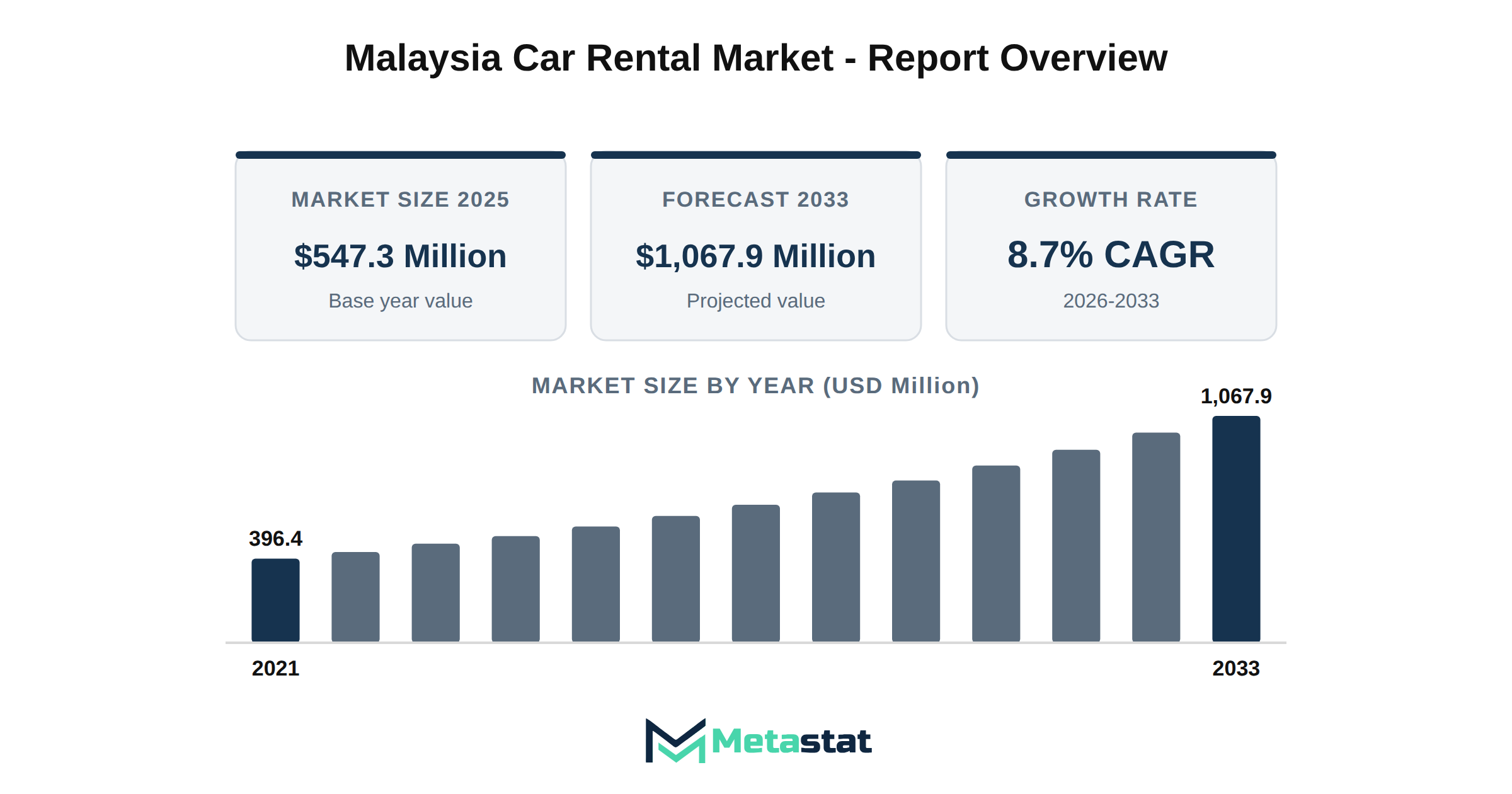
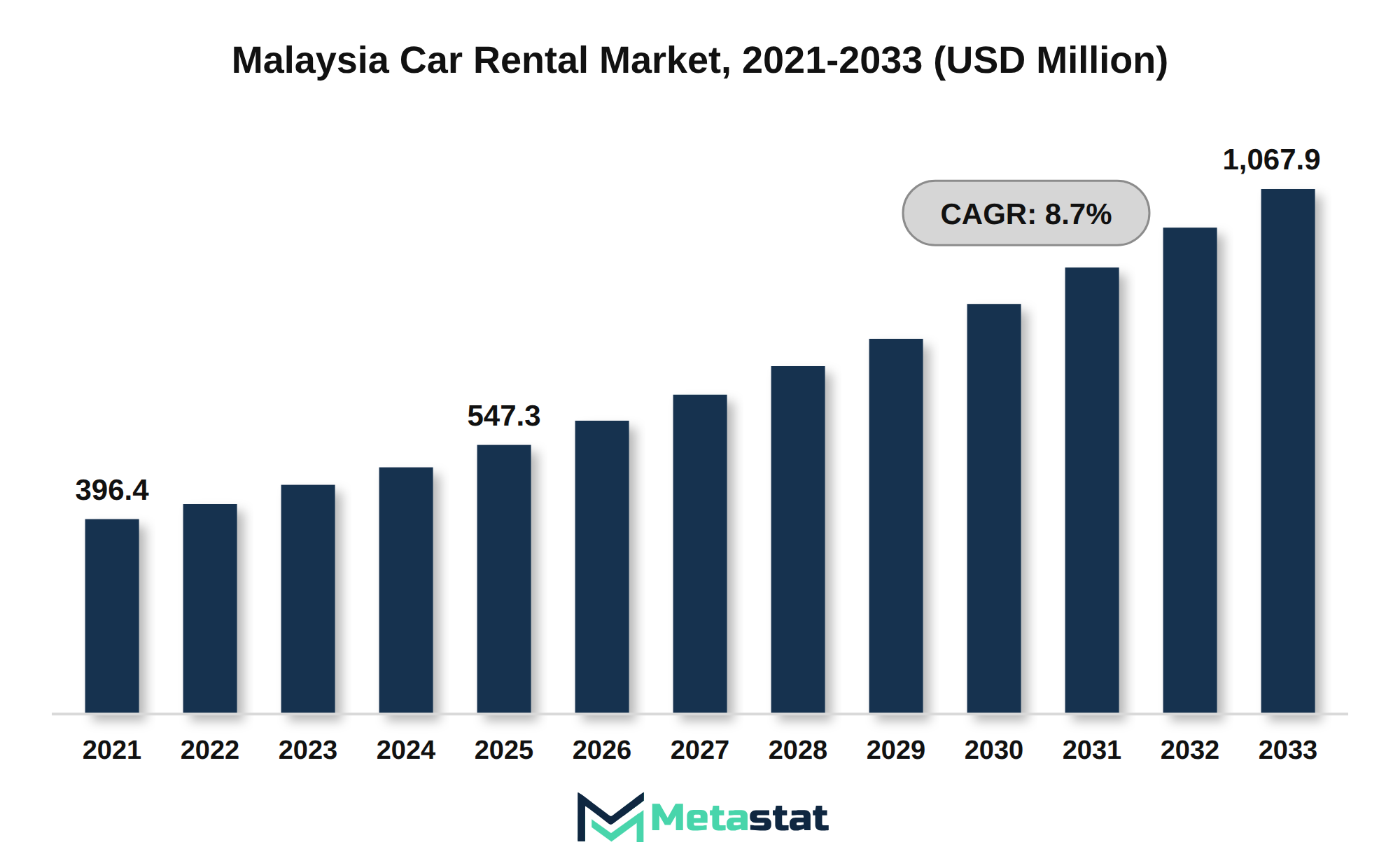
The Malaysia Car Rental market was valued at USD 547.3 million in 2025 and is projected to reach USD 1,067.9 million by 2033, growing at a CAGR of 8.7% over the forecast period.
The Malaysia Car Rental market was valued at USD 547.3 million in 2025, reflecting an increase from USD 396.4 million in 2021. This upward trend demonstrates a compound annual growth rate (CAGR) of 8.7% during the forecast period from 2026 to 2033, with projections estimating the market is expected to reach USD 1,067.9 million by 2033.
Short-term rentals, which span 1 to 7 days, comprise the largest segment of the market, with a revenue forecast of USD 722.8 million by 2033. Medium-term rentals, covering 8 to 30 days, are projected to contribute USD 106.5 million. Long-term leasing, defined by rentals exceeding 31 days, is anticipated to generate USD 238.7 million by the same year.
The growth trajectory of the Malaysia Car Rental market is influenced by various factors including increased tourism, urbanization, and evolving consumer preferences. Rising domestic and international travel drives demand for rental vehicles, prompting significant investment in service diversification and fleet expansion by key players.
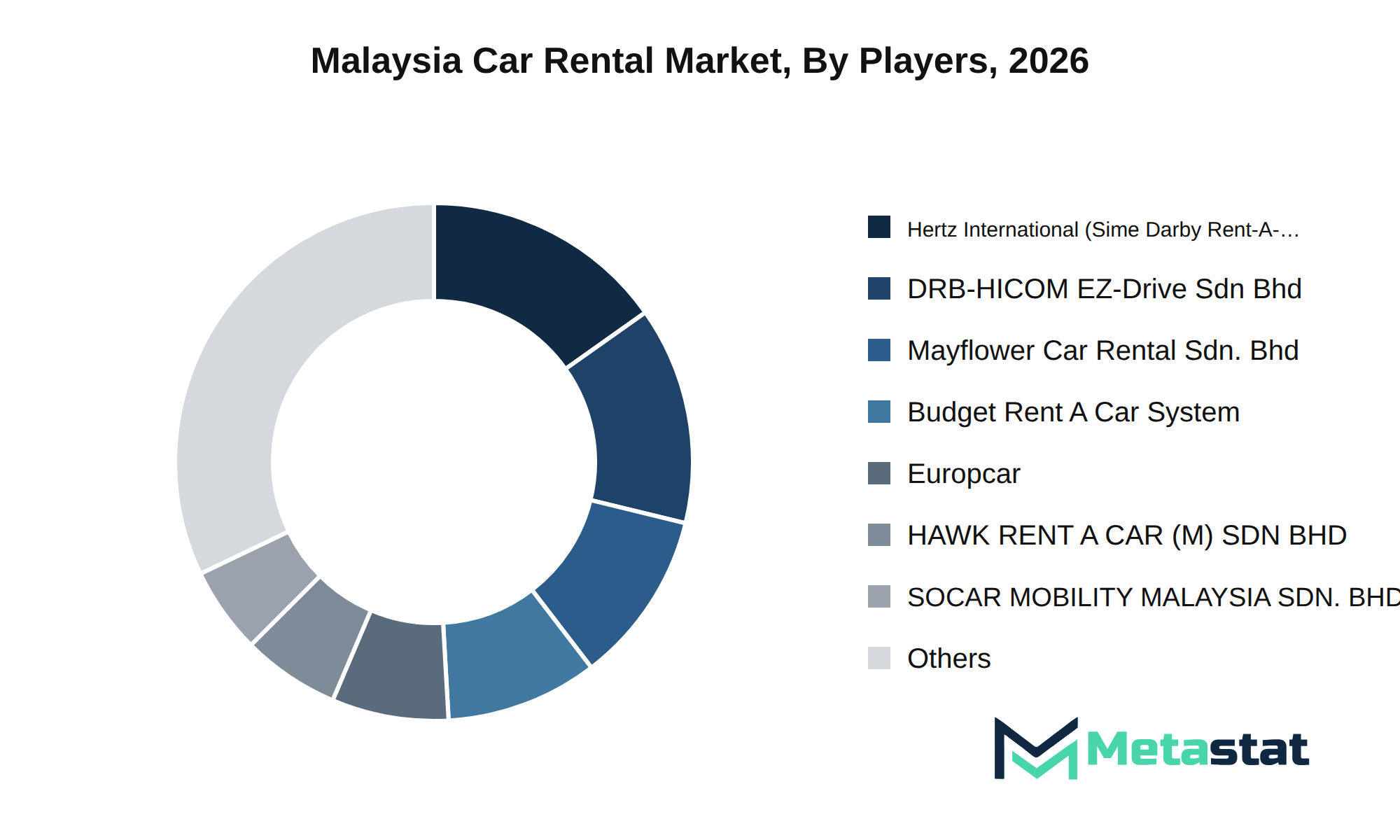
Key players in the market include DRB-HICOM EZ-Drive Sdn Bhd, Hertz International (Sime Darby Rent-A-Car Sdn Bhd), and Mayflower Car Rental Sdn. Bhd., which actively compete to enhance their service offerings and expand their market reach. Advancements in technology and customer service strategies further support market growth, ensuring a competitive environment that attracts consumers.
The Malaysia Car Rental market experiences significant dynamics influenced by various factors. Regulatory compliance and standards play a crucial role in shaping operational practices. Adherence to local regulations ensures the legal operation of rental services, enhancing consumer trust and satisfaction. Geopolitical risks introduce uncertainties, impacting market stability and operational costs, which necessitate adaptive strategic planning by market players.
Disruption from technological advancements drives innovation within the sector. Next-generation innovations, particularly in digital booking platforms and vehicle management systems, enhance customer experiences and streamline operations. Sustainable transformation remains a priority, with decarbonization initiatives gaining traction driven by rental companies seeking environmentally friendly options to meet consumer demand for sustainability.
The supply chain landscape reflects a complex web of logistics architecture and sourcing dynamics. Market fragmentation presents opportunities for niche players to thrive, while larger companies pursue mergers and acquisitions to consolidate resources and expand market reach. The value chain is evolving, with procurement strategies adapting to ensure efficiency and cost-effectiveness, influencing the overall customer journey.
Capital allocation reflects a strategic focus on infrastructure investments, enabling companies to enhance service delivery. Both capital expenditures and operational expenditures are monitored closely to maintain fiscal health amid macroeconomic headwinds. Inflationary pressures and currency volatility pose challenges, requiring agile financial strategies to safeguard profitability.
The future strategic outlook for the Malaysia Car Rental market emphasizes the importance of corporate imperatives that prioritize customer satisfaction, sustainability, and technological advancement. High-value recommendations center on investing in digital transformation and sustainable practices to capture evolving consumer preferences and enhance competitive positioning within the market.
Market Dynamics
Increased urbanization drives rental demand
The ongoing trend of urbanization significantly influences the Malaysia Car Rental market. Rapid population growth in urban areas generates heightened demand for flexible transportation options. Individuals in metropolitan regions increasingly prefer car rentals over vehicle ownership owing to factors including convenience and cost-effectiveness. This shift reflects changing consumer preferences driven by lifestyle changes, economic considerations, and the availability of various rental options.
The market benefits from the rising number of tourists, which further boosts demand for short-term rentals. Urban centers, popular among domestic and international travelers, serve because key markets for rental providers. Enhanced accessibility and improved infrastructure in these regions facilitate easy access to rental services, leading to increased transactions and higher revenue potential for operators.
Partnerships between rental companies and digital platforms streamline the booking process, enhancing customer experience. The integration of technology into operations enables firms to optimize their service offerings, leading to increased competitiveness. Consequently, the Malaysia Car Rental market is expected to continue growth driven by urbanization trends and evolving consumer behaviors.
Capital investment environments support rental market growth
Capital investment environments exhibit a crucial role in the expansion of the Malaysia Car Rental market. The relationship of GDP growth, favorable interest rates, and venture funding enhances the financial landscape for both rental companies and consumers. An uptick in GDP boosts consumer confidence and spending power, driving demand for rental vehicles, particularly in urban centers. Investment in infrastructure and public-private partnerships improves the development of transport networks, enhancing accessibility and convenience for rental services, which supports long-term market growth.
Investment in technological integration presents additional growth opportunities within the market. Rental companies increasingly adopt automation and digital tools to streamline operations, reduce costs, and enhance customer experiences. These advancements lead to improved efficiency in vehicle management, booking systems, and customer interactions. A focus on technological transformation optimizes operations and positions rental companies to respond rapidly to shifting consumer preferences, ultimately strengthening competitive advantages and expanding market reach.
The growing trend towards sustainability influences capital investments in the car rental sector. Companies prioritize eco-friendly vehicle options and sustainable practices to align with consumer expectations and environmental considerations. This proactive approach enhances brand reputation and opens avenues for collaboration with environmentally conscious consumers and businesses. The Malaysia Car Rental market is projected to expand, driven by these capital investment environments and the integration of innovative technologies.
Regulatory compliance and economic pressures
The Malaysia Car Rental market faces considerable challenges due to regulatory compliance and economic pressures that hinder growth. Regulatory tightening creates a complex environment, requiring companies to navigate a maze of legal mandates, which increases operational costs and complicates service delivery. Compliance hurdles lead to higher administrative burdens for firms, affecting their ability to compete effectively in the market.
Macroeconomic headwinds, including inflationary pressures, impact the overall cost structure within the market. Rising costs associated with fuel, vehicle maintenance, and insurance increase financial strain on rental companies. Such economic conditions reduce profit margins and limit service offerings, constraining the market's growth potential.
Supply chain disruptions further exacerbate these issues, creating delays in vehicle availability and increasing rental rates. Geopolitical instability adds uncertainty to operations, affecting cross-border rentals and international tourism, which represent significant revenue streams for the market. Consequently, these factors contribute to constraints on market expansion, highlighting the need for strategic adaptations within the industry.
High capital investment requirements represent an additional restraint, particularly for new entrants attempting to establish a foothold. The necessity for substantial investments in vehicle acquisition and maintenance facilities deters potential market players, thereby limiting competition. This capital stagnation, combined with escalating operating costs, creates barriers that inhibit the overall dynamism of the Malaysia Car Rental market.
Technological obsolescence poses a risk due to the rapid pace of innovation in vehicle technology demanding continuous upgrades to fleet offerings. Substitution risks arise from alternative mobility solutions, including ride-sharing services, which divert potential customers away from traditional car rental models. Such factors contribute to market fragmentation, complicating operational strategies for existing rental companies and impacting their long-term viability.
Infrastructure gaps, including inadequate transportation networks, further hinder market accessibility, particularly in rural areas. These connectivity deficits limit customer reach and reduce rental opportunities in regions where demand is significant. Deployment bottlenecks, stemming from insufficient logistical support, slow the expansion of rental services into emerging markets.
Skilled labor deficiencies present a challenge for companies seeking to deliver quality service. The inability to attract and retain talent leads to workforce gaps that affect customer experience and operational efficiency. Rising workforce overhead associated with labor costs adds another layer of complexity for firms operating in the market.
Data security vulnerabilities and privacy concerns regarding customer information represent additional obstacles. The prevalence of cyber threats necessitates investments in robust security systems, which further strain financial resources for rental companies. Consequently, the cumulative effect of these restraints presents significant challenges to growth and competitiveness within the Malaysia Car Rental market.
Geopolitical tensions influence market stability
The Malaysia Car Rental market encounters challenges stemming from geopolitical fragmentation, which disrupts supply chains and compromises trade relationships. Heightened tensions between nations result in tariff friction, impacting the cost structures of rental companies. Increased tariffs on imported vehicles and components lead to higher operational expenses, which businesses struggle to absorb without raising rental prices.
Technological disruptions introduce added complexity in the market. The rapid pace of innovation necessitates significant investments in research and development, while interoperability friction between new technologies and existing systems complicates integration efforts. These challenges stall the adoption of advanced rental systems, impeding overall market growth.
Logistics disruptions and supply chain instability further exacerbate the situation, creating delays in vehicle availability and increasing downtime for rental agencies. This environment creates pricing compression, placing pressure on profit margins and complicating talent retention efforts for skilled workers. Workforce skill gaps become more pronounced in this competitive landscape, hindering companies from effectively implementing new technologies and practices.
Environmental lifecycle footprints and sustainability demands challenge the Malaysia Car Rental market. Evolving legal liabilities and the need for compliance with tightening regional regulatory standards place additional burdens on rental companies. Organizations invest in retrofitting existing fleets and enhancing sustainability practices, diverting resources from core business strategies.
While the market evolves, it navigates these multifaceted challenges while striving to meet changing downstream demands. The combination of market saturation and substitution vector pressures compounds the need for differentiation, compelling rental agencies to innovate and adapt to maintain a competitive edge.
Emerging Demands And Digital Transformation
The Malaysia Car Rental market experiences a distinct opportunity for growth driven by emerging regional demands and digital transformation. Increasing tourist arrivals and the rise in local excursions enhance the need for rental vehicles, creating favorable conditions for market expansion. Enhanced digital platforms simplify the booking process for consumers, ensuring a straightforward experience that attracts a wider customer base.
Infrastructure modernization contributes significantly to the market's trajectory. New transportation projects, including road improvements and upgraded airports, facilitate easier access to rental services, thereby stimulating demand. Geographic expansion into underserved regions allows rental companies to tap into new customer segments, increasing overall market share.
The integration of next-generation innovations, including electric vehicles and smart technology, positions players to cater to environmentally conscious consumers. Sustainability imperatives prompt rental operators to adopt greener technologies, aligning with global trends towards eco-friendly practices. This shift boosts brand image and attracts a demographic increasingly concerned with corporate social responsibility.
Strategic consolidation through partnerships and collaborations strengthens competitiveness within the market. By joining forces, companies enhance service offerings and operational efficiencies, leading to better customer satisfaction and retention. The focus on product integration and niche application growth expands the range of services available, accommodating various customer preferences.
Value-chain optimization and process automation enhance operational yield for rental companies. Streamlined operations reduce costs and improve service delivery, positioning the market for sustained growth. Digital procurement shifts facilitate adaptive business models that align with evolving consumer behaviors, supporting the market’s overall dynamism and resilience.
Market Segmentation Analysis
The Malaysia Car Rental market is segmented based on Rental Duration, Vehicle Type, Booking Type, and Customer Type.
By Rental Duration, the market is further segmented into:
Short-Term (1-7 Days)
Medium-Term (8-30 Days)
Long-Term / Leasing (31+ Days)
Short-Term (1-7 Days)
Valued at USD 415.2 million in 2026, the Short-Term (1-7 Days) segment is projected to reach USD 722.8 million by 2033, with a CAGR of 8.2% during the forecast period. Increasing demand for short-term rentals stems from various factors, including growth in tourism, business travel, and rising preference for flexible transportation options. Several customer segments, particularly tourists and business professionals, drive this demand, seeking convenience and cost-efficiency in their travel plans.
Technological advancements, including mobile applications and online booking platforms, enhance customer experience and simplify the rental process. The shift towards digital solutions allows providers to respond to consumer preferences more effectively, improving customer loyalty and repeat business. This evolution in the market aligns with broader trends in consumer behavior, where convenience and accessibility take precedence.
Pricing volatility remains a consideration for operators within this segment, influenced by factors including fuel costs and competition dynamics. The market's resilience relies on operators' ability to manage operating expenses while maintaining competitive pricing, thus ensuring profitability. Strategic investments in marketing and fleet diversification position companies favorably in a competitive environment, enabling them to capture a larger share of the Malaysia Car Rental market.
Regulatory compliance standards play a significant role in shaping the operational framework for rental companies. Adherence to safety regulations and environmental standards ensures compliance and enhances brand reputation among increasingly environmentally conscious consumers. The focus on sustainable practices within the short-term rental segment leads to improved market positioning and customer trust.
Medium-Term (8-30 Days)
Growth in the Medium-Term (8-30 Days) segment of the Malaysia Car Rental market is driven by increasing demand for flexible transportation solutions among both business and leisure travelers. Corporate clients require vehicle rentals for extended periods, facilitating business trips and corporate events. With international travel resuming, the segment attracts tourists who prioritize convenience and reliability in transportation services, contributing to revenue growth.
Technological advancements, including improved online booking platforms and mobile applications, enhance customer experience and streamline rental processes. Consumers increasingly embrace digital solutions for reservations, leading to higher efficiency and satisfaction. This technological maturation supports the segment's expansion, making it more accessible to customers prioritizing straightforward interactions.
Regulatory compliance and evolving certifications in the automotive sector influence operational standards within the segment. Companies that adapt to these regulations enhance their reputations and broaden their market appeal. Compliance drives investment in modern vehicle fleets, aligning with consumer preferences for fuel-efficient and environmentally friendly options.
The Medium-Term (8-30 Days) segment is estimated to reach USD 106.5 million by 2033, at a CAGR of 8.5% during the forecast period. Pricing volatility in the automotive market poses challenges, impacting rental rates and profit margins. Strategic pricing models incorporating dynamic pricing strategies mitigate these pressures and enhance profitability.
The Medium-Term segment demonstrates robust potential within the Malaysia Car Rental market, supported by shifting consumer behaviors, technological enhancements, and regulatory adaptations. This segment's growth trajectory reflects a response to evolving market dynamics and an increasing reliance on rental services for both personal and professional use.
Long-Term / Leasing (31+ Days)
Demand for long-term leasing options in the Malaysia Car Rental market reflects a shift in consumer preferences towards flexibility and cost-effectiveness. Companies and individuals increasingly prefer long-term rentals for their financial benefits compared to purchasing vehicles outright. This segment supports enterprises seeking to manage operational efficiency while minimizing capital expenditure on fleet acquisition.
Long-term leasing encourages businesses to allocate resources to core operations, enhancing productivity. The segment is expected to reach USD 238.7 million by 2033, demonstrating a growth trajectory driven by favorable economic conditions and shifting consumer behaviors. Enhanced mobility solutions and evolving customer expectations further drive growth within the market.
Technological advancements play a significant role in shaping the leasing segment, with innovations enabling streamlined booking processes and improved fleet management systems. Customers increasingly demand transparent pricing models and flexible lease terms, influencing suppliers to adapt their offerings. The market anticipates continued growth resulting from these trends becoming integral to rental strategies.
Regulatory compliance regarding emissions and safety standards presents both challenges and opportunities within the leasing landscape. Suppliers who align their fleets with evolving regulations enhance their competitiveness while capturing a larger market share. Overall, the long-term leasing segment is positioned for development, contributing to the overall expansion of the Malaysia Car Rental market.
By Vehicle Type, the market is further segmented into:
Mini & Economy Cars
Compact & Intermediate Cars
Sedans
SUVs
MPVs
Luxury & Premium Cars
Vans & Commercial Vehicles
Mini & Economy Cars
Sub-segment Mini & Economy Cars (By Vehicle Type)
Consumer preferences in the Malaysia Car Rental market increasingly favor Mini and Economy Cars due to their affordability and fuel efficiency. These vehicles cater to budget-conscious travelers and daily commuters seeking cost-effective transportation solutions. The rise in local tourism and domestic travel further increases the demand for this sub-segment, driven by consumers prioritizing economical options.
Adoption of Mini and Economy Cars benefits from advancements in technology that enhance vehicle performance and sustainability. Manufacturers focus on improving fuel efficiency and reducing emissions, aligning with growing environmental awareness among consumers. This trend positions Mini and Economy Cars because a viable choice for environmentally conscious renters.
Regulatory compliance concerning emissions standards influences the development of Mini and Economy Cars, encouraging manufacturers to innovate and offer compliant models. Enhanced safety features and technological upgrades contribute to attracting customers, ensuring that the segment remains competitive within the broader market.
Pricing volatility in the automotive sector affects the operational costs of rental companies, influencing rental rates for Mini and Economy Cars. Competitive pricing strategies are essential for operators aiming to capture market share in this lucrative segment. Effective cost management and strategic pricing enhance the appeal of Mini and Economy Cars in the Malaysia Car Rental market.
Compact & Intermediate Cars
The Compact and Intermediate Cars segment in the Malaysia Car Rental market shows robust demand driven by the increasing preference for fuel-efficient and cost-effective vehicle options. Urban commuters and tourists select this category for its balance of affordability and functionality, making it a popular choice among various consumer groups.
Industry players respond to evolving consumer preferences by enhancing their offerings with next-generation upgrades, which include improved fuel efficiency and advanced safety features. Technological maturation in vehicle design contributes to a more appealing rental experience, directly influencing adoption rates within this segment.
Shifts in consumption patterns, particularly the growing emphasis on sustainability, lead to heightened interest in Compact and Intermediate Cars, which feature lower emissions and reduced environmental impact. Regulatory compliance standards requiring greener vehicle options further fortify demand for these models, pushing rental companies to invest in fleet diversification strategies.
Pricing volatility stemming from fluctuating fuel prices and logistical challenges influences operational costs associated with this segment. Companies strategically analyze cost structures to maintain competitive pricing while ensuring quality service. Overall, the market experiences significant growth potential, driven by strategic opportunity windows and a strong focus on meeting consumer demands for efficient and environmentally friendly transportation solutions.
Sedans
In the Malaysia Car Rental market, the demand for sedans remains a prominent choice among consumers owing to a combination of factors including affordability, versatility, and comfort. These vehicles cater to a wide demographic, encompassing both business travelers and leisure tourists. The growing trend towards urbanization and increased road connectivity enhances the appeal of sedans for intercity travel, particularly in metropolitan areas where ease of maneuverability and fuel efficiency are critical.
Technological advancements significantly contribute to the evolution of sedans in the market. Upgrades in fuel efficiency and the introduction of hybrid options align with environmental regulations, attracting eco-conscious consumers. This shift towards more sustainable transportation options reinforces the segment's relevance, appealing to government and institutional buyers seeking compliance with eco-friendly policies.
Consumer preferences are shifting towards enhanced features, including advanced safety systems and in-car connectivity. This evolution not only meets customer expectations but strengthens market competitiveness. While demand for sedans continues to grow, strategic opportunities emerge for market players to expand their offerings, enhance customer experience, and capture a larger market share.
In response to evolving consumer preferences, companies within the Malaysia Car Rental market invest in their fleets to include a wider range of sedans. This strategic move addresses various customer needs, from corporate rentals to family outings, ensuring that companies remain agile in a competitive environment.
SUVs
Consumer interest in SUVs within the Malaysia Car Rental market reflects a shift towards vehicles that offer both space and versatility. Increasing urbanization and a growing preference for leisure travel significantly contribute to this segment's expansion. Families and groups favor SUVs for their capacity and comfort, making them an attractive choice for longer trips and excursions.
Technological advancements play a vital role in driving consumer adoption of SUVs. Improvements in fuel efficiency and the introduction of hybrid and electric models attract environmentally conscious renters. This trend aligns with broader market demands for sustainability and lower emissions, positioning SUVs because a favorable option for eco-aware consumers.
The evolving preferences of corporate clients further increase demand for SUVs. Businesses prioritize vehicle types that accommodate multiple passengers or transport equipment, leading to increased bookings in this sector.
Market dynamics are influenced by competitive pricing and promotional strategies implemented by rental companies. This facilitates access to a wider audience, encouraging both local and foreign tourists to explore options within the SUVs segment.
In response to growing competition, rental firms continue to invest in their fleets, ensuring a diverse selection of modern SUVs equipped with the latest technology and safety features. This development enhances the overall customer experience and contributes positively to market growth.
MPVs
Within the Malaysia Car Rental market, the MPVs segment represents a noteworthy category driven by a combination of factors. Growing family travel and the preference for spacious vehicles significantly influence demand dynamics. Families and groups of travelers increasingly prioritize comfort and safety, propelling interest in MPVs.
Segment expansion connects with the rise in domestic tourism. Enhanced accessibility to various destinations and the increasing availability of recreational activities contribute to heightened demand for MPVs. Companies operating within this segment continuously evolve their offerings to meet customer expectations, integrating advanced technologies and safety features to attract consumers.
Next-gen upgrades play a critical role in captivating the market. The introduction of hybrid and electric variants of MPVs aligns with global sustainability trends, creating opportunities for rental companies to appeal to environmentally conscious customers. Such technological maturation strengthens market positioning, ultimately enhancing customer loyalty.
End-use dynamics reflect a shift toward renting MPVs for varied applications, including family vacations, corporate events, and leisure trips. Adaptable to multiple customer types, this segment addresses diverse needs within the market. The regulatory framework surrounding vehicle emissions and safety standards influences operational practices, prompting rental companies to adapt and comply with emerging regulations.
Pricing volatility and margin pressures persist owing to significant factors that affect profitability. Fluctuations in fuel prices and changes in consumer behavior influence rental rates, requiring careful management of operational costs. The overall landscape positions the MPVs segment because a resilient component within the Malaysia Car Rental market, creating diverse opportunities for growth while navigating challenges associated with market dynamics.
Luxury and premium cars in the Malaysia Car Rental market attract high-end customers seeking exclusive experiences and comfort. This segment benefits from rising disposable incomes and a growing affluent population, particularly in urban areas. Increasing tourism, particularly from high-net-worth individuals, contributes to the demand for luxury vehicles, driven by a desire for premium services and enhanced travel experiences.
Technological advancements play a crucial role in shaping customer preferences. Enhanced in-car technology, including connectivity features and advanced safety systems, appeals to luxury vehicle renters. Consumers increasingly prioritize convenience and features that enhance their driving experience, driving the adoption of luxury options in the market.
Regulatory compliance and the need for certifications ensure that providers meet safety and environmental standards, influencing operational practices within this segment. Luxury car rental companies focus on maintaining high service quality, which includes regular maintenance and upgrades to meet evolving customer expectations.
Market participants face pressures related to pricing volatility, particularly due to fluctuating demand and operational costs. The presence of multiple players in the luxury rental space creates competition, compelling firms to innovate continually and offer attractive pricing structures without compromising service quality. This dynamic environment encourages strategic opportunity windows, prompting businesses to adapt quickly to market trends.
Vans & Commercial Vehicles
Demand for Vans and Commercial Vehicles within the Malaysia Car Rental market stems from various sectors, including logistics, construction, and tourism. These vehicles serve essential functions in transporting goods and people, which drives demand from businesses seeking efficient solutions for their operational needs. The expansion of e-commerce contributes significantly to this demand, driven by businesses requiring rental vehicles to facilitate deliveries and transport products to customers.
Technological advancements play a crucial role in enhancing the value proposition of vans and commercial vehicles. Developments in fuel efficiency and emissions reductions align with growing environmental consciousness among consumers and businesses. This shift towards greener technologies attracts customers prioritizing sustainability in their operations. In addition, vehicle manufacturers increasingly integrate advanced telematics and safety features, appealing to businesses focused on operational efficiency and compliance with regulatory standards.
Market players face particular challenges related to supply chain resilience, which impacts the availability of vans and commercial vehicles. Disruptive alternatives, including ride-sharing services, present competition by offering flexible transport solutions. To counter these pressures, rental companies invest in marketing and service diversification, emphasizing the unique advantages of renting commercial vehicles over ownership. This strategic shift supports customer retention and attracts new clientele seeking reliable transportation solutions.
Overall, the dynamics of the Vans and Commercial Vehicles segment in the Malaysia Car Rental market reflect evolving customer preferences, technological maturation, and competitive pressures. These factors collectively shape the market and outline future opportunities for growth and innovation in the segment.
By Booking Type, the market is further segmented into:
Online Booking
Offline Booking
Online Booking
Online booking has gained traction within the Malaysia Car Rental market, driven by increased digitalization and consumer preference for convenience. This trend aligns with broader shifts in how consumers engage with services, favoring platforms that provide easy access to rental options. The rise of mobile applications and improved internet connectivity have further accelerated this adoption, allowing users to browse, compare, and reserve vehicles.
Segment expansion for online booking stems from the increasing number of tech-savvy individuals seeking efficient travel solutions. Corporate clients have begun prioritizing online booking to streamline their travel management processes, enhancing efficiency. These dynamics contribute to greater market penetration, leading to heightened competition among rental companies striving to optimize their online platforms and improve user experiences.
Technological maturation shapes consumer expectations within the market. The integration of advanced features including real-time availability, instant confirmations, and user-friendly interfaces enhances the appeal of online booking. Rental companies continuously innovate, incorporating next-gen upgrades to their platforms, thereby improving service delivery and customer satisfaction.
Cost structures associated with online booking typically favor efficiency, resulting in lower overhead for rental companies. The reduction in reliance on physical locations allows firms to allocate resources more effectively. Pricing volatility remains a concern, driven by fluctuations in demand during peak travel seasons that affect pricing strategies and profit margins.
While the market evolves, strategic opportunity windows emerge for companies willing to invest in enhancing their online platforms. The focus on providing a superior user experience alongside competitive pricing will determine success in capturing market share. Continued investment in technology and user engagement strategies stands to yield substantial benefits, positioning firms favorably against disruptive alternatives within the Malaysia Car Rental market.
Offline Booking
Offline booking remains a fundamental aspect of the Malaysia Car Rental market, catering to customers who prefer face-to-face interactions or lack access to digital platforms. Traditional offline channels facilitate rental agreements through physical locations, allowing customers to interact directly with rental agents, inspect vehicles, and finalize transactions without online intermediaries. This preference aligns with segments of the population that value personal service and reassurance when entering into rental agreements.
Consumer behavior demonstrates stable demand for offline booking, particularly among segments that prioritize security and trust, including corporate clients and government institutions. These customer types favor established relationships with rental agencies, which offline booking enables. Demand drivers in this segment include an increasing number of business travelers visiting Malaysia and local customers requiring vehicles for events or temporary personal use.
Technological advancements in the rental industry continue to evolve, yet offline booking remains significant due to the unique needs of certain customer segments. The interaction between technology and offline services enhances customer experience by integrating booking systems, payment processing, and vehicle availability into an operation that caters to diverse consumer preferences. This strategic integration creates a reliable offline environment, ensuring that customer needs are met promptly.
Regulatory compliance influences offline booking dynamics. Rental agencies adhere to local regulations concerning vehicle safety and consumer rights, which influences operational practices. Rising standards for vehicle maintenance and customer service create upward pressure on costs, impacting pricing strategies and profit margins within the market.
In the context of the Malaysia Car Rental market, offline booking offers strategic opportunities for rental agencies to strengthen customer loyalty and build brand trust. While market competition intensifies, agencies focusing on personalized customer experiences and efficient service delivery through offline channels are well-positioned to capture and retain clientele. The ability to adapt to shifting consumer preferences while maintaining high service standards proves crucial for sustained growth in this critical segment.
By Customer Type, the market is further segmented into:
Individual - Tourism & Leisure
Individual - Local / Intercity Travel
Corporate / Business
Corporate / Fleet
Government & Institutional
Competitive Landscape and Strategic Insights
Forecast and Future Outlook
Car Rental Market Key Segments
By Rental Duration
Short-Term (1-7 Days)
Medium-Term (8-30 Days)
Long-Term / Leasing (31+ Days)
By Vehicle Type
Mini & Economy Cars
Compact & Intermediate Cars
Sedans
SUVs
MPVs
Luxury & Premium Cars
Vans & Commercial Vehicles
By Booking Type
Online Booking
Offline Booking
By Customer Type
Individual - Tourism & Leisure
Individual - Local / Intercity Travel
Corporate / Business
Corporate / Fleet
Government & Institutional
Key Car Rental Industry Players
DRB-HICOM EZ-Drive Sdn Bhd
Hertz International (Sime Darby Rent-A-Car Sdn Bhd)
What is the Malaysia Car Rental market growth rate?
Which type segment leads the Malaysia Car Rental market?
What are the key drivers for the Malaysia Car Rental market?
What factors are restraining the Malaysia Car Rental market growth?
What factors are favoring product adoption in this industry?
What is the forecasted size of the Malaysia Car Rental market by 2033?
Who are the key players in the Malaysia Car Rental Market?
Table of Content
Market Introduction
Executive Summary
Market Definition
Market Scope
Research Methodology
Primary Research
Secondary Research
Assumptions and Exclusions
Secondary Data Sources
Car Rental Market Dynamics and Overview
Report Segmentation and Scope
Key Market Trends
Drivers
Restraints
Opportunity
Porter's Five Forces Analysis
Market Share Analysis
Rental Duration Overview
Introduction
Market Size and Forecast
Short-Term (1-7 Days)
Market Size and Forecast
Medium-Term (8-30 Days)
Market Size and Forecast
Long-Term / Leasing (31+ Days)
Market Size and Forecast
Market Size and Forecast
Market Size and Forecast
Market Size and Forecast
Market Size and Forecast
Market Size and Forecast
Market Size and Forecast
Market Size and Forecast
Vehicle Type Overview
Introduction
Market Size and Forecast
Mini & Economy Cars
Market Size and Forecast
Compact & Intermediate Cars
Market Size and Forecast
Sedans
Market Size and Forecast
SUVs
Market Size and Forecast
MPVs
Market Size and Forecast
Luxury & Premium Cars
Market Size and Forecast
Vans & Commercial Vehicles
Market Size and Forecast
Market Size and Forecast
Market Size and Forecast
Market Size and Forecast
Booking Type Overview
Introduction
Market Size and Forecast
Online Booking
Market Size and Forecast
Offline Booking
Market Size and Forecast
Market Size and Forecast
Market Size and Forecast
Market Size and Forecast
Market Size and Forecast
Market Size and Forecast
Market Size and Forecast
Market Size and Forecast
Market Size and Forecast
Customer Type Overview
Introduction
Market Size and Forecast
Individual - Tourism & Leisure
Market Size and Forecast
Individual - Local / Intercity Travel
Market Size and Forecast
Corporate / Business
Market Size and Forecast
Corporate / Fleet
Market Size and Forecast
Government & Institutional
Market Size and Forecast
Market Size and Forecast
Market Size and Forecast
Market Size and Forecast
Market Size and Forecast
Market Size and Forecast
Company Profile
DRB-HICOM EZ-Drive Sdn Bhd
Company Basic Information, Operating Footprint, Service Area, and Key Competitors
DRB-HICOM EZ-Drive Sdn Bhd Product Category, Application, and Specification
DRB-HICOM EZ-Drive Sdn Bhd Financial Performance
Main Business/Business Overview
Hertz International (Sime Darby Rent-A-Car Sdn Bhd)
Europcar
Sixt
HAWK RENT A CAR (M) SDN BHD
Kasina
Future Mobility Solutions Sdn Bhd
WAHDAH
Suria Car Rental
CityLimo Leasing (M) Sdn Bhd
Green Motion International
New Emerald Travel & Tours Sdn Bhd
Kinabalu Journey
KKIA Car Rental
Individual - Tourism & Leisure
Demand for car rental services from individual tourists and leisure travelers in Malaysia experiences significant growth, driven by increasing travel activities and heightened interest in exploring local attractions. Rising disposable income among consumers enhances their ability to engage in leisure travel, prompting a shift towards rental services for convenience and flexibility during trips. Marketing strategies targeting this customer segment emphasize user-friendly booking platforms and tailored rental packages that cater to the unique preferences of leisure travelers.
Technological advancements play a crucial role in the adoption of car rental services among individuals, with mobile applications and online platforms streamlining the booking process. The availability of various vehicle types within the market enhances customer options, catering to different travel needs and preferences. This flexibility in vehicle selection encourages a wider range of customers, from solo travelers to families, to consider rental services for their excursions.
Seasonal variations in travel patterns significantly impact the demand dynamics within the Malaysia Car Rental market. Peak tourist seasons generate increased rental activity, with customers seeking short-term rentals for vacations or business trips. To capitalize on this demand, rental companies implement promotional strategies and loyalty programs aimed at enhancing customer satisfaction and retention.
Regulatory compliance continues to shape service offerings, with rental companies adhering to safety standards and customer protection regulations. These measures build trust and confidence among customers, influencing their decisions to choose rental options during their travels. The integration of eco-friendly vehicles into rental fleets reflects an emerging trend in sustainable tourism, appealing to environmentally conscious travelers seeking greener alternatives.
Market players prioritize enhancing customer experiences through personalized services and additional amenities including GPS navigation and insurance coverage. This focus on value-added services strengthens customer loyalty and encourages repeat business within the leisure travel segment. Overall, the combination of evolving consumer preferences, technological improvements, and regulatory frameworks creates a dynamic environment that drives growth in the individual tourism and leisure segment of the Malaysia Car Rental market.
Individual - Local / Intercity Travel
Increased mobility needs among individuals traveling locally or between cities drive significant demand in the Malaysia Car Rental market. Preferences for convenience and flexibility influence consumer choices, leading to heightened interest in rental options tailored for short trips. Enhanced urbanization and improved transportation infrastructure contribute to the segment's growth, facilitating easier access to rental services for individuals. Evolving work patterns, including remote work and flexible schedules, prompt more people to seek rental vehicles for intercity travel without the commitment of ownership.
Technological advancements play a vital role in shaping consumer experiences. The proliferation of mobile applications and online booking platforms streamlines the rental process, catering to the preferences of tech-savvy customers. The availability of diverse vehicle options enhances the attractiveness of rental services, allowing customers to select vehicles that suit their specific travel requirements. Competitive pricing strategies among rental companies further encourage individuals to consider rentals for local and intercity travel.
Regulatory developments impact operational dynamics within the segment. Compliance with local transportation regulations ensures that rental services align with safety and environmental standards, enhancing consumer trust. Sustainability has become a priority, leading rental companies to adopt eco-friendly vehicle options that appeal to environmentally conscious customers. This aligns with broader market trends promoting sustainable travel solutions, boosting the segment's appeal among individual customers.
Overall, the Individual - Local / Intercity Travel segment within the Malaysia Car Rental market experiences growth driven by shifting consumer preferences, technological innovations, and evolving regulatory frameworks. These factors collectively enhance the value proposition for individuals seeking convenient and flexible transportation solutions.
Corporate / Business
Corporate clients increasingly rely on car rental services to support business operations, travel needs, and employee transportation. This segment benefits from rising corporate activity in Malaysia, where companies seek flexible transportation solutions to enhance operational efficiency. Demand originates from sectors including finance, technology, and consulting, where frequent travel requires access to reliable vehicles. The convenience and cost-effectiveness of rental services appeal to these organizations, allowing them to allocate resources effectively without the burdens of vehicle ownership.
Technological advancements in booking systems and vehicle management enhance service delivery, driving adoption among corporate clients. Online booking platforms facilitate reservations and vehicle tracking, improving overall user experience. Corporate customers increasingly favor rental solutions that offer flexibility in vehicle type, with options ranging from compact cars to SUVs, catering to diverse travel requirements.
Regulatory compliance further influences corporate rental decisions, particularly regarding sustainability and emissions standards. Companies prioritize partnerships with rental providers committed to environmentally friendly practices, aligning with corporate social responsibility objectives. These dynamics create strategic opportunities for rental companies to differentiate their offerings through sustainable vehicle options and enhanced service features.
Challenges within this segment include pricing volatility and margin pressures due to fluctuating demand and operational costs. Rental companies navigate these financial landscapes while providing competitive pricing structures to attract corporate clients. Strategic capital investments and cost control measures become essential for maintaining profitability and service quality.
The evolving nature of the Malaysia Car Rental market continues to present opportunities for growth. Corporate clients' increasing reliance on flexible rental solutions signals an ongoing trend towards greater adoption within this segment, positioning it because a vital contributor to the overall market's expansion.
Corporate / Fleet
Corporate clients represent a significant portion of the Malaysia Car Rental market through their consistent demand for mobility solutions. Various factors contribute to the growth of this segment, including increasing business activities in sectors including tourism, construction, and logistics. The necessity for flexible transportation options drives organizations to seek rental services for both short-term projects and long-term fleet requirements.
Investment in technology enhances service offerings, allowing companies to streamline operations and improve customer experiences. Many rental agencies are adopting next-generation booking platforms, enabling corporate clients to access vehicles efficiently. This technological maturation encourages adoption among businesses seeking to optimize logistics and reduce operational costs.
Regulatory compliance remains a priority for organizations using car rentals while ensuring adherence to safety and environmental standards. Corporate clients view rental services because a strategic solution to maintain compliance without the burden of ownership. This approach provides flexibility, allowing organizations to adjust their vehicle fleet in response to changing business needs.
While the market evolves, demand for environmental sustainability influences purchasing decisions. Companies increasingly favor rental services that offer eco-friendly vehicle options. This trend aligns with broader industry movements towards greener practices and reflects a growing awareness among corporate entities regarding their environmental impact.
Competitive pressures within the Malaysia Car Rental market encourage service providers to innovate continually. This environment encourages strategic partnerships and collaborations among key industry players, further enhancing service offerings and expanding market reach. By capitalizing on these opportunities, corporate clients benefit from tailored solutions that meet their specific transportation needs.
Government & Institutional
Government and institutional clients exhibit distinct patterns in the Malaysia Car Rental market, driven by specific operational requirements and regulatory compliance. The demand from this segment arises from various governmental activities, including official travel, public service operations, and institutional events. Agencies and organizations often prioritize reliability, cost efficiency, and compliance with governmental standards when selecting rental services.
Technological advancements play a crucial role in enhancing the offerings for government and institutional customers. The integration of next-generation technologies, including fleet management systems and telematics, improves efficiency and enhances service quality. This shift towards technology-driven solutions expands the operational scope of government entities, allowing for better resource allocation and management.
Consumption shifts within the government and institutional segment reflect an increasing focus on sustainability and environmental consciousness. Regulatory frameworks often mandate adherence to eco-friendly practices, driving rental companies to adopt greener vehicles and practices. Compliance with such standards aligns with governmental policies and enhances the attractiveness of services to environmentally conscious institutions.
Cost structures in the government sector exhibit unique characteristics, where budget constraints and procurement regulations influence purchasing decisions. Institutions often seek long-term contracts or partnerships that ensure predictable pricing and availability of services. Consequently, rental companies that demonstrate competitive pricing, robust service offerings, and compliance with procurement policies position themselves favorably in this segment.
Strategic opportunity windows arise from government agencies increasingly seeking to modernize their operations. Partnerships with car rental companies facilitate access to updated vehicle fleets and specialized services tailored to specific governmental needs. This collaboration creates a resilient supply chain, allowing rental companies to adapt to evolving demands within this critical customer segment.
The ongoing evolution of the market emphasizes the importance of understanding the unique dynamics of government and institutional clients. By aligning service offerings with the specific needs of this segment, rental companies enhance their competitive edge and secure a stable revenue stream from government contracts.
Competitive Landscape and Strategic Insights
Strategic consolidation within the Malaysia Car Rental market drives increased competition among established players. Companies engage in various go-to-market strategies to differentiate offerings, targeting diverse customer segments including individual tourists and corporate clients. Pricing architectures evolve owing to firms seeking to enhance value propositions while maintaining competitive rates. Mergers and acquisitions significantly influence market dynamics, reshaping industry structures and allowing companies to leverage broader service portfolios.
Technological maturation presents opportunities for next-gen upgrades, enabling firms to offer enhanced customer experiences through mobile applications and digital platforms. Proprietary technology moats establish competitive advantages, ensuring that players maintain market relevance amid evolving consumer preferences. Customer retention strategies emphasize building brand loyalty and managing switching costs, particularly for corporate clients who require consistent and reliable service.
Market players face challenges related to cost structures and pricing volatility, impacting profit margins and operational efficiency. Regulatory compliance standards influence service delivery, prompting operators to adapt to changing legal frameworks. Strategic opportunity windows emerge because companies invest in capital to enhance fleet offerings, focusing on sustainability and electric vehicle integration to meet environmental mandates.
Supply chain resilience becomes crucial amid global disruptions, affecting raw material sourcing and logistics vulnerabilities. Firms explore substitution risks and disruptive alternatives to maintain competitive positioning. Continuous monitoring of consumption shifts informs strategic growth vectors, enabling players to identify high-growth pockets within the market.
Forecast and Future Outlook
Market size is forecast to rise from USD 547.3 million in 2025 to over USD 1,067.9 million by 2033. The anticipated growth in the Malaysia Car Rental market stems from several primary demand drivers, including an increase in domestic tourism, urbanization trends, and rising disposable incomes. Enhanced mobility solutions are crucial for individuals and businesses seeking efficient transportation options, further contributing to market expansion. Segment expansion catalysts include technological advancements in vehicle management systems and rental platforms, which streamline the booking process and improve customer experiences.
Adoption of rental services is influenced by evolving consumer preferences for flexibility and convenience. The integration of next-generation technologies, including AI-driven customer service applications and electric vehicles, drives the market forward. Product evolution tailored to contemporary consumer needs, including eco-friendly fleets and tailored pricing models, supports sustained growth in the customer type segment. Downstream applications for rental services extend to business travel, special events, and leisure activities, demonstrating the diverse utility of rental vehicles.
Consumption shifts towards short-term rentals reflect changes in travel habits, with consumers increasingly favoring flexible arrangements over long-term commitments. Regulatory compliance standards regarding vehicle emissions and safety play a significant role in shaping operational practices within the market. Cost structures influenced by fuel prices and vehicle maintenance expenditures present ongoing challenges for operators, with pricing volatility impacting profitability.
Strategic opportunity windows arise from the need for companies to adapt to consumer demands while navigating regulatory landscapes. Investments in supply chain resilience enhance firms' ability to respond to market fluctuations, ensuring continuous service availability. Overall, the Malaysia Car Rental market positions itself for significant growth, driven by consumer trends, technological advancements, and strategic investments in operational efficiency.
Car Rental Market Key Segments
Customer types within the Malaysia Car Rental market reflect diverse preferences and requirements, shaped by varying use cases. Individual customers, primarily those engaged in tourism and leisure activities, demonstrate a strong inclination towards short-term rental options, while corporate clients seek longer rental durations for business trips. The ongoing evolution of consumer behavior drives rental companies to enhance their offerings, adopting advanced booking systems and tailored service packages to attract these varied customer segments. Growing demand for personalized travel experiences compels companies to invest in fleet diversification to meet the distinct needs of individual travelers and businesses alike.
Corporate clients emphasize efficiency and cost-effectiveness when selecting rental services, leading to heightened competition among suppliers targeting this segment. The rise of online platforms facilitates access to rental services, enhancing customer engagement and satisfaction. This shift toward digitalization contributes to a more responsive market, allowing companies to adapt quickly to changing consumer preferences. Overall, these dynamics within the customer types segment shape growth strategies and operational practices across the Malaysia Car Rental market.
By Rental Duration
Short-term rental options in the Malaysia Car Rental market attract a diverse customer base seeking flexibility and convenience. This segment primarily caters to tourists and individuals requiring temporary transportation solutions, which significantly increases demand. Various factors drive this demand, including the growing trend of travel within the region and increasing disposable incomes among consumers. The convenience of vehicle access through short-term rentals appeals to individuals who find ownership impractical or costly, reinforcing demand for this segment.
Medium-term rentals serve those requiring vehicles for travel lasting from eight to thirty days. This duration suits both personal and business travelers, allowing for an extended stay without the commitment of full ownership. Enhanced travel itineraries, driven by business needs or personal leisure, support the growth of this segment, reflecting broader trends within the Malaysia Car Rental market.
Long-term leasing options attract corporate clients and government institutions seeking cost-effective solutions for fleet management. This segment emphasizes consistent demand resulting from organizations prioritizing efficiency and budget management through leasing agreements. Accessing a diverse fleet without the burden of maintenance or depreciation enhances its appeal, contributing to significant growth in the Malaysia Car Rental market.
Interest in short-term rental services within the Malaysia Car Rental market reflects the increasing demand for flexibility and convenience among travelers. Factors including rising tourism and urban mobility requirements drive this trend, appealing to both local residents and international visitors. The quick turnaround of rental transactions enhances customer satisfaction, fueling further adoption. This segment benefits from technological advancements, including mobile applications and online booking platforms, streamlining the rental process and providing consumers with real-time information. Companies that offer competitive pricing and diverse vehicle options strengthen their appeal to this customer base. Overall, the shift towards short-term rentals reinforces its position, reflecting a key segment in the Malaysia Car Rental market.
Strong demand for medium-term rental options in the Malaysia Car Rental market arises from both corporate and individual customers seeking flexibility and convenience. Businesses find value in this segment for employee travel, meetings, and events, enabling them to manage costs and enhance operational efficiency. Individuals planning extended trips benefit from the affordability and accessibility of medium-term rentals, avoiding the high costs associated with longer leases or ownership.
Technological advancements contribute to the growth of the medium-term segment. Enhanced online booking platforms and mobile applications facilitate easier access to rental services, streamlining the user experience. The trend toward digital solutions is significant in attracting consumers seeking hassle-free transactions.
Regulatory compliance regarding vehicle maintenance and emissions standards influences the market. Rental companies prioritize adherence to environmental policies, ensuring their fleets align with governmental expectations. Compliance enhances brand reputation and builds customer trust.
Cost structures within the medium-term segment continue to evolve, reflecting fluctuating fuel prices and maintenance expenses. Competitive pricing strategies become essential for rental providers aiming to attract budget-conscious consumers. Economic conditions further impact consumer spending, shaping demand patterns in the market.
Strategic opportunity windows exist for companies that adapt to emerging consumer preferences. The shift toward sustainable practices, including electric vehicle rentals, represents a forward-thinking approach appealing to environmentally conscious customers. Investment in diversified fleet options captures a broader audience, reinforcing market presence.
Demand for long-term rental options in the Malaysia Car Rental market reflects a shift towards flexible transportation solutions among various customer segments. This trend arises from changing consumer preferences, particularly among corporate clients and government institutions seeking reliable mobility without the long-term commitment of vehicle ownership. The segment's expansion results from increasing urbanization and the need for businesses to optimize operational costs while ensuring mobility for employees.
Technological advancements, including improvements in vehicle tracking and management systems, enhance the appeal of long-term leasing options, enabling greater adoption among businesses. Such innovations lead to more efficient fleet management, reducing overhead costs and improving service delivery, which benefits corporate and institutional customers directly. The rise in digital platforms for booking and managing car rentals streamlines the process, facilitating access to long-term rental services.
Regulatory compliance continues to influence the market, with a focus on sustainability and environmentally friendly vehicle options. This aspect encourages rental companies to diversify their fleets, integrating hybrid and electric vehicles into their long-term leasing offerings. Consequently, businesses and institutions increasingly align leasing choices with corporate social responsibility goals, further driving demand.
Market dynamics indicate a promising outlook for long-term leasing, particularly with rising operational costs pushing companies towards more cost-effective transportation solutions. The evolution of customer expectations towards greater value and service quality positions the long-term rental segment favorably for sustained growth in the Malaysia Car Rental market.
By Vehicle Type
Shifts in consumer preferences towards convenience and accessibility influence the vehicle types chosen within the Malaysia Car Rental market. Increased urbanization and rising disposable incomes shape demand for various vehicle categories, including mini and economy cars, compact and intermediate cars, sedans, SUVs, MPVs, luxury and premium cars, and vans and commercial vehicles. The appeal of fuel-efficient and compact models strongly connects with individual tourists and local travelers seeking cost-effective solutions. Corporate clients opt for SUVs and luxury vehicles to enhance their business travel experiences, highlighting the diversity in customer needs.
Technological advancements in vehicle design and features further encourage adoption across different customer types. Innovations including hybrid and electric vehicles gain traction, aligning with the global shift towards sustainability. Regulatory compliance with environmental standards drives rental companies to expand their fleets with eco-friendly options, appealing to environmentally conscious consumers. Price dynamics reflect the varying marginal costs associated with different vehicle types, creating competitive pressures among rental service providers.
Emerging trends, including online booking systems and improved customer service experiences, reshape how consumers engage with the rental market. Enhanced digital platforms facilitate efficient vehicle selection and booking processes, increasing accessibility for both individual and corporate customers. The Malaysia Car Rental market continues to evolve, driven by these emerging technologies and shifting consumer behaviors, creating a competitive environment where adaptability and innovation are essential for success.
Demand for Mini and Economy Cars within the Malaysia Car Rental market reflects several primary drivers, including affordability and increasing urbanization. Economic considerations heavily influence customer choices, with a focus on budget-friendly transportation options leading to higher interest in this segment. The adoption of Mini and Economy Cars appeals to individual tourists and local travelers seeking economical solutions for short-term rentals. Enhanced fuel efficiency and lower rental rates contribute to the segment's attractiveness, driving significant growth within the market.
Technological advancements in vehicle design and features support the expansion of Mini and Economy Cars. Manufacturers focus on incorporating hybrid and electric models, aligning with environmental concerns and regulatory pressures for reduced emissions. Such innovations increase the appeal of these vehicles among environmentally conscious consumers, further enhancing market dynamics.
Shifts in consumption patterns and preferences regarding travel behavior in Malaysia have resulted in increased demand for car rentals. Urban dwellers, facing congested public transport systems, find Mini and Economy Cars a practical alternative for short trips. Market players respond by enhancing their offerings, ensuring the availability of diverse models to cater to evolving customer needs.
Regulatory compliance standards related to vehicle emissions and safety continue to shape the Mini and Economy Cars segment. Stricter regulations compel rental companies to update their fleets, which raises operational costs. However, investment in newer, compliant vehicles presents an opportunity for firms to capture a larger share of the market by appealing to eco-conscious consumers.
Competitive positioning within the Malaysia Car Rental market hinges on how well companies adapt to these dynamics, including technological upgrades and changes in consumer behavior. Strategic investments in marketing and fleet diversification are likely to enhance the capabilities of rental firms, driving growth in the Mini and Economy Cars segment. The overall outlook for this segment appears favorable, influenced by a combination of expanding urban populations, evolving customer preferences, and a commitment to sustainable transportation solutions.
Consumer interest in Compact & Intermediate Cars within the Malaysia Car Rental market reflects a trend towards versatile and fuel-efficient vehicles. This segment appeals to a broad range of customers, including individuals seeking personal transport and businesses needing reliable options for corporate travel. Convenience and cost-effectiveness drive the preference for this vehicle type, particularly in urban environments where parking and maneuverability are critical considerations.
Technological advancements in vehicle design and features enhance the appeal of Compact & Intermediate Cars. Innovations in fuel efficiency and safety features attract environmentally conscious consumers and businesses focused on operational costs. Advancements in digital connectivity and infotainment systems improve the user experience, making these vehicles an attractive choice for tech-savvy customers.
Adoption of Compact & Intermediate Cars aligns with ongoing shifts in consumer preferences towards rental services that provide flexibility and convenience. Increasing urbanization and a growing population in Malaysia contribute to heightened demand for temporary vehicle solutions that meet diverse travel needs. This segment is projected to expand within the broader context of the Malaysia Car Rental market, driven by changing mobility patterns and preferences for short-term rentals.
Regulatory factors influence the Compact & Intermediate Cars segment. Compliance with emissions standards and safety regulations ensures that rental companies maintain updated fleets that align with governmental policies. Such adherence enhances company reputation and positions rental services favorably within a competitive market.
Overall, the Compact & Intermediate Cars segment demonstrates significant potential for growth, supported by evolving customer demands and strategic industry responses. This adaptability will be crucial in maintaining relevance within the dynamic Malaysia Car Rental market.
Sub-segment Sedans (By Customer Type)
Growing interest in sedans within the Malaysia Car Rental market reflects evolving consumer preferences for comfort and spaciousness. Factors contributing to this trend include the rising number of business and leisure travelers seeking reliable transportation solutions. Sedans fulfill the needs of both individual and corporate customers prioritizing comfort during travel. This results in steady demand across various rental durations.
Technological advancements in sedans enhance their appeal, with features including improved fuel efficiency and integrated infotainment systems becoming standard. These upgrades boost customer satisfaction and lead to an increased willingness to rent these vehicles, expanding the segment. Regulatory compliance and environmental standards influence the adoption of newer, more sustainable sedan models, driving market growth.
Consumption shifts toward sedans align with changing travel habits, particularly among urban consumers who prefer renting over ownership. The segment attracts attention due to its versatility, catering to diverse end-use dynamics ranging from corporate events to family vacations. While the market evolves, strategic opportunities emerge for rental companies to innovate their offerings in the sedan category, ensuring sustained growth and competitiveness.
Interest in SUVs within the Malaysia Car Rental market reflects a shift in consumer preferences toward larger and more versatile vehicles. Factors driving this trend include the popularity of road trips, increased urbanization, and a growing appreciation for the comfort and space offered by SUVs. Families, tourists, and adventure seekers looking to explore Malaysia's diverse landscapes find these vehicles appealing, enhancing their rental experience.
Technological advancements contribute to the appeal of SUVs, with manufacturers introducing models equipped with enhanced safety features, better fuel efficiency, and advanced connectivity options. The evolving nature of customer expectations drives rental companies to expand their SUV offerings, catering to a broader audience seeking practicality and style during their travels in Malaysia.
Adoption of SUVs in the rental market aligns with broader consumption shifts, where individuals prioritize experiences that enhance leisure travel. Companies offering SUVs are positioned well to capture this segment, benefiting from increased customer satisfaction and repeat business. The market environment supports growth through strategic investments in marketing and fleet diversification, reinforcing competitiveness.
Sub-segment MPVs (By Customer Type)
Diverse consumer preferences shape the demand landscape for MPVs within the Malaysia Car Rental market. Families and groups favor these vehicles due to their spacious interiors and flexibility, making them ideal for vacations and events. Increasing urbanization and a growing middle class contribute to the rising interest in MPVs, driven by consumers seeking transportation solutions that accommodate larger groups and provide comfort during travel.
Technological advancements enhance the attractiveness of MPVs. Features including advanced safety systems, fuel efficiency improvements, and integrated entertainment options appeal to modern consumers, driving adoption rates. With manufacturers focusing on next-generation upgrades, the market experiences a shift towards vehicles that meet evolving consumer expectations for both usability and eco-friendliness.
Market dynamics surrounding MPVs are influenced by regulatory compliance standards, particularly regarding emissions and safety. Stricter regulations favor rental companies investing in newer, more compliant vehicles, thereby improving operational efficiencies and enhancing customer satisfaction. These factors create a competitive environment where businesses seek to differentiate their offerings, further stimulating growth in the segment.
Cost structures remain key considerations for operators in the MPV segment. While initial investments in new technology and vehicles are substantial, the long-term benefits of reduced maintenance costs and improved fuel economy align with broader market trends. Price volatility in the automotive sector impacts rental pricing strategies, necessitating adaptive approaches to maintain profitability while attracting customers.
Strategic opportunity windows emerge because the market navigates shifting consumption patterns. Increasing demand for eco-friendly options opens avenues for rental services to introduce hybrid and electric MPVs, attracting environmentally conscious consumers. This adaptability to market changes ensures sustained relevance within the Malaysia Car Rental market.
High-net-worth individuals and corporate clients drive demand for Luxury & Premium Cars within the Malaysia Car Rental market. This segment attracts consumers seeking comfort, performance, and prestige, aligning with the growing trend of experiential travel. The rise of luxury tourism in Malaysia, coupled with an increase in business travel, supports this demand. Rental companies continuously expand their fleets with high-end vehicles to cater to discerning customers, strengthening competitive positions in the market.
Technological advancements play a crucial role in shaping this segment. The integration of advanced features, including enhanced safety systems and in-car entertainment, contributes to the appeal of luxury vehicles. Rental companies emphasize superior customer service, which enhances the rental experience for clients opting for premium offerings. This focus on quality and innovation leads to higher customer satisfaction and loyalty, critical factors influencing the competitive environment.
Market dynamics reflect a shift toward more personalized services. Customized rental options attract clients who prioritize unique experiences, creating opportunities for rental firms to differentiate themselves. Strategic partnerships between car rental companies and luxury brands create exclusive offers, further appealing to affluent consumers. These collaborations increase brand visibility and enhance revenue potential.
Regulatory compliance in the luxury segment ensures adherence to safety standards, which customers increasingly consider when choosing rental services. This focus on compliance not only protects consumers but enhances the reputation of rental companies. By maintaining high standards, firms enhance their credibility, leading to increased market share in the luxury sector.
Pricing strategies reflect ongoing shifts in consumer expectations. While demand for luxury and premium vehicles rises, rental companies adjust their pricing models to maximize profitability. Competitive pricing alongside quality service creates a value proposition that appeals to high-end clients. This approach is vital for sustained growth and profitability in the Malaysia Car Rental market.
Increasing demand for Vans and Commercial Vehicles within the Malaysia Car Rental market arises from the expansion of logistics services and e-commerce. Businesses seeking reliable transportation options contribute significantly to this trend. Flexible rental periods align with the needs of companies managing fluctuating operational demands, emphasizing the importance of availability for both short and long-term projects.
Technological advancements influence the segment by enhancing vehicle efficiency and safety features. Innovations including automated systems for fleet management and GPS tracking offer businesses improved operational control, driving interest in these vehicles. Environmentally friendly options gain traction, prompting rental companies to incorporate hybrid and electric models within their fleets to meet consumer expectations for sustainability.
Regulatory compliance shapes the operational landscape. Adhering to local transportation regulations and safety standards is essential for rental companies, ensuring vehicle reliability and customer safety. This focus on compliance not only builds consumer trust but encourages rental firms to invest in newer vehicle models that meet regulatory requirements.
Market dynamics reflect shifts in consumer behavior, with an increasing number of businesses transitioning towards rental solutions instead of ownership. This shift indicates a growing preference for flexibility and cost-effectiveness. The Vans and Commercial Vehicles segment is anticipated to experience growth driven by businesses adapting to changing economic conditions and seeking efficient transportation solutions.
By Booking Type
Online booking emerges because a critical aspect of the Malaysia Car Rental market, responding to a trend towards digital transformation within consumer behavior. The proliferation of smartphones and internet access has significantly increased the adoption of online platforms for securing rental vehicles. This shift enhances customer convenience, allowing users to compare options, check availability, and finalize bookings with ease.
Offline booking remains relevant, particularly among customers who prefer direct interactions or seek personalized service. Traditional rental avenues, including physical rental counters and travel agencies, continue to attract segments of the market that value face-to-face communication. This dual approach facilitates accessibility for various consumer demographics, accommodating differing preferences.
While the market evolves, technological advancements in mobile applications and web platforms drive further integration of online booking systems. Enhanced user experiences, including real-time updates and streamlined payment processes, contribute to expanding market penetration. Continuous improvements in digital interfaces enhance customer loyalty and encourage repeat business.
Regulatory compliance standards around data protection and customer privacy play a significant role in shaping booking practices within the market. Adhering to these regulations ensures customer trust and security, vital components in the competitive landscape. These factors collectively contribute to the long-term sustainability of both online and offline booking models in the Malaysia Car Rental market.
Digital transformation significantly influences consumer behavior within the Malaysia Car Rental market. The increasing penetration of smartphones and internet accessibility enhances the convenience of online booking platforms, making them more appealing to consumers. Customers increasingly prefer the flexibility and ease of reserving vehicles through mobile applications and websites, a trend driven by broader technological advancements across various industries.
The shift towards online booking reflects changing consumer expectations regarding service delivery and accessibility. Real-time availability, ease of comparison, and the provision of customer reviews contribute to a more informed decision-making process for consumers. This segment's growth results from the efficiency of online platforms in processing bookings and managing customer interactions, leading to enhanced user experiences.
Technological maturation shapes the online booking landscape within the market. Continuous improvements in user interface design and secure payment gateways facilitate smoother transactions. Integration with location-based services allows customers to receive personalized recommendations, further driving adoption rates among various demographic groups.
Online booking platforms generate competitive advantages for rental companies by reducing the overhead costs associated with traditional booking methods. By streamlining operations, companies allocate resources more efficiently, ultimately improving profit margins. This strategic opportunity aligns with the broader trend of digital engagement in consumer services, positioning businesses favorably in the market.
Consumer preferences for speed and simplicity underpin the segment's expansion. While customers increasingly prioritize convenience over traditional interaction methods, online booking becomes a critical differentiator for rental companies. Companies investing in technological upgrades and enhanced online capabilities are expected to capture a larger share of the growing market.
Consumer interactions through offline booking channels remain significant within the Malaysia Car Rental market. Traditional methods of booking vehicles appeal to customers who prefer personal interactions and direct communication. This segment attracts individuals seeking reassurance in their rental choices, particularly those unfamiliar with digital platforms. The presence of established rental agencies that emphasize face-to-face customer service strengthens this segment's appeal.
Offline booking enables a tailored experience for consumers, allowing them to negotiate terms directly, inquire about specific vehicle features, and assess pricing options without the influence of online algorithms. This personal touch enhances customer satisfaction, building loyalty among users who value direct engagement. Certain demographics, including older consumers or those with limited internet access, favor this approach, ensuring a stable demand for offline services.
With ongoing developments in the rental services industry, offline booking methods adapt to changing consumer dynamics. Rental agencies are integrating technology to streamline offline operations, reducing wait times and enhancing the overall customer experience. This evolution positions offline booking because a complementary option alongside digital platforms, ensuring a comprehensive approach to customer engagement within the market.
By Customer Type
Sub-segment By Customer Type (By Customer Type)
Growing interest in the tourism and leisure sector drives demand among individual customers for car rentals in the Malaysia Car Rental market. This trend reflects a shift towards convenience, with travelers seeking flexibility in transportation options during their trips. Corporate and business customers increasingly recognize the advantages of rental services for short-term engagements, enhancing the appeal of the market in this segment. The individual category remains significant, attributed to local and intercity travelers renting vehicles for various purposes, including family visits and business meetings. Factors including enhanced online booking platforms further facilitate customer engagement and streamline the rental process, contributing to overall market growth.
Regulatory compliance and safety standards increasingly shape demand dynamics, with customers prioritizing companies that demonstrate adherence to established guidelines. The increasing availability of diverse vehicle types caters to evolving preferences, allowing customers to choose vehicles that best suit their travel needs. Competitive pricing strategies among key players create an attractive landscape for customers, encouraging more individuals to engage with the rental market for their transportation requirements. The market's adaptability to changing consumer needs plays a critical role in shaping future demand within the Malaysia Car Rental market.
Demand for car rental services from individual tourists and leisure travelers in Malaysia experiences significant growth, driven by increasing travel activities and heightened interest in exploring local attractions. Rising disposable income among consumers enhances their ability to engage in leisure travel, prompting a shift towards rental services for convenience and flexibility during trips. Marketing strategies targeting this customer segment emphasize user-friendly booking platforms and tailored rental packages that cater to the unique preferences of leisure travelers.
Technological advancements play a crucial role in the adoption of car rental services among individuals, with mobile applications and online platforms streamlining the booking process. The availability of various vehicle types within the market enhances customer options, catering to different travel needs and preferences. This flexibility in vehicle selection encourages a wider range of customers, from solo travelers to families, to consider rental services for their excursions.
Seasonal variations in travel patterns significantly impact the demand dynamics within the Malaysia Car Rental market. Peak tourist seasons generate increased rental activity, with customers seeking short-term rentals for vacations or business trips. To capitalize on this demand, rental companies implement promotional strategies and loyalty programs aimed at enhancing customer satisfaction and retention.
Regulatory compliance continues to shape service offerings, with rental companies adhering to safety standards and customer protection regulations. These measures build trust and confidence among customers, influencing their decisions to choose rental options during their travels. The integration of eco-friendly vehicles into rental fleets reflects an emerging trend in sustainable tourism, appealing to environmentally conscious travelers seeking greener alternatives.
Market players prioritize enhancing customer experiences through personalized services and additional amenities including GPS navigation and insurance coverage. This focus on value-added services strengthens customer loyalty and encourages repeat business within the leisure travel segment. Overall, the combination of evolving consumer preferences, technological improvements, and regulatory frameworks creates a dynamic environment that drives growth in the individual tourism and leisure segment of the Malaysia Car Rental market.
Increased mobility needs among individuals traveling locally or between cities drive significant demand in the Malaysia Car Rental market. Preferences for convenience and flexibility influence consumer choices, leading to heightened interest in rental options tailored for short trips. Enhanced urbanization and improved transportation infrastructure contribute to the segment's growth, facilitating easier access to rental services for individuals. Evolving work patterns, including remote work and flexible schedules, prompt more people to seek rental vehicles for intercity travel without the commitment of ownership.
Technological advancements play a vital role in shaping consumer experiences. The proliferation of mobile applications and online booking platforms streamlines the rental process, catering to the preferences of tech-savvy customers. The availability of diverse vehicle options enhances the attractiveness of rental services, allowing customers to select vehicles that suit their specific travel requirements. Competitive pricing strategies among rental companies further encourage individuals to consider rentals for local and intercity travel.
Regulatory developments impact operational dynamics within the segment. Compliance with local transportation regulations ensures that rental services align with safety and environmental standards, enhancing consumer trust. Sustainability has become a priority, leading rental companies to adopt eco-friendly vehicle options that appeal to environmentally conscious customers. This aligns with broader market trends promoting sustainable travel solutions, boosting the segment's appeal among individual customers.
Overall, the Individual - Local / Intercity Travel segment within the Malaysia Car Rental market experiences growth driven by shifting consumer preferences, technological innovations, and evolving regulatory frameworks. These factors collectively enhance the value proposition for individuals seeking convenient and flexible transportation solutions.
Corporate clients increasingly rely on car rental services to support business operations, travel needs, and employee transportation. This segment benefits from rising corporate activity in Malaysia, where companies seek flexible transportation solutions to enhance operational efficiency. Demand originates from sectors including finance, technology, and consulting, where frequent travel requires access to reliable vehicles. The convenience and cost-effectiveness of rental services appeal to these organizations, allowing them to allocate resources effectively without the burdens of vehicle ownership.
Technological advancements in booking systems and vehicle management enhance service delivery, driving adoption among corporate clients. Online booking platforms facilitate reservations and vehicle tracking, improving overall user experience. Corporate customers increasingly favor rental solutions that offer flexibility in vehicle type, with options ranging from compact cars to SUVs, catering to diverse travel requirements.
Regulatory compliance further influences corporate rental decisions, particularly regarding sustainability and emissions standards. Companies prioritize partnerships with rental providers committed to environmentally friendly practices, aligning with corporate social responsibility objectives. These dynamics create strategic opportunities for rental companies to differentiate their offerings through sustainable vehicle options and enhanced service features.
Challenges within this segment include pricing volatility and margin pressures due to fluctuating demand and operational costs. Rental companies navigate these financial landscapes while providing competitive pricing structures to attract corporate clients. Strategic capital investments and cost control measures become essential for maintaining profitability and service quality.
The evolving nature of the Malaysia Car Rental market continues to present opportunities for growth. Corporate clients' increasing reliance on flexible rental solutions signals an ongoing trend towards greater adoption within this segment, positioning it because a vital contributor to the overall market's expansion.
Corporate clients represent a significant portion of the Malaysia Car Rental market through their consistent demand for mobility solutions. Various factors contribute to the growth of this segment, including increasing business activities in sectors including tourism, construction, and logistics. The necessity for flexible transportation options drives organizations to seek rental services for both short-term projects and long-term fleet requirements.
Investment in technology enhances service offerings, allowing companies to streamline operations and improve customer experiences. Many rental agencies are adopting next-generation booking platforms, enabling corporate clients to access vehicles efficiently. This technological maturation encourages adoption among businesses seeking to optimize logistics and reduce operational costs.
Regulatory compliance remains a priority for organizations using car rentals while ensuring adherence to safety and environmental standards. Corporate clients view rental services because a strategic solution to maintain compliance without the burden of ownership. This approach provides flexibility, allowing organizations to adjust their vehicle fleet in response to changing business needs.
While the market evolves, demand for environmental sustainability influences purchasing decisions. Companies increasingly favor rental services that offer eco-friendly vehicle options. This trend aligns with broader industry movements towards greener practices and reflects a growing awareness among corporate entities regarding their environmental impact.
Competitive pressures within the Malaysia Car Rental market encourage service providers to innovate continually. This environment encourages strategic partnerships and collaborations among key industry players, further enhancing service offerings and expanding market reach. By capitalizing on these opportunities, corporate clients benefit from tailored solutions that meet their specific transportation needs.
Government and institutional clients exhibit distinct patterns in the Malaysia Car Rental market, driven by specific operational requirements and regulatory compliance. The demand from this segment arises from various governmental activities, including official travel, public service operations, and institutional events. Agencies and organizations often prioritize reliability, cost efficiency, and compliance with governmental standards when selecting rental services.
Technological advancements play a crucial role in enhancing the offerings for government and institutional customers. The integration of next-generation technologies, including fleet management systems and telematics, improves efficiency and enhances service quality. This shift towards technology-driven solutions expands the operational scope of government entities, allowing for better resource allocation and management.
Consumption shifts within the government and institutional segment reflect an increasing focus on sustainability and environmental consciousness. Regulatory frameworks often mandate adherence to eco-friendly practices, driving rental companies to adopt greener vehicles and practices. Compliance with such standards aligns with governmental policies and enhances the attractiveness of services to environmentally conscious institutions.
Cost structures in the government sector exhibit unique characteristics, where budget constraints and procurement regulations influence purchasing decisions. Institutions often seek long-term contracts or partnerships that ensure predictable pricing and availability of services. Consequently, rental companies that demonstrate competitive pricing, robust service offerings, and compliance with procurement policies position themselves favorably in this segment.
Strategic opportunity windows arise from government agencies increasingly seeking to modernize their operations. Partnerships with car rental companies facilitate access to updated vehicle fleets and specialized services tailored to specific governmental needs. This collaboration creates a resilient supply chain, allowing rental companies to adapt to evolving demands within this critical customer segment.
The ongoing evolution of the market emphasizes the importance of understanding the unique dynamics of government and institutional clients. By aligning service offerings with the specific needs of this segment, rental companies enhance their competitive edge and secure a stable revenue stream from government contracts.
Key Car Rental Industry Players
Competition in the Malaysia Car Rental market features a diverse array of players, each contributing to a vibrant environment. Key companies including DRB-HICOM EZ-Drive Sdn Bhd, Hertz International (Sime Darby Rent-A-Car Sdn Bhd), and Mayflower Car Rental Sdn. Bhd. operate in the field. Their strategies often emphasize fleet diversification, catering to various customer segments, including tourism and corporate travel. Companies invest in expanding their service offerings and enhancing customer experiences, which drives growth in the market.
Technological advancements play an important role in shaping competitive strategies. Firms prioritize online booking platforms, facilitating convenience for customers and optimizing operational efficiency. The integration of innovative fleet management systems allows companies to enhance service reliability while reducing operational costs. Strategic partnerships further strengthen market presence, enabling firms to leverage complementary strengths for mutual benefit.
Market players face challenges related to cost structures, including fluctuating fuel prices and vehicle maintenance expenses. Fluctuating fuel prices and vehicle maintenance expenses influence pricing strategies and profit margins across the industry. Regulatory compliance standards impact operational dynamics, prompting firms to adapt their practices to meet evolving requirements. Consequently, the competitive environment remains fluid, with players continuously seeking opportunities for differentiation and growth within the Malaysia Car Rental market.
DRB-HICOM EZ-Drive Sdn Bhd
Increasing consumer expectations for vehicle quality and convenience drive demand for DRB-HICOM EZ-Drive Sdn Bhd in the Malaysia Car Rental market. Enhanced customer service and a diverse fleet of vehicles cater to various traveler preferences, ensuring high satisfaction levels among clients. This segment benefits from a transition towards digital platforms for bookings, improving the customer experience and streamlining operations. Competitive pricing strategies position DRB-HICOM EZ-Drive Sdn Bhd favorably against other market participants, enhancing its appeal in a price-sensitive market. Continuous investment in fleet upgrades and maintenance supports long-term growth and operational efficiency. A focus on regulatory compliance ensures that operations align with local standards, further enhancing the company's reputation. Enhanced marketing efforts targeting both individual and corporate customers highlight the segment's adaptability to evolving market demands.
Hertz International (Sime Darby Rent-A-Car Sdn Bhd)
The presence of Hertz International (Sime Darby Rent-A-Car Sdn Bhd) within the Malaysia Car Rental market reflects a strategic engagement with diverse customer requirements. This company capitalizes on the growing demand for convenient transportation solutions among individual and corporate clients. Urbanization intensifies and travel frequency increases, leading individuals to seek flexible transportation options that suit their mobility needs. Corporate clients emphasize reliable vehicle rentals for business trips and events, enhancing Hertz's market penetration.
Technological advancements facilitate a smooth customer experience, with the adoption of online booking systems and mobile applications simplifying the reservation process. These innovations attract tech-savvy consumers who prefer efficient and user-friendly platforms for car rentals. Hertz's fleet diversification, which includes various vehicle types, enhances its ability to cater to distinct customer preferences. This broad selection appeals to both leisure travelers and corporate clients, driving demand in the market.
Competitive pricing strategies contribute to the company's appeal, allowing it to attract price-sensitive consumers while maintaining quality service. Through effective marketing initiatives, Hertz aligns its offerings with consumer expectations, building customer loyalty. Strategic partnerships and collaborations with travel agencies and local businesses further increase its visibility, reinforcing its position in the Malaysia Car Rental market.
Regulatory compliance and sustainability efforts connect with environmentally conscious consumers. Hertz prioritizes eco-friendly vehicle options, reflecting a commitment to reducing its carbon footprint. Such initiatives not only enhance brand reputation but attract customers increasingly concerned with sustainable practices. This trend contributes positively to the overall growth trajectory of the market.
While the Malaysia Car Rental market continues to evolve, the combination of technological innovation, customer-centric strategies, and adaptability to market trends positions Hertz International (Sime Darby Rent-A-Car Sdn Bhd) because a significant player in this competitive environment. The company's focus on meeting diverse customer needs ensures sustained relevance and growth in the coming years.
Europcar
Sub-segment Europcar (By Customer Type)
Consumer preferences within the Malaysia Car Rental market reflect a strong inclination towards flexibility and convenience. Individuals typically seek short-term rental options, aligning with travel needs that require immediate and accessible vehicle solutions. The increasing demand for efficient transportation has prompted Europcar to enhance its service offerings, catering to both leisure and corporate clients. Enhanced customer experiences drive loyalty and repeat business, creating a competitive advantage within the market.
Technological advancements play a crucial role in shaping Europcar's operations. The integration of digital booking platforms enables smooth customer interactions and facilitates an increased volume of transactions. With a focus on user-friendly interfaces, Europcar attracts a diverse customer base that values time efficiency and ease of access to rental services. Such innovations act because significant catalysts for market expansion, particularly among younger consumers who prioritize online engagement.
Regulatory compliance remains essential within the Malaysia Car Rental market, with emphasis on safety standards and environmental considerations. Europcar actively adheres to stringent regulations, ensuring vehicles meet required safety protocols while exploring eco-friendly options. This commitment to compliance and sustainability enhances brand reputation and aligns with the growing consumer demand for responsible travel solutions.
Pricing strategies directly influence consumer decisions within the market. Europcar's competitive pricing models, combined with promotional offers, enhance appeal among various customer segments. By understanding consumer behavior and pricing elasticity, Europcar effectively positions itself to capture market share while maintaining profitability.
Strategic partnerships and collaborations with local businesses enhance Europcar’s market presence. Such alliances facilitate access to a broader audience, allowing for targeted marketing efforts that connect with specific demographics. This approach strengthens Europcar's competitive positioning and contributes to ongoing growth within the Malaysia Car Rental market.
Sixt
Demand for car rental services in the Malaysia Car Rental market reflects a growing trend among individual consumers who seek convenience and flexibility in transportation options. The increasing popularity of travel and tourism stimulates higher rental vehicle usage, particularly among leisure travelers. A shift towards urban living prompts individuals to consider renting because a viable alternative to ownership, especially in metropolitan areas where parking and maintenance pose challenges.
Various catalysts contribute to segment expansion, including improved digital platforms that facilitate online bookings. The rise of mobile applications enhances customer experience, allowing users to reserve vehicles with minimal effort. Advancements in vehicle technology, including the introduction of electric vehicles and connected car features, attract environmentally conscious consumers who prefer sustainable transportation solutions. These developments create significant opportunities for players in the market to innovate and tailor offerings to meet evolving customer demands.
End-use dynamics play a critical role in shaping consumption patterns, with corporate clients increasingly opting for rental services for business travel and fleet management. This trend presents a strategic opportunity for growth within the market, because companies seek to reduce overhead costs associated with vehicle ownership while ensuring access to a diverse range of vehicle options. The regulatory landscape further influences the market, with environmental policies promoting the adoption of greener vehicle technologies.
Pricing volatility and margin pressures remain significant challenges for operators in this segment, particularly in the context of economic fluctuations. Operators adopt effective pricing strategies to balance competitiveness with profitability, ensuring sustainable growth. This complex environment necessitates agility in responding to market shifts, which reinforces the importance of enhancing service offerings and strengthening customer loyalty within the Malaysia Car Rental market.
HAWK RENT A CAR (M) SDN BHD
HAWK RENT A CAR (M) SDN BHD contributes significantly to the Malaysia Car Rental market by catering to individual customers seeking diverse rental options. This segment experiences demand driven by factors including travel convenience and growing disposable income among consumers. Enhanced vehicle offerings and flexible rental durations drive frequent rentals for both leisure and local travel needs.
Increased competition among car rental providers promotes innovation in service delivery, leading to next-generation upgrades in vehicle technology and customer experience. Adoption of digital platforms for online bookings streamlines the rental process, appealing to a tech-savvy customer base. Regulatory compliance, including safety standards, shapes the operational framework, ensuring that companies like HAWK RENT A CAR adhere to industry requirements, thereby building consumer trust.
While the market evolves, a focus on sustainability and eco-friendly vehicle options presents strategic opportunity windows for HAWK RENT A CAR. By aligning with global trends toward greener transportation, the company captures the attention of environmentally conscious consumers. Overall, these dynamics position HAWK RENT A CAR (M) SDN BHD because a vital player within the Malaysia Car Rental market, influencing overall growth and customer satisfaction.
Kasina
Individual customers engaging with Kasina demonstrate a strong preference for variety and flexibility in vehicle selection. Factors including convenience and accessibility significantly influence rental decisions. The expanding tourism sector in Malaysia creates a favorable environment for Kasina, attracting travelers seeking efficient mobility solutions. Enhanced internet connectivity and mobile applications simplify the booking process, encouraging consumer adoption.
Technological advancements contribute to the increasing availability of user-friendly platforms, improving customer experience. Enhanced features, including GPS integration and mobile payments, support segment expansion, allowing Kasina to cater to evolving consumer demands. Regulatory compliance remains crucial, ensuring that anticipated safety and environmental standards are met, thereby building trust among consumers.
A competitive landscape characterized by numerous players drives innovation in service offerings and pricing structures. Cost structures remain a focal point, with margin pressures influencing rental rates. Price volatility experienced in the broader automotive market impacts consumer behavior, leading to shifts in rental preferences towards flexible options. Strategic opportunities exist within the segment, particularly attributed to shifts in consumer behavior towards environmentally-friendly vehicle options, aligning with global sustainability trends.
Future Mobility Solutions Sdn Bhd
Future Mobility Solutions Sdn Bhd focuses on innovative transportation solutions tailored to the evolving needs of customers in the Malaysia Car Rental market. This segment experiences growth driven by rising consumer awareness of sustainable practices and the adoption of technologies that enhance efficiency and convenience in vehicle access. Customers increasingly seek flexible rental options that align with their lifestyle and travel patterns, prompting companies to adapt their offerings accordingly.
Technological maturation within the sector supports the introduction of next-generation upgrades, enabling online booking systems and enhanced vehicle connectivity features. Such advancements create a more user-friendly experience, appealing to individual customers and corporate clients who prioritize convenience. This shift contributes to the segment's expansion, allowing businesses to capture a larger share of the market.
Regulatory compliance standards and environmental policies push the industry towards greener alternatives, influencing customer preferences and leading to a surge in demand for hybrid and electric vehicles. These developments create strategic opportunity windows for companies that prioritize sustainability within their business models, positioning them favorably in the competitive environment. Continued investment in research and development is essential for maintaining technological relevancy and adapting to changing consumer expectations.
Supply chain resilience becomes increasingly important, particularly because companies explore diverse sourcing strategies to mitigate risks associated with disruptions. This focus on sourcing flexibility allows businesses in the segment to maintain competitive pricing, manage margins effectively, and respond to fluctuations in demand. Consumption shifts towards more eco-conscious practices further emphasize the necessity for strategic planning and innovation in product offerings.
WAHDAH
WAHDAH focuses on individual customers seeking reliable transportation solutions in the Malaysia Car Rental market. The segment emphasizes the importance of flexibility and convenience in rental options, with customers increasingly valuing short-term rentals for tourism and leisure activities. This trend results from a growing preference for personalized travel experiences and the ability to access vehicles without long-term commitments.
Technological advancements influence the segment by enhancing booking processes and optimizing vehicle availability. Online booking platforms facilitate interactions, allowing customers to secure vehicles quickly and efficiently. Adoption of mobile applications ensures that individual clients experience greater ease in managing reservations and accessing support services.
Market growth stems from rising disposable income among consumers, which supports increased travel frequency and vehicle rental usage. Economic conditions promoting domestic tourism contribute to expanded demand within the segment. WAHDAH's emphasis on customer service and vehicle quality positions the segment favorably to attract repeat business and build customer loyalty.
Competitive dynamics within the segment highlight the importance of brand reputation and service reliability. Companies prioritizing customer satisfaction and innovative solutions establish a distinct advantage. The ability to adapt to changing consumer expectations drives ongoing success and growth in the Malaysia Car Rental market.
Suria Car Rental
Consumer engagement with Suria Car Rental reflects a growing trend towards personalized and flexible rental experiences. Increased mobility needs among urban populations stimulate demand for convenient car rental options tailored to various customer preferences. This trend aligns with broader shifts in the Malaysia Car Rental market towards accommodating diverse customer needs.
Technological advancements have influenced the evolution of rental services offered by Suria Car Rental. Integration of mobile applications and online booking systems enhances customer convenience and streamlines the rental process. This technological maturation promotes higher customer satisfaction and the potential for repeat business, contributing positively to market dynamics.
Regulatory compliance and environmental considerations play a significant role in shaping the offerings within the rental segment. Adopting eco-friendly vehicles aligns with global sustainability trends, attracting environmentally conscious consumers. Such strategic initiatives enhance the competitive positioning of Suria Car Rental within the evolving market of the Malaysia Car Rental sector.
Cost structures and pricing strategies affect the operational efficiency of Suria Car Rental. Fluctuations in fuel prices and maintenance costs present challenges that require strategic management to maintain profitability. Effective pricing models that balance customer affordability and profitability strengthen market presence.
Strategic partnerships and alliances with local businesses and tourism operators enhance service offerings and expand customer reach. Collaborations focused on providing bundled services, including travel packages, attract a broader audience and support growth in the segment. This approach positions Suria Car Rental favorably within the competitive environment of the market.
Investment in innovative vehicle options and fleet modernization presents opportunities for differentiation. By responding proactively to trends in consumer preferences for electric and hybrid vehicles, Suria Car Rental capitalizes on emerging market segments and strengthens its value proposition. Such advancements are expected to enhance its appeal to an increasingly eco-aware customer base.
CityLimo Leasing (M) Sdn Bhd
Consumer demand for CityLimo Leasing (M) Sdn Bhd reflects a shift towards personalized transport solutions within the Malaysia Car Rental market. This segment caters primarily to individual clients seeking convenience and flexibility, enhancing its appeal in the urban mobility landscape. The growth of ride-sharing applications and the increasing preference for personalized services increase the significance of this provider, reflecting a trend towards tailored customer experiences.
Strategic initiatives to improve service offerings contribute to segment expansion. Emphasis on customer satisfaction and technological integration, including mobile applications for booking and real-time vehicle tracking, positions CityLimo Leasing (M) Sdn Bhd because a competitive player. In the context of regulatory compliance, adherence to local transport laws ensures operational stability, further building trust among consumers.
Cost structures within this segment are influenced by factors including fleet management and vehicle maintenance. Pricing strategies align with consumer expectations, balancing affordability with service quality. The adaptability of pricing models enhances the segment's resilience to market fluctuations, enabling sustained engagement with customers.
Investment in next-generation vehicles forms a critical aspect of CityLimo Leasing (M) Sdn Bhd's strategy. The incorporation of fuel-efficient and environmentally friendly options aligns with consumer trends towards sustainability. This strategic focus on eco-friendly transportation improves brand perception and attracts environmentally conscious customers.
With the ongoing evolution of the Malaysia Car Rental market, CityLimo Leasing (M) Sdn Bhd stands ready to capture an increasing share of emerging trends. Continuous monitoring of consumer preferences and market dynamics will support the segment's growth trajectory, ensuring alignment with evolving demands in urban transportation.
Green Motion International
Green Motion International positions itself strategically within the Malaysia Car Rental market by addressing shifting consumer preferences towards sustainable and eco-friendly transportation options. This segment appeals to environmentally conscious customers who prioritize lower emissions and energy-efficient vehicles. Adoption of hybrid and electric vehicles within this segment signifies a broader trend toward sustainable choices, reflecting growing awareness and regulatory pushes for greener solutions.
Demand for vehicle rental services among environmentally conscious individuals continues to expand, driven by increasing regulations aimed at reducing carbon footprints. The segment's expansion results from heightened consumer expectations for sustainability, prompting rental companies to enhance their fleets with greener options. Technological maturation in electric and hybrid vehicle production further supports this shift, enabling Green Motion International to offer versatile and appealing choices for modern consumers.
Investment in next-generation technologies and vehicle upgrades remains critical for Green Motion International. This evolution meets customer demand and aligns with global trends toward sustainability in transportation. Enhanced vehicle features, including advanced connectivity and user-friendly booking systems, contribute to a better customer experience, increasing engagement in the market.
Regulatory compliance standards play a significant role in shaping operational frameworks for this segment. Green Motion International adheres to these evolving regulations, ensuring its offerings meet the requisite environmental criteria, thereby building trust and enhancing brand value. The growing emphasis on sustainability from both consumers and regulators creates a competitive advantage for firms focused on environmentally friendly practices.
Vulnerabilities within the supply chain, particularly concerning the sourcing of raw materials for electric vehicles, require careful navigation. Strategic opportunities arise through innovative partnerships and collaborations that enhance supply chain resilience. Addressing these logistical challenges effectively improves operational efficiency and strengthens market positioning in the face of increasing competition.
Emerging consumer trends indicate a significant shift towards rental services that prioritize sustainability and fuel efficiency. This transition signals a broader consumption shift within the market, where customers increasingly select brands that align with their values. Green Motion International's commitment to sustainability aligns well with these changing preferences, positioning the brand favorably for future growth within the Malaysia Car Rental market.
New Emerald Travel & Tours Sdn Bhd
New Emerald Travel & Tours Sdn Bhd serves a distinctive segment within the Malaysia Car Rental market, focusing on individual customers seeking tourism and leisure experiences. This segment experiences significant demand driven by increasing travel activities and a growing interest in local tourism. Enhanced accessibility to various destinations within Malaysia encourages customers to rent vehicles for leisure travel.
Adoption is influenced by the rise in disposable income among consumers, facilitating increased travel opportunities. In addition, digital transformation within the rental process, including online booking platforms and mobile applications, improves access and enhances customer experience. This technological maturation aligns with shifts in consumer behavior, where convenience and efficient transactions receive increasing priority.
Segment expansion catalysts include partnerships with hotels, travel agencies, and local attractions, which further boost visibility and accessibility for potential customers. Such strategic collaborations enhance the value proposition of New Emerald Travel & Tours Sdn Bhd, allowing it to differentiate itself within the competitive market. Growing awareness of environmental sustainability impacts consumer choices, prompting companies to consider greener vehicle options, aligning with broader market trends.
Regulatory compliance shapes operational standards, ensuring safety and service quality within the segment. Navigating these compliance landscapes requires robust internal processes, impacting cost structures and operational efficiencies. Price volatility resulting from fluctuating demand dynamics introduces margin pressures, necessitating adaptive pricing strategies to maintain profitability.
Opportunities for strategic growth lie in identifying white-space analysis, focusing on underserved regions or niche markets. Investment in diversified vehicle offerings, alongside innovative marketing approaches, positions New Emerald Travel & Tours Sdn Bhd for sustained relevance in the Malaysia Car Rental market. Capital investment outlook remains positive, supported by a favorable economic environment and increasing tourism influx.
Kinabalu Journey
Engagement with Kinabalu Journey focuses on individual travelers seeking authentic experiences in Malaysia. This segment benefits from increasing tourism, particularly in natural attractions and cultural sites, driving demand for rental vehicles. Travelers prioritize convenience and flexibility, leading to a preference for short-term rental options.
The expansion of this segment results from a growing trend in experiential tourism. Customers prioritize unique adventures, creating opportunities for car rental services tailored to specific itineraries. Companies that understand these travel patterns are likely to capture increased market share by offering tailored packages and competitive pricing strategies.
Individual consumers increasingly value online booking solutions that streamline the rental process. The convenience of digital platforms enhances customer experiences, making it essential for providers within the Malaysia Car Rental market to enhance their online presence and service offerings.
The segment faces challenges related to pricing volatility and fluctuating operational costs. Providers develop strategies to mitigate these pressures while maintaining service quality. Strategic investments in customer service and fleet management enhance operational efficiency, ultimately benefiting customer retention and satisfaction.
Growing awareness of environmental impact influences consumer preferences, leading to increased interest in sustainable vehicle options. Companies that explore eco-friendly fleet options attract environmentally conscious customers, positioning themselves favorably within the competitive environment.
Overall, the Kinabalu Journey segment significantly influences the dynamics of the Malaysia Car Rental market. Understanding consumer preferences and adapting to evolving market conditions will support long-term growth and success in this segment.
KKIA Car Rental
Transportation options for travelers at Kota Kinabalu International Airport (KKIA) reflect a growing segment within the Malaysia Car Rental market. Demand for car rentals in this area aligns with the increasing influx of tourists and business travelers, enhancing the need for accessible and reliable transportation solutions. This growth arises from the airport's strategic position because a key entry point for both domestic and international travelers, contributing significantly to the overall activity in the market.
Trends indicate that ease of online booking drives customer satisfaction, particularly for individual tourists seeking convenience upon arrival. Organizations operating in this segment focus on delivering high-quality service experiences, promoting enhanced customer engagement and loyalty. The adoption of digital platforms enables quick reservations and efficient management of vehicle fleets, ensuring operational efficiency and responsiveness to consumer needs.
Competitive dynamics within the KKIA Car Rental segment emphasize customer service excellence and fleet diversification. Companies adapt their offerings based on demographic shifts and evolving consumer preferences, ensuring alignment with market trends. With an emphasis on sustainability, operators increasingly incorporate eco-friendly vehicles into their fleets, catering to the environmentally conscious traveler while enhancing brand reputation within the market.
Investment in technology and infrastructure supports operational resilience and adaptability, critical owing to fluctuations in demand within the market. Strategic partnerships and collaborations among local service providers enhance service quality and broaden market reach. This collaborative approach improves supply chain efficiency and positions firms to capitalize on growth opportunities within the Malaysia Car Rental market.
Report Coverage
Market dynamics within the Malaysia Car Rental market reflect various dimensions, including primary demand drivers and factors influencing adoption. Segment expansion stems from technological maturation and next-generation upgrades, which enhance service offerings and customer experience. Product evolution aligns with end-use dynamics, incorporating shifts in consumption patterns and regulatory compliance standards that affect market operations. Cost structures and pricing volatility exert pressure on margins, necessitating strategic adjustments among key players to maintain profitability.
Insights into supply chain resilience highlight the importance of raw material sourcing and logistics vulnerabilities. Substitution risks and disruptive alternatives provide a framework for strategic opportunity windows. White-space analysis identifies unaddressed market needs, presenting avenues for innovation and investment. Companies focus on capital investment outlook to remain competitive and meet evolving consumer demands, which is expected to strengthen their market position.
WHAT REPORT PROVIDES: Key Company Market Share, Revenue, and Position; Key Market Participants; Full In-Depth Analysis of the Parent Industry; Industry Statistics; Important Changes in Market and Its Dynamics; Segmentation Details of the Market; Historical, Ongoing, and Projected Market Analysis; Assessment of Niche Industry Developments; Market Share Analysis; Key Strategies of Major Players; Company Profiles of Key Players; Unique Selling Propositions of Leading Market Participants; Emerging Segments and Regional Growth Potential; Key Strategic Recommendations; Competitive Benchmarking.
Key questions related to the Malaysia Car Rental market include: How large is the Malaysia market? What is the growth rate of the Malaysia Car Rental market? Which customer types dominate in the market? What are the significant trends affecting the Malaysia Car Rental market? Who are the key players within the market? What are the primary challenges facing the Malaysia Car Rental industry? What future opportunities exist in this market?
WHAT REPORT PROVIDES
In the Malaysia Car Rental market, primary demand drivers include rising urbanization and increased disposable income among consumers. Adoption of car rental services has gained traction due to the growing preference for flexibility and convenience in transportation. Segment expansion catalysts encompass the increasing number of tourists and business travelers, leading to heightened demand for rental vehicles across various customer segments. Technological maturation, including advancements in booking platforms and vehicle tracking systems, supports customer experiences and operational efficiency.
Next-generation upgrades in vehicle offerings, including electric and hybrid options, align with environmental concerns and government initiatives favoring sustainable transport solutions. Product evolution focuses on enhancing customer preferences, with rental companies introducing diverse fleets to accommodate varying needs. Downstream application extends to corporate clients seeking cost-effective solutions for fleet management, further driving market dynamics. Consumption shifts reflect a trend towards short-term rentals, fueled by changing consumer behavior influenced by the sharing economy.
Regulatory compliance standards enhance safety and service quality within the market, while pricing volatility stemming from fluctuating fuel prices affects rental rates. Margin pressures prompt companies to innovate and improve operational efficiencies. Supply chain resilience remains critical, ensuring a steady flow of vehicles to meet demand across different rental durations. Raw material sourcing for vehicle manufacturing impacts availability and pricing structures, adding complexity to operational strategies.
Logistics vulnerabilities pose challenges to timely vehicle deliveries, requiring strategic partnerships to mitigate risks. Substitution risks from ride-sharing services create competitive dynamics, compelling traditional rental companies to adapt their offerings. Disruptive alternatives including subscription-based vehicle access models gain popularity, presenting both challenges and opportunities within the market. Technological obsolescence necessitates ongoing investment in fleet upgrades and IT infrastructure to maintain competitiveness.
Strategic opportunity windows arise from unmet consumer needs in specific customer segments, promoting targeted marketing efforts and service enhancements. White-space analysis uncovers potential for growth in underserved regions, encouraging investment in infrastructure and service expansion. The capital investment outlook remains positive, with companies focusing on fleet modernization and technology integration to capture emerging market opportunities.
FREQUENTLY ASKED QUESTIONS
Understanding the demand drivers within the Malaysia Car Rental market provides critical insights into evolving consumer needs. Factors including increasing tourism and a growing preference for personalized travel experiences fuel demand. Adoption of car rental services aligns with consumers seeking convenience and flexibility, particularly among individual travelers and corporate clients. Segment expansion benefits from enhanced customer experiences, including streamlined booking processes and vehicle options tailored to specific needs.
Technological advancements play a crucial role in transforming consumer interactions with rental services. The introduction of mobile applications and online booking systems enhances accessibility and convenience for customers. These innovations position rental agencies to capture a broader audience and adapt to changing consumer preferences.
Market dynamics display a notable shift towards sustainable practices, with an increasing number of consumers favoring eco-friendly vehicle options. This trend drives rental companies to expand their fleets to include hybrid and electric vehicles, addressing environmental concerns while appealing to eco-conscious customers. Such efforts align with broader regulatory trends advocating for greener transportation solutions.
Certain challenges persist within the market. Fluctuations in fuel prices affect operational costs for rental companies. These expenses lead to price adjustments, influencing consumer spending behavior. However, effective pricing strategies and value-added services, including insurance and roadside assistance, enhance offerings, allowing rental firms to maintain competitive positions.
Strategic capital investments in technology and fleet expansion significantly impact the overall growth trajectory of the market. Companies exploring partnerships with technology providers create opportunities for innovative solutions that facilitate customer experiences. Enhanced service quality and operational efficiencies contribute to long-term customer loyalty and sustained revenue growth.
How big is the Malaysia market?
The Metastat Insights study indicates that the Car Rental market size was valued at USD 547.3 million in 2025. This figure demonstrates robust demand for rental services across various customer types in Malaysia. The market reflects the increasing need for mobility solutions among individuals and businesses, driven by growing tourism and rising urbanization. With an annual growth rate projected at 8.7%, the market is expected to reach USD 1,067.9 million by 2033, illustrating strong adoption trends and expansion opportunities.
Customers seeking individual rental options, particularly in tourism and leisure, contribute significantly to market dynamics. The demand for short-term rentals, which represents a substantial portion of total rentals, aligns with the needs of tourists and local travelers. This segment is anticipated to grow from USD 415.2 million in 2026 to USD 722.8 million by 2033, reflecting an 8.2% CAGR.
Corporate and business customers increasingly turn to rental solutions for fleet management and travel needs, thereby enhancing market diversity and competition. The market's adaptability to consumer preferences, including online booking options, further supports its growth trajectory. Overall, the Malaysia Car Rental market demonstrates strong potential for continued expansion, influenced by shifts in consumption patterns and regulatory support for rental services.
What is the Malaysia Car Rental market growth rate?
The growth trajectory of the Malaysia Car Rental market reflects an increasing demand for flexible transportation solutions across various customer segments. Factors driving this demand include rising domestic and international travel, urbanization, and the growing preference for car rental services over ownership. The market is projected to grow at a CAGR of 8.7% during the forecast period from 2026 to 2033. This growth creates significant opportunities for service providers to expand their offerings and improve customer experiences through enhanced service quality and technology integration.
Corporate clients play a crucial role in market expansion, with businesses increasingly opting for car rentals to manage transportation needs efficiently. The rising trend of remote work and business travel creates a favorable environment for the market, allowing companies to optimize their travel budgets. This change contributes to overall revenue growth and encourages further investment in service innovation. Increasing rental duration from short to medium-term options signifies a shift in consumer behavior towards greater flexibility and convenience when planning travel itineraries.
Ongoing advancements in technology, including mobile applications and online booking platforms, enable effective customer interactions with rental services. These innovations enhance the overall customer experience, driving higher engagement and loyalty. The Malaysia Car Rental market stands poised for significant growth, with strategic investments in fleet expansion and service diversification expected to further capture the evolving preferences of consumers and businesses alike.
Which type segment leads the Malaysia Car Rental market?
Individual customers seeking car rental services significantly influence the Malaysia Car Rental market. Demand from the tourism and leisure sector drives growth, with travelers requiring transportation options for their journeys. Increased domestic and international travel has led to a higher volume of rental transactions, particularly during peak seasons. The corporate sector exhibits robust demand, with businesses using rental services for local and intercity travel. This segment experiences consistent growth, reflecting the need for flexible, convenient transportation solutions, strengthening long-term demand.
Technological advancements enhance customer experiences within the market. Online booking platforms and mobile applications streamline the rental process, allowing users to reserve vehicles quickly and efficiently. These innovations contribute to the overall appeal of rental services, making them increasingly attractive to different customer types. Partnerships between rental companies and technology providers improve the integration of next-gen upgrades, enhancing service delivery and operational efficiency, resulting in increased investment across the value chain.
Regulatory compliance and evolving standards shape market dynamics. Rental companies adhere to safety and environmental regulations while ensuring customer satisfaction. This emphasis on compliance creates a competitive landscape where companies strive to differentiate themselves through unique offerings and superior service. Businesses increasingly invest in fleet modernization and sustainability initiatives to align with market demands and regulatory expectations, reinforcing the segment's position.
Future growth opportunities within the Malaysia Car Rental market hinge on addressing customer preferences and expanding service offerings. Tailored solutions for various customer segments, including corporate clients and leisure travelers, will capture a broader market share. Ongoing investments in technology, customer service, and fleet diversification position rental companies to meet evolving consumer expectations effectively, expanding the addressable base.
What are the key drivers for the Malaysia Car Rental market?
Increasing urbanization drives demand for flexible transportation options, significantly impacting the Malaysia Car Rental market. A surge in domestic and international tourism contributes to a rise in short-term rentals, appealing to travelers seeking convenience. The growth of the corporate sector fuels demand, with businesses requiring rental vehicles for meetings and events. Enhanced connectivity and infrastructure improvements facilitate access to car rental services, enabling higher adoption rates among customers.
Technological advancements play a key role in shaping consumer preferences, with online booking systems and mobile applications enhancing user experience. These innovations streamline the rental process, making it easier for customers to secure vehicles on-demand. Environmental concerns prompt a shift towards more sustainable vehicle options, influencing rental companies to expand their fleets with eco-friendly choices. Rising consumer expectations for quality and service drive competition, encouraging companies to improve offerings and customer satisfaction.
Market dynamics reflect changing travel habits, driven by individuals prioritizing flexibility and affordability. Increased emphasis on safety and hygiene standards enhances customer confidence, particularly post-pandemic. The Malaysia Car Rental market benefits from these trends, creating opportunities for growth and innovation. Strong performance in this segment indicates ongoing investment in technology and customer engagement will be critical for capturing future market share.
What factors are restraining the Malaysia Car Rental market growth?
Challenges in the Malaysia Car Rental market stem from several factors that restrict growth potential. Competition from ride-hailing services has intensified, drawing customers who prefer on-demand transportation. This shift in consumer preference places pressure on traditional car rental services, particularly among individual customers in the tourism and leisure sector.
Regulatory compliance presents another obstacle, with evolving standards impacting operational flexibility. Companies allocate resources to adapt to these regulations, diverting funds from potential growth investments. Increased maintenance and insurance prices raise operational costs, further straining profit margins and affecting overall competitiveness in the market.
Economic fluctuations hinder discretionary spending, leading to reduced demand for rental services. This trend particularly affects individual customers who prioritize essential expenses over leisure activities. Consequently, operators face challenges in maintaining revenue streams while navigating external pressures on consumer behavior.
What factors are favoring product adoption in this industry?
Product adoption within the Malaysia Car Rental market is significantly influenced by increasing urbanization and the growing preference for flexible transportation solutions. Urban residents seek convenient access to vehicles without the long-term commitment of ownership. The rise of the sharing economy further supports this trend, encouraging individuals to opt for rental solutions during both leisure and business travel.
Technological advancements enhance user experience, with digital platforms facilitating online booking processes. Customers benefit from easy access to rental services through mobile applications and websites that streamline reservations and payments. This convenience attracts a broader customer base, including tourists and local travelers who prefer efficient travel arrangements.
Environmental consciousness among consumers promotes the adoption of eco-friendly vehicles in the rental fleet. Companies that offer hybrid and electric options appeal to environmentally aware individuals, thereby capturing a segment of the market eager to reduce carbon footprints. This shift aligns with global trends towards sustainability in transportation.
Competitive pricing structures and promotional offers attract diverse customer segments. Rental agencies frequently implement discount campaigns and loyalty programs that appeal to both individual and corporate clients. These strategies enhance customer retention and expand market reach by enticing new users to experience rental services. The presence of multiple rental options enables consumers to choose services that fit their needs and budget.
What is the forecasted size of the Malaysia Car Rental market by 2033?
The Car Rental market is estimated to reach a valuation of USD 1,067.9 million by 2033. This growth is attributed to increasing travel activities and rising disposable income among consumers. While tourism continues to expand, demand for rental services becomes more pronounced, driving the need for flexible transportation options. The market benefits from technological advancements that enhance customer experience, facilitating online bookings and streamlined service processes. Evolving consumer preferences for convenience and affordability significantly shape market dynamics, leading to increased competition among service providers. The growing popularity of short-term rentals reflects a shift in consumer behavior, with travelers opting for immediate and accessible transportation solutions. Overall, the expected market valuation reflects the growth trajectory of the Malaysia Car Rental market through 2033.
Who are the key players in the Malaysia Car Rental Market?
Key players in the Malaysia Car Rental market include a range of established companies that shape the competitive landscape. DRB-HICOM EZ-Drive Sdn Bhd operates with a strong regional presence, providing various rental options. Hertz International, through its partnership with Sime Darby Rent-A-Car Sdn Bhd, offers a diverse fleet catering to both locals and tourists. Mayflower Car Rental Sdn. Bhd. has established itself because a reliable service provider, focusing on customer satisfaction and convenience. Europcar maintains its competitive edge through innovative service offerings and customer engagement strategies. Budget Rent A Car System, Inc. emphasizes affordability while ensuring quality service, appealing to cost-conscious consumers. Sixt has gained traction with its modern vehicle offerings and flexible rental terms. These companies, among others, contribute to the dynamic nature of the market, driving innovation and competition.
Table of Content
Demand drivers within the Individual - Tourism & Leisure segment significantly influence the Malaysia Car Rental market. Increasing travel activities and tourism interest contribute to a rising number of visitors opting for rental cars, enhancing convenience and flexibility during their stay. Segment expansion is propelled by growing domestic tourism coupled with international travelers exploring Malaysia's diverse attractions. Technological advancements in mobile applications streamline the booking process, improving customer engagement and service accessibility.
Adoption rates in the Individual - Local / Intercity Travel segment benefit from rising fuel prices, prompting consumers to consider rental vehicles for their travel needs. Government support through infrastructure improvement and road development creates a favorable environment for car rental services, enhancing connectivity and customer accessibility. Shifts in consumer preferences towards more sustainable transportation options encourage rental services to diversify their fleets with eco-friendly vehicles, catering to a more environmentally conscious clientele.
Corporate / Business customers exhibit an increasing demand for rental services, driven by the necessity for flexible transportation solutions. This segment relies on car rentals for business travel, client meetings, and corporate events, directly impacting the market's growth. The Corporate / Fleet segment reflects businesses seeking to manage operational costs efficiently, using rental services for short-term requirements without the burden of maintaining a fleet.
Compliance with regulatory standards and safety certifications shapes industry dynamics. Rental companies prioritizing these standards enhance brand reputation, gaining consumer trust and increasing market share. The evolving regulatory environment mandates continuous updates to business practices, ensuring alignment with safety and operational guidelines.
Overall, changing consumption patterns and evolving market demands highlight the need for rental service providers to adapt quickly. Continuous investment in technology and fleet diversification positions companies to capture emerging opportunities in the Malaysia Car Rental market, catering to various customer needs while navigating the complexities of an evolving market.
Market Introduction
The Malaysia Car Rental market experiences diverse dynamics influenced by various consumer groups. Individual customers, including tourists and local travelers, significantly impact demand trends. Corporate clients contribute another layer, seeking reliable transportation solutions for business purposes. The market benefits from increased travel activity, particularly in tourism, leading to heightened demand for rental vehicles. The rise of shared mobility services and changes in consumer preferences encourage rental adoption across different demographics.
Technological advancements play a crucial role in shaping the market landscape. Innovations in online booking and mobile applications enhance user convenience and accessibility, attracting a broader customer base. Evolving consumer behavior reflects a shift towards flexibility and cost-effectiveness, pushing businesses to adapt their service offerings accordingly. This evolution, coupled with regulatory developments, positions the market for sustained growth in the coming years.
Investment in fleet modernization and sustainability initiatives emerges because vital for rental companies aiming to differentiate themselves. Adopting environmentally friendly vehicles and enhancing service quality aligns with rising consumer expectations for responsible travel options. These strategic shifts not only improve operational efficiency but contribute to the overall growth of the Malaysia Car Rental market.
Executive Summary
Current trends in the Malaysia Car Rental market show increasing demand from various customer segments. Individual travelers, including those focused on tourism and leisure, significantly influence market dynamics. This segment experiences substantial growth driven by rising disposable incomes, an expanding middle class, and an increasing preference for convenient travel options. Corporate clients contribute to overall demand, influenced by business travel needs and the necessity for efficient transportation solutions.
Technological advancements further enhance the market, supporting the development of user-friendly booking platforms and improving customer experience through mobile applications. The transition towards digital services supports the trend of online bookings, which continues to gain traction among users. Regulatory compliance plays a critical role in shaping market offerings, with companies adapting to evolving standards and consumer expectations.
Market players actively respond to these shifts by introducing innovative service packages tailored to specific customer needs. This evolution promotes competitive differentiation, supporting the growth of the Malaysia Car Rental market. The focus on sustainable practices and eco-friendly vehicle options aligns with increasing environmental awareness among consumers, contributing positively to brand loyalty and customer retention.
Market Definition
The Malaysia Car Rental market encompasses various customer types, each exhibiting unique characteristics and preferences. Individual consumers, particularly those engaged in tourism and leisure, drive substantial demand for rental vehicles. These customers prioritize accessibility and convenience, contributing to the expansion of short-term rental services. Corporate and business customers require reliable transportation solutions for operational efficiency, while governmental and institutional clients rent vehicles for official functions and events.
Adoption trends reflect shifting consumer behaviors, with an increasing preference for digital platforms facilitating online booking processes. Technological advancements in vehicle tracking and management enhance operational efficiencies, enabling rental companies to optimize their fleets. Evolving customer expectations drive the market to adapt through enhanced service offerings, competitive pricing strategies, and flexible rental durations.
Regulatory compliance and environmental standards influence operational dynamics within the market. Emerging regulations aimed at enhancing sustainability prompt rental companies to invest in eco-friendly vehicle options, aligning with global trends toward reduced carbon footprints. Strategic opportunities arise from addressing these regulatory changes while maintaining customer satisfaction and operational efficiency.
Overall, the Malaysia Car Rental market features a diverse customer base, driven by varying needs and expectations. Continuous adaptation to technological advancements, regulatory changes, and evolving consumer preferences positions the market for sustained growth and innovation.
Market Scope
Demand for car rental services in the Malaysia Car Rental market is shaped by various factors influencing customer behavior and preferences. Individual segments, including tourism and local travel, reflect shifting consumption patterns driven by travel trends, economic conditions, and lifestyle changes, which enhance the demand for rental vehicles among tourists and residents alike. Regulatory frameworks supporting the development of the transportation sector contribute to an environment where car rental services thrive. Compliance with safety and environmental standards reinforces consumer trust and expands market reach.
Technological advancements enable service innovations in the market, enhancing the customer experience through streamlined booking processes and improved vehicle tracking systems. Evolving consumer expectations drive car rental companies to upgrade their fleets with modern, eco-friendly vehicles. This evolution aligns with the global trend toward sustainability, attracting environmentally conscious consumers. Strategic investments in digital platforms enable providers to cater to a diverse clientele, ranging from leisure travelers to corporate clients, creating an inclusive rental ecosystem.
Competition intensifies within the market, prompting service providers to differentiate offerings and adopt new pricing strategies. Innovation in customer service, including personalized experiences and loyalty programs, creates added value for consumers. The integration of flexible rental options, including short-term and long-term leasing, aligns with changing travel behaviors, positioning rental services because a viable alternative to ownership. Companies that effectively navigate these dynamics are likely to capitalize on growth opportunities, enhancing their market presence.
Research Methodology
Primary demand drivers within the Malaysia Car Rental market include the rising inclination for flexible transport options among consumers. Urbanization trends contribute to this behavior, leading to increased mobility needs across various demographics. Adoption of car rental services is influenced by factors including the growing popularity of digital platforms for booking and payments, enhancing user experience and convenience.
Segment expansion catalysts encompass advancements in technology, particularly in vehicle management systems. Next-generation upgrades in vehicle types and services, including electric and hybrid models, align with consumer demand for more sustainable transportation solutions. Product evolution in the market reflects a shift towards offering diversified options including luxury and premium vehicles, catering to a broader audience.
Downstream applications of rental services extend into tourism, business travel, and local commuting, reflecting the dynamic end-use dynamics within the sector. Consumption shifts towards shorter rental durations align with changing travel patterns, especially following global disruptions. Regulatory compliance standards, including safety and environmental regulations, shape business operations, creating challenges and opportunities for players in the market.
Cost structures exhibit variability influenced by fuel prices and maintenance expenses, which directly affect pricing strategies. Pricing volatility remains a significant concern, requiring companies to develop robust financial frameworks to maintain profitability. Margin pressures arise from competitive pricing strategies among players, necessitating efficiency improvements and service differentiation.
Supply chain resilience becomes crucial given potential logistics vulnerabilities. Awareness of substitution risks encourages rental companies to innovate continually, ensuring they remain competitive against alternative transportation solutions. Disruptive alternatives, including ride-sharing services, impact market dynamics, pushing traditional rental services to adapt swiftly to maintain relevance.
Technological obsolescence in vehicle offerings highlights the importance of staying updated with market trends. Strategic opportunity windows arise from identifying unmet needs within consumer segments, informing capital investment outlooks. Continuous investment in infrastructure and service enhancements is essential for capturing growth opportunities within the Malaysia Car Rental market.
Primary Research
Car rental services tailored for individuals in the Malaysia Car Rental market experience significant demand driven by the rise in domestic and international tourism. Enhanced travel accessibility and evolving consumer preferences toward mobility solutions play important roles in driving this segment. Individual customers favor flexible rental options for short trips, leisure activities, or local travel, contributing to the segment's growth. Consumer behavior shifts toward convenience and cost-effectiveness influence rental choices, particularly among leisure travelers seeking efficiency in transit solutions.
Technological advancements in booking systems enhance customer experiences, enabling efficient online reservations and effective vehicle management. This evolution facilitates increased customer satisfaction, reinforcing loyalty within the market. Marketing efforts targeting specific demographics, including millennials and tech-savvy travelers, have improved awareness and accessibility of rental options, thereby expanding the segment's customer base.
Regulatory compliance and fleet management strategies will significantly impact operational costs and pricing structures in this market. Investments in eco-friendly vehicles align with growing environmental awareness, influencing consumer choices and brand perception. Supply chain resilience, particularly in vehicle procurement, will remain crucial because market players navigate economic fluctuations. The combination of these factors positions the individual rental segment for continued expansion within the Malaysia Car Rental market.
Secondary Research
Growth in the Malaysia Car Rental market reflects shifts in consumer preferences and behavior. Demand drivers include the increasing trend of individuals opting for short-term mobility solutions, influenced by urbanization and tourism. Various factors contribute to segment expansion, including the proliferation of digital platforms facilitating rental bookings. Technological maturation within the industry enhances customer experiences through efficient online services and real-time availability tracking.
Downstream applications of car rental services span individual tourism, local intercity travel, and corporate needs. Each customer type experiences unique consumption shifts, with corporate clients increasingly seeking flexible fleet solutions. Regulatory compliance standards dictate operational protocols, impacting overall market dynamics. Pricing volatility poses challenges and requires strategic responses from rental companies to maintain profitability amid fluctuating demand.
Supply chain resilience remains crucial in navigating logistics vulnerabilities associated with vehicle procurement and maintenance. Strategic opportunity windows arise during peak travel seasons, prompting rental companies to optimize their service offerings. Continuous product evolution through next-gen upgrades aligns with consumer expectations for sustainable and technologically advanced vehicles. The focus on margin pressures necessitates innovative cost structures that enhance operational efficiency while delivering exemplary customer service.
Assumptions and Exclusions
Various assumptions and exclusions shape the Malaysia Car Rental market. Primary demand drivers include evolving consumer preferences for flexible transportation solutions and increasing needs for convenient travel options among tourists and business travelers. Adoption of car rental services benefits from enhancements in technology, particularly through online booking systems that simplify the rental process.
Market expansion relies on factors including urbanization trends, rising disposable incomes, and an expanding tourism sector, which fuels demand for short-term rentals. Technological advancements, including the integration of mobile applications and advanced fleet management systems, play a significant role in meeting consumer expectations and enhancing operational efficiency.
End-use dynamics highlight the shift toward alternative mobility solutions, with car rental services providing a viable option for both leisure and corporate segments. Regulatory compliance standards focusing on safety and environmental considerations influence operational practices within the market, prompting companies to adopt sustainable practices.
Cost structures are impacted by pricing volatility driven by fluctuations in fuel costs and competitive pricing strategies among players. Margin pressures arise from balancing affordability for consumers with profitability for rental companies. Strategic opportunity windows exist for players to innovate their service offerings and expand their market presence, particularly in underserved regions.
Overall, the Malaysia Car Rental market thrives on the interaction of these factors, positioning it for continued growth and adaptation in response to consumer demands and market trends.
Secondary Data Sources
Secondary data sources for the Malaysia Car Rental market play a crucial role in shaping market insights and strategies. These sources encompass various forms of information, including industry reports, governmental publications, and market studies, which provide valuable context and validation for market trends. Accessing reliable secondary data enables stakeholders to identify historical patterns, consumer behavior, and competitive dynamics within the market. This data-driven approach supports informed decision-making and strategic planning, allowing businesses to capitalize on emerging opportunities.
Integration of secondary data sources enhances understanding of market dynamics, including shifts in consumer preferences and technological advancements. Companies apply these insights to adapt their offerings, refine marketing strategies, and optimize operational efficiencies. The evolving landscape of the Malaysia Car Rental market highlights the importance of leveraging comprehensive secondary data for strategic advantage. Continuous monitoring of these sources enables market participants to effectively respond to competitive pressures and evolving consumer demands.
Car Rental Market Dynamics and Overview
Consumer preferences in the Malaysia Car Rental market shift towards convenience and flexibility, driving demand for services tailored to individual needs. Growth in tourism and increased urbanization contribute significantly to these changing preferences, with travelers seeking accessible transportation options that align with their itineraries. Corporate and business customers require reliable and efficient solutions, leading to a rise in demand for fleet services that cater to their travel needs. Government and institutional clients engage in long-term contracts, emphasizing the necessity for specialized offerings that meet compliance and regulatory standards.
The evolution of technology plays a critical role in enhancing customer experiences within the market. Innovations in online booking platforms and mobile applications simplify the rental process, allowing customers to access services effortlessly. Advanced tracking and telemetry systems improve vehicle management and ensure timely deliveries, further attracting customers who prioritize efficiency. While consumers become more tech-savvy, the expectation for effective interactions with rental services rises, compelling providers to invest in next-gen upgrades and digital solutions.
End-use dynamics indicate a growing inclination toward environmentally friendly options, prompting rental companies to diversify their fleets to include electric vehicles. This shift not only meets consumer demands but positions businesses favorably amid increasing regulatory pressures to adopt sustainable practices. Competitive forces shape market dynamics, with companies striving to differentiate themselves through unique service offerings and pricing strategies. Such strategies enhance customer loyalty and build long-term relationships, reinforcing the market's growth trajectory.
Pricing volatility remains a concern within the sector, influenced by fluctuations in fuel costs and changing consumer expectations. Companies face margin pressures that necessitate efficient cost management and pricing strategies that reflect operational realities. Strategic investments in supply chain resilience and technological advancements mitigate risks associated with logistics vulnerabilities and substitution threats, enabling companies to maintain competitiveness. Overall, the relationship between consumer preferences, technological advancements, and competitive pressures will significantly impact the growth and evolution of the Malaysia Car Rental market.
Report Segmentation and Scope
Increasing interest in car rental services for tourism and local travel significantly impacts customer dynamics within the Malaysia Car Rental market. Individual travelers, both local and international, exhibit a growing preference for flexible mobility solutions, stimulating demand for short-term rentals. Corporate and institutional customers prioritize efficient transport options for business needs, contributing to market expansion.
Technological advancements in booking systems and vehicle management enhance user experience, driving higher adoption rates across customer segments. The shift towards online booking platforms aligns with consumer expectations for convenience and accessibility, influencing market growth.
Regulatory compliance related to vehicle safety and emissions standards shapes operational practices for rental companies. Adhering to these regulations ensures customer safety and supports sustainability initiatives, which gain traction among environmentally conscious consumers, reinforcing long-term demand.
Competitive pricing strategies play a crucial role in attracting diverse customer types. Rental companies adjust pricing to accommodate varying demand levels, particularly during peak travel seasons, allowing for effective market positioning and increasing investment across the value chain.
Understanding shifting consumption patterns, including increased demand for eco-friendly vehicles, presents strategic opportunities for rental firms to enhance their offerings. Capitalizing on these trends results in a more robust market presence and positions companies favorably against competitors, expanding the addressable base.
Key Market Trends
Significant transformations within the Malaysia Car Rental market result from changing consumer preferences, technological advancements, and evolving regulatory frameworks. Increased travel and tourism activities drive demand for rental vehicles, particularly among individual tourists seeking convenient transportation options. Enhanced digital platforms streamline the booking process, attracting tech-savvy consumers who prioritize efficiency and user experience.
Emerging trends in sustainability push companies to adopt eco-friendly vehicle options, responding to growing environmental concerns among consumers. The market observes a shift towards electric and hybrid vehicles, aligning with global sustainability goals and appealing to environmentally conscious customers.
Regulatory compliance standards increasingly influence operational practices within the market. Companies face pressure to meet stringent environmental regulations, necessitating investment in cleaner technologies and practices. Adapting to these standards enhances brand reputation while providing a competitive advantage.
Pricing strategies evolve in response to market fluctuations. Competitive pricing and promotional offers attract budget-conscious consumers, while premium services cater to individuals seeking luxury or specialized vehicles. These dynamics contribute to overall market growth and diversification, enabling companies to target various consumer segments effectively.
Drivers
Growth in the Individual - Tourism & Leisure segment of the Malaysia Car Rental market arises from several factors, including increased travel and tourism activities. Rising disposable income among consumers supports greater expenditures on leisure travel. Enhanced accessibility to travel information through digital platforms facilitates easier planning and booking processes, propelling demand for car rental services. The growing trend of experiential travel encourages tourists to seek flexible transportation options, contributing to increased rental durations.
Technological advancements drive innovation within the rental landscape, with online booking platforms enhancing customer convenience. The integration of mobile applications streamlines the rental process, appealing to tech-savvy travelers. The emphasis on sustainability influences consumer choices, leading to heightened interest in environmentally friendly vehicle options.
Regulatory compliance standards aimed at increasing safety and service quality shape market dynamics. Companies investing in fleet upgrades to meet these standards strengthen their competitive positions. Enhanced safety regulations build consumer trust, boosting rental transactions among individuals.
Economic factors, including fluctuating fuel prices and vehicle maintenance costs, impact operational expenses for rental companies. Efficient operational management and strategic pricing models are essential in mitigating pricing volatility and maintaining margins. These factors collectively support the growth trajectory of the market, reflecting ongoing evolution of consumer preferences and industry standards.
Restraints
Challenges within the Malaysia Car Rental market primarily stem from fluctuating consumer preferences and economic uncertainties. Shifts in customer expectations lead to varying demand for services across different segments. Factors including pricing volatility and unexpected economic downturns impose constraints on rental companies, affecting operational margins and pricing strategies, limiting their ability to respond effectively to market changes.
Regulatory compliance presents another barrier for operators. Meeting stringent regulations requires significant investment in fleet management and maintenance, impacting overall profitability. Companies face pressures related to operational costs, which hinder competitive pricing strategies and reduce their flexibility in the market.
Technological advancements pose a dual challenge. While these advancements offer opportunities for efficiency, the rapid pace of innovation requires constant updates to infrastructure and services. Companies that struggle to keep pace with these technologies risk losing market share to more agile competitors, affecting their long-term viability in the market.
Market players experience increased competition among established firms and new entrants, which heightens the need for differentiated services and strategic pricing models. This competitive pressure limits the ability of companies to increase market share effectively, particularly in a landscape where consumer preferences evolve rapidly, necessitating continuous adaptation and innovation.
Opportunity
Growing interest in flexible rental options represents a significant opportunity in the Malaysia Car Rental market. Increasing consumer preference for short-term rentals aligns with lifestyle changes and a rise in domestic tourism. This shift fuels demand for convenient and cost-effective transportation solutions, attracting individual users seeking mobility without long-term commitments.
Emerging trends in the car rental sector indicate a rise in digital booking platforms, enhancing customer accessibility and experience. The integration of advanced technology, including mobile applications and contactless transactions, facilitates user interactions, driving market growth. Enhanced customer engagement through personalized services leads to increased customer loyalty and repeat usage.
Ongoing economic development and urbanization in Malaysia contribute to the expansion of the customer base. Increased disposable income allows more individuals to consider rental services, significantly impacting market dynamics. The rise of remote work and flexible travel arrangements opens new avenues for car rental adoption, further diversifying customer segments within the market.
Investment in marketing strategies targeting younger demographics enhances market penetration. This demographic, often seeking innovative and unique travel experiences, increasingly opts for car rental services. Companies that adapt their offerings to meet the preferences of this segment capture a larger share of the market.
Porter's Five Forces Analysis
Competition within the Malaysia Car Rental market depends on various factors, including the threat posed by new entrants. Low barriers to entry allow new companies to enter the market easily, intensifying competition. Established players with strong brand recognition and customer loyalty create challenges for newcomers, resulting in a competitive landscape that encourages innovation and service differentiation. Pricing strategies adopted by both new entrants and existing companies influence market dynamics, impacting customer decisions.
The bargaining power of suppliers in the market shapes operational costs. Companies depend on vehicle manufacturers, maintenance service providers, and fuel suppliers for their operations. Suppliers with strong market positions exert pressure on rental companies by increasing prices or limiting availability, directly affecting profit margins. In response, rental firms often seek diverse supplier relationships to mitigate these risks and maintain stable pricing structures.
Customer bargaining power influences pricing and service offerings. With multiple rental options available, customers prioritize competitive pricing, quality service, and flexible rental terms. Rental companies that fail to meet customer expectations risk losing market share. This drives companies to enhance service quality, provide value-added offerings, and focus on customer satisfaction to retain clients and attract new ones.
The threat of substitute products poses another challenge for the Malaysia Car Rental market. Alternatives including ride-sharing services and public transportation offer consumers different mobility solutions. Increased adoption of these substitutes reduces demand for traditional car rental services. Rental companies adapt by integrating technology, enhancing customer experiences, and providing flexible rental options to compete with these alternatives effectively.
Lastly, the intensity of competitive rivalry within the market remains high. Major players continuously strive to improve their services and expand their market presence, resulting in aggressive marketing strategies and promotional campaigns. Companies invest in technology and innovation to differentiate their offerings, thereby enhancing their competitive edge. This rivalry shapes the overall market and influences strategic business decisions across the industry.
Market Share Analysis
Analysis of the Malaysia Car Rental market demonstrates distinct dynamics within the Customer Type segmentation. Individual customers, spanning tourism and local intercity travel, drive a substantial portion of demand. This segment benefits from an increase in domestic tourism, reflecting a growing preference for flexible transportation options. Corporate and business clients contribute significantly, influenced by a rise in business travel and corporate events in urban areas.
Increasing availability of online booking platforms facilitates the transition to digital services, attracting a younger demographic. Corporate clients seek long-term leasing options to manage fleet requirements efficiently, indicating a shift towards operational flexibility. Government and institutional clients utilize car rental services for official travel needs, thus supporting demand across several customer types.
Competitive pressures shape pricing strategies across the market. Suppliers focus on delivering enhanced customer experiences to differentiate their services. Strategic partnerships, particularly in technology and fleet management, enable firms to innovate service offerings, enhancing operational efficiency and customer satisfaction.
Overall, the evolving dynamics of the Malaysia Car Rental market reflect a balance between traditional rental practices and emerging customer demands, driving ongoing growth across all segments.
Demand for short-term rental options in the Malaysia Car Rental market continues to increase, driven by a growing tourism sector and urbanization trends. Tourists frequently seek convenient transportation solutions, influencing rental durations of one to seven days. The urban population, engaged in business activities and intercity travel, contributes significantly to this demand. Rising flexible travel arrangements enhance the attractiveness of short-term rentals, allowing consumers to adapt their transportation according to immediate needs.
Medium-term rentals, spanning eight to thirty days, find traction among business travelers and individuals seeking temporary vehicle solutions during relocations. Companies use medium-term rental services to support employee mobility, particularly in sectors experiencing growth. This segment benefits from an increase in corporate travel, with organizations prioritizing flexibility and cost-effectiveness in transportation logistics.
Long-term leasing arrangements, extending beyond thirty days, attract customers requiring sustained vehicle access while minimizing the upfront costs associated with outright purchases. Organizations, particularly in the corporate sector, leverage long-term leases to optimize fleet management and reduce overall transportation expenses. The ongoing evolution of consumer preferences towards accessibility and convenience significantly shapes the appeal of long-term rental options within the market.
Introduction
Consumer preferences within the Malaysia Car Rental market reflect diverse needs across multiple customer types. Individual travelers demand flexible options, while corporate clients seek reliable services for business operations. The increasing trend toward short-term rental solutions aligns with the changing lifestyle of urban residents and tourists. Enhanced digital platforms facilitate booking experiences, allowing consumers to easily compare offerings and select suitable services. The market adapts to technological advancements, incorporating next-generation upgrades that enhance user experience and improve operations.
Shifts in consumer expectations influence the growth trajectory of the market. Increased interest in eco-friendly and efficient vehicles aligns with broader sustainability trends, prompting suppliers to diversify their fleets. Regulatory compliance standards play a critical role in shaping operational practices, ensuring safety and service quality. Economic fluctuations impact pricing strategies, compelling firms to maintain competitive rates while managing margin pressures. Understanding these dynamics supports stakeholders in capitalizing on emerging opportunities within the Malaysia Car Rental market.
Market Size and Forecast
Shifts in consumer preferences and increased emphasis on convenience significantly contribute to the dynamics of the Malaysia Car Rental market. A growing inclination towards flexible travel options drives demand, particularly among individual tourists and business travelers. The rapid expansion of technology facilitates more accessible booking options, enabling a straightforward rental experience. The rise of digital platforms allows customers to compare services and prices, enhancing competition among providers.
The increasing number of domestic and international tourists strengthens the demand for rental services, particularly in urban areas. The influx of travelers generates greater interest in short-term rentals, pushing providers to adapt their offerings to meet evolving customer expectations. Adaptation to technological advancements, including mobile applications for booking and customer service, positions rental companies to capture a larger share of this growing market.
Corporate customers display distinct patterns in their rental preferences, often opting for medium- to long-term contracts. This segment's unique needs drive suppliers to develop specialized offerings aimed at businesses, including bulk rentals and fleet management solutions. Consequently, the market's evolution reflects various consumption shifts that align with the preferences of both individual and corporate clients, highlighting significant growth potential during the forecast period.
Interest in short-term rental services within the Malaysia Car Rental market reflects the increasing demand for flexibility and convenience among travelers. Factors including rising tourism and urban mobility requirements drive this trend, appealing to both local residents and international visitors. The quick turnaround of rental transactions enhances customer satisfaction, fueling further adoption. This segment benefits from technological advancements, including mobile applications and online booking platforms, streamlining the rental process and providing consumers with real-time information. Companies that offer competitive pricing and diverse vehicle options strengthen their appeal to this customer base. Overall, the shift towards short-term rentals reinforces its position, reflecting a key segment in the Malaysia Car Rental market.
Shifts in consumer preferences and increased emphasis on convenience significantly contribute to the dynamics of the Malaysia Car Rental market. A growing inclination towards flexible travel options drives demand, particularly among individual tourists and business travelers. The rapid expansion of technology facilitates more accessible booking options, enabling a straightforward rental experience. The rise of digital platforms allows customers to compare services and prices, enhancing competition among providers.
The increasing number of domestic and international tourists strengthens the demand for rental services, particularly in urban areas. The influx of travelers generates greater interest in short-term rentals, pushing providers to adapt their offerings to meet evolving customer expectations. Adaptation to technological advancements, including mobile applications for booking and customer service, positions rental companies to capture a larger share of this growing market.
Corporate customers display distinct patterns in their rental preferences, often opting for medium- to long-term contracts. This segment's unique needs drive suppliers to develop specialized offerings aimed at businesses, including bulk rentals and fleet management solutions. Consequently, the market's evolution reflects various consumption shifts that align with the preferences of both individual and corporate clients, highlighting significant growth potential during the forecast period.
Strong demand for medium-term rental options in the Malaysia Car Rental market arises from both corporate and individual customers seeking flexibility and convenience. Businesses find value in this segment for employee travel, meetings, and events, enabling them to manage costs and enhance operational efficiency. Individuals planning extended trips benefit from the affordability and accessibility of medium-term rentals, avoiding the high costs associated with longer leases or ownership.
Technological advancements contribute to the growth of the medium-term segment. Enhanced online booking platforms and mobile applications facilitate easier access to rental services, streamlining the user experience. The trend toward digital solutions is significant in attracting consumers seeking hassle-free transactions.
Regulatory compliance regarding vehicle maintenance and emissions standards influences the market. Rental companies prioritize adherence to environmental policies, ensuring their fleets align with governmental expectations. Compliance enhances brand reputation and builds customer trust.
Cost structures within the medium-term segment continue to evolve, reflecting fluctuating fuel prices and maintenance expenses. Competitive pricing strategies become essential for rental providers aiming to attract budget-conscious consumers. Economic conditions further impact consumer spending, shaping demand patterns in the market.
Strategic opportunity windows exist for companies that adapt to emerging consumer preferences. The shift toward sustainable practices, including electric vehicle rentals, represents a forward-thinking approach appealing to environmentally conscious customers. Investment in diversified fleet options captures a broader audience, reinforcing market presence.
Shifts in consumer preferences and increased emphasis on convenience significantly contribute to the dynamics of the Malaysia Car Rental market. A growing inclination towards flexible travel options drives demand, particularly among individual tourists and business travelers. The rapid expansion of technology facilitates more accessible booking options, enabling a straightforward rental experience. The rise of digital platforms allows customers to compare services and prices, enhancing competition among providers.
The increasing number of domestic and international tourists strengthens the demand for rental services, particularly in urban areas. The influx of travelers generates greater interest in short-term rentals, pushing providers to adapt their offerings to meet evolving customer expectations. Adaptation to technological advancements, including mobile applications for booking and customer service, positions rental companies to capture a larger share of this growing market.
Corporate customers display distinct patterns in their rental preferences, often opting for medium- to long-term contracts. This segment's unique needs drive suppliers to develop specialized offerings aimed at businesses, including bulk rentals and fleet management solutions. Consequently, the market's evolution reflects various consumption shifts that align with the preferences of both individual and corporate clients, highlighting significant growth potential during the forecast period.
Demand for long-term rental options in the Malaysia Car Rental market reflects a shift towards flexible transportation solutions among various customer segments. This trend arises from changing consumer preferences, particularly among corporate clients and government institutions seeking reliable mobility without the long-term commitment of vehicle ownership. The segment's expansion results from increasing urbanization and the need for businesses to optimize operational costs while ensuring mobility for employees.
Technological advancements, including improvements in vehicle tracking and management systems, enhance the appeal of long-term leasing options, enabling greater adoption among businesses. Such innovations lead to more efficient fleet management, reducing overhead costs and improving service delivery, which benefits corporate and institutional customers directly. The rise in digital platforms for booking and managing car rentals streamlines the process, facilitating access to long-term rental services.
Regulatory compliance continues to influence the market, with a focus on sustainability and environmentally friendly vehicle options. This aspect encourages rental companies to diversify their fleets, integrating hybrid and electric vehicles into their long-term leasing offerings. Consequently, businesses and institutions increasingly align leasing choices with corporate social responsibility goals, further driving demand.
Market dynamics indicate a promising outlook for long-term leasing, particularly with rising operational costs pushing companies towards more cost-effective transportation solutions. The evolution of customer expectations towards greater value and service quality positions the long-term rental segment favorably for sustained growth in the Malaysia Car Rental market.
Shifts in consumer preferences and increased emphasis on convenience significantly contribute to the dynamics of the Malaysia Car Rental market. A growing inclination towards flexible travel options drives demand, particularly among individual tourists and business travelers. The rapid expansion of technology facilitates more accessible booking options, enabling a straightforward rental experience. The rise of digital platforms allows customers to compare services and prices, enhancing competition among providers.
The increasing number of domestic and international tourists strengthens the demand for rental services, particularly in urban areas. The influx of travelers generates greater interest in short-term rentals, pushing providers to adapt their offerings to meet evolving customer expectations. Adaptation to technological advancements, including mobile applications for booking and customer service, positions rental companies to capture a larger share of this growing market.
Corporate customers display distinct patterns in their rental preferences, often opting for medium- to long-term contracts. This segment's unique needs drive suppliers to develop specialized offerings aimed at businesses, including bulk rentals and fleet management solutions. Consequently, the market's evolution reflects various consumption shifts that align with the preferences of both individual and corporate clients, highlighting significant growth potential during the forecast period.
Shifts in consumer preferences and increased emphasis on convenience significantly contribute to the dynamics of the Malaysia Car Rental market. A growing inclination towards flexible travel options drives demand, particularly among individual tourists and business travelers. The rapid expansion of technology facilitates more accessible booking options, enabling a straightforward rental experience. The rise of digital platforms allows customers to compare services and prices, enhancing competition among providers.
The increasing number of domestic and international tourists strengthens the demand for rental services, particularly in urban areas. The influx of travelers generates greater interest in short-term rentals, pushing providers to adapt their offerings to meet evolving customer expectations. Adaptation to technological advancements, including mobile applications for booking and customer service, positions rental companies to capture a larger share of this growing market.
Corporate customers display distinct patterns in their rental preferences, often opting for medium- to long-term contracts. This segment's unique needs drive suppliers to develop specialized offerings aimed at businesses, including bulk rentals and fleet management solutions. Consequently, the market's evolution reflects various consumption shifts that align with the preferences of both individual and corporate clients, highlighting significant growth potential during the forecast period.
Shifts in consumer preferences and increased emphasis on convenience significantly contribute to the dynamics of the Malaysia Car Rental market. A growing inclination towards flexible travel options drives demand, particularly among individual tourists and business travelers. The rapid expansion of technology facilitates more accessible booking options, enabling a straightforward rental experience. The rise of digital platforms allows customers to compare services and prices, enhancing competition among providers.
The increasing number of domestic and international tourists strengthens the demand for rental services, particularly in urban areas. The influx of travelers generates greater interest in short-term rentals, pushing providers to adapt their offerings to meet evolving customer expectations. Adaptation to technological advancements, including mobile applications for booking and customer service, positions rental companies to capture a larger share of this growing market.
Corporate customers display distinct patterns in their rental preferences, often opting for medium- to long-term contracts. This segment's unique needs drive suppliers to develop specialized offerings aimed at businesses, including bulk rentals and fleet management solutions. Consequently, the market's evolution reflects various consumption shifts that align with the preferences of both individual and corporate clients, highlighting significant growth potential during the forecast period.
Shifts in consumer preferences and increased emphasis on convenience significantly contribute to the dynamics of the Malaysia Car Rental market. A growing inclination towards flexible travel options drives demand, particularly among individual tourists and business travelers. The rapid expansion of technology facilitates more accessible booking options, enabling a straightforward rental experience. The rise of digital platforms allows customers to compare services and prices, enhancing competition among providers.
The increasing number of domestic and international tourists strengthens the demand for rental services, particularly in urban areas. The influx of travelers generates greater interest in short-term rentals, pushing providers to adapt their offerings to meet evolving customer expectations. Adaptation to technological advancements, including mobile applications for booking and customer service, positions rental companies to capture a larger share of this growing market.
Corporate customers display distinct patterns in their rental preferences, often opting for medium- to long-term contracts. This segment's unique needs drive suppliers to develop specialized offerings aimed at businesses, including bulk rentals and fleet management solutions. Consequently, the market's evolution reflects various consumption shifts that align with the preferences of both individual and corporate clients, highlighting significant growth potential during the forecast period.
Shifts in consumer preferences and increased emphasis on convenience significantly contribute to the dynamics of the Malaysia Car Rental market. A growing inclination towards flexible travel options drives demand, particularly among individual tourists and business travelers. The rapid expansion of technology facilitates more accessible booking options, enabling a straightforward rental experience. The rise of digital platforms allows customers to compare services and prices, enhancing competition among providers.
The increasing number of domestic and international tourists strengthens the demand for rental services, particularly in urban areas. The influx of travelers generates greater interest in short-term rentals, pushing providers to adapt their offerings to meet evolving customer expectations. Adaptation to technological advancements, including mobile applications for booking and customer service, positions rental companies to capture a larger share of this growing market.
Corporate customers display distinct patterns in their rental preferences, often opting for medium- to long-term contracts. This segment's unique needs drive suppliers to develop specialized offerings aimed at businesses, including bulk rentals and fleet management solutions. Consequently, the market's evolution reflects various consumption shifts that align with the preferences of both individual and corporate clients, highlighting significant growth potential during the forecast period.
Shifts in consumer preferences and increased emphasis on convenience significantly contribute to the dynamics of the Malaysia Car Rental market. A growing inclination towards flexible travel options drives demand, particularly among individual tourists and business travelers. The rapid expansion of technology facilitates more accessible booking options, enabling a straightforward rental experience. The rise of digital platforms allows customers to compare services and prices, enhancing competition among providers.
The increasing number of domestic and international tourists strengthens the demand for rental services, particularly in urban areas. The influx of travelers generates greater interest in short-term rentals, pushing providers to adapt their offerings to meet evolving customer expectations. Adaptation to technological advancements, including mobile applications for booking and customer service, positions rental companies to capture a larger share of this growing market.
Corporate customers display distinct patterns in their rental preferences, often opting for medium- to long-term contracts. This segment's unique needs drive suppliers to develop specialized offerings aimed at businesses, including bulk rentals and fleet management solutions. Consequently, the market's evolution reflects various consumption shifts that align with the preferences of both individual and corporate clients, highlighting significant growth potential during the forecast period.
Shifts in consumer preferences and increased emphasis on convenience significantly contribute to the dynamics of the Malaysia Car Rental market. A growing inclination towards flexible travel options drives demand, particularly among individual tourists and business travelers. The rapid expansion of technology facilitates more accessible booking options, enabling a straightforward rental experience. The rise of digital platforms allows customers to compare services and prices, enhancing competition among providers.
The increasing number of domestic and international tourists strengthens the demand for rental services, particularly in urban areas. The influx of travelers generates greater interest in short-term rentals, pushing providers to adapt their offerings to meet evolving customer expectations. Adaptation to technological advancements, including mobile applications for booking and customer service, positions rental companies to capture a larger share of this growing market.
Corporate customers display distinct patterns in their rental preferences, often opting for medium- to long-term contracts. This segment's unique needs drive suppliers to develop specialized offerings aimed at businesses, including bulk rentals and fleet management solutions. Consequently, the market's evolution reflects various consumption shifts that align with the preferences of both individual and corporate clients, highlighting significant growth potential during the forecast period.
Shifts in consumer preferences and increased emphasis on convenience significantly contribute to the dynamics of the Malaysia Car Rental market. A growing inclination towards flexible travel options drives demand, particularly among individual tourists and business travelers. The rapid expansion of technology facilitates more accessible booking options, enabling a straightforward rental experience. The rise of digital platforms allows customers to compare services and prices, enhancing competition among providers.
The increasing number of domestic and international tourists strengthens the demand for rental services, particularly in urban areas. The influx of travelers generates greater interest in short-term rentals, pushing providers to adapt their offerings to meet evolving customer expectations. Adaptation to technological advancements, including mobile applications for booking and customer service, positions rental companies to capture a larger share of this growing market.
Corporate customers display distinct patterns in their rental preferences, often opting for medium- to long-term contracts. This segment's unique needs drive suppliers to develop specialized offerings aimed at businesses, including bulk rentals and fleet management solutions. Consequently, the market's evolution reflects various consumption shifts that align with the preferences of both individual and corporate clients, highlighting significant growth potential during the forecast period.
Vehicle Type Overview
Consumer preferences regarding vehicle types in the Malaysia Car Rental market evolve with shifting market dynamics and technological advancements. Key demand drivers include increasing urbanization and rising disposable income, which lead to higher adoption of personal and shared mobility solutions. Customers exhibit a strong inclination towards mini and economy cars for their affordability and fuel efficiency, particularly among individuals seeking cost-effective travel options. Corporate clients frequently opt for more spacious vehicles including SUVs and vans, reflecting a demand for comfort during business trips and fleet services.
Technological maturation enables enhanced vehicle features including GPS tracking, mobile app integration, and advanced safety systems. These next-generation upgrades significantly improve the customer experience, driving higher satisfaction rates and repeat rentals. Evolution in product offerings, including electric and hybrid vehicles, caters to environmentally conscious consumers and aligns with regulatory compliance standards aimed at reducing carbon emissions.
Pricing volatility impacts vehicle type preference. Rental companies adjust rates based on fuel price fluctuations and maintenance costs. Margin pressures stemming from rising operational costs compel rental firms to optimize their vehicle fleets, focusing on popular vehicle classes that ensure high utilization rates. Strategic opportunity windows emerge for businesses that swiftly adapt their offerings to align with consumer demand patterns, ultimately shaping the future of the Malaysia Car Rental market.
Consumer preferences within the Malaysia Car Rental market reflect diverse needs across multiple customer types. Individual travelers demand flexible options, while corporate clients seek reliable services for business operations. The increasing trend toward short-term rental solutions aligns with the changing lifestyle of urban residents and tourists. Enhanced digital platforms facilitate booking experiences, allowing consumers to easily compare offerings and select suitable services. The market adapts to technological advancements, incorporating next-generation upgrades that enhance user experience and improve operations.
Shifts in consumer expectations influence the growth trajectory of the market. Increased interest in eco-friendly and efficient vehicles aligns with broader sustainability trends, prompting suppliers to diversify their fleets. Regulatory compliance standards play a critical role in shaping operational practices, ensuring safety and service quality. Economic fluctuations impact pricing strategies, compelling firms to maintain competitive rates while managing margin pressures. Understanding these dynamics supports stakeholders in capitalizing on emerging opportunities within the Malaysia Car Rental market.
Shifts in consumer preferences and increased emphasis on convenience significantly contribute to the dynamics of the Malaysia Car Rental market. A growing inclination towards flexible travel options drives demand, particularly among individual tourists and business travelers. The rapid expansion of technology facilitates more accessible booking options, enabling a straightforward rental experience. The rise of digital platforms allows customers to compare services and prices, enhancing competition among providers.
The increasing number of domestic and international tourists strengthens the demand for rental services, particularly in urban areas. The influx of travelers generates greater interest in short-term rentals, pushing providers to adapt their offerings to meet evolving customer expectations. Adaptation to technological advancements, including mobile applications for booking and customer service, positions rental companies to capture a larger share of this growing market.
Corporate customers display distinct patterns in their rental preferences, often opting for medium- to long-term contracts. This segment's unique needs drive suppliers to develop specialized offerings aimed at businesses, including bulk rentals and fleet management solutions. Consequently, the market's evolution reflects various consumption shifts that align with the preferences of both individual and corporate clients, highlighting significant growth potential during the forecast period.
Demand for Mini and Economy Cars within the Malaysia Car Rental market reflects several primary drivers, including affordability and increasing urbanization. Economic considerations heavily influence customer choices, with a focus on budget-friendly transportation options leading to higher interest in this segment. The adoption of Mini and Economy Cars appeals to individual tourists and local travelers seeking economical solutions for short-term rentals. Enhanced fuel efficiency and lower rental rates contribute to the segment's attractiveness, driving significant growth within the market.
Technological advancements in vehicle design and features support the expansion of Mini and Economy Cars. Manufacturers focus on incorporating hybrid and electric models, aligning with environmental concerns and regulatory pressures for reduced emissions. Such innovations increase the appeal of these vehicles among environmentally conscious consumers, further enhancing market dynamics.
Shifts in consumption patterns and preferences regarding travel behavior in Malaysia have resulted in increased demand for car rentals. Urban dwellers, facing congested public transport systems, find Mini and Economy Cars a practical alternative for short trips. Market players respond by enhancing their offerings, ensuring the availability of diverse models to cater to evolving customer needs.
Regulatory compliance standards related to vehicle emissions and safety continue to shape the Mini and Economy Cars segment. Stricter regulations compel rental companies to update their fleets, which raises operational costs. However, investment in newer, compliant vehicles presents an opportunity for firms to capture a larger share of the market by appealing to eco-conscious consumers.
Competitive positioning within the Malaysia Car Rental market hinges on how well companies adapt to these dynamics, including technological upgrades and changes in consumer behavior. Strategic investments in marketing and fleet diversification are likely to enhance the capabilities of rental firms, driving growth in the Mini and Economy Cars segment. The overall outlook for this segment appears favorable, influenced by a combination of expanding urban populations, evolving customer preferences, and a commitment to sustainable transportation solutions.
Shifts in consumer preferences and increased emphasis on convenience significantly contribute to the dynamics of the Malaysia Car Rental market. A growing inclination towards flexible travel options drives demand, particularly among individual tourists and business travelers. The rapid expansion of technology facilitates more accessible booking options, enabling a straightforward rental experience. The rise of digital platforms allows customers to compare services and prices, enhancing competition among providers.
The increasing number of domestic and international tourists strengthens the demand for rental services, particularly in urban areas. The influx of travelers generates greater interest in short-term rentals, pushing providers to adapt their offerings to meet evolving customer expectations. Adaptation to technological advancements, including mobile applications for booking and customer service, positions rental companies to capture a larger share of this growing market.
Corporate customers display distinct patterns in their rental preferences, often opting for medium- to long-term contracts. This segment's unique needs drive suppliers to develop specialized offerings aimed at businesses, including bulk rentals and fleet management solutions. Consequently, the market's evolution reflects various consumption shifts that align with the preferences of both individual and corporate clients, highlighting significant growth potential during the forecast period.
Consumer interest in Compact & Intermediate Cars within the Malaysia Car Rental market reflects a trend towards versatile and fuel-efficient vehicles. This segment appeals to a broad range of customers, including individuals seeking personal transport and businesses needing reliable options for corporate travel. Convenience and cost-effectiveness drive the preference for this vehicle type, particularly in urban environments where parking and maneuverability are critical considerations.
Technological advancements in vehicle design and features enhance the appeal of Compact & Intermediate Cars. Innovations in fuel efficiency and safety features attract environmentally conscious consumers and businesses focused on operational costs. Advancements in digital connectivity and infotainment systems improve the user experience, making these vehicles an attractive choice for tech-savvy customers.
Adoption of Compact & Intermediate Cars aligns with ongoing shifts in consumer preferences towards rental services that provide flexibility and convenience. Increasing urbanization and a growing population in Malaysia contribute to heightened demand for temporary vehicle solutions that meet diverse travel needs. This segment is projected to expand within the broader context of the Malaysia Car Rental market, driven by changing mobility patterns and preferences for short-term rentals.
Regulatory factors influence the Compact & Intermediate Cars segment. Compliance with emissions standards and safety regulations ensures that rental companies maintain updated fleets that align with governmental policies. Such adherence enhances company reputation and positions rental services favorably within a competitive market.
Overall, the Compact & Intermediate Cars segment demonstrates significant potential for growth, supported by evolving customer demands and strategic industry responses. This adaptability will be crucial in maintaining relevance within the dynamic Malaysia Car Rental market.
Shifts in consumer preferences and increased emphasis on convenience significantly contribute to the dynamics of the Malaysia Car Rental market. A growing inclination towards flexible travel options drives demand, particularly among individual tourists and business travelers. The rapid expansion of technology facilitates more accessible booking options, enabling a straightforward rental experience. The rise of digital platforms allows customers to compare services and prices, enhancing competition among providers.
The increasing number of domestic and international tourists strengthens the demand for rental services, particularly in urban areas. The influx of travelers generates greater interest in short-term rentals, pushing providers to adapt their offerings to meet evolving customer expectations. Adaptation to technological advancements, including mobile applications for booking and customer service, positions rental companies to capture a larger share of this growing market.
Corporate customers display distinct patterns in their rental preferences, often opting for medium- to long-term contracts. This segment's unique needs drive suppliers to develop specialized offerings aimed at businesses, including bulk rentals and fleet management solutions. Consequently, the market's evolution reflects various consumption shifts that align with the preferences of both individual and corporate clients, highlighting significant growth potential during the forecast period.
Sub-segment Sedans (By Customer Type)
Growing interest in sedans within the Malaysia Car Rental market reflects evolving consumer preferences for comfort and spaciousness. Factors contributing to this trend include the rising number of business and leisure travelers seeking reliable transportation solutions. Sedans fulfill the needs of both individual and corporate customers prioritizing comfort during travel. This results in steady demand across various rental durations.
Technological advancements in sedans enhance their appeal, with features including improved fuel efficiency and integrated infotainment systems becoming standard. These upgrades boost customer satisfaction and lead to an increased willingness to rent these vehicles, expanding the segment. Regulatory compliance and environmental standards influence the adoption of newer, more sustainable sedan models, driving market growth.
Consumption shifts toward sedans align with changing travel habits, particularly among urban consumers who prefer renting over ownership. The segment attracts attention due to its versatility, catering to diverse end-use dynamics ranging from corporate events to family vacations. While the market evolves, strategic opportunities emerge for rental companies to innovate their offerings in the sedan category, ensuring sustained growth and competitiveness.
Shifts in consumer preferences and increased emphasis on convenience significantly contribute to the dynamics of the Malaysia Car Rental market. A growing inclination towards flexible travel options drives demand, particularly among individual tourists and business travelers. The rapid expansion of technology facilitates more accessible booking options, enabling a straightforward rental experience. The rise of digital platforms allows customers to compare services and prices, enhancing competition among providers.
The increasing number of domestic and international tourists strengthens the demand for rental services, particularly in urban areas. The influx of travelers generates greater interest in short-term rentals, pushing providers to adapt their offerings to meet evolving customer expectations. Adaptation to technological advancements, including mobile applications for booking and customer service, positions rental companies to capture a larger share of this growing market.
Corporate customers display distinct patterns in their rental preferences, often opting for medium- to long-term contracts. This segment's unique needs drive suppliers to develop specialized offerings aimed at businesses, including bulk rentals and fleet management solutions. Consequently, the market's evolution reflects various consumption shifts that align with the preferences of both individual and corporate clients, highlighting significant growth potential during the forecast period.
Interest in SUVs within the Malaysia Car Rental market reflects a shift in consumer preferences toward larger and more versatile vehicles. Factors driving this trend include the popularity of road trips, increased urbanization, and a growing appreciation for the comfort and space offered by SUVs. Families, tourists, and adventure seekers looking to explore Malaysia's diverse landscapes find these vehicles appealing, enhancing their rental experience.
Technological advancements contribute to the appeal of SUVs, with manufacturers introducing models equipped with enhanced safety features, better fuel efficiency, and advanced connectivity options. The evolving nature of customer expectations drives rental companies to expand their SUV offerings, catering to a broader audience seeking practicality and style during their travels in Malaysia.
Adoption of SUVs in the rental market aligns with broader consumption shifts, where individuals prioritize experiences that enhance leisure travel. Companies offering SUVs are positioned well to capture this segment, benefiting from increased customer satisfaction and repeat business. The market environment supports growth through strategic investments in marketing and fleet diversification, reinforcing competitiveness.
Shifts in consumer preferences and increased emphasis on convenience significantly contribute to the dynamics of the Malaysia Car Rental market. A growing inclination towards flexible travel options drives demand, particularly among individual tourists and business travelers. The rapid expansion of technology facilitates more accessible booking options, enabling a straightforward rental experience. The rise of digital platforms allows customers to compare services and prices, enhancing competition among providers.
The increasing number of domestic and international tourists strengthens the demand for rental services, particularly in urban areas. The influx of travelers generates greater interest in short-term rentals, pushing providers to adapt their offerings to meet evolving customer expectations. Adaptation to technological advancements, including mobile applications for booking and customer service, positions rental companies to capture a larger share of this growing market.
Corporate customers display distinct patterns in their rental preferences, often opting for medium- to long-term contracts. This segment's unique needs drive suppliers to develop specialized offerings aimed at businesses, including bulk rentals and fleet management solutions. Consequently, the market's evolution reflects various consumption shifts that align with the preferences of both individual and corporate clients, highlighting significant growth potential during the forecast period.
Sub-segment MPVs (By Customer Type)
Diverse consumer preferences shape the demand landscape for MPVs within the Malaysia Car Rental market. Families and groups favor these vehicles due to their spacious interiors and flexibility, making them ideal for vacations and events. Increasing urbanization and a growing middle class contribute to the rising interest in MPVs, driven by consumers seeking transportation solutions that accommodate larger groups and provide comfort during travel.
Technological advancements enhance the attractiveness of MPVs. Features including advanced safety systems, fuel efficiency improvements, and integrated entertainment options appeal to modern consumers, driving adoption rates. With manufacturers focusing on next-generation upgrades, the market experiences a shift towards vehicles that meet evolving consumer expectations for both usability and eco-friendliness.
Market dynamics surrounding MPVs are influenced by regulatory compliance standards, particularly regarding emissions and safety. Stricter regulations favor rental companies investing in newer, more compliant vehicles, thereby improving operational efficiencies and enhancing customer satisfaction. These factors create a competitive environment where businesses seek to differentiate their offerings, further stimulating growth in the segment.
Cost structures remain key considerations for operators in the MPV segment. While initial investments in new technology and vehicles are substantial, the long-term benefits of reduced maintenance costs and improved fuel economy align with broader market trends. Price volatility in the automotive sector impacts rental pricing strategies, necessitating adaptive approaches to maintain profitability while attracting customers.
Strategic opportunity windows emerge because the market navigates shifting consumption patterns. Increasing demand for eco-friendly options opens avenues for rental services to introduce hybrid and electric MPVs, attracting environmentally conscious consumers. This adaptability to market changes ensures sustained relevance within the Malaysia Car Rental market.
Shifts in consumer preferences and increased emphasis on convenience significantly contribute to the dynamics of the Malaysia Car Rental market. A growing inclination towards flexible travel options drives demand, particularly among individual tourists and business travelers. The rapid expansion of technology facilitates more accessible booking options, enabling a straightforward rental experience. The rise of digital platforms allows customers to compare services and prices, enhancing competition among providers.
The increasing number of domestic and international tourists strengthens the demand for rental services, particularly in urban areas. The influx of travelers generates greater interest in short-term rentals, pushing providers to adapt their offerings to meet evolving customer expectations. Adaptation to technological advancements, including mobile applications for booking and customer service, positions rental companies to capture a larger share of this growing market.
Corporate customers display distinct patterns in their rental preferences, often opting for medium- to long-term contracts. This segment's unique needs drive suppliers to develop specialized offerings aimed at businesses, including bulk rentals and fleet management solutions. Consequently, the market's evolution reflects various consumption shifts that align with the preferences of both individual and corporate clients, highlighting significant growth potential during the forecast period.
High-net-worth individuals and corporate clients drive demand for Luxury & Premium Cars within the Malaysia Car Rental market. This segment attracts consumers seeking comfort, performance, and prestige, aligning with the growing trend of experiential travel. The rise of luxury tourism in Malaysia, coupled with an increase in business travel, supports this demand. Rental companies continuously expand their fleets with high-end vehicles to cater to discerning customers, strengthening competitive positions in the market.
Technological advancements play a crucial role in shaping this segment. The integration of advanced features, including enhanced safety systems and in-car entertainment, contributes to the appeal of luxury vehicles. Rental companies emphasize superior customer service, which enhances the rental experience for clients opting for premium offerings. This focus on quality and innovation leads to higher customer satisfaction and loyalty, critical factors influencing the competitive environment.
Market dynamics reflect a shift toward more personalized services. Customized rental options attract clients who prioritize unique experiences, creating opportunities for rental firms to differentiate themselves. Strategic partnerships between car rental companies and luxury brands create exclusive offers, further appealing to affluent consumers. These collaborations increase brand visibility and enhance revenue potential.
Regulatory compliance in the luxury segment ensures adherence to safety standards, which customers increasingly consider when choosing rental services. This focus on compliance not only protects consumers but enhances the reputation of rental companies. By maintaining high standards, firms enhance their credibility, leading to increased market share in the luxury sector.
Pricing strategies reflect ongoing shifts in consumer expectations. While demand for luxury and premium vehicles rises, rental companies adjust their pricing models to maximize profitability. Competitive pricing alongside quality service creates a value proposition that appeals to high-end clients. This approach is vital for sustained growth and profitability in the Malaysia Car Rental market.
Shifts in consumer preferences and increased emphasis on convenience significantly contribute to the dynamics of the Malaysia Car Rental market. A growing inclination towards flexible travel options drives demand, particularly among individual tourists and business travelers. The rapid expansion of technology facilitates more accessible booking options, enabling a straightforward rental experience. The rise of digital platforms allows customers to compare services and prices, enhancing competition among providers.
The increasing number of domestic and international tourists strengthens the demand for rental services, particularly in urban areas. The influx of travelers generates greater interest in short-term rentals, pushing providers to adapt their offerings to meet evolving customer expectations. Adaptation to technological advancements, including mobile applications for booking and customer service, positions rental companies to capture a larger share of this growing market.
Corporate customers display distinct patterns in their rental preferences, often opting for medium- to long-term contracts. This segment's unique needs drive suppliers to develop specialized offerings aimed at businesses, including bulk rentals and fleet management solutions. Consequently, the market's evolution reflects various consumption shifts that align with the preferences of both individual and corporate clients, highlighting significant growth potential during the forecast period.
Increasing demand for Vans and Commercial Vehicles within the Malaysia Car Rental market arises from the expansion of logistics services and e-commerce. Businesses seeking reliable transportation options contribute significantly to this trend. Flexible rental periods align with the needs of companies managing fluctuating operational demands, emphasizing the importance of availability for both short and long-term projects.
Technological advancements influence the segment by enhancing vehicle efficiency and safety features. Innovations including automated systems for fleet management and GPS tracking offer businesses improved operational control, driving interest in these vehicles. Environmentally friendly options gain traction, prompting rental companies to incorporate hybrid and electric models within their fleets to meet consumer expectations for sustainability.
Regulatory compliance shapes the operational landscape. Adhering to local transportation regulations and safety standards is essential for rental companies, ensuring vehicle reliability and customer safety. This focus on compliance not only builds consumer trust but encourages rental firms to invest in newer vehicle models that meet regulatory requirements.
Market dynamics reflect shifts in consumer behavior, with an increasing number of businesses transitioning towards rental solutions instead of ownership. This shift indicates a growing preference for flexibility and cost-effectiveness. The Vans and Commercial Vehicles segment is anticipated to experience growth driven by businesses adapting to changing economic conditions and seeking efficient transportation solutions.
Shifts in consumer preferences and increased emphasis on convenience significantly contribute to the dynamics of the Malaysia Car Rental market. A growing inclination towards flexible travel options drives demand, particularly among individual tourists and business travelers. The rapid expansion of technology facilitates more accessible booking options, enabling a straightforward rental experience. The rise of digital platforms allows customers to compare services and prices, enhancing competition among providers.
The increasing number of domestic and international tourists strengthens the demand for rental services, particularly in urban areas. The influx of travelers generates greater interest in short-term rentals, pushing providers to adapt their offerings to meet evolving customer expectations. Adaptation to technological advancements, including mobile applications for booking and customer service, positions rental companies to capture a larger share of this growing market.
Corporate customers display distinct patterns in their rental preferences, often opting for medium- to long-term contracts. This segment's unique needs drive suppliers to develop specialized offerings aimed at businesses, including bulk rentals and fleet management solutions. Consequently, the market's evolution reflects various consumption shifts that align with the preferences of both individual and corporate clients, highlighting significant growth potential during the forecast period.
Shifts in consumer preferences and increased emphasis on convenience significantly contribute to the dynamics of the Malaysia Car Rental market. A growing inclination towards flexible travel options drives demand, particularly among individual tourists and business travelers. The rapid expansion of technology facilitates more accessible booking options, enabling a straightforward rental experience. The rise of digital platforms allows customers to compare services and prices, enhancing competition among providers.
The increasing number of domestic and international tourists strengthens the demand for rental services, particularly in urban areas. The influx of travelers generates greater interest in short-term rentals, pushing providers to adapt their offerings to meet evolving customer expectations. Adaptation to technological advancements, including mobile applications for booking and customer service, positions rental companies to capture a larger share of this growing market.
Corporate customers display distinct patterns in their rental preferences, often opting for medium- to long-term contracts. This segment's unique needs drive suppliers to develop specialized offerings aimed at businesses, including bulk rentals and fleet management solutions. Consequently, the market's evolution reflects various consumption shifts that align with the preferences of both individual and corporate clients, highlighting significant growth potential during the forecast period.
Shifts in consumer preferences and increased emphasis on convenience significantly contribute to the dynamics of the Malaysia Car Rental market. A growing inclination towards flexible travel options drives demand, particularly among individual tourists and business travelers. The rapid expansion of technology facilitates more accessible booking options, enabling a straightforward rental experience. The rise of digital platforms allows customers to compare services and prices, enhancing competition among providers.
The increasing number of domestic and international tourists strengthens the demand for rental services, particularly in urban areas. The influx of travelers generates greater interest in short-term rentals, pushing providers to adapt their offerings to meet evolving customer expectations. Adaptation to technological advancements, including mobile applications for booking and customer service, positions rental companies to capture a larger share of this growing market.
Corporate customers display distinct patterns in their rental preferences, often opting for medium- to long-term contracts. This segment's unique needs drive suppliers to develop specialized offerings aimed at businesses, including bulk rentals and fleet management solutions. Consequently, the market's evolution reflects various consumption shifts that align with the preferences of both individual and corporate clients, highlighting significant growth potential during the forecast period.
Shifts in consumer preferences and increased emphasis on convenience significantly contribute to the dynamics of the Malaysia Car Rental market. A growing inclination towards flexible travel options drives demand, particularly among individual tourists and business travelers. The rapid expansion of technology facilitates more accessible booking options, enabling a straightforward rental experience. The rise of digital platforms allows customers to compare services and prices, enhancing competition among providers.
The increasing number of domestic and international tourists strengthens the demand for rental services, particularly in urban areas. The influx of travelers generates greater interest in short-term rentals, pushing providers to adapt their offerings to meet evolving customer expectations. Adaptation to technological advancements, including mobile applications for booking and customer service, positions rental companies to capture a larger share of this growing market.
Corporate customers display distinct patterns in their rental preferences, often opting for medium- to long-term contracts. This segment's unique needs drive suppliers to develop specialized offerings aimed at businesses, including bulk rentals and fleet management solutions. Consequently, the market's evolution reflects various consumption shifts that align with the preferences of both individual and corporate clients, highlighting significant growth potential during the forecast period.
Booking Type Overview
Sub-segment Booking Type Overview (By Customer Type)
Transitioning consumer preferences towards online booking platforms significantly influence the Malaysia Car Rental market. Increased smartphone penetration and internet accessibility enhance the convenience of online reservations, attracting a broader customer base. Corporate clients benefit from streamlined booking processes, which allow for efficient fleet management.
Offline booking, while traditional, remains relevant for specific demographics, including older consumers less familiar with digital platforms. These customers prefer direct interaction with rental agencies, which ensures personalized service and assistance in navigating rental agreements.
The market experiences ongoing technological advancements that enable integration of booking systems with mobile applications. Enhanced user experiences through advanced interfaces and personalized recommendations drive customer satisfaction and loyalty.
Competitive strategies increasingly revolve around adapting to these booking preferences. Companies implementing robust online platforms position themselves advantageously, capturing a larger market share. Continuous investment in technology infrastructure supports effective customer engagement and retention, driving growth within the market.
Consumer preferences within the Malaysia Car Rental market reflect diverse needs across multiple customer types. Individual travelers demand flexible options, while corporate clients seek reliable services for business operations. The increasing trend toward short-term rental solutions aligns with the changing lifestyle of urban residents and tourists. Enhanced digital platforms facilitate booking experiences, allowing consumers to easily compare offerings and select suitable services. The market adapts to technological advancements, incorporating next-generation upgrades that enhance user experience and improve operations.
Shifts in consumer expectations influence the growth trajectory of the market. Increased interest in eco-friendly and efficient vehicles aligns with broader sustainability trends, prompting suppliers to diversify their fleets. Regulatory compliance standards play a critical role in shaping operational practices, ensuring safety and service quality. Economic fluctuations impact pricing strategies, compelling firms to maintain competitive rates while managing margin pressures. Understanding these dynamics supports stakeholders in capitalizing on emerging opportunities within the Malaysia Car Rental market.
Shifts in consumer preferences and increased emphasis on convenience significantly contribute to the dynamics of the Malaysia Car Rental market. A growing inclination towards flexible travel options drives demand, particularly among individual tourists and business travelers. The rapid expansion of technology facilitates more accessible booking options, enabling a straightforward rental experience. The rise of digital platforms allows customers to compare services and prices, enhancing competition among providers.
The increasing number of domestic and international tourists strengthens the demand for rental services, particularly in urban areas. The influx of travelers generates greater interest in short-term rentals, pushing providers to adapt their offerings to meet evolving customer expectations. Adaptation to technological advancements, including mobile applications for booking and customer service, positions rental companies to capture a larger share of this growing market.
Corporate customers display distinct patterns in their rental preferences, often opting for medium- to long-term contracts. This segment's unique needs drive suppliers to develop specialized offerings aimed at businesses, including bulk rentals and fleet management solutions. Consequently, the market's evolution reflects various consumption shifts that align with the preferences of both individual and corporate clients, highlighting significant growth potential during the forecast period.
Digital transformation significantly influences consumer behavior within the Malaysia Car Rental market. The increasing penetration of smartphones and internet accessibility enhances the convenience of online booking platforms, making them more appealing to consumers. Customers increasingly prefer the flexibility and ease of reserving vehicles through mobile applications and websites, a trend driven by broader technological advancements across various industries.
The shift towards online booking reflects changing consumer expectations regarding service delivery and accessibility. Real-time availability, ease of comparison, and the provision of customer reviews contribute to a more informed decision-making process for consumers. This segment's growth results from the efficiency of online platforms in processing bookings and managing customer interactions, leading to enhanced user experiences.
Technological maturation shapes the online booking landscape within the market. Continuous improvements in user interface design and secure payment gateways facilitate smoother transactions. Integration with location-based services allows customers to receive personalized recommendations, further driving adoption rates among various demographic groups.
Online booking platforms generate competitive advantages for rental companies by reducing the overhead costs associated with traditional booking methods. By streamlining operations, companies allocate resources more efficiently, ultimately improving profit margins. This strategic opportunity aligns with the broader trend of digital engagement in consumer services, positioning businesses favorably in the market.
Consumer preferences for speed and simplicity underpin the segment's expansion. While customers increasingly prioritize convenience over traditional interaction methods, online booking becomes a critical differentiator for rental companies. Companies investing in technological upgrades and enhanced online capabilities are expected to capture a larger share of the growing market.
Shifts in consumer preferences and increased emphasis on convenience significantly contribute to the dynamics of the Malaysia Car Rental market. A growing inclination towards flexible travel options drives demand, particularly among individual tourists and business travelers. The rapid expansion of technology facilitates more accessible booking options, enabling a straightforward rental experience. The rise of digital platforms allows customers to compare services and prices, enhancing competition among providers.
The increasing number of domestic and international tourists strengthens the demand for rental services, particularly in urban areas. The influx of travelers generates greater interest in short-term rentals, pushing providers to adapt their offerings to meet evolving customer expectations. Adaptation to technological advancements, including mobile applications for booking and customer service, positions rental companies to capture a larger share of this growing market.
Corporate customers display distinct patterns in their rental preferences, often opting for medium- to long-term contracts. This segment's unique needs drive suppliers to develop specialized offerings aimed at businesses, including bulk rentals and fleet management solutions. Consequently, the market's evolution reflects various consumption shifts that align with the preferences of both individual and corporate clients, highlighting significant growth potential during the forecast period.
Consumer interactions through offline booking channels remain significant within the Malaysia Car Rental market. Traditional methods of booking vehicles appeal to customers who prefer personal interactions and direct communication. This segment attracts individuals seeking reassurance in their rental choices, particularly those unfamiliar with digital platforms. The presence of established rental agencies that emphasize face-to-face customer service strengthens this segment's appeal.
Offline booking enables a tailored experience for consumers, allowing them to negotiate terms directly, inquire about specific vehicle features, and assess pricing options without the influence of online algorithms. This personal touch enhances customer satisfaction, building loyalty among users who value direct engagement. Certain demographics, including older consumers or those with limited internet access, favor this approach, ensuring a stable demand for offline services.
With ongoing developments in the rental services industry, offline booking methods adapt to changing consumer dynamics. Rental agencies are integrating technology to streamline offline operations, reducing wait times and enhancing the overall customer experience. This evolution positions offline booking because a complementary option alongside digital platforms, ensuring a comprehensive approach to customer engagement within the market.
Shifts in consumer preferences and increased emphasis on convenience significantly contribute to the dynamics of the Malaysia Car Rental market. A growing inclination towards flexible travel options drives demand, particularly among individual tourists and business travelers. The rapid expansion of technology facilitates more accessible booking options, enabling a straightforward rental experience. The rise of digital platforms allows customers to compare services and prices, enhancing competition among providers.
The increasing number of domestic and international tourists strengthens the demand for rental services, particularly in urban areas. The influx of travelers generates greater interest in short-term rentals, pushing providers to adapt their offerings to meet evolving customer expectations. Adaptation to technological advancements, including mobile applications for booking and customer service, positions rental companies to capture a larger share of this growing market.
Corporate customers display distinct patterns in their rental preferences, often opting for medium- to long-term contracts. This segment's unique needs drive suppliers to develop specialized offerings aimed at businesses, including bulk rentals and fleet management solutions. Consequently, the market's evolution reflects various consumption shifts that align with the preferences of both individual and corporate clients, highlighting significant growth potential during the forecast period.
Shifts in consumer preferences and increased emphasis on convenience significantly contribute to the dynamics of the Malaysia Car Rental market. A growing inclination towards flexible travel options drives demand, particularly among individual tourists and business travelers. The rapid expansion of technology facilitates more accessible booking options, enabling a straightforward rental experience. The rise of digital platforms allows customers to compare services and prices, enhancing competition among providers.
The increasing number of domestic and international tourists strengthens the demand for rental services, particularly in urban areas. The influx of travelers generates greater interest in short-term rentals, pushing providers to adapt their offerings to meet evolving customer expectations. Adaptation to technological advancements, including mobile applications for booking and customer service, positions rental companies to capture a larger share of this growing market.
Corporate customers display distinct patterns in their rental preferences, often opting for medium- to long-term contracts. This segment's unique needs drive suppliers to develop specialized offerings aimed at businesses, including bulk rentals and fleet management solutions. Consequently, the market's evolution reflects various consumption shifts that align with the preferences of both individual and corporate clients, highlighting significant growth potential during the forecast period.
Shifts in consumer preferences and increased emphasis on convenience significantly contribute to the dynamics of the Malaysia Car Rental market. A growing inclination towards flexible travel options drives demand, particularly among individual tourists and business travelers. The rapid expansion of technology facilitates more accessible booking options, enabling a straightforward rental experience. The rise of digital platforms allows customers to compare services and prices, enhancing competition among providers.
The increasing number of domestic and international tourists strengthens the demand for rental services, particularly in urban areas. The influx of travelers generates greater interest in short-term rentals, pushing providers to adapt their offerings to meet evolving customer expectations. Adaptation to technological advancements, including mobile applications for booking and customer service, positions rental companies to capture a larger share of this growing market.
Corporate customers display distinct patterns in their rental preferences, often opting for medium- to long-term contracts. This segment's unique needs drive suppliers to develop specialized offerings aimed at businesses, including bulk rentals and fleet management solutions. Consequently, the market's evolution reflects various consumption shifts that align with the preferences of both individual and corporate clients, highlighting significant growth potential during the forecast period.
Shifts in consumer preferences and increased emphasis on convenience significantly contribute to the dynamics of the Malaysia Car Rental market. A growing inclination towards flexible travel options drives demand, particularly among individual tourists and business travelers. The rapid expansion of technology facilitates more accessible booking options, enabling a straightforward rental experience. The rise of digital platforms allows customers to compare services and prices, enhancing competition among providers.
The increasing number of domestic and international tourists strengthens the demand for rental services, particularly in urban areas. The influx of travelers generates greater interest in short-term rentals, pushing providers to adapt their offerings to meet evolving customer expectations. Adaptation to technological advancements, including mobile applications for booking and customer service, positions rental companies to capture a larger share of this growing market.
Corporate customers display distinct patterns in their rental preferences, often opting for medium- to long-term contracts. This segment's unique needs drive suppliers to develop specialized offerings aimed at businesses, including bulk rentals and fleet management solutions. Consequently, the market's evolution reflects various consumption shifts that align with the preferences of both individual and corporate clients, highlighting significant growth potential during the forecast period.
Shifts in consumer preferences and increased emphasis on convenience significantly contribute to the dynamics of the Malaysia Car Rental market. A growing inclination towards flexible travel options drives demand, particularly among individual tourists and business travelers. The rapid expansion of technology facilitates more accessible booking options, enabling a straightforward rental experience. The rise of digital platforms allows customers to compare services and prices, enhancing competition among providers.
The increasing number of domestic and international tourists strengthens the demand for rental services, particularly in urban areas. The influx of travelers generates greater interest in short-term rentals, pushing providers to adapt their offerings to meet evolving customer expectations. Adaptation to technological advancements, including mobile applications for booking and customer service, positions rental companies to capture a larger share of this growing market.
Corporate customers display distinct patterns in their rental preferences, often opting for medium- to long-term contracts. This segment's unique needs drive suppliers to develop specialized offerings aimed at businesses, including bulk rentals and fleet management solutions. Consequently, the market's evolution reflects various consumption shifts that align with the preferences of both individual and corporate clients, highlighting significant growth potential during the forecast period.
Shifts in consumer preferences and increased emphasis on convenience significantly contribute to the dynamics of the Malaysia Car Rental market. A growing inclination towards flexible travel options drives demand, particularly among individual tourists and business travelers. The rapid expansion of technology facilitates more accessible booking options, enabling a straightforward rental experience. The rise of digital platforms allows customers to compare services and prices, enhancing competition among providers.
The increasing number of domestic and international tourists strengthens the demand for rental services, particularly in urban areas. The influx of travelers generates greater interest in short-term rentals, pushing providers to adapt their offerings to meet evolving customer expectations. Adaptation to technological advancements, including mobile applications for booking and customer service, positions rental companies to capture a larger share of this growing market.
Corporate customers display distinct patterns in their rental preferences, often opting for medium- to long-term contracts. This segment's unique needs drive suppliers to develop specialized offerings aimed at businesses, including bulk rentals and fleet management solutions. Consequently, the market's evolution reflects various consumption shifts that align with the preferences of both individual and corporate clients, highlighting significant growth potential during the forecast period.
Shifts in consumer preferences and increased emphasis on convenience significantly contribute to the dynamics of the Malaysia Car Rental market. A growing inclination towards flexible travel options drives demand, particularly among individual tourists and business travelers. The rapid expansion of technology facilitates more accessible booking options, enabling a straightforward rental experience. The rise of digital platforms allows customers to compare services and prices, enhancing competition among providers.
The increasing number of domestic and international tourists strengthens the demand for rental services, particularly in urban areas. The influx of travelers generates greater interest in short-term rentals, pushing providers to adapt their offerings to meet evolving customer expectations. Adaptation to technological advancements, including mobile applications for booking and customer service, positions rental companies to capture a larger share of this growing market.
Corporate customers display distinct patterns in their rental preferences, often opting for medium- to long-term contracts. This segment's unique needs drive suppliers to develop specialized offerings aimed at businesses, including bulk rentals and fleet management solutions. Consequently, the market's evolution reflects various consumption shifts that align with the preferences of both individual and corporate clients, highlighting significant growth potential during the forecast period.
Shifts in consumer preferences and increased emphasis on convenience significantly contribute to the dynamics of the Malaysia Car Rental market. A growing inclination towards flexible travel options drives demand, particularly among individual tourists and business travelers. The rapid expansion of technology facilitates more accessible booking options, enabling a straightforward rental experience. The rise of digital platforms allows customers to compare services and prices, enhancing competition among providers.
The increasing number of domestic and international tourists strengthens the demand for rental services, particularly in urban areas. The influx of travelers generates greater interest in short-term rentals, pushing providers to adapt their offerings to meet evolving customer expectations. Adaptation to technological advancements, including mobile applications for booking and customer service, positions rental companies to capture a larger share of this growing market.
Corporate customers display distinct patterns in their rental preferences, often opting for medium- to long-term contracts. This segment's unique needs drive suppliers to develop specialized offerings aimed at businesses, including bulk rentals and fleet management solutions. Consequently, the market's evolution reflects various consumption shifts that align with the preferences of both individual and corporate clients, highlighting significant growth potential during the forecast period.
Shifts in consumer preferences and increased emphasis on convenience significantly contribute to the dynamics of the Malaysia Car Rental market. A growing inclination towards flexible travel options drives demand, particularly among individual tourists and business travelers. The rapid expansion of technology facilitates more accessible booking options, enabling a straightforward rental experience. The rise of digital platforms allows customers to compare services and prices, enhancing competition among providers.
The increasing number of domestic and international tourists strengthens the demand for rental services, particularly in urban areas. The influx of travelers generates greater interest in short-term rentals, pushing providers to adapt their offerings to meet evolving customer expectations. Adaptation to technological advancements, including mobile applications for booking and customer service, positions rental companies to capture a larger share of this growing market.
Corporate customers display distinct patterns in their rental preferences, often opting for medium- to long-term contracts. This segment's unique needs drive suppliers to develop specialized offerings aimed at businesses, including bulk rentals and fleet management solutions. Consequently, the market's evolution reflects various consumption shifts that align with the preferences of both individual and corporate clients, highlighting significant growth potential during the forecast period.
Customer Type Overview
Sub-segment Customer Type Overview (By Customer Type)
Customer segmentation within the Malaysia Car Rental market reflects varying preferences and needs, particularly among individual and corporate customers. Individuals engaging in tourism and leisure activities demonstrate a strong inclination toward short-term rentals, seeking flexibility and convenience in their travel plans. Local and intercity travelers prefer medium-term options to accommodate extended journeys without the commitment of ownership.
Corporate and business customers focus on fleet rentals, prioritizing efficiency and cost-effectiveness for operational requirements. This segment includes government and institutional users, who require reliable transportation for various official duties. The distinct demands of these customer types drive the evolution of offerings within the market, influencing vehicle types, booking channels, and service models.
Shifts in consumer behavior toward online booking platforms enhance accessibility and convenience for all customer types, promoting increased rental activity. The market's response to these dynamics creates a competitive environment where service quality and customer satisfaction influence client loyalty and attract new customers.
Consumer preferences within the Malaysia Car Rental market reflect diverse needs across multiple customer types. Individual travelers demand flexible options, while corporate clients seek reliable services for business operations. The increasing trend toward short-term rental solutions aligns with the changing lifestyle of urban residents and tourists. Enhanced digital platforms facilitate booking experiences, allowing consumers to easily compare offerings and select suitable services. The market adapts to technological advancements, incorporating next-generation upgrades that enhance user experience and improve operations.
Shifts in consumer expectations influence the growth trajectory of the market. Increased interest in eco-friendly and efficient vehicles aligns with broader sustainability trends, prompting suppliers to diversify their fleets. Regulatory compliance standards play a critical role in shaping operational practices, ensuring safety and service quality. Economic fluctuations impact pricing strategies, compelling firms to maintain competitive rates while managing margin pressures. Understanding these dynamics supports stakeholders in capitalizing on emerging opportunities within the Malaysia Car Rental market.
Shifts in consumer preferences and increased emphasis on convenience significantly contribute to the dynamics of the Malaysia Car Rental market. A growing inclination towards flexible travel options drives demand, particularly among individual tourists and business travelers. The rapid expansion of technology facilitates more accessible booking options, enabling a straightforward rental experience. The rise of digital platforms allows customers to compare services and prices, enhancing competition among providers.
The increasing number of domestic and international tourists strengthens the demand for rental services, particularly in urban areas. The influx of travelers generates greater interest in short-term rentals, pushing providers to adapt their offerings to meet evolving customer expectations. Adaptation to technological advancements, including mobile applications for booking and customer service, positions rental companies to capture a larger share of this growing market.
Corporate customers display distinct patterns in their rental preferences, often opting for medium- to long-term contracts. This segment's unique needs drive suppliers to develop specialized offerings aimed at businesses, including bulk rentals and fleet management solutions. Consequently, the market's evolution reflects various consumption shifts that align with the preferences of both individual and corporate clients, highlighting significant growth potential during the forecast period.
Demand for car rental services from individual tourists and leisure travelers in Malaysia experiences significant growth, driven by increasing travel activities and heightened interest in exploring local attractions. Rising disposable income among consumers enhances their ability to engage in leisure travel, prompting a shift towards rental services for convenience and flexibility during trips. Marketing strategies targeting this customer segment emphasize user-friendly booking platforms and tailored rental packages that cater to the unique preferences of leisure travelers.
Technological advancements play a crucial role in the adoption of car rental services among individuals, with mobile applications and online platforms streamlining the booking process. The availability of various vehicle types within the market enhances customer options, catering to different travel needs and preferences. This flexibility in vehicle selection encourages a wider range of customers, from solo travelers to families, to consider rental services for their excursions.
Seasonal variations in travel patterns significantly impact the demand dynamics within the Malaysia Car Rental market. Peak tourist seasons generate increased rental activity, with customers seeking short-term rentals for vacations or business trips. To capitalize on this demand, rental companies implement promotional strategies and loyalty programs aimed at enhancing customer satisfaction and retention.
Regulatory compliance continues to shape service offerings, with rental companies adhering to safety standards and customer protection regulations. These measures build trust and confidence among customers, influencing their decisions to choose rental options during their travels. The integration of eco-friendly vehicles into rental fleets reflects an emerging trend in sustainable tourism, appealing to environmentally conscious travelers seeking greener alternatives.
Market players prioritize enhancing customer experiences through personalized services and additional amenities including GPS navigation and insurance coverage. This focus on value-added services strengthens customer loyalty and encourages repeat business within the leisure travel segment. Overall, the combination of evolving consumer preferences, technological improvements, and regulatory frameworks creates a dynamic environment that drives growth in the individual tourism and leisure segment of the Malaysia Car Rental market.
Shifts in consumer preferences and increased emphasis on convenience significantly contribute to the dynamics of the Malaysia Car Rental market. A growing inclination towards flexible travel options drives demand, particularly among individual tourists and business travelers. The rapid expansion of technology facilitates more accessible booking options, enabling a straightforward rental experience. The rise of digital platforms allows customers to compare services and prices, enhancing competition among providers.
The increasing number of domestic and international tourists strengthens the demand for rental services, particularly in urban areas. The influx of travelers generates greater interest in short-term rentals, pushing providers to adapt their offerings to meet evolving customer expectations. Adaptation to technological advancements, including mobile applications for booking and customer service, positions rental companies to capture a larger share of this growing market.
Corporate customers display distinct patterns in their rental preferences, often opting for medium- to long-term contracts. This segment's unique needs drive suppliers to develop specialized offerings aimed at businesses, including bulk rentals and fleet management solutions. Consequently, the market's evolution reflects various consumption shifts that align with the preferences of both individual and corporate clients, highlighting significant growth potential during the forecast period.
Increased mobility needs among individuals traveling locally or between cities drive significant demand in the Malaysia Car Rental market. Preferences for convenience and flexibility influence consumer choices, leading to heightened interest in rental options tailored for short trips. Enhanced urbanization and improved transportation infrastructure contribute to the segment's growth, facilitating easier access to rental services for individuals. Evolving work patterns, including remote work and flexible schedules, prompt more people to seek rental vehicles for intercity travel without the commitment of ownership.
Technological advancements play a vital role in shaping consumer experiences. The proliferation of mobile applications and online booking platforms streamlines the rental process, catering to the preferences of tech-savvy customers. The availability of diverse vehicle options enhances the attractiveness of rental services, allowing customers to select vehicles that suit their specific travel requirements. Competitive pricing strategies among rental companies further encourage individuals to consider rentals for local and intercity travel.
Regulatory developments impact operational dynamics within the segment. Compliance with local transportation regulations ensures that rental services align with safety and environmental standards, enhancing consumer trust. Sustainability has become a priority, leading rental companies to adopt eco-friendly vehicle options that appeal to environmentally conscious customers. This aligns with broader market trends promoting sustainable travel solutions, boosting the segment's appeal among individual customers.
Overall, the Individual - Local / Intercity Travel segment within the Malaysia Car Rental market experiences growth driven by shifting consumer preferences, technological innovations, and evolving regulatory frameworks. These factors collectively enhance the value proposition for individuals seeking convenient and flexible transportation solutions.
Shifts in consumer preferences and increased emphasis on convenience significantly contribute to the dynamics of the Malaysia Car Rental market. A growing inclination towards flexible travel options drives demand, particularly among individual tourists and business travelers. The rapid expansion of technology facilitates more accessible booking options, enabling a straightforward rental experience. The rise of digital platforms allows customers to compare services and prices, enhancing competition among providers.
The increasing number of domestic and international tourists strengthens the demand for rental services, particularly in urban areas. The influx of travelers generates greater interest in short-term rentals, pushing providers to adapt their offerings to meet evolving customer expectations. Adaptation to technological advancements, including mobile applications for booking and customer service, positions rental companies to capture a larger share of this growing market.
Corporate customers display distinct patterns in their rental preferences, often opting for medium- to long-term contracts. This segment's unique needs drive suppliers to develop specialized offerings aimed at businesses, including bulk rentals and fleet management solutions. Consequently, the market's evolution reflects various consumption shifts that align with the preferences of both individual and corporate clients, highlighting significant growth potential during the forecast period.
Corporate clients increasingly rely on car rental services to support business operations, travel needs, and employee transportation. This segment benefits from rising corporate activity in Malaysia, where companies seek flexible transportation solutions to enhance operational efficiency. Demand originates from sectors including finance, technology, and consulting, where frequent travel requires access to reliable vehicles. The convenience and cost-effectiveness of rental services appeal to these organizations, allowing them to allocate resources effectively without the burdens of vehicle ownership.
Technological advancements in booking systems and vehicle management enhance service delivery, driving adoption among corporate clients. Online booking platforms facilitate reservations and vehicle tracking, improving overall user experience. Corporate customers increasingly favor rental solutions that offer flexibility in vehicle type, with options ranging from compact cars to SUVs, catering to diverse travel requirements.
Regulatory compliance further influences corporate rental decisions, particularly regarding sustainability and emissions standards. Companies prioritize partnerships with rental providers committed to environmentally friendly practices, aligning with corporate social responsibility objectives. These dynamics create strategic opportunities for rental companies to differentiate their offerings through sustainable vehicle options and enhanced service features.
Challenges within this segment include pricing volatility and margin pressures due to fluctuating demand and operational costs. Rental companies navigate these financial landscapes while providing competitive pricing structures to attract corporate clients. Strategic capital investments and cost control measures become essential for maintaining profitability and service quality.
The evolving nature of the Malaysia Car Rental market continues to present opportunities for growth. Corporate clients' increasing reliance on flexible rental solutions signals an ongoing trend towards greater adoption within this segment, positioning it because a vital contributor to the overall market's expansion.
Shifts in consumer preferences and increased emphasis on convenience significantly contribute to the dynamics of the Malaysia Car Rental market. A growing inclination towards flexible travel options drives demand, particularly among individual tourists and business travelers. The rapid expansion of technology facilitates more accessible booking options, enabling a straightforward rental experience. The rise of digital platforms allows customers to compare services and prices, enhancing competition among providers.
The increasing number of domestic and international tourists strengthens the demand for rental services, particularly in urban areas. The influx of travelers generates greater interest in short-term rentals, pushing providers to adapt their offerings to meet evolving customer expectations. Adaptation to technological advancements, including mobile applications for booking and customer service, positions rental companies to capture a larger share of this growing market.
Corporate customers display distinct patterns in their rental preferences, often opting for medium- to long-term contracts. This segment's unique needs drive suppliers to develop specialized offerings aimed at businesses, including bulk rentals and fleet management solutions. Consequently, the market's evolution reflects various consumption shifts that align with the preferences of both individual and corporate clients, highlighting significant growth potential during the forecast period.
Corporate clients represent a significant portion of the Malaysia Car Rental market through their consistent demand for mobility solutions. Various factors contribute to the growth of this segment, including increasing business activities in sectors including tourism, construction, and logistics. The necessity for flexible transportation options drives organizations to seek rental services for both short-term projects and long-term fleet requirements.
Investment in technology enhances service offerings, allowing companies to streamline operations and improve customer experiences. Many rental agencies are adopting next-generation booking platforms, enabling corporate clients to access vehicles efficiently. This technological maturation encourages adoption among businesses seeking to optimize logistics and reduce operational costs.
Regulatory compliance remains a priority for organizations using car rentals while ensuring adherence to safety and environmental standards. Corporate clients view rental services because a strategic solution to maintain compliance without the burden of ownership. This approach provides flexibility, allowing organizations to adjust their vehicle fleet in response to changing business needs.
While the market evolves, demand for environmental sustainability influences purchasing decisions. Companies increasingly favor rental services that offer eco-friendly vehicle options. This trend aligns with broader industry movements towards greener practices and reflects a growing awareness among corporate entities regarding their environmental impact.
Competitive pressures within the Malaysia Car Rental market encourage service providers to innovate continually. This environment encourages strategic partnerships and collaborations among key industry players, further enhancing service offerings and expanding market reach. By capitalizing on these opportunities, corporate clients benefit from tailored solutions that meet their specific transportation needs.
Shifts in consumer preferences and increased emphasis on convenience significantly contribute to the dynamics of the Malaysia Car Rental market. A growing inclination towards flexible travel options drives demand, particularly among individual tourists and business travelers. The rapid expansion of technology facilitates more accessible booking options, enabling a straightforward rental experience. The rise of digital platforms allows customers to compare services and prices, enhancing competition among providers.
The increasing number of domestic and international tourists strengthens the demand for rental services, particularly in urban areas. The influx of travelers generates greater interest in short-term rentals, pushing providers to adapt their offerings to meet evolving customer expectations. Adaptation to technological advancements, including mobile applications for booking and customer service, positions rental companies to capture a larger share of this growing market.
Corporate customers display distinct patterns in their rental preferences, often opting for medium- to long-term contracts. This segment's unique needs drive suppliers to develop specialized offerings aimed at businesses, including bulk rentals and fleet management solutions. Consequently, the market's evolution reflects various consumption shifts that align with the preferences of both individual and corporate clients, highlighting significant growth potential during the forecast period.
Government and institutional clients exhibit distinct patterns in the Malaysia Car Rental market, driven by specific operational requirements and regulatory compliance. The demand from this segment arises from various governmental activities, including official travel, public service operations, and institutional events. Agencies and organizations often prioritize reliability, cost efficiency, and compliance with governmental standards when selecting rental services.
Technological advancements play a crucial role in enhancing the offerings for government and institutional customers. The integration of next-generation technologies, including fleet management systems and telematics, improves efficiency and enhances service quality. This shift towards technology-driven solutions expands the operational scope of government entities, allowing for better resource allocation and management.
Consumption shifts within the government and institutional segment reflect an increasing focus on sustainability and environmental consciousness. Regulatory frameworks often mandate adherence to eco-friendly practices, driving rental companies to adopt greener vehicles and practices. Compliance with such standards aligns with governmental policies and enhances the attractiveness of services to environmentally conscious institutions.
Cost structures in the government sector exhibit unique characteristics, where budget constraints and procurement regulations influence purchasing decisions. Institutions often seek long-term contracts or partnerships that ensure predictable pricing and availability of services. Consequently, rental companies that demonstrate competitive pricing, robust service offerings, and compliance with procurement policies position themselves favorably in this segment.
Strategic opportunity windows arise from government agencies increasingly seeking to modernize their operations. Partnerships with car rental companies facilitate access to updated vehicle fleets and specialized services tailored to specific governmental needs. This collaboration creates a resilient supply chain, allowing rental companies to adapt to evolving demands within this critical customer segment.
The ongoing evolution of the market emphasizes the importance of understanding the unique dynamics of government and institutional clients. By aligning service offerings with the specific needs of this segment, rental companies enhance their competitive edge and secure a stable revenue stream from government contracts.
Shifts in consumer preferences and increased emphasis on convenience significantly contribute to the dynamics of the Malaysia Car Rental market. A growing inclination towards flexible travel options drives demand, particularly among individual tourists and business travelers. The rapid expansion of technology facilitates more accessible booking options, enabling a straightforward rental experience. The rise of digital platforms allows customers to compare services and prices, enhancing competition among providers.
The increasing number of domestic and international tourists strengthens the demand for rental services, particularly in urban areas. The influx of travelers generates greater interest in short-term rentals, pushing providers to adapt their offerings to meet evolving customer expectations. Adaptation to technological advancements, including mobile applications for booking and customer service, positions rental companies to capture a larger share of this growing market.
Corporate customers display distinct patterns in their rental preferences, often opting for medium- to long-term contracts. This segment's unique needs drive suppliers to develop specialized offerings aimed at businesses, including bulk rentals and fleet management solutions. Consequently, the market's evolution reflects various consumption shifts that align with the preferences of both individual and corporate clients, highlighting significant growth potential during the forecast period.
Shifts in consumer preferences and increased emphasis on convenience significantly contribute to the dynamics of the Malaysia Car Rental market. A growing inclination towards flexible travel options drives demand, particularly among individual tourists and business travelers. The rapid expansion of technology facilitates more accessible booking options, enabling a straightforward rental experience. The rise of digital platforms allows customers to compare services and prices, enhancing competition among providers.
The increasing number of domestic and international tourists strengthens the demand for rental services, particularly in urban areas. The influx of travelers generates greater interest in short-term rentals, pushing providers to adapt their offerings to meet evolving customer expectations. Adaptation to technological advancements, including mobile applications for booking and customer service, positions rental companies to capture a larger share of this growing market.
Corporate customers display distinct patterns in their rental preferences, often opting for medium- to long-term contracts. This segment's unique needs drive suppliers to develop specialized offerings aimed at businesses, including bulk rentals and fleet management solutions. Consequently, the market's evolution reflects various consumption shifts that align with the preferences of both individual and corporate clients, highlighting significant growth potential during the forecast period.
Shifts in consumer preferences and increased emphasis on convenience significantly contribute to the dynamics of the Malaysia Car Rental market. A growing inclination towards flexible travel options drives demand, particularly among individual tourists and business travelers. The rapid expansion of technology facilitates more accessible booking options, enabling a straightforward rental experience. The rise of digital platforms allows customers to compare services and prices, enhancing competition among providers.
The increasing number of domestic and international tourists strengthens the demand for rental services, particularly in urban areas. The influx of travelers generates greater interest in short-term rentals, pushing providers to adapt their offerings to meet evolving customer expectations. Adaptation to technological advancements, including mobile applications for booking and customer service, positions rental companies to capture a larger share of this growing market.
Corporate customers display distinct patterns in their rental preferences, often opting for medium- to long-term contracts. This segment's unique needs drive suppliers to develop specialized offerings aimed at businesses, including bulk rentals and fleet management solutions. Consequently, the market's evolution reflects various consumption shifts that align with the preferences of both individual and corporate clients, highlighting significant growth potential during the forecast period.
Shifts in consumer preferences and increased emphasis on convenience significantly contribute to the dynamics of the Malaysia Car Rental market. A growing inclination towards flexible travel options drives demand, particularly among individual tourists and business travelers. The rapid expansion of technology facilitates more accessible booking options, enabling a straightforward rental experience. The rise of digital platforms allows customers to compare services and prices, enhancing competition among providers.
The increasing number of domestic and international tourists strengthens the demand for rental services, particularly in urban areas. The influx of travelers generates greater interest in short-term rentals, pushing providers to adapt their offerings to meet evolving customer expectations. Adaptation to technological advancements, including mobile applications for booking and customer service, positions rental companies to capture a larger share of this growing market.
Corporate customers display distinct patterns in their rental preferences, often opting for medium- to long-term contracts. This segment's unique needs drive suppliers to develop specialized offerings aimed at businesses, including bulk rentals and fleet management solutions. Consequently, the market's evolution reflects various consumption shifts that align with the preferences of both individual and corporate clients, highlighting significant growth potential during the forecast period.
Shifts in consumer preferences and increased emphasis on convenience significantly contribute to the dynamics of the Malaysia Car Rental market. A growing inclination towards flexible travel options drives demand, particularly among individual tourists and business travelers. The rapid expansion of technology facilitates more accessible booking options, enabling a straightforward rental experience. The rise of digital platforms allows customers to compare services and prices, enhancing competition among providers.
The increasing number of domestic and international tourists strengthens the demand for rental services, particularly in urban areas. The influx of travelers generates greater interest in short-term rentals, pushing providers to adapt their offerings to meet evolving customer expectations. Adaptation to technological advancements, including mobile applications for booking and customer service, positions rental companies to capture a larger share of this growing market.
Corporate customers display distinct patterns in their rental preferences, often opting for medium- to long-term contracts. This segment's unique needs drive suppliers to develop specialized offerings aimed at businesses, including bulk rentals and fleet management solutions. Consequently, the market's evolution reflects various consumption shifts that align with the preferences of both individual and corporate clients, highlighting significant growth potential during the forecast period.
Shifts in consumer preferences and increased emphasis on convenience significantly contribute to the dynamics of the Malaysia Car Rental market. A growing inclination towards flexible travel options drives demand, particularly among individual tourists and business travelers. The rapid expansion of technology facilitates more accessible booking options, enabling a straightforward rental experience. The rise of digital platforms allows customers to compare services and prices, enhancing competition among providers.
The increasing number of domestic and international tourists strengthens the demand for rental services, particularly in urban areas. The influx of travelers generates greater interest in short-term rentals, pushing providers to adapt their offerings to meet evolving customer expectations. Adaptation to technological advancements, including mobile applications for booking and customer service, positions rental companies to capture a larger share of this growing market.
Corporate customers display distinct patterns in their rental preferences, often opting for medium- to long-term contracts. This segment's unique needs drive suppliers to develop specialized offerings aimed at businesses, including bulk rentals and fleet management solutions. Consequently, the market's evolution reflects various consumption shifts that align with the preferences of both individual and corporate clients, highlighting significant growth potential during the forecast period.
Company Profile
Several key players contribute to shaping the Malaysia Car Rental market. Companies including DRB-HICOM EZ-Drive Sdn Bhd, Hertz International (Sime Darby Rent-A-Car Sdn Bhd), and Mayflower Car Rental Sdn. Bhd. actively participate in the competitive landscape, each employing distinct strategies to cater to customer needs. The presence of major international brands like Europcar, Budget Rent A Car System, Inc., and Sixt further intensifies competition, compelling local players to enhance service quality and diversify offerings.
Strategic partnerships and collaborations among industry participants encourage innovation and operational efficiency. These collaborations help companies optimize fleet management and improve customer engagement through advanced technological integration. Companies frequently focus on expanding service portfolios, including additional vehicle types and booking channels, to attract a wider customer base. Enhancing online presence and streamlining the booking process enables firms to capture growing demand for convenience and accessibility in vehicle rentals.
Investment in technology plays a crucial role in driving competitiveness within the market. The adoption of next-generation technologies, including mobile applications and automated customer service, enhances user experience. These advancements support the industry's ability to respond to changing consumer preferences and evolving market dynamics. Adherence to regulatory compliance and sustainability measures influences brand image and ensures long-term growth within the Malaysia Car Rental market.
Overall, strategic initiatives undertaken by key players significantly influence market trends, driving advancements in service delivery and customer satisfaction. Continuous investment in technology, customer engagement strategies, and fleet management enhances competitive positioning and contributes to overall market growth.
Increasing consumer expectations for vehicle quality and convenience drive demand for DRB-HICOM EZ-Drive Sdn Bhd in the Malaysia Car Rental market. Enhanced customer service and a diverse fleet of vehicles cater to various traveler preferences, ensuring high satisfaction levels among clients. This segment benefits from a transition towards digital platforms for bookings, improving the customer experience and streamlining operations. Competitive pricing strategies position DRB-HICOM EZ-Drive Sdn Bhd favorably against other market participants, enhancing its appeal in a price-sensitive market. Continuous investment in fleet upgrades and maintenance supports long-term growth and operational efficiency. A focus on regulatory compliance ensures that operations align with local standards, further enhancing the company's reputation. Enhanced marketing efforts targeting both individual and corporate customers highlight the segment's adaptability to evolving market demands.
Company Basic Information, Operating Footprint, Service Area, and Key Competitors
Key players in the Malaysia Car Rental market include a mix of local and international companies, each contributing to the competitive landscape. DRB-HICOM EZ-Drive Sdn Bhd operates across various regions, leveraging its extensive service area to cater to individual and corporate customers. Hertz International, represented by Sime Darby Rent-A-Car Sdn Bhd, enhances its offerings through strategic partnerships and a strong presence in urban areas. Mayflower Car Rental Sdn. Bhd. focuses on customer-centric services, targeting both leisure and business travelers. Europcar and Budget Rent A Car System, Inc. emphasize regional expansion and fleet diversity, providing options for different customer segments. Sixt and HAWK RENT A CAR (M) SDN BHD are known for their innovative rental solutions, appealing to tech-savvy consumers seeking efficient booking experiences. Other notable players, including Kasina and SOCAR MOBILITY MALAYSIA SDN. BHD., expand their operational footprint through tailored services, effectively meeting the evolving demands of the market.
These companies compete by offering diverse vehicle types, ranging from economy to luxury cars, suitable for various customer needs. Strategies involve enhancing operational efficiency and adapting to market trends, which is essential for maintaining competitiveness. Pricing strategies focus on market demand and operational costs. Companies invest in technology to streamline operations and improve customer experiences, further strengthening their positions within the Malaysia Car Rental market.
DRB-HICOM EZ-Drive Sdn Bhd Product Category, Application, and Specification
DRB-HICOM EZ-Drive Sdn Bhd operates within the Malaysia Car Rental market, focusing on various product categories tailored to meet specific customer needs. The company emphasizes vehicle diversity, offering a range of options from economy to luxury cars, which enhances its appeal to different customer segments. With the inclusion of various applications including corporate, leisure, and local travel, DRB-HICOM EZ-Drive addresses a range of customer preferences, ultimately boosting its market presence.
Technological maturation significantly influences the offerings from DRB-HICOM EZ-Drive. Next-generation upgrades, including the integration of advanced vehicle tracking systems and enhanced booking platforms, improve user experience and operational efficiency. The evolution of products to accommodate diverse customer needs indicates a proactive approach to market demands, ensuring alignment with changing consumer expectations.
Understanding end-use dynamics remains essential for DRB-HICOM EZ-Drive. The steady growth in demand for rental services correlates with shifts in consumption patterns, where customers increasingly prefer short-term rentals for flexibility. Regulatory compliance standards further shape the operational environment, compelling the company to adhere to environmental regulations while enhancing service quality.
Cost structures and pricing volatility impact profitability, particularly in competitive market segments. Effective margin management strategies contribute to maintaining a balance between service quality and pricing, allowing DRB-HICOM EZ-Drive to remain competitive. Supply chain resilience, including raw material sourcing and logistics management, strengthens the company's operational framework while minimizing risks associated with disruptions.
Strategic opportunities continue to emerge, allowing DRB-HICOM EZ-Drive to capitalize on unmet market needs. Its focus on innovation and adaptability positions the company favorably in the competitive environment, ensuring sustained growth potential within the Malaysia Car Rental market.
DRB-HICOM EZ-Drive Sdn Bhd Financial Performance
Financial performance analysis of DRB-HICOM EZ-Drive Sdn Bhd emphasizes the company’s strategic initiatives in the Malaysia Car Rental market. Focused on enhancing operational efficiencies, DRB-HICOM EZ-Drive Sdn Bhd prioritizes the adoption of advanced technologies and customer-centric solutions to meet evolving consumer expectations. This approach reflects a commitment to improving service quality and expanding the range of vehicle options available to customers.
Investment in fleet diversification and sustainability initiatives positions the company favorably within the market. Emphasizing environmentally friendly vehicles aligns with global trends toward sustainability and attracts an increasing segment of eco-conscious consumers. This strategic focus enhances the company’s brand image and contributes to its long-term profitability.
Partnerships with technology providers facilitate the integration of innovative booking platforms, enhancing customer convenience. Such advancements streamline the rental process, increasing accessibility for both individuals and corporate clients. The company’s ability to adapt to market changes and capitalize on technological advancements strengthens its competitive position in the Malaysia Car Rental market.
Cost management strategies and efficient pricing structures remain central to maintaining margins under competitive pressures. By optimizing operational costs, DRB-HICOM EZ-Drive Sdn Bhd offers competitive pricing without compromising service quality. This balance between cost efficiency and customer satisfaction is critical for sustaining growth and profitability in the evolving market.
Main Business/Business Overview
Corporate and business clients play a vital role in the Malaysia Car Rental market, driving demand through their unique transportation needs. This segment benefits from the growing trend of businesses seeking flexible mobility solutions to enhance operational efficiency. Increasing globalization and the expansion of multinational corporations contribute to the sustained demand for car rental services, enabling companies to manage travel costs while providing employees with access to transportation options that align with business requirements.
The adoption of technology within the car rental industry has streamlined processes for corporate clients. Online booking systems and mobile applications facilitate easier access to rental services, allowing businesses to arrange transportation quickly. This convenience, paired with a focus on customer service, supports the expansion of the segment by enhancing overall user experience.
Corporate clients often require specific vehicle types to cater to their operational needs. Demand for higher-end vehicles, including luxury and premium cars, has risen significantly, reflecting the expectations of business travelers. Consequently, rental agencies are adapting their fleets to meet these preferences, impacting inventory management and pricing strategies.
Cost structures in the corporate segment have evolved, with companies seeking cost-effective solutions that provide value without compromising on quality. Competitive pricing and tailored rental packages become essential for attracting and retaining business clients. This focus on value drives innovation across the market, driven by companies striving to offer customized solutions that fulfill diverse customer requirements.
Regulatory compliance remains a significant consideration for corporate clients. Adhering to local laws and industry standards ensures that rental operations align with government expectations, building trust and reliability in service providers. This compliance contributes to the overall stability of the market, reinforcing customer confidence in the services offered.
The presence of Hertz International (Sime Darby Rent-A-Car Sdn Bhd) within the Malaysia Car Rental market reflects a strategic engagement with diverse customer requirements. This company capitalizes on the growing demand for convenient transportation solutions among individual and corporate clients. Urbanization intensifies and travel frequency increases, leading individuals to seek flexible transportation options that suit their mobility needs. Corporate clients emphasize reliable vehicle rentals for business trips and events, enhancing Hertz's market penetration.
Technological advancements facilitate a smooth customer experience, with the adoption of online booking systems and mobile applications simplifying the reservation process. These innovations attract tech-savvy consumers who prefer efficient and user-friendly platforms for car rentals. Hertz's fleet diversification, which includes various vehicle types, enhances its ability to cater to distinct customer preferences. This broad selection appeals to both leisure travelers and corporate clients, driving demand in the market.
Competitive pricing strategies contribute to the company's appeal, allowing it to attract price-sensitive consumers while maintaining quality service. Through effective marketing initiatives, Hertz aligns its offerings with consumer expectations, building customer loyalty. Strategic partnerships and collaborations with travel agencies and local businesses further increase its visibility, reinforcing its position in the Malaysia Car Rental market.
Regulatory compliance and sustainability efforts connect with environmentally conscious consumers. Hertz prioritizes eco-friendly vehicle options, reflecting a commitment to reducing its carbon footprint. Such initiatives not only enhance brand reputation but attract customers increasingly concerned with sustainable practices. This trend contributes positively to the overall growth trajectory of the market.
While the Malaysia Car Rental market continues to evolve, the combination of technological innovation, customer-centric strategies, and adaptability to market trends positions Hertz International (Sime Darby Rent-A-Car Sdn Bhd) because a significant player in this competitive environment. The company's focus on meeting diverse customer needs ensures sustained relevance and growth in the coming years.
Sub-segment Europcar (By Customer Type)
Consumer preferences within the Malaysia Car Rental market reflect a strong inclination towards flexibility and convenience. Individuals typically seek short-term rental options, aligning with travel needs that require immediate and accessible vehicle solutions. The increasing demand for efficient transportation has prompted Europcar to enhance its service offerings, catering to both leisure and corporate clients. Enhanced customer experiences drive loyalty and repeat business, creating a competitive advantage within the market.
Technological advancements play a crucial role in shaping Europcar's operations. The integration of digital booking platforms enables smooth customer interactions and facilitates an increased volume of transactions. With a focus on user-friendly interfaces, Europcar attracts a diverse customer base that values time efficiency and ease of access to rental services. Such innovations act because significant catalysts for market expansion, particularly among younger consumers who prioritize online engagement.
Regulatory compliance remains essential within the Malaysia Car Rental market, with emphasis on safety standards and environmental considerations. Europcar actively adheres to stringent regulations, ensuring vehicles meet required safety protocols while exploring eco-friendly options. This commitment to compliance and sustainability enhances brand reputation and aligns with the growing consumer demand for responsible travel solutions.
Pricing strategies directly influence consumer decisions within the market. Europcar's competitive pricing models, combined with promotional offers, enhance appeal among various customer segments. By understanding consumer behavior and pricing elasticity, Europcar effectively positions itself to capture market share while maintaining profitability.
Strategic partnerships and collaborations with local businesses enhance Europcar’s market presence. Such alliances facilitate access to a broader audience, allowing for targeted marketing efforts that connect with specific demographics. This approach strengthens Europcar's competitive positioning and contributes to ongoing growth within the Malaysia Car Rental market.
Demand for car rental services in the Malaysia Car Rental market reflects a growing trend among individual consumers who seek convenience and flexibility in transportation options. The increasing popularity of travel and tourism stimulates higher rental vehicle usage, particularly among leisure travelers. A shift towards urban living prompts individuals to consider renting because a viable alternative to ownership, especially in metropolitan areas where parking and maintenance pose challenges.
Various catalysts contribute to segment expansion, including improved digital platforms that facilitate online bookings. The rise of mobile applications enhances customer experience, allowing users to reserve vehicles with minimal effort. Advancements in vehicle technology, including the introduction of electric vehicles and connected car features, attract environmentally conscious consumers who prefer sustainable transportation solutions. These developments create significant opportunities for players in the market to innovate and tailor offerings to meet evolving customer demands.
End-use dynamics play a critical role in shaping consumption patterns, with corporate clients increasingly opting for rental services for business travel and fleet management. This trend presents a strategic opportunity for growth within the market, because companies seek to reduce overhead costs associated with vehicle ownership while ensuring access to a diverse range of vehicle options. The regulatory landscape further influences the market, with environmental policies promoting the adoption of greener vehicle technologies.
Pricing volatility and margin pressures remain significant challenges for operators in this segment, particularly in the context of economic fluctuations. Operators adopt effective pricing strategies to balance competitiveness with profitability, ensuring sustainable growth. This complex environment necessitates agility in responding to market shifts, which reinforces the importance of enhancing service offerings and strengthening customer loyalty within the Malaysia Car Rental market.
HAWK RENT A CAR (M) SDN BHD contributes significantly to the Malaysia Car Rental market by catering to individual customers seeking diverse rental options. This segment experiences demand driven by factors including travel convenience and growing disposable income among consumers. Enhanced vehicle offerings and flexible rental durations drive frequent rentals for both leisure and local travel needs.
Increased competition among car rental providers promotes innovation in service delivery, leading to next-generation upgrades in vehicle technology and customer experience. Adoption of digital platforms for online bookings streamlines the rental process, appealing to a tech-savvy customer base. Regulatory compliance, including safety standards, shapes the operational framework, ensuring that companies like HAWK RENT A CAR adhere to industry requirements, thereby building consumer trust.
While the market evolves, a focus on sustainability and eco-friendly vehicle options presents strategic opportunity windows for HAWK RENT A CAR. By aligning with global trends toward greener transportation, the company captures the attention of environmentally conscious consumers. Overall, these dynamics position HAWK RENT A CAR (M) SDN BHD because a vital player within the Malaysia Car Rental market, influencing overall growth and customer satisfaction.
Individual customers engaging with Kasina demonstrate a strong preference for variety and flexibility in vehicle selection. Factors including convenience and accessibility significantly influence rental decisions. The expanding tourism sector in Malaysia creates a favorable environment for Kasina, attracting travelers seeking efficient mobility solutions. Enhanced internet connectivity and mobile applications simplify the booking process, encouraging consumer adoption.
Technological advancements contribute to the increasing availability of user-friendly platforms, improving customer experience. Enhanced features, including GPS integration and mobile payments, support segment expansion, allowing Kasina to cater to evolving consumer demands. Regulatory compliance remains crucial, ensuring that anticipated safety and environmental standards are met, thereby building trust among consumers.
A competitive landscape characterized by numerous players drives innovation in service offerings and pricing structures. Cost structures remain a focal point, with margin pressures influencing rental rates. Price volatility experienced in the broader automotive market impacts consumer behavior, leading to shifts in rental preferences towards flexible options. Strategic opportunities exist within the segment, particularly attributed to shifts in consumer behavior towards environmentally-friendly vehicle options, aligning with global sustainability trends.
Future Mobility Solutions Sdn Bhd focuses on innovative transportation solutions tailored to the evolving needs of customers in the Malaysia Car Rental market. This segment experiences growth driven by rising consumer awareness of sustainable practices and the adoption of technologies that enhance efficiency and convenience in vehicle access. Customers increasingly seek flexible rental options that align with their lifestyle and travel patterns, prompting companies to adapt their offerings accordingly.
Technological maturation within the sector supports the introduction of next-generation upgrades, enabling online booking systems and enhanced vehicle connectivity features. Such advancements create a more user-friendly experience, appealing to individual customers and corporate clients who prioritize convenience. This shift contributes to the segment's expansion, allowing businesses to capture a larger share of the market.
Regulatory compliance standards and environmental policies push the industry towards greener alternatives, influencing customer preferences and leading to a surge in demand for hybrid and electric vehicles. These developments create strategic opportunity windows for companies that prioritize sustainability within their business models, positioning them favorably in the competitive environment. Continued investment in research and development is essential for maintaining technological relevancy and adapting to changing consumer expectations.
Supply chain resilience becomes increasingly important, particularly because companies explore diverse sourcing strategies to mitigate risks associated with disruptions. This focus on sourcing flexibility allows businesses in the segment to maintain competitive pricing, manage margins effectively, and respond to fluctuations in demand. Consumption shifts towards more eco-conscious practices further emphasize the necessity for strategic planning and innovation in product offerings.
WAHDAH focuses on individual customers seeking reliable transportation solutions in the Malaysia Car Rental market. The segment emphasizes the importance of flexibility and convenience in rental options, with customers increasingly valuing short-term rentals for tourism and leisure activities. This trend results from a growing preference for personalized travel experiences and the ability to access vehicles without long-term commitments.
Technological advancements influence the segment by enhancing booking processes and optimizing vehicle availability. Online booking platforms facilitate interactions, allowing customers to secure vehicles quickly and efficiently. Adoption of mobile applications ensures that individual clients experience greater ease in managing reservations and accessing support services.
Market growth stems from rising disposable income among consumers, which supports increased travel frequency and vehicle rental usage. Economic conditions promoting domestic tourism contribute to expanded demand within the segment. WAHDAH's emphasis on customer service and vehicle quality positions the segment favorably to attract repeat business and build customer loyalty.
Competitive dynamics within the segment highlight the importance of brand reputation and service reliability. Companies prioritizing customer satisfaction and innovative solutions establish a distinct advantage. The ability to adapt to changing consumer expectations drives ongoing success and growth in the Malaysia Car Rental market.
Consumer engagement with Suria Car Rental reflects a growing trend towards personalized and flexible rental experiences. Increased mobility needs among urban populations stimulate demand for convenient car rental options tailored to various customer preferences. This trend aligns with broader shifts in the Malaysia Car Rental market towards accommodating diverse customer needs.
Technological advancements have influenced the evolution of rental services offered by Suria Car Rental. Integration of mobile applications and online booking systems enhances customer convenience and streamlines the rental process. This technological maturation promotes higher customer satisfaction and the potential for repeat business, contributing positively to market dynamics.
Regulatory compliance and environmental considerations play a significant role in shaping the offerings within the rental segment. Adopting eco-friendly vehicles aligns with global sustainability trends, attracting environmentally conscious consumers. Such strategic initiatives enhance the competitive positioning of Suria Car Rental within the evolving market of the Malaysia Car Rental sector.
Cost structures and pricing strategies affect the operational efficiency of Suria Car Rental. Fluctuations in fuel prices and maintenance costs present challenges that require strategic management to maintain profitability. Effective pricing models that balance customer affordability and profitability strengthen market presence.
Strategic partnerships and alliances with local businesses and tourism operators enhance service offerings and expand customer reach. Collaborations focused on providing bundled services, including travel packages, attract a broader audience and support growth in the segment. This approach positions Suria Car Rental favorably within the competitive environment of the market.
Investment in innovative vehicle options and fleet modernization presents opportunities for differentiation. By responding proactively to trends in consumer preferences for electric and hybrid vehicles, Suria Car Rental capitalizes on emerging market segments and strengthens its value proposition. Such advancements are expected to enhance its appeal to an increasingly eco-aware customer base.
Consumer demand for CityLimo Leasing (M) Sdn Bhd reflects a shift towards personalized transport solutions within the Malaysia Car Rental market. This segment caters primarily to individual clients seeking convenience and flexibility, enhancing its appeal in the urban mobility landscape. The growth of ride-sharing applications and the increasing preference for personalized services increase the significance of this provider, reflecting a trend towards tailored customer experiences.
Strategic initiatives to improve service offerings contribute to segment expansion. Emphasis on customer satisfaction and technological integration, including mobile applications for booking and real-time vehicle tracking, positions CityLimo Leasing (M) Sdn Bhd because a competitive player. In the context of regulatory compliance, adherence to local transport laws ensures operational stability, further building trust among consumers.
Cost structures within this segment are influenced by factors including fleet management and vehicle maintenance. Pricing strategies align with consumer expectations, balancing affordability with service quality. The adaptability of pricing models enhances the segment's resilience to market fluctuations, enabling sustained engagement with customers.
Investment in next-generation vehicles forms a critical aspect of CityLimo Leasing (M) Sdn Bhd's strategy. The incorporation of fuel-efficient and environmentally friendly options aligns with consumer trends towards sustainability. This strategic focus on eco-friendly transportation improves brand perception and attracts environmentally conscious customers.
With the ongoing evolution of the Malaysia Car Rental market, CityLimo Leasing (M) Sdn Bhd stands ready to capture an increasing share of emerging trends. Continuous monitoring of consumer preferences and market dynamics will support the segment's growth trajectory, ensuring alignment with evolving demands in urban transportation.
Green Motion International positions itself strategically within the Malaysia Car Rental market by addressing shifting consumer preferences towards sustainable and eco-friendly transportation options. This segment appeals to environmentally conscious customers who prioritize lower emissions and energy-efficient vehicles. Adoption of hybrid and electric vehicles within this segment signifies a broader trend toward sustainable choices, reflecting growing awareness and regulatory pushes for greener solutions.
Demand for vehicle rental services among environmentally conscious individuals continues to expand, driven by increasing regulations aimed at reducing carbon footprints. The segment's expansion results from heightened consumer expectations for sustainability, prompting rental companies to enhance their fleets with greener options. Technological maturation in electric and hybrid vehicle production further supports this shift, enabling Green Motion International to offer versatile and appealing choices for modern consumers.
Investment in next-generation technologies and vehicle upgrades remains critical for Green Motion International. This evolution meets customer demand and aligns with global trends toward sustainability in transportation. Enhanced vehicle features, including advanced connectivity and user-friendly booking systems, contribute to a better customer experience, increasing engagement in the market.
Regulatory compliance standards play a significant role in shaping operational frameworks for this segment. Green Motion International adheres to these evolving regulations, ensuring its offerings meet the requisite environmental criteria, thereby building trust and enhancing brand value. The growing emphasis on sustainability from both consumers and regulators creates a competitive advantage for firms focused on environmentally friendly practices.
Vulnerabilities within the supply chain, particularly concerning the sourcing of raw materials for electric vehicles, require careful navigation. Strategic opportunities arise through innovative partnerships and collaborations that enhance supply chain resilience. Addressing these logistical challenges effectively improves operational efficiency and strengthens market positioning in the face of increasing competition.
Emerging consumer trends indicate a significant shift towards rental services that prioritize sustainability and fuel efficiency. This transition signals a broader consumption shift within the market, where customers increasingly select brands that align with their values. Green Motion International's commitment to sustainability aligns well with these changing preferences, positioning the brand favorably for future growth within the Malaysia Car Rental market.
New Emerald Travel & Tours Sdn Bhd serves a distinctive segment within the Malaysia Car Rental market, focusing on individual customers seeking tourism and leisure experiences. This segment experiences significant demand driven by increasing travel activities and a growing interest in local tourism. Enhanced accessibility to various destinations within Malaysia encourages customers to rent vehicles for leisure travel.
Adoption is influenced by the rise in disposable income among consumers, facilitating increased travel opportunities. In addition, digital transformation within the rental process, including online booking platforms and mobile applications, improves access and enhances customer experience. This technological maturation aligns with shifts in consumer behavior, where convenience and efficient transactions receive increasing priority.
Segment expansion catalysts include partnerships with hotels, travel agencies, and local attractions, which further boost visibility and accessibility for potential customers. Such strategic collaborations enhance the value proposition of New Emerald Travel & Tours Sdn Bhd, allowing it to differentiate itself within the competitive market. Growing awareness of environmental sustainability impacts consumer choices, prompting companies to consider greener vehicle options, aligning with broader market trends.
Regulatory compliance shapes operational standards, ensuring safety and service quality within the segment. Navigating these compliance landscapes requires robust internal processes, impacting cost structures and operational efficiencies. Price volatility resulting from fluctuating demand dynamics introduces margin pressures, necessitating adaptive pricing strategies to maintain profitability.
Opportunities for strategic growth lie in identifying white-space analysis, focusing on underserved regions or niche markets. Investment in diversified vehicle offerings, alongside innovative marketing approaches, positions New Emerald Travel & Tours Sdn Bhd for sustained relevance in the Malaysia Car Rental market. Capital investment outlook remains positive, supported by a favorable economic environment and increasing tourism influx.
Engagement with Kinabalu Journey focuses on individual travelers seeking authentic experiences in Malaysia. This segment benefits from increasing tourism, particularly in natural attractions and cultural sites, driving demand for rental vehicles. Travelers prioritize convenience and flexibility, leading to a preference for short-term rental options.
The expansion of this segment results from a growing trend in experiential tourism. Customers prioritize unique adventures, creating opportunities for car rental services tailored to specific itineraries. Companies that understand these travel patterns are likely to capture increased market share by offering tailored packages and competitive pricing strategies.
Individual consumers increasingly value online booking solutions that streamline the rental process. The convenience of digital platforms enhances customer experiences, making it essential for providers within the Malaysia Car Rental market to enhance their online presence and service offerings.
The segment faces challenges related to pricing volatility and fluctuating operational costs. Providers develop strategies to mitigate these pressures while maintaining service quality. Strategic investments in customer service and fleet management enhance operational efficiency, ultimately benefiting customer retention and satisfaction.
Growing awareness of environmental impact influences consumer preferences, leading to increased interest in sustainable vehicle options. Companies that explore eco-friendly fleet options attract environmentally conscious customers, positioning themselves favorably within the competitive environment.
Overall, the Kinabalu Journey segment significantly influences the dynamics of the Malaysia Car Rental market. Understanding consumer preferences and adapting to evolving market conditions will support long-term growth and success in this segment.
Transportation options for travelers at Kota Kinabalu International Airport (KKIA) reflect a growing segment within the Malaysia Car Rental market. Demand for car rentals in this area aligns with the increasing influx of tourists and business travelers, enhancing the need for accessible and reliable transportation solutions. This growth arises from the airport's strategic position because a key entry point for both domestic and international travelers, contributing significantly to the overall activity in the market.
Trends indicate that ease of online booking drives customer satisfaction, particularly for individual tourists seeking convenience upon arrival. Organizations operating in this segment focus on delivering high-quality service experiences, promoting enhanced customer engagement and loyalty. The adoption of digital platforms enables quick reservations and efficient management of vehicle fleets, ensuring operational efficiency and responsiveness to consumer needs.
Competitive dynamics within the KKIA Car Rental segment emphasize customer service excellence and fleet diversification. Companies adapt their offerings based on demographic shifts and evolving consumer preferences, ensuring alignment with market trends. With an emphasis on sustainability, operators increasingly incorporate eco-friendly vehicles into their fleets, catering to the environmentally conscious traveler while enhancing brand reputation within the market.
Investment in technology and infrastructure supports operational resilience and adaptability, critical owing to fluctuations in demand within the market. Strategic partnerships and collaborations among local service providers enhance service quality and broaden market reach. This collaborative approach improves supply chain efficiency and positions firms to capitalize on growth opportunities within the Malaysia Car Rental market.
Market positioning strategies
The Malaysia Car Rental market features numerous players competing across various strategies to capture market share. Companies including DRB-HICOM EZ-Drive Sdn Bhd, Hertz International (Sime Darby Rent-A-Car Sdn Bhd), and Mayflower Car Rental Sdn. Bhd. adopt aggressive pricing strategies to attract cost-conscious consumers, particularly in the short-term rental segment. This approach enables these companies to enhance their competitive positioning and increase customer acquisition.
Innovative service offerings
In response to changing consumer preferences, several companies, including SOCAR MOBILITY MALAYSIA SDN. BHD. and Future Mobility Solutions Sdn Bhd, emphasize digital platforms for booking and vehicle access. This shift towards online services enhances customer convenience and supports growth in the market, particularly among tech-savvy individuals and corporate clients. The focus on digitalization is expected to strengthen customer engagement and expand the addressable market.
Market size is forecast to rise from USD 547.3 million in 2025 to over USD 1,067.9 million by 2033. The base case targets USD 547.3 million in 2025, reaching USD 1,067.9 million by 2033 at a CAGR of 8.7%. In a bullish scenario, increased investment in infrastructure and technological advancements could drive growth beyond the projected figures, resulting in heightened competition and expanded service offerings. Conversely, a bearish outlook reflects potential economic downturns, regulatory challenges, or market saturation, which could hinder growth and limit expansion opportunities within the Malaysia Car Rental market.
Malaysia Car Rental Market Key Segments
By Rental Duration:
Short-Term (1-7 Days)
Medium-Term (8-30 Days)
Long-Term / Leasing (31+ Days)
By Vehicle Type:
Mini & Economy Cars
Compact & Intermediate Cars
Sedans
SUVs
MPVs
Luxury & Premium Cars
Vans & Commercial Vehicles
By Booking Type:
Online Booking
Offline Booking
By Customer Type:
Individual - Tourism & Leisure
Individual - Local / Intercity Travel
Corporate / Business
Corporate / Fleet
Government & Institutional
Key Malaysia Car Rental Industry Players
DRB-HICOM EZ-Drive Sdn Bhd
Hertz International (Sime Darby Rent-A-Car Sdn Bhd)
The report strategically identifies and profiles the key market players and analyses their core competencies in each sub-segment of the Car Rental market.
Report Attributes
Details
Study Period
2021-2033
Base Year
2025
Estimated Year
2026
Forecast Period
2026-2033
Historical Period
2021-2025
Growth Rate
CAGR 8.7% from 2026 to 2033
Revenue Unit
USD million
Segmentation
By Rental Duration, Vehicle Type, Booking Type, and Customer Type
Key Company Market Share, Revenue and Ranking for the Malaysia Car Rental Market
Key Market Leaders in the Malaysia Car Rental Industry
Full In-Depth Analysis of the Parent Industry
Industry Statistics for the Malaysia Car Rental Market
Important Changes in Market Dynamics and Trends
Segmentation Details of the Malaysia Car Rental Market
Historical, Ongoing and Projected Market Analysis
Key Strategies of Major Players in the Market
End of Report Overview
Frequently Asked Questions
Find answers to common questions about this report
The Car Rental market size in Malaysia was valued at USD 547.3 million in 2025.
The Car Rental market is projected to grow at a CAGR of 8.7% during the forecast period from 2026 to 2033.
The segment leading the Malaysia Car Rental market is Short-Term (1-7 Days), with a projected value of USD 722.8 million by 2033. This segment represents the largest share based on rental duration.
The key drivers for the Malaysia Car Rental market include the ongoing trend of urbanization, which increases demand for flexible transportation options, and rising tourist numbers that boost short-term rental demand. favorable capital investment environments, including GDP growth and technological integration, enhance operational efficiency and competitiveness in the market.
The Malaysia Car Rental market faces challenges from regulatory compliance and economic pressures, which increase operational costs and complicate service delivery. high capital investment requirements deter new entrants, limiting competition and market dynamism. Supply chain disruptions and geopolitical instability further constrain growth potential.
Urbanization trends significantly favor product adoption in the Malaysia Car Rental market. The rapid growth of urban populations increases demand for flexible transportation options, while enhanced infrastructure and accessibility facilitate easy access to rental services, driving higher transaction volumes and revenue potential for operators.
The Car Rental market is estimated to reach a valuation of USD 1,067.9 million by 2033.
Key players operating in the Malaysia Car Rental market include DRB-HICOM EZ-Drive Sdn Bhd, Hertz International (Sime Darby Rent-A-Car Sdn Bhd), Mayflower Car Rental Sdn. Bhd., Europcar, Budget Rent A Car System, Inc., and SOCAR MOBILITY MALAYSIA SDN. BHD.
The short-term rental segment is projected to grow from USD 415.2 million in 2026 to USD 722.8 million by 2033, reflecting a CAGR of 8.2.
The medium-term rental segment is expected to reach USD 106.5 million by 2033, indicating a CAGR of 8.5.
High Voltage (HV) Battery Management System (BMS) Market
High Voltage (HV) Battery Management System (BMS) market size is valued at USD 4.5 billion in 2025 and projected to reach USD 9.5 billion by 2033.
High Voltage (HV) Battery Management System (BMS) market, High Voltage (HV) Battery Management System (BMS) Market Size, High Voltage (HV) Battery Management System (BMS) Market Share, High Voltage (HV) Battery Management System (BMS) Market Analysis, High Voltage (HV) Battery Management System (BMS) Market Growth, High Voltage (HV) Battery Management System (BMS) Market Trends, High Voltage (HV) Battery Management System (BMS) Market Research Report, High Voltage (HV) Battery Management System (BMS) Market Forecast, High Voltage (HV) Battery Management System (BMS), High Voltage (HV) Battery Management System (BMS) Market Research, High Voltage (HV) Battery Management System (BMS) Industry, High Voltage (HV) Battery Management System (BMS) Industry Report, High Voltage (HV) Battery Management System (BMS) Market Data, High Voltage (HV) Battery Management System (BMS) Statistics, High Voltage (HV) Battery Management System (BMS) Market Statistics, High Voltage (HV) Battery Management System (BMS) Industry Trends, High Voltage (HV) Battery Management System (BMS) Market Report, High Voltage (HV) Battery Management System (BMS) Market Trends, High Voltage (HV) Battery Management System (BMS) Market News, High Voltage (HV) Battery Management System (BMS) Forecasts, High Voltage (HV) Battery Management System (BMS) Market Intelligence Report, High Voltage (HV) Battery Management System (BMS) market 2033, High Voltage (HV) Battery Management System (BMS) market outlook, High Voltage (HV) Battery Management System (BMS) market segmentation, High Voltage (HV) Battery Management System (BMS) market drivers, High Voltage (HV) Battery Management System (BMS) market restraints, High Voltage (HV) Battery Management System (BMS) market opportunities, High Voltage (HV) Battery Management System (BMS) market CAGR, High Voltage (HV) Battery Management System (BMS) suppliers, High Voltage (HV) Battery Management System (BMS) manufacturers, High Voltage (HV) Battery Management System (BMS) market by region, North America High Voltage (HV) Battery Management System (BMS) market, Asia Pacific High Voltage (HV) Battery Management System (BMS) market, Europe High Voltage (HV) Battery Management System (BMS) market, High Voltage (HV) Battery Management System (BMS) market competitive landscape, High Voltage (HV) Battery Management System (BMS) market key players, High Voltage (HV) Battery Management System (BMS) market by battery capacity, High Voltage (HV) Battery Management System (BMS) market by battery type, High Voltage (HV) Battery Management System (BMS) market by voltage, High Voltage (HV) Battery Management System (BMS) market by application.
Automotive Headlight Bulb market size is valued at USD 22.7 billion in 2025 and projected to reach USD 31.4 billion by 2033, growing at a CAGR of 4.1%.