
LEAD ANALYST
Utkarsh Khirodkar is a Lead Market Research Analyst at MetaStat Insight, specializing in market intelligence, technology sector assessments, and competitive strategy.

Metalworking Market By Process (Casting, Machining, Welding, Forming, Cutting, Other Processes), By Application (Automobile Manufacturing, Energy & Power, Aerospace & Defense, Private Shipbuilding, Home Appliance, Others), Industry Analysis, Size, Share, Growth, Trends, and Forecasts 2025-2032
Report ID
MSI-4446
Published
November, 2025
Pages
255 Pages
Format
Report Details
Choose Your License
Metalworking Market
The global metalworking market has been the mainstay of industrial development, the basis for manufacturing and engineering not only for centuries but the whole range of development in these fields. The industry went from the very first hand-made tools and blacksmithing to a massive laid out network of mechanized production during the Industrial Revolution. What started as a skillful handcraft gradually transformed into a complex ecosystem that made the industry of the whole world. First, steam and then electricity powered those processes, making them much more efficient than before, and thereby marking the first significant turning point in the global metalworking market.
Century by century, the process of mass production had completely reshaped metal fabrication. The rise of precision types of processes like casting, machining, and welding were to a large extent due to the manufacturing of automobiles, railroads, and huge machines. It was really very much an era of radical changes; in fact, the factories would soon become the field of applied research where materials and machining techniques would be invented and soon be used in aerospace and defense besides. The post-war period marked the beginning of another decisive epoch, as the world opened up, and large-scale industrial centers sprang up in Asia and Europe with the help of the West. The global metalworking market already was showing the interconnectedness of that time to a greater extent, where raw materials, technology, and know-how were moving across borders to satisfy the rising industrial demand.
The last twenty years of the 20th century saw the birth and introduction of computer numerical control (CNC) systems, which caused a revolution in manufacturing with respect to both accuracy and speed. Automation transformed the flow of operations so that human error was minimized at the same time that productivity was increased. The digitalization path started to take over in the manufacturing sector and it became more smart and adaptive with the beginning of the new millennium. Among the defining characteristics of its future may be the smart factories, 3D metal printing and sensor-controlled machining. Environmental regulations will operate as well and influence the current situation in a sense that they will lead the manufacturers to choose sustainable sources of materials and adopt cleaner production methods.
Currently, the global market for metalworking is a mix of old-time practices and new technologies. The pouring of metal into different shapes is the same old thing but the ways to do so will be changed constantly through the use of data processing, robotics, and breakthroughs in materials science. The path it has taken—from hand tools to intelligent machines—tells the saga of being tough and changing. The metalworking sector will not only be a quick respondent to the demand of the industries but also a predictor that will create the very materials and structures supporting the new inventions.
The global metalworking market is mainly classified based on Process, Application.
|
Forecast Period |
2025-2032 |
|
Market Size in 2025 |
$11.6 Million |
|
Market Size by 2032 |
$13.6 Million |
|
Growth Rate from 2025 to 2032 |
2.3% |
|
Base Year |
2024 |
|
Regions Covered |
North America, Europe, Asia-Pacific, South America, Middle East & Africa |
Growing demand for precision components in automotive and aerospace industries: The global metalworking market is seeing significant demand due to the rising need for precision components in the automotive and aerospace sectors. These industries depend on highly accurate metal parts that ensure safety, durability, and performance. As manufacturers introduce lighter and stronger materials, metalworking technologies are evolving to meet the exact requirements for shaping and finishing. The focus on reducing production time and enhancing precision has encouraged the use of advanced cutting, welding, and forming processes. The increasing need for custom parts and specialized components is also adding to market growth.
Expansion of manufacturing and industrial automation sectors: The global metalworking market is expanding due to rapid industrialization and the rise of automated manufacturing systems. Automation helps improve accuracy and reduce human error, which makes it ideal for large-scale production. Modern manufacturing units are integrating robotics and smart machinery that allow continuous and efficient operation. This trend not only enhances productivity but also supports sustainability by minimizing waste and energy consumption. The growing global focus on efficiency and competitiveness is leading industries to upgrade their facilities with advanced metalworking technologies, ensuring faster turnaround and consistent product quality.
High initial investment in advanced machinery and tools: The global metalworking market faces challenges from the high cost of acquiring advanced machinery and tools. Setting up modern facilities requires large capital, which can limit smaller firms from adopting new technologies. Despite the benefits of automation and precision equipment, the initial financial burden often slows adoption rates. Maintenance and training costs also add to the total expense. However, long-term benefits such as reduced downtime, improved accuracy, and higher output make such investments worthwhile over time, encouraging gradual adoption among forward-looking manufacturers.
Shortage of skilled labour for specialized metalworking operations: The global metalworking market is affected by the shortage of skilled labor capable of handling specialized metalworking operations. Advanced machinery requires trained workers who understand complex systems, programming, and precision techniques. Many regions face a gap between available workers and industry needs, leading to delays and reduced productivity. Training programs and partnerships between industries and technical institutions are being developed to bridge this gap. As technology continues to evolve, continuous skill development will be essential to maintain the required quality and efficiency in metalworking processes.
Adoption of advanced technologies such as CNC machining and additive manufacturing: The global metalworking market has promising opportunities through the adoption of advanced technologies like CNC machining and additive manufacturing. These methods allow higher accuracy, reduced waste, and faster production cycles. CNC machines provide consistency and flexibility for complex designs, while additive manufacturing enables the creation of lightweight and customized components. The combination of both techniques improves production efficiency and product quality. Growing awareness of these technologies across various industries is driving modernization, allowing manufacturers to remain competitive while meeting changing customer and market demands effectively.
The industry is a mix of both international leaders and regional competitors, each contributing to the steady growth and development of the global metalworking market. This market continues to expand as demand increases across sectors such as construction, automotive, aerospace, and industrial manufacturing. Constant advancements in production methods, automation, and precision engineering have encouraged companies to enhance quality, efficiency, and output while maintaining cost control and sustainability.
Prominent competitors include Robert Bosch GmbH, Atlas Copco Group, BTD Manufacturing Inc., DMG Mori Co. Ltd, Standard Iron & Wire Works Inc., Clark’s Welding LLC, Sandvik AB, Matcor Matsu Group Inc., AMADA Group, IMC Companies, R.S. Hughes Co., Inc., O’Neal Manufacturing Services, Ironform Corporation, Alcoa Corporation, PMF Industries Inc., Monti Inc., and Robinson Metal Inc. Each organization holds a unique position in the market, supported by long-standing experience, strong technological foundations, and a focus on innovation. International corporations often invest heavily in automation and digital systems to meet global standards, while regional players tend to emphasize flexibility and customer-specific solutions.
Increasing global competition has also encouraged partnerships and acquisitions, helping companies strengthen supply chains and broaden their customer base. Technological integration, including the use of computer-aided manufacturing and precision machining, continues to redefine production standards and improve accuracy in metal fabrication. Moreover, sustainability has become a crucial factor, pushing companies to adopt eco-friendly materials and energy-efficient processes.
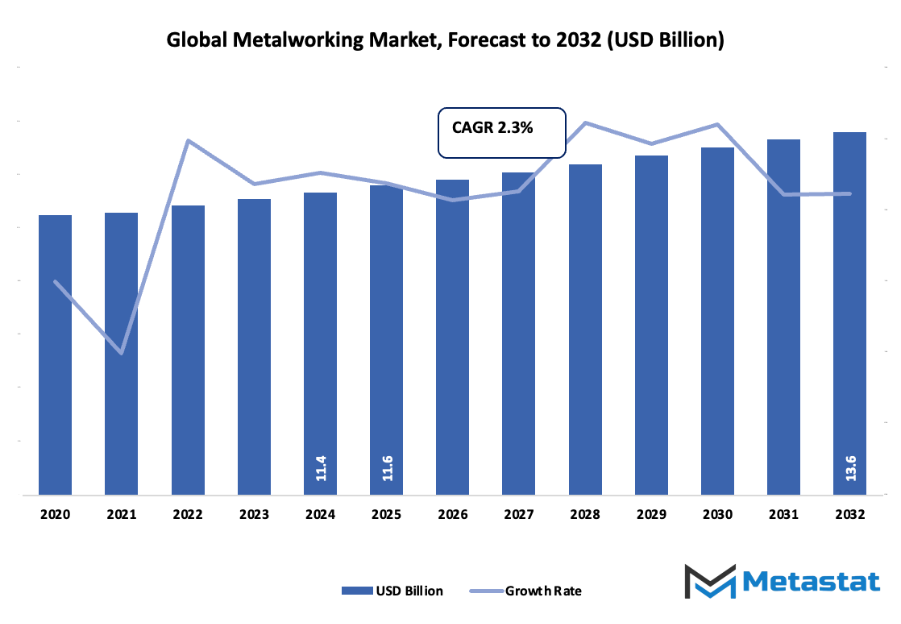
Market size is forecast to rise from USD 11.6 million in 2025 to over USD 13.6 million by 2032. Metalworking will maintain dominance but face growing competition from emerging formats.
The overall direction of the market points toward continued modernization and diversification. As infrastructure projects expand and manufacturing demand rises, the metalworking industry will maintain a central role in supporting global development. Through innovation, collaboration, and consistent improvement, both established leaders and emerging manufacturers will continue to shape the industry’s progress.
This research report categorizes the global metalworking market based on various segments and regions, forecasts revenue growth, and analyzes trends in each submarket. The report analyses the key growth drivers, opportunities, and challenges influencing the global metalworking market. Recent market developments and competitive strategies such as expansion, type launch, development, partnership, merger, and acquisition have been included to draw the competitive landscape in the market. The report strategically identifies and profiles the key market players and analyses their core competencies in each sub-segment of the global metalworking market.
Find answers to common questions about this report
Global Metalworking market is valued at $11.6 million in 2025.
Global Metalworking market is estimated to grow with a CAGR of 2.3% from 2025 to 2032.
Global Metalworking market is estimated to reach $13.6 million by 2032.
Top players operating in the Metalworking industry includes Robert Bosch GmbH, Atlas Copco Group,, BTD Manufacturing Inc., DMG Mori Co Ltd, Standard I
The analysts below cover Machinery & Equipment research at Metastat Insights.
LEAD ANALYST
Utkarsh Khirodkar is a Lead Market Research Analyst at MetaStat Insight, specializing in market intelligence, technology sector assessments, and competitive strategy.

INDUSTRY CONSULTANT - CHEMICALS & ADVANCED MATERIALS
Chemicals and Materials · Machinery & Equipment · Packaging
Amit Gadhekar Consultant for Chemicals and Materials at MetaStat Insight, directing sector-specific intelligence, research, and strategic consulting across global chemical and processing markets.

PRINCIPAL CONSULTANT - QUALITY SYSTEMS & COMPLIANCE
Electronics and Semiconductor · Machinery & Equipment · Professional Services
Omkar Phadtare is an Industry Consultant at MetaStat Insight, specializing in quality systems, regulatory compliance, and standards benchmarking to drive data-driven market intelligence and strategic industry research.

ENERGY & INFRASTRUCTURE INDUSTRY CONSULTANT
Automotive and Transportation · Electronics and Semiconductor · Energy and Power · Machinery & Equipment
Saurabh Vasant Ganvir consults for Energy & Infrastructure Industry at MetaStat Insight, specializing in renewable energy, solar EPC, and electric vehicle (EV) infrastructure markets.

LEAD CONSULTANT - COMMUNICATION, TELECOM, AND IT
Electronics and Semiconductor · Information & Technology · Machinery & Equipment · Professional Services
Ravindra Sathe Consultants for Communication, Telecom, and IT at MetaStat Insight. He leads the firm's industry research initiatives across telecommunications infrastructure, digital connectivity, enterprise networking, and emerging information technology domains.
Assessing commercial microgrid software adoption requires looking past top-level installation numbers and examining utility interconnection queues. The research provided verifiable data on average permitting timelines, tariff structures, and battery storage integration costs across regional utility territories. That grounded perspective was valuable for our team when building five-year demand projections for industrial microgrid controllers.
Ambulatory surgical centers have very different purchasing cycles for robotic-assisted surgery platforms than major hospital networks. The MetaStat Insight study focused squarely on capital expenditure depreciation, procedural reimbursement pathways, and surgeon training overhead. That operational clarity made it much simpler to validate multi-year procedure growth forecasts against actual ambulatory center adoption patterns.
When planning edge sensor rollouts across refinery environments, generic IoT reports typically miss the harsh-environment certification bottlenecks. MetaStat Insight gave an objective evaluation of ATEX and Class 1 Division 2 hardware availability, along with realistic five-year maintenance cycle cost projections. The comparison of wireless mesh versus private cellular backhaul helped our team pressure-test network reliability models for remote processing facilities.
Explore related market intelligence reports worth reading alongside this one.