
LEAD ANALYST
Utkarsh Khirodkar is a Lead Market Research Analyst at MetaStat Insight, specializing in market intelligence, technology sector assessments, and competitive strategy.

Middle East Home Storage Organization Market Size, Share, By Product Type (Cabinets, Cupboards & Sideboards, Wardrobes & Closet Systems, Shelving & Bookcases, Racks & Freestanding Storage Units, Storage Boxes, Bins & Totes, Baskets & Hampers, Drawer Organizers & Dividers, Hooks, Hangers & Wall-Mounted Organizers), By Primary Material (Wood & Engineered Wood, Plastic & Polymer, Metal, Textile & Fabric, Natural Fiber, Glass), By Distribution Channel (Brand-Owned Stores & Showrooms, Specialty Furniture & Homeware Retailers, Home Improvement & Hardware Retailers, Department & Lifestyle Stores, Hypermarkets & Mass Merchandisers, Specialty E-Commerce Retailers, Online Marketplaces), By Country (Saudi Arabia, United Arab Emirates, Israel, Oman, Kuwait, Rest of Middle East), Industry Analysis, Growth, Trends, and Forecast, 2026-2033
Report ID
MSI-4938
Published
August, 2026
Pages
261 Pages
Format
Historical
Base year
Forecast
Forecast period
Report Details
Choose Your License
Middle East Home Storage Organization Market
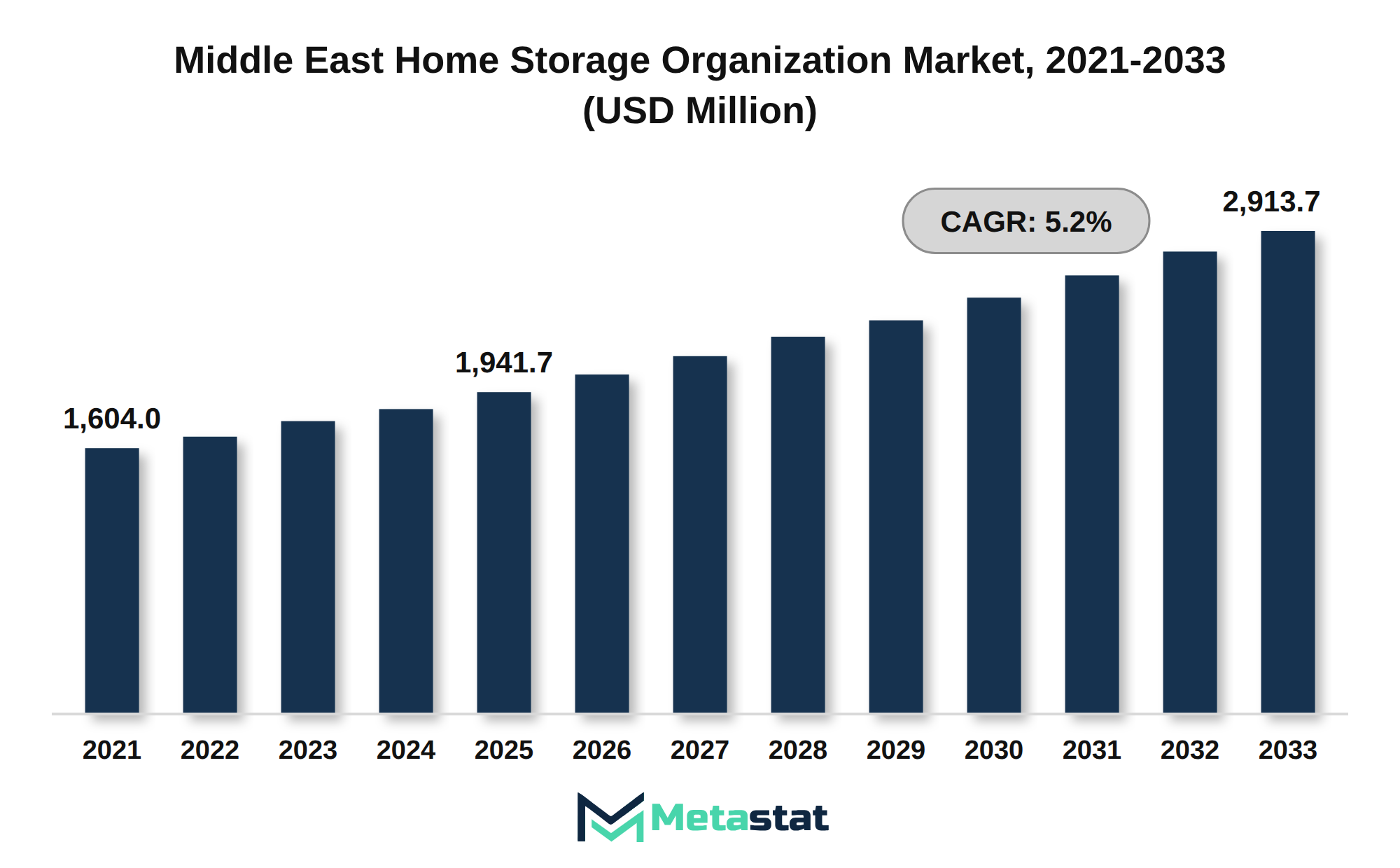
The Middle East Home Storage Organization market was valued at USD 1,941.7 million in 2025 and is projected to reach USD 2,913.7 million by 2033, growing at a CAGR of 5.2% over the forecast period.
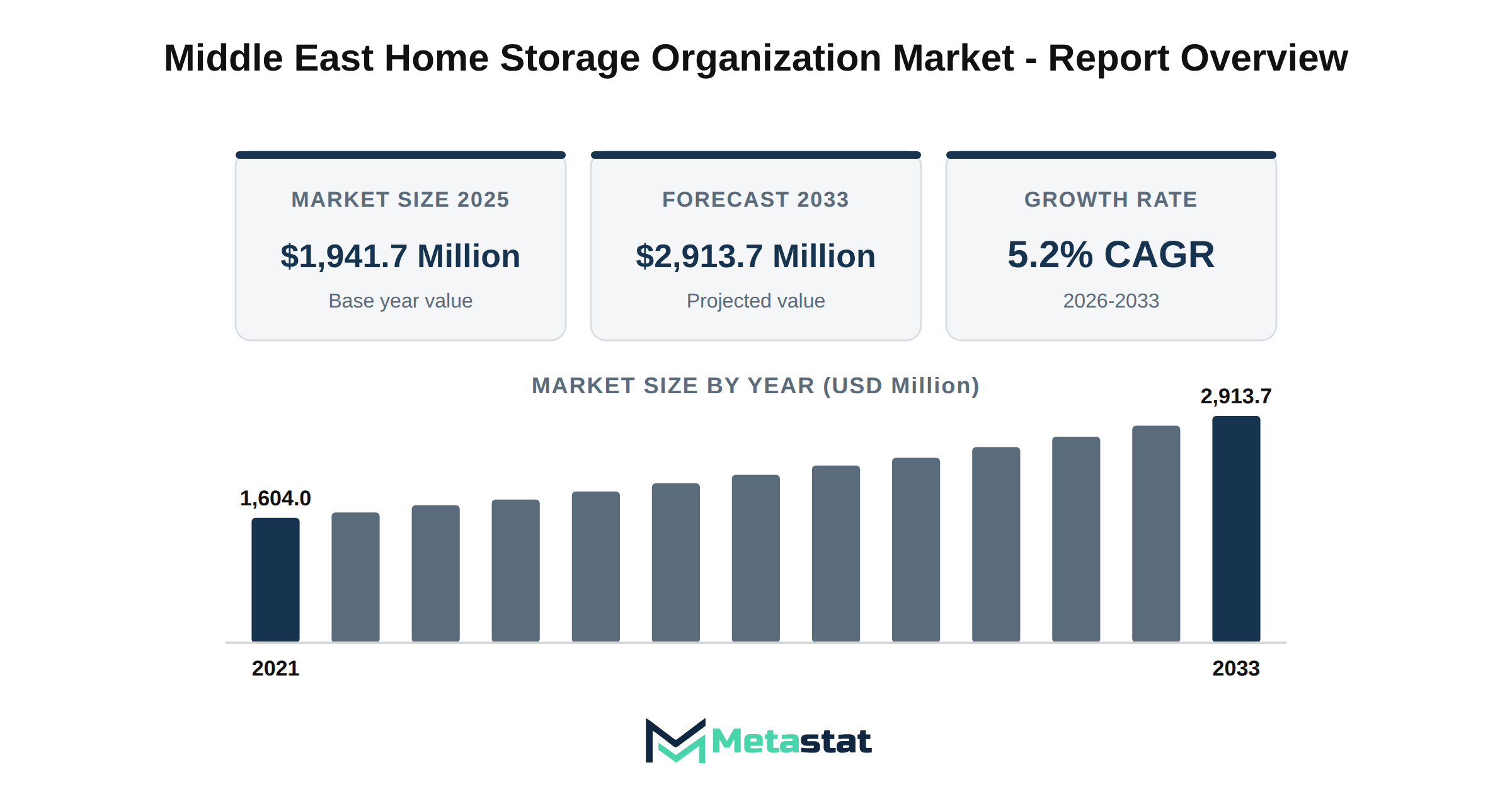
The Middle East Home Storage Organization market is projected to grow from USD 1,941.7 million in 2025 to USD 2,913.7 million by 2033, reflecting a compound annual growth rate (CAGR) of 5.2%. This growth trajectory indicates rising demand for organized home storage solutions across the region.
Market dynamics are influenced by several factors, including changing consumer preferences towards home organization and increased urbanization. The ongoing trend of home improvement and interior design drives higher adoption rates of storage solutions among homeowners and renters. Demand for innovative storage options is particularly pronounced in countries including Saudi Arabia and the United Arab Emirates, where significant investments in real estate and infrastructure support market growth.
Product types like cabinets, cupboards, and sideboards represent a notable segment of the market, accounting for 19.8% of the total share. This segment demonstrates a steady growth outlook, driven by the increasing need for efficient storage in residential spaces. Wardrobes and closet systems, comprising 18.1% of the market share, gain traction, propelled by the rising trend of customized storage solutions.
In terms of primary materials, wood and engineered wood dominate the market, with a projected value increase from USD 745.2 million in 2026 to USD 990.1 million by 2033, corresponding to a CAGR of 4.1%. The plastic and polymer segment exhibits higher growth potential, with an anticipated value reaching USD 729.6 million by 2033, growing at a CAGR of 6.2%. This shift towards versatile materials reflects changing consumer tastes and demand for lightweight, durable storage options.
The Middle East Home Storage Organization market experiences substantial growth driven by increasing urbanization and a rising focus on home aesthetics. Urban populations increasingly seek efficient storage solutions, leading to heightened demand for various storage products. This trend correlates with consumer preferences for organized living spaces, contributing to market expansion.
Regulatory compliance shapes product offerings within the market. Manufacturers adhere to safety and quality standards, which influences product design and materials used. This adherence ensures customer safety and builds trust in brands, ultimately enhancing market competitiveness.
Innovation remains a key driver, particularly regarding next-generation storage solutions. Manufacturers invest significantly in research and development, focusing on the introduction of multifunctional and space-saving designs. The integration of smart technology into storage products signifies a crucial evolution within the market, catering to tech-savvy consumers seeking convenience and efficiency.
The supply chain landscape within the market faces challenges stemming from geopolitical risks and inflationary pressures. Fluctuations in material costs directly impact pricing strategies, influencing consumer purchasing behavior. Effective management of logistics and sourcing strategies becomes essential for manufacturers aiming to maintain profitability during these challenges.
Capital allocation strategies reflect a growing trend toward sustainability. Companies prioritize eco-friendly materials and production processes, aligning with consumer expectations for environmentally responsible products. This shift toward sustainable transformation enhances brand reputation and appeals to a broader customer base concerned about ecological impact.
Future strategic outlooks indicate a continuation of these trends, with an emphasis on value chain optimization. Manufacturers investing in enhancing customer journey dynamics and understanding consumer preferences will likely strengthen their market position. The ongoing commitment to innovation and sustainability will shape the future trajectory of the Middle East Home Storage Organization market, supporting resilience and growth.
Urbanization significantly influences the Middle East Home Storage Organization market. Rapid population growth in urban areas increases housing density, leading to limited living space. This shift raises the demand for effective storage solutions that maximize available space, driving the growth of various storage products.
Changing lifestyles, characterized by an increase in dual-income households, contribute to the need for organized home environments. Consumers seek efficient storage options that simplify living spaces while addressing clutter challenges. Evolving consumer preferences stimulate investment in innovative home storage solutions that cater to modern living conditions.
In response to urbanization trends, manufacturers and retailers expand their product offerings to meet the specific needs of urban dwellers. This strategy enhances competitive positioning within the market while driving revenue growth. The combination of urbanization and changing demographics highlights the importance of effective storage solutions, positioning the market for sustained expansion through 2033.
The Middle East Home Storage Organization market benefits from rising consumer spending patterns, which directly enhance demand for various storage solutions. Economic recovery, coupled with increasing disposable income, enables consumers to invest in home organization products. Households prioritize aesthetics and functionality in their living spaces, resulting in significant spending on storage solutions. This shift stems from evolving consumer behaviors, reflecting a greater emphasis on home improvement and personal organization.
Several factors contribute to this trend, including shifts in lifestyle choices, where consumers increasingly seek efficient and aesthetically pleasing storage options. Enhanced marketing efforts by suppliers increase awareness of home storage products, making them more appealing to consumers. Manufacturers and retailers experience increased sales opportunities and revenue growth, reinforcing their commitment to innovate and diversify product offerings in the Middle East Home Storage Organization market.
Investment in marketing and product development aligns with changing consumer expectations, driving suppliers to create tailored solutions that address specific storage challenges. The anticipated growth in consumer spending creates a favorable environment for expanding market opportunities and increasing competition among participants in the industry.
Regulatory compliance presents a significant obstacle for the Middle East Home Storage Organization market. Stringent regulations for product safety, materials, and environmental impact often require companies to invest heavily in compliance measures, diverting funds that could support innovation or expansion. Organizations face increased operational costs associated with documentation, testing, and certification, which constrains profitability and slows market growth.
Macroeconomic pressures, including inflationary trends and geopolitical instability, further complicate the operating environment. Rising material costs and supply chain disruptions impede manufacturers' ability to maintain competitive pricing. The market experiences a ripple effect from these challenges, with higher prices deterring potential consumers and creating a slowdown in downstream demand. Capital stagnation restricts investment in new products and expansion efforts, leading to a competitive disadvantage for those unable to adapt quickly.
The combination of regulatory compliance and economic pressures highlights a challenging environment for the Middle East Home Storage Organization market. Companies navigate these hurdles carefully to sustain growth and market positioning while addressing rising costs and meeting consumer expectations.
The Middle East Home Storage Organization market faces significant challenges stemming from geopolitical tensions that affect supply chain stability. Trade disputes and regional conflicts generate uncertainty, resulting in disruptions that impact the production and distribution of home storage solutions. Manufacturers and suppliers experience heightened operational risks, contributing to increasing costs and delays in product availability.
Trade deficits and tariff friction complicate the importation of essential materials and components. Fluctuating tariffs lead to unpredictable pricing structures, creating margin pressures for both manufacturers and retailers. This situation forces companies to reassess their cost structures and sourcing strategies, impacting profitability across the market.
Technological disruptions further complicate market dynamics. Rapid advancements in automation and digital integration require ongoing investment in research and development. Companies encounter challenges related to the interoperability of systems and technologies, hindering efficiency and responsiveness in meeting consumer demands. Firms remain agile in adapting to these technological shifts.
Logistic disruptions stemming from infrastructure gaps and tight regional regulatory standards contribute to compliance overhead. Companies face challenges in adhering to evolving legal liabilities, necessitating investment in compliance measures that detract from core operational activities. These challenges cumulatively impact the competitiveness of the Middle East Home Storage Organization market.
Price compression resulting from market saturation and substitution vector pressures adds further complexity. Consumers become more discerning, and the demand for innovative and differentiated products increases. Firms invest strategically to enhance product offerings, straining resources in an already competitive landscape.
The Middle East Home Storage Organization market experiences notable expansion driven by technological advancements. Innovations in smart storage solutions, including app-integrated organizational systems, enhance user experiences and create demand within the residential sector. Customers increasingly seek products that offer convenience and efficiency, aligning with modern lifestyle preferences.
The integration of automation technologies simplifies organization, encouraging consumers to adopt new solutions in their homes. Enhanced functionalities including adjustable shelving and modular designs cater to diverse consumer needs. These developments drive market growth through increased product offerings and improved customer satisfaction.
Digital transformation plays a critical role in shaping consumer purchasing behaviors. An increase in online shopping platforms allows manufacturers to engage directly with customers, providing tailored solutions that meet specific storage requirements. This shift toward e-commerce positively influences market dynamics, resulting in higher sales and broader market access.
Sustainability trends fuel interest in eco-friendly materials and production processes within the market. Consumers prioritize products that align with green practices, prompting manufacturers to innovate with sustainable materials and energy-efficient designs. This focus on sustainability not only attracts environmentally conscious buyers but strengthens brand loyalty.
The Middle East Home Storage Organization market benefits from regional diversification strategies. Expansion into emerging markets across the region enables suppliers to tap into new customer bases, enhancing revenue potential. Strategic partnerships and collaborations further facilitate market penetration, allowing companies to leverage shared resources and expertise.
Overall, the convergence of technology, sustainable practices, and market expansion strategies positions the Middle East Home Storage Organization market for continued growth and innovation. These elements collectively drive demand, ensuring a robust outlook for the sector through 2033. The market is expected to experience significant advancements in product development and consumer engagement, contributing to its overall expansion.
The Middle East Home Storage Organization market is segmented based on Product Type, Primary Material, Distribution Channel, and Country.
Valued at USD 401.6 million in 2026, the Cabinets, Cupboards & Sideboards segment is projected to reach USD 522.4 million by 2033, reflecting a CAGR of 3.8% during the forecast period. An increase in urbanization and a growing emphasis on home organization contribute significantly to market expansion. Consumers seek efficient storage solutions that enhance living spaces. This trend drives demand for innovative designs and functional aesthetics.
Technological advancements in materials and production processes facilitate the introduction of next-generation storage solutions. Manufacturers focus on sustainable materials and smart designs to meet evolving consumer preferences. The trend toward minimalism and multifunctional living spaces enhances the appeal of cabinets and sideboards that optimize storage without compromising style.
Rising disposable incomes and urban lifestyles boost consumer confidence in investing in home furnishings, including cabinets and cupboards. Enhanced online shopping experiences and the proliferation of e-commerce platforms enable wider access to products, attracting a diverse customer base. While consumers prioritize quality and design, brands that emphasize craftsmanship and customization gain competitive advantages in the market.
The Middle East Home Storage Organization market reflects a positive outlook, with the Cabinets, Cupboards & Sideboards segment poised for growth. Strategic investments in marketing, product innovation, and distribution channels enhance brand visibility and strengthen market positioning. By addressing consumer needs for functionality and style, manufacturers capitalize on emerging opportunities in this expanding segment.
Increasing consumer emphasis on organization and space efficiency drives demand for wardrobes and closet systems in the Middle East Home Storage Organization market. These systems enhance home aesthetics and maximize storage utility, particularly in urban settings where living spaces tend to be limited. The adoption of innovative designs and smart storage solutions supports this trend, catering to the preferences of modern consumers who prioritize functionality alongside style.
The wardrobes and closet systems segment is estimated to reach USD 555.4 million by 2033, at a CAGR of 5.8% during the forecast period. This growth results from evolving consumer lifestyles that favor customized storage solutions. Technological advancements contribute to this segment’s expansion, with manufacturers incorporating features like adjustable shelving and integrated lighting into their designs, significantly enhancing user experience.
Market dynamics indicate a shift towards eco-friendly materials in product offerings. Consumers increasingly prefer wardrobes and closet systems manufactured from sustainable resources, reflecting a broader trend towards environmental consciousness. This shift aligns with consumer values and influences purchasing decisions, further propelling market growth.
Price sensitivity remains a consideration, with various consumers seeking affordable yet stylish options. Manufacturers face pressures to balance quality and cost, ensuring that products remain accessible while meeting consumer expectations for durability and design. This balance is crucial for maintaining competitive advantage in the Middle East Home Storage Organization market.
Growth in the Shelving & Bookcases segment reflects increasing consumer focus on home organization and efficient space utilization in residential settings. The demand arises from shifting consumer preferences towards functional and aesthetic furniture that complements modern living spaces. Interest in versatile shelving solutions that accommodate various storage needs drives market expansion.
Technological advancements enhance product design and manufacturing processes, enabling the introduction of innovative shelving options that cater to evolving consumer tastes. The market experiences expansion through strategic collaborations between furniture manufacturers and home decor retailers, enhancing accessibility and visibility of shelving products. Consumer engagement through social media and online platforms strengthens brand loyalty, further stimulating growth in this segment.
The Shelving & Bookcases segment is expected to reach USD 377 million by 2033. This growth reflects increasing investments in home renovations and the rising popularity of DIY projects, encouraging consumers to create personalized and organized living spaces. Environmental considerations influence purchasing decisions, with many consumers opting for sustainable materials in shelving products.
Fluctuations in raw material prices impact cost structures, requiring manufacturers to adapt pricing strategies to maintain profitability. Efficient supply chain management becomes essential to mitigate these challenges and ensure consistent product availability. Increasing competition among key players drives innovation and variety, resulting in an expanded range of choices for consumers.
Strategic investment in marketing and product development remains vital to capitalize on emerging opportunities within the Middle East Home Storage Organization market. The segment's growth trajectory aligns with broader trends in home improvement and interior design, indicating a positive outlook for shelving and bookcases in the coming years.
Growth in the Racks & Freestanding Storage Units segment reflects evolving consumer preferences for versatile and efficient storage solutions. Increasing urban populations and smaller living spaces prompt demand for products that maximize functionality without sacrificing aesthetics. The CAGR of 4% during the forecast period indicates steady expansion within this segment, aligning with broader trends in the Middle East Home Storage Organization market.
Shifts in consumer behavior toward minimalist lifestyles contribute to the rising popularity of freestanding storage solutions. These units cater to both residential and commercial applications, enhancing organizational capabilities while adapting to diverse spatial constraints. The versatility of these products positions them well within the market, appealing to a wide range of end users.
Technological advancements in materials and design enable manufacturers to offer innovative products that meet evolving consumer needs. Enhanced durability and sustainability characteristics drive product adoption, addressing growing environmental awareness among consumers. Significant investment in research and development fuels advancements in Racks & Freestanding Storage Units.
Competitive pressures among market participants drive continuous improvement in product offerings. The presence of key companies within the market facilitates innovation and enhances consumer choice, ultimately leading to improved market dynamics. Overall, the performance of the Racks & Freestanding Storage Units segment significantly shapes the future of the overall market.
Demand for storage boxes, bins, and totes within the Middle East Home Storage Organization market aligns closely with evolving consumer preferences for efficient space management. Increasing urbanization and a growing population contribute to heightened demand for practical storage solutions. Consumers prioritize organization in residential environments, leading to greater interest in versatile storage products that complement various lifestyles.
Technological advancements play a significant role in product evolution, introducing innovative designs and materials that enhance functionality and aesthetics. Manufacturers respond to market demands by developing sustainable options, catering to eco-conscious consumers. The migration towards smart home solutions influences product features, integrating technology with traditional storage methods to improve usability and appeal.
Downstream applications for storage boxes, bins, and totes span multiple sectors, including residential, commercial, and industrial environments. The versatility of these products allows for their use in diverse settings, driving further adoption. Consumers increasingly seek multifunctional items that serve various purposes, positioning this segment for continued growth.
Cost structures remain essential in determining the pricing strategies for storage solutions. Supply chain resilience factors heavily into pricing volatility, influenced by raw material sourcing challenges and production costs. Manufacturers strive to maintain competitive pricing while addressing margin pressures stemming from fluctuations in material costs and demand shifts.
Strategic opportunity windows arise from the expanding e-commerce sector, enabling brands to reach wider audiences. Increased online shopping behavior enhances market visibility, encouraging investment in innovative marketing strategies. While competition intensifies, brands focus on differentiation through unique product offerings and enhanced customer experiences, ensuring sustained interest in the Middle East Home Storage Organization market.
Baskets and hampers represent a critical component of the Middle East Home Storage Organization market, driven by increased consumer demand for practical and aesthetically pleasing storage solutions. The growing trend towards minimalism and organized living prompts consumers to seek options that enhance home functionality while complementing interior designs. This segment benefits from an expanding range of materials, including sustainable options, catering to environmentally conscious consumers.
Adoption of innovative designs and multifunctional products further supports the segment's growth. Manufacturers focus on developing products that not only provide storage but serve decorative purposes, appealing to a broader customer base. The integration of technology into storage solutions, including smart baskets, aligns with contemporary consumer preferences for convenience and efficiency.
End-use dynamics demonstrate a shift towards versatile storage solutions that adapt to various spaces, addressing the needs of urban households facing space constraints. These factors contribute to increased consumption and demand for baskets and hampers, reinforcing their role in overall market expansion.
Pricing volatility impacts the segment, influenced by fluctuations in raw material costs and supply chain dynamics. Strategic investments in production capabilities and supply chain resilience are essential for maintaining competitive pricing and meeting rising consumer expectations. The market presents strategic opportunity windows for manufacturers willing to innovate and diversify their offerings, capturing evolving consumer preferences.
Recent trends in home organization indicate a growing interest in efficient space utilization, driving demand for drawer organizers and dividers in the Middle East Home Storage Organization market. Consumers increasingly seek solutions that enhance the functionality of their living spaces, prompting innovations in product design and functionality to meet these expectations. While urban dwellings shrink, the emphasis on maximizing storage capacity while maintaining aesthetic appeal has become essential.
Adoption of drawer organizers and dividers has accelerated due to rising consumer awareness about organization and the benefits of decluttering. Market players focus on user-friendly designs, enabling consumers to achieve tidy and accessible storage solutions. This shift aligns with broader lifestyle trends towards minimalism and functionality, reflecting a societal movement towards personalizing and optimizing living environments.
Strategic partnerships between manufacturers and retailers enhance product availability and visibility, facilitating growth in this sub-segment. Effective marketing strategies emphasize the benefits of organized storage solutions, driving consumer interest and purchase intent. Increased competition among suppliers encourages innovation, promoting the development of next-generation products designed for specific consumer preferences.
Challenges including pricing volatility and margin pressures complicate the operational landscape for suppliers. The need for cost-effective sourcing of raw materials influences pricing strategies, impacting overall market dynamics. Nonetheless, strong demand for drawer organizers and dividers continues to drive investment opportunities within the Middle East Home Storage Organization market, creating avenues for growth and expansion.
Innovations in design and functionality drive growth for hooks, hangers, and wall-mounted organizers in the Middle East Home Storage Organization market. These products enhance space efficiency and cater to the evolving preferences of consumers seeking efficient home organization solutions. The segment benefits from advancements in materials and manufacturing processes, which enable the production of lightweight yet durable organizers that appeal to a wide range of consumers.
Changing consumer behaviors reflect an increased inclination toward personalized and customizable organization solutions. This shift encourages manufacturers to diversify their product offerings, introducing various styles and configurations that meet specific consumer needs. The segment's expansion aligns with broader trends in home improvement and interior design, where aesthetic appeal and practicality are prioritized.
The rising popularity of minimalism and decluttering philosophies influences consumers' purchasing decisions. Hooks, hangers, and wall-mounted organizers serve because essential tools for maximizing storage while maintaining a clean and orderly environment. Increased awareness of the benefits of home organization supports segment growth, because consumers recognize the advantages of using vertical space effectively.
Technological advancements play a critical role in the evolution of these products. Enhanced manufacturing techniques enable the development of innovative designs, leading to greater functionality and improved user experience. While manufacturers continue to explore new designs and materials, the segment is expected to adapt to changing market demands and consumer preferences.
Increased investment in marketing and branding strategies further enhances segment visibility within the market. Companies focus on educating consumers about the advantages of efficient storage solutions, creating a stronger connection between product utility and consumer lifestyle choices. This proactive approach positions hooks, hangers, and wall-mounted organizers because integral components of modern home organization.
Overall, the hooks, hangers, and wall-mounted organizers segment reflects a dynamic relationship of consumer demand, technological innovation, and evolving market trends within the Middle East Home Storage Organization market. This environment presents significant opportunities for growth and product development, shaping the future of home storage solutions.
In the Middle East Home Storage Organization market, the Others (Under-Bed Storage, Specialty Cases & Holders) sub-segment reflects unique consumer preferences for maximizing space utilization. Increased interest in efficient living spaces drives adoption, particularly in urban settings where space is limited. Innovative designs and functional features enhance product appeal, attracting a diverse consumer base seeking practical storage solutions.
Product evolution emphasizes aesthetics alongside functionality, leading to an array of options that cater to various tastes and preferences. The shift towards multifunctional furniture contributes to the growth of this sub-segment, driven by consumers searching for products that serve dual purposes while conserving space. An increasing focus on home organization aligns with rising disposable incomes. Consumers invest in solutions that improve their living environments.
Regulatory compliance regarding materials used in storage solutions influences product development, ensuring safety and environmental standards are met. Emphasis on sustainable materials presents opportunities for brands to differentiate themselves in a competitive environment. This focus on eco-friendly options aligns with global trends, positioning manufacturers for enhanced market penetration.
Strategic opportunities emerge in addressing the needs of specific demographics, including students, young professionals, and families, all of whom seek affordable yet stylish storage solutions. Trends point towards remote work and smaller living spaces. The market for under-bed storage and specialty cases continues to widen, creating avenues for capital investment and innovation.
Valued at USD 745.2 million in 2026, the Wood & Engineered Wood segment is projected to reach USD 990.1 million by 2033, reflecting a CAGR of 4.1% during the forecast period. This steady growth aligns with the increasing consumer preference for sustainable and aesthetically appealing storage solutions. Enhanced awareness regarding the environmental impact of materials influences purchasing decisions, with wood products gaining traction among eco-conscious consumers.
Market expansion is driven by technological maturation that facilitates the production of engineered wood products. Innovations in manufacturing processes enhance the strength and durability of these materials, making them more appealing for home storage applications. The growing trend of home remodeling and renovation projects supports demand, driven by homeowners seeking attractive storage solutions that integrate with contemporary interior designs.
End-use dynamics indicate a shift towards multifunctional storage solutions that combine style and practicality. Increased demand for customized storage options drives market growth, with consumers seeking versatile products that maximize space efficiency. These trends create opportunities for manufacturers to innovate and expand their offerings in the Middle East Home Storage Organization market, ultimately enhancing the competitive environment.
Consumer consumption patterns show a preference for high-quality wood and engineered wood products, which offer durability alongside design versatility. This inclination impacts pricing structures, prompting suppliers to adapt their pricing strategies to align with consumer expectations while maintaining profit margins. The market remains resilient against raw material sourcing challenges, owing to manufacturers increasingly exploring sustainable forestry practices to secure their supply chains.
Strategic investment in marketing and product development aligns with evolving consumer preferences, creating strategic opportunity windows for companies operating in the market. Ongoing capital investments aimed at enhancing manufacturing capabilities and expanding distribution channels further support the Wood & Engineered Wood segment's growth trajectory.
Favorable demand dynamics underpin the growth of the Plastic & Polymer segment within the Middle East Home Storage Organization market. Increased consumer preference for lightweight, durable, and cost-effective storage solutions drives investment in this material. Anticipated advancements in production technology facilitate the creation of innovative designs that cater to evolving consumer expectations. The segment is estimated to reach USD 729.6 million by 2033, at a CAGR of 6.2% during the forecast period.
The shift towards sustainable products encourages manufacturers to explore eco-friendly materials, aligning with global trends in environmental consciousness. This transition influences product development strategies, encouraging the incorporation of recycled plastics and polymers into storage solutions. Such initiatives enhance brand reputation and attract environmentally-aware consumers, further supporting market growth.
Increased urbanization in the region further drives demand for home organization solutions, driven by the necessity for space-efficient products to maximize living areas. The expansion of e-commerce platforms enables broader access to a variety of plastic and polymer storage options, providing consumers with competitive pricing and convenience. This heightened accessibility contributes to strong market performance, making the Plastic & Polymer segment a vital component of the overall market landscape.
Valued at USD 551.6 million by 2033, the Metal segment within the Middle East Home Storage Organization market demonstrates considerable growth potential. Increased demand for durable and long-lasting storage solutions drives this segment forward, particularly in regions experiencing urbanization and population growth. Factors including rising disposable incomes and a shift towards modern living spaces contribute to the increased preference for metal-based storage options, appealing to both residential and commercial consumers.
Technological advancements in manufacturing processes enhance the quality and variety of metal storage products, encouraging innovation in design and functionality. The segment's expansion correlates with changing consumer preferences for aesthetics and space efficiency, leading to an increased interest in stylish and functional storage solutions. The versatility of metal because a primary material offers benefits in terms of strength and reliability, making it attractive for diverse applications within the market.
Strategic investments in production capabilities and supply chain enhancements offer avenues for growth among manufacturers. Players in the market focus on optimizing cost structures while maintaining product quality, ensuring competitive pricing in a dynamic environment. This approach supports the segment's resilience against pricing volatility and margin pressures, ultimately enabling sustainable growth trends within the Metal segment of the Middle East Home Storage Organization market.
Growing interest in eco-friendly and sustainable products supports the demand for the Textile & Fabric segment within the Middle East Home Storage Organization market. Consumers increasingly seek materials that align with environmentally conscious lifestyles, driving manufacturers to innovate with biobased textiles and recycled fabrics. This shift enhances product appeal and expands market opportunities for suppliers.
The Textile & Fabric segment is projected to grow at a CAGR of 5% during the forecast period. Companies investing in advanced manufacturing techniques and sustainable sourcing strategies are likely to gain a competitive edge. This investment drives innovation in product design, functionality, and durability, aligning with consumer preferences for high-quality and long-lasting storage solutions.
Adoption of smart home technologies introduces a range of new functionalities for textile-based storage products. Integration with home automation systems appeals to tech-savvy consumers, enhancing convenience and efficiency in home organization. This technological maturation encourages greater investment in research and development, pushing the boundaries of traditional storage solutions.
Regulatory compliance surrounding sustainable materials influences sourcing strategies. Manufacturers face challenges in adapting to these regulations while maintaining cost-effective production. Balancing compliance with cost structures remains essential for profitability and long-term sustainability in the market.
Raw material sourcing remains a critical factor for the Textile & Fabric segment. Fluctuations in raw material prices, particularly in organic and recycled fabrics, introduce pricing volatility. Companies that establish resilient supply chain networks navigate these challenges more effectively, ensuring steady product availability and competitive pricing.
Growing consumer interest in sustainable and eco-friendly products enhances the appeal of natural fiber materials, including rattan, wicker, and bamboo, within the Middle East Home Storage Organization market. These materials align with environmental consciousness, prompting manufacturers to innovate designs that effectively use these resources.
Increased urbanization, coupled with rising disposable incomes, drives demand for aesthetically pleasing and functional storage solutions. Consumers increasingly seek products that combine traditional craftsmanship with modern designs, creating significant opportunities for natural fiber segments. The versatility of these materials allows for diverse applications, appealing to a broad range of consumers.
Competitive pricing strategies among suppliers further stimulate interest in natural fiber products. Manufacturers focus on cost-efficient sourcing and production processes to deliver affordable options to consumers. This cost structure, combined with the growing trend towards sustainability, positions natural fiber products favorably within the market.
Investment in marketing and consumer education about the benefits of natural fiber storage solutions supports segment growth. While awareness of sustainable living increases, consumers are more inclined to invest in products that provide both functionality and environmental benefits. This trend positions natural fibers because a strong competitor within the broader materials segment.
Interest in the Glass sub-segment arises from its aesthetic appeal and versatility in various domestic settings, contributing to the overall dynamics of the Middle East Home Storage Organization market. Consumers increasingly prefer glass components for their elegant, modern look, enhancing the visual quality of storage solutions. This trend reflects a significant shift toward premium materials; buyers seek unique designs that combine functionality with style.
Technological advancements in glass production lead to improvements in durability and safety, making glass a more viable option for storage solutions. Enhanced manufacturing techniques result in lighter, shatter-resistant glass products that cater to the needs of contemporary homes. This innovation supports market growth by attracting consumers who prioritize aesthetics and practicality.
The demand for glass in home storage aligns with broader consumption shifts favoring sustainable materials. Environmentally conscious consumers drive adoption by selecting products with recyclable attributes or those sourced from eco-friendly manufacturers. Sustainability becomes increasingly important; glass storage solutions gain traction, positioning themselves because a responsible choice within the market.
Regulatory compliance regarding material safety and environmental impact influences the development of glass storage products. Manufacturers adhere to stringent standards, ensuring that their offerings meet consumer expectations for safety and sustainability. This compliance presents initial challenges but ultimately enhances the credibility of glass products, facilitating their acceptance in the market.
Strategically, opportunities exist for manufacturers to expand their product lines to include customizable glass storage solutions. This flexibility attracts a wider audience, including those with specific design preferences. By leveraging customization capabilities, suppliers position themselves to meet evolving consumer demands and enhance their competitive edge in the market.
Interest in the Others (Acrylic, Leather & Paperboard) sub-segment arises from its versatility and unique aesthetic appeal. These materials offer lightweight options for home storage solutions, catering to consumers seeking stylish and functional designs. Demand for aesthetically pleasing storage solutions drives product development in this segment, resulting in innovative designs that align with contemporary interior styles.
Consumer preferences shift toward personalized and customizable storage solutions, prompting manufacturers to explore diverse material combinations. Enhanced product evolution leads to opportunities for brands in the Middle East Home Storage Organization market to differentiate their offerings, tapping into niche markets that seek distinct aesthetics and functionality.
Regulatory compliance standards influence sourcing practices within this segment. Manufacturers align their products with sustainability trends. Increasing awareness of environmentally friendly materials encourages the adoption of alternative materials, impacting pricing structures and cost management strategies across the market.
Strategic opportunity windows arise from evolving consumer expectations, enabling brands to enhance their presence in the Middle East Home Storage Organization market. Competition intensifies, and companies focusing on innovative designs and sustainable materials are likely to capture significant market share.
In 2026, the Brand-Owned Stores & Showrooms segment is valued at USD 447.2 million and is projected to reach USD 581 million by 2033, at a CAGR of 3.8% during the forecast period. Growth in this segment reflects increasing consumer preference for personalized shopping experiences and exclusive product offerings available in brand-owned environments. Customers often seek brands that provide unique designs and quality materials, driving demand for home storage solutions that align with individual tastes and lifestyles. This trend is evident across urban centers in the Middle East, where brand presence enhances consumer engagement and loyalty.
Technological advancements in retail environments support this segment's expansion. Innovations in in-store experiences, including interactive displays and augmented reality, enhance informed purchasing decisions, improving customer satisfaction. Retailers are integrating e-commerce platforms with physical stores, creating a smooth shopping experience that caters to changing consumer behaviors. This integration accelerates conversion rates, contributing to revenue growth within the market.
Brand-owned environments provide a controlled setting for effective branding and customer interaction. Retailers employ strategic layout designs to display products prominently, influencing purchasing behavior. Continued investments in store aesthetics and customer service training enhance the overall shopping experience, reinforcing brand loyalty and driving repeat purchases.
Shifts toward home improvement and organization trends increase demand for storage solutions available in brand-owned stores. Increased consumer focus on home aesthetics leads to higher spending on quality storage products, creating a favorable landscape for growth in the Middle East Home Storage Organization market. The segment's performance will significantly impact overall market dynamics, reflecting consumers' prioritization of organizational aesthetics in their purchasing decisions.
Market dynamics for the Specialty Furniture & Homeware Retailers segment reflect significant expansion, driven by a surge in consumer interest toward aesthetically pleasing and functional home storage solutions. This interest stems from evolving lifestyle trends prioritizing organization and efficiency in residential spaces. Enhanced product offerings in this segment align with consumer demands, resulting in a projected market value of USD 525.3 million by 2033, at a CAGR of 4% during the forecast period.
Technological advancements contribute to the evolution of product designs, improving both usability and appeal. Retailers focus on providing innovative solutions that cater to the diverse needs of consumers, driving increased adoption rates. The influence of e-commerce transforms purchasing behaviors, expanding access to specialty offerings within the Middle East Home Storage Organization market and enhancing growth opportunities for retailers in this segment.
Pricing strategies remain integral to capturing market share within the segment. Competitive pricing, coupled with the introduction of promotions and discounts, influences consumer purchasing decisions significantly. While margins tighten, retailers strategically navigate pricing volatility while maintaining product quality, ensuring sustained customer loyalty and satisfaction. The market environment demands ongoing adaptation to shifting pricing pressures, affecting overall profitability within the segment.
Demand for home improvement and hardware retailers in the Middle East Home Storage Organization market experiences significant growth driven by consumers prioritizing organization and efficiency within their living spaces. Increasing urbanization contributes to a shift in consumer preferences, driving the adoption of innovative storage solutions that enhance functionality and aesthetics. The segment is expected to reach USD 319.3 million by 2033, reflecting a robust compound annual growth rate (CAGR) that signals ongoing investment from retailers aiming to meet evolving customer needs.
Technological advancements play a crucial role in shaping product offerings within this segment. Retailers are integrating smart storage solutions that allow for enhanced usability and convenience. The product evolution emphasizes customization and modular design, catering to diverse consumer requirements. Strategic partnerships with manufacturers enable retailers to provide a wide range of options, supporting increased consumer choice and driving market expansion.
Shifts in consumption patterns indicate a growing preference for multifunctional storage products, pushing retailers to adapt their inventory accordingly. Regulatory compliance standards, including safety and sustainability certifications, further influence product development, ensuring alignment with market demands. Retailers face pricing volatility due to fluctuations in raw material costs, necessitating strategic pricing strategies to maintain margins while remaining competitive. Overall, the home improvement and hardware retailers segment demonstrates resilience, positioning itself because a key contributor to the growth of the Middle East Home Storage Organization market.
Department & Lifestyle Stores within the Middle East Home Storage Organization market is projected to grow at a CAGR of 4% during the forecast period. Increased consumer preference for stylish and functional storage solutions drives demand in this segment. These stores provide a curated selection, allowing customers to explore various home organization options that align with contemporary aesthetics.
Shifts in consumer preferences towards multifunctional and space-saving designs contribute to the expansion of this segment. Retailers focus on providing a diverse range of products, including storage boxes, bins, and furniture that optimize space. This alignment with consumer preferences enhances sales opportunities for Department & Lifestyle Stores, furthering their impact on overall market dynamics.
Pricing strategies within this segment reflect trends in consumer spending and competitive pressures. Retailers strategically adjust prices based on product offerings and market trends, influencing consumer purchasing behavior. Investment in marketing and promotional activities ensures that these stores remain competitive, capturing a larger share of the growing market.
The Department & Lifestyle Stores segment benefits from evolving consumer preferences and effective retail strategies, supporting long-term demand and expanding market reach.
Growing consumer preferences for convenience and one-stop shopping experiences drive the adoption of home storage solutions through hypermarkets and mass merchandisers. These retail channels provide consumers with a range of options, allowing for easier access to various storage products. The market benefits from the strategic placement of home storage items, enhancing visibility and encouraging impulse purchases. Competitive pricing strategies in these channels attract budget-conscious consumers, while promotional activities, including discounts and bundled offers, stimulate demand. Innovations in product design and functionality, including modular storage systems, appeal to consumers seeking versatility and efficiency in home organization efforts.
Changing demographics and urbanization trends influence consumption patterns, with younger consumers increasingly seeking stylish and functional storage solutions for smaller living spaces. Hypermarkets and mass merchandisers adapt their offerings to align with these shifts, ensuring relevance in a dynamic marketplace. Regulatory compliance concerning product safety and material quality remains crucial, reinforcing consumer confidence in purchasing decisions. Overall, the hypermarkets and mass merchandisers segment significantly impacts the Middle East Home Storage Organization market by providing accessible, diverse, and competitively priced products that meet evolving consumer needs.
Online purchasing continues to reshape consumer behavior within the Middle East Home Storage Organization market. The convenience of e-commerce platforms allows customers to access a wider variety of products, enhancing overall shopping experiences. Increased smartphone penetration and internet accessibility across the region boost the adoption of specialty e-commerce retailers, leading to heightened competition among providers. Innovative marketing strategies, including targeted advertising and social media engagement, drive consumer interest in home storage solutions. Shifts in consumer preferences toward personalized and unique products create differentiation among specialty e-commerce retailers. The ability to offer customized storage solutions positions retailers to cater to diverse consumer needs effectively. Advancements in technology enhance the shopping experience, allowing for augmented reality features that enable customers to visualize storage products in their own spaces. Pricing strategies within this segment require careful consideration of value versus cost, particularly in the face of rising raw material prices. Retailers that adopt transparent pricing models build greater trust with consumers while mitigating concerns regarding price fluctuations. Capital investments in logistics and supply chain management remain critical to maintain efficiency and responsiveness to market demands. The growing presence of specialty e-commerce retailers within the Middle East Home Storage Organization market signals a significant shift in how consumers engage with home storage solutions.
Digitalization transforms retail dynamics across various sectors, with online marketplaces significantly shaping the Middle East Home Storage Organization market. The shift toward e-commerce reflects changing consumer preferences for convenience, broader product selections, and competitive pricing. Increased internet penetration and smartphone usage facilitate access to these platforms, supporting wider adoption of home storage solutions.
The rapid evolution of technology influences online marketplaces, enhancing user experiences through personalized recommendations, customer reviews, and effective payment options. Product evolution aligns with evolving consumer needs, driven by innovative designs and versatile storage solutions that become more prominent in the digital shopping space. The integration of augmented reality in online platforms allows consumers to visualize products in their homes before purchase, further driving engagement and sales.
Growing consumer interest in home organization contributes to the expansion of this segment. Increased awareness of the benefits of efficient home storage fuels demand for diverse product offerings. Online marketplaces enable suppliers to reach a broader audience, increasing brand visibility and market penetration. The flexibility of online shopping aligns with busy lifestyles, offering time-saving solutions for consumers.
Effective pricing strategies play a vital role in enhancing competitiveness in this segment. Promotions, discounts, and loyalty programs attract consumers and encourage repeat purchases. While competition intensifies, maintaining attractive pricing structures becomes critical to sustaining market share. Suppliers face pricing volatility influenced by raw material costs, logistics, and supply chain dynamics, making strategic pricing essential to protect margins.
Investment in digital marketing and enhanced logistics capabilities strengthens the position of online marketplaces in the Middle East Home Storage Organization market. Companies that prioritize supply chain resilience and quick delivery options capitalize on shifting consumer behaviors favoring online purchases. Maintaining robust relationships with logistics partners ensures efficient product delivery and customer satisfaction, further driving market growth.
Growth in the Others (Catalog & Direct-Order Channels) segment reflects increasing consumer preferences for online shopping and convenience. Shifts in shopping behavior lead to higher demand for accessible and diverse product offerings, driving market expansion. This trend aligns with the overall trajectory of the Middle East Home Storage Organization market, where adaptability to consumer needs remains essential.
Technological advancements in e-commerce platforms enhance user experience, enabling customers to access a broader range of home storage solutions. The integration of user-friendly interfaces and efficient logistics systems creates an efficient purchasing experience, appealing to tech-savvy consumers. This evolution in the distribution landscape highlights the strategic opportunity within the segment to capture growing online consumer engagement.
Competition within the market intensifies owing to more retailers adopting direct-order models, pushing innovation in product offerings and pricing strategies. Companies focusing on enhancing their online presence gain a competitive edge, aligning with consumer demand for convenience and accessibility. This dynamic environment promotes ongoing investment in digital marketing and customer engagement strategies, further reinforcing the relevance of the Others (Catalog & Direct-Order Channels) segment.
Saudi Arabia represents a significant segment within the Middle East Home Storage Organization market, valued at USD 665.9 million in 2026 and projected to reach USD 988.9 million by 2033, at a CAGR of 5.8% during the forecast period. Effective urbanization and increasing population density in Saudi Arabia drive the demand for efficient home storage solutions, leading to greater consumer focus on organization and space optimization. This trend aligns with a growing interest in home decor and improvement, prompting investments in furniture and organizational systems that enhance living spaces.
The market experiences strong demand for various product types, particularly wardrobes and closet systems, which are favored for their utility and aesthetic contributions to household organization. While consumers become more discerning, demand for innovative and customizable storage solutions rises. Manufacturers invest in new technologies and product designs to ensure offerings meet evolving consumer expectations for functionality and style.
The segment benefits from increasing disposable incomes, enabling consumers to spend more on home organization products. Retail channels, including specialty furniture and homeware retailers, play a crucial role in distributing these products, influencing purchasing decisions through curated selections and personalized customer experiences. Strategic marketing initiatives and promotional campaigns within these retail environments contribute to heightened awareness and penetration of home storage solutions among consumers.
Ongoing technological advancements enhance product offerings in the segment, with innovations including modular and multi-functional storage solutions gaining traction. These advancements enable consumers to maximize utility while maintaining aesthetic appeal, further driving growth in the Saudi Arabian market. The influx of international brands and localized production promotes healthy competition, enhancing product diversification and availability.
Overall, the Saudi Arabian segment within the Middle East Home Storage Organization market positions itself for growth, driven by consumer preferences for innovative, space-efficient storage solutions that cater to modern living needs.
Increasing urbanization and a growing population in the United Arab Emirates drive demand for home storage solutions. Consumers seek efficient organization methods to optimize limited living space, enhancing the appeal of various storage products. The market reflects a shift towards multifunctional and aesthetically pleasing storage options, aligning with modern consumer preferences.
The United Arab Emirates segment is estimated to reach USD 727 million by 2033, at a CAGR of 6.1% during the forecast period. This growth results from rising disposable incomes and a trend towards home improvement projects, prompting consumers to invest in high-quality storage solutions. The market shows potential for innovative and sustainable products, reflecting global sustainability trends.
Technological advancements in materials and design contribute to product evolution, allowing manufacturers to introduce next-generation storage solutions. Innovative features, including modular designs and smart storage systems, enhance consumer interest and participation in the market. Evolving consumer behaviors, including a preference for online purchasing channels, influence distribution strategies among retailers.
Regulatory compliance and standards related to material safety and sustainability impact product development and market dynamics. Cost structures remain a crucial factor for consumers, prompting a focus on value-driven offerings that balance quality and affordability. The competitive environment encourages continuous innovation, enabling brands to capture market share through effective marketing strategies and product differentiation.
Overall, the Middle East Home Storage Organization market in the United Arab Emirates reflects a dynamic environment where consumer needs and preferences shape industry trends. Investment in research and development is essential for brands aiming to remain competitive and responsive to changing market demands.
Consumer demand for home storage solutions in Israel reflects a growing focus on space optimization and organization within residences. The market experiences significant interest driven by urbanization, which creates residential space constraints. Homeowners increasingly require functional and aesthetically pleasing storage options that maximize utility in limited areas.
Innovations in design and materials enhance product offerings, catering to diverse preferences among buyers. Technological advancements in materials, particularly in lightweight and durable options, contribute to the segment's appeal, positioning it well within the Middle East Home Storage Organization market. Sustainable practices in manufacturing align with consumer values, further boosting adoption rates and product evolution.
Israel's segment is projected to reach USD 379.4 million by 2033. This growth correlates with increasing investment in home improvement and renovation, signaling a robust shift towards more organized living spaces. Retailers focus on offering tailored solutions that address specific consumer needs, creating a competitive environment and encouraging strategic partnerships among suppliers.
Overall, the Israel market is driven by evolving consumer behaviors, technological enhancements, and a commitment to quality, reinforcing its significance within the broader Middle East Home Storage Organization market.
Growing interests in home organization solutions in Oman contribute to a projected growth rate of 5.3% during the forecast period. Increasing awareness of the benefits of effective storage systems drives consumer adoption. Urban development projects and rising disposable incomes increase demand for efficient home storage solutions, aligning with trends observed in the broader Middle East Home Storage Organization market. Affordability and versatility of products influence purchasing decisions, leading to enhanced market penetration.
Product evolution in the segment focuses on innovative designs and materials, catering to changing consumer preferences. The introduction of multifunctional storage options aligns with contemporary living spaces, increasing appeal among urban residents. Manufacturers invest in sustainable materials, addressing growing environmental concerns among consumers. Strategic partnerships between retailers and manufacturers stimulate availability and accessibility of various storage solutions, enhancing competition.
Oman's market offers significant opportunities for players focused on customized solutions. Local manufacturers and international brands compete to capture market share through unique offerings. The emphasis on customization allows brands to cater to specific needs, enhancing consumer loyalty and satisfaction. Investments in marketing and brand positioning support growth and recognition within the sector.
Overall, the combination of economic growth, consumer preferences, and product innovation positions Oman because a vital segment within the Middle East Home Storage Organization market. Continued expansion in this region reflects the evolving demands for home organization solutions, impacting operational strategies and competitive dynamics throughout the market.
Consumer interest in home storage solutions within Kuwait aligns with broader trends observed in the Middle East Home Storage Organization market. Factors driving demand include increasing urbanization, rising disposable incomes, and a growing emphasis on home organization and aesthetics. These trends reflect a significant shift in consumer behavior toward enhancing living spaces through effective storage solutions.
The adoption of innovative design and multifunctional furniture supports segment expansion. Consumers prioritize products that not only fulfill storage needs but blend seamlessly with interior aesthetics. This trend opens strategic opportunity windows for suppliers to introduce contemporary and versatile storage solutions that cater to the evolving preferences of Kuwaiti consumers.
Technological advancements further influence product evolution within this segment. Innovations in materials and manufacturing processes enhance durability and design flexibility, appealing to consumers seeking high-quality storage solutions. Downstream application in urban residential settings drives demand for products that optimize space and functionality.
Regulatory compliance standards concerning materials and safety continue to shape product offerings in Kuwait. Suppliers adhere to these standards, ensuring that their products meet consumer safety expectations while maintaining competitive pricing structures. Pricing volatility arises from fluctuations in raw material costs, impacting margins and overall market dynamics.
Investment in supply chain resilience remains essential for maintaining product availability during potential logistics vulnerabilities. Effective raw material sourcing strategies enable manufacturers to mitigate risks associated with supply chain disruptions. The emergence of disruptive alternatives and substitution risks necessitates continuous innovation and adaptation within the market.
The Middle East Home Storage Organization market reflects significant growth potential, driven by evolving consumer preferences and technological advancements. Providers in Kuwait navigate these dynamics effectively to capture market share and capitalize on emerging opportunities in the home storage sector.
Consumer interest in home storage solutions remains prominent across the Rest of Middle East segment. The region's diverse cultural and lifestyle preferences encourage the adoption of innovative storage products that cater to various needs. Urbanization trends and increasing population density further drive the demand for efficient home organization solutions. Technological advancements and product evolution enhance the appeal of home storage options.
Retail dynamics within the Middle East Home Storage Organization market experience shifts driven by consumers prioritizing functionality and aesthetics in storage products. Evolving consumer preferences dictate product offerings, prompting manufacturers and retailers to develop items that combine design and practicality. The focus on sustainability influences material choices and production processes, aligning with environmental consciousness among consumers.
Strategic opportunities arise from shifts in consumer behavior, with a notable trend toward online purchasing and digital engagement. This transformation presents avenues for brands to reach broader audiences and enhance customer experiences. Companies investing in e-commerce platforms and digital marketing strategies contribute to expanding their market presence while catering to the increasing demand for convenience.
Understanding the unique characteristics of the Rest of Middle East segment allows manufacturers and retailers to tailor their offerings for maximum market impact. Emphasis on regulatory compliance and quality certifications ensures products meet consumer expectations. The combination of these factors shapes the competitive landscape, positioning the market for continued growth in the coming years.
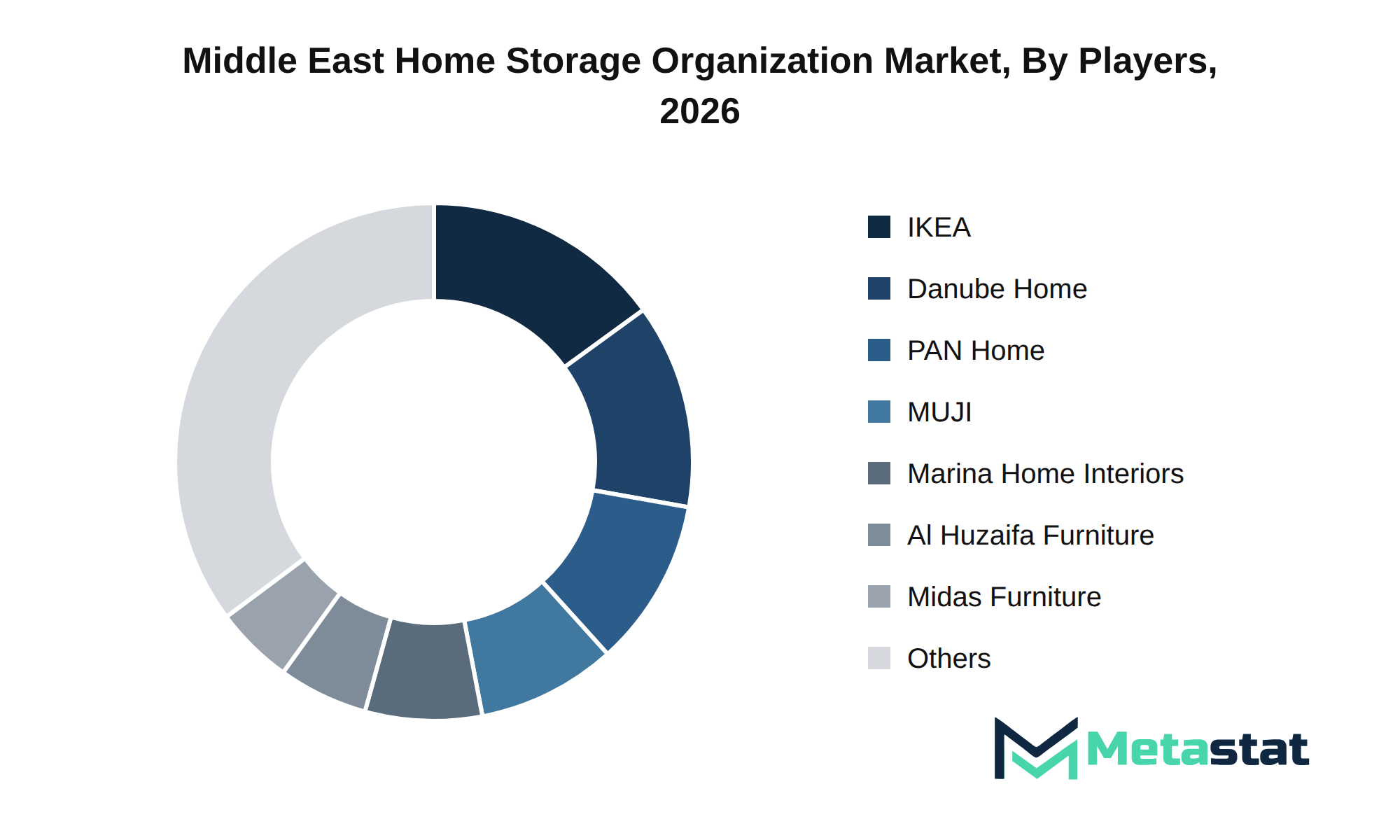
The competitive landscape in the Middle East Home Storage Organization market features various strategic behaviors among key players. Companies like IKEA, Danube Home, and MUJI focus on product differentiation by offering a broad range of innovative storage solutions that cater to the diverse needs of consumers in the region. This differentiation enhances brand equity and supports customer loyalty.
Strategic alliances and partnerships significantly expand market reach and enhance product offerings. Regional players including Marina Home Interiors and Al Huzaifa Furniture actively seek collaborations to improve their market presence. Competitive pricing architectures, alongside customer retention strategies, contribute to their positioning within the market.
Research and development efforts among competitors, including Keter Group and Midas Furniture, emphasize innovation in materials and design, which strengthens their technological defensibility. Barriers to entry remain prominent due to established brand equity and the capital-intensive nature of the industry. This environment presents challenges for new entrants, ensuring that existing players maintain their market position.
The future competitive outlook suggests a continued emphasis on value chain integration and procurement leverage, positioning companies to better respond to market demands. Overall, the dynamics within the Middle East Home Storage Organization market reflect a complex set of strategic initiatives aimed at sustaining growth and enhancing competitive advantage.
Market size is forecast to rise from USD 1,941.7 million in 2025 to over USD 2,913.7 million by 2033. The base case anticipates growth at a 5.2% CAGR, reflecting a steady increase in consumer demand for home storage solutions. Economic factors including rising disposable incomes and urbanization contribute to the expansion of the Middle East Home Storage Organization market. Increased investment in housing and infrastructure development enhances the demand for efficient storage solutions.
The bull case scenario projects heightened growth driven by rapid advancements in next-generation technology, improving product functionality and aesthetics. Integration of smart technologies into storage solutions presents new market opportunities, attracting tech-savvy consumers. In contrast, the bear case signals potential challenges including economic downturns, fluctuating raw material prices, and regulatory changes that could impact market dynamics.
Structural consumption shifts towards more organized living environments promote continuous innovation and diversification in product offerings. Strategic capital allocation towards research and development leads to commercialization timelines that align with evolving consumer preferences. Compliance with regulatory milestones and evolving policies regarding materials and safety standards shapes the competitive environment of the market.
Geopolitical realignments and trade corridor shifts influence supply chain dynamics, affecting pricing and availability of storage solutions. Meeting unmet enterprise needs through innovative products and services opens high-growth pockets within the market. Companies focusing on executive-level strategic imperatives and defensibility roadmaps position themselves to capture emerging opportunities, ensuring long-term growth and sustainability.
The report strategically identifies and profiles the key market players and analyses their core competencies in each sub-segment of the Home Storage Organization market.
Report Attributes | Details |
Study Period | 2021-2033 |
Base Year | 2025 |
Estimated Year | 2026 |
Forecast Period | 2026-2033 |
Historical Period | 2021-2025 |
Growth Rate | CAGR 5.2% from 2026 to 2033 |
Revenue Unit | USD million |
Segmentation | By Product Type, Primary Material, Distribution Channel, Country, and Region |
Find answers to common questions about this report
The Home Storage Organization market size in the Middle East was valued at USD 1,941.7 million in 2025.
The Home Storage Organization market is projected to grow at a CAGR of 5.2% during the forecast period from 2026 to 2033.
The leading segment in the Middle East Home Storage Organization market is "Cabinets, Cupboards & Sideboards," with a projected value of USD 522.4 million by 2033. This segment holds the largest share based on its revenue potential compared to other product types.
Key drivers for the Middle East Home Storage Organization market include urbanization, which increases housing density and demand for effective storage solutions. rising consumer spending patterns, coupled with changing lifestyles and an emphasis on home improvement, enhance the demand for innovative storage products that address clutter challenges.
Regulatory compliance poses a significant challenge for the Middle East Home Storage Organization market, because stringent regulations for product safety and environmental impact increase operational costs. geopolitical tensions disrupt supply chains, leading to higher costs and delays in product availability, which further constrains market growth.
Rapid urbanization and rising disposable incomes drive product adoption in the Middle East Home Storage Organization market. Consumers increasingly seek efficient and aesthetically pleasing storage solutions to address space limitations and enhance home organization. enhanced marketing efforts by suppliers boost awareness and appeal of these products, further stimulating demand.
The Home Storage Organization market is estimated to reach a valuation of USD 2,913.7 million by 2033.
Key players in the Middle East Home Storage Organization market include IKEA, Danube Home, PAN Home, MUJI, Marina Home Interiors, and Al Huzaifa Furniture.
The cabinets segment is projected to grow at a CAGR of 3.8% from USD 401.6 million in 2026 to USD 522.4 million by 2033.
Urbanization and changing lifestyles are primary drivers, increasing the need for effective storage solutions that maximize limited living space.
The analysts below cover Consumer Goods research at Metastat Insights.
LEAD ANALYST
Utkarsh Khirodkar is a Lead Market Research Analyst at MetaStat Insight, specializing in market intelligence, technology sector assessments, and competitive strategy.
Transitioning ultra-class mining haul trucks to alternative power requires concrete data on remote hydrogen refueling infrastructure economics. The report evaluated megawatt-scale electrolyzer installation expenses, onsite storage safety mandates, and heavy-duty fuel cell stack degradation under continuous duty cycles. That technical rigor helped our engineers benchmark realistic total operating cost horizons for off-highway fleet decarbonization.
Enterprise zero-trust network rollouts are often slowed down by multi-cloud transit latency and proprietary hardware retirement schedules. This study provided realistic total cost of ownership models comparing cloud-delivered security edge solutions against traditional hardware refreshes. The analysis of contract renewal lengths and software maintenance fees gave us clear visibility into enterprise replacement cycles over the next three to five years.
Scaling antibody-drug conjugate manufacturing hinges on contract manufacturing availability for high-potency active ingredients. The MetaStat Insight analysis looked closely at global cleanroom slot constraints, bioconjugation batch failure rates, and supply chain redundancies between the US, Europe, and India. The supplier capability matrix proved genuinely useful for our team when mapping secondary source options across our clinical pipeline.
Explore related market intelligence reports worth reading alongside this one.