
LEAD ANALYST
Utkarsh Khirodkar is a Lead Market Research Analyst at MetaStat Insight, specializing in market intelligence, technology sector assessments, and competitive strategy.

Global Multi-family and HOA Property Management Software Market Size, Share, By Solution Type (Accounting and Financial Management, Leasing and Resident Management, Maintenance and Work Order Management, Community Governance and Communication, Others), By Deployment Model (Cloud, Hybrid Deployment and On-Premises), By End User (Third-Party Property Management Companies, Multifamily Owners and Operators, HOA and Condominium Management Companies, Self-Managed Associations and Boards, Others), Industry Analysis, Growth, Trends, and Forecast, 2026-2033
Report ID
MSI-4827
Published
July, 2026
Updated
Pages
302 Pages
Format
Report Details
Choose Your License
Global Multi-family and HOA Property Management Software Market
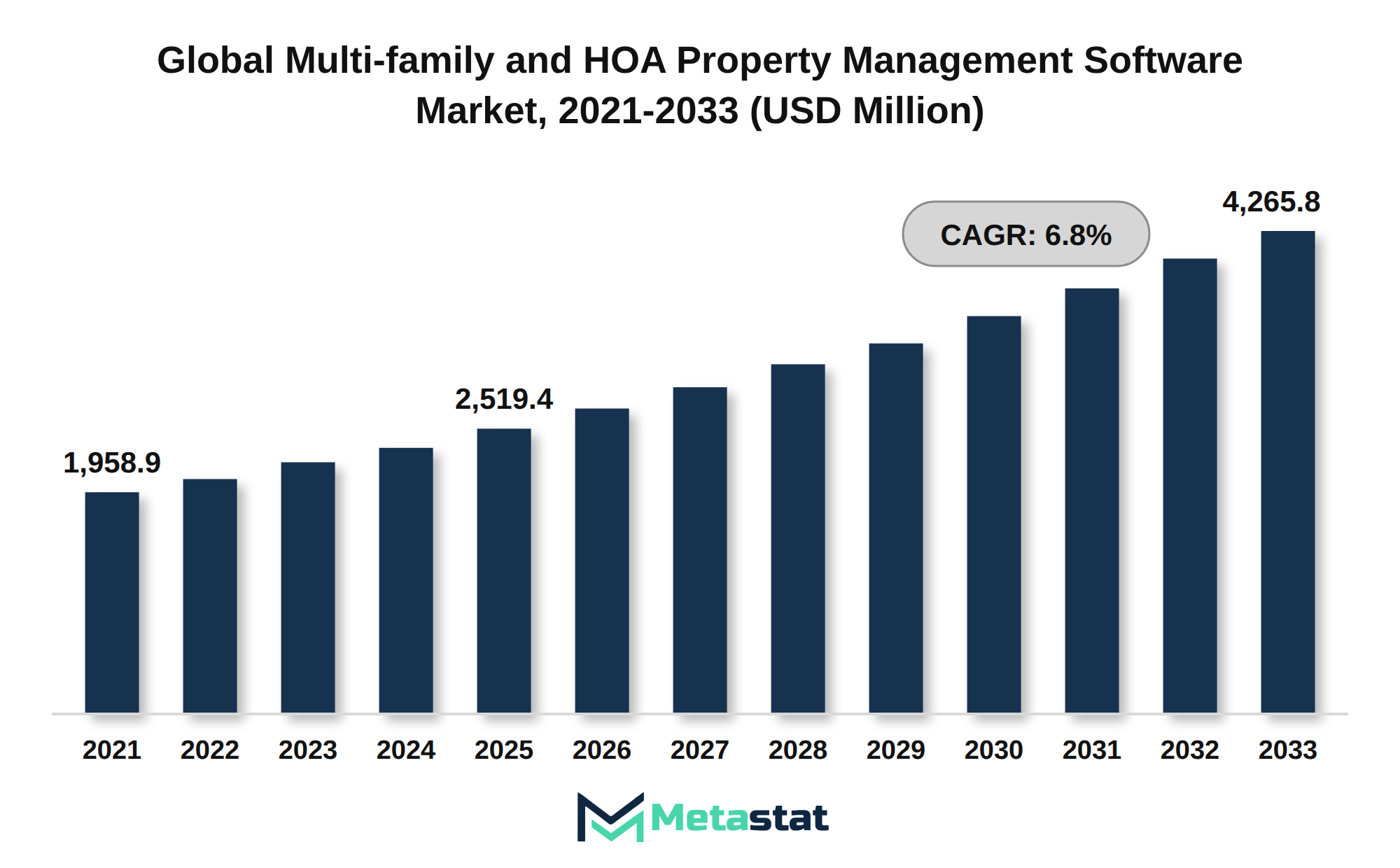
The global Multi-family and HOA Property Management Software market was valued at USD 2,519.4 million in 2025 and is projected to reach USD 4,265.8 million by 2033, growing at a CAGR of 6.8% over the forecast period.
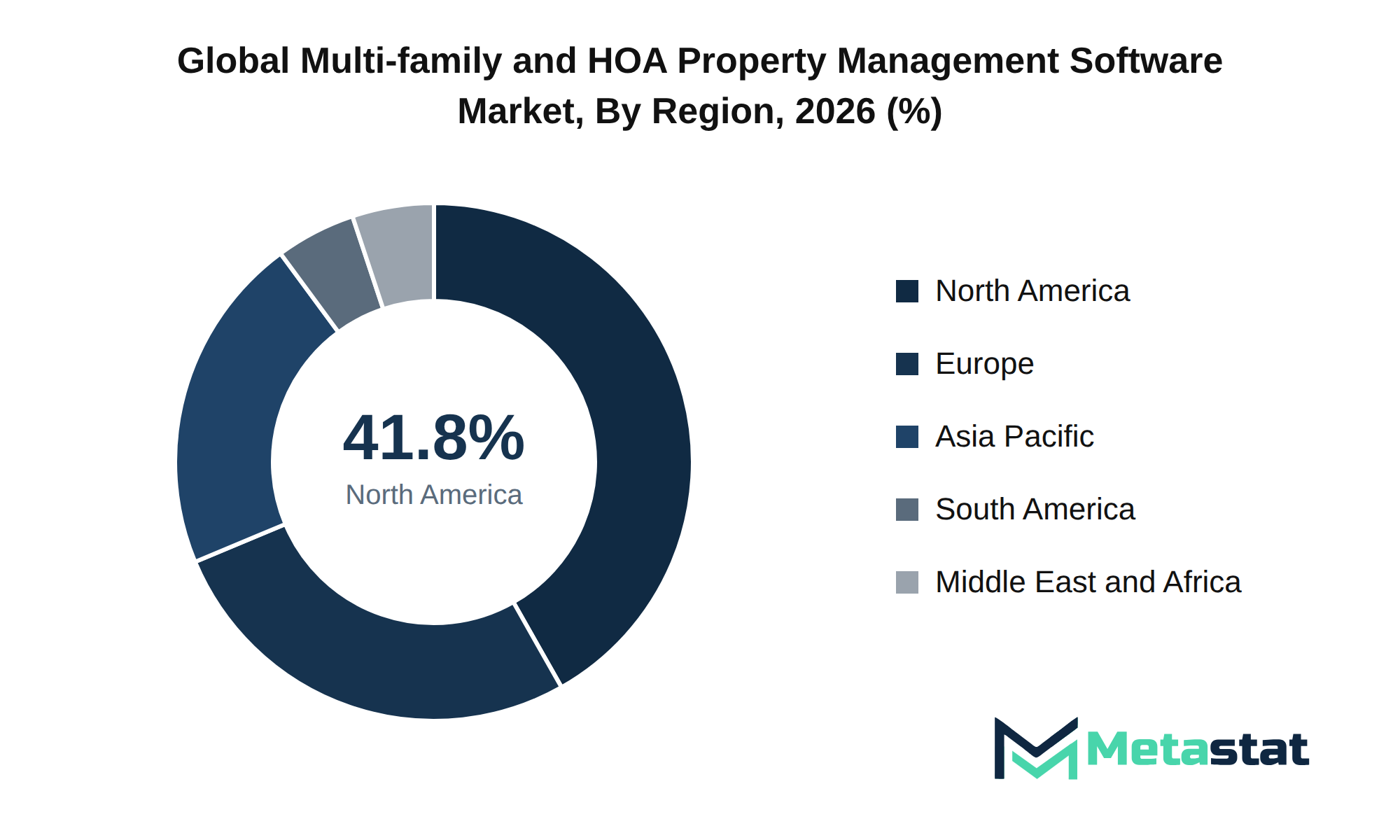
The Multi-family and HOA Property Management Software market, valued at USD 2,519.4 million in 2025, is projected to grow significantly, reaching USD 4,265.8 million by 2033. This growth represents a compound annual growth rate (CAGR) of 6.8% over the forecast period from 2026 to 2033. North America holds a substantial market share, accounting for 41.8% in 2025, with the United States leading this segment in 2026.
Geographically, North America dominates the market, driven by a combination of a strong economy, high occupancy rates in multi-family units, and a growing preference for technologically advanced property management solutions. The increasing demand for efficient management of residential properties supports the expansion of this sector. The projected market value for North America in 2033 is USD 1,705.5 million, maintaining a CAGR of 6.8% during the forecast period.
Europe follows as the second-largest region, contributing 26.9% to the market in 2025. The adoption of property management software in Europe is influenced by various factors including regulatory compliance, the need for improved operational efficiency, and a shift toward digital solutions. The Asia Pacific region holds 21.2% of the market share, reflecting a growing trend toward modernization in property management practices across countries like China, Japan, and India.
The increasing need for regulatory compliance within the real estate sector is driving demand for comprehensive software solutions, Property management software facilitates adherence to local regulations, ensuring that property managers and owners meet their legal obligations efficiently, are some of the key factors propelling the growth of the market.
Next-gen innovations play a critical role in shaping the market. Advancements in cloud-based solutions allow for greater flexibility and scalability, enabling property managers to access data remotely and streamline operations. The shift towards cloud deployment is notable, with a forecasted increase from USD 1,804.9 million in 2026 to USD 2,972.6 million by 2033, reflecting a CAGR of 7.4%. This growth indicates a clear trend towards embracing technology that enhances operational capabilities.
Additionally, the competitive environment of the market features a variety of players, including both established companies and new entrants. Key providers like AppFolio, Inc., Yardi Systems, Inc., and RealPage, Inc. are leading this industry, offering diverse solutions tailored to the needs of property management. The presence of multiple stakeholders contributes to market fragmentation, which can create opportunities for niche providers to capture specific segments of the market.
Investment in research and development (R&D) is essential for companies aiming to stay competitive in the Multi-family and HOA Property Management Software market. As customer needs evolve, organizations are focusing on developing innovative features that enhance user experience and operational efficiency. Continuous improvement and adaptation to market demands will be vital for sustaining growth and gaining market share over the coming years.
The Multi-family and HOA Property Management Software market is poised for significant expansion, driven by increasing demand for regulatory compliance, advancements in technology, and the competitive dynamics among key players. North America leads the market, with contributions from Europe and Asia Pacific. As the sector evolves, organizations will need to focus on innovation and customer-centric solutions to capitalize on emerging opportunities.
In the Multi-family and HOA Property Management Software market, regulatory compliance plays an essential role in shaping operational frameworks for property management companies. Adherence to local laws and regulations affects software functionalities and service offerings, ensuring that solutions align with legal requirements. Companies are expected to invest in understanding these regulations to avoid compliance risks and potential penalties. As regulations evolve, continuous updates to software systems become necessary, demanding ongoing investment in research and development to adapt to changes.
The competitive landscape of the market is characterized by a diverse range of players, including established companies such as AppFolio, Inc. and Yardi Systems, Inc., alongside newer entrants. This fragmentation drives innovation, as companies strive to differentiate their offerings through unique features and functionalities. The presence of numerous vendors provides customers with various choices, which will drive down costs and enhance service quality. However, it also leads to challenges in brand recognition and customer loyalty as consumers evaluate multiple options.
Capital allocation within the Multi-family and HOA Property Management Software market is heavily influenced by the need for robust infrastructure investments. Firms will allocate significant resources toward technology upgrades, cloud solutions, and security measures to maintain competitive advantages. The forecast indicates a rising trend in cloud-based deployments, with investments expected to reach USD 2,972.6 million by 2033, reflecting a compound annual growth rate (CAGR) of 7.4%. This shift toward cloud solutions highlights the importance of scalability and flexibility in meeting customer demands.
Macroeconomic factors significantly impact the market's growth trajectory. Inflationary pressures can influence operational costs for property management companies, which in turn may affect software pricing strategies. As costs rise, companies will need to adjust their pricing models to maintain profitability while remaining competitive. Economic conditions also play a role in consumer spending patterns, potentially affecting the adoption rates of property management solutions.
Despite the positive growth outlook for the Multi-family and HOA Property Management Software market, several constraints persist. Supply chain disruptions and geopolitical risks can hinder the timely delivery of necessary components and software updates. Companies will have to navigate these challenges to ensure operational efficiency and customer satisfaction. The dependency on consistent technological advancements and regulatory compliance will remain critical as the market evolves, necessitating strategic planning and investment to mitigate potential risks and capitalize on emerging opportunities. This ongoing focus on technology and compliance will be essential for sustaining growth and addressing future challenges.
Emerging digital transformation initiatives across various sectors are significantly enhancing the demand for Multi-family and HOA Property Management Software. As property management companies increasingly adopt advanced technologies such as automation and artificial intelligence, the need for comprehensive software solutions that facilitate these integrations has grown. This transition enables organizations to streamline operations, improve tenant engagement, and optimize property management processes. Enhanced software solutions appeal to both existing and prospective clients who seek to leverage technology for improved efficiency and productivity.
Regions such as North America are experiencing the most pronounced impact from these transformation initiatives, largely due to higher investment levels in technology and innovation. The market is projected to reach USD 1,705.5 million by 2033, reflecting a CAGR of 6.8%. Multifamily owners and operators, along with third-party management companies, focus on deploying cloud-based solutions to enhance accessibility and operational flexibility. As urbanization trends continue to rise, the need for effective property management tools becomes even more critical, further propelling market growth in these segments.
Suppliers in the market will adapt to the increasing demand for integrated solutions that support digital transformation efforts. The push for cloud-based deployment models indicates a shift towards scalable platforms that can accommodate evolving client needs. Providers will benefit from developing innovative features that align with ongoing digital trends, ensuring they remain competitive and responsive to the demands of a rapidly changing market.
Changing demographic trends, particularly the aging population and urbanization, significantly impact the Multi-family and HOA Property Management Software market. As more individuals, especially seniors, seek to downsize or transition into community-based living, the demand for multi-family and homeowners association (HOA) properties increases. This demographic shift necessitates sophisticated property management solutions that can address the unique needs of these communities, including enhanced communication, maintenance management, and financial oversight. In addition, younger generations, including millennials and Generation Z, are increasingly urbanizing, favoring rental properties over home ownership. This preference drives the need for efficient property management systems to cater to a higher volume of tenants and to facilitate effective leasing and resident management.
Regions with the most pronounced demographic changes, such as North America and Europe, experience heightened demand for property management software solutions. North America, particularly, is projected to maintain a significant share of the market, with expectations of reaching USD 1,705.5 million by 2033. As urban centers become more densely populated and the baby boomer generation ages, property management software becomes crucial in managing growing tenant bases and maintaining operational efficiency. In Europe, similar demographic trends apply, resulting in increased demand for innovative solutions that streamline property management processes.
For suppliers, these demographic shifts present opportunities to develop tailored solutions that address the specific needs of diverse user groups. By leveraging insights from shifting demographics, software providers can enhance their offerings to include features such as community engagement tools, real-time maintenance tracking, and financial reporting capabilities. Adapting to these trends will enable suppliers to capture a larger market share within the evolving Multi-family and HOA Property Management Software market, ensuring they remain competitive and relevant in an increasingly dynamic environment.
High capital investment requirements pose a significant constraint on the Multi-family and HOA Property Management Software market. Many prospective buyers, particularly smaller property management firms and self-managed associations, struggle to secure the necessary funding to implement comprehensive software solutions. This financial barrier arises from the substantial upfront costs associated with software acquisition, hardware upgrades, and ongoing maintenance expenses. Larger organizations have the resources to invest, while smaller entities face limitations that restrict their ability to adopt advanced property management software.
Regions that absorb the most damage from these capital constraints include North America and Europe, where competitive pressures drive the need for sophisticated software. However, many smaller companies in this region may be unable to make the necessary investments in technology. Similarly, Europe faces challenges as smaller firms struggle against larger competitors with more substantial financial backing. This disparity creates a competitive imbalance that hinders growth opportunities for smaller players across both regions.
The industry is currently addressing these challenges through flexible payment options and subscription models that lower the initial financial burden. Software providers offer tiered pricing structures or cloud-based solutions that reduce the need for extensive upfront capital. Despite these efforts, the workaround remains incomplete, as many organizations still find the total cost of ownership to be prohibitively high. As a result, the potential users may opt for lower-cost alternatives or continue with manual processes, limiting overall adoption of advanced property management software in the market.
Firms operating within the Multi-family and HOA Property Management Software market face significant operational challenges stemming from compliance overhead and evolving legal liabilities. These complexities arise from tightening global regulatory standards, which necessitate substantial resources for adherence. As regulations shift, organizations must continuously adapt their software solutions to meet compliance demands, leading to increased operational costs and potential disruptions in service delivery.
The difficulties are particularly pronounced in North America and Europe, where regulatory frameworks are more stringent. In these regions, firms encounter heightened scrutiny regarding data protection and tenant rights. This can result in extensive legal consultation and software modifications, which detract from core operational efficiencies and innovation efforts. Companies that primarily manage multi-family housing or homeowner associations are especially affected, as they must balance compliance requirements with tenant satisfaction and operational excellence.
To address these challenges, firms are investing in enhanced compliance management systems and legal expertise, which adds to their overall financial burden. This investment does not come without cost; for many organizations, the allocation of resources toward compliance and legal oversight diverts funds from other critical areas such as technology upgrades or customer service enhancements. As a result, the market experiences pricing compression and margin pressures, potentially hindering growth prospects. The focus on compliance also necessitates ongoing training for employees, further straining operational budgets. While the need for robust compliance frameworks is essential, it imposes notable challenges that firms must actively manage to sustain their competitiveness in the market.
Growth in the Multi-family and HOA Property Management Software market is being significantly influenced by emerging regional demands. The increasing urbanization and a rise in the number of multi-family housing units have created a pressing need for efficient property management solutions. As markets in North America, Europe, and Asia Pacific expand, the demand for software that can streamline operations, enhance tenant satisfaction, and ensure compliance with local regulations becomes critical. The market's value is projected to grow from USD 2,519.4 million in 2025 to USD 4,265.8 million by 2033, demonstrating a compound annual growth rate (CAGR) of 6.8% throughout the forecast period.
Companies that can effectively capture this market opportunity will need to prioritize technological advancements and tailored solutions to meet regional needs. Providers must focus on functionalities such as leasing and resident management, community governance, and maintenance tracking to keep pace with user expectations. The ability to offer cloud-based solutions, which are anticipated to reach USD 2,972.6 million by 2033, will be particularly essential for companies aiming to enhance service delivery and operational efficiency. In addition, integrating sustainability imperatives and eco-friendly practices into their offerings will connect with environmentally conscious consumers and organizations.
The timing for capitalizing on this opportunity is crucial, as many competitors are already advancing their software capabilities. Rapid technological shifts and evolving buying behaviors are creating a narrow window for market entry and expansion. Companies that delay in adopting innovative solutions or fail to align with the demands of multi-family and HOA sectors risk losing market share to more agile competitors. As the market evolves, those who invest in next-generation innovations and operational improvements will strengthen their presence in this growing market.
The Global Multi-family and HOA Property Management Software market is segmented based on Solution Type, Deployment Model, End User, and undefined.
Valued at USD 798.6 million in 2026, the Accounting and Financial Management segment is projected to reach USD 1,200.3 million by 2033, reflecting a CAGR of 6% during the forecast period. This growth is driven by increasing demand for automated financial solutions among multi-family and HOA property managers. As organizations seek to enhance operational efficiency, there is a significant shift towards software that facilitates streamlined accounting processes, tax compliance, and financial reporting.
Adoption of cloud-based solutions will further accelerate this growth, as they provide scalable and flexible options for managing finances. The transition to cloud computing allows property management firms to access real-time financial data, which improves decision-making and enhances overall management. Regulatory compliance standards continue to evolve, necessitating robust financial management systems that can adapt to changing regulations and reporting requirements.
The market is also witnessing an uptick in next-gen upgrades, including features that integrate artificial intelligence and machine learning for predictive analytics. These advancements improve efficiency and allow for more accurate forecasting and budgeting. As technology matures, firms are increasingly looking for comprehensive solutions that encompass both accounting and financial management, leading to greater product evolution and innovation in the market.
By 2033, the Leasing and Resident Management segment is projected to reach USD 1,093.3 million, growing at a CAGR of 7.1% throughout the forecast period. This segment benefits from several primary demand drivers, including a strong push towards digital transformation in property management practices. As property owners and management companies seek efficient ways to manage lease agreements and resident interactions, the adoption of advanced software solutions is gaining traction.
Technological maturation is significant for this segment's growth. The integration of cloud-based solutions is enhancing accessibility and streamlining operations for property managers. Next-generation upgrades, including mobile access and real-time data analytics, are increasingly in demand, enabling property managers to respond quickly to resident needs and optimize leasing processes.
End-use dynamics further influence market expansion. As more multifamily and HOA management companies recognize the benefits of automated systems, the shift toward resident-focused features such as online payments and communication portals becomes essential. Regulatory compliance standards are adding pressure to these companies, driving them to invest in software that ensures adherence to evolving legislation.
Within the Multi-family and HOA Property Management Software market, the Leasing and Resident Management segment stands out for its potential to enhance operational efficiency and improve resident satisfaction through innovative technology solutions.
By 2033, the Maintenance and Work Order Management segment is projected to reach USD 920.9 million. This growth is primarily driven by increasing demand for efficient property maintenance solutions as property managers seek to enhance tenant satisfaction while reducing operational costs.
Adoption rates are rising significantly as property management firms recognize the benefits of streamlined workflows. These solutions facilitate real-time tracking of maintenance requests, enabling property managers to prioritize tasks effectively and improve service delivery. Enhanced communication platforms integrated within these systems further support responsiveness, ensuring that tenant concerns are addressed promptly.
Technological advancements are important in this segment, with next-generation upgrades such as AI-driven analytics and mobile applications transforming how maintenance tasks are handled. These innovations not only optimize resource allocation but also provide valuable insights into maintenance patterns, helping operators to anticipate issues before they escalate.
As the Multi-family and HOA Property Management Software market evolves, regulatory compliance standards are becoming more stringent. Software that ensures adherence to safety and maintenance regulations is increasingly sought after, shifting focus toward compliance-driven solutions. This trend highlights the importance of integrating robust reporting features into maintenance management systems.
This segment is projected to grow at a CAGR of 6.6% during the forecast period. As property management practices evolve, the demand for effective community governance and communication tools is becoming increasingly critical. Property managers and homeowners associations (HOAs) are recognizing the importance of streamlined communication channels to enhance resident engagement and improve operational efficiency.
Key factors driving this growth include the increasing need for transparency in community management and the desire for collaborative decision-making processes among residents. Software solutions that facilitate real-time communication, notifications, and document sharing are gaining traction as they address these demands. The integration of mobile applications within community governance software has proven to enhance user experience, catering to a demographic that increasingly relies on mobile devices for information access.
Technological advancements play a vital role in the evolution of this segment. Features such as automated reminders, online voting systems, and community forums are being adopted to ensure that residents remain informed and involved. Such innovations not only improve operational efficiencies for property managers but also create a sense of community among residents.
As the Multi-family and HOA Property Management Software market continues to expand, the Community Governance and Communication segment is set to capitalize on trends favoring digital solutions that enhance interaction and collaboration within communities.
In the Multi-family and HOA Property Management Software market, the "Others" segment, which encompasses Records, Compliance, Violation Management, Contractor Management, and Analytics, is essential for enhancing operational efficiency and regulatory adherence. Primary demand drivers for this segment include the increasing need for accurate record-keeping and compliance management, as regulatory requirements become more stringent across various regions. This necessity is heightened by the growing complexity of property management laws and the heightened scrutiny from regulatory bodies.
Adoption of advanced analytics tools within this segment is a significant catalyst for expansion. These tools provide valuable insights, enabling property managers to make data-driven decisions that enhance performance and tenant satisfaction. As technology matures, the integration of compliance and violation management solutions with existing systems becomes more feasible, making it easier for property managers to streamline operations.
Additionally, the evolution of contractor management solutions is gaining traction, driven by the need to efficiently oversee vendor relationships and service delivery. This shift not only optimizes costs but also ensures that property management organizations can maintain high service standards. Overall, the Others segment is characterized by its capacity to adapt to regulatory changes, improve operational workflows, and leverage data analytics for enhanced decision-making.
Valued at USD 1,804.9 million in 2026, the cloud segment is projected to reach USD 2,972.6 million by 2033, reflecting a compound annual growth rate (CAGR) of 7.4% during the forecast period. This growth can be attributed to several factors that are shaping the demand for cloud-based solutions in the Multi-family and HOA Property Management Software market.
Increasing adoption of cloud technology across real estate sectors is a primary demand driver. Property management companies are increasingly seeking solutions that offer remote accessibility, scalability, and reduced IT maintenance costs. The shift towards cloud solutions allows organizations to enhance operational efficiency and reduce overhead expenses, which is particularly appealing in a competitive market.
In addition, segment expansion is driven by technological maturation. As cloud technologies advance, they provide enhanced capabilities such as advanced analytics, real-time reporting, and improved customer engagement features. These functionalities are crucial for property managers aiming to streamline operations and enhance tenant satisfaction.
Consumption shifts also play a significant role in this segment's growth. With rising tenant expectations for digital experiences, property management software must evolve. Cloud solutions facilitate the integration of next-gen upgrades and features that meet these demands. Consequently, firms in the sector are prioritizing investments in cloud-based tools to remain competitive and responsive to market changes.
By 2033, the Hybrid Deployment segment is estimated to reach USD 758.7 million, expanding at a CAGR of 6.6% during the forecast period. A key driver of growth in this segment is the increasing demand for flexible solutions that combine the benefits of both on-premises and cloud-based deployments. Organizations seek to optimize their operations while addressing unique challenges such as data security and compliance, particularly in the Multi-family and HOA Property Management Software market.
Adoption of hybrid deployment models allows property management companies to leverage existing investments in infrastructure while gaining access to the scalability and innovation offered by cloud solutions. This flexibility is particularly appealing to multifamily owners and operators who may face varying regulatory requirements across different regions, prompting a need for adaptable technology solutions.
Another factor contributing to the segment's expansion is the technological maturation of property management software. As solutions evolve, they incorporate advanced features such as analytics and integration capabilities, which enhance operational efficiency and user experience. Next-generation upgrades are increasingly being prioritized, driven by the need for advanced functionalities that support complex property management tasks.
Overall, the growth of the Hybrid Deployment segment reflects a broader trend in the market towards integrated solutions that meet diverse operational needs while addressing the specific challenges faced by property managers and associations.
By 2033, the On-Premises segment is expected to reach USD 534.5 million. The growth of this segment is driven by specific demand drivers, including the necessity for robust data security measures and regulatory compliance, which many organizations prioritize. On-premises solutions allow for greater control over sensitive information, making them particularly appealing to large property management firms and HOAs that manage extensive real estate portfolios.
Adoption of on-premises software in the Multi-family and HOA Property Management Software market is often influenced by existing IT infrastructure and budget constraints. Organizations with significant legacy systems may find it more feasible to integrate new software into their current setup rather than transitioning to cloud-based solutions. This lingering reliance on traditional systems can result in slower growth for the segment, yet it remains critical for entities that prioritize control and customization.
Segment expansion catalysts include advancements in software functionalities, which have made on-premises solutions more adaptable to evolving market needs. This adaptability allows property management companies to tailor features according to specific operational demands, driving interest among users looking for bespoke solutions. The prevalence of regulatory compliance standards across regions necessitates that organizations invest in systems that can adequately address legal and operational requirements.
Ultimately, as the market for Multi-family and HOA Property Management Software develops, on-premises solutions will retain their relevance by catering to a distinct user base that values control, compliance, and the ability to tailor their systems to meet unique business needs.
In the Multi-family and HOA Property Management Software market, third-party property management companies are driving significant demand for advanced software solutions. The increasing complexities of property management, including the need for efficient financial tracking and tenant communication, highlight the importance of robust software capabilities. These companies often manage multiple properties, requiring effective tools to streamline operations, enhance tenant experiences, and ensure compliance with various regulations.
Adoption of technology among these companies is facilitated by a growing recognition of the value that comprehensive property management software can bring. The need for scalability is critical, as these firms aim to expand their portfolios without compromising service quality. As they integrate more software solutions, the focus on technological maturation becomes evident, with providers constantly updating their offerings to meet evolving market needs.
The increased emphasis on automation and data analytics is reshaping the environment for third-party property management companies. The ability to leverage data insights enables better strategic decision-making, enhancing operational efficiencies and tenant satisfaction. As a result, these companies are more inclined to invest in next-gen upgrades that promise to improve overall service delivery.
With ongoing regulatory compliance requirements, third-party managers face the challenge of maintaining adherence to evolving standards. Software solutions that offer compliance tracking features are becoming essential, ensuring that these companies can navigate the complexities of property management while minimizing risks associated with non-compliance.
Increasing tenant expectations drive demand for advanced digital solutions among multifamily owners and operators. As property managers seek to enhance resident satisfaction and engagement, they are adopting software that facilitates effective communication and efficient management processes. This trend is particularly pronounced in urban markets where competition for tenants is fierce. Owners are prioritizing systems that offer integrated features such as maintenance requests, online payment options, and community management tools.
Adoption rates of property management software in this segment are supported by the need for operational efficiency. Many multifamily owners are transitioning from manual processes to automated solutions that streamline tasks, reduce errors, and save time. This shift not only lowers operational costs but also allows property managers to allocate resources more effectively, contributing to overall business growth.
Technological maturation is influencing product evolution within the market. Multifamily owners are increasingly inclined to invest in next-gen upgrades that provide analytics and reporting capabilities, enabling data-driven decision-making. As these technologies advance, they allow owners to optimize rental pricing, forecast occupancy trends, and enhance overall property performance. This investment in technology supports a more competitive stance in the market.
Regulatory compliance standards also play a critical role in shaping the market dynamics. Multifamily owners must navigate various laws and regulations related to tenant management, safety, and environmental standards, prompting them to adopt compliant software solutions that simplify record-keeping and reporting. This necessity further fuels the market for property management software tailored to meet these stringent requirements.
In the context of HOA and Condominium Management Companies, several factors drive the demand for specialized software solutions. As these entities manage multiple residential units, they face unique challenges that necessitate efficient operational management. This pressure often leads to increased adoption of Multi-family and HOA Property Management Software, which can streamline processes such as accounting, communication, and maintenance tracking.
Technological maturation plays an important role in this segment. Advances in cloud computing enable more scalable and accessible software solutions, which are particularly appealing to HOA and condominium management firms. The shift towards cloud-based models allows for real-time data access, improving decision-making and enhancing the overall management experience.
Next-generation upgrades further facilitate this transition. New features such as automated maintenance requests, integrated payment systems, and communication tools cater to the evolving needs of communities, making software not just a tool for management, but a comprehensive platform for resident engagement. This evolution aligns with the broader trends in consumer expectations for immediate, efficient service. The integration of these advanced features supports the operational efficiency that management companies seek.
Cost structures also significantly impact the decisions of HOA and condominium management companies. As these organizations seek to balance operational costs while maintaining service quality, software that offers flexible pricing models becomes increasingly attractive. Ultimately, the intersection of these factors contributes to the ongoing growth within the multi-family and HOA property management software market.
Self-managed associations and boards play a significant role in the Multi-family and HOA Property Management Software market, primarily driven by the need for effective governance and communication within communities. Members of these associations increasingly seek tools that streamline administrative tasks, facilitate communication, and enhance community engagement. This shift in demand is mainly influenced by the desire for greater control over property management processes, allowing associations to manage budgets, enforce rules, and maintain community standards more effectively.
Adoption of technology in self-managed associations is driven by the increasing availability of user-friendly software solutions that cater specifically to the needs of smaller boards and committees. These solutions typically offer features such as financial management, maintenance tracking, and community communication tools. As technological maturation continues, self-managed associations are more likely to integrate advanced functionalities, including mobile access and cloud-based solutions, which enhance user experience and operational efficiency.
Additionally, the evolution of products within this segment reflects a growing emphasis on customization and scalability. As associations expand or contract, software solutions must adapt to meet varying needs. This flexibility is essential for boards managing diverse community types, from small homeowner associations to larger condominium complexes. Regulatory compliance also remains a crucial factor, with associations increasingly prioritizing software that assists in staying updated with local regulations and standards, thereby reducing risk and enhancing community trust.
Real estate developers, housing authorities, housing cooperatives, and asset management firms significantly influence the Multi-family and HOA Property Management Software market. These stakeholders are increasingly adopting advanced software solutions to enhance operational efficiency and streamline management processes. The growing demand for integrated platforms allows these entities to manage multiple properties effectively while ensuring compliance with regulatory standards.
One primary driver for adoption in this segment includes the shift towards digitization and automation. Housing authorities and cooperatives are leveraging software to manage tenant relations, track compliance with housing regulations, and streamline financial reporting. As these organizations face increasing pressure to improve service delivery, the use of technology becomes essential in optimizing their operations.
Technological maturation encourages adoption among these end-users. The availability of next-gen upgrades offers enhanced functionalities such as real-time analytics, improved communication tools, and better maintenance management systems. Consequently, this shift provides a competitive edge for organizations that embrace these robust solutions.
As the market evolves, strategic opportunity windows are opening for software vendors targeting this segment. By focusing on the unique needs of real estate developers and housing authorities, companies can create tailored solutions that address specific challenges, such as compliance and tenant management, thus driving growth in the market.
Based on geography, the Global Multi-family and HOA Property Management Software market is divided into North America, Europe, Asia-Pacific, South America, Middle East, and Africa.
The North America Multi-family and HOA Property Management Software market is projected to experience significant growth, expanding at a CAGR of 6.8% during the forecast period. By 2033, the market is expected to reach a total addressable market (TAM) of USD 1,705.5 million. This growth is largely attributed to increasing demand for digital solutions across various segments, particularly in the United States, Canada, and Mexico.
In 2025, North America is expected to hold a substantial share of the global market. This dominant position reflects the region’s advanced infrastructure and the widespread adoption of technology solutions among property management entities. The presence of major players in the market further enhances competitive dynamics, encouraging innovations that cater to the evolving needs of property owners and residents.
Adoption rates for Multi-family and HOA Property Management Software are particularly strong in urban areas, where density leads to higher management complexity. The trend toward cloud-based solutions is expected to drive growth, as more property management companies seek scalable options that support remote operations and enhance data accessibility.
Emerging market front-runners, especially in metropolitan regions, are expected to further contribute to market expansion. The increasing number of high-density residential developments in cities such as New York, Toronto, and Mexico City present ample opportunities for vendors to offer tailored solutions that address specific needs.
Infrastructure modernization initiatives across North America also play a role in the market’s growth trajectory. As property management firms upgrade their systems to comply with new regulations and improve operational efficiency, demand for advanced software solutions rises. This evolution is essential for maintaining competitiveness and addressing tenant expectations for reliable service delivery.
Europe holds a significant share of the Multi-family and HOA Property Management Software market, capturing 26.9% of the global market in 2025. This region's diverse real estate landscape contributes to its dynamic adoption rates of property management solutions. In countries such as Germany, France, and the UK, heightened tenant expectations and the demand for advanced digital solutions are leading to greater investment in software capabilities.
Germany's mature market dynamics exhibit strong growth, driven primarily by the rising trend of digital transformation among property management firms. The need for streamlined processes in leasing and maintenance management is driving the adoption of cloud-based solutions. Additionally, the growing emphasis on regulatory compliance in several European nations encourages innovation within the sector.
Emerging market front-runners like Spain and Italy are also experiencing increased interest in property management software. Local companies are beginning to recognize the value of efficient communication and governance tools, particularly within homeowner associations and condominium management. As these markets expand, they are likely to attract more investment, further enhancing their capabilities in the property management space.
Russia, while facing geopolitical challenges, remains a noteworthy player in the European market. Local compliance mandates and regulatory frameworks are influencing software purchasing decisions, driving demand for tailored solutions that accommodate unique regional needs. This localized focus may provide opportunities for domestic vendors to consolidate their positions as market leaders.
As the market continues to evolve, incremental growth vectors such as energy-efficient solutions and localized procurement dynamics will influence strategic entry barriers for new entrants. Companies operating in Europe must navigate a complex regulatory environment while capitalizing on technological advancements to maintain competitiveness. Efforts towards infrastructure modernization will remain essential, enabling the region to leverage its existing assets while preparing for future growth in the Multi-family and HOA Property Management Software market.
The Asia-Pacific region accounts for a significant share of the Multi-family and HOA Property Management Software market. This region's growth is supported by increasing urbanization and a rising demand for residential properties, particularly in countries like China and India. The ongoing expansion of real estate development in urban centers is a crucial factor driving the adoption of advanced property management solutions.
China and India are emerging market front-runners, showing high adoption rates of software solutions. In China, rapid economic growth and an expanding middle class have led to increased investment in residential real estate. Meanwhile, India’s growing population and urban migration contribute to a heightened need for effective property management to address tenant needs and streamline operations.
Infrastructure modernization efforts in the region also play a vital role. Governments in countries such as Japan and South Korea are investing heavily in smart city initiatives, which include integrating technology into property management systems. This trend is likely to encourage further adoption of the market's software solutions, as property owners seek to improve operational efficiency and enhance resident experiences.
The market also faces challenges in areas that remain underpenetrated, particularly in Southeast Asia and the Rest of Asia Pacific. These regions present growth opportunities for vendors looking to establish a presence. As local compliance mandates evolve, the demand for tailored software solutions that meet specific regulatory requirements will increase.
From a competitive perspective, the Asia-Pacific market features a mix of domestic players and multinational companies. This dynamic creates a competitive environment where local vendors can capitalize on their understanding of regional nuances while leveraging the advanced technologies offered by international firms. As the sector matures, the focus on customer-centric service models will likely intensify, prompting further software innovations and enhancements in product offerings.
With a projected share of 5.00% of the global market in 2025, the South America region is poised for growth in the Multi-family and HOA Property Management Software market. Brazil and Argentina are the primary contributors to this market, with Brazil leading in adoption rates. This growth is driven by increasing urbanization, which boosts demand for efficient property management solutions.
Emerging market front-runners like Brazil are experiencing an uptick in the demand for cloud-based solutions. This trend aligns with the global shift towards digital transformation, as property management companies seek to improve operational efficiency and enhance resident satisfaction. The segment for Leasing and Resident Management is expected to show significant growth, reflecting the need for streamlined tenant interactions.
Infrastructure modernization efforts in South America also play a role in market expansion. Investments in technology and local infrastructure readiness contribute to a favorable environment for adopting advanced property management software. Underpenetrated territories in the region present opportunities for vendors to introduce their solutions and capture new market share.
In Argentina, cultural nuances influence B2B buying behaviors, where localized approaches can enhance vendor success. Domestic market leaders are adapting their strategies to address specific regional needs, thereby increasing their competitiveness. The presence of several local players alongside international firms creates a competitive environment that benefits end-users by providing a variety of choices.
Overall, the Multi-family and HOA Property Management Software market in South America is experiencing incremental growth vectors, with Brazil and Argentina leading the way. As the region embraces technological advancements and improved operational frameworks, the market is expected to evolve, catering better to the needs of property management companies and their clients.
The Multi-family and HOA Property Management Software market is experiencing a notable presence in the Middle East and Africa. This region, particularly countries such as Saudi Arabia, the UAE, and South Africa, is seeing a rise in demand driven by several factors, including urbanization and a growing housing sector.
Saudi Arabia and the UAE are emerging market front-runners, characterized by significant infrastructure modernization initiatives. These countries aim to enhance their urban environments, thereby increasing the need for advanced property management solutions. The growth in these nations is fueled by foreign direct investment (FDI) flows, which are directed toward real estate development and modernization efforts.
In South Africa, the market dynamics reflect a gradual but steady adoption of property management software, driven by a maturing real estate sector and an increasing focus on operational efficiency. The adoption rates in South Africa suggest that there is considerable room for growth, particularly as more property management companies recognize the value of integrating technology into their operations.
The Rest of Middle East and Africa also presents underpenetrated territories where the market can expand. Countries in this category are increasingly adopting digital solutions to improve property management efficiency and governance. Cultural nuances and localized procurement dynamics in these areas further influence the unique buying behaviors exhibited by businesses.
Investment in localized manufacturing and the availability of technology infrastructure are key factors that contribute to market growth. The region's competitive environment includes various domestic players and international vendors, each aiming to capitalize on the increasing demand for Multi-family and HOA Property Management Software. This competitive environment is expected to stimulate further innovation and efficiency within the market.
The Multi-family and HOA Property Management Software market exhibits a diverse competitive structure, marked by the presence of both established players and emerging firms. Key participants include AppFolio, Inc., Yardi Systems, Inc., RealPage, Inc., and MRI Software LLC, alongside various specialized providers like Entrata, Inc., ResMan, LLC, and DoorLoop Inc. This competitive range enables product differentiation across various solutions, including accounting and financial management, leasing and resident management, and maintenance and work order management. The growth of cloud-based solutions has further intensified competition, with companies investing heavily in technology to enhance service delivery.
Consolidation patterns are evident in the market, as larger firms pursue strategic mergers and acquisitions to broaden their service offerings and strengthen their market positions. This trend allows companies to enhance their technological capabilities and expand their customer bases. The focus on strategic alliances and partnerships is notable, enabling firms to leverage complementary strengths. For instance, alliances between property management software providers and financial service companies can enhance value propositions through integrated offerings, increasing customer retention and driving sales growth.
Pricing strategies in the market vary widely, influenced by deployment models and solution types. Companies offering cloud solutions often adopt subscription-based pricing, appealing to customers seeking flexibility and scalability. This pricing model contrasts with traditional on-premises solutions, which typically require significant upfront investments. As the market continues to evolve, firms must navigate pricing architectures that balance competitiveness with profitability, particularly in a landscape where customer expectations are shifting towards more affordable and comprehensive solutions.
Barriers to entry in the Multi-family and HOA Property Management Software market are shaped by several factors, including technological complexity, brand loyalty, and regulatory compliance. New entrants face challenges in establishing credibility against well-known brands like Yardi Systems, Inc. and AppFolio, Inc., which have secured strong customer bases and built extensive product ecosystems. Additionally, the necessity for continuous innovation in software features and user experience presents a significant hurdle for startups aiming to compete. As the market matures, the threat of new entrants is tempered by the established players' capacity to invest in research and development, ensuring they maintain technological leadership.
Switching costs for end users can deter customers from transitioning to new platforms, reinforcing the competitive positions of existing players. Providers that deliver robust customer support and integration with existing processes will likely encourage greater loyalty among their clients. Intellectual property (IP) positioning also has a significant impact on competitive dynamics, as firms with strong patent portfolios can defend against market disruptions and maintain a technological edge.
Looking ahead, the Multi-family and HOA Property Management Software market is poised for continued growth, with a projected increase to USD 4,265.8 million by 2033, reflecting a compound annual growth rate (CAGR) of 6.8%. As the demand for integrated property management solutions rises, companies will need to adapt their strategies to meet evolving customer needs while navigating the complexities of the competitive landscape. Defensive imperatives, such as investing in innovation and enhancing customer engagement, will be essential for sustaining growth and capturing market share in this dynamic environment.
The Multi-family and HOA Property Management Software market is projected to experience significant growth, with market size forecast to rise from USD 2,519.4 million in 2025 to over USD 4,265.8 million by 2033. This trajectory represents a compound annual growth rate (CAGR) of 6.8%, reflecting increasing demand for efficient property management solutions across various segments and regions.
As the market matures, strategic capital allocation will become essential for sustained growth. Companies should focus on emerging white-space opportunities that address unmet enterprise needs, particularly in the realms of leasing and resident management, and maintenance and work order management. Investing in research and development for next-generation technology integration could yield substantial returns. Firms that prioritize a diversified product portfolio will likely weather fluctuations in demand more effectively.
Executives will develop defensibility roadmaps that identify potential risks and outline strategic imperatives to enhance resilience against economic cycles. This includes evaluating the deployment model preferences of end users, with an increasing shift towards cloud-based solutions expected to dominate the market. Companies should continue to explore hybrid deployment models to appeal to a wider range of customers, ensuring that they meet the evolving needs of third-party property management companies, multifamily owners, and self-managed associations.
Infrastructure commitments and capital expenditure investment vectors must align with anticipated market demand. By identifying and prioritizing investments in infrastructure that supports scalable software solutions, companies can strengthen their market positioning and enhance their operational capabilities. This proactive approach will help mitigate risks associated with market fluctuations and regulatory changes.
Continued investment in technology innovation, alignment with customer needs, and responsiveness to changing market dynamics are essential. Successful navigation of geopolitical challenges, adherence to regulatory changes, and a commitment to strategic partnerships will also play a crucial role in ensuring the Multi-family and HOA Property Management Software market realizes its growth potential through 2033.
The report strategically identifies and profiles the key market players and analyses their core competencies in each sub-segment of the Multi-family and HOA Property Management Software market.
|
Report Attributes |
Details |
|
Study Period |
2021-2033 |
|
Base Year |
2025 |
|
Estimated Year |
2026 |
|
Forecast Period |
2026-2033 |
|
Historical Period |
2021-2025 |
|
Growth Rate |
CAGR 6.8% from 2026 to 2033 |
|
Revenue Unit |
USD million |
|
Segmentation |
By Solution Type, Deployment Model, End User, and Region |
|
By Region |
North America (By Solution Type, Deployment Model, End User, and Country)
|
|
Europe (By Solution Type, Deployment Model, End User, and Country)
|
|
|
Asia Pacific (By Solution Type, Deployment Model, End User, and Country)
|
|
|
South America (By Solution Type, Deployment Model, End User, and Country)
|
|
|
Middle East and Africa (By Solution Type, Deployment Model, End User, and Country)
|
Find answers to common questions about this report
The Multi-family and HOA Property Management Software market size was valued at USD 2,519.4 million in 2025, according to the Metastat Insights study.
The Multi-family and HOA Property Management Software market is expected to experience a growth rate of 6.8% CAGR during the forecast period from 2026 to 2033.
According to Metastat Insights analysis, the North America Multi-family and HOA Property Management Software market size is projected to reach USD 1,705.5 million by 2033.
Leasing and Resident Management leads the Multi-family and HOA Property Management Software market, with a projected value of USD 1,093.3 million by 2033. This segment outperforms others in growth potential, indicated by its higher compound annual growth rate of 7.1%.
Emerging digital transformation initiatives and changing demographic trends are key drivers for the Multi-family and HOA Property Management Software market. The demand for advanced technologies, particularly in North America and Europe, is increasing as property management companies seek to enhance efficiency and tenant engagement.
North America holds the dominant share of the Multi-family and HOA Property Management Software market, with a regional share of 41.8% in 2025.
High capital investment requirements significantly restrain the Multi-family and HOA Property Management Software market growth. Smaller property management firms and self-managed associations often struggle to secure funding for comprehensive software solutions, leading to limited adoption of advanced systems. This financial barrier is particularly pronounced in regions like North America and Europe, where competitive pressures further exacerbate the challenges for smaller players.
Emerging digital transformation initiatives and changing demographic trends are favoring product adoption in the Multi-family and HOA Property Management Software market. The increasing demand for advanced technologies, such as cloud-based solutions, and the need for effective management tools amid rising urbanization are driving this growth, particularly in North America and Europe.
The Multi-family and HOA Property Management Software market is estimated to reach a valuation of USD 4,265.8 million by 2033.
Key players in the Multi-family and HOA Property Management Software market include AppFolio, Inc., Yardi Systems, Inc., RealPage, Inc., MRI Software LLC, Entrata, Inc., and ResMan, LLC.
The analysts below cover Professional Services research at Metastat Insights.
LEAD ANALYST
Utkarsh Khirodkar is a Lead Market Research Analyst at MetaStat Insight, specializing in market intelligence, technology sector assessments, and competitive strategy.

PRINCIPAL CONSULTANT - ENTERPRISE AI & EMERGING TECHNOLOGIES
Banking & Finance · Electronics and Semiconductor · Energy and Power · Healthcare IT · Information & Technology · Professional Services
Vijay Gunti is a Principal Consultant at MetaStat Insight, bringing over two decades of experience across enterprise digital transformation, technology strategy, and intelligent systems.

PRINCIPAL CONSULTANT - QUALITY SYSTEMS & COMPLIANCE
Electronics and Semiconductor · Machinery & Equipment · Professional Services
Omkar Phadtare is an Industry Consultant at MetaStat Insight, specializing in quality systems, regulatory compliance, and standards benchmarking to drive data-driven market intelligence and strategic industry research.

LEAD CONSULTANT - COMMUNICATION, TELECOM, AND IT
Electronics and Semiconductor · Information & Technology · Machinery & Equipment · Professional Services
Ravindra Sathe Consultants for Communication, Telecom, and IT at MetaStat Insight. He leads the firm's industry research initiatives across telecommunications infrastructure, digital connectivity, enterprise networking, and emerging information technology domains.
Last Updated: August, 2026
Evaluating secondary resin quality across post-consumer packaging streams requires reliable technical segmentation. MetaStat Insight delivered an objective assessment that distinguished between extrusion-grade flake pricing and optical sorting throughput limitations across Western Europe. The competitive positioning breakdown for licensed depolymerization technology providers answered several questions during our feedstock feasibility audit. Their team clarified regional trade restrictions on mixed plastic scrap quickly when our team submitted follow-up requests.
Evaluating sovereign cloud deployments for core banking platforms demands a clear view of data residency regulations and migration exit strategies. MetaStat Insight delivered an exhaustive review of regional latency tolerances, mainframe decommission milestones, and third-party vendor concentration risk. The regulatory compliance mapping across European and Asian financial jurisdictions gave our team a dependable baseline for multi-cloud infrastructure discussions.
Replacing petrochemical surfactants with bio-based alternatives requires realistic timelines on industrial precision fermentation scaling. The market research broke down commercialization timelines, feedstock sugar price sensitivities, and regional cosmetic ingredient regulatory approvals in Europe and East Asia. That supplier readiness mapping gave our formulations team reliable context when comparing renewable chemical sourcing roadmaps.
Explore related market intelligence reports worth reading alongside this one.