
LEAD ANALYST
Utkarsh Khirodkar is a Lead Market Research Analyst at MetaStat Insight, specializing in market intelligence, technology sector assessments, and competitive strategy.

Global PVC Coated Fabrics Market Size, Share, By Material Type (Polyester, Nylon, Polyvinylidene Fluoride (PVDF), Polyurethane (PU), and Others), By End-use Industry (Automotive, Construction, Medical, Defense, Aerospace, and Others), By Coating Type (Plastisol, Polyurethane, Teflon, Polyether Ether Ketone (PEEK), and Others), Industry Analysis, Growth, Trends, and Forecast, 2026-2033
Report ID
MSI-4553
Published
February, 2026
Pages
311 Pages
Format
Report Details
Choose Your License
PVC Coated Fabrics Market
The global PVC Coated Fabrics market size is valued at USD 2,396.2 million in 2025. The market is projected to grow from USD 2,524.4 million in 2026 to USD 3,684 million by 2033, exhibiting a CAGR of 5.5% during the forecast period.
Global PVC Coated Fabrics market was valued at USD 2,396.2 million in 2025 and is projected to reach USD 3,684.0 million by 2033, at a CAGR of 5.5% during 2026–2033.
North America holds 21.7% in 2025 with US leading the market share in 2026.
Polyester segment accounts for a market share of 35.2% in 2025, owing to innovation and research.
Key trends driving growth: Rising adoption of durable and waterproof coated fabrics in automotive and transportation applications.
Key opportunity includes increasing adoption of recyclable and lower-impact coated fabrics aligned with sustainability targets across end-use industries.
Key insight: The global PVC coated fabric market shows steady momentum supported by industrial versatility, while balancing cost and environmental pressures with emerging application potential.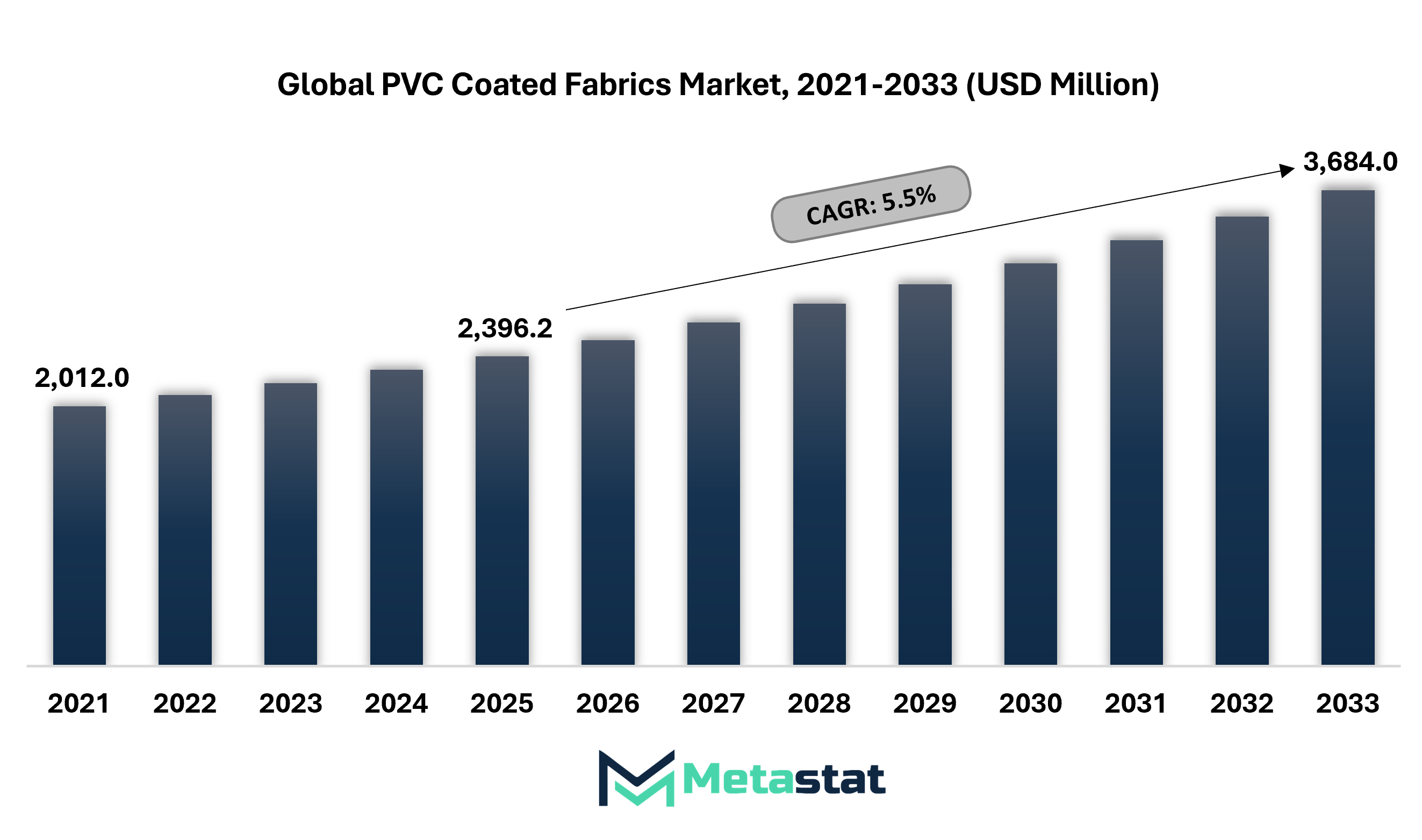
The global PVC coated fabrics market will expand into adjacent applications as manufacturers and end-use sectors prioritize functional surfaces that combine durability with design flexibility. Conventional applications will not constrain the market with adoption rising in applications where material performance aligns with design flexibility, regulatory expectations, and shifting consumption patterns. Future trajectory will be shaped by the industry’s response to emerging requirements rather than legacy demand patterns.
Over the next few years, PVC coated fabrics will be increasingly marketed as engineered surfaces rather than straightforward protection. Architecture, transportation interiors and controlled-environment infrastructure will specify such materials because they are able to balance rugged service with aesthetic versatility. Materials will be specified not only by resistance and longevity but on their ability to support branding, personalization, and modular construction concepts defining the upcoming future projects.
The global PVC coated fabrics market will maintain steady momentum owing to automotive and transportation OEMs prioritize moisture resistance, durability, and ease of maintenance for interior and protective applications. Seat covers, interior linings, and protective covers will increasingly more opt for lined fabric, as sustainability standards and protection expectations in international mobility networks emerge as more potent.
The ongoing infrastructure growth will guide vast application of covered fabric in construction environments. Awnings, umbrellas and tarpaulins get precedence because of their climate resistance and versatility. The global PVC coated fabrics market will benefit from city improvement tasks that demand dependable substances able to performing in exceptional climatic situations.
Environmental focus will place pressure on producers for the use of traditional PVC materials. Waste management challenges and disposal limitations will slow down the adoption in sustainability-centred sectors. The worldwide PVC covered fabric market will also face regulatory scrutiny, encouraging re-evaluation of cloth selections even as balancing overall performance expectancies with environmental responsibility.
Fluctuations in prices of petrochemical-based inputs will affect cost structures in production chains. As manufacturers adjust pricing strategies, there will be disruptions to profit margins. The global PVC coated fabric market will require careful supply planning to manage uncertainty while maintaining a competitive position in price-sensitive end-use industries.
Innovation focused on recyclable and low-impact coatings will open new avenues of growth. End-use industries will prioritize materials aligned with sustainability targets without compromising performance requirements. The global PVC coated fabric market will grow through investments in green technologies supporting long-term acceptance in construction, transportation and industrial applications.
The global PVC Coated Fabrics market is mainly classified based on Material Type, End-use Industry, and Coating Type.
Polyester segment was valued at USD 888.1 million in 2026 and is projected to reach USD 1,292.4 million by 2033, at a CAGR of 5.5% during the forecast period.
Polyester-based coated fabrics will retain traction owing to durability, flexibility, and cost-effective performance across industrial and infrastructure applications. They will be used more in industries that need materials that can handle stress and weather. Improved manufacturing techniques will assist them keep on with surfaces higher, making them final longer and allowing more production to satisfy infrastructure and transportation desires later.
Nylon segment was valued at USD 639.2 million in 2026 and is projected to reach USD 927.7 million by 2033, at a CAGR of 5.5% during the forecast period.
Nylon-based coated fabrics will retain relevance owing to abrasion resistance and favourable strength-to-weight characteristics in demanding applications. Industries will adopt the application where strong however lightweight fabric is required. The advanced coating will assist it remaining longer, making it excellent for difficult spots and working nicely for an extended time frame.
Polyvinylidene Fluoride (PVDF) segment was valued at USD 401.2 million in 2026 and is projected to reach USD 587.7 million by 2033, at a CAGR of 5.6% during the forecast period.
PVDF topcoat solutions will gain traction in applications requiring enhanced chemical resistance and weatherability owing to the fact they could withstand chemical substances and manage one-of-a-kind environments. Industries will begin the usage of PVDF for things that want to remain a long time when subjected to harsh conditions. New generation will assist defend the market and keep it performing as properly even if situations are difficult.
Polyurethane (PU) segment was valued at USD 251.9 million in 2026 and is projected to reach USD 368.6 million by 2033, at a CAGR of 5.6% during the forecast period.
PU coatings will see increased uptake in applications requiring flexibility, high surface-finish quality, and improved handling performance, owing to strong pliability and consistent film formation. Target uses include smooth, cleanable surfaces where uniform coating spread and adhesion support repeatable finishing outcomes. Formulation advances will improve abrasion resistance and durability while maintaining lightweight performance suited to automotive, industrial, and engineered-surface applications.
Others (Acrylic, etc.) segment was valued at USD 344.1 million in 2026 and is projected to reach USD 507.6 million by 2033, at a CAGR of 5.7% during the forecast period.
Other materials such as acrylic, etc., will be used for specific applications. These materials will only be used when needed for a certain purpose. New formulas will propel the market for adaptable while still being cheap and working well for what industries need.
Automotive segment is projected to reach USD 1,296.2 million by 2033, at a CAGR of 5.4% during the forecast period.
Automotive application will have coated fabrics for the inside, for safety, and for protection. The trend of making cars lighter will help these materials be used more. Future cars will have coated surfaces to make them last longer, be comfier, and handle stress better.
Construction segment is projected to reach USD 874.7 million by 2033, at a CAGR of 5.2% during the forecast period.
The need for PVC Coated fabrics in construction will stay the stagnant owing to the help in protection of the buildings and cover surfaces. Big projects will use them to resist weather and last a long time. Cities being built in the future will rely on materials that can handle outside enviroment.
Medical segment is projected to reach USD 520.5 million by 2033, at a CAGR of 6.3% during the forecast period.
Medical application segment will grow owing cleaner and long-lasting properties of PVC Coated Fabrics. Coated fabrics will be used for equipment covers and protection. The use of PVC Coated Fabrics will help them be cleaned easier and resist damage, which is important for future healthcare standards.
Defense segment is projected to reach USD 295.5 million by 2033, at a CAGR of 5.7% during the forecast period.
The strong and protective nature of PVC Coated fabrics will propel the usage within military and defence segment. The PVC coated fabrics will be used to shield equipment and to make sure things work. Enhanced materials will make them last longer in tough conditions and keep working the same.
Aerospace segment is projected to reach USD 207.1 million by 2033, at a CAGR of 6.3% during the forecast period.
Aerospace Industry will use these fabrics owing to the light, strong, and resistant nature. They will be used for insulation and protection. New tech will help make these materials work well with what planes need for better efficient and safety.
Others segment is projected to reach USD 490.1 million by 2033, at a CAGR of 5.4% during the forecast period.
By Coating Type, the market is further divided into:
Plastisol segment is projected to reach USD 1,491.5 million by 2033 with a share of 40.6% in 2025.
Plastisol coatings will still be used because they can be thick and last a long time. Industries will keep using them for surfaces that need to be strong. Making them better will help them resist damage while still being cheap to produce.
Polyurethane segment is projected to reach USD 1,014.9 million by 2033 with a share of 26.4% in 2025.
Polyurethane coatings should get more attention because they are bendable and make surfaces smooth. They will be used for things that need to stretch and be protected. Making them better will focus on helping them resist wear while staying light.
Teflon segment is projected to reach USD 418.5 million by 2033 with a share of 11.7% in 2025.
Polyether Ether Ketone (PEEK) segment is projected to reach USD 169.8 million by 2033 with a share of 4.4% in 2025.
PEEK coatings will be used for advanced things that need to be very strong. Industries that need high-performance materials will use them more. Making these materials better will help them resist heat and stress, which is good for future engineering.
Others segment is projected to reach USD 589.2 million by 2033 with a share of 16.9% in 2025.
Other coatings will be used for specific needs. They will only be used in certain situations. Research will help them be used in new ways and work with new materials.
Based on geography, the global PVC Coated Fabrics market is divided into North America, Europe, Asia-Pacific, South America, Middle East, and Africa.
North America PVC Coated Fabrics Market is set to expand at a CAGR of 5.5% within the forecast period, reaching a market size (TAM) of USD 786 million by the end of 2033.
In North America, consistent demand from the car and commercial transportation sectors will aid sustained adoption of PVC lined fabrics.
Increasing infrastructure refurbishment and lengthy-term investments in North America for climate-resistant materials will in addition improve regional intake.
Asia Pacific will present strong opportunities owing to fast urban expansion requiring long lasting, fee-efficient surface and overlaying answers.
Rising production interest mixed with export-oriented production will open new avenues for Asia Pacific providers and converters.
Middle East, Africa, and South America will exhibit steady growth supported by infrastructure investment and targeted industrial applications rather than broad-based volume expansion.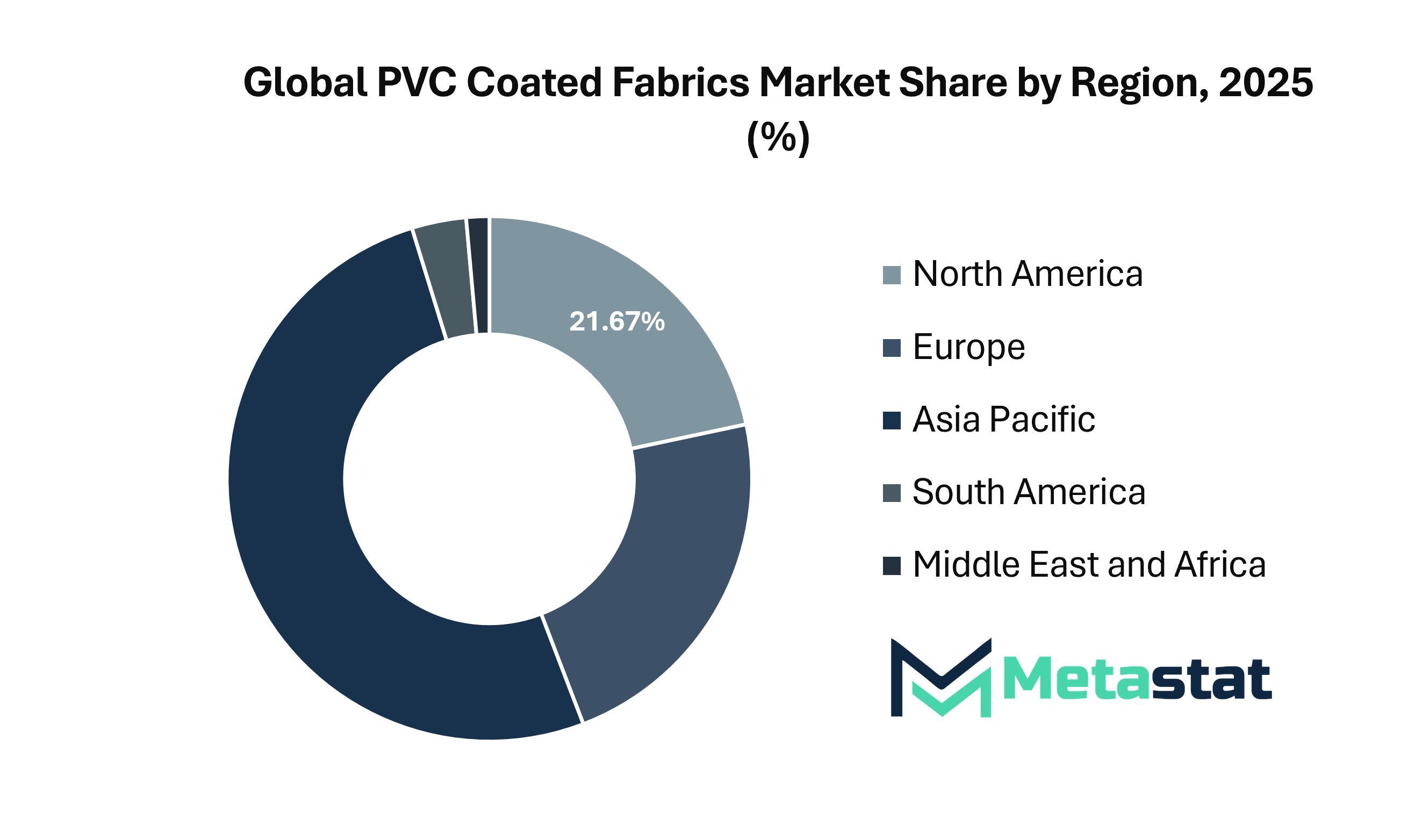
The global PVC coated fabric market is progressing well as various industries are relentlessly exploring materials with the properties of durability, flexibility and easy maintenance. The versatility of PVC coated fabrics used in construction, transportation, manufacturing, furniture and protective clothing will ensure their continued demand in both developed and developing countries. With increasing usage, the focus will be on increasing the durability, strength and customization of their surface as per the needs of the end user.
Herculite Products, Inc., Bruin Plastics Company Inc., ABC Industries, Bondcote, DAF Products Inc., Value Vinyl Inc., TVF Inc., and companies such as Tex Tech Industries have developed market recognition as suppliers of coated fabrics for use in the industrial, architectural and commercial sectors. Further investment in this area will also support the continued provision of these materials to global customers.
Large international players further strengthen the competitive environment by combining innovation with global reach. Companies including SRF Limited, Sioen Industries NV, Coating Group (Griffin Nductin SA), Seaman Corporation, Spradling International Inc., Trelleborg Group, Serge Ferrari Group, Cooley Group and The Haartz Corporation are known for serving diverse industries with advanced coated fabric solutions. These organizations will continue to refine production technologies while responding to regulatory standards and customer expectations related to safety, durability and sustainability.
Along with global leaders, regional and niche manufacturers add depth to the market landscape. New Arts Structures Pvt. Ltd., Indiana Coated Fabrics, Marlen Textile and Snyder Manufacturing contribute by addressing specific needs and offering tailored solutions for specific applications. Together, all the companies will shape the future direction of the global PVC coated fabric market by balancing performance, cost efficiency and growing customer demands.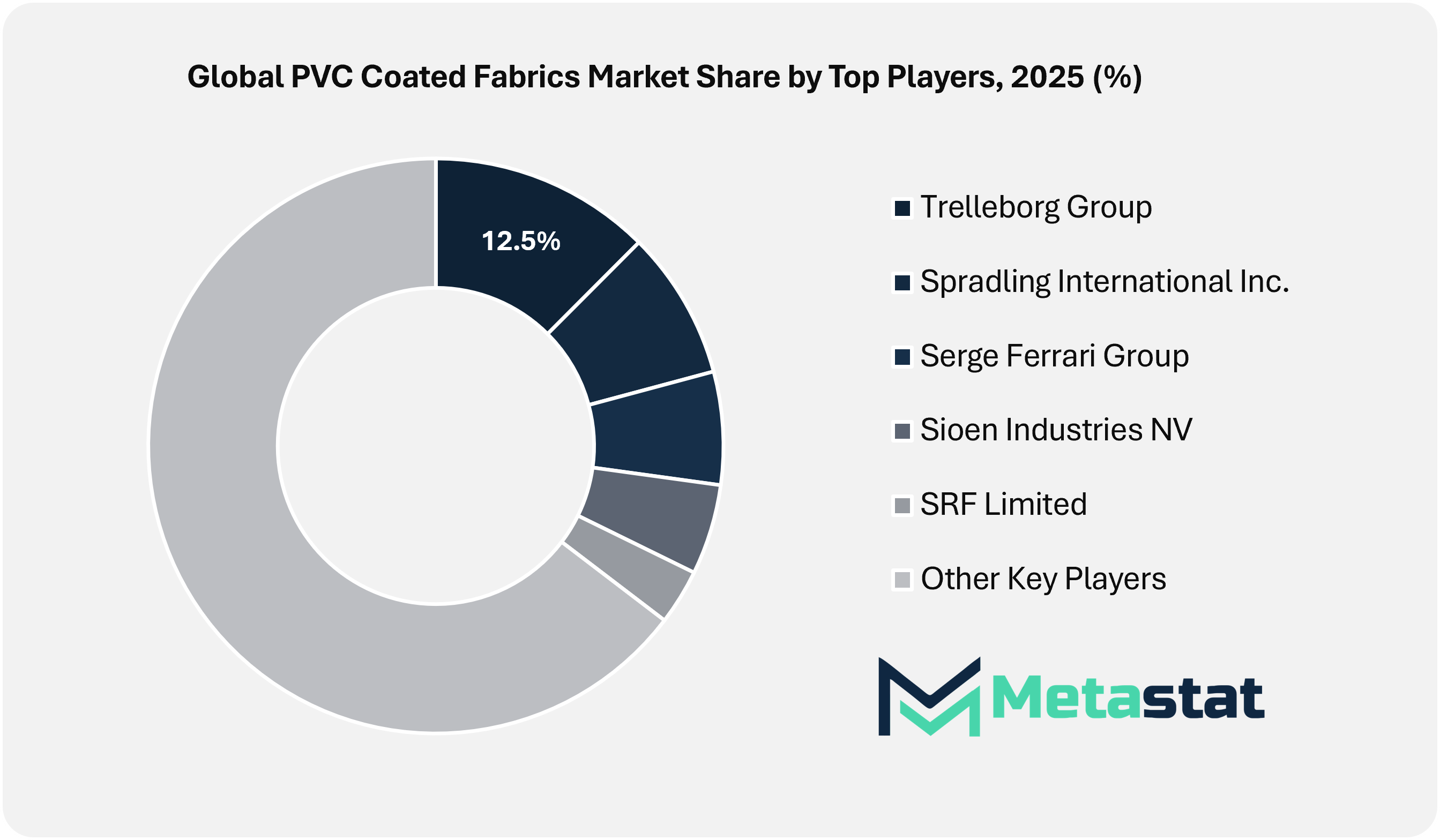
Market size is projected to rise from USD 2,396.2 million in 2025 to USD 3,684.0 million by 2033.
The industry will also be more closely integrated with the digital manufacturing ecosystem. Automated coating processes, precision cutting and digital surface patterning will enable shorter production cycles and tailored outputs. As supply chains adopt better planning systems, PVC coated fabrics will align with just-in-time production models, supporting efficiency-driven procurement strategies across global operations. This perspective will encourage collaborative innovation between materials scientists, recyclers, and end users. Looking ahead, the global PVC coated fabric market will stand as a platform for cross-industry collaboration, where functional materials will support future-ready designs, infrastructure flexibility and industrial adaptability without being limited to traditional definitions or applications.
This research report categorizes the PVC Coated Fabrics market based on key segments and regions, forecasts revenue growth, and analyses trends in each submarket. The report analyses the key growth drivers, opportunities, and challenges influencing the PVC Coated Fabrics market. Recent market developments and competitive strategies such as expansion, type launch, development, partnership, merger, and acquisition have been included to draw the competitive landscape in the market.
The report strategically identifies and profiles the key market players and analyses their core competencies in each sub-segment of the PVC Coated Fabrics market.
|
Report Attributes |
Details |
|
Study Period |
2021-2033 |
|
Base Year |
2025 |
|
Estimated Year |
2026 |
|
Forecast Period |
2026-2033 |
|
Historical Period |
2021-2025 |
|
Growth Rate |
CAGR 5.5% from 2026 to 2033 |
|
Revenue Unit |
USD Million |
|
Sales Volume Unit |
Kilotons |
|
Segmentation |
By Material Type, End-use Industry, Coating Type, and Region |
|
By Region |
North America (By Material Type, End-use Industry, Coating Type, and Country)
|
|
Europe (By Material Type, End-use Industry, Coating Type, and Country)
|
|
|
Asia Pacific (By Material Type, End-use Industry, Coating Type, and Country)
|
|
|
South America (By Material Type, End-use Industry, Coating Type, and Country)
|
|
|
Middle East and Africa (By Material Type, End-use Industry, Coating Type, and Country)
|
Find answers to common questions about this report
The Metastat Insights study shows that the global PVC Coated Fabrics market size was USD 2,396.2 million in 2025.
The global PVC Coated Fabrics market is likely to grow at a CAGR of 5.5% over the forecast period (2026-2033).
The Metastat Insights analysis shows that the North America PVC Coated Fabrics market size is estimated to be USD 786 million by 2033.
Plastisol is the leading type segment in the global market.
Rising demand for durable and waterproof materials in automotive and transportation sectors and growth in construction activities increasing use of PVC coated fabrics for awnings, canopies, and tarpaulins are key driving factors, boosting the market.
Asia Pacific region dominates the market.
Global PVC Coated Fabrics market is estimated to reach USD 3,684 million by 2033.
Top players operating in the PVC Coated Fabrics industry include Herculite Products, Inc, Bruin Plastics Company Inc., ABC Industries, Bondcote, DAF Products Inc., and Value Vinyl Inc.
The analysts below cover Chemicals and Materials research at Metastat Insights.
LEAD ANALYST
Utkarsh Khirodkar is a Lead Market Research Analyst at MetaStat Insight, specializing in market intelligence, technology sector assessments, and competitive strategy.

INDUSTRY CONSULTANT - CHEMICALS & ADVANCED MATERIALS
Chemicals and Materials · Machinery & Equipment · Packaging
Amit Gadhekar Consultant for Chemicals and Materials at MetaStat Insight, directing sector-specific intelligence, research, and strategic consulting across global chemical and processing markets.
Enterprise zero-trust network rollouts are often slowed down by multi-cloud transit latency and proprietary hardware retirement schedules. This study provided realistic total cost of ownership models comparing cloud-delivered security edge solutions against traditional hardware refreshes. The analysis of contract renewal lengths and software maintenance fees gave us clear visibility into enterprise replacement cycles over the next three to five years.
Scaling antibody-drug conjugate manufacturing hinges on contract manufacturing availability for high-potency active ingredients. The MetaStat Insight analysis looked closely at global cleanroom slot constraints, bioconjugation batch failure rates, and supply chain redundancies between the US, Europe, and India. The supplier capability matrix proved genuinely useful for our team when mapping secondary source options across our clinical pipeline.
Floating offshore wind feasibility relies heavily on specialized installation vessel availability and port crane limits, which most broad renewable energy forecasts ignore. The report delivered a thorough analysis of dry dock capacity, mooring chain supply constraints, and raw material pricing trends for deepwater anchor installations. It served as a solid independent sanity check for our offshore project capital expenditure assumptions.
Explore related market intelligence reports worth reading alongside this one.