
LEAD ANALYST
Utkarsh Khirodkar is a Lead Market Research Analyst at MetaStat Insight, specializing in market intelligence, technology sector assessments, and competitive strategy.

Rapid Food Safety Testing Market Size, Share, By Offering (Instruments, Analyzers, Reagents, Consumables, Rapid Test Kits, Culture, Enrichment Media, Testing, Certification Services, and Others), By Technology (Polymerase Chain Reaction (PCR)–based Testing, Immunoassay-based Testing, Biosensors and Spectroscopy-based Methods, and Others), By Target Tested (Pathogens, Allergens, Pesticides, Genetically Modified Organisms (GMOs), and Others), By End User (Food Manufacturers, Processors, Food Service, Retail, Regulatory Bodies, Testing Laboratories, and Others), Industry Analysis, Growth, Trends, and Forecast, 2026-2033
Report ID
MSI-4631
Published
April, 2026
Pages
325 Pages
Format
Report Details
Choose Your License
Rapid Food Safety Testing Market
The Global Rapid Food Safety Testing market size was valued at USD 19.7 billion in 2025 and projected to grow at a CAGR of 9.8% during the forecast period, reaching USD 41.6 billion by 2033.
North America held 34.0% of the global market in 2025, with the U.S. accounting for the largest regional share.
Instruments and Analyzers segment accounted for 17.6% of the market in 2025.
Key trends driving growth: Tightened regulatory compliance and audit intensity across food supply chains, increased ready-to-eat production and high-throughput quality workflows
Opportunities include Connected, on-site rapid diagnostics with analytics-enabled decision support across distributed facilities
Key insight: Speed-focused food safety validation is reshaping quality control priorities across global food supply networks.
The Global Rapid Food Safety Testing Market will move beyond faster laboratory workflows and evolve into a compliance and decision-support layer that influences how food systems operate, manage risk, and resolve disputes. Testing platforms will no longer remain limited to end-of-line inspection and will increasingly be embedded across procurement, logistics checkpoints, production environments, and digital compliance systems.
Rapid testing solutions will increasingly integrate with traceability platforms, enabling results to validate shipment integrity in near real time. Food exporters will rely on portable diagnostics not only for contamination screening, but also for trade verification, customs documentation, and liability tracking. The market will therefore expand beyond quality assurance into a broader compliance and risk-management function across global food trade.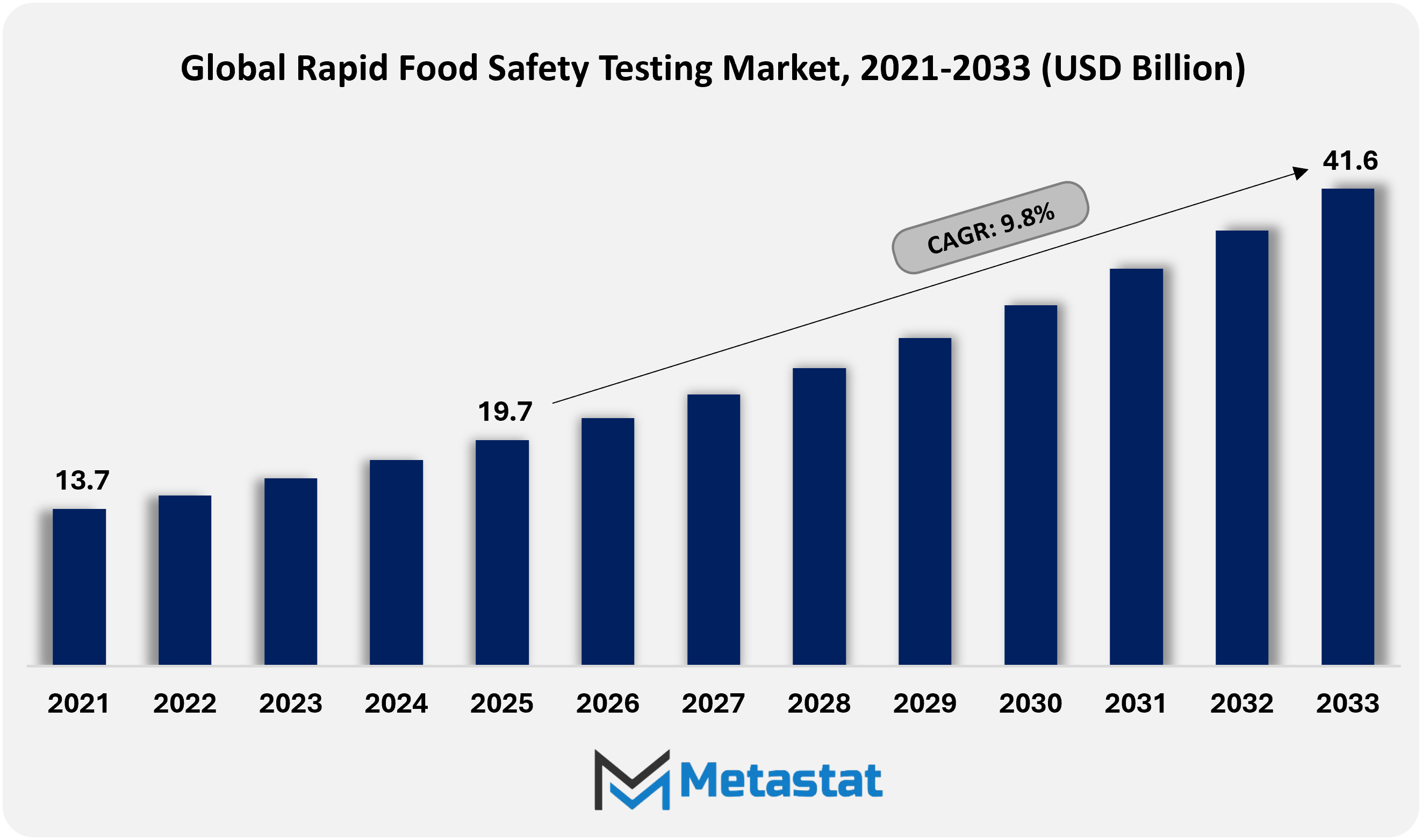
Tightened regulatory compliance and audit intensity across food supply chains.
Stricter inspection frameworks and frequent compliance audits are increasing reliance on rapid testing solutions across manufacturing, processing, and distribution stages. Regulatory authorities require faster contaminant detection, documented traceability, and validated results. Adoption of rapid testing strengthens compliance assurance while reducing recall exposure and enforcement risk.
Increased ready-to-eat production and high-throughput quality workflows
Rising demand for ready-to-eat food categories is increasing pressure on manufacturers to maintain safety without slowing throughput. Rapid testing methods support continuous quality verification within compressed production cycles. Automated workflows paired with fast diagnostics enable scale expansion while maintaining microbiological and chemical safety thresholds.
High instrument and consumables cost burden for routine testing programs
High instrument costs and recurring consumables expenses will limit adoption among cost-sensitive processors and regional laboratories. Budget constraints may delay modernization projects, particularly among small and mid-sized organizations. Procurement decisions will continue to depend on long-term return on investment despite the operational benefits of rapid testing.
Matrix interference risk and method validation or acceptance complexity across regions
Variability across food matrices creates analytical interference that can affect result accuracy across product categories. Differences in regional validation protocols and regulatory acceptance extend approval timelines. These harmonization gaps reduce consistency in cross-border testing and slow standardized deployment.
Connected, on-site rapid diagnostics with analytics-enabled decision support across distributed facilities
On-site diagnostic platforms integrated with analytics are reshaping testing workflows across multi-site operations. Real-time data interpretation supports faster corrective action and predictive risk assessment. Digital connectivity improves visibility, compliance reporting, and decision accuracy across geographically distributed food facilities.
The Global Rapid Food Safety Testing market is segmented by Offering, Technology, Target Tested, End User, and Region.
Instruments and Analyzers segment is estimated at USD 3.8 billion in 2026 and is projected to reach USD 6.7 billion by 2033, at a CAGR of 8.3% during the forecast period.
Instruments and analyzers represent a capital-intensive offering designed to supply pace, precision, and scalability throughout meals testing environments. Advanced automation, miniaturization, and digital integration will assist in better sample throughput. Continuous upgrades in detection sensitivity will permit early chance identity, supporting stricter safety frameworks throughout the destiny food delivery networks.
Reagents and Consumables segment is estimated at USD 6.9 billion in 2026 and is projected to reach USD 13.8 billion by 2033, at a CAGR of 10.4% during the forecast period.
Reagents and consumables guide routine testing workflows through repeat usage and steady demand. Improved formulation stability and extended shelf life will enhance operational efficiency. Future development will focus on compatibility with a couple of platforms, cost optimization, and fast reaction performance to meet rising testing volumes across varied meal categories.
Rapid Test Kits segment is estimated at USD 4.5 billion in 2026 and is projected to reach USD 9.9 billion by 2033, at a CAGR of 11.8% during the forecast period.
Rapid test kits allow on-site screening through simplified approaches and minimal infrastructure necessities. Adoption will grow owing to quicker decision-making and reduced dependency on centralized laboratories. Ongoing innovation will fortify accuracy degrees even as keeping ease of management, supporting proactive, high-quality manipulation practices within time-sensitive meals operations.
Culture and Enrichment Media segment is estimated at USD 2 billion in 2026 and is projected to reach USD 3 billion by 2033, at a CAGR of 5.7% during the forecast period.
Culture and enrichment media stay crucial for pathogen growth and confirmation approaches. Future answers will emphasize shorter incubation intervals and better selectivity. Enhanced formulations will align with rapid workflows, enabling reliable downstream evaluation while preserving regulatory recognition within structured protection evaluation protocols.
Testing and Certification Services segment is estimated at USD 3.7 billion in 2026 and is projected to reach USD 7.3 billion by 2033, at a CAGR of 10.1% during the forecast period.
Testing and certification services will expand through compliance-driven calls for and go-border alternate requirements. Digital reporting, standardized methodologies, and real-time traceability will toughen service costs. Strategic partnerships with producers and the government will assist steady food safety validation throughout complex distribution structures.
Others segment is estimated at USD 0.6 billion in 2026 and is projected to reach USD 0.9 billion by 2033, at a CAGR of 6% during the forecast period.
Other services include software program platforms, information management equipment, and auxiliary add-ons helping to check out ecosystems. Integration of analytics and predictive tracking will increase preventive safety strategies. These additions will enhance transparency, operational planning, and long-time period danger mitigation within evolving food quality infrastructures.
Polymerase Chain Reaction (PCR)–based Testing segment is projected to reach USD 15.5 billion by 2033, at a CAGR of 10.9% during the forecast period.
PCR-based testing promises high sensitivity through molecular amplification techniques. Future adoption will grow through quicker thermal cycling and transportable device designs. Enhanced multiplexing capability will assist simultaneous detection of a couple of contaminants, reinforcing precision-led protection warranty across commercial and regulatory testing environments.
Immunoassay-based Testing segment is projected to reach USD 16.1 billion by 2033, at a CAGR of 9.2% during the forecast period.
Immunoassay-based testing supports rapid detection via antigen–antibody interactions. Advancements will raise awareness on better specificity and decreased cross-reactivity. Compact formats and automatic readers will enhance usability, allowing steady screening across processing centers and retail checkpoints beneath strict satisfactory expectations.
Biosensors and Spectroscopy-based Methods segment is projected to reach USD 6.5 billion by 2033, at a CAGR of 11.9% during the forecast period.
Biosensors and spectroscopy-based methods enable real-time analysis via advanced signal interpretation. Future development will center on non-unfavourable testing and continuous monitoring. Integration with digital platforms will support early alerts and adaptive manipulation mechanisms inside present day meals protection control systems.
Others segment is projected to reach USD 3.5 billion by 2033, at a CAGR of 5.2% during the forecast period.
Other technologies consist of emerging hybrid methods combining molecular, chemical, and optical strategies. Research investment will encourage bendy detection models able to address novel contaminants. These strategies will assist adaptive responses to transferring protection-demanding situations driven by innovation in food manufacturing.
Pathogens segment is projected to reach USD 17.9 billion by 2033.
Pathogen trying out stays a number one attention owing to direct public health implications. Faster detection and lower limits of identification will reduce outbreak dangers. Future structures will prioritize early-degree screening and high-throughput functionality to hold protection across increasing global food distribution channels.
Allergens segment is projected to reach USD 11.5 billion by 2033.
Allergen checking supports accurate labeling and client protection. Technological refinement will enable detection at hint tiers across complicated matrices. Enhanced reliability will beef up compliance and logo acceptance, supporting inclusive meals production aligned with rising nutritional sensitivity cognizance.
Pesticides segment is projected to reach USD 7.5 billion by 2033.
Pesticide trying out addresses chemical residue worries linked to agricultural practices. Advanced analytical precision will help achieve tighter regulatory thresholds. Future answers will focus on rapid multi-residue detection, permitting more secure sourcing selections across fresh produce and processed food supply chains.
Genetically Modified Organisms (GMOs) segment is projected to reach USD 2.2 billion by 2033.
GMO checking out supports transparency and regulatory alignment inside food labelling standards. Molecular based totally advancements will improve differentiation accuracy. Future will replicate rising patron attention and export requirements, reinforcing structured verification throughout raw fabric and completed product degrees.
Others segment is projected to reach USD 2.5 billion by 2033.
Other targets encompass pollutants, adulterants, and rising contaminants. Expanding and trying out will address evolving risk profiles inside complicated meal structures. Adaptive detection frameworks will help preparedness towards unexpected protection-demanding situations related to climate and deliver variability.
Food Manufacturers and Processors segment is projected to grow at a CAGR of 8.7% during the forecast period.
Food Manufacturers and Processors constitute a core adoption section driven by using first-class warranty desires. Automation and inline testing will toughen preventive management. Future investment will focus on decreasing risks and retaining steady compliance for the duration of excessive-volume production cycles.
Food Service and Retail segment is projected to grow at a CAGR of 12.8% during the forecast period.
Food Service and retail environments require fast verification to assist client safety and logo integrity. Portably trying out solutions will permit on-page tests. Increased duty will encourage habitual screening across storage, coaching, and point-of-sale levels.
Regulatory Bodies and Testing Laboratories segment is projected to grow at a CAGR of 9.6% during the forecast period.
Regulatory bodies and checking out laboratories uphold standardized enforcement through authorized methodologies. Digital transformation will beautify statistics, transparency, and audit efficiency. Future collaboration with enterprise members will strengthen harmonized safety governance across nearby and worldwide markets.
Others segment is projected to grow at a CAGR of 7.1% during the forecast period.
Other end customers encompass research institutions and logistics companies supporting food safety ecosystems. Analytical guide and monitoring offerings will increase within these segments. Participation will contribute to device-intensive resilience and knowledgeable decision-making across interconnected meals fee chains.
Based on geography, the Global Rapid Food Safety Testing market is divided into North America, Europe, Asia-Pacific, South America, and the Middle East & Africa.
North America Rapid Food Safety Testing Market is set to expand at a CAGR of 9.8% within the forecast period, reaching a market size (TAM) of USD 12.6 billion by the end of 2033.
North America sees accelerated adoption of speedy food safety initiatives pushed with the aid of stringent regulatory scrutiny throughout the meat, dairy, and packaged meals supply chains.
North America's demand strengthens owing to excessive occurrence reporting, mature laboratory infrastructure, and strong investment throughout meals diagnostics innovation.
Asia Pacific gives a major possibility via expanding meals processing sectors and growing enforcement of hygiene requirements throughout urban markets.
Asia Pacific growth capability increases with export-oriented food production and growing attractiveness of on-web page rapid checking out technology.
Across the Middle East, Africa, and South America, the Global Rapid Food Safety Testing Market advances through improving bloodless chain networks, gradual regulatory alignment, and growing consciousness of contamination control within home meals distribution systems.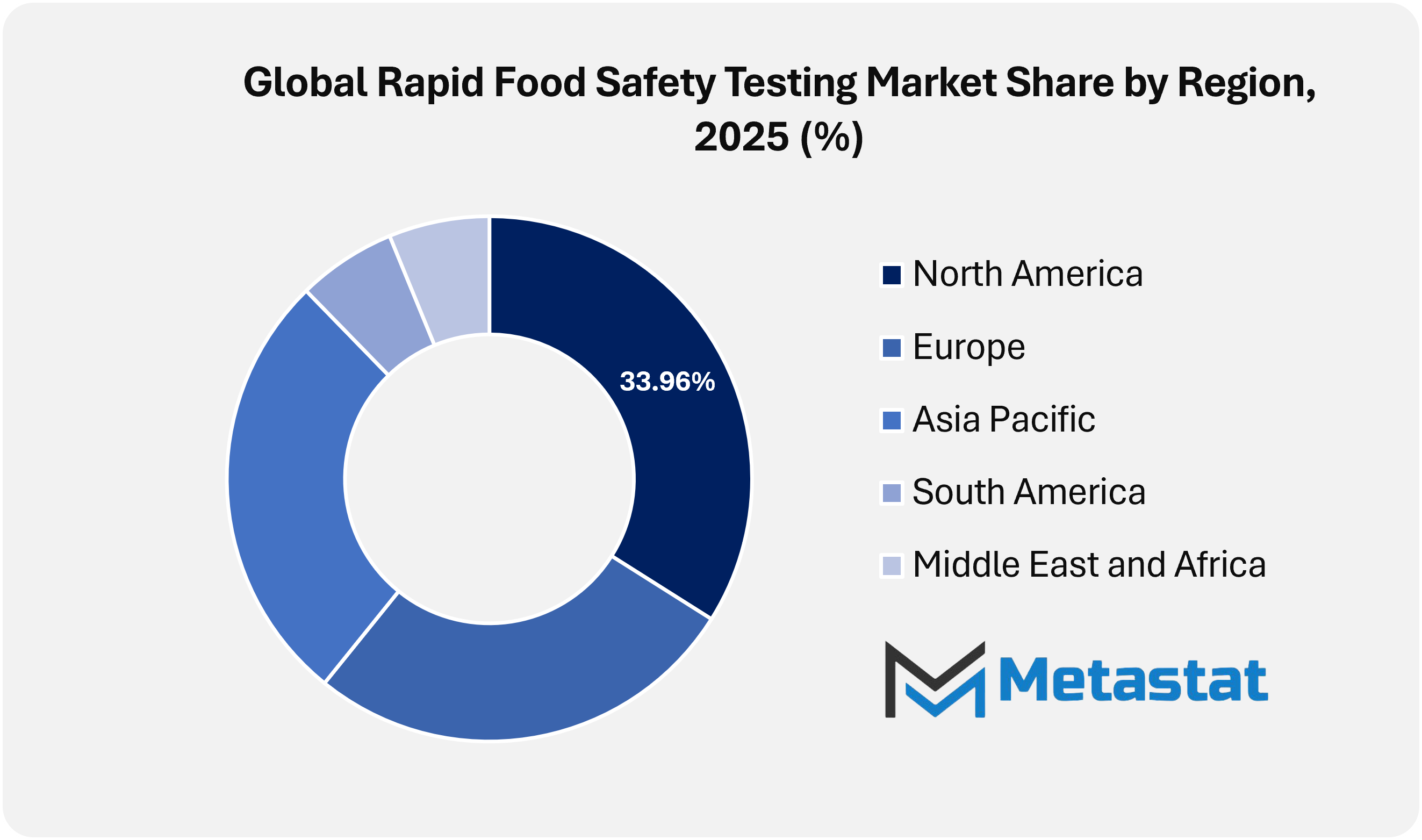
The Global Rapid Food Safety Testing Market has become a critical part of modern food systems, driven by the need for faster decisions and tighter quality control across the supply chain. Food manufacturers, processors, and regulators are increasingly relying on rapid testing solutions to detect pathogens, allergens, and chemical residues before products reach consumers. Speed has become critical, since delayed results can lead to shipment holds, recalls, financial losses, and brand damage. As food trade expands across borders, testing providers will continue to play an essential role in maintaining safety and supporting regulatory compliance.
Large multinational players have built strong positions via imparting reliable technologies subsidized by deep scientific expertise. Companies such as Thermo Fisher Scientific Inc., Merck KGaA, Agilent Technologies, Inc., Bio-Rad Laboratories, Inc., Shimadzu Corporation, and Waters Corporation are recognised for their extensive product portfolios and superior analytical equipment. These companies will invest in quicker detection methods and person-friendly structures to meet the rising demand from industrial meals manufacturers.
Specialized checking out and diagnostics companies add depth and versatility to the market by means of specializing in targeted answers and service-driven fashions. BioMérieux SA, Neogen Corporation, Revvity, Inc., R-Biopharm AG, Charm Sciences, Inc., Hygiena, LLC, Romer Labs, Inc., Megazyme Ltd., Zeulab S.L., PathogenDx, Inc., Roka Bioscience, and Invisible Sentinel, Inc. are identified for speedy kits, molecular testing tools, and on-site online answers. The products are frequently favored by means of food processors and smaller laboratories seeking faster turnaround instances without heavy infrastructure. Innovation in this segment will live targeted on simplicity, portability, and quicker consequences.
Testing service providers and certification-focused organizations strengthen the market by offering independent verification and global reach. SGS SA, Control Union, AsureQuality Limited, Q Laboratories, Inc., FARE Labs, and ALS Laboratories guide meals agencies through auditing, inspection, and laboratory testing offerings. Their function becomes even more crucial in worldwide exchange, in which third-party validation builds self-assurance among shoppers and sellers. Together, those players form a market with the intention to move in the direction of faster, more convenient, and more reliable food safety checking out, helping public fitness at the same time as assisting the meals industry function with extra confidence.
Market size is forecast to rise from USD 19.7 billion in 2025 to over USD 41.6 billion by 2033.
The Global Rapid Food Safety Testing Market will position itself less as a diagnostic supplier and more as a structural enabler of accountability across food supply chains, where speed, data credibility, and legal defensibility will define long-term relevance.
This research report categorizes the Rapid Food Safety Testing market based on key segments and regions, forecasts revenue growth, and analyses trends in each submarket. The report analyzes the key growth drivers, opportunities, and challenges influencing the Rapid Food Safety Testing market. Recent market developments and competitive strategies such as expansion, product launch, partnership, merger, and acquisition have been included to draw the competitive landscape in the market.
The report strategically identifies and profiles the key market players and analyses their core competencies in each sub-segment of the Rapid Food Safety Testing market.
|
Report Attributes |
Details |
|
Study Period |
2021-2033 |
|
Base Year |
2025 |
|
Estimated Year |
2026 |
|
Forecast Period |
2026-2033 |
|
Historical Period |
2021-2025 |
|
Growth Rate |
CAGR 9.8% from 2026 to 2033 |
|
Revenue Unit |
USD billion |
|
Segmentation |
By Offering, Technology, Target Tested, End User, and Region |
|
By Region |
North America (By Offering, Technology, Target Tested, End User, and Country)
|
|
Europe (By Offering, Technology, Target Tested, End User, and Country)
|
|
|
Asia Pacific (By Offering, Technology, Target Tested, End User, and Country)
|
|
|
South America (By Offering, Technology, Target Tested, End User, and Country)
|
|
|
Middle East and Africa (By Offering, Technology, Target Tested, End User, and Country)
|
Key Company Market Share, Revenue, and Position/Ranking
Key Market Leaders
Full In-Depth Analysis of the Parent Industry
Industry Statistics
Important Changes in Market and Its Dynamics
Segmentation Details of the Market
Historical, On-Going, and Projected Market Analysis
Assessment of Niche Industry Developments
Market Share Analysis
Key Strategies of Major Players
Company Profiles of Key Players
Unique Selling Propositions of Leading Market Players
Emerging Segments and Regional Growth Potential
Key Strategic Recommendations
Competitive Benchmarking
Import-Export Trade Statistics
Find answers to common questions about this report
Top players operating in the Rapid Food Safety Testing industry include Thermo Fisher Scientific Inc., bioMérieux SA, Neogen Corporation, Merck KGaA, Agilent Technologies, Inc., and Revvity, Inc.
High instrument and consumables cost burden for routine testing programs will hamper the market growth within the forecast period.
Global Rapid Food Safety Testing market is estimated to reach USD 41.6 billion by 2033.
Tightened regulatory compliance and audit intensity across food supply chains and Increased ready-to-eat production and high-throughput quality workflows are key driving factors, boosting the market.
North America region dominates the market.
The Reagents and Consumables is the leading type of segment in the Global market.
The Metastat Insights analysis shows that the North America Rapid Food Safety Testing market size is estimated to be USD 12.6 billion by 2033.
The Global Rapid Food Safety Testing market is expected to grow at a CAGR of 9.8% over the forecast period (2026-2033).
The Metastat Insights study shows that the Global Rapid Food Safety Testing market size was USD 19.7 billion in 2025.
The analysts below cover Food and Beverages research at Metastat Insights.
LEAD ANALYST
Utkarsh Khirodkar is a Lead Market Research Analyst at MetaStat Insight, specializing in market intelligence, technology sector assessments, and competitive strategy.

LEAD PRINCIPAL ANALYST, PHARMA AND HEALTHCARE
Food and Beverages · Healthcare · Healthcare IT · Medical Devices
Ajay Devgire is the Lead Healthcare Analyst at MetaStat Insight, leading strategic research and market intelligence initiatives across the global healthcare domain.

SENIOR RESEARCH ANALYST
Biotechnology · Food and Beverages · Medical Devices · Packaging
Snehal Pasalkar is a Research Analyst at MetaStat Insight, operating at the intersection of life sciences research, competitive strategy, and market intelligence.
Tracking maintenance cycle demand for secondary flight display units and terrain collision avoidance systems across regional jet fleets involves complex aftermarket dynamics. MetaStat Insight provided practical analysis separating airline retrofit programs from OEM forward-fit production schedules in North America and Southeast Asia. The supplier matrix highlighted component obsolescence timelines without resorting to vague generalizations. The dataset served as a dependable reference during our annual program review meetings.
Evaluating secondary resin quality across post-consumer packaging streams requires reliable technical segmentation. MetaStat Insight delivered an objective assessment that distinguished between extrusion-grade flake pricing and optical sorting throughput limitations across Western Europe. The competitive positioning breakdown for licensed depolymerization technology providers answered several questions during our feedstock feasibility audit. Their team clarified regional trade restrictions on mixed plastic scrap quickly when our team submitted follow-up requests.
Evaluating sovereign cloud deployments for core banking platforms demands a clear view of data residency regulations and migration exit strategies. MetaStat Insight delivered an exhaustive review of regional latency tolerances, mainframe decommission milestones, and third-party vendor concentration risk. The regulatory compliance mapping across European and Asian financial jurisdictions gave our team a dependable baseline for multi-cloud infrastructure discussions.
Explore related market intelligence reports worth reading alongside this one.