
LEAD ANALYST
Utkarsh Khirodkar is a Lead Market Research Analyst at MetaStat Insight, specializing in market intelligence, technology sector assessments, and competitive strategy.

UK Point-of-Sale Finance and BNPL Market Size, Share, By Type (Short-Term Interest-Free Split-Pay (Pay in 3/4), Deferred Single-Payment Credit (Pay Later), Interest-Free Fixed-Term Retail Finance (5+ Instalments), Interest-Bearing Fixed-Term Retail Finance, Revolving Retail Credit / Store Cards), By Channel (Online Merchant Checkout, In-Store Merchant Point of Sale, Remote-Assisted Merchant Sales (Payment Link, SMS, QR, Telesales), Direct-to-Consumer App / Pre-Approval), By Service Vertical (Home Furniture & Furnishings, Consumer Electronics & Appliances, Fashion, Apparel & Footwear, Home Improvement, DIY & Garden, Automotive Parts, Repair & Servicing, Healthcare, Dental & Mobility, Travel & Hospitality, Beauty, Wellness & Personal Care, Jewellery & Luxury Goods), Industry Analysis, Growth, Trends, and Forecast, 2026-2033
Report ID
MSI-5158
Published
September, 2026
Pages
293 Pages
Format
Historical
Base year
Forecast
Forecast period
Report Details
Choose Your License
UK Point-of-Sale Finance and BNPL Market
The UK Point-of-Sale Finance and BNPL market was valued at USD 25.1 billion in 2025 and is projected to reach USD 36 billion by 2033, growing at a CAGR of 4.6% over the forecast period.
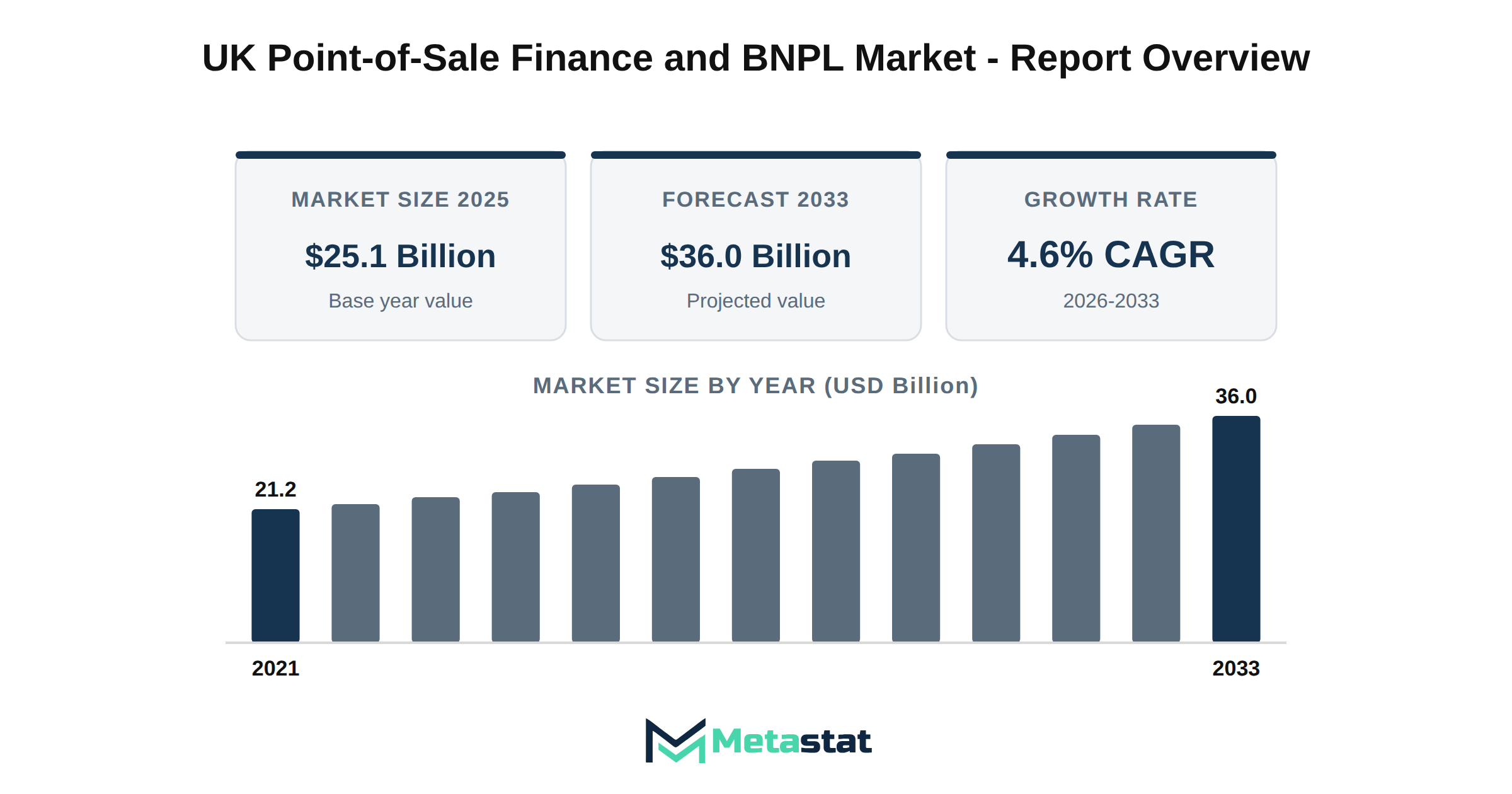
The UK Point-of-Sale Finance and BNPL market reached USD 25.1 billion in 2025, reflecting a steady growth trajectory. Projections indicate an increase to USD 36 billion by 2033, representing a compound annual growth rate (CAGR) of 4.6%. This growth stems from changing consumer behaviors and increasing acceptance of flexible payment options across various retail sectors.
Consumer adoption and repayment behavior have significantly influenced market dynamics. Retail consumers exhibit a preference for payment solutions that allow deferred payments, which enhances purchasing power and improves cash flow management. This trend prompts retailers to integrate point-of-sale financing options into their checkout processes, facilitating higher conversion rates during sales.
Retailer demand for these financing solutions rises due to businesses seeking to enhance customer satisfaction and drive sales. Partner selection becomes crucial, with retailers favoring providers that offer competitive terms and streamlined integration processes. The performance of the approval funnel directly impacts checkout conversion rates, with an emphasis on reducing friction in the financing application process.
Alternative credit solutions play a vital role in shaping affordability decisioning, allowing consumers with varying credit profiles to access financing. These options enhance financial inclusion, broadening the consumer base for retailers. Competitive positioning within the market requires players to innovate continuously, ensuring that their offerings remain attractive in a changing environment.
Merchant pricing strategies and finance subsidy economics contribute significantly to the overall market structure. Retailers evaluate the cost-benefit of offering point-of-sale financing, balancing customer acquisition with profitability. Regulatory impacts, including compliance with standards and geopolitical frameworks, introduce additional considerations for market participants.
The evolving dynamics of consumer adoption and repayment behavior significantly influence the UK Point-of-Sale Finance and BNPL market. A growing inclination towards flexible payment options prompts consumers to engage with various financing solutions. Consequently, consumers exhibit varying repayment patterns, impacting overall market performance and customer retention rates. Retailers benefit from understanding these behaviors, enabling them to tailor their offerings and improve customer satisfaction.
Retailer demand for point-of-sale financing options reflects an increasing recognition of the value these solutions provide to enhance sales and customer loyalty. Partner selection optimizes financing offerings, with retailers seeking providers that deliver competitive terms and streamlined integration. This strategic alignment allows merchants to enhance their value propositions, ultimately leading to increased sales conversions and improved customer experiences.
Alternative credit solutions shape affordability decisioning processes in the market. Consumers increasingly seek innovative financing options that align with their financial capabilities. This trend drives the development of tailored credit solutions that accommodate diverse consumer profiles while ensuring responsible lending practices. The emphasis on affordability enables providers to expand their customer base and establish long-term relationships.
Checkout conversion rates and approval-funnel performance significantly impact the overall success of financing solutions. Streamlined processes that minimize friction during the checkout experience enhance conversion rates, driving sales and improving customer satisfaction. Providers that optimize approval funnels through advanced technologies and data analytics gain a competitive edge, increasing their market presence in the UK Point-of-Sale Finance and BNPL market.
Competitive positioning and second-line lending strategies are vital to market participants. Providers leverage unique value propositions to differentiate themselves in a crowded landscape, focusing on niche segments and tailored offerings. This approach builds customer loyalty and supports long-term growth within the market.
Understanding merchant pricing and finance subsidy economics influences the profitability of financing solutions. Providers that offer attractive pricing models enhance their appeal to retailers, driving increased adoption of point-of-sale financing options. This strategic pricing approach allows for a balance between profitability and competitiveness, ensuring sustained growth in the market.
The regulatory environment surrounding deferred payment credit significantly impacts market operations. Compliance with evolving standards and regulations poses challenges for market participants, necessitating ongoing adaptation and investment in regulatory frameworks. Providers that navigate these complexities effectively position themselves because trusted partners in the UK Point-of-Sale Finance and BNPL market.
Market fragmentation and M&A dynamics shape the competitive landscape. The presence of numerous players encourages innovation and drives competition, leading to varied offerings and services. Strategic mergers and acquisitions provide opportunities for market participants to expand their capabilities and enhance their market presence.
Capital allocation and infrastructure investments shape the future outlook of the market. Providers that strategically allocate resources towards technology and innovation enhance their operational efficiencies and customer engagement. This focus on investment supports the continued growth of the UK Point-of-Sale Finance and BNPL market, driving advancements and improving service delivery.
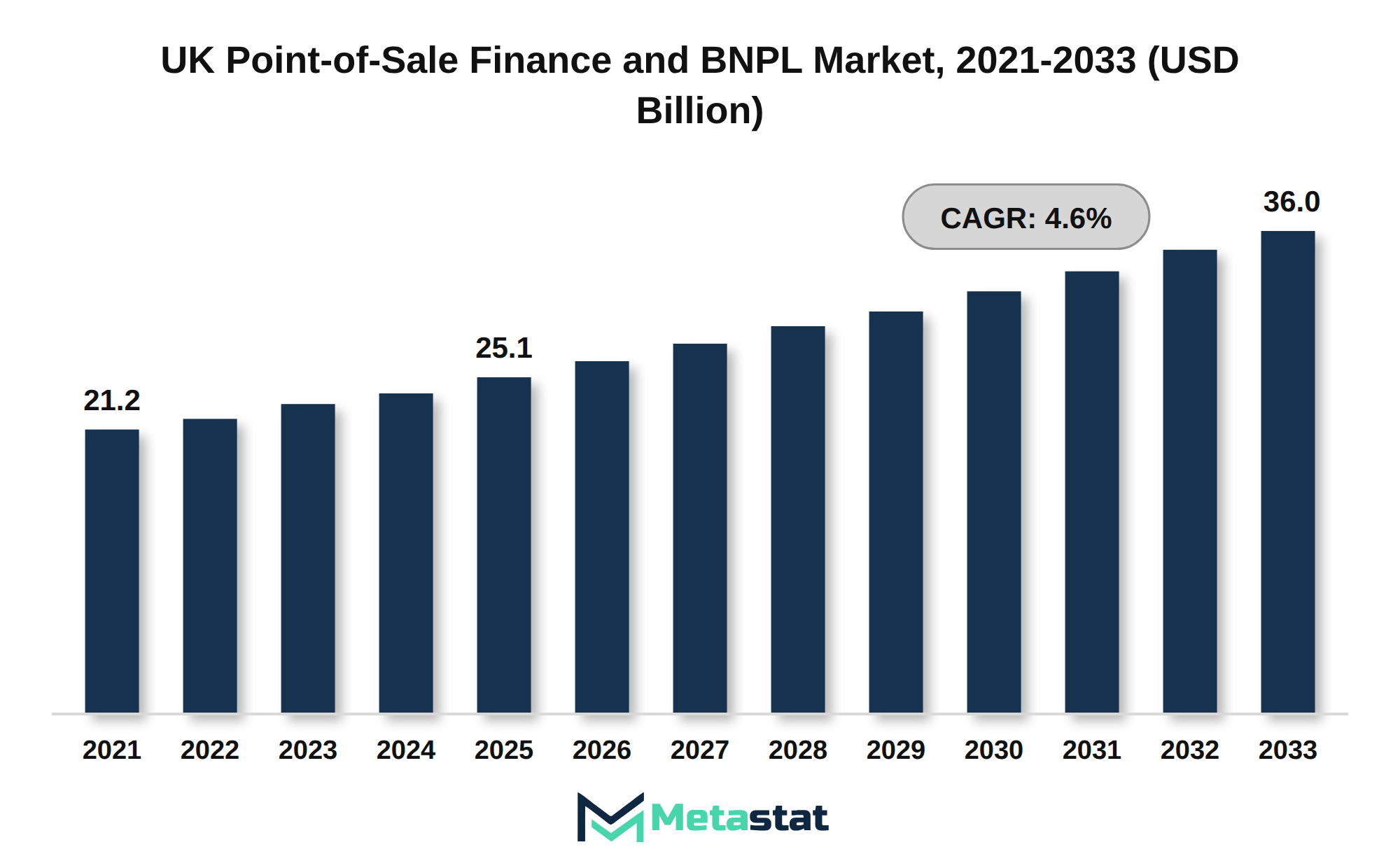
The UK Point-of-Sale Finance and BNPL market experiences significant growth driven by a shift in consumer preferences towards flexible payment solutions, particularly split-pay options like Pay in 3 or Pay in 4. This trend arises from increasing financial awareness among consumers, who seek to manage their budgets more effectively without incurring high-interest debt. The convenience of splitting payments allows consumers to make purchases while spreading the financial burden over time, thus enhancing affordability. This evolving mindset particularly appeals to younger demographics, who prioritize flexibility and control over their financial commitments.
Retailers benefit from this growing consumer inclination by adopting point-of-sale finance solutions that integrate effective payment options at checkout. By offering such solutions, retailers enhance customer satisfaction and reduce cart abandonment rates, directly impacting revenue growth. The market anticipates this trend will continue, aligning with broader economic factors including rising disposable incomes and increased consumer confidence, which further fuel demand for flexible finance solutions.
The segment for Short-Term Interest-Free Split-Pay is projected to grow at a compound annual growth rate of 6.2% from USD 8.5 billion in 2026 to USD 13 billion in 2033, highlighting the strong demand for these financial products. The increasing integration of technology in retail environments supports this trend, driven by digital transformation that facilitates the implementation of user-friendly payment systems catering to the evolving preferences of the market.
The ongoing shift towards digital transformation significantly influences the UK Point-of-Sale Finance and BNPL market. Companies prioritize technological integration, focusing on the adoption of automation, artificial intelligence, and modern software solutions. These advancements enhance efficiency and streamline operations, creating a more responsive business environment. The competitive nature of the market drives firms to invest in digitizing legacy processes, ensuring relevance and the ability to meet evolving consumer expectations.
This digital evolution attracts substantial capital investment, further stimulating growth in the market. Enhanced technological infrastructure facilitates better customer experiences, contributing to increased adoption of point-of-sale finance options. The integration of innovative solutions allows firms to offer more tailored financial products, catering to diverse consumer needs. The market is projected to expand, reflecting the benefits of digital transformation on operational productivity and cost efficiency.
The focus on technology improves service delivery and enhances security measures and compliance standards. Stronger security protocols build consumer trust in digital financing solutions, encouraging more individuals to engage with the market. While organizations invest in digital technologies, this trend positions the UK Point-of-Sale Finance and BNPL market for sustained growth through enhanced capabilities and improved customer satisfaction.
Regulatory tightening presents challenges in the UK Point-of-Sale Finance and BNPL market. Compliance hurdles arise from evolving financial regulations, which impose additional reporting requirements and operational constraints on providers. This complexity affects small and emerging players, often resulting in increased operational costs that hinder market entry and limit competitiveness.
Macroeconomic headwinds, including inflationary pressures and resource scarcity, further complicate the market landscape. Rising costs of goods and services affect consumers' disposable income, which directly impacts their purchasing power and willingness to engage in financing options. Higher interest rates deter consumers from choosing BNPL solutions, thereby slowing market growth.
Infrastructure gaps play a significant role in the market's expansion. The need for robust digital frameworks to facilitate transactions is critical. Inadequate broadband connectivity in certain regions limits access to online payment solutions, further exacerbating the divide between urban and rural consumers. This connectivity deficit restricts the ability of the market to reach its full potential, leading to disparities in adoption rates across different demographics.
Technological obsolescence presents another restraint, driven by the rapid pace of innovation that demands constant upgrades and investments in new systems. Firms that lag in adopting the latest technologies risk losing market share to more agile competitors. These escalating operating costs create barriers for market participants, particularly smaller firms that lack the resources for continuous investment.
Privacy concerns and data security vulnerabilities have a significant impact on consumer confidence. Increased awareness regarding data breaches leads to hesitance among potential users, affecting the willingness to engage with BNPL services. The market's success relies heavily on robust security measures to build trust and enhance customer engagement.
Finally, market fragmentation poses challenges for scalability. Diverse offerings from various players create a complex environment that complicates consumer decision-making. The sheer volume of choices overwhelms consumers, leading to indecision and potentially hindering the growth of the UK Point-of-Sale Finance and BNPL market.
Geopolitical fragmentation impacts the UK Point-of-Sale Finance and BNPL market, creating uncertainties for businesses and consumers. Trade deficits contribute to inflationary pressures, affecting consumer spending power and altering purchasing behaviors. Increased tariff friction complicates cross-border financial transactions, resulting in higher costs that suppliers pass on to consumers. This situation creates a challenging environment for the growth of the market, owing to companies confronting rising operational expenses.
Technological disruptions present another challenge, with rapid advancements in financial technologies requiring swift adaptations. Companies struggle to integrate new systems effectively, leading to interoperability friction that hinders customer experiences. The complexity of R&D integrations further strains resources, diverting attention from core services. Such challenges inhibit the efficiency and growth potential of the market, impacting investment decisions.
The market faces tightening regional regulatory standards, which drive compliance overhead. Evolving legal liabilities necessitate increased diligence from service providers, affecting operational efficiency and profitability. These heightened requirements deter new entrants, thereby slowing market growth.
Pricing compression and margin pressures emerge due to heightened competition among players in the market. Rising input cost structures put additional strain on profit margins, compelling companies to reassess pricing strategies. The need for workforce skill development adds another layer of complexity, because firms strive to retain talent capable of navigating the evolving financial landscape. Such factors significantly influence market dynamics and affect overall growth trajectories.
The UK Point-of-Sale Finance and BNPL market benefits from evolving consumer trends that prioritize convenience and flexibility in payment options. Increased demand for alternative financing solutions aligns with shifting consumer behaviors, resulting in heightened interest in interest-free payment plans and deferred payment options. These preferences encourage retailers to adopt such solutions, driving competitive differentiation and enhancing customer loyalty.
Technological advancements in payment processing and e-commerce integration play a significant role in the market's growth. The rise of mobile payments and digital wallets streamlines the purchasing experience, enabling consumers to complete transactions effortlessly. Retailers adopting these technologies gain a competitive edge, leading to increased sales conversion rates and improved customer satisfaction.
Geographical expansion opportunities arise from the increasing penetration of point-of-sale finance solutions in various sectors. The retail, travel, and healthcare industries embrace BNPL offerings to cater to a wider audience, supporting sales growth and creating partnerships with financial service providers. Such collaborations enhance product offerings, ensuring that diverse consumer needs are met effectively.
Shifts in buyer behavior toward eco-friendly and sustainable practices further influence the market's trajectory. Consumers increasingly favor brands that align with their environmental values. This trend presents an opportunity for providers to integrate sustainability into their offerings, thereby capturing the attention of socially conscious consumers and enhancing brand reputation.
Strategic consolidation among players within the UK Point-of-Sale Finance and BNPL market is anticipated, aiding firms in optimizing resources and expanding their service offerings. Mergers and acquisitions facilitate product diversification and entry into new markets while enhancing competitive positioning. This consolidation creates a more robust ecosystem, enabling stronger responses to consumer demands and market challenges.
The UK Point-of-Sale Finance and BNPL market is segmented based on Type, Channel, and Service Vertical.
Valued at USD 8.5 billion in 2026, the Short-Term Interest-Free Split-Pay (Pay in 3/4) segment is projected to reach USD 13 billion by 2033, registering a CAGR of 6.2% during the forecast period. This growth reflects a rise in consumer preference for payment flexibility, enabling consumers to manage their budgets more effectively while shopping. Adoption of this financing model is driven by increasing online transactions and the demand for efficient checkout experiences, particularly among younger demographics.
Retailers across various sectors, including fashion and electronics, integrate the Short-Term Interest-Free Split-Pay option to enhance customer satisfaction and drive sales. The technology enabling this payment option continues to mature, with advancements in mobile payment solutions and integration with e-commerce platforms facilitating adoption. While product offerings evolve, consumers enjoy greater visibility and control over their payment schedules, enhancing their overall buying experience.
In terms of regulatory compliance, the segment benefits from a straightforward framework compared to more complex financing options. This simplicity encourages more retailers to offer the service, further fueling growth. Cost structures for retailers implementing this model remain manageable, allowing them to maintain competitive pricing while enhancing margins through increased transaction volumes. Overall, the Short-Term Interest-Free Split-Pay segment demonstrates potential within the UK Point-of-Sale Finance and BNPL market, with strategic opportunities for expansion and technological upgrades.
Adoption of Deferred Single-Payment Credit (Pay Later) continues to gain traction within the UK Point-of-Sale Finance and BNPL market. This segment is estimated to reach USD 5 billion by 2033, at a CAGR of 5.5% during the forecast period. Factors driving this trend include increasing consumer preference for flexible payment options and the desire for financial control without immediate financial outlay. Retailers benefit from enhanced sales conversions attributed to customers expressing a willingness to purchase higher-ticket items when financing options are available at checkout.
Technological advancements simplify the integration of deferred payment solutions into various retail channels, enhancing user experiences. The trend towards convenient online shopping experiences leads to an uptick in demand for such payment solutions. While merchants adopt advanced payment systems, the enhanced customer journey encourages loyalty and repeat business.
Compliance with regulatory standards influences market dynamics. Regulatory frameworks around consumer protection and transparency in lending practices impact the offerings and operational practices of finance providers. Adapting to these regulations ensures that companies maintain consumer trust while mitigating the risk of penalties.
Cost structures associated with providing deferred payment options remain a focal point for service providers. Pricing strategies align with consumer expectations and competitive pressures. With increasing competition among finance providers, margin pressures arise, prompting ongoing innovation and differentiated service offerings in the market.
Projected growth in the Interest-Free Fixed-Term Retail Finance (5+ Instalments) segment contributes to the overall expansion of the UK Point-of-Sale Finance and BNPL market. This segment is projected to reach USD 9 billion by 2033, driven by increasing consumer preference for flexible payment options that ease financial burdens on larger purchases. Adoption of digital financial services continues to enhance user experience, encouraging both consumers and retailers to embrace these financing solutions.
Market dynamics reflect a shift towards longer-term financing options, appealing to consumers aiming to manage their budgets effectively. Retailers across various sectors, including home improvement and consumer electronics, leverage these offerings to attract customers, increasing sales and building loyalty. Enhanced technological capabilities in the processing and approval of these finance plans support the segment's growth, enabling smooth integration into the retail environment.
Regulatory compliance and consumer protection standards play a significant role in shaping the landscape, ensuring transparency in lending practices. These developments create a favorable environment for both consumers and retailers, validating the growing trust in interest-free financing options. While competition intensifies, providers are expected to innovate, focusing on enhancing customer service and expanding their offerings to capture a larger market share within the UK Point-of-Sale Finance and BNPL market.
Growth in the Interest-Bearing Fixed-Term Retail Finance segment aligns with the increasing consumer preference for flexible payment options. This demand reflects a shift in consumer behavior toward financing solutions that provide predictable payment schedules without the risk of variable interest rates. The segment is projected to grow at a CAGR of 2.6% during the forecast period. Financial institutions and retail partners recognize the importance of these offerings, which assist consumers in managing their budgets more effectively.
The market benefits from product evolution, with advancements in technology facilitating efficient application processes and enhanced user experiences. Consumers increasingly favor digital solutions that allow for quick approval and effective transactions. This trend in technological maturation supports the adoption of Interest-Bearing Fixed-Term Retail Finance, driven by users prioritizing convenience and efficiency in their purchasing decisions. Retailers that integrate these financing options into their sales strategies gain a competitive edge, capturing more transactions and improving customer loyalty.
Regulatory compliance standards play a role in shaping the segment, owing to institutions navigating guidelines to ensure responsible lending practices. This compliance builds consumer trust and encourages wider adoption of Interest-Bearing Fixed-Term Retail Finance solutions. In response to these factors, businesses focusing on this segment are well-positioned to capture market share within the broader UK Point-of-Sale Finance and BNPL market.
With rising consumer demand for financial products that support budget management, the segment's growth presents strategic opportunity windows for investment and expansion. Companies investing in marketing and technology to promote these offerings anticipate enhanced engagement and increased transaction volumes, driving revenue growth in the sector.
Growth in the Revolving Retail Credit / Store Cards segment of the UK Point-of-Sale Finance and BNPL market stems from a combination of consumer behavior shifts and the evolving landscape of retail finance options. Increasing consumer preference for flexible payment solutions drives higher adoption rates across various retail sectors. Enhanced competition among financial service providers leads to more attractive offerings, which increases acceptance of revolving credit solutions among consumers.
Technological advancements enhance user experiences associated with revolving credit options. Streamlined application processes and improved user interfaces effectively reduce barriers to entry for consumers seeking credit. Strategic partnerships between retailers and financial institutions strengthen the ecosystem, increasing the availability and promotion of revolving credit options at points of sale.
Regulatory compliance standards impact the operational framework of revolving credit offerings. Adhering to evolving regulations necessitates investments in technology and infrastructure, contributing to operational costs for providers. However, effective management of these costs ensures competitive pricing structures, which builds consumer trust and encourages greater participation in this segment.
Market dynamics reflect a gradual shift towards more responsible borrowing, influencing consumer attitudes and expectations. Education around responsible credit usage emerges because a key component in enhancing consumer confidence in revolving credit offerings. This evolving understanding supports sustained growth within the segment, aligning with broader trends in the UK Point-of-Sale Finance and BNPL market.
Strategic opportunity windows arise from shifts in consumer preferences and market conditions. Enhanced focus on customer-centric solutions and innovative product offerings positions providers to capture a larger market share. Continuous evaluation of consumer needs and preferences remains crucial for adapting to future changes in the revolving credit landscape.
Valued at USD 14.6 billion in 2026, the Online Merchant Checkout segment is projected to reach USD 21.6 billion by 2033, at a CAGR of 5.7% during the forecast period. Increased consumer preference for convenient online shopping experiences drives demand within the UK Point-of-Sale Finance and BNPL market. The uptake of digital payment solutions aligns with shifts in consumer behavior, emphasizing flexibility and convenience in transaction methods.
Technological advancements play a crucial role in enhancing the user experience, enabling smoother payment processes at online checkout. Merchants increasingly adopt innovative solutions, including one-click payments and integrated financing options, to attract and retain customers. This trend highlights the importance of providing efficient and user-friendly payment methods that cater to evolving consumer expectations.
Growth catalysts within the segment include the expansion of e-commerce platforms and increasing internet penetration. While online shopping continues to gain traction, the demand for financial solutions that facilitate easier transactions rises. Retailers investing in advanced BNPL offerings enhance competitive positioning, contributing to segment expansion.
Market dynamics reflect a shift towards consumer empowerment, with financing options that promote responsible spending. This evolution supports customer loyalty and enhances overall sales for merchants. The growing interest in adopting BNPL solutions illustrates a broader trend towards financial inclusivity and accessibility within the market.
In-Store Merchant Point of Sale segment is estimated to reach USD 8.6 billion by 2033, at a CAGR of 2.8% during the forecast period. Growth in this segment aligns with increased consumer preference for in-person shopping experiences that incorporate flexible payment options. Retailers adopt in-store financing solutions to enhance customer satisfaction and drive sales, responding to significant demand for accessible payment methods at physical locations. This trend illustrates a shift in consumer behavior, where shoppers seek immediate gratification while maintaining financial control over their purchases.
The market benefits from technological advancements that streamline the payment process. Integration of digital payment systems, mobile wallets, and contactless payment methods enhances user experience and encourages higher transaction volumes. Retailers investing in these technologies gain a competitive edge, making in-store environments more appealing to consumers. This creates a strategic opportunity for investment in next-generation payment solutions, impacting overall segment growth.
Changes in consumer spending habits influence the in-store merchant point of sale dynamics. Increased consumer confidence in economic stability contributes to higher expenditures on discretionary items. Retailers specializing in consumer electronics, fashion, and home furnishings particularly benefit from offering flexible payment options at the point of sale. The UK Point-of-Sale Finance and BNPL market reflects this evolving demand, indicating a robust outlook for in-store financing solutions through 2033.
Regulatory frameworks surrounding consumer finance continue to shape the operating environment. Compliance with emerging regulations enhances consumer trust and protects against potential market risks. Retailers aligning with these standards position themselves favorably, gaining consumer confidence. Overall, investment in in-store financing solutions strengthens the market, providing opportunities for growth and innovation in the coming years.
Growth in the Remote-Assisted Merchant Sales segment hinges on consumer preferences for convenience and the increasing reliance on technology for transactions. The surge in mobile payment solutions and digital wallets drives demand, enabling consumers to engage with retailers through various platforms, including SMS and QR codes. This trend reflects broader patterns within the UK Point-of-Sale Finance and BNPL market, where technological advancements facilitate effective purchasing experiences.
Valued at USD 2.2 billion by 2033, the segment benefits from strategic investments in user-friendly interfaces and efficient payment processes. Retailers adopting these technologies enhance customer engagement, leading to higher conversion rates and improved sales performance. The segment's growth aligns with shifts in consumer behavior, where immediate gratification and convenience dictate purchasing decisions.
Regulatory compliance, particularly in data protection and consumer rights, shapes the operational landscape for businesses within this segment. Ensuring adherence to standards builds consumer trust, vital for the segment's long-term viability. While the market matures, ongoing innovation and the introduction of next-generation payment solutions will further support the Remote-Assisted Merchant Sales segment, positioning it because a key player in the UK Point-of-Sale Finance and BNPL market.
Consumer preferences increasingly favor mobile solutions for financing options. This trend reflects a broader digital shift within the UK Point-of-Sale Finance and BNPL market, where convenience and immediacy drive consumer behavior. The Direct-to-Consumer App / Pre-Approval segment is projected to grow at a CAGR of 4.6% during the forecast period. Enhanced user experiences and streamlined applications promote higher adoption rates among consumers seeking flexible payment solutions.
Technological advancements play a vital role in this segment's expansion. Upgrades in app functionalities and user interfaces enhance the customer journey, allowing users to navigate financing options with greater ease. Integration with various merchants further supports this trend, enabling consumers to access financing solutions seamlessly at the point of sale.
Regulatory compliance remains a critical factor, with evolving standards shaping operational frameworks. Compliance with financial regulations ensures consumer protection and builds trust, driving demand for Direct-to-Consumer App / Pre-Approval solutions. The market's adaptability to these standards influences its overall growth trajectory.
Competitive dynamics within the market prompt players to innovate continuously. Companies strive to differentiate their offerings through unique features and competitive rates, addressing diverse consumer needs. Strategic capital investments in technology and marketing support these efforts, enhancing market positioning and consumer outreach.
Valued at USD 4.9 billion in 2026, the Home Furniture & Furnishings segment is projected to reach USD 6 billion by 2033, at a CAGR of 3% during the forecast period. Key demand drivers include rising disposable incomes and increasing consumer confidence, which drive higher spending on home improvement and furnishing projects. The segment experiences expansion due to trends emphasizing personalized home aesthetics and comfort, compelling consumers to invest in quality furniture. While sustainable practices gain traction, eco-friendly furniture options attract environmentally conscious buyers, influencing purchasing decisions in the UK Point-of-Sale Finance and BNPL market.
Technological maturation supports the segment, with advancements facilitating efficient online shopping experiences and financing options. Consumers increasingly prefer integrated payment solutions that enhance convenience and satisfaction, promoting adoption. In addition, attractive financing offers, including interest-free periods, encourage higher transaction volumes, driving growth in this sector.
Margin pressures persist due to rising raw material costs and potential supply chain vulnerabilities. Targeted strategies focusing on consumer trends and technological integration present strategic opportunities. Continued investment in next-gen upgrades and product evolution, including smart furniture solutions, positions companies to capture a larger market share. Overall, the Home Furniture & Furnishings segment significantly influences the broader UK Point-of-Sale Finance and BNPL market.
Growth in the Consumer Electronics & Appliances segment aligns with increased consumer spending on technology and home electronics. This segment is projected to reach USD 5.4 billion by 2033, at a CAGR of 3.8% during the forecast period. Demand drivers include innovation in product design, functionality, and energy efficiency, which enhance consumer appeal. Manufacturers invest in next-gen upgrades, addressing the shift towards smart and connected appliances. Increased financing options, including point-of-sale finance, support consumer access to higher-priced items, facilitating adoption in the market.
Product evolution remains essential in this segment, with significant advancements in smart technology integration. Consumers increasingly seek devices that improve convenience and connectivity in their homes. Downstream applications of financing options enhance accessibility, allowing buyers to purchase high-demand products without immediate financial burden. Cost structures associated with consumer electronics fluctuate due to technological advancements and resource availability. Pricing volatility affects consumer choices, necessitating competitive financing solutions that meet varying budget constraints.
Regulatory compliance standards impact product offerings, ensuring safety and performance in consumer electronics. Continued growth in the sector is supported by strong market dynamics, including consumer preferences for innovative products and flexible payment options. Strategic opportunity windows emerge owing to retailers expanding their financing offerings, directly addressing consumer needs. The UK Point-of-Sale Finance and BNPL market will likely experience changes driven by these trends, enhancing market prospects.
Trends in the Fashion, Apparel & Footwear segment drive significant growth within the UK Point-of-Sale Finance and BNPL market. Increasing consumer demand for flexible payment options enhances customer engagement and drives sales in this sector. Retailers leverage point-of-sale financing to improve conversion rates and attract a broader customer base. The projected market value for this segment is expected to reach USD 6.1 billion by 2033, highlighting its growth potential.
Technological advancements influence product evolution, with enhanced digital platforms streamlining the checkout experience. Features like mobile optimization and instant credit approvals contribute to a frictionless shopping experience, promoting higher customer satisfaction. Through these innovations, the market strengthens its position among younger consumers, who prioritize convenience and flexibility in their purchasing behavior.
Regulatory compliance standards continue to shape the operational landscape. Adherence to emerging regulations regarding consumer protection and data security remains vital for market participants. Companies that successfully navigate these regulations position themselves favorably, ensuring consumer trust and operational resilience within the competitive environment.
Investment in marketing strategies targeting the Fashion, Apparel & Footwear segment generates heightened brand awareness. Collaborations with influencers and targeted campaigns enhance visibility, increasing the appeal of financing options. This strategic focus contributes to the overall expansion of the segment, further enhancing its role in the UK Point-of-Sale Finance and BNPL market.
Projecting growth at a CAGR of 4.6% during the forecast period, the Home Improvement, DIY & Garden segment reflects significant consumer interest in enhancing living spaces. Rising disposable incomes and increased spending on home renovation projects drive demand. Homeowners prioritize comfort and functionality, leading to heightened adoption of financing solutions. Retailers and service providers in this segment leverage point-of-sale finance options to attract customers seeking flexible payment methods.
The UK Point-of-Sale Finance and BNPL market benefits from the trend towards enhanced home environments, with consumers drawn to a variety of products and services. This segment is projected to reach USD 6 billion by 2033, reflecting ongoing commitment to home improvement investments. The availability of financing options facilitates larger purchases, enabling consumers to undertake more extensive renovation projects without immediate financial burden.
Increasing consumer interest in automotive maintenance and repair services drives demand within the Automotive Parts, Repair & Servicing segment. Affordability plays a critical role in shaping purchasing behavior, with financing options offering consumers flexibility during high-cost repairs. The ongoing evolution of vehicle technology, including electric and hybrid models, necessitates specialized services, further driving demand for accessible financing solutions.
The shift towards online purchasing and servicing encourages the adoption of point-of-sale financing within this sector. Customers increasingly seek convenience, often opting for financing at the point of service, which enhances their purchasing power. The integration of digital solutions in automotive retail continues to reshape the market, encouraging businesses to adopt financing options that cater to evolving consumer preferences, emphasizing ease of use and quick approval processes.
Regulatory changes and evolving compliance standards influence market dynamics, necessitating that service providers remain agile. Adapting to new regulations regarding vehicle emissions and safety standards involves additional costs, creating opportunities for financing arrangements that support compliance while maintaining service affordability. The presence of multiple financing providers enhances competition, encouraging innovation and improvements in service delivery.
Overall, the Automotive Parts, Repair & Servicing segment within the UK Point-of-Sale Finance and BNPL market presents strategic opportunities for growth. Businesses that align their offerings with consumer expectations and navigate the regulatory landscape efficiently improve their market position and attract a broader customer base.
Consumer interest in healthcare services continues to increase, driving demand in the UK Point-of-Sale Finance and BNPL market. Patients appreciate flexible payment options, allowing them to access necessary healthcare, dental, and mobility products without the burden of upfront costs. This shift towards financing solutions enhances the affordability of treatments and services, aligning with consumer expectations for accessible healthcare. Regulatory compliance is important in shaping the market, ensuring that financing options adhere to established guidelines for consumer protection. Technological advancements contribute to segment evolution, with digital platforms facilitating effective payment experiences. Providers increasingly integrate point-of-sale financing into their offerings, capitalizing on technological maturation. Strategic opportunity windows emerge, particularly because healthcare providers seek to attract a broader clientele. Shifts in consumer behavior reflect a growing preference for financial flexibility, particularly in healthcare. The market responds by tailoring financing solutions to diverse needs, enhancing customer experience and satisfaction. Ongoing investments in technology and infrastructure support expansion within this segment, ensuring that providers meet evolving consumer demands effectively. The UK Point-of-Sale Finance and BNPL market remains positioned to adapt to these trends, reinforcing its relevance in the healthcare landscape.
Consumer behavior in the travel and hospitality sector shapes the demand for point-of-sale finance and buy now pay later (BNPL) solutions. Travelers increasingly seek flexible payment options to manage expenses associated with bookings, accommodations, and experiences. The rise in domestic and international travel, following periods of restricted movement, stimulates spending and the need for accessible financial solutions. Enhanced consumer confidence in travel, along with increased disposable incomes, contributes to an uptick in travel-related expenditures.
Technological advancements enable integration of financing options into booking platforms and travel agencies. Digital payment methods simplify the purchasing process while providing consumers with choices that suit their financial situations. The convenience of mobile applications facilitates quick access to financial services, improving the customer experience in the travel and hospitality market. Innovations in payment processing support the growth of BNPL solutions, making these options more appealing to consumers seeking alternative payment methods.
Regulatory compliance continues to shape the market landscape. Adherence to financial regulations ensures consumer protection and builds trust in financing options. Increasing scrutiny on lending practices and transparent pricing models impacts how companies in the travel and hospitality sector develop their financing offerings. Maintaining compliance with regulations enhances credibility and attracts a broader customer base for service providers.
While market dynamics evolve, strategic opportunities arise for businesses to capitalize on emerging consumer preferences. Customized financing solutions tailored to the unique needs of travelers drive growth in the UK Point-of-Sale Finance and BNPL market. Focusing on customer education regarding financing options promotes informed decision-making and encourages the adoption of BNPL solutions within the travel and hospitality sector.
Consumer behavior increasingly reflects a focus on wellness and personal care, influencing spending patterns in the UK Point-of-Sale Finance and BNPL market. Shifts toward self-care and beauty products drive demand for flexible financing options, enabling consumers to manage expenses without upfront payments. This shift presents opportunities for retailers to enhance their offerings through innovative financing solutions tailored to customer needs.
Technological advancements impact the Beauty, Wellness & Personal Care segment, with online platforms gaining prominence for transactions. Enhanced digital experiences, including personalized recommendations and improved checkout processes, contribute to increased adoption of BNPL solutions. Retailers leveraging technology improve customer engagement and cultivate brand loyalty, ultimately driving sales growth.
Regulatory compliance shapes market dynamics within this segment. Adherence to evolving standards builds consumer trust, influencing willingness to access point-of-sale financing options. Retailers prioritizing compliance and transparency in their financing offerings attract a broader customer base, contributing to market expansion.
Investment in marketing strategies tailored for the Beauty, Wellness & Personal Care segment strengthens retail performance. Targeted campaigns highlighting the advantages of flexible payment options appeal to consumers seeking affordable solutions for beauty and wellness purchases. Brands effectively communicating value propositions through financing gain a competitive edge in the market.
Consumer interest in jewellery and luxury goods has surged, driven by a combination of aesthetic appeal and social status associated with these products. Increasing disposable income among consumers, particularly in urban areas, fuels demand for premium items, resulting in a robust market environment. Retailers leverage point-of-sale finance options to enhance purchasing flexibility, enabling consumers to acquire high-value items without immediate financial burden.
Adoption of financing solutions has expanded significantly within this segment, with customers increasingly preferring flexible payment plans. Retailers offering tailored financing options capture a larger share of the market, appealing to a diverse consumer base seeking affordability in luxury purchases. This trend enhances customer loyalty, because buyers return for subsequent purchases, influenced by positive previous experiences with financing.
Regulatory compliance remains a focal point within the jewellery and luxury goods segment. Retailers adhere to standards that ensure transparent financing processes, safeguarding consumer rights and building trust. The evolving landscape of consumer protection regulations influences market strategies, compelling providers to refine their offerings while adhering to compliance frameworks.
Technological advancements enhance the shopping experience, with integration of digital solutions streamlining the point-of-sale process. For instance, augmented reality applications allow customers to visualize products before purchase, while mobile payment solutions simplify transactions. The market benefits from these innovations, driving increased engagement and satisfaction among consumers.
The segmentation of the market into various service verticals facilitates targeted marketing strategies and enhances customer engagement. By understanding the unique preferences of consumers in the jewellery and luxury goods space, retailers optimize their financing offers, ensuring alignment with consumer expectations. This strategic approach promotes growth within the segment, contributing positively to the overall UK Point-of-Sale Finance and BNPL market.
Growing interest in educational and training services, outdoor activities, and pet care drives demand for financing options in the UK Point-of-Sale Finance and BNPL market. This segment benefits from increasing consumer willingness to invest in personal development, leisure activities, and pet-related expenditures, reflecting broader consumption shifts. The rise in e-learning platforms and outdoor retail experiences contributes to a growing base of consumers seeking flexible payment alternatives, leading to an uptick in the adoption of point-of-sale financing solutions.
Technological advancements fuel segment evolution, with digital platforms facilitating transactions for services related to education, sports, and veterinary care. Enhanced online experiences, combined with mobile payment solutions, improve purchasing processes, making financing more accessible to consumers. Shifting preferences towards convenience and speed prompt players in this market to adapt their offerings to align with technological maturation.
Regulatory compliance shapes the financing landscape for these sectors. Adhering to consumer protection standards and responsible lending practices ensures that offerings remain attractive while maintaining transparency and trust. This creates an environment conducive to growth and encourages further investments in innovative solutions tailored to specific consumer needs.
Capital investments in technology and user experience continue to enhance customer engagement within this segment. By focusing on integration across various channels, businesses capitalize on strategic opportunity windows that emerge with changing consumer behavior. This proactive approach positions players competitively in the evolving UK Point-of-Sale Finance and BNPL market, ultimately driving growth and enhancing margins.
Valued at USD 26.3 billion in 2026, the market is projected to reach USD 36 billion by 2033, at a CAGR of 4.6% during the forecast period. Growth in this segment derives from increasing consumer adoption of financing options that provide flexibility without immediate financial burden. The shift towards online shopping and the rise of e-commerce platforms significantly contribute to the increasing demand for Buy Now, Pay Later (BNPL) solutions within the UK Point-of-Sale Finance and BNPL market. Consumer preferences for efficient payment experiences encourage retailers to implement these financing options, enhancing customer engagement and satisfaction.
Technological advancements in payment processing systems support the evolution of this segment. The integration of artificial intelligence and machine learning in credit assessment allows for quicker and more accurate decision-making processes, reducing barriers for consumers seeking financing. Regulatory compliance standards shape market dynamics, ensuring that providers meet consumer protection requirements. The evolving regulatory landscape encourages market players to innovate, thus driving competition and expansion strategies.
Major players actively seek strategic partnerships to enhance service offerings and expand customer bases. Investment in marketing and educational initiatives promotes awareness of financing options, contributing to shifting consumer behaviors toward long-term financial planning. While the market for UK Point-of-Sale Finance and BNPL continues to expand, stakeholders focus on optimizing profit margins while maintaining a balance between risk and consumer accessibility.
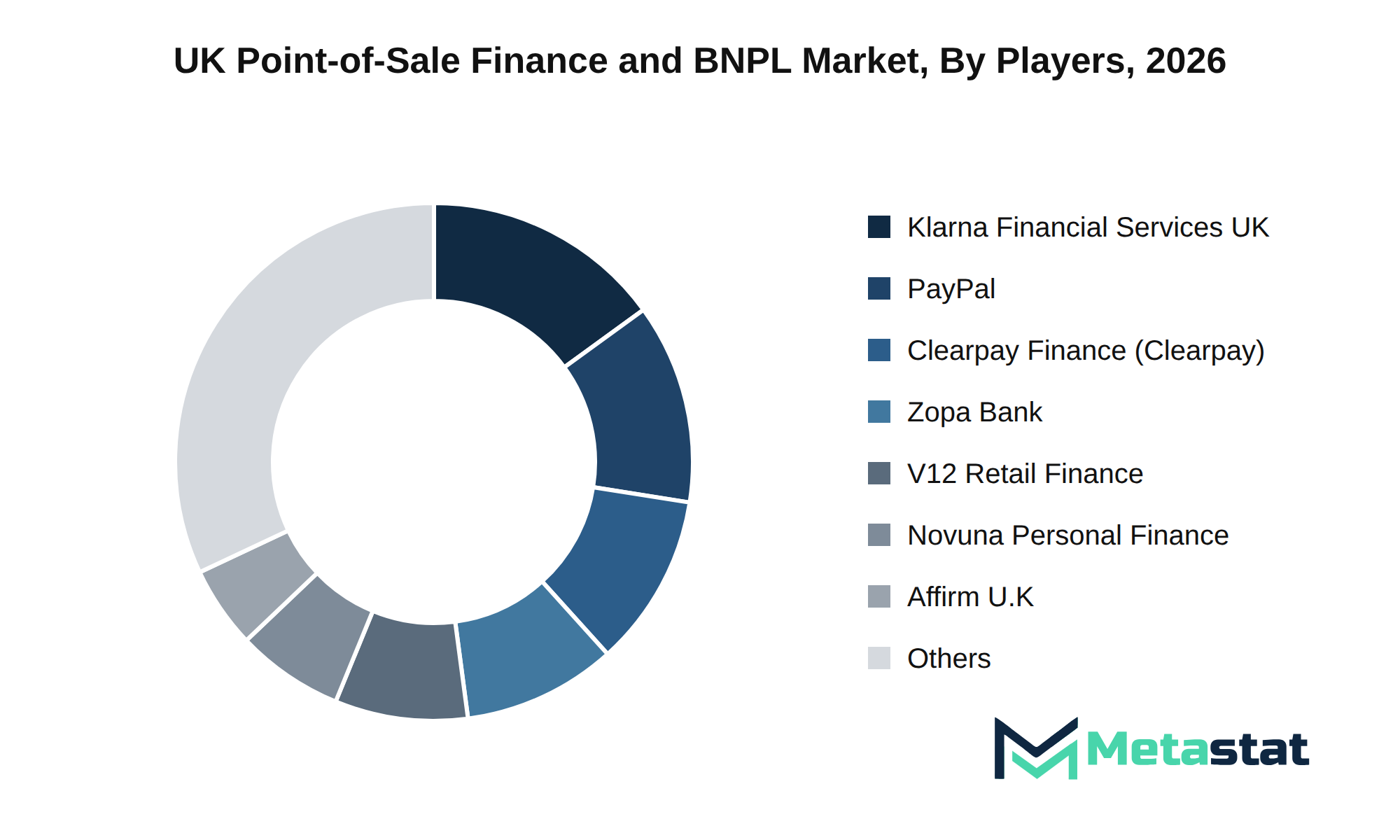
The UK Point-of-Sale Finance and BNPL market features a diverse competitive landscape, with key players employing various strategies to strengthen their market positions. Companies like Klarna Financial Services UK Limited, Zopa Bank Limited, and PayPal emphasize product differentiation by offering unique financing options tailored to consumer preferences. Strategic alliances and partnerships enhance their market presence, enabling firms to leverage complementary strengths and expand their customer bases.
Pricing architectures vary across the sector, with firms like Clearpay Finance Ltd offering interest-free payment solutions, while others including Omni Capital Retail Finance Limited provide interest-bearing options. The competitive environment encourages innovation, since companies invest in R&D pipelines to develop proprietary technologies that enhance user experience and streamline payment processes. Customer retention strategies play a significant role, with organizations focusing on building brand equity and reducing switching costs to maintain consumer loyalty.
The threat of new entrants in the UK Point-of-Sale Finance and BNPL market persists, driven by evolving consumer behaviors and technological advancements. However, established firms leverage their market presence and intellectual property portfolios to create barriers to entry, ensuring a competitive edge. Future competitive dynamics will likely hinge on strategic growth vectors that emphasize value chain integration and supply chain dominance, reflecting how companies adapt to changing market conditions and consumer demands.
Market size is forecast to rise from USD 25.1 billion in 2025 to over USD 36 billion by 2033. The base case anticipates a steady growth trajectory, with a compound annual growth rate (CAGR) of 4.6%. This growth reflects increasing consumer acceptance of point-of-sale finance solutions and the Buy Now Pay Later (BNPL) offerings, driven by a shift in consumer purchasing behavior towards flexible payment options.
The bull case scenario envisions accelerated adoption of next-generation technologies and innovative payment solutions, propelling the UK Point-of-Sale Finance and BNPL market beyond current projections. Enhanced digital integration and improved customer experiences could significantly boost transaction volumes, leading to higher market valuations. Conversely, the bear case considers potential economic downturns, regulatory challenges, or shifts in consumer sentiment that could hinder market growth.
Downstream demand changes will play a crucial role in shaping the market's future. Consumers increasingly prioritize convenience and flexibility, driving demand for point-of-sale financing options across various retail sectors. Core industry maturation indicates a competitive landscape where established players and new entrants vie for market share, driving innovation and improving service offerings.
Regulatory evolution is anticipated to influence market dynamics significantly. Compliance with emerging regulations will require strategic adjustments from market participants, impacting operational costs and service delivery. Geopolitical realignments and evolving trade corridors affect supply chains, leading to shifts in regional market dynamics.
Strategic capital allocation and infrastructure commitments will further define the market's growth trajectory. Investment in technological advancements and digital infrastructure will enhance the customer experience and operational efficiency. Identifying emerging white-space opportunities and unmet enterprise needs will provide avenues for growth and expansion within the UK Point-of-Sale Finance and BNPL market.
The report strategically identifies and profiles the key market players and analyses their core competencies in each sub-segment of the Point-of-Sale Finance and BNPL market.
Report Attributes | Details |
Study Period | 2021-2033 |
Base Year | 2025 |
Estimated Year | 2026 |
Forecast Period | 2026-2033 |
Historical Period | 2021-2025 |
Growth Rate | CAGR 4.6% from 2026 to 2033 |
Revenue Unit | USD billion |
Segmentation | By Type, Channel, Service Vertical, and Region |
Find answers to common questions about this report
The Metastat Insights study indicates that the Point-of-Sale Finance and BNPL market size was valued at USD 25.1 billion in 2025.
The Point-of-Sale Finance and BNPL market is projected to grow at a CAGR of 4.6% during the forecast period from 2026 to 2033.
The Short-Term Interest-Free Split-Pay (Pay in 3/4) segment leads the UK Point-of-Sale Finance and BNPL market, with a value of USD 8.5 billion in 2026. This segment represents the largest share compared to other types.
Key drivers for the UK Point-of-Sale Finance and BNPL market include a shift in consumer preferences towards flexible payment solutions, particularly split-pay options. Increasing financial awareness among consumers enhances demand for manageable budgets, while the integration of technology in retail environments supports efficient payment experiences, driving growth in this sector.
Regulatory tightening creates compliance hurdles that increase operational costs for providers, particularly impacting small and emerging players. Macroeconomic factors, including inflation and rising interest rates, further diminish consumer purchasing power and willingness to engage with BNPL solutions. inadequate digital infrastructure limits access to online payment options, hindering market growth.
Increasing consumer preference for flexible payment solutions, particularly split-pay options, drives product adoption in the UK Point-of-Sale Finance and BNPL market. Enhanced financial awareness enables consumers to manage budgets effectively, while technological integration in retail environments improves service delivery and security, building greater consumer trust and engagement.
The Point-of-Sale Finance and BNPL market is estimated to reach a valuation of USD 36 billion by 2033.
Key players in the UK Point-of-Sale Finance and BNPL market include Klarna Financial Services UK Limited (Klarna), Zopa Bank Limited, V12 Retail Finance Limited, PayPal, Clearpay Finance Ltd (Clearpay), and Affirm U.K. Limited.
The Short-Term Interest-Free Split-Pay segment is projected to grow at a compound annual growth rate of 6.2% from USD 8.5 billion in 2026 to USD 13 billion in 2033.
The Online Merchant Checkout channel is anticipated to grow from USD 14.6 billion in 2026 to USD 21.6 billion in 2033, reflecting a compound annual growth rate of 5.7%.
The analysts below cover Banking & Finance research at Metastat Insights.
LEAD ANALYST
Utkarsh Khirodkar is a Lead Market Research Analyst at MetaStat Insight, specializing in market intelligence, technology sector assessments, and competitive strategy.

PRINCIPAL CONSULTANT - ENTERPRISE AI & EMERGING TECHNOLOGIES
Banking & Finance · Electronics and Semiconductor · Energy and Power · Healthcare IT · Information & Technology · Professional Services
Vijay Gunti is a Principal Consultant at MetaStat Insight, bringing over two decades of experience across enterprise digital transformation, technology strategy, and intelligent systems.
Most industry reports on warehouse automation bundle autonomous mobile robots and fixed conveyor installations into the same top-level numbers, which complicates advisory work. This study split the market cleanly by payload tiers, navigation technology, and fleet management software layers. The regional forecast for Western Europe gave our team defensible adoption benchmarks when evaluating capital allocation for logistics clients, saving us days of secondary data scrubbing.
Analyzing the transition from natural gas to green hydrogen in iron ore reduction requires realistic infrastructure timelines. Meta stat insight supplied a detailed regional assessment of DRI plant conversion costs and scrap metal availability in North America and Western Europe. Their report carefully examined pellet quality specs and electrical grid access constraints without making oversimplified market assumptions. The research material served as a practical reference during internal technology roadmap discussions.
Integrating zero-trust access controls across legacy electronic health record systems involves complex compliance overhead. Team produced an analysis that clearly separated identity governance and administration tools from privileged access management platforms. Their evaluation of HIPAA and GDPR compliance features across cloud native solutions gave our architecture group clear baseline criteria. The custom data request regarding biometric authentication adoption in hospital networks was returned promptly with clear documentation.
Explore related market intelligence reports worth reading alongside this one.
Starting from
$2950