
Explore the key factors driving growth in the Battery Energy Management System market, including technological advancements, regulatory pressures, and sustainability initiatives.
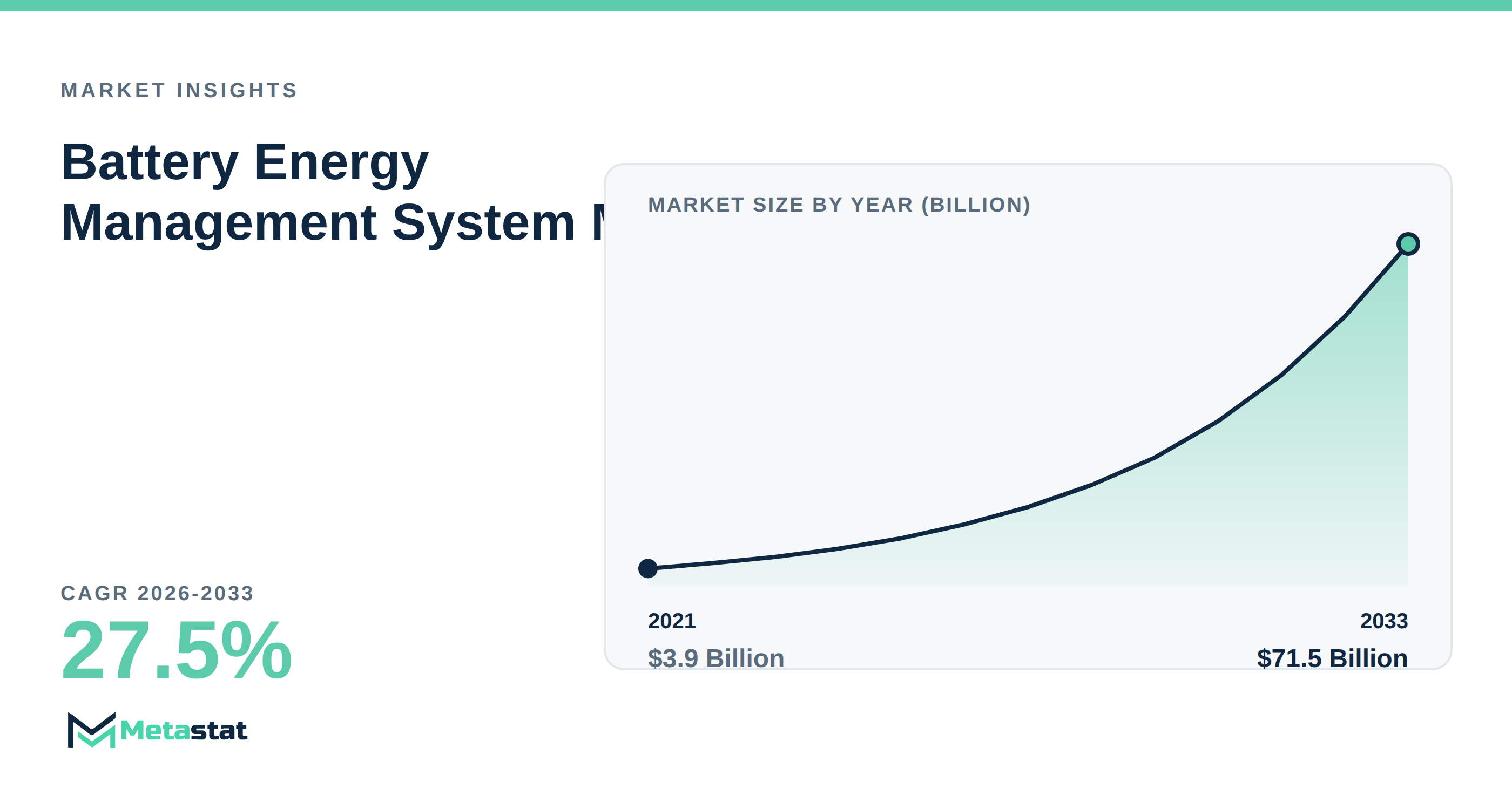
The Battery Energy Management System market is on a significant growth trajectory, with anticipation to reach USD 71.5 billion by 2033. This expansion arises from various dynamics impacting industries reliant on advanced battery technologies. Understanding these factors provides valuable insights for stakeholders invested in the market.
1. Rapid advancements in battery technologies
Continuous innovation within battery technologies, especially Lithium Iron Phosphate (LFP) and Lithium Nickel Manganese Cobalt (NMC), plays a meaningful role in shaping the Battery Energy Management System market. These innovations lead to enhanced energy density, safety, and lifecycle, directly addressing the demands of the electric vehicle (EV) sector and renewable energy sectors. For instance, the LFP segment is set to increase from USD 7.4 billion in 2026 to USD 37.2 billion by 2033, translating to a CAGR of 25.9%. Meanwhile, NMC is projected to witness an impressive CAGR of 31.6% during the same timeframe, indicating robust demand for high-performance energy solutions.
2. Increasing regulatory compliance pressures
Regulatory compliance holds significant importance in influencing the Battery Energy Management System market. Stricter regulations concerning battery safety, efficiency, and end-of-life management compel manufacturers to invest extensively in technology and processes to comply with these requirements. This compliance introduces higher operational costs and slows down the adoption rates, particularly for smaller enterprises that find it challenging to adapt to evolving legal requirements. With global regulations tightening, companies prioritize compliance to ensure sustained market access and consumer confidence.
3. Supply chain complexities and geopolitical risks
The Battery Energy Management System market confronts substantial challenges arising from supply chain complexities and geopolitical uncertainties. Trade tensions and tariffs complicate the acquisition of essential components, contributing to increased production costs and potential disruptions in availability. Such geopolitical fragmentation impacts pricing strategies and overall market stability. To counter these risks, companies enhance supply chain resilience and explore diversified sourcing strategies, ensuring consistent access to critical materials while adapting to fluctuating market conditions.
4. Growing emphasis on sustainability
Sustainability has emerged because a major focus area for companies across a range of sectors. The demand for efficient energy management systems that align with decarbonization efforts continues to rise. Organizations are increasingly prioritizing the reduction of their carbon footprints through improved energy solutions, enhancing their market appeal and creating new revenue opportunities. This commitment to greener technologies presents substantial growth potential for companies specializing in Battery Energy Management Systems, particularly within the transportation and renewable energy industries.
5. Digital transformation driving market expansion
The ongoing digital transformation across various sectors significantly accelerates the adoption of Battery Energy Management Systems. The integration of advanced automation, artificial intelligence, and real-time data analytics improves operational efficiency and decision-making capabilities. Sectors focusing on electrification and renewable energy are increasingly recognizing the advantages of modernizing legacy systems, optimizing performance and resource allocation in the process. While organizations invest in digital technologies, the Battery Energy Management System market is expected to experience substantial growth.
6. Fragmentation and competitive dynamics
The Battery Energy Management System market displays a high degree of fragmentation due to the vast array of products, solutions, and applications available. This fragmentation intensifies competition among manufacturers, impacting pricing strategies and innovation rates. Mergers and acquisitions are commonplace since companies pursue opportunities to enhance technological capabilities, expand market access, and consolidate resources. This dynamic environment requires market participants to consistently innovate and adapt to maintain competitive advantages.
In conclusion, the Battery Energy Management System market is being reshaped by several significant forces. From technological advancements and regulatory compliance to sustainability initiatives and digital transformation, stakeholders equipped with this understanding position themselves effectively for success in an evolving market. For further insights, explore the Global Battery Energy Management System Market.
Tags
About the Authors

LEAD ANALYST
Utkarsh Khirodkar is a Lead Market Research Analyst at MetaStat Insight, specializing in market intelligence, technology sector assessments, and competitive strategy.

PRINCIPAL CONSULTANT - ENTERPRISE AI & EMERGING TECHNOLOGIES
Banking & Finance · Electronics and Semiconductor · Energy and Power · Healthcare IT · Information & Technology · Professional Services
Vijay Gunti is a Principal Consultant at MetaStat Insight, bringing over two decades of experience across enterprise digital transformation, technology strategy, and intelligent systems.

ENERGY & INFRASTRUCTURE INDUSTRY CONSULTANT
Automotive and Transportation · Electronics and Semiconductor · Energy and Power · Machinery & Equipment
Saurabh Vasant Ganvir consults for Energy & Infrastructure Industry at MetaStat Insight, specializing in renewable energy, solar EPC, and electric vehicle (EV) infrastructure markets.