
Explore the evolving dynamics of the Home Entertainment Audio and Video Content market, focusing on key growth drivers and challenges affecting industry players.
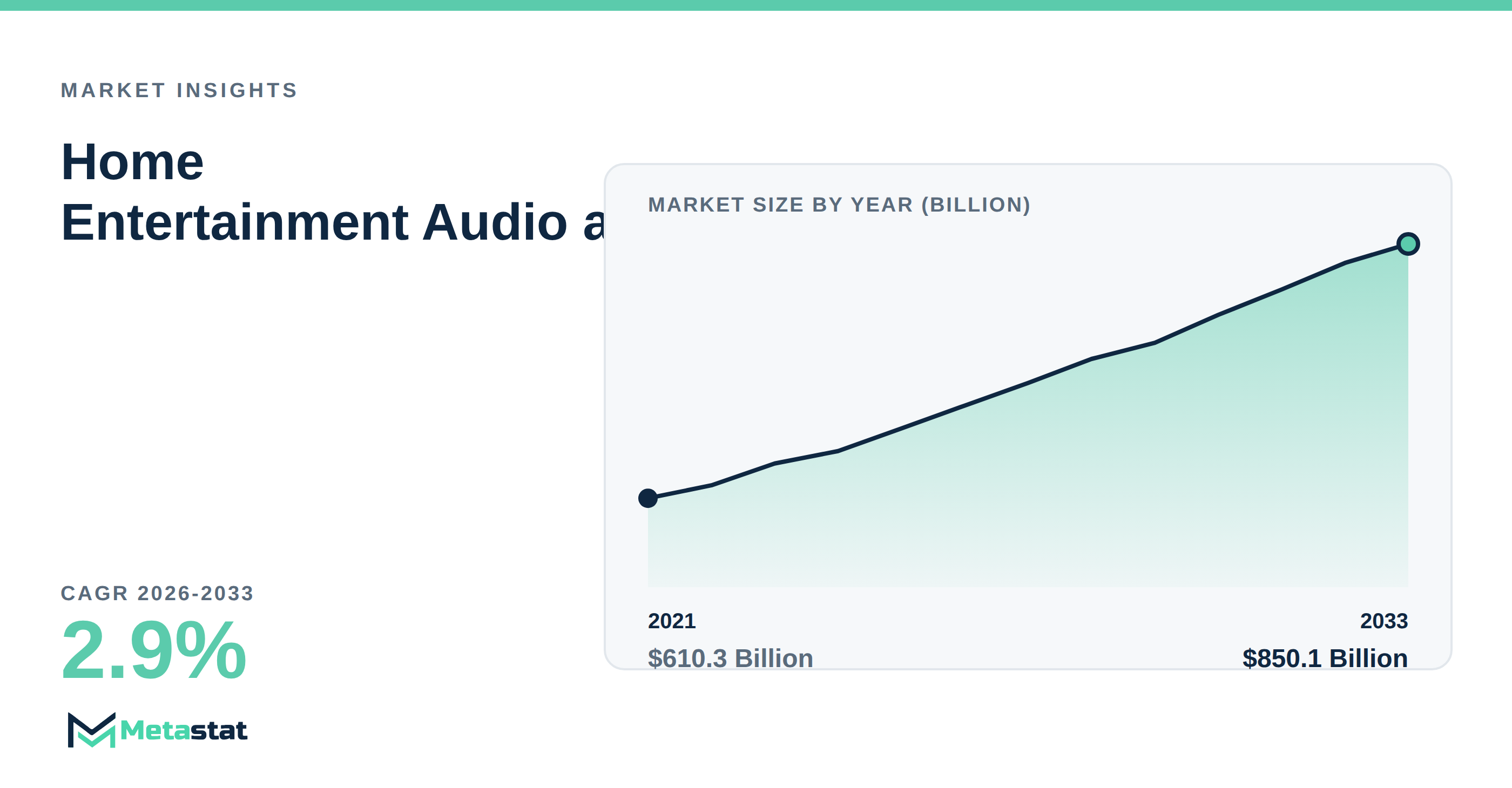
The global Home Entertainment Audio and Video Content market has achieved a notable valuation of USD 676.1 billion in 2025, with projections showing it could reach USD 850.1 billion by 2033. Strong consumer demand and advancements in technology are key factors shaping the industry's growth. Below are six significant forces impacting this vibrant market.
1. Consumer preference for on-demand content drives growth
The shift towards on-demand viewing options significantly fuels the expansion of the Home Entertainment Audio and Video Content market. This transition showcases consumers' desire for greater control over their viewing experiences, enabling them to choose when and what to watch. Direct-to-consumer (DTC) platforms have successfully tapped into this trend, providing vast libraries of content that viewers access on multiple devices. Companies that prioritize personalized content and enriching user experiences are likely to see increased engagement and customer loyalty, ultimately fostering growth.
2. Rising investments in streaming technology enhance user experience
Technological advancements play a crucial role in influencing the Home Entertainment Audio and Video Content market, particularly through investments in improved streaming quality and infrastructure. Companies are dedicating resources to high-definition content delivery, enhancing service reliability, and reducing buffering times. The deployment of 5G networks offers remarkable enhancements in streaming capabilities, allowing users to access high-quality audio and video seamlessly. Organizations that focus on these technological upgrades are better positioned to attract and retain subscribers in a competitive environment.
3. Direct-to-Consumer OTT platforms show rapid growth
The Direct-to-Consumer OTT Platforms segment is projected to expand from USD 276.4 billion in 2026 to USD 367.3 billion by 2033, reflecting a robust compound annual growth rate. This expansion stems from consumers' growing preference for personalized content delivered directly via internet platforms. These channels present significant opportunities for content providers to develop subscriber loyalty and enhance revenues through innovative advertising strategies and subscription models. The competitive landscape compels ongoing investments in original programming, diversifying content offerings to attract audiences.
4. Economic growth boosts content consumption
Improving economic conditions result in higher disposable incomes, stimulating demand for home entertainment options. This economic growth enhances consumer purchasing power, enabling individuals to invest in various audio and video content forms. Regions including North America and Asia Pacific exhibit robust market expansion, driven by consumers' willingness to spend on premium content. Companies that align their products with local market trends are positioned to capture substantial revenue opportunities.
5. Fragmented market landscape demands strategic adaptation
The Home Entertainment Audio and Video Content market comprises a fragmented structure with diverse distribution channels and monetization models. Organizations navigate this complexity by formulating clear strategies for market penetration. Companies that efficiently identify and capitalize on emerging opportunities, particularly within underserved regions, can enhance profitability and broaden their audience base. Strategic partnerships and innovative content strategies are vital to overcoming these challenges.
6. Regulatory challenges impact operational agility
Regulatory compliance and shifting legal standards present ongoing constraints within the Home Entertainment Audio and Video Content market. Companies encounter increased operational costs due to the necessity for continual technology upgrades and adherence to compliance protocols. These challenges hinder product launch speed, affecting the market's responsiveness. Organizations that proactively adapt to regulatory frameworks while optimizing their operations are better equipped to navigate these constraints effectively.
In conclusion, the forces reshaping the Home Entertainment Audio and Video Content market emphasize the critical importance of adaptability and strategic investment in technology and consumer engagement. Companies that acknowledge and respond to these dynamics are more likely to thrive in this expanding market.
The full analysis is in Global Home Entertainment Audio and Video Content Market.
Tags
About the Authors

LEAD ANALYST
Utkarsh Khirodkar is a Lead Market Research Analyst at MetaStat Insight, specializing in market intelligence, technology sector assessments, and competitive strategy.

PRINCIPAL CONSULTANT - ENTERPRISE AI & EMERGING TECHNOLOGIES
Banking & Finance · Electronics and Semiconductor · Energy and Power · Healthcare IT · Information & Technology · Professional Services
Vijay Gunti is a Principal Consultant at MetaStat Insight, bringing over two decades of experience across enterprise digital transformation, technology strategy, and intelligent systems.

PRINCIPAL CONSULTANT - QUALITY SYSTEMS & COMPLIANCE
Electronics and Semiconductor · Machinery & Equipment · Professional Services
Omkar Phadtare is an Industry Consultant at MetaStat Insight, specializing in quality systems, regulatory compliance, and standards benchmarking to drive data-driven market intelligence and strategic industry research.

ENERGY & INFRASTRUCTURE INDUSTRY CONSULTANT
Automotive and Transportation · Electronics and Semiconductor · Energy and Power · Machinery & Equipment
Saurabh Vasant Ganvir consults for Energy & Infrastructure Industry at MetaStat Insight, specializing in renewable energy, solar EPC, and electric vehicle (EV) infrastructure markets.

LEAD CONSULTANT - COMMUNICATION, TELECOM, AND IT
Electronics and Semiconductor · Information & Technology · Machinery & Equipment · Professional Services
Ravindra Sathe Consultants for Communication, Telecom, and IT at MetaStat Insight. He leads the firm's industry research initiatives across telecommunications infrastructure, digital connectivity, enterprise networking, and emerging information technology domains.