
Italy shows 48% tattooed in one survey and 12.8% in another. This analysis compares online panels with representative surveys in Italy, Germany and the United States, and shows what the gap means for tattoo supplies, laser removal and body-art demand forecasts.
Tattoo statistics travel fast and rarely carry their methods with them. One widely shared ranking puts Italy first, with 48% of people tattooed. Italy’s own national health institute counts 12.8%. Both numbers are real, they answer different questions, and anyone sizing tattoo-linked demand needs to know which one is on the table.
This analysis separates what each survey measured, then turns to what it means for suppliers, laser operators and body-art retailers. Buyers of tattoo supplies often inherit prevalence figures from headlines, and the spread between sources is wide enough to move a forecast. Survey results below are reported as published, Metastat figures are Metastat estimates, and interpretation is flagged as our reading.
 One Country, Two Answers: Italy and the United States
Italy: 48% online, 12.8% nationally
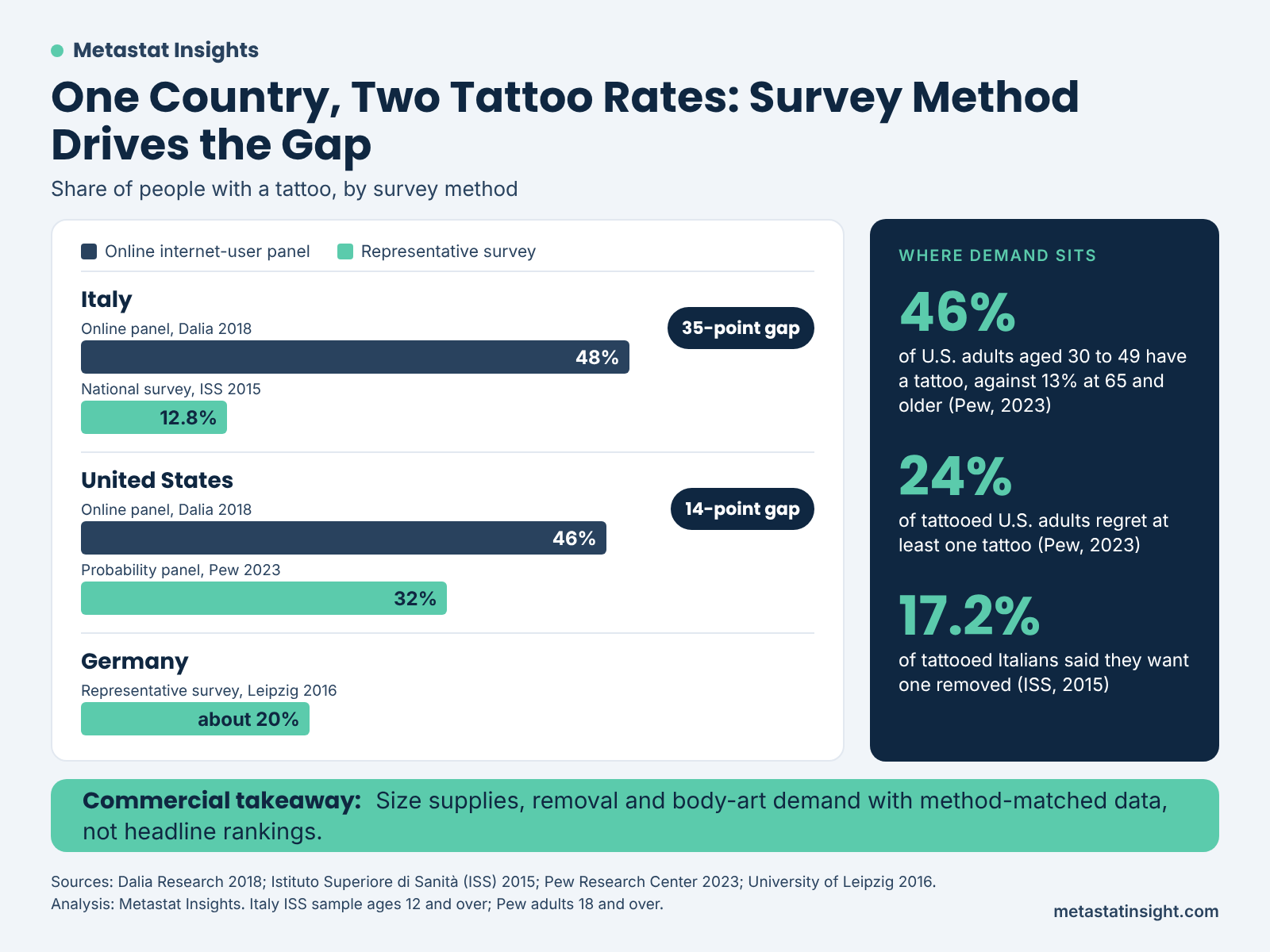
A 2018 survey by Dalia Research, charted by Metastat Insights, ranked Italy first with 48% of respondents tattooed, ahead of Sweden at 47% and the United States at 46%. The survey was run online among internet users.
Italy’s National Institute of Health (ISS) asked the same question differently. Its survey, concluded in 2015 and summarized on EpiCentro, covered 7,608 people representative of the Italian population aged 12 and over. It found 12.8% tattooed, about 6.9 million people.
The gap is 35.2 percentage points, or roughly 3.8 times. Some of it comes from design: the ISS sample includes minors (7.7% of those aged 12 to 17 had a tattoo), and fieldwork dates are three years apart. Our reading is that sampling logic matters more. An online panel draws people who are already active online, a group that can skew younger and more urban than the country as a whole.
United States: 46% online, 32% probability-based
Pew Research Center surveyed 8,480 U.S. adults in July 2023 through a panel recruited by random sampling of residential addresses. It found 32% have a tattoo and 22% have more than one. Dalia’s 2018 figure for the United States was 46%, a 14-point difference.
The later, probability-based number is the lower one. Prevalence would be expected to hold or rise over five years, not fall, so time is unlikely to explain the gap. Method is the likelier cause.
Germany Shows Why League Tables Mislead
A 2016 University of Leipzig survey of 2,510 people aged 14 to 94 found roughly one in five Germans tattooed. Set beside Sweden at 47% in the Dalia ranking, Sweden looks more than twice as tattooed as Germany. That comparison mixes a representative survey with an online one, so it says little about the two countries.
A more defensible comparison uses representative samples only: about 13% in Italy, about 20% in Germany and 32% in the United States. Even these differ in age range, question wording and year, but they sit in one band, roughly one in eight to one in three. The online ranking puts Italy and the United States at 48% and 46%, and those figures should not be read as national population levels.
Age and Gender Decide Where Demand Sits
Pew found 41% of U.S. adults under 30 have a tattoo, rising to 46% at ages 30 to 49 and falling to 13% at 65 and older. Women are ahead of men, 38% to 27%. The ISS survey shows the same shape in Italy: the 35 to 44 group is highest at 23.9%, almost double the national rate, and 13.8% of women are tattooed against 11.7% of men.
In both countries the peak cohort is in its thirties and forties, not the youngest adults. The commercial reading is that tattoo-linked spending is concentrated in people with established earnings, a point that matters for studio pricing, aftercare ranges and the timing of later removal. With 22% of U.S. adults holding more than one tattoo, repeat sessions are part of the demand base.
Regret and Removal: The Downstream Market
Pew found 24% of tattooed adults regret at least one tattoo. The ISS reported that 17.2% of tattooed Italians said they wanted a tattoo removed. These are different questions, regret in one case and a wish for removal in the other, so the two figures are not interchangeable. Both point to a sizeable minority for whom a tattoo is a service need later in life.
Metastat’s Aesthetic Lasers Market report estimates the category at USD 1,799.1 million in 2023, rising to USD 3,487.4 million by 2030, a 9.9% CAGR. It values the tattoo removal segment at USD 174.3 million in 2022. These are Metastat estimates, not survey results.
Our reading is that removal is a small share of laser demand but one tied to a stock of existing tattoos, and that stock depends on prevalence. If a model starts from 46% when the representative figure is nearer 13% to 32%, the removal pool it implies can be overstated several times over.
Supplies and Adjacent Body Art Grow at Different Speeds
Metastat’s Tattoo Supplies Market report estimates the category at USD 2,232.7 million in 2023, reaching USD 3,084.6 million by 2030, a 4.7% CAGR. Over the same 2023 to 2030 window, Metastat’s laser estimate grows at 9.9%. If both estimates hold, value is moving toward the services that follow a tattoo faster than toward the consumables used to make it.
Body piercing is a related category with its own demand pattern. The Body Piercing Jewelry Market report estimates USD 8,639.4 million in 2025 and USD 14,410.6 million by 2033, a 6.6% CAGR. The evidence here covers market size, not overlap between tattoo and piercing buyers, so treat it as a separate demand pool.
Sizing Tattoo Demand From Mixed Sources
Four practical rules follow from the survey record:
- Match methods. Compare online panels with online panels and representative surveys with representative surveys. A cross-method gap is not a country gap.
- Anchor levels on representative data. Use online panels for relative attitudes and rankings within one study, not for the share of a national population.
- Segment by age. A national average hides a peak in the thirties and forties that drives purchasing.
- Treat removal as a lagging market. It follows tattoo adoption by years and depends on the same prevalence input.
For suppliers, the practical consequence is a smaller and better-defined customer base than headline rankings imply, with growth that is slower in consumables and faster in removal on Metastat’s estimates. Teams building category forecasts can start with the supply-side sizing in Metastat’s Tattoo Supplies Market report and test it against the method-matched prevalence ranges above.
Tags
About the Author

LEAD ANALYST
Utkarsh Khirodkar is a Lead Market Research Analyst at MetaStat Insight, specializing in market intelligence, technology sector assessments, and competitive strategy.