
Market volatility, temporary curbs on fresh gold fund investments, uncertainty around U.S. work-based residency applications and data-centre expansion are feeding a bold property-market thesis. The evidence points to potential pressure in specific locations, while a nationwide price surge remains unproven.
Could India’s Real Estate Market See a Price Surge in 2027? Three Signals to Watch
A few current developments could influence Indian real estate demand in 2027. But the claim that prices are “about to blow up” goes beyond the available evidence.
The latest figures reported by Business Standard from Knight Frank’s 2026 data show that home sales across India’s top eight cities were broadly flat at 258,238 units in the first nine months of 2026. New launches rose 4% to 279,899 units, exceeding sales for the 16th consecutive quarter. Prices rose across tracked markets, but annual growth varied: 3–6% in most cities, with Bengaluru at 11%, partly reflecting a shift toward higher-priced homes. That points to local differences, not a uniform national surge.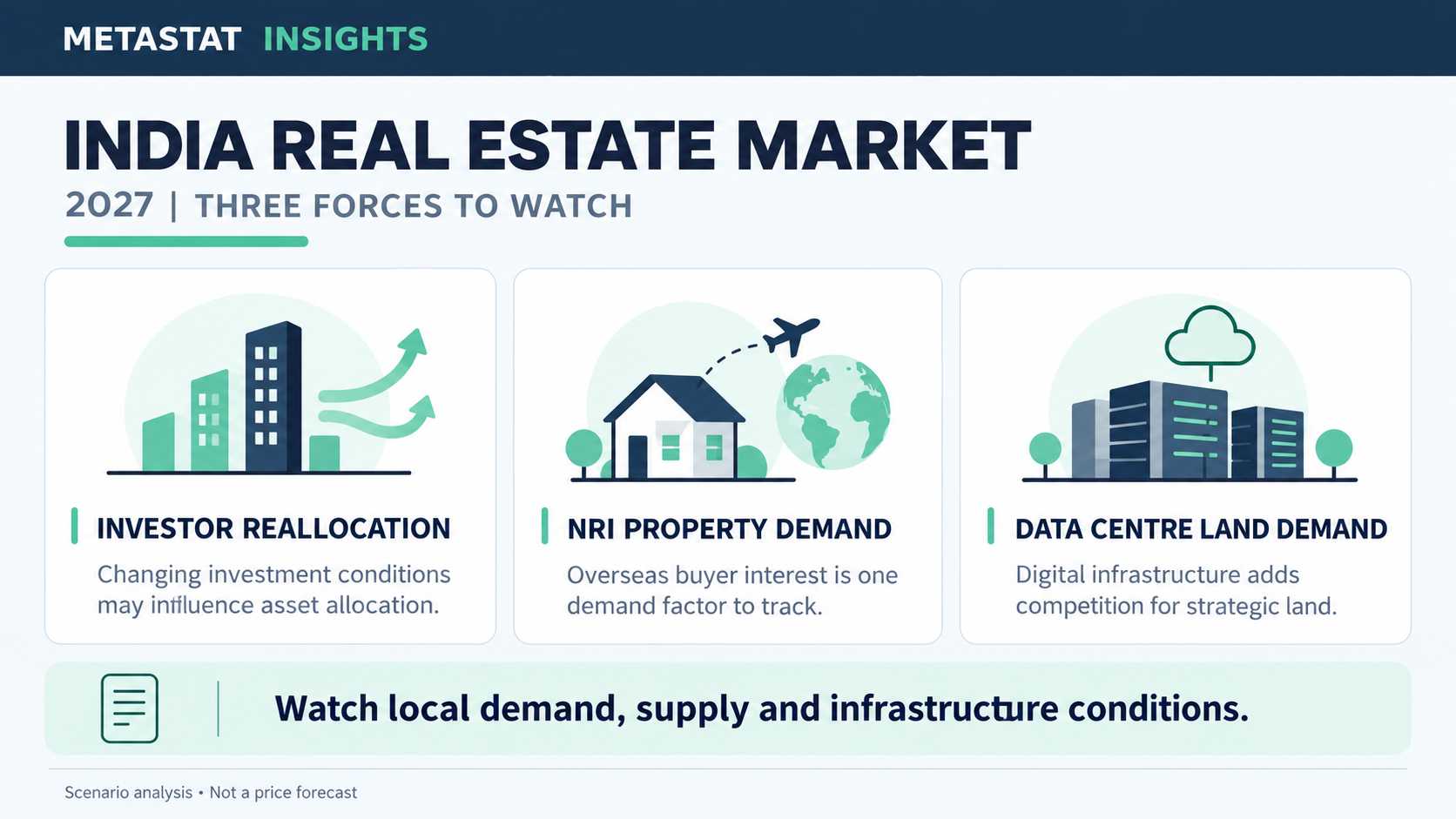
Three developments are worth watching.
1. Changing investment conditions could influence asset allocation
Reuters reported on October 14 that the Nifty 50 had fallen 13% in 2026 to that point. Yet retail participation had not disappeared: AMFI data reported by The Indian Express showed monthly SIP contributions reached a record ₹32,490 crore in September. Market weakness alone does not show that investors have abandoned equities.
Gold-linked mutual fund access also changed. The Economic Times reported that around 17 fund houses temporarily restricted fresh subscriptions to Gold ETF Fund of Funds from October 15–16; redemptions and existing systematic investments continued. Reuters reported that fund notices did not explain the move and that SEBI did not respond to its request for comment. This is a reported restriction on specific gold-linked fund subscriptions, not a blanket ban on gold investing.
Some households could consider property as part of their asset mix, but that is a possibility-not evidence that money is moving from stocks or gold into homes. For broader context on property types, investor groups and investment strategies, see Metastat’s Real Estate Investment Management Market report.
2. NRI demand is a factor; the green-card link remains unproven
On October 8, the U.S. Labor Department suspended PERM processing for applications involving several named technology and IT services companies, including Microsoft, TCS, Infosys, Wipro and HCLTech. PERM is a step in most employer-sponsored green-card cases. The action applies to applications involving those employers; it is not a freeze on every green-card route or on all NRIs. Reuters’ report says U.S. officials cited alleged fraud and protection of American jobs as the reasons for the move.
Whether this will lead affected workers to send more money to India or buy property here is unknown. There is evidence of NRI interest, but the frequently cited national share should be treated as an estimate. Mint’s coverage of a 2023 NoBroker survey put NRI participation at 15% at the time and projected 20% by 2025. A later industry estimate reported by BusinessToday put the 2025 range at 18–20%, while noting it was an estimate rather than an official nationwide transaction count.
Company-level figures show why NRI buyers remain part of the conversation. DLF’s media page reported that NRIs bought ₹5,250 crore of its properties, mainly homes, between April and December of FY2026-about one-third of the company’s sales bookings. That is a single-developer figure, not a national market share, and it does not establish a link to the U.S. PERM suspension.
3. Data-centre expansion could raise competition for suitable land
Data-centre growth is creating visible demand for large, infrastructure-ready sites. Reuters, citing JLL, reported that India’s data-centre capacity could rise from 1.6 GW in mid-2026 to 6 GW by 2029. Global hyperscalers have committed more than $50 billion toward building 1.4 GW of capacity in India by then.
Recent land activity includes Amazon Data Services India’s purchase of 10.61 acres in Ambernath near Mumbai for ₹125.13 crore, based on registration documents reviewed by CRE Matrix and reported by Hindustan Times. The Economic Times reported that TCS purchased an 88-acre parcel in Pune for ₹640.5 crore and received a 200-acre allotment in Andhra Pradesh. Lodha, meanwhile, plans to monetise land at its Palava data-centre park to help fund about 1 GW of powered-shell capacity across roughly 90 acres, according to ETDatacenters. These are distinct transactions and plans, not proof of housing-price increases around each site.
Data-centre projects depend on more than land: power, water, fibre connectivity, approvals and local infrastructure matter. The government is preparing a data-centre policy amid concerns about electricity demand and local objections, Reuters reported. These constraints could shape which corridors attract investment and how much nearby property benefits.
Metastat’s Data Center Market report provides broader context on global data-centre segments and industry participants. It is a global sector report, not an India housing-price forecast.
What to watch in 2027
Capital-allocation changes, NRI activity and data-centre development could support demand in selected locations. Current evidence does not establish a nationwide real-estate price surge for 2027. The more useful signals will be city-level price changes, sales and new launches, unsold inventory, rental demand, financing costs, and data-centre approvals and infrastructure access.
This is a market analysis, not investment advice.
Tags
About the Authors

LEAD ANALYST
Utkarsh Khirodkar is a Lead Market Research Analyst at MetaStat Insight, specializing in market intelligence, technology sector assessments, and competitive strategy.

PRINCIPAL CONSULTANT - ENTERPRISE AI & EMERGING TECHNOLOGIES
Banking & Finance · Electronics and Semiconductor · Energy and Power · Healthcare IT · Information & Technology · Professional Services
Vijay Gunti is a Principal Consultant at MetaStat Insight, bringing over two decades of experience across enterprise digital transformation, technology strategy, and intelligent systems.