
LEAD ANALYST
Utkarsh Khirodkar is a Lead Market Research Analyst at MetaStat Insight, specializing in market intelligence, technology sector assessments, and competitive strategy.

Data Center Market Size, Share, By Data Center Type (Colocation, Hyperscale, Edge, Managed, Modular, and Others), By Tier Level (Tier 1 and Tier 2, Tier 3, and Tier 4), By Data Center Size (Small, Medium, and Large), By Industry (BFSI, IT, Telecom, Healthcare, Government, Manufacturing, Retail, E-commerce, Media, Entertainment, and Others), Industry Analysis, Growth, Trends, and Forecast, 2026-2033
Report ID
MSI-4776
Published
May, 2026
Pages
315 Pages
Format
Report Details
Choose Your License
Data Center Market
Global Data Center market size is valued at USD 382.7 billion in 2025 and projected to grow at a CAGR of 11.6% during the forecast period, reaching USD 920.7 billion by 2033.
North America holds 38.8% in 2025 with US leading the market share in 2025.
Colocation segment account for a market share of 37.83% in 2025.
Key trends driving growth: Rising adoption of artificial intelligence and cloud computing platforms is accelerating demand for high-performance data centers and increasing enterprise digital transformation and IoT integration are boosting large-scale data storage requirements.
Opportunities include expansion of green data centers powered by renewable energy is creating long-term investment opportunities and growing deployment of edge computing infrastructure is opening new revenue streams across smart cities and industrial applications.
Key insight: AI-driven hyperscale infrastructure expansion is reshaping global data center investment strategies and capacity planning.
The global data center market is witnessing strong expansion, supported by rising digital transformation initiatives, cloud computing adoption, artificial intelligence workloads, and increasing enterprise dependence on real-time data processing. Organizations across banking, healthcare, retail, telecom, and government sectors are investing heavily in advanced computing infrastructure to support high-volume data storage and faster processing capabilities. Hyperscale cloud providers continue to dominate infrastructure investments, while colocation services are gaining traction among enterprises seeking scalable and cost-efficient solutions. AI applications, generative AI systems, IoT ecosystems, and edge computing deployments are further increasing the need for high-density data centers equipped with advanced cooling systems and energy-efficient architectures. The global data center market is projected to register strong double-digit growth during the forecast period, supported by rising data traffic and cloud-native application deployment.
The market is also undergoing structural transformation focused on sustainability, energy optimization, and regional diversification. Data center operators are increasingly adopting renewable energy sources, liquid cooling technologies, modular infrastructure, and AI-driven energy management systems to reduce operating costs and carbon emissions. Large-scale investments from hyperscalers such as Amazon, Microsoft, Google, and Meta are accelerating the development of AI-ready facilities capable of supporting GPU-intensive workloads.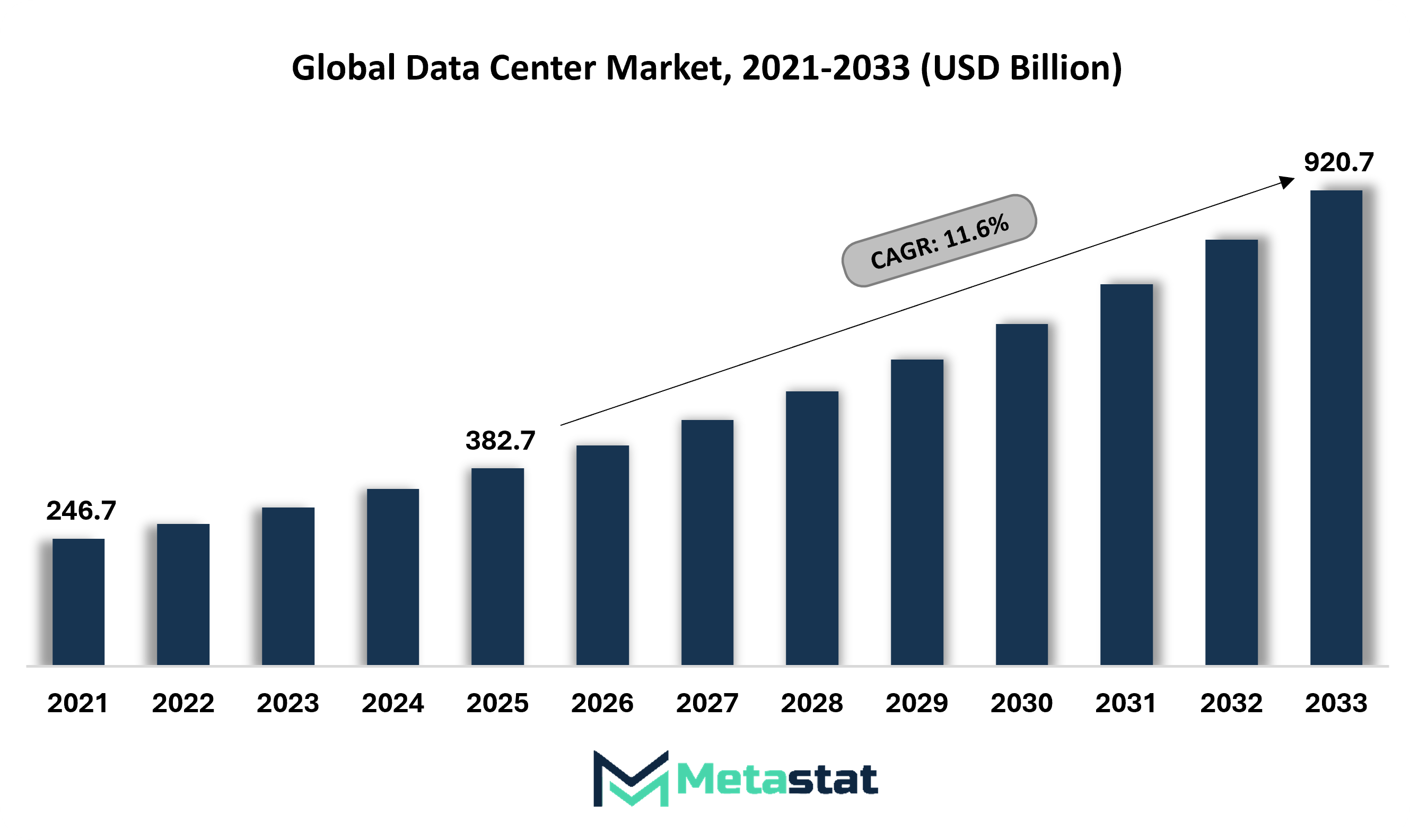
Rising adoption of artificial intelligence and cloud computing platforms is accelerating demand for high-performance data centers.
Rising adoption of artificial intelligence and cloud computing platforms is accelerating demand for high-performance data centers across the data center market. Advanced analytics, machine learning operations, remote enterprise functions, and digital business models are increasing pressure on storage capacity and processing speed. Future investment patterns indicate stronger deployment of hyperscale infrastructure supporting automation, predictive computing, and secure digital ecosystems.
Increasing enterprise digital transformation and IoT integration are boosting large-scale data storage requirements.
Increasing enterprise digital transformation and IoT integration are boosting large-scale data storage requirements across the data center market. Connected devices, smart manufacturing systems, digital banking platforms, and healthcare monitoring networks are generating continuous data streams. Future infrastructure development will focus on scalable architectures, edge computing capabilities, and improved network reliability supporting real-time operational efficiency.
High energy consumption and power grid limitations are creating operational challenges for data center operators.
High energy consumption and power grid limitations are creating operational challenges for operators in the data center market. Expanding computing workloads are increasing electricity demand across major infrastructure hubs, placing pressure on utility networks. Future operational planning will require advanced cooling technologies, energy-efficient management systems, and regional power diversification strategies supporting stable long-term performance.
Rising construction costs and supply chain disruptions for servers, cooling systems, and semiconductors are impacting profitability.
Rising construction costs and supply chain disruptions for servers, cooling systems, and semiconductors are impacting profitability across the data center market. Delays in component availability are affecting project timelines and infrastructure expansion plans. Future market conditions will encourage localized manufacturing partnerships, improved procurement planning, and adoption of modular construction methods to reduce operational uncertainty.
Expansion of green data centers powered by renewable energy is creating long-term investment opportunities.
Expansion of green data centers powered by renewable energy is creating long-term investment opportunities across the data center market. Sustainability goals among enterprises are increasing demand for low-emission infrastructure supported by solar, wind, and hydroelectric energy sources. Future industry direction indicates stronger focus on carbon-neutral operations, energy-efficient cooling systems, and environmentally responsible digital infrastructure development.
The Global Data Center market is classified based on Data Center Type, Tier Level, Data Center Size, and Industry.
Colocation segment is valued at USD 160.7 billion in 2026 and is projected to reach USD 329.6 billion by 2033, at a CAGR of 10.8% during the forecast period.
Colocation facilities continue gaining demand across the Data Center Market owing to rising enterprise dependence on outsourced infrastructure. Business organizations prefer flexible storage environments with lower operational burden and improved scalability. Future growth will emerge from higher cloud adoption, stronger cybersecurity investments, rising digital transactions, and increasing demand for reliable connectivity across developing economies.
Hyperscale segment is valued at USD 139.4 billion in 2026 and is projected to reach USD 322.3 billion by 2033, at a CAGR of 12.7% during the forecast period.
Hyperscale infrastructure holds strong importance in the Data Center Market owing to rapid expansion of cloud computing services, artificial intelligence workloads, and large-scale data processing. Large technology companies continue investing heavily in advanced facilities with energy-efficient systems. Future development will accelerate through automation technologies, renewable energy integration, and rising internet penetration worldwide.
Edge segment is valued at USD 53.5 billion in 2026 and is projected to reach USD 134.4 billion by 2033, at a CAGR of 14.1% during the forecast period.
Edge data centers are witnessing growing deployment across the Data Center Market, with low-latency processing supporting real-time digital applications. Growth of smart cities, autonomous systems, connected devices, and 5G networks is creating stronger need for localized computing infrastructure. Future opportunities will increase through industrial automation, remote healthcare services, and advanced digital entertainment platforms.
Others (Managed, Modular) segment is valued at USD 73.4 billion in 2026 and is projected to reach USD 134.4 billion by 2033, at a CAGR of 9% during the forecast period.
Managed and modular facilities are creating new growth avenues in the Data Center Market owing to faster deployment capabilities and scalable infrastructure models. Enterprises are seeking cost-efficient solutions that support changing storage requirements. Future expansion will emerge from remote business operations, temporary computing needs, disaster recovery initiatives, and rising digital transformation across small enterprises.
Tier 1 and Tier 2 segment is projected to reach USD 136.3 billion by 2033, at a CAGR of 9.1% during the forecast period.
Tier 1 and Tier 2 infrastructure continues to serve small enterprises seeking low-cost operational environments within the Data Center Market. Demand remains stable owing to moderate uptime requirements and lower installation costs. Future market development will strengthen through digital adoption among local businesses, educational institutions, and emerging startup ecosystems.
Tier 3 segment is projected to reach USD 464.1 billion by 2033, at a CAGR of 11.2% during the forecast period.
Tier 3 facilities maintain considerable demand in the Data Center Market owing to high operational reliability and maintenance flexibility. Enterprises handling critical workloads prefer infrastructure with minimal downtime risks. Future expansion will rise from financial institutions, cloud service providers, healthcare systems, and digital commerce platforms requiring uninterrupted operations and secure storage environments.
Tier 4 segment is projected to reach USD 320.4 billion by 2033, at a CAGR of 13.5% during the forecast period.
Tier 4 infrastructure represents premium operational standards in the Data Center Market owing to maximum redundancy and strong fault tolerance. Large organizations handling sensitive digital assets continue investing in advanced facilities. Future growth will accelerate through artificial intelligence expansion, security-related applications, high-frequency trading systems, and rising cybersecurity concerns across industries.
Small segment is projected to reach USD 136.3 billion by 2033.
Small data centers hold relevance within the Data Center Market owing to localized computing requirements and lower infrastructure investment. Regional enterprises often select compact environments supporting limited operational workloads. Future demand will increase through rural digitalization programs, local government projects, retail digitization, and increasing internet access across underserved areas.
Medium segment is projected to reach USD 279.9 billion by 2033.
Medium-sized infrastructure holds balanced growth potential in the Data Center Market owing to operational flexibility and manageable investment requirements. Mid-sized companies continue adopting scalable computing environments supporting moderate digital workloads. Future opportunities will emerge from hybrid cloud integration, regional expansion strategies, and growing digital service consumption among developing businesses.
Large segment is projected to reach USD 504.6 billion by 2033
Large-scale infrastructure dominates primary investment activity within the Data Center Market owing to rising global data traffic and growing enterprise cloud migration. Technology firms continue developing advanced facilities supporting large storage and processing requirements. Future expansion will strengthen through artificial intelligence growth, machine learning applications, and global digital connectivity initiatives.
BFSI segment is projected to grow at a CAGR of 10.6% during the forecast period.
BFSI organizations generate strong demand within the Data Center Market owing to rising digital banking activities, online payment platforms, and cybersecurity requirements. Financial institutions continue investing in reliable storage infrastructure supporting sensitive transaction data. Future growth will accelerate through fintech innovation, blockchain integration, and increasing digital financial inclusion worldwide.
IT & Telecom segment is projected to grow at a CAGR of 12.2% during the forecast period.
IT and telecom sectors remain major contributors to the Data Center Market owing to expanding internet services, cloud computing demand, and mobile connectivity growth. Technology providers require advanced infrastructure supporting high-volume digital traffic. Future opportunities will increase through 5G deployment, artificial intelligence integration, and rising demand for remote communication systems.
Healthcare segment is projected to grow at a CAGR of 12.2% during the forecast period.
Healthcare organizations are increasing investments in the Data Center Market owing to rising digital patient records, telemedicine adoption, and connected medical technologies. Secure infrastructure remains essential for managing sensitive healthcare data. Future development will strengthen through artificial intelligence diagnostics, wearable health devices, and expansion of remote healthcare services globally.
Government segment is projected to grow at a CAGR of 9.7% during the forecast period.
Government organizations continue supporting growth in the Data Center Market owing to increasing digital governance programs and secure public data management requirements. National administrations are modernizing infrastructure for better operational efficiency. Future development will emerge through smart city development, digital identity systems, and growing investment in cybersecurity protection measures.
Manufacturing segment is projected to grow at a CAGR of 10.8% during the forecast period.
Manufacturing industries are generating higher demand in the Data Center Market owing to industrial automation, connected production systems, and real-time operational monitoring. Advanced computing infrastructure supports predictive maintenance and supply chain management. Future growth will strengthen through smart factory adoption, robotics integration, and industrial internet technology implementation across production facilities.
Retail & E-commerce segment is projected to grow at a CAGR of 13.2% during the forecast period.
Retail and e-commerce sectors continue expanding their presence in the Data Center Market owing to rising online shopping activity and digital payment transactions. Businesses require dependable infrastructure supporting customer analytics and inventory management. Future opportunities will strengthen through personalized shopping technologies, same-day delivery systems, and growing smartphone-based purchasing behavior.
Others (Media & Entertainment) segment is projected to grow at a CAGR of 11% during the forecast period.
Media and entertainment industries are increasing infrastructure investments in the Data Center Market owing to rising digital streaming consumption and online gaming demand. High-capacity storage environments support content delivery and user engagement platforms. Future growth will accelerate through virtual reality experiences, interactive digital entertainment, and expansion of global streaming services.
Based on geography, the Global Data Center market is divided into North America, Europe, Asia-Pacific, South America, Middle East, and Africa.
Strong investments from hyperscale companies such as AWS, Microsoft, Google, and Meta continue to strengthen North America’s regional market dominance.
Rapid AI infrastructure deployment across the United States is increasing demand for advanced cooling and high-density server environments.
Europe is focusing heavily on sustainable and energy-efficient data center development, with strict carbon reduction goals encouraging renewable-powered infrastructure and advanced cooling adoption.
Rapid digitalization and cloud adoption throughout India, China, and Southeast Asia are creating substantial hyperscale expansion possibilities.
Government-backed smart city initiatives and growing 5G deployment are increasing demand for localized edge data centers in Asia Pacific.
The Middle East is emerging as a strategic hub for AI-ready infrastructure investments. Africa is witnessing rising colocation demand owing to growing internet penetration, while South America is benefiting from increasing cloud adoption and expansion of regional connectivity networks.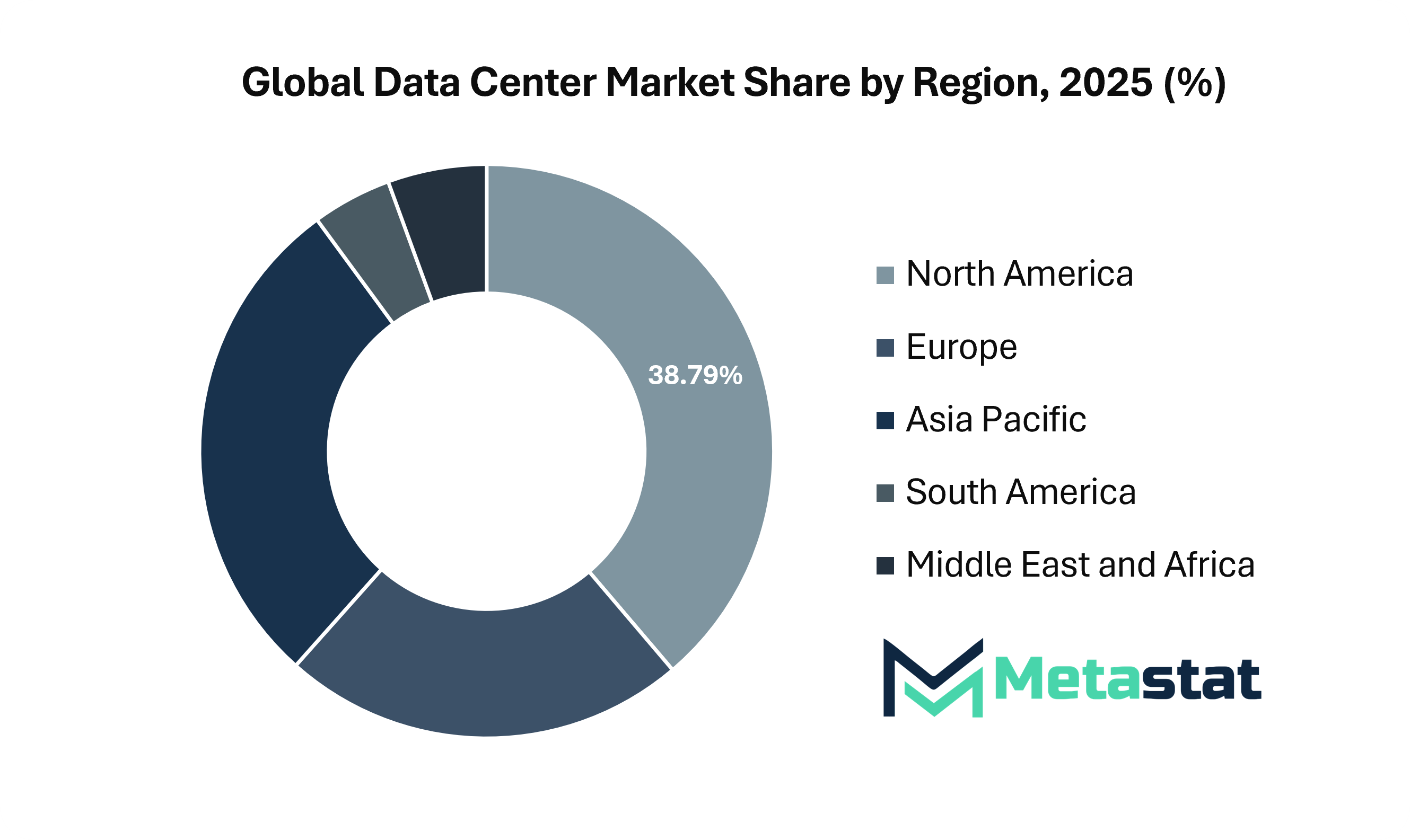
The Global Data Center Market has gained strong interest in recent years, with businesses relying heavily on digital services, cloud storage, online payments, video streaming, and remote work systems. Companies across different sectors are investing in secure and high-speed data centers to manage growing internet traffic and customer demand. The growing use of artificial intelligence, machine learning, and connected devices has further increased the need for reliable infrastructure that processes large volumes of data with minimal latency. Many companies are moving from traditional storage systems to advanced cloud-based infrastructure to improve speed, flexibility, and operational efficiency. Governments and private enterprises are also supporting smart city initiatives and digital transformation plans, creating increased demand for advanced facilities with better energy management and higher security standards. At the same time, companies are paying close attention to sustainability through renewable energy sources and efficient cooling systems to reduce environmental impact and lower operating costs.
Firms such as ABB Ltd., Cisco Systems, Inc., Dell Technologies, Schneider Electric, and Huawei Technologies Co., Ltd. are offering advanced networking equipment, energy systems, and automation technologies that support efficient operations. Cloud service providers such as Amazon Web Services, Inc., Google LLC, Microsoft Corporation, Alibaba Cloud, Oracle, Tencent Cloud, and IBM Corporation are expanding their global presence to meet growing customer demand for digital services.
Infrastructure companies such as Equinix, Inc., Digital Realty, CyrusOne, EdgeConneX, AirTrunk, QTS Data Centers, NEXTDC, Telehouse, CoreSite, and Vantage Data Centers continue to expand facilities across North America, Europe, and Asia Pacific. Several companies are focusing on hyperscale projects that support large cloud platforms and high-speed applications. Firms such as ST Telemedia Global Data Centres, Princeton Digital Group, Global Switch, STACK Infrastructure, and Yondr Group are strengthening regional networks by building facilities closer to business hubs and urban centers. This approach helps reduce latency and improves customer experience. Telecom operators such as AT&T Intellectual Property, China Telecom Americas, Inc., KDDI Corporation, and Lumen Technologies are also improving connectivity through better network integration and stronger communication systems.
The industry is anticipated to maintain steady progress in the coming years, supported by rising internet penetration, growing digital transactions, and continuous demand for cloud computing services. Businesses will increase investments in automation, edge computing, and energy-efficient technologies to handle future infrastructure requirements. Companies focusing on sustainability, robust security systems, and faster connectivity will gain a competitive advantage in the global industry landscape.
Market size is forecast to rise from USD 382.7 billion in 2025 to over USD 920.7 billion by 2033.
The outlook for the data center market remains highly positive, supported by continuous advancements in artificial intelligence, machine learning, 5G connectivity, autonomous technologies, and cloud ecosystems. Future market expansion is expected to be driven by AI supercomputing demand, rising hyperscale investments, expansion of edge computing networks, and increasing enterprise migration toward hybrid cloud infrastructure.
This research report categorizes the Data Center market based on key segments and regions, forecasts revenue growth, and analyses trends in each submarket. The report analyses the key growth drivers, opportunities, and challenges influencing the Data Center market. Recent market developments and competitive strategies such as expansion, product launch, partnership, merger, and acquisition have been included to draw the competitive landscape in the market.
The report strategically identifies and profiles the key market players and analyses their core competencies in each sub-segment of the Data Center market.
|
Report Attributes |
Details |
|
Study Period |
2021-2033 |
|
Base Year |
2025 |
|
Estimated Year |
2026 |
|
Forecast Period |
2026-2033 |
|
Historical Period |
2021-2025 |
|
Growth Rate |
CAGR 11.6% from 2026 to 2033 |
|
Revenue Unit |
USD billion |
|
Segmentation |
By Data Center Type, Tier Level, Data Center Size, Industry, and Region |
|
By Region |
North America (By Data Center Type, Tier Level, Data Center Size, Industry, and Country)
|
|
Europe (By Data Center Type, Tier Level, Data Center Size, Industry, and Country)
|
|
|
Asia Pacific (By Data Center Type, Tier Level, Data Center Size, Industry, and Country)
|
|
|
South America (By Data Center Type, Tier Level, Data Center Size, Industry, and Country)
|
|
|
Middle East and Africa (By Data Center Type, Tier Level, Data Center Size, Industry, and Country)
|
Find answers to common questions about this report
Top players operating in the Data Center industry includes ABB Ltd., AirTrunk, Alibaba Cloud, Amazon Web Services, Inc., AT&T Intellectual Property, and China Telecom Americas, Inc.
High energy consumption and power grid limitations are creating operational challenges for data center operators will hamper the market growth within the forecast period.
North America region dominates the market.
The Global Data Center market is expected to grow at a CAGR of 11.6% over the forecast period (2026-2033).
Global Data Center market is estimated to reach USD 920.7 billion by 2033.
The Colocation is the leading type segment in the Global market.
Rising adoption of artificial intelligence and cloud computing platforms is accelerating demand for high-performance data centers and increasing enterprise digital transformation and IoT integration are boosting large-scale data storage requirements are key driving factors, boosting the market.
The Metastat Insights analysis shows that the North America Data Center market size is estimated to be USD 338.8 billion by 2033.
The Metastat Insights study shows that the Global Data Center market size was USD 382.7 billion in 2025.
The analysts below cover Information & Technology research at Metastat Insights.
LEAD ANALYST
Utkarsh Khirodkar is a Lead Market Research Analyst at MetaStat Insight, specializing in market intelligence, technology sector assessments, and competitive strategy.

PRINCIPAL CONSULTANT - ENTERPRISE AI & EMERGING TECHNOLOGIES
Banking & Finance · Electronics and Semiconductor · Energy and Power · Healthcare IT · Information & Technology · Professional Services
Vijay Gunti is a Principal Consultant at MetaStat Insight, bringing over two decades of experience across enterprise digital transformation, technology strategy, and intelligent systems.

LEAD CONSULTANT - COMMUNICATION, TELECOM, AND IT
Electronics and Semiconductor · Information & Technology · Machinery & Equipment · Professional Services
Ravindra Sathe Consultants for Communication, Telecom, and IT at MetaStat Insight. He leads the firm's industry research initiatives across telecommunications infrastructure, digital connectivity, enterprise networking, and emerging information technology domains.
Our team was tracking whether regional recycling infrastructure could realistically absorb the growing volume of lithium iron phosphate batteries over the next decade. The report did a solid job separating announced hydrometallurgical plant capacity from active, permitted operational throughput. That distinction made the feedstock availability projections and regional recovery rate models far more credible than standard commercial overviews.
Tracking capacity expansion in single-use bioprocessing requires dependable data on raw material availability and cleanroom-grade polymer supply chains. The competitive landscape chapter gave a grounded evaluation of secondary component suppliers across North America and Asia-Pacific rather than simply reprinting press releases. Having that level of supplier benchmarking helped clarify dual-sourcing considerations for our clinical pipeline planning.
When evaluating distributed energy resource management systems, standard research summaries tend to gloss over the operational differences between front-of-the-meter utility deployments and behind-the-meter industrial sites. The MetaStat Insight report addressed those distinctions directly, especially regarding software interoperability standards and grid interconnection backlogs. The five-year market sizing across regional transmission organizations provided actionable context for our grid modernization strategy.
Explore related market intelligence reports worth reading alongside this one.
Starting from
$2950