
LEAD ANALYST
Utkarsh Khirodkar is a Lead Market Research Analyst at MetaStat Insight, specializing in market intelligence, technology sector assessments, and competitive strategy.

Data Center Colocation Market Size, Share, By Colocation Type (Retail Colocation, Wholesale Colocation , and Hybrid Colocation), By Tier Standard (Tier I, Tier II, Tier III, and Tier IV), By Enterprise Size (Small Enterprises, Medium Enterprises, and Large Enterprises), By Industry Vertical (IT, Telecom, BFSI, Healthcare, Retail, Government, Defense, Manufacturing, Media, Entertainment, and Others), Industry Analysis, Growth, Trends, and Forecast, 2026-2033
Report ID
MSI-4737
Published
May, 2026
Pages
316 Pages
Format
Report Details
Choose Your License
Data Center Colocation Market
Global Data Center Colocation market size is valued at USD 96.2 billion in 2025 and projected to grow at a CAGR of 14.4% during the forecast period, reaching USD 282.1 billion by 2033.
Global Data Center Colocation market valued at USD 96.2 billion in 2025, growing at a CAGR of 14.4% through 2033, with potential to exceed USD 282.1 billion.
North America holds 37.1% in 2025 with US leading the market share in 2025.
Retail Colocation segment account for a market share of 52.0% in 2025.
Key trends driving growth: Cloud and hybrid IT adoption increasing outsourced data center footprint and interconnection-rich digital ecosystems increasing carrier-neutral colocation uptake.
Opportunities include AI-ready high-density colocation expansion aligned with accelerated compute demand.
Key insight: Rising enterprise cloud migration and hybrid IT deployment strategies position colocation facilities at the center of scalable digital infrastructure demand.
Global Data Center Colocation Market within the digital infrastructure industry will move beyond conventional rack leasing and power provisioning, shaping how companies architect long-term technology ecosystems. Over the coming years, operators will position facilities as integrated digital campuses where cloud on-ramps, edge nodes, AI clusters, and private network fabrics converge into a single operational environment. Rather than functioning only as secure physical sites, colocation hubs will operate as interconnection exchanges that orchestrate data gravity, latency control, and distributed computing strategies for multinational enterprises.
Enterprises will increasingly view colocation facilities as strategic control points in hybrid and multi-cloud architecture. Advanced cross-connect fabrics will enable direct, low-latency pathways between hyperscale clouds, telecom carriers, content delivery platforms, and enterprise workloads. Artificial intelligence deployments will accelerate demand for high-density environments optimized for liquid cooling, specialized chipsets, and modular expansion. Facilities will evolve into high-performance computing environments capable of supporting model training, real-time analytics, and industry-specific digital twins.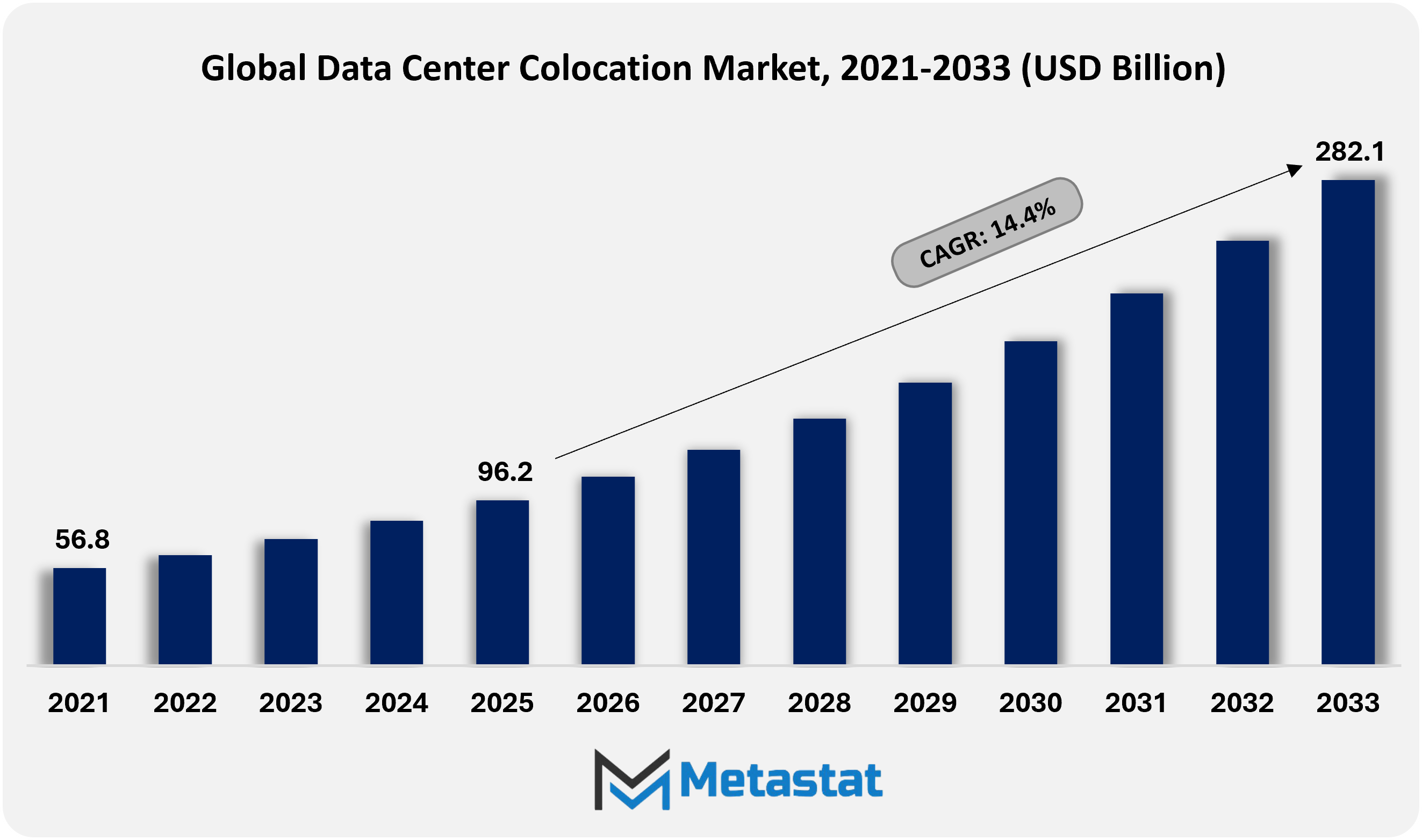
Cloud and hybrid IT adoption increasing outsourced data center footprint.
Rising enterprise migration toward cloud-based workloads and hybrid IT architecture will increase dependence on third-party infrastructure environments. Enterprises pursuing workload portability, disaster recovery readiness, and cost visibility will allocate larger budgets to colocation facilities. Global Data Center Colocation Market growth will accelerate as businesses seek scalable rack capacity, geographic redundancy, and managed infrastructure frameworks that support long-term digital transformation roadmaps.
Interconnection-rich digital ecosystems increasing carrier-neutral colocation uptake
Demand for low-latency connectivity will increase preference for carrier-neutral campuses offering dense interconnection fabrics. Enterprises, cloud providers, and network operators will cluster within shared facilities to enable direct cross-connects and efficient traffic exchange. Global Data Center Colocation Market expansion will strengthen through digital ecosystems where financial services, content platforms, and enterprise networks converge to enhance performance, resilience, and data exchange speed.
Power availability constraints and grid interconnection lead times limiting new capacity delivery
Electricity supply bottlenecks and extended grid interconnection processes will limit timely deployment of new capacity across metropolitan hubs. Utility approval cycles, transmission constraints, and sustainability mandates will delay energized site readiness. Global Data Center Colocation Market participants will face scheduling uncertainty, requiring strategic land banking, alternative power sourcing, and long-term power purchase agreements to stabilize infrastructure expansion pipelines.
High capex intensity and long permitting timelines extending project payback cycles
Large-scale campus development requires substantial capital allocation across land acquisition, electrical systems, cooling infrastructure, and compliance processes. Lengthy permitting approvals will extend development timelines and delay revenue realization. Global Data Center Colocation Market stakeholders will encounter prolonged payback cycles, increasing exposure to financing risk, regulatory revisions, and evolving technical requirements that shape facility design and operational efficiency.
AI-ready high-density colocation expansion aligned with accelerated compute demand
Rapid acceleration in artificial intelligence workloads will generate demand for high-density rack configurations supporting advanced processors and liquid cooling technologies. Facilities engineered for higher power densities will attract hyperscale clients seeking compute-intensive environments. Global Data Center Colocation Market growth trajectory will strengthen through infrastructure optimized for AI training clusters, edge inference nodes, and high-performance computing ecosystems.
The Global Data Center Colocation market is classified based on Colocation Type, Tier Standard, Enterprise Size, and Industry Vertical.
Retail Colocation segment is valued at USD 57.2 billion in 2026 and is projected to reach USD 115.5 billion by 2033, at a CAGR of 10.6% during the forecast period.
Retail Colocation will support enterprises seeking flexible rack space with shared infrastructure and managed services. Growing startup ecosystems and mid-sized companies will drive demand for cost-efficient hosting solutions. Providers will enhance security, remote monitoring, and modular expansion capabilities to address performance requirements without major capital expenditure commitments.
Wholesale Colocation segment is valued at USD 40.7 billion in 2026 and is projected to reach USD 126.6 billion by 2033, at a CAGR of 17.6% during the forecast period.
Wholesale Colocation will attract hyperscale cloud providers and large enterprises requiring dedicated space and power capacity. Long-term contracts and customized infrastructure configurations will support strategic partnerships. Expansion into secondary cities will improve geographic redundancy and disaster recovery planning for large-scale digital operations.
Hybrid Colocation segment is valued at USD 12 billion in 2026 and is projected to reach USD 40.1 billion by 2033, at a CAGR of 18.8% during the forecast period.
Hybrid Colocation will integrate private infrastructure with public cloud environments, enabling workload optimization and seamless data exchange. Enterprises pursuing digital transformation will adopt hybrid frameworks to balance security and scalability. Future facilities will include advanced connectivity ecosystems to support multi-cloud strategies and edge deployments.
Tier I segment is projected to reach USD 6 billion by 2033, at a CAGR of 2.4% during the forecast period.
Tier I facilities will remain suitable for non-critical workloads where basic redundancy meets operational needs. Small enterprises with limited uptime requirements will consider entry-level infrastructure to reduce hosting costs. Gradual improvements in monitoring and cooling efficiency will enhance reliability without significant capital expansion.
Tier II segment is projected to reach USD 35.7 billion by 2033, at a CAGR of 10.1% during the forecast period.
Tier II infrastructure will offer improved redundancy for power and cooling systems, ensuring moderate uptime reliability. Growing enterprises will adopt such facilities for business continuity planning. Investment in predictive maintenance technologies will strengthen operational stability and reduce unexpected service disruptions.
Tier III segment is projected to reach USD 140.4 billion by 2033, at a CAGR of 14% during the forecast period.
Tier III facilities will dominate enterprise demand owing to concurrent maintainability and higher uptime assurance. Mission-critical applications across finance, healthcare, and telecommunications will rely on such infrastructure. Future enhancements will emphasize renewable energy integration and intelligent workload management systems.
Tier IV segment is projected to reach USD 100.1 billion by 2033, at a CAGR of 18.5% during the forecast period.
Tier IV infrastructure will deliver fault tolerance and maximum uptime for high-value digital ecosystems. Large enterprises and government organizations will prefer fully redundant systems to protect sensitive operations. Advanced automation and real-time risk assessment tools will enhance resilience against cyber and physical threats.
Small and Medium Enterprises (SMEs) segment is projected to reach USD 111.1 billion by 2033.
Small and Medium Enterprises will increasingly use colocation services to avoid heavy infrastructure investment. Affordable pricing models and scalable contracts will support business expansion. Access to enterprise-grade security and compliance frameworks will strengthen competitiveness in digital markets.
Large Enterprises segment is projected to reach USD 171.1 billion by 2033.
Large Enterprises will adopt colocation facilities to manage large data volumes and distributed operations. Customized infrastructure, high-density power support, and global connectivity networks will remain priority requirements. Strategic expansion across multiple geographies will strengthen redundancy and regulatory alignment.
IT & Telecom segment is projected to grow at a CAGR of 15.2% during the forecast period.
IT & Telecom sector will generate strong demand owing to rapid 5G deployment, cloud service expansion, and edge computing initiatives. High bandwidth capacity and low-latency connectivity will remain primary priorities. Future infrastructure will incorporate artificial intelligence-driven network optimization.
BFSI segment is projected to grow at a CAGR of 13.3% during the forecast period.
BFSI institutions will rely on secure colocation environments to protect financial data and maintain regulatory compliance. Real-time transaction processing and disaster recovery frameworks will drive infrastructure upgrades. Enhanced encryption and surveillance systems will strengthen trust and operational continuity.
Healthcare segment is projected to grow at a CAGR of 15.5% during the forecast period.
Healthcare companies will require compliant hosting environments for digital health records and telemedicine platforms. Rising data volumes from medical devices will increase storage requirements. Secure connectivity and strict regulatory adherence will guide infrastructure expansion.
Retail segment is projected to grow at a CAGR of 15.1% during the forecast period.
Retail enterprises will use colocation services to support e-commerce growth, digital payment systems, and supply chain analytics. Seasonal demand fluctuations will require scalable infrastructure solutions. Real-time inventory tracking and customer analytics will increase computational requirements.
Government & Defense segment is projected to grow at a CAGR of 13.1% during the forecast period.
Government & Defense organizations will prioritize highly secure, redundant facilities for critical national data. Advanced cybersecurity frameworks and physical security measures will remain essential. Sovereign data hosting requirements will support localized infrastructure development.
Manufacturing segment is projected to grow at a CAGR of 13% during the forecast period.
Manufacturing sector will adopt colocation services to manage industrial automation systems and Internet of Things deployments. Predictive maintenance analytics and smart factory operations will increase data processing requirements. Reliable infrastructure will enhance production efficiency and operational visibility.
Media & Entertainment segment is projected to grow at a CAGR of 17.1% during the forecast period.
Media & Entertainment industry will generate demand for high-capacity storage and fast content distribution networks. Streaming platforms and digital production workflows will require low-latency environments. Scalable infrastructure will support immersive technologies and global audience reach.
Others segment is projected to grow at a CAGR of 11.9% during the forecast period.
Other sectors such as education, energy, and transportation will contribute to market expansion through digital transformation initiatives. Remote learning platforms, smart grid management, and intelligent mobility systems will increase infrastructure dependence. Flexible hosting models will support diverse operational requirements.
Based on geography, the Global Data Center Colocation market is divided into North America, Europe, Asia-Pacific, South America, Middle East, and Africa.
North America Data Center Colocation Market is set to expand at a CAGR of 14.4% within the forecast period, reaching a market size (TAM) of USD 91.7 billion by the end of 2033.
North America drives the Data Center Colocation Market through strong hyperscale cloud expansion and rising enterprise outsourcing demand across the U.S. and Canada.
Europe supports market expansion through strong data protection regulations, sustainability initiatives, and rising enterprise demand for resilient colocation infrastructure.
Asia Pacific presents major opportunities in the Data Center Colocation Market, driven by rapid digital transformation and expanding startup ecosystems across China, India, and Southeast Asia.
South America and Middle East and Africa are witnessing steady progress in the Data Center Colocation Market, supported by improving connectivity infrastructure, government-backed digital initiatives, and rising enterprise migration toward third-party data hosting services.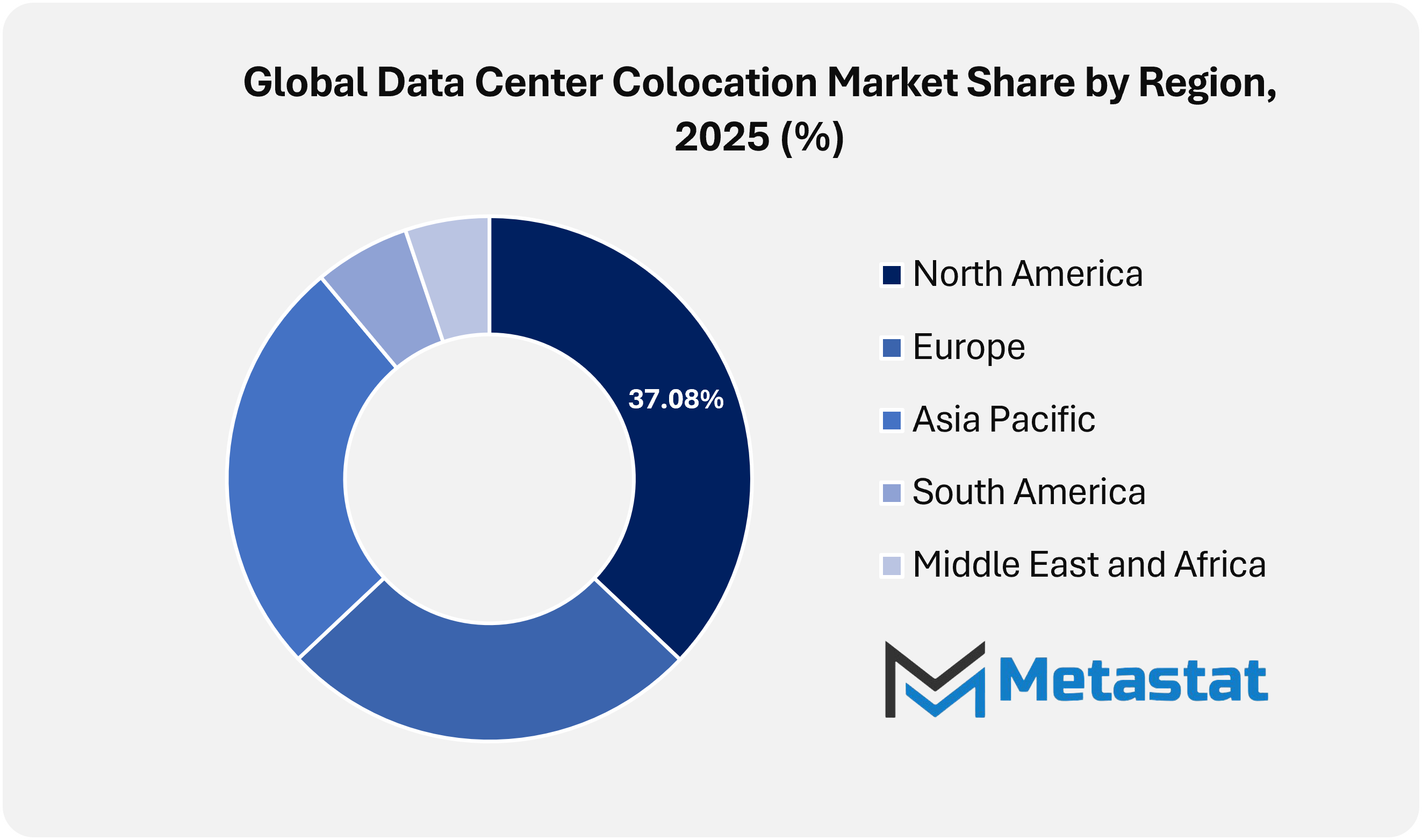
The global data center colocation market is expanding steadily as enterprises continue to rely on digital platforms, cloud computing, and data-driven operations. Companies across sectors are generating large volumes of data, and managing in-house infrastructure is becoming increasingly expensive and complex. Colocation services provide a practical solution by offering secure facilities, reliable power, cooling systems, and high-speed connectivity without requiring enterprises to build their own data centers. Demand will continue to rise as companies focus on lowering capital expenditure while improving operational efficiency. The expansion of remote work, online services, and digital payments will further support market growth in the coming years.
Major industry participants are strengthening their global presence through facility expansion, strategic partnerships, and investment in energy-efficient infrastructure. Leading companies such as Equinix, Inc. and Digital Realty Trust, Inc. operate extensive networks of interconnected data centers across multiple regions. NTT Global Data Centers and CyrusOne LLC are recognized for providing scalable solutions that serve hyperscale cloud providers and enterprise customers. QTS Realty Trust, LLC and CoreSite Realty Corporation continue enhancing their service portfolios to meet rising demand for hybrid IT environments.
Other major competitors are focusing on regional expansion and specialized service offerings. Switch, Ltd. and Iron Mountain Incorporated provide secure and sustainable facilities designed to meet strict compliance standards. STACK Infrastructure, Inc. and Vantage Data Centers, LLC are expanding hyperscale campuses to serve large cloud operators. Companies including DataBank Holdings, Ltd., Flexential Corp., Cologix, Inc., and EdgeConneX, Inc. are strengthening connectivity-rich facilities in key metropolitan markets.
The market also includes strong regional and global participants that continue shaping competitive dynamics. Colt Group Holdings Limited and Telehouse International Corporation maintain a solid presence across Europe and Asia. VIRTUS Data Centres Limited, DATA4 Group, and Kao Data Limited are expanding across European markets. In Asia Pacific, STT Global Data Centres India Private Limited, NEXTDC Limited, GDS Holdings Limited, CtrlS Datacenters Limited, and Nxtra Data Limited are investing in capacity expansion to meet rising digital demand. With continuous investment in connectivity, sustainability, and edge deployments, the global data center colocation market will remain competitive and growth-oriented over the forecast period.
Market size is forecast to rise from USD 96.2 billion in 2025 to over USD 282.1 billion by 2033.
Regulatory shifts surrounding data sovereignty will further reshape deployment strategies in the Data Center Colocation Market. Enterprises will distribute workloads across compliant facilities while maintaining centralized visibility through unified orchestration layers. Security models will transition toward zero-trust frameworks embedded directly within colocation ecosystems, combining physical safeguards with software-defined perimeter controls.
This research report categorizes the Data Center Colocation market based on key segments and regions, forecasts revenue growth, and analyses trends in each submarket. The report analyses the key growth drivers, opportunities, and challenges influencing the Data Center Colocation market. Recent market developments and competitive strategies such as expansion, product launch, partnership, merger, and acquisition have been included to draw the competitive landscape in the market.
The report strategically identifies and profiles the key market players and analyses their core competencies in each sub-segment of the Data Center Colocation market.
|
Report Attributes |
Details |
|
Study Period |
2021-2033 |
|
Base Year |
2025 |
|
Estimated Year |
2026 |
|
Forecast Period |
2026-2033 |
|
Historical Period |
2021-2025 |
|
Growth Rate |
CAGR 14.4% from 2026 to 2033 |
|
Revenue Unit |
USD billion |
|
Segmentation |
By Colocation Type, Tier Standard, Enterprise Size, Industry Vertical, and Region |
|
By Region |
North America (By Colocation Type, Tier Standard, Enterprise Size, Industry Vertical, and Country)
|
|
Europe (By Colocation Type, Tier Standard, Enterprise Size, Industry Vertical, and Country)
|
|
|
Asia Pacific (By Colocation Type, Tier Standard, Enterprise Size, Industry Vertical, and Country)
Rest of Asia Pacific |
|
|
South America (By Colocation Type, Tier Standard, Enterprise Size, Industry Vertical, and Country)
|
|
|
Middle East and Africa (By Colocation Type, Tier Standard, Enterprise Size, Industry Vertical, and Country)
|
WHAT REPORT PROVIDES
Find answers to common questions about this report
Global Data Center Colocation market is estimated to reach USD 282.1 billion by 2033.
Top players operating in the Data Center Colocation industry include Equinix, Inc., Digital Realty Trust, Inc., NTT Global Data Centers (NTT Ltd.), CyrusOne LLC, and QTS Realty Trust, LLC.
Power availability constraints and long grid interconnection lead times limiting new capacity delivery are expected to hamper market growth during the forecast period.
Cloud and hybrid IT adoption increasing outsourced data center footprint and Interconnection-rich digital ecosystems increasing carrier-neutral colocation uptake are key driving factors, boosting the market.
North America region dominates the market.
The Retail Colocation is the leading type segment in the Global market.
The Metastat Insights analysis shows that the North America Data Center Colocation market size is estimated to be USD 91.7 billion by 2033.
The Global Data Center Colocation market is expected to grow at a CAGR of 14.4% over the forecast period (2026-2033).
The Metastat Insights study shows that the Global Data Center Colocation market size was USD 96.2 billion in 2025.
The analysts below cover Information & Technology research at Metastat Insights.
LEAD ANALYST
Utkarsh Khirodkar is a Lead Market Research Analyst at MetaStat Insight, specializing in market intelligence, technology sector assessments, and competitive strategy.

PRINCIPAL CONSULTANT - ENTERPRISE AI & EMERGING TECHNOLOGIES
Banking & Finance · Electronics and Semiconductor · Energy and Power · Healthcare IT · Information & Technology · Professional Services
Vijay Gunti is a Principal Consultant at MetaStat Insight, bringing over two decades of experience across enterprise digital transformation, technology strategy, and intelligent systems.

LEAD CONSULTANT - COMMUNICATION, TELECOM, AND IT
Electronics and Semiconductor · Information & Technology · Machinery & Equipment · Professional Services
Ravindra Sathe Consultants for Communication, Telecom, and IT at MetaStat Insight. He leads the firm's industry research initiatives across telecommunications infrastructure, digital connectivity, enterprise networking, and emerging information technology domains.
Integrating zero-trust access controls across legacy electronic health record systems involves complex compliance overhead. Team produced an analysis that clearly separated identity governance and administration tools from privileged access management platforms. Their evaluation of HIPAA and GDPR compliance features across cloud native solutions gave our architecture group clear baseline criteria. The custom data request regarding biometric authentication adoption in hospital networks was returned promptly with clear documentation.
Evaluating calorific value requirements and air permit compliance across municipal waste facilities requires localized data. Metastat Insight structured their analysis around operational throughput capacity and feedstock composition variations in Latin America and Eastern Europe. Their competitive mapping of sorting equipment vendors helped clarify technology differences between optical separators and heavy media systems. The study provided an objective baseline during our capital expenditure reviews.
Decarbonizing industrial thermal processes hinges on refrigerant regulations and compressor efficiency limits. Metastat Insights delivered a thorough market analysis that evaluated natural refrigerants like CO2 and hydrocarbons against synthetic low-GWP alternatives. The breakdown of utility incentives and grid capacity constraints across key European manufacturing hubs offered valuable perspective. The follow-up conversation with their sector analysts addressed our specific questions on mechanical vapor recompression systems efficiently.
Explore related market intelligence reports worth reading alongside this one.