
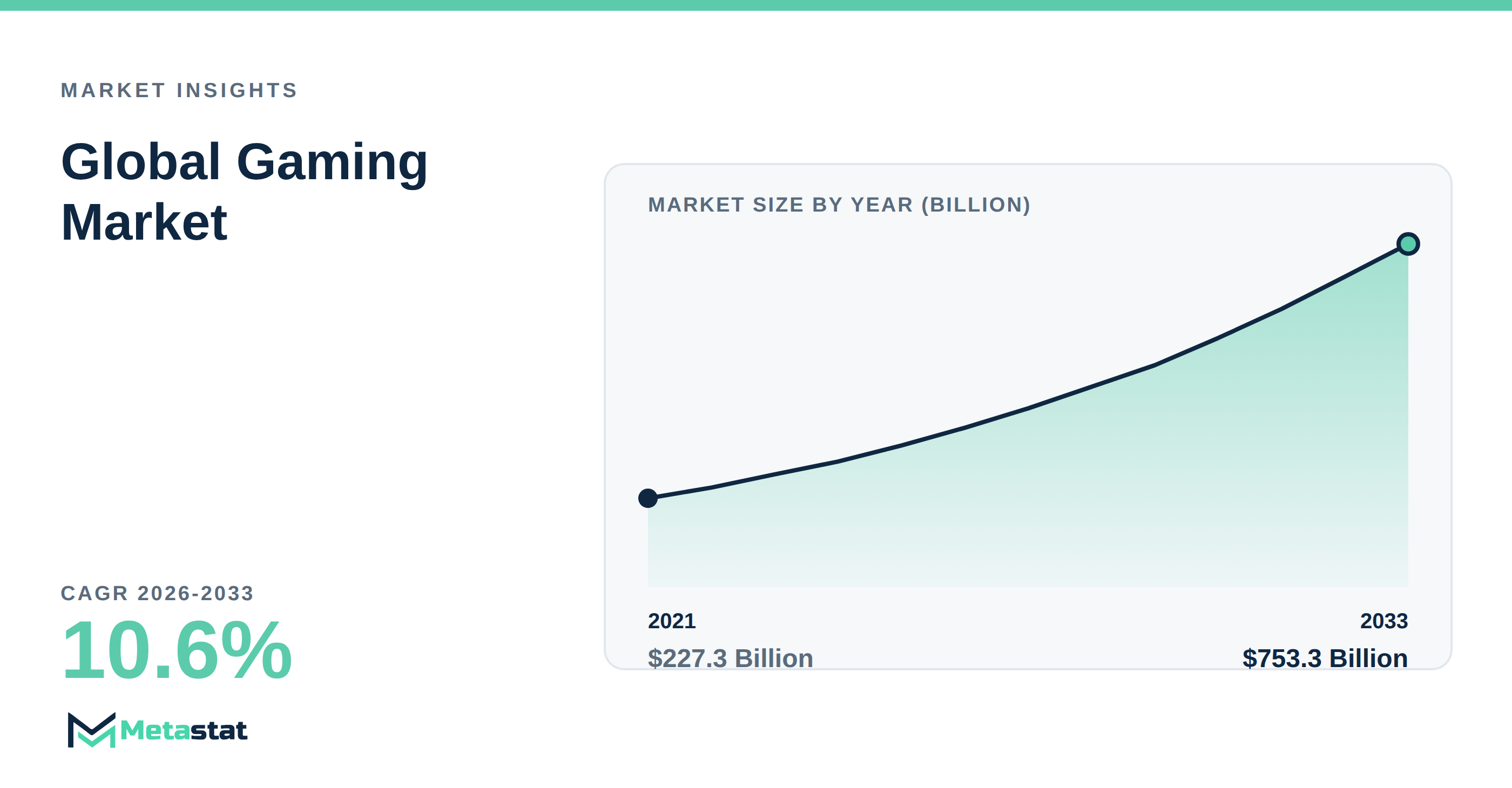
The global Gaming market is on track for significant expansion, projected to reach USD 753.3 billion by 2033. This blog explores the key trends shaping the future of gaming.
The global Gaming market is expected to grow significantly, reaching USD 753.3 billion by 2033, reflecting a notable increase from USD 336.3 billion in 2025. This growth, translating to a compound annual growth rate (CAGR) of 10.6%, signifies a market rapidly adapting to technological advancements and shifting consumer demands.
Technological advancements shape the gaming environment
The emergence of technologies including augmented reality (AR) and virtual reality (VR) is set to transform user engagement in the Gaming market. These innovations enhance the immersive experience, attracting a broader audience. Key industry players, including Tencent Holdings Ltd. and Sony Interactive Entertainment LLC, are investing heavily in research and development to produce engaging gaming solutions that meet the increasing demand for interactive experiences. Such investments are anticipated to support ongoing revenue growth, attributed to the desire for highly sophisticated gameplay among players.
The online gaming segment alone is anticipated to achieve a valuation of USD 595.6 billion by 2033, driven by a surge in mobile gaming popularity. Improved internet connectivity and cutting-edge streaming technologies facilitate smoother gameplay, appealing especially to younger audiences who prefer digital formats over traditional methods.
Changing consumer preferences favor online platforms
Shifting consumer preferences are significantly influencing the trajectory of the Gaming market. Many players are increasingly opting for online platforms, providing flexible and convenient access to gaming content. The rise of Free-to-Play and subscription-based models is spearheading this transition, allowing wider access and enhancing user engagement.
In response to these evolving preferences, the Gaming market is seeing a growth in in-game purchases and advertising-supported models that present viable revenue streams. Developers dedicated to creating distinctive game experiences and tailored offerings will enhance player retention, establishing competitive advantages in a rapidly evolving market.
Sustainability demands drive corporate strategies
Within the Gaming market, sustainability initiatives are gaining traction. Companies are placing significant emphasis on environmental responsibility, responding to the growing consumer appetite for eco-friendly practices. This shift not only cultivates brand loyalty but aligns with overarching trends focused on Environmental, Social, and Governance (ESG) standards.
Leading companies, including Microsoft Corporation and Ubisoft Entertainment SA, are making strides to incorporate sustainability into their business frameworks. By adopting circular economy practices and reducing carbon emissions, these firms are positioning themselves favorably for future growth within an increasingly conscientious market.
Market resilience amid regulatory and economic challenges
Despite promising growth prospects, the Gaming market faces several regulatory and economic challenges that could hinder expansion. Compliance requirements often impose operational costs on developers and publishers, potentially reducing profitability. Macroeconomic factors including inflation and geopolitical instability disrupts supply chains and complicate market entry for new players.
The necessity for substantial capital investment restricts innovation, emphasizing the need for companies to devise effective strategies to overcome these hurdles. Successfully navigating the evolving regulatory landscape is essential for firms seeking to maintain relevance and capitalize on growth opportunities.
Conclusion: What to watch for in the future
Looking forward, the Gaming market is poised for considerable transformation, driven by technological innovations, sustainability initiatives, and evolving consumer preferences. Firms that effectively adapt to these trends will likely capture larger market shares. Observers and stakeholders remain attentive to regulatory changes and emerging opportunities, ensuring competitiveness in this dynamic environment.
For in-depth insights, details, and analysis on the Gaming market, access the Global Gaming Market report.
Tags
About the Authors

LEAD ANALYST
Utkarsh Khirodkar is a Lead Market Research Analyst at MetaStat Insight, specializing in market intelligence, technology sector assessments, and competitive strategy.

PRINCIPAL CONSULTANT - ENTERPRISE AI & EMERGING TECHNOLOGIES
Banking & Finance · Electronics and Semiconductor · Energy and Power · Healthcare IT · Information & Technology · Professional Services
Vijay Gunti is a Principal Consultant at MetaStat Insight, bringing over two decades of experience across enterprise digital transformation, technology strategy, and intelligent systems.

LEAD CONSULTANT - COMMUNICATION, TELECOM, AND IT
Electronics and Semiconductor · Information & Technology · Machinery & Equipment · Professional Services
Ravindra Sathe Consultants for Communication, Telecom, and IT at MetaStat Insight. He leads the firm's industry research initiatives across telecommunications infrastructure, digital connectivity, enterprise networking, and emerging information technology domains.