
Alphabet's October 2026 sell-off highlights the tension between rapid cloud expansion and investment payback. This analysis examines cash generation, search monetization and the decisions facing enterprise technology buyers, advertisers and infrastructure suppliers as Google scales its AI business.
The Google stock sell-off has brought a practical business question into focus: how quickly can expanding demand repay the infrastructure required to serve it? For enterprises buying cloud services, advertisers funding search campaigns and suppliers building computing capacity, that question reaches well beyond Alphabet's share price.
According to GOOGL closing-price data supplied by S&P Global Market Intelligence through Stock Analysis, Alphabet's Class A shares fell 12.64% on October 29, 2026, then another 1.40% to $279.84 on October 30. The two-session decline was 13.87%, calculated against the October 28 close of $324.89. The sharpest fall therefore occurred on October 29.
The commercially useful interpretation is a reassessment of investment payback. Strong demand can coexist with weaker near-term cash conversion. However, price movements alone cannot establish how much investors attributed to spending, search performance, earnings composition or wider market conditions.
What does the Google stock sell-off reveal about growth quality?
Alphabet's third-quarter 2026 earnings release furnished to the SEC reported revenue of $127.6 billion, up 25% year over year, and operating income growth of 30%. Google Cloud revenue reached $30.7 billion, up 103%. These are consolidated global results and segment figures, respectively, rather than measurements of the overall AI market.
Those results support a more demanding analytical question than whether customers want the technology. Investors and commercial partners also need to understand the revenue mix, the resources required to deliver it and the period over which investment becomes productive.
A provider can win business while committing cash faster than customers generate returns for it. Equally, heavy spending can establish capacity that supports profitable growth later. Distinguishing those possibilities requires evidence on utilization, pricing and cash collection. A single quarter cannot settle the long-term outcome.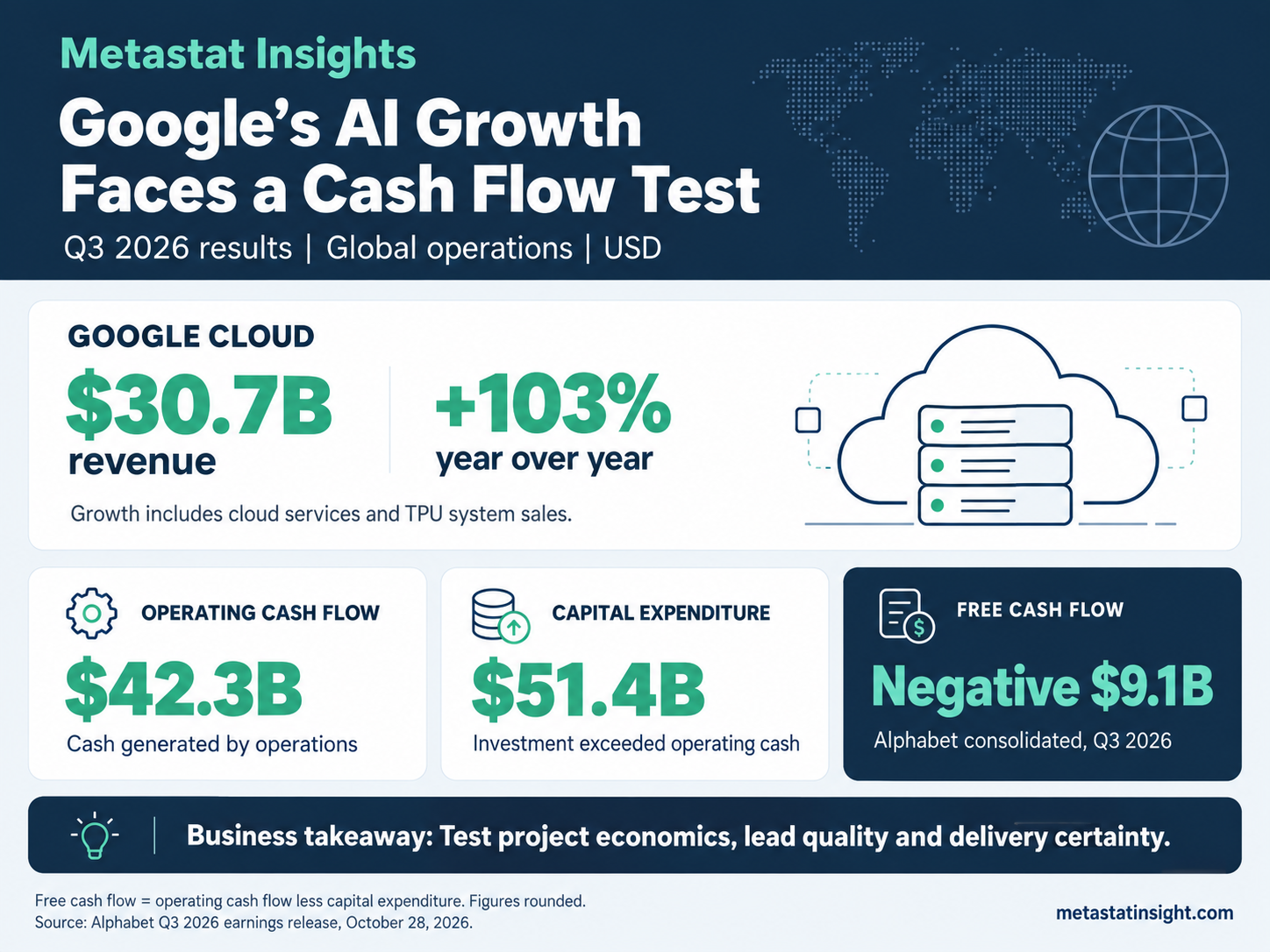
Infrastructure spending exposes the gap between profit and cash
Alphabet generated $42.290 billion in quarterly operating cash flow and spent $51.355 billion on capital expenditure, producing negative free cash flow of $9.065 billion. The preceding quarter recorded negative $5.855 billion. Yet trailing twelve-month free cash flow remained positive at $19.747 billion. Alphabet defines this non-GAAP measure as operating cash flow less capital expenditure.
That distinction matters. Operating profit, operating cash generation and cash remaining after investment answer different questions. Negative quarterly free cash flow indicates that capital spending exceeded operating cash generation during that period. It does not, by itself, establish that the underlying operations were loss-making.
There were additional pressures. In the October 28 earnings call, reproduced in the full management transcript, executives said operating cash flow was affected by inventory built for TPU system sales and a $5.2 billion payment relating to a European Commission fine. Management also maintained 2026 capital expenditure guidance of $195 billion to $205 billion, a forecast rather than completed spending.
The implication is that cash recovery depends on several mechanisms: spending discipline, inventory conversion, collections and the productivity of installed assets. Treating every movement as evidence of deteriorating customer economics would overlook those differences.
Cloud buyers need a cost per completed task
Google Cloud's reported growth included TPU system sales alongside services. Its segment operating result also excludes certain shared research costs held at Alphabet level. Consequently, neither segment growth nor segment profitability establishes the return on all of Alphabet's AI investment.
For enterprise buyers, the more useful benchmark is the cost of producing an acceptable business outcome. A document-processing application, for example, should be assessed against successful completion, exception handling and human review. Low usage prices offer limited savings if unreliable outputs create substantial rework.
Procurement teams should compare normal and peak workloads, integration costs, support requirements and the expense of moving data or changing providers. Minimum spending commitments deserve particular attention when projected usage depends on deployments that have yet to prove their value.
This purchasing context connects directly with the global service and deployment models covered in Metastat Insights' Cloud Services Market report. Infrastructure, platform and software services create different cost structures for buyers. Comparing them as interchangeable offerings can obscure where expenditure and operational responsibility actually sit.
Platform competition may encourage discounts or bundled features. Buyers should test whether those terms remain attractive after introductory incentives expire and whether operational dependence would make a later switch expensive.
Search advertisers must follow qualified demand through changing formats
Management attributed Search's sequential growth deceleration to several factors, identifying foreign exchange as the largest. Lower monetization of AI Mode queries also contributed. Executives said advertising was expanding across those experiences, so describing monetization as simply absent would overstate the position.
For B2B marketers, the practical issue is how changing discovery formats affect commercial outcomes. More engagement may support demand creation, but campaign value ultimately depends on relevant enquiries, sales acceptance, pipeline and customer acquisition costs.
Advertisers should separate brand searches from new-customer discovery and examine performance by query intent. An apparent improvement in conversion volume can conceal weaker lead quality if campaigns attract more low-intent enquiries. Conversely, an informative interaction may influence a later purchase without producing an immediate form submission.
Controlled budget tests and consistent CRM attribution can help distinguish those effects. The useful commercial response is to measure changes at the campaign and customer level before making broad assumptions about the direction of search advertising returns.
Infrastructure suppliers face an execution and payment test
For suppliers of servers, networking equipment, electrical systems and cooling, capital expenditure creates an opportunity whose value depends on execution. A spending budget, a signed order, an installed system and a collected payment represent different stages of commercial progress.
Sales teams should examine which projects have secured power, completed design approvals and established delivery schedules. Finance teams need visibility into milestone payments, cancellation rights and customer concentration. Manufacturing capacity committed against uncertain schedules can create working-capital pressure even when the underlying demand narrative remains strong.
The United States is one specific infrastructure market within this global investment cycle. Metastat Insights' United States Data Center Design-Build & Infrastructure Services Market report covers design, delivery, power and cooling, commissioning, and related services. That scope helps distinguish opportunities across the delivery chain without treating a US market assessment as a global spending measure.
Suppliers can strengthen their position by demonstrating dependable commissioning and lifecycle performance. Winning an order is more valuable when equipment can enter service on schedule and support the customer's intended workload.
What would demonstrate a stronger investment payoff?
The next useful evidence would connect capacity additions with productive usage, revenue collection and cash generation. For search, the question is whether newer experiences preserve advertiser economics as engagement changes. For cloud customers, it is whether production deployments deliver repeatable operational savings or revenue benefits.
Two scenarios remain plausible. Better utilization and inventory conversion could improve cash generation as earlier investment becomes productive. Alternatively, continued capacity expansion and operating costs could keep cash conversion under pressure despite revenue growth. These are analytical scenarios, not forecasts of Alphabet's results or share price.
The business implication is to tie commitments to measurable outcomes. Buyers should validate deployment economics, advertisers should track qualified demand, and suppliers should test delivery and payment certainty. For a broader view of the purchasing models behind those decisions, explore Metastat Insights' Cloud Services Market report.
Tags
About the Authors

LEAD ANALYST
Utkarsh Khirodkar is a Lead Market Research Analyst at MetaStat Insight, specializing in market intelligence, technology sector assessments, and competitive strategy.

PRINCIPAL CONSULTANT - ENTERPRISE AI & EMERGING TECHNOLOGIES
Banking & Finance · Electronics and Semiconductor · Energy and Power · Healthcare IT · Information & Technology · Professional Services
Vijay Gunti is a Principal Consultant at MetaStat Insight, bringing over two decades of experience across enterprise digital transformation, technology strategy, and intelligent systems.

LEAD CONSULTANT - COMMUNICATION, TELECOM, AND IT
Electronics and Semiconductor · Information & Technology · Machinery & Equipment · Professional Services
Ravindra Sathe Consultants for Communication, Telecom, and IT at MetaStat Insight. He leads the firm's industry research initiatives across telecommunications infrastructure, digital connectivity, enterprise networking, and emerging information technology domains.