
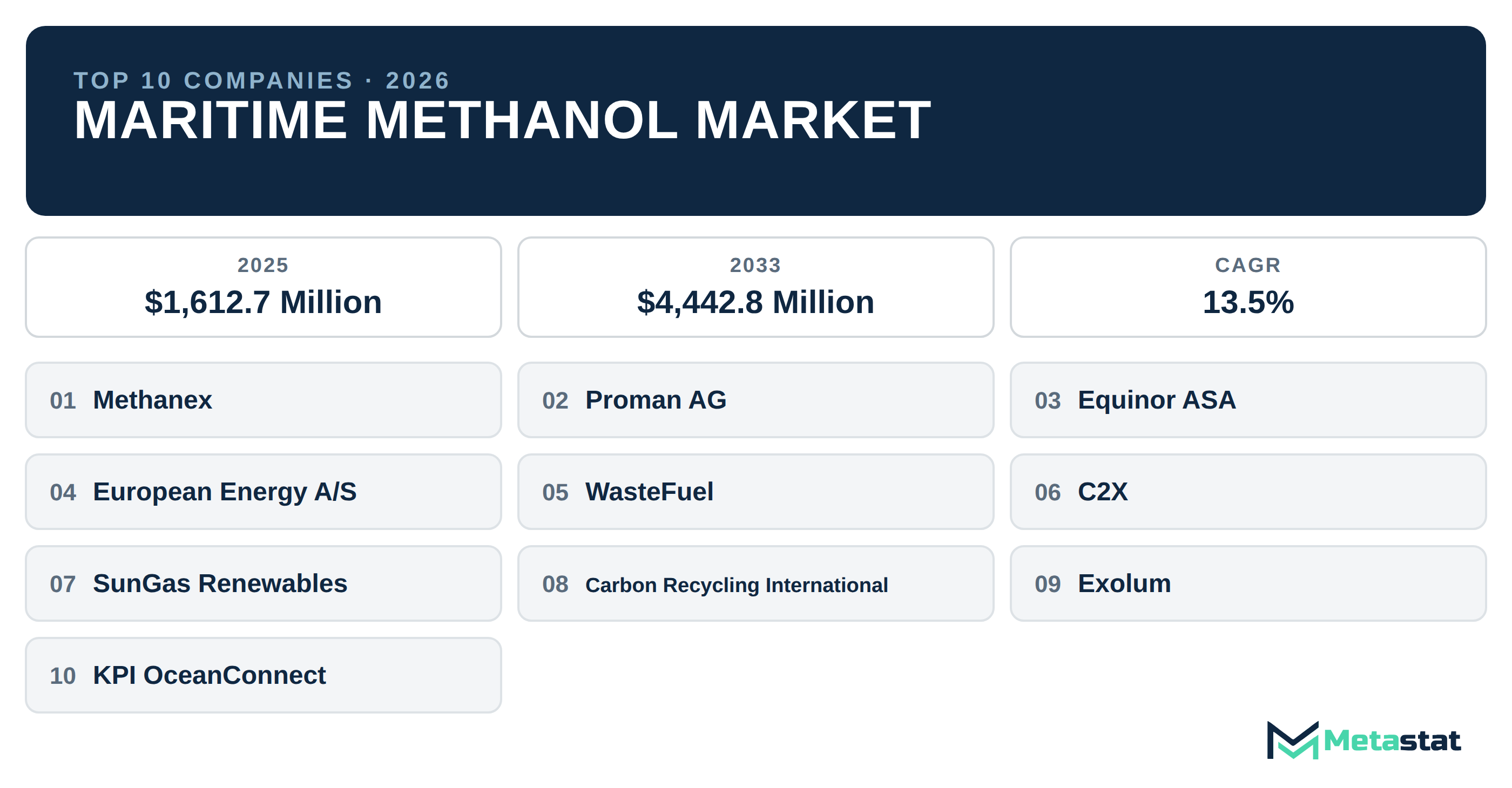
Explore the Global Maritime Methanol Market, projected to grow from USD 1,612.7 Million in 2025 to USD 4,442.8 Million by 2033, highlighting top 10 companies.
The Global Maritime Methanol Market is valued at USD 1,612.7 Million in 2025 and is projected to reach USD 4,442.8 Million by 2033, growing at a CAGR of 13.5%. This market encompasses the production and supply of methanol used as a marine fuel, driven by increasing demand for sustainable shipping solutions. Factors such as regulatory pressures to reduce emissions and advancements in methanol production technologies drive the growth of this market.
Maritime Methanol serves as an alternative fuel for various vessel types, offering a cleaner energy source compared to traditional fuels. Its adoption is encouraged by favorable government policies and a growing awareness of environmental concerns within the maritime sector.
Global Maritime Methanol Market Size, Data, & Statistics
The Global Maritime Methanol Market was valued at USD 982.4 Million in 2021. It increased to USD 1,106.2 Million in 2022 and reached USD 1,259.9 Million in 2023. By 2024, the market is expected to grow to USD 1,416.3 Million, and it will achieve a size of USD 1,612.7 Million in 2025.
According to projections, the market will expand to USD 1,835.2 Million in 2026 and USD 2,086.1 Million in 2027. The anticipated growth continues with expected values of USD 2,372.7 Million in 2028, USD 2,672.9 Million in 2029, and USD 3,049 Million in 2030. By 2031, it is forecasted to reach USD 3,465.2 Million, with further growth to USD 3,940.4 Million in 2032 and USD 4,442.8 Million by 2033.
The market is forecasted to grow at a compound annual growth rate (CAGR) of 13.5% from 2025 to 2033. This growth indicates a significant shift in the maritime industry towards sustainable fuel alternatives.
Regional breakdown shows that Asia Pacific holds the largest share at 41.9%, followed by Europe with 30.3%, North America at 13.9%, Middle East and Africa at 8.9%, and South America at 4.9%. These figures highlight the geographic distribution of demand for maritime methanol.
Top 10 Trends in the Global Maritime Methanol Market
Increased regulatory support for sustainable fuels
Governments worldwide are implementing stringent regulations to reduce greenhouse gas emissions from shipping. This regulatory support encourages the uptake of maritime methanol as a low-carbon fuel alternative.
Technological advancements in methanol production
Innovations in methanol production processes are improving efficiency and reducing costs. These advancements facilitate greater adoption of methanol in maritime applications, enhancing its competitiveness against traditional fuels.
Growing investments in renewable energy
Investments in renewable energy sources are driving the development of bio-methanol and e-methanol, supporting the transition to greener shipping solutions. This trend aligns with global efforts to achieve carbon neutrality.
Partnerships between fuel suppliers and shipping companies
Collaborations between maritime fuel suppliers and shipping companies are increasing to ensure a steady supply of methanol. These partnerships enhance the logistics and infrastructure necessary for methanol adoption.
Expansion of methanol bunkering infrastructure
The establishment of dedicated methanol bunkering facilities is critical for supporting vessel operations. Growth in this infrastructure is essential for enabling maritime fleets to transition smoothly to methanol fuel.
Increased focus on lifecycle emissions
Stakeholders in the maritime sector are prioritizing lifecycle emissions assessments, encouraging the adoption of fuels with lower overall environmental impacts, including maritime methanol, which can be produced sustainably.
Growing interest in dual-fuel engines
Dual-fuel engines that can operate on both conventional fuels and methanol are gaining traction. This flexibility allows for easier transitions for shipping companies moving towards cleaner fuel options.
Market consolidation among methanol producers
Consolidation among firms in the methanol production sector is occurring as companies seek to enhance market position. This trend may lead to improved economies of scale, benefiting the overall maritime methanol market.
Consumer demand for greener shipping options
Consumers are increasingly advocating for sustainable practices in shipping. This demand encourages the adoption of maritime methanol as an eco-friendly alternative, influencing companies to incorporate it into their operations.
Emerging markets adopting methanol solutions
Several emerging markets are beginning to explore methanol as a viable marine fuel. This expansion into new regions presents opportunities for growth within the maritime methanol market.
Top 10 Companies in the Global Maritime Methanol Market
1. Methanex Corporation
Headquarters: Vancouver, Canada · Founded: 1968.
Methanex Corporation is a key player in the methanol production industry, focusing on delivering high-quality methanol to various markets. The company operates a global network of production facilities and has established itself as a prominent supplier in the maritime methanol sector. Methanex’s commitment to sustainability drives its efforts to produce cleaner methanol, aligning with the growing demand for eco-friendly shipping solutions.
2. Proman AG
Headquarters: Zug, Switzerland · Founded: 2008.
Proman AG is a significant international player in the methanol sector, engaged in the production and supply of methanol and its derivatives. The company emphasizes operational efficiency and innovation in its production processes, which enhance its position in the maritime methanol market. Proman AG continuously explores opportunities for renewable methanol production to meet evolving market demands.
3. Equinor ASA
Headquarters: Stavanger, Norway · Founded: 1972.
Equinor ASA is a global energy company, focusing on oil, gas, and renewable energy solutions. With increasing investments in cleaner energy technologies, Equinor is exploring the potential of methanol as a maritime fuel. The company aims to leverage its expertise in energy transition to support sustainable practices in shipping and promote the broader adoption of maritime methanol.
4. European Energy A/S
Headquarters: Fredericia, Denmark · Founded: 2006.
European Energy A/S specializes in renewable energy solutions and is actively engaged in the production of green methanol. The company’s initiatives in developing sustainable energy projects demonstrate its commitment to providing eco-friendly alternatives in the maritime sector. European Energy A/S advances the maritime methanol market through its innovative approaches and renewable projects.
5. WasteFuel Inc.
Headquarters: San Francisco, USA · Founded: 2020.
WasteFuel Inc. focuses on converting waste materials into renewable methanol, positioning itself as a leader in sustainable fuel solutions. The company’s innovative processes contribute to reducing waste while providing a cleaner fuel alternative for the maritime industry. WasteFuel Inc. aims to support the transition to renewable energy sources and enhance the adoption of maritime methanol as a green fuel.
6. C2X Ltd.
Headquarters: Høje-Taastrup, Denmark · Founded: 2019.
C2X Ltd. specializes in producing methanol from captured carbon dioxide and hydrogen. The company’s focus on sustainable production methods aligns with the growing demand for low-carbon fuels in the maritime market. C2X Ltd. aims to contribute to decarbonizing the shipping sector through its innovative approach to methanol production and by providing an alternative fuel source.
7. SunGas Renewables Inc.
Headquarters: Denver, USA · Founded: 2017.
SunGas Renewables Inc. develops advanced gasification technology to convert biomass and waste into renewable methanol. The company’s commitment to sustainability and circular economy principles is evident in its operations. SunGas Renewables Inc. supports the maritime sector by providing green methanol solutions as an alternative to traditional fuels.
8. Carbon Recycling International
Headquarters: Reykjavik, Iceland · Founded: 2006.
Carbon Recycling International focuses on converting carbon dioxide into renewable methanol, helping to address climate change. The company leverages its expertise in carbon capture technology to produce methanol that can be used in the maritime sector. Carbon Recycling International's innovative approach positions it as a significant player in the growth of the maritime methanol market.
9. Exolum Corporation S.A.
Headquarters: Madrid, Spain · Founded: 2014.
Exolum Corporation S.A. is involved in the logistics of fuel distribution and storage, including the handling of methanol. The company is committed to enhancing the infrastructure required for the maritime methanol market. By providing essential logistics support, Exolum Corporation S.A. ensures the reliable supply of methanol to the maritime industry.
10. KPI OceanConnect
Headquarters: London, United Kingdom · Founded: 2012.
KPI OceanConnect is a prominent marine fuel supplier focusing on providing sustainable fuel options, including methanol. The company is dedicated to supporting the transition towards greener maritime solutions. KPI OceanConnect actively engages with shipping companies to promote the adoption of maritime methanol as a responsible fuel choice.
Conclusion
The Global Maritime Methanol Market is poised for significant growth, with increasing demand driven by sustainability initiatives and regulatory support. The top Maritime Methanol companies highlighted in this report display the industry's commitment to providing cleaner fuel solutions, positioning themselves strategically to meet future market needs. Their diverse approaches and innovative technologies contribute to a more sustainable maritime sector.
As the maritime industry continues to evolve, companies focused on Maritime Methanol will play a crucial role in shaping the future of shipping. Stakeholders should explore partnerships and technology investments that align with the growing trend towards sustainable and renewable fuels.
Tags
About the Authors

LEAD ANALYST
Utkarsh Khirodkar is a Lead Market Research Analyst at MetaStat Insight, specializing in market intelligence, technology sector assessments, and competitive strategy.

ENERGY & INFRASTRUCTURE INDUSTRY CONSULTANT
Automotive and Transportation · Electronics and Semiconductor · Energy and Power · Machinery & Equipment
Saurabh Vasant Ganvir consults for Energy & Infrastructure Industry at MetaStat Insight, specializing in renewable energy, solar EPC, and electric vehicle (EV) infrastructure markets.