
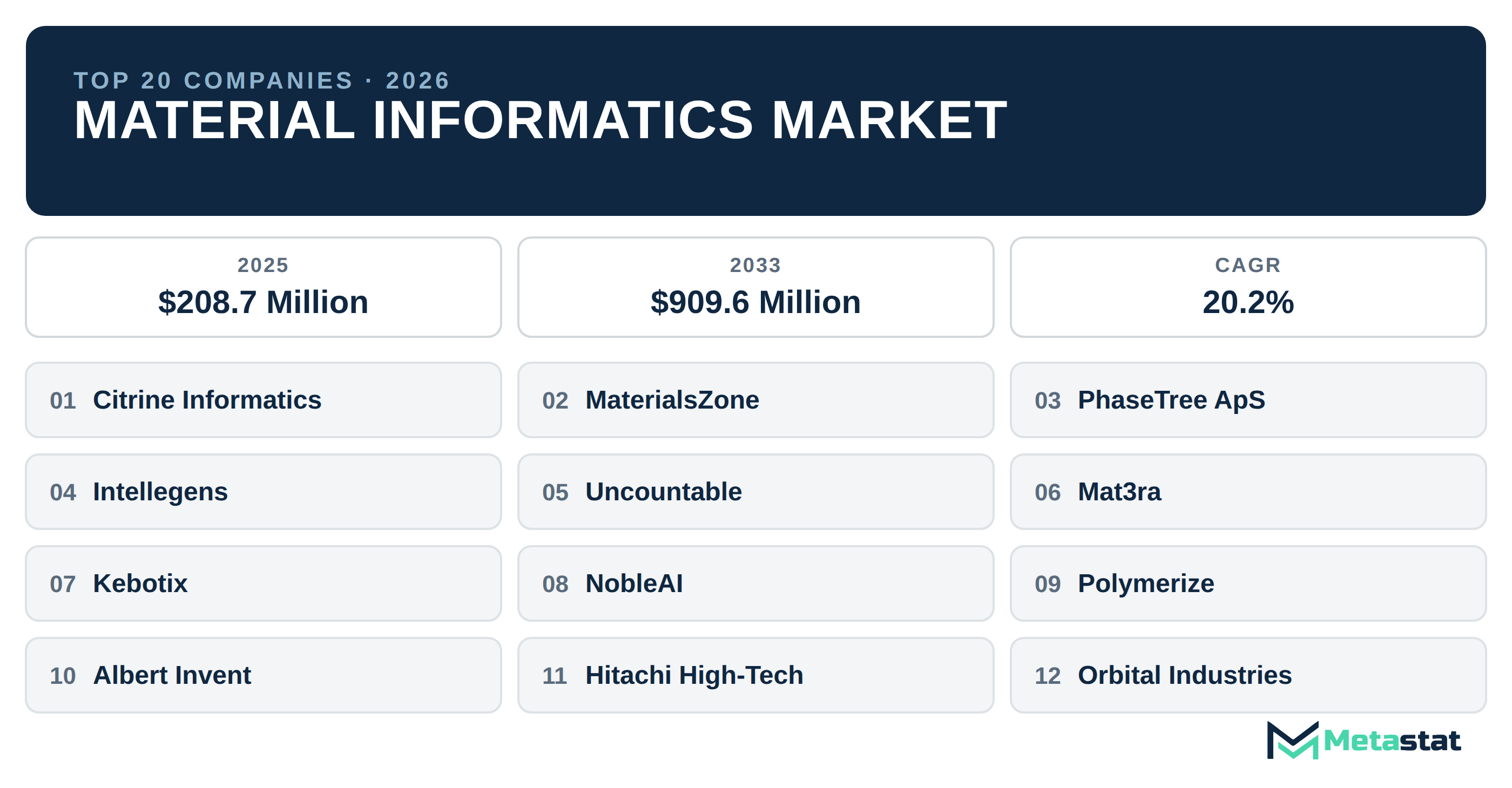
Explore the top 20 companies in the Global Material Informatics Market, projected to grow from USD 208.7 Million in 2025 to USD 909.6 Million by 2033.
The Global Material Informatics Market is valued at USD 208.7 Million in 2025 and is projected to reach USD 909.6 Million by 2033, growing at a CAGR of 20.2%. This market encompasses various sectors, including the development and application of advanced materials through data-driven approaches. Significant investments in research and development, along with advancements in artificial intelligence, drive the adoption of material informatics solutions across industries.
Material informatics plays a critical role in sectors such as chemicals, energy storage, and automotive, aiding in materials discovery, property prediction, and process optimization. As industries seek to innovate and enhance product performance, the demand for efficient material informatics solutions continues to rise.
Global Material Informatics Market Size, Data, & Statistics
The Global Material Informatics Market size in 2021 was USD 101 Million, showing a steady increase as industries recognized the value of data-driven material development.
By 2022, the market grew to USD 120.5 Million, reflecting heightened interest and investment in material informatics technologies.
In 2023, the market further expanded to USD 145.3 Million, indicating a strong growth trajectory.
Forecasts indicate a market size of USD 208.7 Million in 2025, further emphasizing the growth potential of material informatics solutions.
The anticipated market size for 2033 is USD 909.6 Million, representing a significant increase and highlighting the importance of materials innovation.
The compound annual growth rate (CAGR) from 2025 to 2033 is projected at 20.2%, underscoring the rapid evolution of this market.
Regionally, North America leads with 37.7% market share, followed by Asia Pacific at 27.6%, Europe at 25.8%, South America at 5%, and Middle East and Africa at 4%.
Top 10 Trends in the Global Material Informatics Market
Inline metrology moves onto the production line
The introduction of inline metrology technologies enables real-time monitoring and quality control during production processes. This shift promotes higher precision and efficiency, leading to reduced waste and improved material properties.
Increased reliance on AI for materials discovery
The adoption of artificial intelligence in materials discovery accelerates the identification of new materials. AI techniques streamline the research process, enabling faster innovation and enhancing the capabilities of material informatics tools.
Greater integration of data sources
Companies are integrating diverse data sources to enhance material property predictions. This multidisciplinary approach improves the accuracy of models, allowing for more effective materials design and optimization.
Collaborative platforms for knowledge sharing
The rise of collaborative platforms facilitates knowledge sharing among researchers and industry professionals. These platforms strengthen partnerships and promote innovation, driving advancements in material informatics.
Focus on sustainability in materials development
Sustainability considerations are increasingly influencing materials development processes. Companies prioritize eco-friendly materials and practices, aligning with global environmental goals and enhancing their market competitiveness.
Advancements in generative design techniques
Generative design techniques enable engineers to explore a wider range of material configurations and properties. This innovation leads to optimized materials that meet specific performance criteria while reducing material usage.
Growth of high-throughput experimentation
High-throughput experimentation enables rapid testing of multiple material formulations. This approach accelerates the development cycle, allowing companies to quickly identify promising materials for further development.
Emergence of digital twin technologies
Digital twin technologies are gaining traction in material informatics, enabling detailed simulations of material behavior in real-world applications. This capability enhances predictive modeling and supports the optimization of manufacturing processes.
Investment in education and training
As the material informatics field evolves, investment in education and training for professionals becomes essential. This focus ensures a skilled workforce capable of leveraging advanced informatics tools effectively.
Enhancements in material property databases
Improvements in material property databases provide researchers and engineers with access to comprehensive and accurate data. This accessibility streamlines the design process, promoting informed decision-making in material selection.
Top 20 Companies in the Global Material Informatics Market
1. Citrine Informatics
Headquarters: Menlo Park, USA · Founded: 2013. Citrine Informatics specializes in applying AI to materials science, focusing on data-driven methods for materials discovery and development. The company enhances the efficiency of material innovation by providing advanced tools for property prediction, formulation, and optimization.
Citrine’s platform integrates diverse datasets to generate insights, accelerating the R&D process in various industries. Their technology supports companies in discovering and optimizing materials, ultimately driving technological advancements.
2. MaterialsZone Ltd.
Headquarters: Edinburgh, UK · Founded: 2015. MaterialsZone Ltd. offers innovative software solutions for materials data management and informatics. The company aims to facilitate collaboration among researchers and engineers by providing user-friendly tools for data sharing and analysis.
By empowering users to manage large datasets effectively, MaterialsZone enhances decision-making in material development. Their focus on creating a comprehensive knowledge ecosystem supports advancements in various sectors, including energy and transportation.
3. PhaseTree ApS
Headquarters: Copenhagen, Denmark. PhaseTree ApS focuses on the development of advanced materials simulation tools. Their software enables users to model complex material behaviors, facilitating better understanding and prediction of material properties.
By leveraging physics-based simulation techniques, PhaseTree enhances material design processes across industries. Their commitment to providing effective solutions helps companies optimize materials for specific applications and performance criteria.
4. Intellegens Ltd.
Headquarters: Cambridge, UK · Founded: 2016. Intellegens Ltd. specializes in AI-driven materials discovery platforms. The company’s unique approach integrates machine learning algorithms to analyze complex datasets, enabling faster identification of optimal materials.
Intellegens promotes innovation by providing tools that enhance collaboration between scientists and engineers. Their technology is applicable across various industries, including automotive and aerospace, driving advancements in material performance and sustainability.
5. Uncountable Inc.
Headquarters: San Francisco, USA · Founded: 2018. Uncountable Inc. develops a software platform designed to streamline the materials development process. The company focuses on integrating data management, experimentation, and analysis into a cohesive system.
By enabling teams to collaborate effectively, Uncountable enhances efficiency in material discovery. Their platform supports rapid iteration and optimization, driving innovation across multiple sectors, including chemicals and energy.
6. Mat3ra Inc.
Headquarters: Boston, USA. Mat3ra Inc. focuses on advancing materials informatics through data analytics and machine learning. The company delivers solutions that streamline the materials development cycle, from discovery to production.
By leveraging data-driven insights, Mat3ra aids organizations in optimizing material properties and processes. Their commitment to innovation supports advancements in sectors such as electronics and healthcare.
7. Kebotix Inc.
Headquarters: Cambridge, USA · Founded: 2017. Kebotix Inc. employs AI and robotics to accelerate materials discovery and development. The company’s platform automates experimental processes, enabling rapid testing and evaluation of materials.
Kebotix’s focus on combining advanced technologies with materials science empowers researchers to explore new material possibilities. Their solutions support a wide range of applications, reinforcing their role in driving innovation.
8. NobleAI Inc.
Headquarters: Santa Fe, USA. NobleAI Inc. provides a platform that leverages AI for materials discovery and optimization. The company’s focus on integrating machine learning with experimental data enhances the materials development process.
NobleAI aims to reduce the time and cost associated with material research, facilitating faster innovation across industries. Their technology supports significant advancements in material properties and performance.
9. Polymerize
Headquarters: San Francisco, USA. Polymerize specializes in providing digital solutions for polymer materials development. The company focuses on integrating materials informatics with digital tools to streamline the design and optimization of polymers.
Through their innovative approach, Polymerize enhances the efficiency of polymer research and development. Their platform supports a wide range of applications, contributing to advancements in various industries, including packaging and automotive.
10. Albert Invent Corp.
Headquarters: San Francisco, USA · Founded: 2018. Albert Invent Corp. focuses on the intersection of AI and materials science to drive innovation. The company develops tools that enhance material property predictions and formulations.
By utilizing data-driven methodologies, Albert Invent accelerates the discovery of new materials and optimizes existing ones. Their solutions support advancements in electronics, energy, and other sectors, promoting sustainable practices.
11. Hitachi High-Tech Corporation
Headquarters: Tokyo, Japan · Founded: 2001. Hitachi High-Tech Corporation provides advanced technology solutions, focusing on materials testing and analysis. The company offers a range of instruments and software to support materials research.
Hitachi High-Tech's commitment to innovation positions it as a key player in material informatics. Their tools enhance the understanding of material properties, supporting various industries, including semiconductors and healthcare.
12. Orbital Industries
Headquarters: Austin, USA · Founded: 2016. Orbital Industries focuses on developing solutions for materials analysis and optimization. The company’s approach integrates advanced data analytics and simulation tools to streamline material development processes.
By promoting efficiency in materials research, Orbital Industries enhances innovation across sectors. Their technology supports companies in optimizing material properties for specific applications.
13. Phaseshift Technologies
Headquarters: San Francisco, USA. Phaseshift Technologies specializes in materials simulation software aimed at enhancing understanding and prediction of material behaviors. Their products enable researchers to model complex scenarios, informing material design strategies.
Phaseshift's focus on physics-based simulations supports advancements in various industries, including aerospace and electronics. Their tools facilitate the optimization of materials to meet specific performance requirements.
14. Schrodinger, Inc.
Headquarters: New York, USA · Founded: 1990. Schrodinger, Inc. is known for its comprehensive computational chemistry solutions that drive materials discovery and optimization. The company’s software integrates advanced modeling and simulation tools.
Schrodinger supports a wide range of applications, aiding researchers in understanding material properties. Their focus on innovation positions them as a leader in material informatics, enhancing product development across sectors.
15. Aionics Inc.
Headquarters: San Francisco, USA. Aionics Inc. develops AI-driven tools to support materials discovery and optimization processes. The company’s platform enhances the efficiency of material development through data analytics.
Aionics’ approach focuses on rapid iteration and experimentation, enabling organizations to innovate faster. Their technology supports advancements in various industries, including energy and electronics.
16. SES AI Corporation
Headquarters: Austin, USA. SES AI Corporation specializes in AI technologies for materials research and development. Their solutions empower researchers with the tools needed for efficient material property prediction and optimization.
By combining AI with materials science, SES AI enhances the innovation process across various sectors. Their commitment to advancing materials informatics supports significant contributions to industry development.
17. Dassault Systèmes SE
Headquarters: Vélizy-Villacoublay, France. Dassault Systèmes SE is a leader in simulation software and digital solutions for materials development. The company focuses on providing tools that enhance collaboration and innovation in material design.
Dassault's comprehensive platform supports organizations in optimizing materials and processes, promoting efficiency. Their technology drives advancements in several industries, including automotive and aerospace.
18. Exabyte Inc.
Headquarters: Boulder, USA · Founded: 2017. Exabyte Inc. focuses on developing cloud-based solutions for materials modeling and simulation. The company’s platform leverages advanced computing to enhance materials research.
Exabyte's commitment to innovation positions it as a valuable player in material informatics. Their tools support organizations in accelerating material discovery and optimization processes.
19. Synopsys, Inc.
Headquarters: Mountain View, USA · Founded: 1986. Synopsys, Inc. is known for its electronic design automation solutions, contributing to materials development in the semiconductor industry. The company’s software supports materials analysis and optimization.
Synopsys' focus on innovation enhances the efficiency of semiconductor manufacturing processes, promoting advancements in material informatics. Their tools support improved material properties and performance.
20. SCM
SCM provides software solutions aimed at materials modeling and simulation. The company focuses on integrating data-driven approaches to enhance materials research processes.
By promoting efficiency and collaboration, SCM supports advancements across various industries, contributing to the overall growth of the material informatics sector.
Conclusion
The Global Material Informatics Market is poised for impressive growth, driven by technological advancements and a focus on innovation in materials science. The companies listed reflect a diverse ecosystem of providers dedicated to enhancing materials discovery, optimization, and application.
Organizations seeking to leverage material informatics can explore partnerships with these companies to improve their product development processes and enhance overall efficiency in materials research.
Tags
About the Authors

LEAD ANALYST
Utkarsh Khirodkar is a Lead Market Research Analyst at MetaStat Insight, specializing in market intelligence, technology sector assessments, and competitive strategy.

INDUSTRY CONSULTANT - CHEMICALS & ADVANCED MATERIALS
Chemicals and Materials · Machinery & Equipment · Packaging
Amit Gadhekar Consultant for Chemicals and Materials at MetaStat Insight, directing sector-specific intelligence, research, and strategic consulting across global chemical and processing markets.