
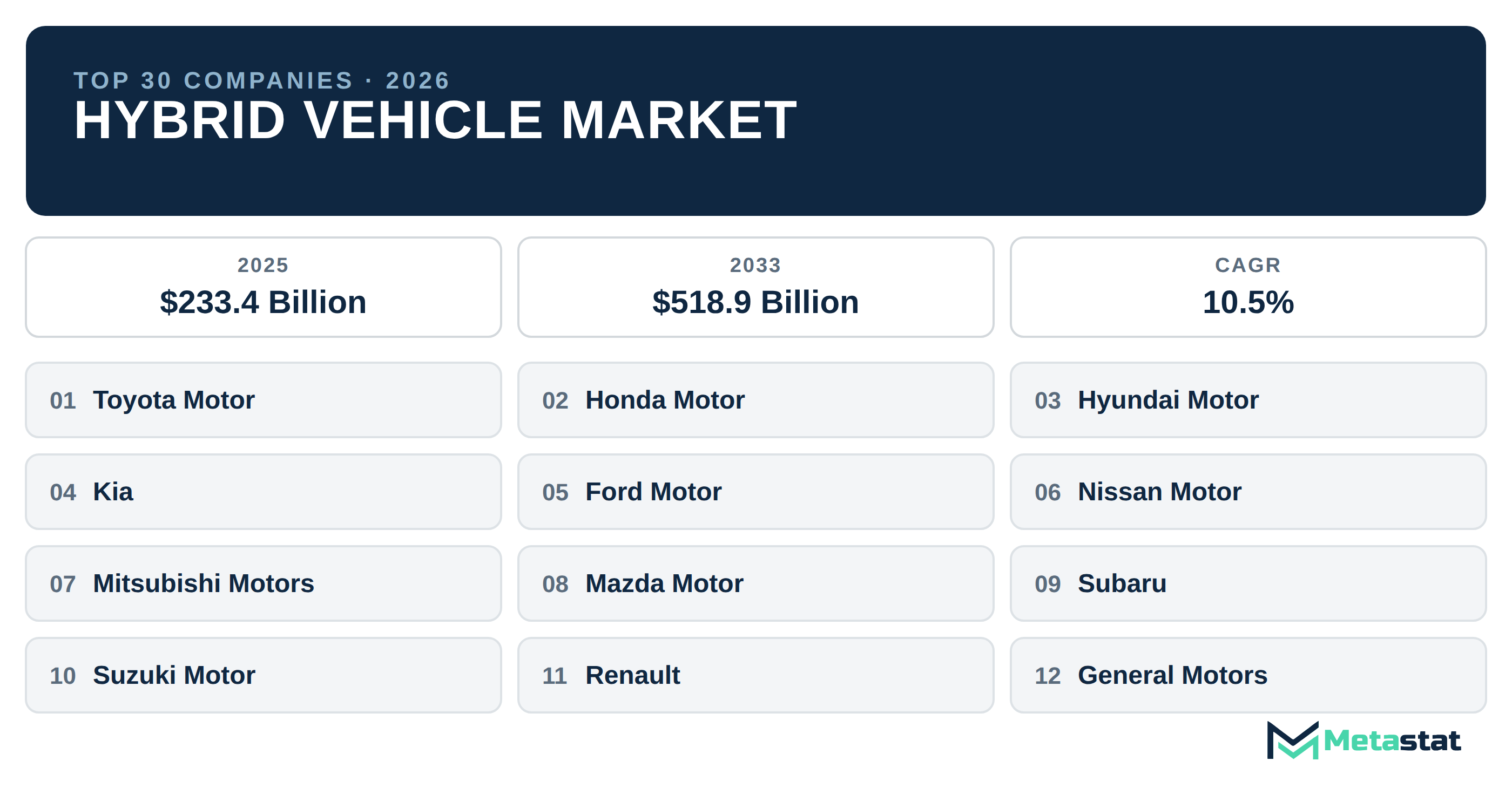
Explore the Global Hybrid Vehicle Market valued at USD 233.4 Billion in 2025, featuring the top 30 companies shaping its future.
The Global Hybrid Vehicle Market is valued at USD 233.4 Billion in 2025 and is projected to reach USD 518.9 Billion by 2033, growing at a CAGR of 10.5%. This market encompasses various hybrid vehicle types, including mild-hybrids, hybrid electric vehicles (HEVs), and plug-in hybrids (PHEVs). The increasing need for fuel efficiency and environmental sustainability drives consumer demand for hybrid vehicles, as they offer reduced emissions and improved fuel economy.
As automakers innovate and expand their hybrid lineups, the market continues to evolve with advancements in battery technology and motor types. These developments enhance vehicle performance while addressing consumer preferences for eco-friendly transportation options.
Global Hybrid Vehicle Market Size, Data, & Statistics
The Global Hybrid Vehicle Market size for the year 2021 was USD 158.3 Billion. In 2022, the market grew to USD 173.5 Billion, reflecting a steady increase. The value for 2023 reached USD 192.4 Billion, continuing the upward trend.
Forecast for 2024 indicates a market size of USD 210.5 Billion, followed by a projected USD 233.4 Billion in 2025. By 2026, the market is expected to expand to USD 258.6 Billion, with further growth anticipated through 2033.
The market's CAGR from 2025 to 2033 is 10.5%. This growth rate demonstrates the significant potential within the hybrid vehicle segment, driven by technological advancements and increasing consumer interest.
The regional distribution of the Global Hybrid Vehicle Market includes North America with 25.8%, Europe at 23.9%, and Asia Pacific leading with 44.3%. South America and the Middle East and Africa represent smaller shares, each at 3%.
Top 10 Trends in the Global Hybrid Vehicle Market
Increased focus on sustainability
Consumers increasingly prioritize sustainability in their purchasing decisions. Automakers are responding by enhancing the environmental benefits of hybrid vehicles, which leads to more investment in eco-friendly technologies.
Advancements in battery technology
Innovation in battery technology improves hybrid vehicle performance. New battery designs enable longer ranges and faster charging times, boosting consumer confidence in hybrid options.
Government incentives for hybrid vehicles
Many governments implement incentives to promote hybrid vehicle adoption. These initiatives include tax breaks and subsidies, making hybrid vehicles more affordable and appealing to consumers.
Expansion of charging infrastructure
The growth of charging infrastructure enhances the practicality of hybrid vehicles. As more charging stations become available, consumers are more likely to consider hybrid options for daily use.
Integration of smart technology
Smart technology integration in hybrid vehicles enhances user experience. Features such as advanced navigation systems and connectivity options provide additional value and convenience to consumers.
Collaboration between manufacturers
Collaborations among manufacturers are increasing, allowing companies to share resources and knowledge for better hybrid vehicle development. These partnerships can lead to innovation and improved market offerings.
Consumer education on hybrid benefits
Educating consumers about the advantages of hybrid vehicles is essential for market growth. Increasing awareness helps potential buyers understand the benefits of hybrids, such as reduced fuel costs and emissions.
Focus on performance and efficiency
Manufacturers are emphasizing both performance and efficiency in hybrid designs. This focus ensures that hybrid vehicles remain competitive with traditional combustion engine models and appeal to a wider audience.
Customization options for hybrid vehicles
Offering customization options allows buyers to tailor hybrid vehicles to their preferences. This trend aligns with consumer desires for personalized features and enhances market appeal.
Growing popularity of luxury hybrid vehicles
The luxury segment of the hybrid vehicle market is expanding. Automakers are introducing high-end hybrids that combine performance with sustainability, attracting affluent consumers concerned about environmental impact.
Top 30 Companies in the Global Hybrid Vehicle Market
1. Toyota Motor Corporation
Headquarters: Toyota City, Japan · Founded: 1937. Toyota Motor Corporation is a pioneer in hybrid vehicle technology, launching the iconic Prius in 1997. The company offers a broad range of hybrids across various segments, emphasizing fuel efficiency and environmental responsibility.
Toyota's focus on sustainability drives its hybrid vehicle strategy, concentrating on reducing emissions and enhancing fuel economy. With continuous innovations in hybrid technology, the company aims to meet evolving consumer demands and regulatory requirements in the automotive market.
2. Honda Motor Co., Ltd.
Headquarters: Tokyo, Japan · Founded: 1948. Honda Motor Co., Ltd. stands out for its engineering prowess and quality manufacturing. The company offers several hybrid models designed to provide a balance of performance and fuel efficiency.
Honda's hybrid vehicles feature advanced technology, including its Intelligent Multi-Mode Drive system, enhancing the overall driving experience. The company’s dedication to innovation positions it well within the hybrid vehicle market as consumer preferences shift toward environmentally friendly options.
3. Hyundai Motor Company
Headquarters: Seoul, South Korea · Founded: 1967. Hyundai Motor Company has established itself as a significant player in the hybrid vehicle sector, offering a diverse lineup of models that combine cutting-edge technology with style.
The company's hybrid vehicles focus on delivering high fuel efficiency and performance, catering to a wide range of customer needs. Hyundai continues to invest in research and development, striving to improve its hybrid technologies and expand its market share.
4. Kia Corporation
Headquarters: Seoul, South Korea · Founded: 1944. Kia Corporation is known for its stylish and affordably priced vehicles, including a growing selection of hybrid models. The company emphasizes fuel efficiency and modern design in its hybrid offerings.
Kia's approach to hybrid technology centers on enhancing overall performance and providing consumers with eco-friendly options without compromising on style. The company actively pursues innovations to improve its hybrid lineup and meet market demands.
5. Ford Motor Company
Headquarters: Dearborn, Michigan, USA · Founded: 1903. Ford Motor Company has a long history in the automotive industry and offers a range of hybrid vehicles that align with its commitment to innovation and sustainability.
The company's hybrid lineup includes popular models that provide excellent fuel economy and performance. Ford's investment in hybrid technology demonstrates its dedication to reducing emissions and meeting consumer preferences for environmentally friendly vehicles.
6. Nissan Motor Co., Ltd.
Headquarters: Yokohama, Japan · Founded: 1933. Nissan Motor Co., Ltd. focuses on developing advanced hybrid technology to enhance the driving experience while minimizing environmental impact. The company offers several hybrid models catering to diverse consumer needs.
Nissan’s approach combines performance with eco-friendliness, providing consumers with vehicles that offer both sustainability and driving enjoyment. Continued investment in hybrid development strengthens Nissan's position in the competitive automotive market.
7. Mitsubishi Motors Corporation
Headquarters: Tokyo, Japan · Founded: 1970. Mitsubishi Motors Corporation has developed a reputation for producing reliable and efficient hybrid vehicles. The company focuses on affordability and practicality in its hybrid lineup.
Mitsubishi's hybrid technology aims to provide consumers with cost-effective alternatives to traditional vehicles while maintaining performance levels. The company actively explores ways to enhance its hybrid offerings and adapt to changing market dynamics.
8. Mazda Motor Corporation
Headquarters: Hiroshima, Japan · Founded: 1920. Mazda Motor Corporation is known for its innovative engineering and unique design philosophy. The company is expanding its hybrid vehicle offerings to align with growing consumer demand for sustainable transportation options.
By focusing on efficient technologies and distinctive styling, Mazda aims to provide vehicles that appeal to environmentally conscious consumers without sacrificing the driving experience. The company continues to push boundaries in hybrid technology development.
9. Subaru Corporation
Headquarters: Tokyo, Japan · Founded: 1953. Subaru Corporation is recognized for its all-wheel-drive vehicles and outdoor lifestyle branding. The company is entering the hybrid vehicle market to meet changing consumer preferences and environmental standards.
Subaru's hybrid technology incorporates its renowned safety features and all-wheel-drive capabilities, offering consumers a unique blend of performance and sustainability. As the company expands its hybrid lineup, it focuses on retaining its core identity while addressing eco-friendly trends.
10. Suzuki Motor Corporation
Headquarters: Hamamatsu, Japan · Founded: 1909. Suzuki Motor Corporation offers a range of compact and efficient vehicles, including hybrids. The company's focus on practicality and affordability resonates with consumers seeking economical options.
Suzuki's hybrid vehicles prioritize fuel efficiency and usability, appealing to a broad demographic. As consumer interest in hybrids grows, Suzuki is committed to enhancing its offerings and keeping pace with market developments.
11. Renault Group
Headquarters: Boulogne-Billancourt, France · Founded: 1899. Renault Group is a key player in the European automotive market, actively developing hybrid vehicles to address consumer preferences for sustainable mobility.
The company emphasizes innovation in its hybrid lineup, focusing on providing eco-friendly alternatives without compromising performance. Renault’s commitment to electric and hybrid technology positions it as a forward-thinking manufacturer in the industry.
12. General Motors Company
Headquarters: Detroit, Michigan, USA · Founded: 1908. General Motors Company has a rich history in the automotive sector, and it is expanding its hybrid vehicle offerings to align with global trends toward sustainability.
The company’s hybrid models focus on performance, safety, and efficiency, catering to diverse consumer needs. General Motors invests in research and development to enhance its hybrid technologies and maintain competitiveness in the market.
13. BMW Group
Headquarters: Munich, Germany · Founded: 1916. BMW Group is renowned for its luxury vehicles and performance. The company is integrating hybrid technology into its lineup, offering models that blend luxury with environmental responsibility.
By focusing on performance-oriented hybrids, BMW appeals to consumers who prioritize driving enjoyment while being mindful of sustainability. The company’s commitment to innovation positions it strongly within the hybrid vehicle market.
14. Mercedes-Benz Group AG
Headquarters: Stuttgart, Germany · Founded: 1926. Mercedes-Benz Group AG is synonymous with luxury and quality in the automotive industry. The company is enhancing its hybrid lineup to meet increasing consumer demand for sustainable luxury vehicles.
Mercedes-Benz focuses on integrating advanced technology into its hybrids, ensuring high performance while reducing environmental impact. The company’s strategic emphasis on hybrid development reflects its commitment to a sustainable future.
15. Audi AG
Headquarters: Ingolstadt, Germany · Founded: 1909. Audi AG is recognized for its premium vehicles and technological innovations. The company is actively expanding its hybrid offerings, focusing on performance and luxury.
Audi's hybrid vehicles incorporate cutting-edge technology, providing a blend of efficiency and driving dynamics. The company aims to meet the evolving needs of consumers who demand both luxury and sustainability in their automotive choices.
16. Volkswagen AG
Headquarters: Wolfsburg, Germany · Founded: 1937. Volkswagen AG is a major player in the global automotive market, offering a wide range of hybrid vehicles designed for everyday use.
The company focuses on enhancing fuel efficiency and reducing emissions in its hybrid models. Volkswagen's commitment to sustainable mobility drives its hybrid vehicle strategy as it seeks to meet consumer expectations for environmentally friendly transportation.
17. Volvo Car AB
Headquarters: Gothenburg, Sweden · Founded: 1927. Volvo Car AB has established a strong reputation for safety and innovation in the automotive industry. The company is committed to expanding its hybrid and electric vehicle portfolio.
Volvo emphasizes sustainability and aims to become a fully electric car brand in the near future. Its hybrid vehicles reflect a blend of performance, safety, and environmental consciousness, appealing to modern consumers.
18. Porsche AG
Headquarters: Stuttgart, Germany · Founded: 1931. Porsche AG is synonymous with high-performance sports cars and luxury vehicles. The company is integrating hybrid technology into its lineup to enhance performance and efficiency.
Porsche's hybrid models combine cutting-edge engineering with sustainable practices, appealing to consumers who seek both luxury and eco-friendliness. The company’s focus on performance and innovation reinforces its position in the hybrid vehicle market.
19. Jaguar Land Rover Limited
Headquarters: Whitley, United Kingdom · Founded: 1922. Jaguar Land Rover Limited specializes in luxury vehicles with a focus on performance and design. The company is expanding its hybrid offerings to enhance sustainability in its lineup.
By integrating hybrid technology, Jaguar Land Rover aims to provide environmentally conscious luxury vehicles. The company’s commitment to innovation ensures its competitiveness in the evolving hybrid vehicle market.
20. Ferrari N.V.
Headquarters: Maranello, Italy · Founded: 1939. Ferrari N.V. is a prestigious manufacturer known for its high-performance sports cars. The company is exploring hybrid technology to enhance vehicle performance while addressing environmental concerns.
Ferrari's approach to hybrid vehicles emphasizes combining power with efficiency, appealing to consumers who seek exclusive performance vehicles. The company’s commitment to innovation continues to shape its hybrid strategy.
21. Automobili Lamborghini S.p.A.
Headquarters: Sant'Agata Bolognese, Italy · Founded: 1963. Automobili Lamborghini S.p.A. is renowned for its luxury sports cars. The company is adopting hybrid technology to maintain its performance reputation while addressing sustainability.
By focusing on high-performance hybrids, Lamborghini aims to appeal to consumers seeking both luxury and eco-friendliness. The company’s innovative approach to hybrid vehicles reinforces its position within the automotive industry.
22. McLaren Automotive Limited
Headquarters: Woking, United Kingdom · Founded: 1963. McLaren Automotive Limited specializes in high-performance sports cars and supercars. The company is integrating hybrid technology to enhance vehicle performance and efficiency.
McLaren’s hybrid offerings focus on delivering exhilarating driving experiences while adhering to environmental standards. The company continues to innovate in hybrid technology, appealing to performance-oriented consumers.
23. Aston Martin Lagonda Global Holdings plc
Headquarters: Gaydon, United Kingdom · Founded: 1913. Aston Martin Lagonda Global Holdings plc is a prestigious luxury automobile manufacturer. The company is incorporating hybrid technology into its lineup to meet consumer demand for sustainable luxury vehicles.
Aston Martin emphasizes performance and refinement in its hybrid models, appealing to discerning buyers who value exclusivity and environmental responsibility. The company's commitment to innovation positions it well in the hybrid vehicle market.
24. BYD Company Limited
Headquarters: Shenzhen, China · Founded: 1995. BYD Company Limited is a leading manufacturer in the electric and hybrid vehicle sectors. The company focuses on innovation and sustainability across its product offerings.
BYD's hybrid vehicles emphasize energy efficiency and advanced technology, catering to a broad consumer base. The company's commitment to sustainable transportation drives its hybrid development strategy.
25. Great Wall Motor Company Limited
Headquarters: Baoding, China · Founded: 1984. Great Wall Motor Company Limited is known for its focus on SUVs and pickup trucks. The company is expanding into the hybrid market to meet evolving consumer needs.
Great Wall's hybrid vehicles prioritize affordability and practicality, appealing to budget-conscious consumers. The company continues to develop innovative hybrid solutions to enhance its product lineup.
26. Chery Automobile Co., Ltd.
Headquarters: Wuhu, China · Founded: 1997. Chery Automobile Co., Ltd. is a prominent Chinese automobile manufacturer specializing in compact vehicles. The company is integrating hybrid technology into its offerings to diversify its product range.
Chery's hybrid vehicles focus on fuel efficiency and cost-effectiveness, addressing consumer demand for economical options. The company's commitment to technological advancement positions it for growth in the hybrid market.
27. SAIC Motor Corporation Limited
Headquarters: Shanghai, China · Founded: 1955. SAIC Motor Corporation Limited is a major Chinese automotive manufacturer with a diverse vehicle portfolio. The company is actively developing hybrid vehicles to respond to market trends.
SAIC’s hybrid technology focuses on enhancing fuel efficiency while maintaining performance. The company’s commitment to innovation supports its expansion in the hybrid vehicle sector.
28. Geely Automobile Holdings Limited
Headquarters: Hangzhou, China · Founded: 1986. Geely Automobile Holdings Limited has emerged as a significant player in China's automotive market. The company is expanding its hybrid vehicle offerings to meet rising customer expectations.
Geely emphasizes technological innovation in its hybrid models, aiming to provide efficient and reliable options for consumers. The company’s strategy includes investing in research and development to enhance its hybrid capabilities.
29. Li Auto Inc.
Headquarters: Beijing, China · Founded: 2015. Li Auto Inc. is known for its innovative approach to electric and hybrid vehicles. The company focuses on creating user-friendly and efficient transportation solutions.
Li Auto’s hybrid offerings are designed to enhance convenience and reduce environmental impact. The company’s commitment to technology-driven solutions positions it for growth in the hybrid vehicle market.
30. Stellantis N.V.
Headquarters: Amsterdam, Netherlands · Founded: 2021. Stellantis N.V. is a global automotive manufacturer formed from the merger of Fiat Chrysler and PSA Group. The company is focusing on expanding its hybrid vehicle portfolio.
Stellantis emphasizes innovation and sustainability in its hybrid offerings, aiming to cater to diverse consumer needs across multiple brands. The company’s strategic direction reflects its commitment to a greener future in mobility.
Conclusion
The Global Hybrid Vehicle Market is anticipated to experience significant growth as consumer demand for sustainable transportation increases. The presence of established companies such as Toyota and Honda highlights a competitive landscape focused on innovation and environmental responsibility.
As hybrid vehicle companies continue to develop advanced technologies and expand their offerings, consumers will benefit from a wider array of choices. Investing in hybrid vehicles can be a strategic move for buyers looking for efficiency and sustainability in their automotive decisions.
Tags
About the Authors

LEAD ANALYST
Utkarsh Khirodkar is a Lead Market Research Analyst at MetaStat Insight, specializing in market intelligence, technology sector assessments, and competitive strategy.

ENERGY & INFRASTRUCTURE INDUSTRY CONSULTANT
Automotive and Transportation · Electronics and Semiconductor · Energy and Power · Machinery & Equipment
Saurabh Vasant Ganvir consults for Energy & Infrastructure Industry at MetaStat Insight, specializing in renewable energy, solar EPC, and electric vehicle (EV) infrastructure markets.