
The Warehouse Automation market shows promising growth driven by e-commerce and advanced technologies, yet faces challenges like high capital investment and operational costs.
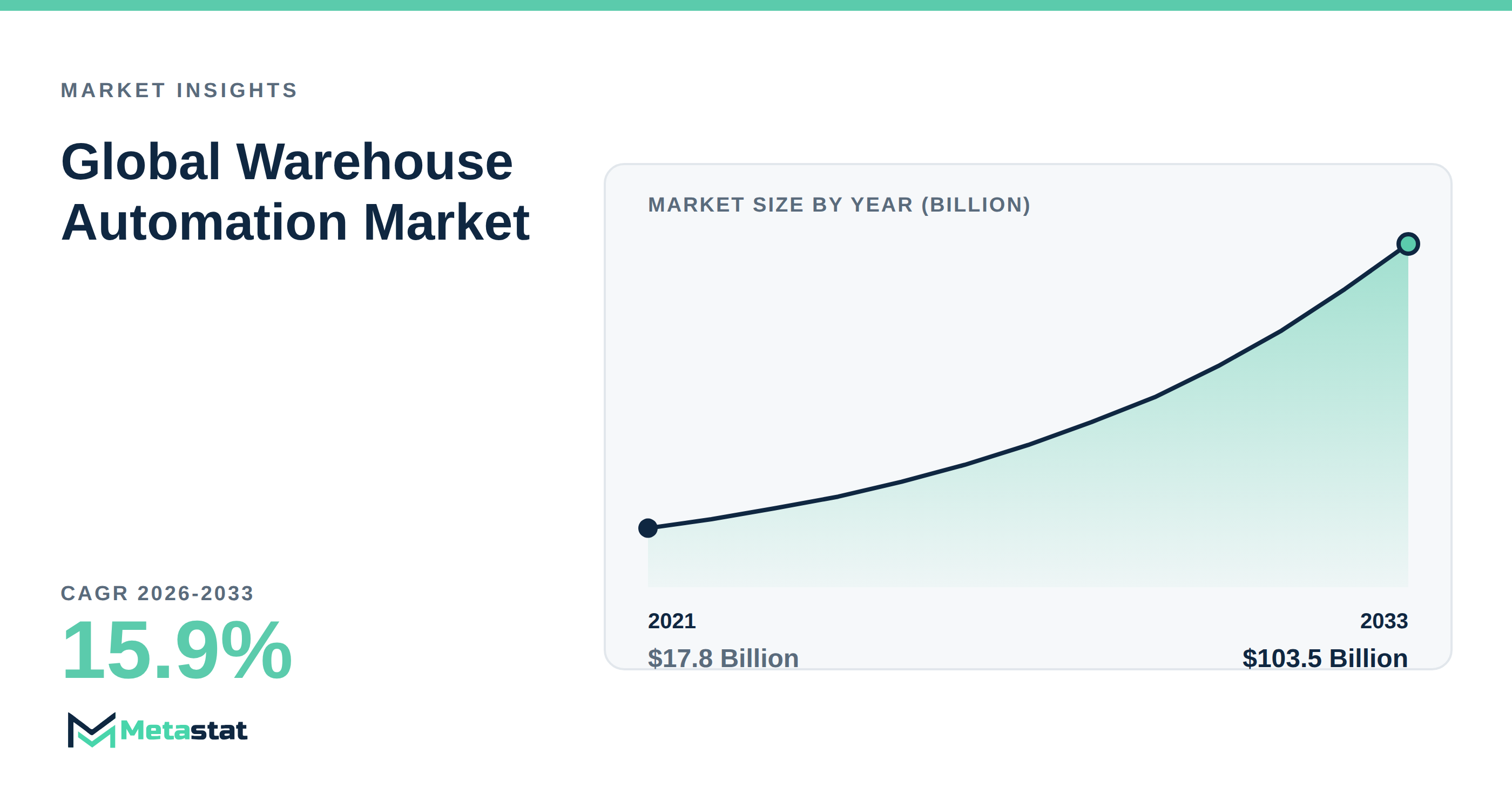
The Warehouse Automation market is often perceived through a narrow lens, primarily focusing on its rapid growth trajectory. While projections indicate the market will increase from USD 31.8 billion in 2025 to USD 103.5 billion by 2033, reflecting a 15.9% CAGR, these figures tell a more nuanced story. Understanding the underlying dynamics is crucial for making informed decisions within this evolving landscape.
What drives demand in the warehouse automation market?
Several factors are fuelling the demand for warehouse automation solutions. The rapid expansion of e-commerce and the shift towards omnichannel fulfillment strategies compel businesses to adopt automation technologies to meet consumer expectations for speed and accuracy. While companies encounter increasing operational pressures, investments in Autonomous Mobile Robots (AMRs), Automated Storage and Retrieval Systems (AS/RS), and similar technologies become essential for enhancing productivity.
The adoption of AMRs, for instance, enhances operational efficiency by facilitating tasks including inventory management and order fulfillment. These robots expedite processes, reducing the dependence on manual labor and improving overall productivity. Coupled with advancements in automated storage systems, organizations maximize space utilization while reducing retrieval times, thus streamlining operations and enhancing customer satisfaction.
What challenges impede warehouse automation growth?
Despite the compelling growth figures, the Warehouse Automation market faces significant challenges. One notable constraint is the high capital investment required for advanced automation technologies. Small and medium-sized enterprises often struggle to secure sufficient funding, limiting their ability to implement these solutions. Escalating operational costs related to technology maintenance and labor complicate the decision-making process for many organizations.
The risk of technological obsolescence creates uncertainty for long-term investments. Rapid advancements in automation technologies render existing systems outdated shortly after implementation, deterring companies from committing fully to automation projects. Disruptions in supply chains, frequently intensified by geopolitical tensions, can compromise the operational reliability of automated systems, leading to hesitance among potential adopters.
How does technological integration shape the warehouse automation landscape?
The integration of advanced technologies significantly impacts the Warehouse Automation market. Organizations are increasingly digitizing legacy processes to improve productivity and reduce errors. Investment in automation software, driven by the need for enhanced analytics and real-time data processing, plays a critical role in optimizing supply chains and reducing costs.
This shift towards technological integration attracts firms to adopt robust software solutions that facilitate better decision-making and operational insights. Companies leveraging data analytics effectively position themselves advantageously within the market, enhancing their competitive edge. The combination of automation and artificial intelligence drives innovation across the sector, enabling businesses to explore new revenue streams while enhancing their overall value propositions.
Which market segments hold the most promise?
Within the broader Warehouse Automation market, certain segments are demonstrating notable promise. The Automated Storage and Retrieval Systems (AS/RS) segment, projected to increase from USD 10 billion in 2026 to approximately USD 26.1 billion by 2033, exemplifies the increasing demand for efficiency and accuracy in warehouse operations. Retail and e-commerce, where order fulfillment speed is critical, significantly drive this growth.
The Autonomous Mobile Robots (AMRs) segment is anticipated to hit a market value of around USD 21 billion by 2033, driven by industries focusing on enhancing operational efficiency. Technological advancements in navigation and obstacle avoidance boost the appeal of these systems, allowing companies to adapt operations effectively to meet fluctuating demand.
What investment trends are shaping the future of warehouse automation?
Investment trends within the Warehouse Automation sector highlight a strong commitment to technology adoption. The rising demand for energy-efficient solutions aligns with increasing sustainability imperatives, prompting companies to explore automation technologies that not only optimize operations but reduce environmental impact. This shift towards sustainability creates opportunities for innovations in warehouse automation reflecting environmental, social, and governance (ESG) criteria.
The emergence of Robotics-as-a-Service (RaaS) and flexible automation business models lowers barriers to entry for many organizations. These models provide adaptable solutions that respond to changing operational needs while minimizing initial capital expenditures. Companies embracing these trends are likely to influence the future direction of the Warehouse Automation market, positioning themselves for improved competitiveness and profitability.
For those looking to understand the intricacies of the market in greater detail, the Global Warehouse Automation Market report provides comprehensive insights and detailed analysis.
Tags
About the Authors

LEAD ANALYST
Utkarsh Khirodkar is a Lead Market Research Analyst at MetaStat Insight, specializing in market intelligence, technology sector assessments, and competitive strategy.

INDUSTRY CONSULTANT - CHEMICALS & ADVANCED MATERIALS
Chemicals and Materials · Machinery & Equipment · Packaging
Amit Gadhekar Consultant for Chemicals and Materials at MetaStat Insight, directing sector-specific intelligence, research, and strategic consulting across global chemical and processing markets.

PRINCIPAL CONSULTANT - QUALITY SYSTEMS & COMPLIANCE
Electronics and Semiconductor · Machinery & Equipment · Professional Services
Omkar Phadtare is an Industry Consultant at MetaStat Insight, specializing in quality systems, regulatory compliance, and standards benchmarking to drive data-driven market intelligence and strategic industry research.

ENERGY & INFRASTRUCTURE INDUSTRY CONSULTANT
Automotive and Transportation · Electronics and Semiconductor · Energy and Power · Machinery & Equipment
Saurabh Vasant Ganvir consults for Energy & Infrastructure Industry at MetaStat Insight, specializing in renewable energy, solar EPC, and electric vehicle (EV) infrastructure markets.

LEAD CONSULTANT - COMMUNICATION, TELECOM, AND IT
Electronics and Semiconductor · Information & Technology · Machinery & Equipment · Professional Services
Ravindra Sathe Consultants for Communication, Telecom, and IT at MetaStat Insight. He leads the firm's industry research initiatives across telecommunications infrastructure, digital connectivity, enterprise networking, and emerging information technology domains.