
LEAD ANALYST
Utkarsh Khirodkar is a Lead Market Research Analyst at MetaStat Insight, specializing in market intelligence, technology sector assessments, and competitive strategy.

Global Warehouse Automation Market Size, Share, By System Type (Automated Storage & Retrieval Systems (AS/RS), Conveyor & Sortation Systems, Autonomous Mobile Robots (AMRs), Automated Guided Vehicles (AGVs) and Automated Forklifts, Robotic Picking & Piece Handling Systems, Robotic Palletizing & Depalletizing Systems), By Component (Hardware, Software, Services), By Function (Inbound Receiving & Unloading, Putaway & Replenishment, Storage & Retrieval, Picking & Order Fulfillment, Sorting & Consolidation, Packing & Labeling, Outbound Staging, Loading & Shipping), By End-Use Industry (Retail & E-commerce, Third-Party Logistics & Contract Logistics, Food & Beverage, Pharmaceuticals & Healthcare, Automotive, General Manufacturing & Industrial, Electronics & Semiconductor, Consumer Packaged Goods, Wholesale & Distribution), Industry Analysis, Growth, Trends, and Forecast, 2026-2033
Report ID
MSI-5296
Published
September, 2026
Pages
281 Pages
Format
Historical
Base year
Forecast
Forecast period
Report Details
Market Valuation: Valued at $31.8 Billion in 2025, projected to reach $103.5 Billion by 2033 at a 15.9% CAGR.
Dominant Segment: Automated Storage & Retrieval Systems (AS/RS) lead the market, driven by the increasing need for efficiency and accuracy in warehouse operations, particularly in retail and e-commerce.
Geographic Lead: North America and Asia Pacific are the fastest-growing regions, propelled by rising e-commerce activities and infrastructure modernization efforts.
What's Inside: The report provides a comprehensive analysis of market dynamics, competitive landscape, and detailed segmentations by system type, component, function, and end-use industry, along with forecasts through 2033.
Emerging Demands: The market is experiencing growth due to rising demands for automation solutions across various industries, particularly driven by the complexities of modern supply chains and the need for faster order fulfillment.
Choose Your License
Global Warehouse Automation Market
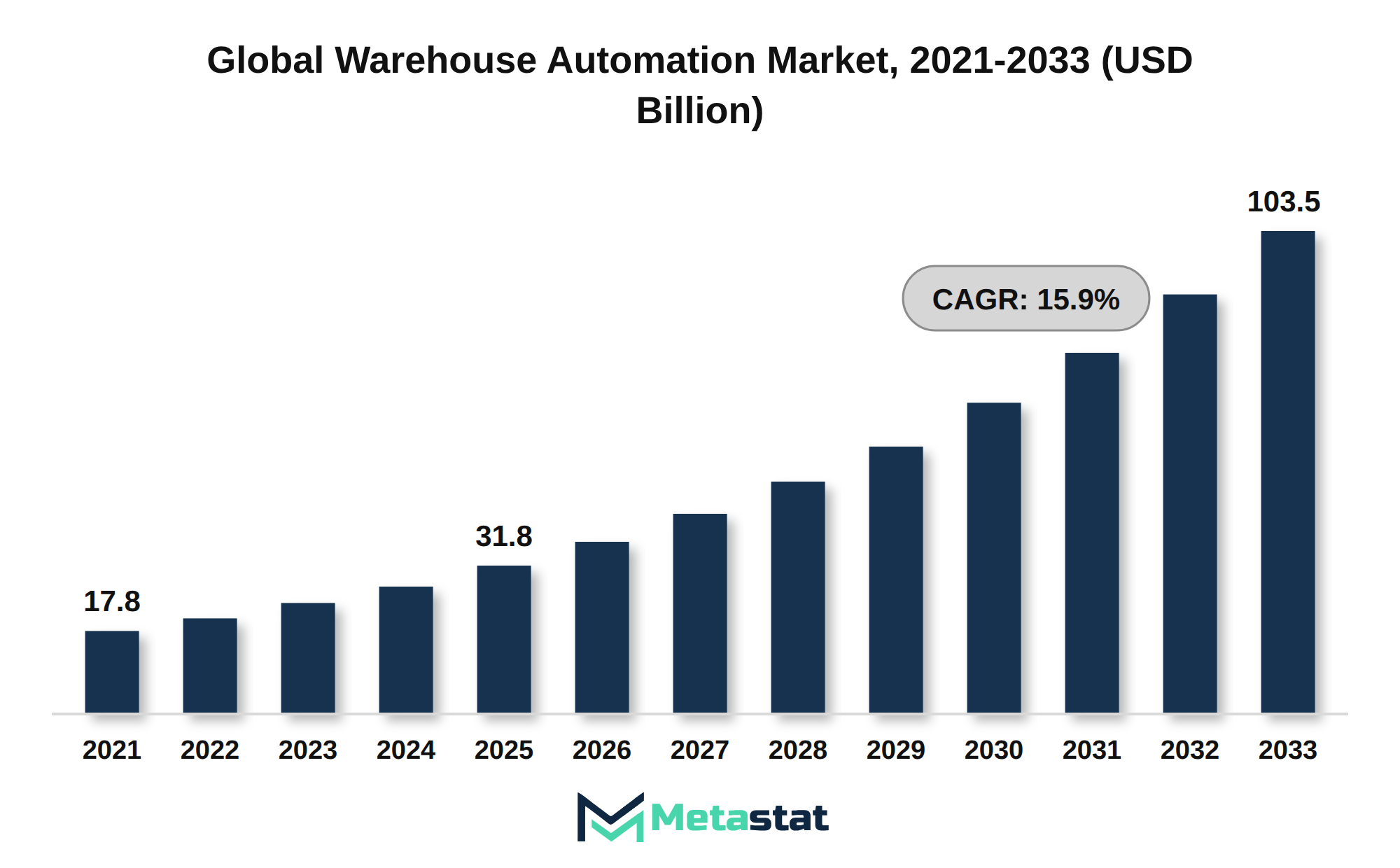
The global Warehouse Automation market was valued at USD 31.8 billion in 2025 and is projected to reach USD 103.5 billion by 2033, growing at a CAGR of 15.9% over the forecast period.
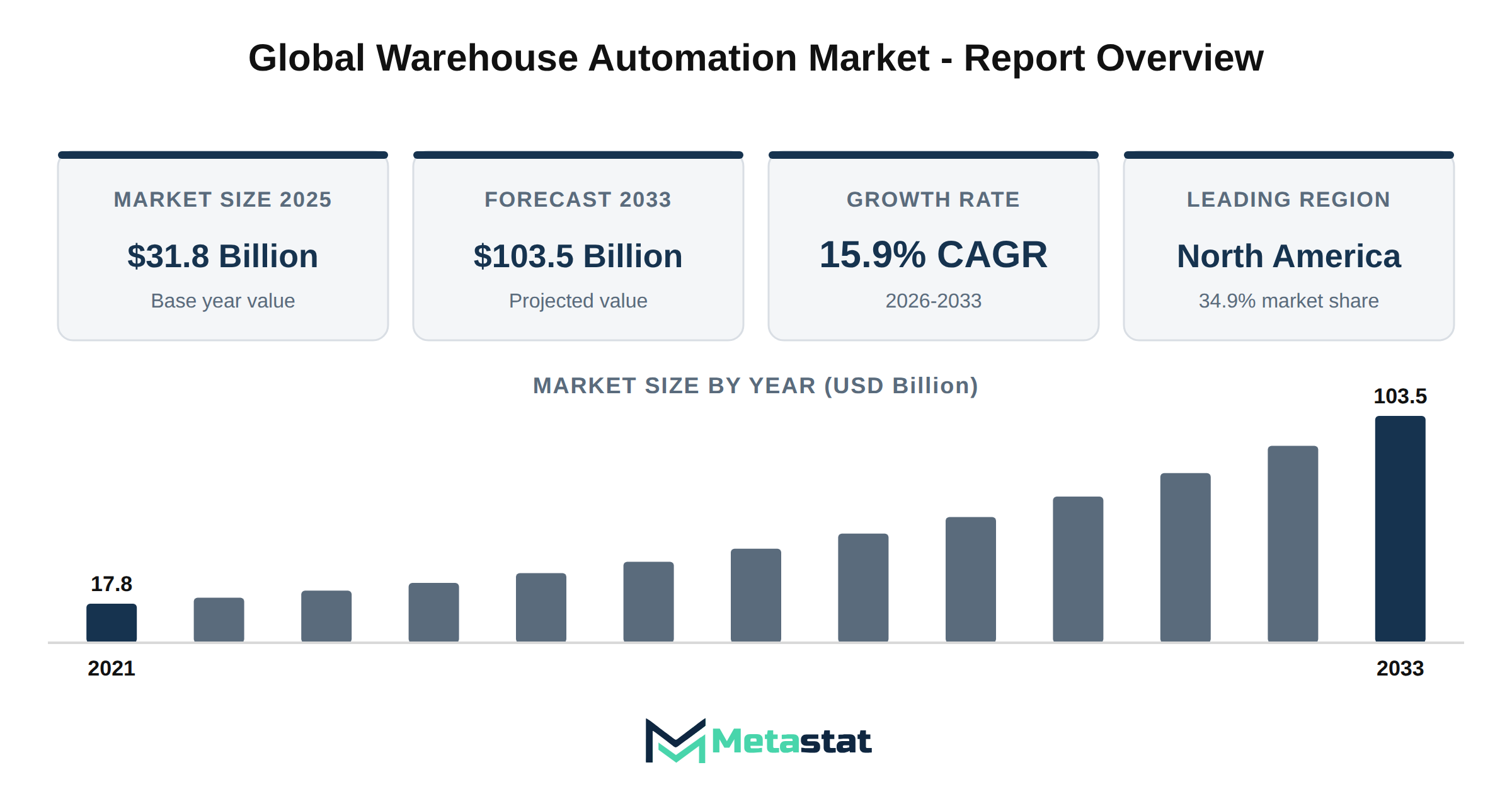
The Warehouse Automation market reached a value of USD 31.8 billion in 2025, with a significant growth trajectory forecasted through 2033. By the end of the forecast period, the market is projected to achieve USD 103.5 billion, reflecting a compound annual growth rate (CAGR) of 15.9%. This robust expansion is driven by the increasing demand for efficient and effective operations across various industries.
Rapid growth in e-commerce and omnichannel fulfillment strategies contributes significantly to the Warehouse Automation market. Businesses prioritize automation to meet the rising consumer expectations for speed and accuracy. Increased investments in technologies that optimize warehouse operations follow this trend.
The adoption of Autonomous Mobile Robots (AMRs) in warehouses grows steadily, enhancing operational efficiency and flexibility. These robots perform tasks including inventory management and order fulfillment, reducing reliance on manual labor and improving overall productivity.
Automated Storage and Retrieval Systems (AS/RS) transform high-density warehousing by maximizing space utilization while reducing retrieval times. This technology streamlines inventory management and improves order processing capabilities, making it essential for businesses aiming to enhance their logistical operations.
AI-powered solutions in warehouse automation and intelligent orchestration are becoming prevalent, enabling real-time decision-making and predictive analytics. These advancements facilitate better inventory control and workforce management, allowing companies to respond to dynamic market conditions effectively.
Robotic picking and piece handling adoption in fulfillment centers significantly impacts operational efficiency. This technology reduces the time needed for order fulfillment, thus enhancing customer satisfaction through faster delivery times.
Integration of Warehouse Management Systems (WMS), Warehouse Execution Systems (WES), and Warehouse Control Systems (WCS) continues to evolve. Effective communication between various components of warehouse operations results from this trend, improving resource allocation and operational effectiveness.
Labor shortages contribute to accelerated investments in warehouse robotics. Companies increasingly turn to automation to mitigate the impacts of limited workforce availability, ensuring continued operational efficiency and output.
Opportunities for brownfield warehouse automation and retrofitting existing facilities are gaining traction. Businesses recognize the advantages of updating and integrating new technologies into established infrastructure, enhancing overall performance without the need for new construction.
Robotics-as-a-Service (RaaS) and flexible automation business models provide companies with scalable solutions tailored to their specific needs. These models lower the barriers to entry for automation, allowing a broader range of businesses to adopt advanced technologies.
Smart conveyors and sortation systems are essential for high-throughput operations, facilitating efficient movement and processing of goods. These technologies play a critical role in maximizing throughput and minimizing delays in the supply chain.
Third-party logistics (3PL) and contract logistics providers increasingly demand warehouse automation solutions. This trend reflects the necessity for these providers to optimize their operations and enhance service offerings to their clients.
The Warehouse Automation market experiences significant growth driven by the expansion of e-commerce and the demand for omnichannel fulfillment. Retailers increasingly seek efficient solutions to manage inventory and streamline operations, leading to higher investments in automated systems.
The rising adoption of Autonomous Mobile Robots (AMRs) in warehouses significantly enhances operational efficiency. AMRs improve the speed and accuracy of picking and transporting goods, which is critical in fulfilling customer demands in a timely manner.
Automated Storage and Retrieval Systems (AS/RS) optimize high-density warehousing by enhancing space utilization and increasing storage efficiency. These systems allow warehouses to maximize their capacity while maintaining efficient operations.
Artificial intelligence significantly impacts warehouse automation, with intelligent orchestration trends emerging to enhance decision-making processes. AI-powered systems analyze vast amounts of data to optimize workflows and predict inventory needs, leading to improved accuracy and reduced operational costs.
Robotic picking and piece handling adoption in fulfillment centers accelerates due to businesses seeking to enhance order accuracy and speed. Advanced robotic systems streamline the picking process, reducing the reliance on manual labor and minimizing errors.
Integration trends in warehouse automation software, including Warehouse Management Systems (WMS), Warehouse Execution Systems (WES), and Warehouse Control Systems (WCS), support the cohesive operation of automated technologies. This integration enhances overall efficiency and facilitates data-driven decision-making.
Labor shortages accelerate investments in warehouse robotics, prompting companies to automate processes to maintain productivity. The challenge of finding skilled labor drives the necessity for automation technology investments across various industries.
Brownfield warehouse automation and retrofit opportunities present significant potential for upgrading existing facilities. Companies are increasingly focusing on enhancing their current infrastructure rather than building new facilities from the ground up.
Robotics-as-a-Service (RaaS) and flexible automation business models emerge because attractive options for businesses seeking to minimize upfront capital expenditures. These models provide scalable solutions that adjust to changing operational needs, making automation accessible to a broader range of companies.
Smart conveyors and sortation systems contribute to high-throughput operations, ensuring efficient movement of goods within warehouses. These systems enhance processing speeds and optimize material handling, significantly improving overall productivity.
Demand for warehouse automation in third-party logistics (3PL) and contract logistics continues to rise. Providers seek to enhance their service offerings through automation, allowing them to manage larger volumes and improve service levels.
Investment trends in the retail and e-commerce sectors highlight a strong commitment to warehouse automation. Companies prioritize adopting advanced technologies to improve efficiency, reduce costs, and enhance customer satisfaction.
Analyzing warehouse automation return on investment (ROI), deployment costs, and total cost of ownership reveals that effective automation leads to substantial long-term savings. Companies experience improved operational efficiency and reduced labor costs through investments in automation technologies.
Interoperability between robotics, material handling, and warehouse software systems enhances overall performance. Efficient integration across various systems allows for better coordination and improved operational workflows.
Automated palletizing, depalletizing, and end-of-line automation trends illustrate the shift toward fully automated processes. These advancements enable businesses to optimize their loading and unloading operations, reducing manual intervention and enhancing efficiency.
Sustainable warehouse automation and energy-efficient intralogistics solutions gain traction because companies prioritize environmentally friendly practices. Investments in energy-efficient technologies contribute to reduced operational costs and lower carbon footprints.
The Asia Pacific region presents significant growth and investment opportunities for warehouse automation, driven by rising e-commerce activities and increasing demand for efficient logistics solutions. Market players are focusing on expanding their presence in this dynamic region.
North America and Europe demonstrate distinct trends in warehouse automation adoption, with established players leading the way. These regions witness substantial investments in technology because companies seek to optimize their supply chains and reduce operational costs.
The competitive landscape of warehouse automation system providers features key players innovating and expanding their product offerings. Companies strive to differentiate themselves through technological advancements and enhanced service capabilities.
The future of fully autonomous warehouses and lights-out fulfillment systems suggests a significant shift in the industry. Companies envision a scenario where automated systems operate with minimal human intervention, further enhancing efficiency and productivity.
The Warehouse Automation market experiences expansion due to a strong emphasis on operational productivity initiatives. Companies increasingly seek to enhance efficiency, streamline processes, and reduce costs in response to rising labor expenses and competitive pressures. Automation technologies facilitate these objectives by optimizing workflows and minimizing human error, which enhances overall operational performance.
Several industries, including retail, food and beverage, and third-party logistics, exhibit heightened demand for automated solutions. Investments in automated systems, including automated storage and retrieval systems, conveyor systems, and autonomous mobile robots, reflect a commitment to improving productivity and operational efficiency. These investments result in long-term cost savings and increased output, positioning businesses to respond effectively to market dynamics.
The anticipated growth in the Warehouse Automation market highlights the significance of operational productivity initiatives, driven by a primary driver. While companies adopt advanced automation technologies, enhanced efficiency and streamlined operations lead to improved competitiveness and increased market share. This trend is expected to shape the market through 2033, contributing to sustained growth and innovation within the sector.
The integration of advanced technologies significantly influences the Warehouse Automation market. Automation, artificial intelligence, and software adoption streamline operations and enhance efficiency across various sectors. Businesses increasingly invest in digitizing legacy processes to improve productivity, reduce errors, and optimize inventory management. This shift towards technological integration results from growing demand for faster and more accurate fulfillment of customer orders.
Investment in automation technologies yields substantial operational benefits. Enhanced process efficiency leads to reduced labor costs and improved accuracy in order fulfillment. Industries including retail and e-commerce leverage these advancements to meet evolving consumer expectations, driving further adoption within the market. The increasing emphasis on data analytics facilitates better decision-making and operational insights, further supporting growth.
While organizations prioritize technological integration, competition within the Warehouse Automation market intensifies. Companies that adopt innovative solutions gain a competitive edge, resulting in increased market share and profitability. The combination of automation and AI drives innovation-led product and service diversification, allowing businesses to explore new revenue streams and enhance overall value propositions.
The Warehouse Automation market faces significant constraints due to high capital investment requirements. Many companies encounter challenges in securing the necessary funding to implement advanced automation solutions, especially small and medium-sized enterprises that lack sufficient capital reserves. This financial barrier restricts expansion and modernization initiatives within warehouses, ultimately stifling the growth potential of the market.
Escalating operating costs further compound the situation, because organizations grapple with increasing expenses related to technology implementation and maintenance. Rising costs associated with labor, materials, and utilities add pressure on profit margins, prompting warehouse operators to reconsider investments in automation technologies. This environment of financial uncertainty leads to hesitance in adopting new systems, impacting overall competitiveness.
Technological obsolescence presents another significant challenge within the market. Rapid advancements in automation technologies create a landscape where existing systems risk becoming outdated swiftly. Companies investing heavily in current solutions find themselves needing to reinvest shortly after implementation, which discourages commitment to automation projects.
Supply chain disruptions, often exacerbated by geopolitical instability, hinder the efficiency and reliability of automated systems. Unforeseen events including trade tensions or natural disasters disrupt operations, raising concerns among potential adopters regarding the resilience of automated solutions. These uncertainties deter investment, particularly in regions already facing infrastructural challenges.
With the Warehouse Automation market evolving, organizations navigate these constraints effectively. Addressing high capital requirements, escalating costs, and technological risks will shape the future trajectory of the market.
The Warehouse Automation market faces challenges stemming from geopolitical fragmentation, which generates trade deficits and tariff friction. These elements contribute to increased costs and uncertainties within supply chains, affecting various industries reliant on efficient logistics and automation solutions. Consequently, companies encounter difficulties in sourcing components and materials, leading to potential operational delays and increased pricing pressures.
Technological disruptions further complicate the landscape. Rapid advancements require continuous investment in research and development, creating complex integration challenges for organizations seeking to remain competitive. The need for interoperability among different automation systems intensifies, resulting in compatibility issues that hinder market growth.
Logistics disruptions, often exacerbated by geopolitical tensions, impact the timely delivery of goods and services. Supply chain instability poses significant risks to market players, affecting their ability to meet customer demands effectively. Rising input costs, alongside margin pressures, place further strain on companies. Strategic adaptations are necessary to maintain profitability.
Environmental considerations present another layer of complexity within the Warehouse Automation market. Companies face escalating sustainability demands and decarbonization mandates, which influence operational practices and cost structures. The pressure to align with tightening global regulatory standards adds compliance overhead that challenges companies to balance efficiency with environmental responsibilities.
Workforce skill gaps and talent retention pressures create challenges in adopting automation technologies. The transition to more advanced systems requires skilled personnel, and shortages in this area slow down implementation timelines. Organizations invest in training and development to bridge these gaps effectively.
Overall, the Warehouse Automation market experiences a convergence of factors that challenge stability and growth. Addressing these challenges requires strategic planning, investment in technology, and a focus on building resilient supply chains that adapt to evolving market dynamics.
The Warehouse Automation market experiences notable opportunity stemming from rising demands across various regions. Growing e-commerce activities in North America and Asia Pacific drive significant investments in automation solutions. This trend aligns with infrastructure modernization efforts aimed at enhancing operational efficiency and productivity in distribution centers. The increasing complexity of supply chains urges companies to adopt automation systems that facilitate streamlined processes and faster order fulfillment.
Digital transformation plays a critical role in the market's evolution, with organizations incorporating advanced technologies to optimize operations. The demand for integrated solutions, combining hardware and software components, is on the rise, allowing businesses to leverage data analytics for enhanced decision-making. This shift promotes investment in software solutions that support real-time inventory management and predictive analytics.
Sustainability imperatives, including eco-friendly practices and environmental, social, and governance (ESG) alignments, present additional opportunities. Companies prioritize sustainable practices in their operations, driving the demand for energy-efficient automation technologies. The market benefits from an emphasis on green transformations, which encourage investments in systems that reduce energy consumption and waste, contributing to long-term cost savings.
The Warehouse Automation market observes changes in buying behaviors, with businesses increasingly adopting digital procurement practices. This transition facilitates quicker decision-making processes and allows for better supplier engagement. While organizations seek to diversify their supply chains, the demand for innovative automation solutions supporting niche applications continues to grow.
The convergence of emerging regional demands, technological disruptions, and sustainability initiatives positions the Warehouse Automation market for significant expansion. Businesses engaging in strategic consolidation and cross-industry mergers enhance their competitive edge, ultimately expanding market presence and driving future investments.
The Global Warehouse Automation market is segmented based on System Type, Component, Function, and End-Use Industry.
Valued at USD 10 billion in 2026, the Automated Storage & Retrieval Systems (AS/RS) segment is projected to reach USD 26.1 billion by 2033, achieving a CAGR of 14.6% during the forecast period. Demand drivers for this segment include the increasing need for efficiency and accuracy in warehouse operations, particularly within industries including retail and e-commerce. Adoption of AS/RS is propelled by technological advancements that enable greater automation and real-time inventory tracking. Enhanced operational efficiencies result from streamlined processes and reduced labor costs, benefiting organizations that implement these systems.
Segment expansion catalysts encompass the rising volume of e-commerce shipments, heightening the demand for reliable and fast order fulfillment solutions. Technological maturation in robotics and artificial intelligence facilitates the development of next-gen AS/RS solutions, enhancing their capabilities. The evolution of these products aligns with the growing complexity of supply chains, necessitating sophisticated storage and retrieval methods to accommodate diverse inventory types and sizes.
End-use dynamics illustrate a shift toward automated solutions. Businesses confront increasing consumer expectations for rapid delivery and service responsiveness. Regulatory compliance standards and certifications further emphasize the importance of safety and efficiency in warehouse operations, prompting investments in automation technologies. Pricing volatility in raw materials and component sourcing influences the overall cost structures of AS/RS implementations, affecting margin pressures for suppliers and end-users.
Heightened focus on supply chain resilience drives investment in automated systems, ensuring businesses adapt to disruptions. The market for Automated Storage & Retrieval Systems (AS/RS) presents strategic opportunity windows for manufacturers and technology providers looking to capitalize on these trends. Overall, the AS/RS segment stands poised for significant growth, reflecting the broader trajectory of the Warehouse Automation market.
Growth in the Conveyor & Sortation Systems segment reflects increasing demand for efficient and automated material handling solutions across various industries. The expansion of e-commerce and the need for optimized logistics operations drive investments in these systems, allowing businesses to enhance productivity and streamline processes. Integration of advanced technologies, including artificial intelligence and machine learning, enables sophisticated sorting and routing capabilities, further enhancing efficiency. The segment is projected to reach USD 21.7 billion by 2033, growing at a CAGR of 13.8% during the forecast period.
Technological maturation plays a critical role in driving adoption. Companies seeking to modernize their operations increasingly invest in next-generation upgrades that enhance system performance and adaptability. Innovations in conveyor and sortation systems, including real-time data analytics and improved sensor technologies, support operational flexibility and efficiency. End-use dynamics indicate that sectors including retail and third-party logistics significantly contribute to demand, with businesses focusing on rapid delivery and efficient inventory management. This trend underscores the importance of automation in maintaining competitive advantage within the market.
Investment in Autonomous Mobile Robots (AMRs) reflects a growing demand for efficiency and productivity in warehouse operations. Industries including retail and e-commerce drive the adoption of these technologies to streamline logistics and enhance operational capabilities. With an expected market value of USD 21 billion by 2033, this segment illustrates the important role of automation in modern supply chains.
Technological advancements fuel the evolution of AMRs, enabling improved navigation, obstacle avoidance, and autonomous decision-making. While companies seek to optimize their processes, the shift towards robotic solutions becomes critical, influencing traditional warehouse dynamics. Increased competition among players within the Warehouse Automation market accelerates innovation, leading to the introduction of next-generation AMRs that offer enhanced features and capabilities.
Market dynamics shift owing to organizations recognizing the importance of supply chain resilience. The integration of AMRs provides flexibility in operations, allowing companies to adapt swiftly to fluctuations in demand. This adaptability contributes to cost efficiency and operational effectiveness, essential for businesses aiming to maintain competitiveness in the evolving marketplace.
Continued investments in research and development will drive future growth in the segment. Players in the Warehouse Automation market focus on enhancing functionality and reliability of AMRs, creating a robust environment for technological maturation. This evolution supports strategic opportunity windows, allowing businesses to capitalize on emerging trends and meet changing consumer expectations.
Investment in Automated Guided Vehicles (AGVs) and Automated Forklifts drives growth within the Warehouse Automation market. The segment is projected to grow at a CAGR of 14.7% during the forecast period. Major factors contributing to this growth include increasing labor costs and the need for operational efficiency across various industries.
Technological advancements including enhanced navigation systems and improved battery technologies improve the capabilities of AGVs and automated forklifts. Enterprises recognize the potential of these technologies to streamline operations, reduce labor reliance, and enhance productivity. Adoption of AGVs and automated forklifts across diverse end-use industries, including retail, logistics, and manufacturing, reflects their versatility in optimizing material handling processes.
Regulatory compliance and safety standards shape the segment's development. Companies prioritize solutions that meet stringent operational requirements while ensuring a safe working environment. This focus on compliance leads to higher demand for advanced AGV systems equipped with safety features and autonomous navigation capabilities.
Price volatility in raw materials influences the cost structures of AGVs and automated forklifts. Manufacturers face margin pressures associated with fluctuating component prices, prompting them to invest in supply chain resilience and innovative manufacturing processes. Consequently, businesses seek strategic opportunities for cost reductions and value creation within their operations.
Overall, the automated guided vehicles and automated forklifts segment demonstrates significant potential within the Warehouse Automation market, driven by technological maturation, evolving industry needs, and a strong focus on compliance and efficiency.
Robotic Picking & Piece Handling Systems play a crucial role in enhancing operational efficiency within the Warehouse Automation market. Increasing demand for automation technologies in various industries, including retail and e-commerce, drives adoption. These systems facilitate rapid and accurate picking processes, leading to improved inventory management and customer satisfaction. The shift towards e-commerce necessitates streamlined operations, which these advanced systems effectively address.
Technological advancements enable the evolution of robotic systems, integrating sophisticated algorithms and AI capabilities. This evolution enhances adaptability and precision, allowing for effective interaction with existing warehouse infrastructure. The continuous evolution of robotics encourages investment from various sectors, highlighting a strategic opportunity window for companies looking to enhance their supply chain resilience.
Cost structures for implementing robotic systems are declining due to advancements in manufacturing processes and increased competition among suppliers. This trend reduces pricing volatility, making these systems more accessible to a broader range of businesses. The Robotics Picking & Piece Handling Systems segment plays an essential role in meeting increasing consumer expectations for faster fulfillment times, positioning itself because a significant contributor to the overall growth of the market.
Growth in the demand for Robotic Palletizing & Depalletizing Systems stems from the ongoing shift toward automation within various industries. Increased labor costs and a shortage of skilled workers drive businesses to adopt these systems for enhanced efficiency and productivity. The ability to handle repetitive tasks with precision offers significant operational advantages, particularly in sectors including retail, e-commerce, and food and beverage. Companies implementing robotic solutions benefit from improved accuracy and reduced labor dependency, enabling them to respond swiftly to market changes.
Technological advancements play a crucial role in the expansion of this segment. Innovations in artificial intelligence and machine learning enhance the capabilities of robotic systems, allowing for better adaptability in dynamic environments. The integration of sensors and advanced imaging technologies improves operational efficiency and safety, further encouraging adoption across various end-use industries. The market's response to these advancements indicates a strong trajectory toward increased investment in automation solutions.
Considerable investment in research and development leads to continuous innovation, resulting in next-generation upgrades in robotic systems. Enhanced functionalities including real-time data analytics and integration with existing warehouse management systems create new opportunities for companies to streamline operations. This evolution reflects a growing demand for more sophisticated automation solutions that adapt to varying demands and operational requirements.
Regulatory compliance standards concerning labor safety and workplace efficiency influence the adoption of robotic systems. Companies seeking to enhance safety protocols and compliance turn to automation because a means of mitigating risks associated with manual handling. The emphasis on safety and productivity positions robotic palletizing and depalletizing systems favorably within the broader Warehouse Automation market.
While industries increasingly focus on supply chain resilience, the role of robotics becomes more prominent. Solutions that enhance flexibility in material handling processes are essential for mitigating disruptions caused by external factors. Businesses that invest in robotic solutions position themselves strategically to navigate fluctuations in demand, ensuring continuity and operational effectiveness.
Growing demand for automation in packaging, labeling, loading, and unloading drives interest in the Others segment of the Warehouse Automation market. Increasing efficiency and accuracy in these processes becomes essential owing to businesses seeking to meet consumer expectations for faster service and delivery. Technological maturation enhances capabilities in these areas, with advancements in robotics and AI.
Investment in this sub-segment is influenced by the need for streamlined operations and reduced labor costs. Companies in e-commerce and retail sectors, where rapid order fulfillment is critical, demonstrate strong adoption of these technologies. The shift toward automation in these functions improves productivity and addresses labor shortages, which have intensified in recent years.
Regulatory compliance standards further shape the market dynamics, particularly concerning safety and quality in packaging. Organizations face pressure to meet these standards while maintaining operational efficiency, leading to increased investments in systems that ensure adherence. The evolving landscape of consumer preferences and regulatory requirements creates strategic opportunity windows for players within the market.
Raw material sourcing and logistics vulnerabilities pose challenges that companies navigate. Effective management of supply chain resilience becomes vital in maintaining a competitive edge. Innovations in technology provide avenues for mitigating risks associated with supply chain disruptions, allowing firms to maintain consistency in operations.
Valued at USD 22.9 billion in 2026, the Hardware segment is projected to reach USD 58.9 billion by 2033, at a CAGR of 14.4% during the forecast period. Growth in this segment is propelled by increasing demand for advanced automation solutions across various industries, including retail, logistics, and manufacturing. Rising efficiency and accuracy in operations drive investment in hardware components that facilitate automated processes.
Technological maturation enhances the expansion of the Hardware segment. Continuous advancements in robotics, artificial intelligence, and machine learning improve the capabilities of hardware solutions, leading to better performance and integration with existing systems. Industries adopting these innovations experience streamlined workflows, reduced labor costs, and enhanced productivity.
End-use dynamics contribute substantially to the segment's growth. Retail and e-commerce sectors increasingly rely on automated solutions to manage vast inventories and fulfill customer orders swiftly. The growing trend of online shopping necessitates robust automated systems, further driving hardware adoption. This shift towards automation aligns with changing consumer preferences for faster delivery and better service.
Investment in infrastructure and capital projects creates strategic opportunity windows for the Hardware segment. Companies prioritize upgrading their systems to meet evolving market demands, ensuring compliance with regulatory standards that emphasize operational efficiency and safety. The focus on sustainability and reducing operational costs influences purchasing decisions, with organizations seeking hardware that delivers both performance and energy efficiency.
Supply chain resilience represents a critical factor affecting the Hardware segment. Disruptions in logistics and sourcing impact production timelines and costs. Manufacturers increasingly invest in reliable suppliers and alternative materials to mitigate risks associated with supply chain vulnerabilities. Consequently, enhancing the reliability of hardware components becomes essential for maintaining operational continuity.
Significant demand for software solutions in the Warehouse Automation market stems from the increasing need for operational efficiency and enhanced productivity across various industries. Automation software plays a crucial role in streamlining warehouse operations, enabling businesses to integrate their systems more effectively. The demand for advanced analytics, real-time data processing, and inventory management drives investments in software, allowing companies to optimize their supply chains and reduce costs.
The Software segment is estimated to reach USD 28.4 billion by 2033, at a CAGR of 18.9% during the forecast period. This growth reflects the rising adoption of technologies including artificial intelligence and machine learning, which enhance operational capabilities. Industries focusing on e-commerce and third-party logistics invest heavily in software solutions to improve their logistics and fulfillment processes.
Emerging trends including the shift towards cloud-based software platforms further influence the market, offering scalability and flexibility for users. Companies seek to leverage these innovations to improve their operational resilience and adapt to changing consumer demands. Regulatory compliance standards necessitate the adoption of software solutions that ensure adherence to industry guidelines.
Market players invest in research and development to introduce next-generation software solutions, enhancing functionalities including automation, reporting, and user interfaces. This continuous evolution of software products reflects the market's dynamic nature. Companies strive to meet the complex demands of their end-users. Overall, the software segment within the Warehouse Automation market is positioned for substantial growth, driven by technological advancements and the increasing importance of efficient warehouse management.
Significant expansion of the Services segment in the Warehouse Automation market is driven by increasing demand for operational efficiency and technological integration. Companies recognize the importance of services that enhance system performance, ensure smooth operations, and provide essential support throughout the lifecycle of automation solutions. This growth aligns with the shift towards automation in various end-use industries, particularly in sectors including retail, third-party logistics, and healthcare.
The Services segment is expected to reach USD 16.1 billion by 2033. Continuous advancements in technology necessitate ongoing training and support for personnel, creating a steady demand for service offerings. Companies investing in automated solutions seek robust support that includes maintenance, upgrades, and integration services. The focus on minimizing downtime and maximizing productivity significantly influences service adoption rates.
Emerging trends including predictive maintenance and real-time monitoring reshape service delivery. These innovations enhance operational resilience and decrease unexpected failures. Organizations prioritize service contracts that offer comprehensive support tailored to their specific needs, ensuring alignment with their operational goals. Overall, the evolving landscape of the Warehouse Automation market presents ample opportunities for service providers to expand their offerings and capture market share.
Investment in the Inbound Receiving & Unloading function reflects rising efficiency requirements within various industries. This segment is valued at USD 2.9 billion in 2026 and is projected to reach USD 7.4 billion by 2033, at a CAGR of 14.4% during the forecast period. Key drivers of growth involve the increasing demand for streamlined operations and enhanced supply chain resilience. Companies across sectors including retail, e-commerce, and third-party logistics emphasize automation to minimize operational costs and respond to fluctuating consumer demands.
The trend towards technological maturation influences investment decisions in automation technologies. Next-generation upgrades in robotics and software solutions enhance capabilities within the Inbound Receiving & Unloading segment. These advancements facilitate rapid sorting, processing, and inventory management, which are critical for maintaining competitive advantage. Regulatory compliance and safety standards increasingly necessitate automated solutions, pushing businesses to adopt innovative systems.
Market dynamics suggest that capital investment in automation solutions for inbound receiving will continue to grow. Increased consumer expectations regarding delivery times and order accuracy create pressure on companies to improve their logistics strategies. Consequently, businesses prioritize investments in automation, positioning the Inbound Receiving & Unloading segment because a vital component of the broader Warehouse Automation market.
Automation technology for Putaway & Replenishment is projected to reach USD 9.3 billion by 2033, at a CAGR of 15.1% during the forecast period. The increasing demand for efficient inventory management drives investment in automation solutions designed to optimize space utilization and streamline restocking processes. Retail and e-commerce sectors, which experience high volumes of inventory turnover, significantly influence growth within this segment. The adoption of advanced technologies, including artificial intelligence and machine learning, enhances decision-making capabilities regarding inventory placement and replenishment schedules.
Enhancements in automation technologies lead to improved accuracy in inventory management. Organizations prioritize real-time data analytics for better visibility of stock levels, directly impacting fulfillment speed and customer satisfaction. The regulatory environment surrounding warehouse safety standards drives investments in automation solutions that comply with compliance mandates while minimizing labor-related risks. Significant cost savings achieved through reduced labor requirements and improved operational efficiency increase the segment's attractiveness to various end-use industries.
Innovations in robotic systems and software solutions further drive growth in the Putaway & Replenishment segment. Next-generation upgrades provide enhanced functionalities, allowing operators to achieve greater flexibility in operations and respond to shifting consumer demands. While organizations focus on driving supply chain resilience, investments in automation technologies support strategic goals of reducing operational risks and addressing market volatility. Overall, the Putaway & Replenishment segment plays a critical role within the broader Warehouse Automation market, reflected in its robust forecast growth.
Driven by the escalating demand for efficient warehouse operations, the Storage & Retrieval segment is expected to reach USD 20.1 billion by 2033. Increased consumer expectations for faster delivery and inventory accuracy significantly influence the adoption of advanced automation technologies within this segment. Companies prioritize automation to enhance operational efficiency, minimize labor costs, and streamline processes.
Technological advancements in automated systems improve system integration, enabling interaction between various warehouse functions. This integration allows for enhanced data analytics, enabling businesses to optimize inventory management and response times. While industries embrace digital transformation, the market experiences heightened interest in innovative solutions that enhance performance and scalability.
Multiple end-use industries, including retail, e-commerce, and pharmaceuticals, drive demand for automated storage and retrieval systems. These sectors require swift operations to accommodate fluctuating consumer demands and maintain competitive advantages. The trend toward just-in-time inventory strategies further increases the necessity for robust storage and retrieval solutions.
Regulatory compliance standards surrounding safety and efficiency in warehousing operations encourage investments in automated technologies. Companies are compelled to adopt advanced systems to meet these regulations while optimizing supply chains. Consequently, the market anticipates substantial growth fueled by ongoing investments in automation technologies that improve operational resilience.
Increasing emphasis on efficiency and accuracy in order fulfillment significantly drives the growth of the Picking & Order Fulfillment segment within the Warehouse Automation market. Enhanced consumer expectations for faster delivery times and improved order accuracy compel retailers and e-commerce businesses to invest in advanced automation solutions. These investments streamline operations, reduce labor costs, and increase throughput, contributing to the segment's growth.
Technological maturation in automation solutions, including artificial intelligence and machine learning, facilitates the development of sophisticated picking systems that improve operational efficiency. The integration of these technologies enables real-time data analysis, optimizing inventory management and order tracking. Consequently, companies operating in the market enhance their responsiveness to consumer demand and adapt to fluctuations in order volumes, further driving the segment's expansion.
Growth in the retail and e-commerce sectors creates additional demand for automated picking and order fulfillment solutions. Shifts toward online shopping and the growth of omnichannel distribution models require businesses to optimize their fulfillment processes. This demand for quick and accurate order delivery enhances the segment's appeal among third-party logistics providers and retailers, fueling investment and innovation in this area.
Regulatory compliance standards necessitate the adoption of automation solutions to ensure safety and efficiency in warehousing operations. Stricter guidelines for labor practices and safety measures encourage businesses to transition towards automated systems that mitigate human error and enhance workplace safety. These factors contribute to the increasing share of the Picking & Order Fulfillment segment in the overall market, highlighting its importance in the evolving warehouse automation sector.
Investments in next-generation upgrades and product evolution support segment expansion. Automation providers concentrate on developing advanced picking solutions, including robotic systems and automated picking software, which enhance the capabilities of fulfillment centers. These innovations allow for greater flexibility and scalability in operations, ultimately improving profitability and reducing operational risks for businesses in the market.
Increased adoption of automation technologies across various industries drives demand for the Sorting & Consolidation function within the Warehouse Automation market. The need for enhanced efficiency, accuracy, and speed in processing orders prompts a shift towards automated solutions. Retailers and e-commerce companies prioritize these technologies to streamline operations and meet consumer expectations for quick delivery, prompting investments in sorting and consolidation systems. The emergence of advanced technologies, including artificial intelligence and machine learning, enhances sorting accuracy and operational efficiency, further supporting market growth.
Next-generation upgrades in sorting systems, characterized by improved algorithms and robotics, contribute to operational improvements. These advancements enable businesses to manage inventory and fulfill orders with greater effectiveness. The evolution of products in this function aligns with the requirements of downstream applications, particularly in sectors including retail, logistics, and pharmaceuticals, where timely and accurate order fulfillment remains critical.
Growing consumer expectations regarding delivery speed and accuracy influence consumption shifts within the market. Companies are increasingly focused on automating sorting functions to enhance overall supply chain resilience and responsiveness. Regulatory compliance standards related to operational efficiency and safety further encourage investments in automated systems. This strategic focus positions businesses favorably, allowing them to improve margins while mitigating pricing volatility.
Continued capital investment in sorting and consolidation technologies remains essential for enhancing competitiveness in the market. The landscape features opportunities for companies to leverage innovative solutions that address current challenges, facilitating significant growth in this segment. While organizations seek to optimize their processes, the Sorting & Consolidation function stands out because a key area for investment and strategic development.
In the Warehouse Automation market, the Packing & Labeling function aligns closely with the broader trends in e-commerce and retailing, where efficient packaging processes improve throughput and customer satisfaction. This segment experiences increased focus on technological advancements, prompting the integration of intelligent systems that enhance accuracy in labeling and packaging. The adoption of automated solutions addresses the growing pressure for faster order fulfillment and minimizes errors, reflecting heightened competition within the retail and logistics sectors.
Demand for automation in packing and labeling is driven by the need for operational efficiency and the reduction of labor costs. Emerging technologies including machine learning and artificial intelligence facilitate the development of smart packing solutions that adapt to varying product sizes and packaging requirements. Such innovations streamline processes and support compliance with stringent labeling regulations, contributing to improved market stability.
The dynamics of downstream applications influence the evolution of packing and labeling processes, with shifting consumer preferences toward sustainable packaging materials prompting manufacturers to innovate. Market participants face pressures related to pricing volatility driven by fluctuations in raw material costs, impacting profit margins. Companies seek strategic opportunities that enhance supply chain resilience and mitigate risks associated with sourcing and logistics vulnerabilities.
Technological obsolescence remains a critical consideration for businesses within this segment. Continuous investment in next-generation upgrades is essential for maintaining competitive advantages, ensuring companies remain capable of meeting evolving consumer demands. The ongoing evolution of the Warehouse Automation market signals a robust capital investment outlook, driven by organizations prioritizing automation technologies to enhance productivity and drive growth.
Automation in Outbound Staging, Loading & Shipping offers significant advantages in operational efficiency and accuracy. The increasing complexity of supply chains necessitates advanced solutions to streamline these processes. Integration of automation technologies enhances throughput and reduces the likelihood of human error, aligning with the demands of sectors including retail and e-commerce, where timely and accurate shipping is essential.
Adoption of automated solutions in this function aligns with the broader trends within the Warehouse Automation market, emphasizing speed and reliability in delivery systems. The growing focus on sustainability encourages businesses to optimize their loading and shipping operations, further driving demand for automation technologies that support energy efficiency and reduced waste.
Investment in next-generation upgrades, including robotics and advanced software systems, plays a critical role in transforming conventional practices in Outbound Staging, Loading & Shipping. These enhancements not only improve performance but enable scalability, allowing businesses to adapt to fluctuating market demands without compromising service quality. This transformation supports the overall growth of the Warehouse Automation market.
Strategic opportunity windows arise owing to companies seeking to modernize their operations. Emphasis on regulatory compliance standards and certifications drives the need for robust automation solutions that ensure adherence to industry norms while maintaining operational efficiency. In this evolving landscape, the potential for capital investment remains strong, particularly in technologies that enhance supply chain resilience and mitigate logistic vulnerabilities.
Automation in inventory counting, stock control, and returns processing enhances efficiency within warehouse operations. Key drivers for adoption include the increasing need for accuracy in inventory management and the demand for streamlined processes. Technological advancements facilitate improvements in tracking and managing inventory, which is crucial for retailers and logistics providers aiming to minimize errors and optimize productivity.
Segment expansion occurs through innovations that enhance the capabilities of existing systems. Integration of next-generation software and hardware solutions supports efficient operations, enabling real-time inventory tracking and management. This trend reflects the broader movement towards digitization in the Warehouse Automation market, where companies transition from traditional approaches to more automated solutions.
End-use dynamics demonstrate a shift towards automated systems that allow for improved responsiveness and adaptability in supply chains. Retail and e-commerce industries particularly benefit from these advancements, because efficient returns processing and accurate stock control address the growing complexities of consumer demands. Regulatory compliance standards and certifications related to inventory management further drive the necessity for sophisticated automation technologies.
Cost structures and pricing volatility influence investment decisions within this segment. Companies often prioritize technologies that deliver measurable returns on investment through reduced labor costs and enhanced operational efficiency. Strategic opportunity windows arise because businesses look to strengthen supply chain resilience, emphasizing the importance of reliable inventory management systems that mitigate risks associated with manual processes.
Overall, the increasing complexity of supply chains and the driving forces behind consumer expectations position inventory counting, stock control, and returns processing because critical areas within the Warehouse Automation market. Continued investment in this segment is anticipated to support future growth and evolution, aligning with trends in technological maturation and product evolution.
Retail & E-commerce segment is valued at USD 10.6 billion in 2026 and is projected to reach USD 30.7 billion by 2033, at a CAGR of 16.4% during the forecast period. This growth stems from the increasing shift toward online shopping and the demand for rapid order fulfillment. Retailers face pressure to improve operational efficiency and accuracy, driving investments in automation technologies that optimize inventory management and enhance service delivery.
The need for advanced solutions in order processing and product handling fuels the ongoing expansion within the Warehouse Automation market. Enhanced technologies, including Automated Storage and Retrieval Systems (AS/RS) and Autonomous Mobile Robots (AMRs), facilitate operations by minimizing human error and reducing labor costs. These developments position businesses to adapt to fluctuating consumer demands while maintaining high service levels.
Regulatory compliance and safety standards further encourage automation adoption in the retail sector, because companies align with best practices to ensure a positive shopping experience. The segment's evolution is marked by continuous technological advancements that drive efficiency and sustainability, providing a competitive edge in a rapidly changing market environment.
Increasing focus on efficient supply chain management drives significant investment in the Third-Party Logistics & Contract Logistics segment. Demand from e-commerce and retail sectors fuels requirements for automated warehousing solutions, enhancing operational efficiency and order accuracy. The adoption of advanced technologies, including robotics and artificial intelligence, improves overall productivity in logistics operations.
The Third-Party Logistics & Contract Logistics segment is estimated to reach USD 19 billion by 2033, at a CAGR of 17.3% during the forecast period. Competitive pressures compel logistics providers to invest in automation, leading to reduced labor costs and enhanced service levels. Rising consumer expectations for rapid deliveries influence investment decisions, pushing firms to implement automated systems to meet stringent timelines.
Technological maturation creates opportunities for next-generation upgrades within this segment. Innovations in Automated Storage & Retrieval Systems (AS/RS) and Autonomous Mobile Robots (AMRs) streamline processes, ultimately improving throughput and reliability. The emphasis on regulatory compliance and sustainability further shapes investment strategies, challenging providers to adapt to evolving standards while optimizing cost structures.
Strategic opportunity windows emerge for firms specializing in end-to-end logistics solutions. Investment in warehouse automation enhances supply chain resilience, providing capabilities to adapt to market fluctuations and disruptions. Companies leveraging automation effectively position themselves to capture a larger market share, benefiting from increased efficiency and reduced operational risks.
Growing focus on automation within the Food & Beverage industry fuels expansion in the Warehouse Automation market. Increasing consumer demands for efficiency and speed in food distribution drive investments in automated solutions. Enhanced operational efficiency, coupled with strict regulatory compliance standards regarding food safety, motivates companies to adopt advanced automation technologies.
The Food & Beverage segment is projected to reach USD 12 billion by 2033. This growth stems from ongoing technological maturation, allowing for the implementation of next-generation upgrades in automated systems. Heightened competition requires businesses to streamline operations, resulting in a strategic shift towards integrated automation solutions.
The rising trend of e-commerce in food delivery services influences consumption shifts, pushing organizations to enhance their logistics capabilities. Companies in this segment invest in software and hardware improvements to optimize inventory management and order fulfillment processes. This trend contributes to the overall growth trajectory of the market.
Investment in automation technologies provides resilience against supply chain vulnerabilities, ensuring smooth operations amid fluctuating demand. Advancements in robotics and artificial intelligence facilitate greater flexibility and accuracy in various processes, including inventory counting and order picking. Evolving cost structures support these investments, enhancing profitability over time and positioning the segment for sustained growth.
Adoption of warehouse automation in the Pharmaceuticals & Healthcare sector reflects the industry's pursuit of increased efficiency and compliance with stringent regulatory standards. Automation technologies enhance accuracy in medication handling and streamline operations, which is crucial in a field where precision directly impacts patient safety. The projected growth at a CAGR of 17.1% during the forecast period indicates strong market confidence and aligns with ongoing digitization trends across healthcare systems.
Rising demands for traceability and inventory management in pharmaceuticals drive the need for advanced automated solutions. Increased focus on reducing errors in order fulfillment and improving speed in distribution channels incentivizes investment in automated systems. Ongoing product evolution in robotic systems and software solutions supports operational efficiency, allowing companies to respond swiftly to market changes and regulatory requirements.
Strategic opportunity windows emerge from the integration of automation technologies in laboratories and distribution centers. Enhanced supply chain resilience through automated systems mitigates risks associated with logistical vulnerabilities, ultimately protecting against delays in product delivery. The increasing complexity of healthcare logistics necessitates further investment in automation, reinforcing the sector's position within the broader Warehouse Automation market.
Demand for warehouse automation in the automotive industry arises from the increasing complexity of manufacturing processes and the need for streamlined operations. The push for efficiency in production lines drives manufacturers to adopt automated solutions that enhance productivity and reduce operational costs. Innovations in automation technologies, including robotics and artificial intelligence, facilitate the evolution of manufacturing capabilities, allowing for more precise assembly and handling of automotive components.
Shifts in consumer expectations towards faster delivery and better quality further influence the adoption of automation. Automotive manufacturers respond to these pressures by integrating advanced automated systems that improve inventory management and order fulfillment processes. Regulatory compliance standards are becoming more stringent, prompting manufacturers to invest in automation solutions that ensure adherence to safety and environmental regulations.
Investment in next-generation upgrades, including autonomous mobile robots and advanced conveyor systems, fuels market growth. This technological maturation enables manufacturers to enhance their supply chain resilience and address logistics vulnerabilities effectively. Automotive firms seek to optimize their production capabilities. Strategic opportunity windows for investments in warehouse automation remain significant. Overall, the warehouse automation market serves because a critical component in driving efficiencies within the automotive sector.
Investment in warehouse automation within the General Manufacturing & Industrial sector reflects the increasing need for efficiency and productivity. Rising labor costs and the demand for faster production cycles drive companies to adopt automated solutions to enhance their operational capabilities. The integration of advanced technologies including robotics and artificial intelligence streamlines processes, enabling manufacturers to reduce operational costs and improve output quality.
Automation solutions in this sector focus on tasks including material handling, packaging, and fulfillment, contributing to significant efficiency gains. Manufacturers experience improved accuracy and reduced errors in inventory management through the deployment of automated systems. Enhanced data analytics capabilities derived from these technologies facilitate better decision-making, aligning production schedules with market demand.
Technological maturation plays a critical role in shaping the warehouse automation market. Next-generation upgrades introduce innovative features that support modularity and scalability, allowing facilities to adapt quickly to changing production requirements. Strategic investments in automation technology position manufacturers competitively in the market, enhancing their agility and responsiveness.
Regulatory compliance standards drive the need for automated systems that ensure adherence to safety and quality requirements. The ability to maintain consistent quality through automation becomes crucial for manufacturers, particularly in sectors including pharmaceuticals and food processing, where strict regulations prevail.
Supply chain resilience emerges because a critical factor, with automated solutions enhancing flexibility and minimizing disruptions. Manufacturers strategically evaluate raw material sourcing and logistics to mitigate vulnerabilities associated with traditional supply chain models. This strategic outlook creates an environment ripe for capital investment, allowing businesses to capitalize on emerging opportunities within the warehouse automation market.
Growing investment in the Electronics & Semiconductor sector reflects the increasing need for specialized automation solutions that enhance efficiency and accuracy. Demand for advanced technologies is fueled by the evolution of electronic devices and components, necessitating precise handling and storage in warehouses. This sector benefits from automation by streamlining processes, reducing human error, and increasing throughput. The transition towards automated solutions aligns with industry trends focusing on technological maturation and next-generation upgrades, ensuring that operations remain competitive in a dynamic environment.
While companies in this sector prioritize supply chain resilience, they explore innovative automation technologies that address challenges in raw material sourcing and logistics vulnerabilities. Increased complexity in product demand drives investment in robotics and automation systems capable of adapting to varied product types and sizes. Strategic opportunity windows arise because firms seek to differentiate themselves in a crowded marketplace, enhancing automation to improve operational capabilities. Consequently, the adoption of warehouse automation technologies continues to shape the dynamics of the Electronics & Semiconductor segment within the broader Warehouse Automation market.
Increasing consumer expectations regarding speed and efficiency in the delivery of goods drive the demand for warehouse automation within the Consumer Packaged Goods sector. Companies seek to optimize operations and enhance customer satisfaction through streamlined processes that reduce turnaround times. The rapid growth of e-commerce further influences demand, compelling companies to adopt automated systems that accommodate fluctuations in order volumes and ensure timely delivery.
Technological advancements in automation are critical for this segment, with innovations including robotic picking and automated storage systems enhancing operational capabilities. These technologies enable real-time inventory management, ensuring stock availability and reducing errors during order fulfillment. The shift towards next-generation upgrades facilitates improved efficiency and productivity, enabling companies to adapt to changing market conditions and consumer preferences.
Regulatory compliance standards in the Consumer Packaged Goods sector drive investments in automation systems that ensure adherence to safety and quality requirements. The rising focus on sustainability encourages companies to adopt energy-efficient technologies, further influencing their automation strategies. The global push towards reducing environmental impact creates opportunities for the deployment of innovative solutions that align with corporate sustainability goals.
Increased competition within the market necessitates that companies leverage automation to maintain operational efficiency and optimize cost structures. The exploration of strategic opportunity windows allows businesses to identify areas for improvement and capitalize on emerging technologies that enhance their market position. Companies that invest in warehouse automation are likely to experience improved supply chain resilience, enabling them to better manage disruptions and adapt to market demands.
Growth in the Wholesale & Distribution segment results from the ongoing demand for enhanced inventory management and order fulfillment processes. Businesses within this sector increasingly seek automation technologies to streamline operations, reduce operational costs, and improve accuracy. Rising consumer expectations for faster delivery times and efficient service compel companies to adopt innovative solutions that enhance productivity and mitigate errors.
Investment in next-generation automation technologies presents significant opportunities for operational improvements. The implementation of advanced systems facilitates real-time tracking and management of inventory, allowing businesses to respond swiftly to market dynamics. Adoption of automated solutions, including robotics and intelligent software, further enhances the efficiency of warehouse operations.
Changing consumption habits and heightened customer expectations exert pressure on companies to maintain a competitive edge. While e-commerce continues to expand, distribution centers adapt to increased order volumes and complexities, driving demand for advanced automation technologies. Strategic partnerships and collaborations between technology providers and wholesale distributors emphasize the importance of integrating innovative solutions into existing frameworks.
Regulatory compliance standards increasingly influence operational strategies within the Wholesale & Distribution segment. Businesses align their processes with evolving regulations, prompting investments in automation that ensure adherence while enhancing operational efficiency. The market's trajectory reflects a commitment to meeting compliance requirements while leveraging technology for sustainable growth.
Technological advancements continue to reshape the Warehouse Automation market. The integration of artificial intelligence and machine learning into warehouse operations allows for predictive analytics, enabling companies to optimize inventory levels and streamline logistics. While technology matures, organizations remain vigilant to avoid obsolescence and capitalize on strategic opportunities presented by emerging innovations.
Cost structures and pricing volatility represent ongoing challenges for businesses in the Wholesale & Distribution segment. Effective management of these factors requires companies to adopt flexible pricing strategies and leverage automation to maintain profit margins. A focus on supply chain resilience encourages a proactive approach to addressing potential vulnerabilities in logistics and raw material sourcing.
The aerospace and defense, publishing, and government sectors represent unique applications for warehouse automation. These industries demand precision and reliability, driving investments in automation technologies that enhance operational efficiency and ensure compliance with regulatory standards. Advances in automation technology facilitate integration and data management, supporting critical functions in supply chain operations.
Aerospace and defense organizations face stringent regulatory requirements that necessitate careful inventory control and tracking, prompting the adoption of advanced automation solutions. Automation minimizes human error and enhances safety, which are critical factors for compliance in this sector. The publishing industry encounters challenges in rapid distribution and inventory management, where automation streamlines order fulfillment and improves throughput.
Government operations increasingly leverage warehouse automation to enhance efficiency in logistics and inventory management. Investment in automation aligns with the need for transparency and accountability in public sector operations, ensuring that procurement processes meet regulatory guidelines. These trends collectively drive the expansion of the warehouse automation market, highlighting the growing relevance of automation across diverse end-use industries.
Based on geography, the Global Warehouse Automation market is divided into North America, Europe, Asia-Pacific, South America, Middle East, and Africa.
North America exhibits a significant presence in the Warehouse Automation market, with a projected market size of USD 34.2 billion by 2033, reflecting a CAGR of 15.9% during the forecast period. The region's share of the global market reached 34.9% in 2025, highlighting its importance in the overall market of warehouse automation.
Key drivers of growth in North America include the ongoing modernization of infrastructure and the increasing trend of nearshoring initiatives. Companies across the United States, Canada, and Mexico invest heavily in automation technologies to enhance operational efficiency and reduce costs. The retail and e-commerce sectors demonstrate robust demand for automated solutions, spurring the expansion of various segments within the market.
Mature market dynamics facilitate high-value replacement cycles, encouraging businesses to upgrade existing systems. The competitive landscape in North America includes several prominent domestic participants, which influences procurement dynamics and vendor consolidation trends. Compliance with local regulations and adherence to geographic frameworks becomes vital for firms operating in this region.
With the increasing emphasis on localized manufacturing densities and regional supply chain resilience, the market evolves to meet diverse consumer demands. Strategic entry barriers and foreign direct investment flows contribute to a favorable environment for market players seeking to capitalize on emerging growth opportunities. The Warehouse Automation market in North America is expected to expand, driven by these compelling factors.
The Warehouse Automation market in Europe exhibits substantial growth potential, driven by the region's commitment to modernizing its supply chain infrastructure. Countries including Germany, France, the UK, Italy, Spain, and Russia actively invest in automation technologies to enhance operational efficiencies and meet rising consumer demands. This modernization reflects a strategic response to evolving market conditions, where regional players focus on adopting advanced automation solutions.
Infrastructure readiness plays a critical role in supporting growth in the market, particularly in established economies. The integration of localized manufacturing capabilities alongside cross-border trade corridors facilitates efficient supply chain operations. High-value replacement cycles contribute to increased spending on updated technologies, allowing businesses to maintain competitive advantages in a rapidly changing environment.
Emerging trends, including nearshoring initiatives, drive the adoption of warehouse automation. Companies seek to optimize logistics through more localized production and distribution strategies, enhancing resilience within their supply chains. The market's growth trajectory aligns with a broader regional aim of improving operational agility in response to geopolitical uncertainties.
The competitive landscape presents opportunities for domestic market participants to consolidate their offerings while new entrants strive to capture market share. Regional B2B buying behaviors reflect a preference for integrated solutions that streamline operations. This cultural nuance shapes procurement dynamics, impacting how suppliers engage with businesses seeking automation technologies.
While the market evolves, investments in energy grid resiliency and resource availability will prove essential for supporting the demands of warehouse automation. Strategic entry barriers present challenges for new players but highlight the potential for significant returns on investment among established firms. Overall, the Warehouse Automation market in Europe positions itself for expansion, fueled by ongoing technological advancements and a shifting economic landscape.
The Warehouse Automation market in the Asia-Pacific region experiences substantial growth driven by rapid industrialization and increasing demand for efficiency across various sectors. Countries including China, Japan, and India lead this expansion, supported by government initiatives promoting automation technologies. The diverse economic landscape facilitates investments in infrastructure modernization and enhances logistics capabilities in South Korea and Australia, positioning these nations because key players in the market.
Technological advancements in robotics and artificial intelligence significantly contribute to the market's evolution, enabling integration of automated systems in warehouses. The emphasis on optimizing supply chains and reducing operational costs creates a favorable environment for the adoption of automated solutions. The growing e-commerce sector increases demand for efficient order fulfillment processes, driving further investment in warehouse automation.
Challenges related to regional compliance mandates and local procurement dynamics influence market strategies for domestic and international players. Companies adapt to cultural nuances and regional B2B buying behaviors to capture market share effectively. The competitive landscape includes a mix of established domestic market participants and emerging vendors, creating a dynamic environment conducive to innovation in warehouse automation.
In terms of market share, Asia-Pacific accounted for 27.3% of the global warehouse automation market in 2025. This significant proportion highlights the region's critical role in advancing automation technologies and optimizing supply chains. Continued focus on localized manufacturing densities and nearshoring initiatives will likely drive incremental growth vectors in the coming years, reinforcing the region's importance in the global market.
Investment in warehouse automation within South America is driven by a growing need for efficient supply chains, particularly in Brazil and Argentina. The region's focus on modernizing infrastructure presents significant opportunities for expansion. Emerging market front-runners, including local companies, are increasing adoption rates of automation technologies to enhance operational efficiency and reduce costs. The Warehouse Automation market has seen heightened interest in sectors like retail and e-commerce, where consumer demands for faster service are prevalent.
Localized manufacturing densities contribute to a gradual shift toward automation. Cross-border trade corridors facilitate the flow of goods, further motivating investment in automated systems that streamline logistics. The competition landscape features a mix of domestic players and international entrants, enhancing the market's vibrancy. Supply chain regionalization and nearshoring initiatives reflect strategic responses to global economic dynamics, driving further growth in the market.
While infrastructure readiness develops, energy grid resiliency becomes essential for supporting automation technologies. Compliance with local regulatory frameworks and trade policies influences procurement dynamics, resulting from companies navigating the complexities of regional operations. Overall, South America presents a unique environment for growth in the warehouse automation sector, characterized by its specific demands and opportunities.
Investment in warehouse automation across the Middle East and Africa experiences gradual growth, driven by increasing recognition of its potential to enhance operational efficiency within various sectors. The region, represented by countries including Saudi Arabia, UAE, and South Africa, currently holds a 4.4% share of the global market. Key factors influencing this market include infrastructural modernization and the establishment of localized manufacturing facilities.
Emerging market front-runners, particularly in Saudi Arabia and the UAE, embrace warehouse automation because a strategy to support evolving consumer demands and streamline supply chain processes. High-value replacement cycles further encourage existing players to upgrade their systems, while local compliance mandates ensure adherence to regulatory standards, facilitating market entry for new vendors. In South Africa, investment in logistics infrastructure complements the increasing adoption of automation technologies, positioning the country because a competitive player in the market.
Challenges stem from geopolitical fragmentation and varying regulatory frameworks across the region, impacting cross-border trade corridors and investment flows. Despite these obstacles, regional resource availability and energy grid resiliency contribute positively to the operational landscape. Overall, the warehouse automation market in the Middle East and Africa exhibits incremental growth vectors fueled by evolving procurement dynamics and a strong push towards advanced technology integration.
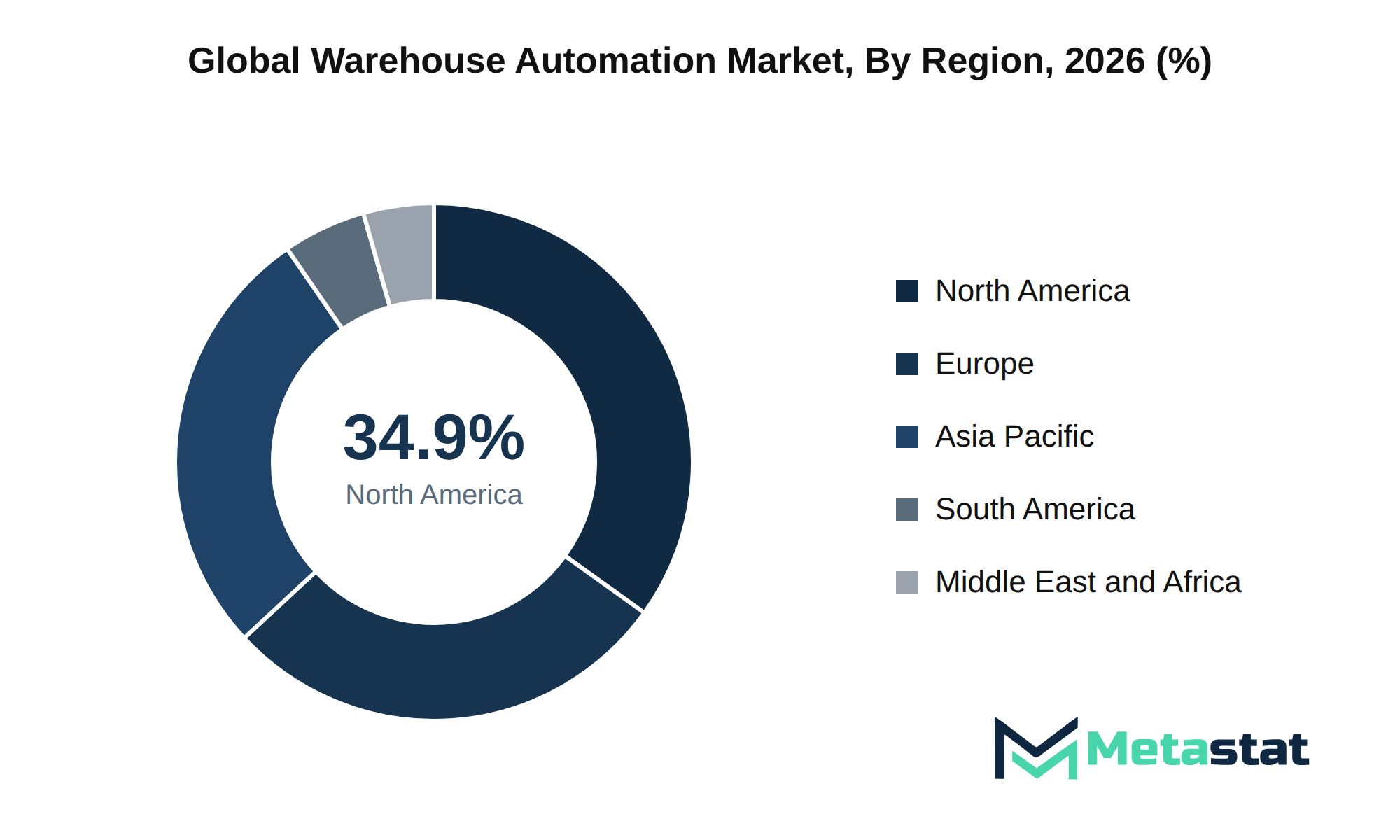
Competition in the Warehouse Automation market reflects a dynamic environment characterized by ongoing mergers, acquisitions, and strategic consolidations. Companies including Daifuku Co., Ltd. and Dematic Group (KION AG) have pursued growth through targeted acquisitions, enhancing their technological capabilities and market reach. This trend is expected to continue, with firms focusing on building comprehensive product portfolios and strengthening competitive positions.
Go-to-market strategies are evolving rapidly, with players like ABB Ltd. and Honeywell International Inc. (Intelligrated) leveraging their extensive networks to penetrate emerging markets. Strategic alliances and joint ventures, particularly in regions like Asia Pacific, facilitate quicker entry and adaptation to local demands. In addition, companies invest in proprietary technology, enhancing their R&D pipelines to create a defensible market position. The emphasis on technological innovation enables product differentiation, allowing firms to address specific customer needs effectively.
Barriers to entry in the Warehouse Automation market remain significant, driven by high capital requirements and established brand equity among key players including Zebra Technologies and AutoStore. The threat of new entrants is mitigated by the dominance of established companies, creating a competitive environment where established brands maintain customer loyalty through effective retention strategies. The future competitive outlook suggests ongoing consolidation among players while highlighting the importance of technological advancements and supply chain integration, reflecting critical growth vectors.
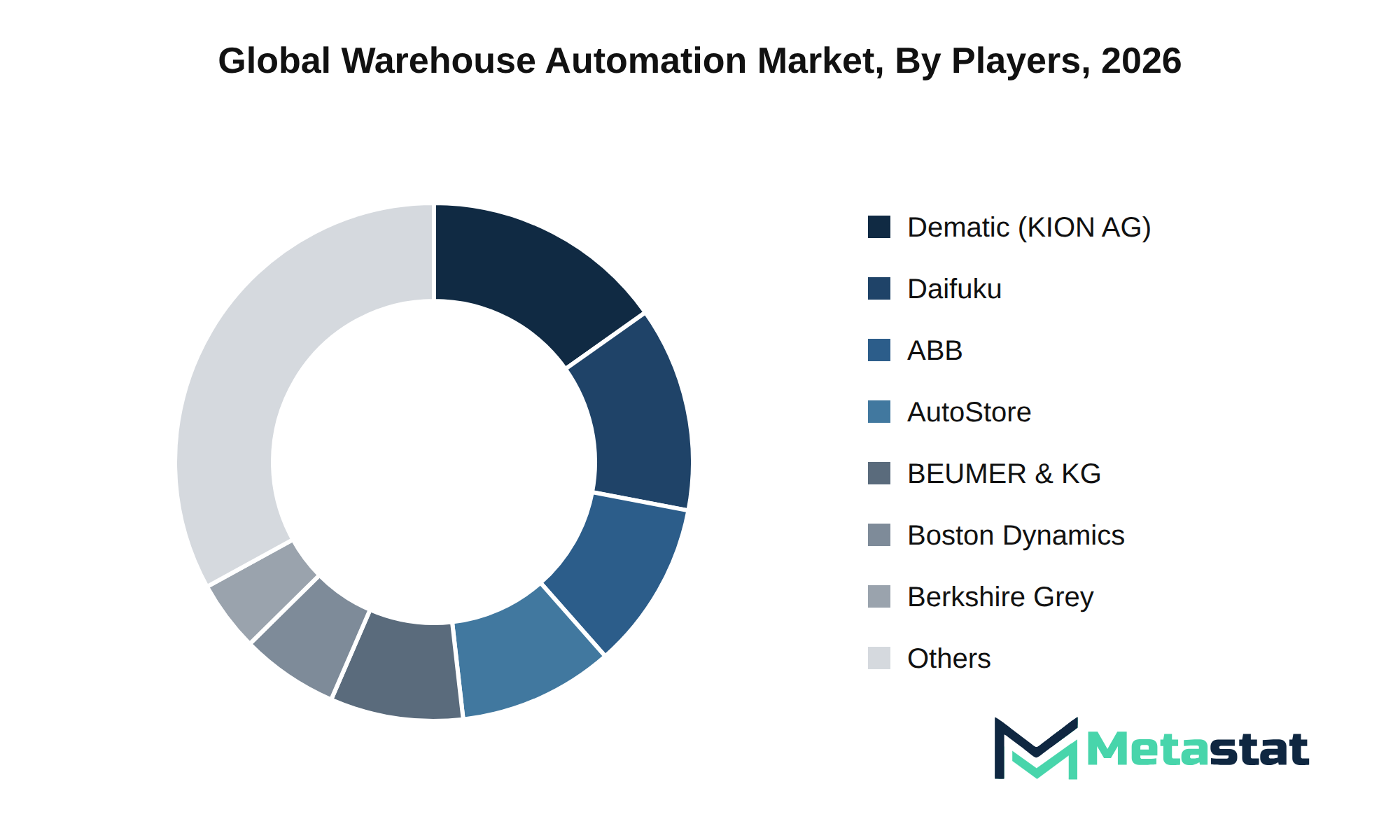
Market size is forecast to rise from USD 31.8 billion in 2025 to over USD 103.5 billion by 2033. This growth reflects a compound annual growth rate (CAGR) of 15.9%. The base case scenario indicates robust demand driven by increasing automation across sectors, particularly in supply chain management and logistics. The integration of next-generation technologies, including artificial intelligence and robotics, supports efficiency improvement, operational cost reduction, and enhanced productivity.
In a bullish scenario, accelerated adoption of advanced warehouse solutions emerges, fueled by heightened investment in automation technologies and strategic capital allocation. This trajectory creates high-growth pockets within the Warehouse Automation market, particularly among retail, e-commerce, and third-party logistics sectors. Conversely, a bearish outlook surfaces from economic downturns, regulatory changes, or geopolitical tensions that disrupt supply chains and hinder investment capacity.
The anticipated evolution of regulatory frameworks in many regions will impose compliance milestones, influencing the pace of technology adoption. Geopolitical realignments and evolving trade corridors present challenges and opportunities, impacting global supply chain dynamics. Organizations focusing on infrastructure commitments and capital expenditure navigate these shifts effectively, positioning themselves for sustainable growth within the market.
The report strategically identifies and profiles the key market players and analyses their core competencies in each sub-segment of the Warehouse Automation market.
|
Report Attributes |
Details |
|
Study Period |
2021-2033 |
|
Base Year |
2025 |
|
Estimated Year |
2026 |
|
Forecast Period |
2026-2033 |
|
Historical Period |
2021-2025 |
|
Growth Rate |
CAGR 15.9% from 2026 to 2033 |
|
Revenue Unit |
USD billion |
|
Segmentation |
By System Type, Component, Function, End-Use Industry, and Region |
|
By Region |
North America (By System Type, Component, Function, End-Use Industry, and Country)
|
|
Europe (By System Type, Component, Function, End-Use Industry, and Country)
|
|
|
Asia Pacific (By System Type, Component, Function, End-Use Industry, and Country)
|
|
|
South America (By System Type, Component, Function, End-Use Industry, and Country)
|
|
|
Middle East and Africa (By System Type, Component, Function, End-Use Industry, and Country)
|
Find answers to common questions about this report
The Warehouse Automation market size was valued at USD 31.8 billion in 2025, according to the Metastat Insights study.
The Warehouse Automation market is projected to grow at a CAGR of 15.9% during the forecast period from 2026 to 2033.
The North America Warehouse Automation market size is estimated to reach USD 34.2 billion by 2033.
Automated Storage & Retrieval Systems (AS/RS) leads the Warehouse Automation market, with a projected value of USD 26.1 billion by 2033. This segment demonstrates a compound annual growth rate (CAGR) of 14.6% from 2026 to 2033.
The Warehouse Automation market experiences growth driven by a strong emphasis on operational productivity initiatives, including efficiency enhancement and cost reduction. Industries including retail and logistics exhibit heightened demand for automated solutions, leading to significant investments in technologies that optimize workflows and improve overall performance.
North America holds the dominant share of the Warehouse Automation market, with a projected value of USD 34.2 billion in 2033, representing 34.9 percent of the total market.
High capital investment requirements and escalating operating costs significantly restrain growth in the Warehouse Automation market. Many companies, particularly small and medium-sized enterprises, struggle to secure funding for advanced automation solutions, while rising expenses related to technology implementation and maintenance further complicate investment decisions.
Enhanced operational productivity initiatives drive product adoption in the Warehouse Automation market. Companies focus on improving efficiency and reducing costs in response to rising labor expenses and competitive pressures, leading to increased investments in automation technologies across various industries.
The Warehouse Automation market is estimated to reach a valuation of USD 103.5 billion by 2033.
Key players in the Warehouse Automation market include ABB Ltd., AutoStore, Berkshire Grey, Daifuku Co., Ltd., Honeywell International Inc. (Intelligrated), KION AG, SSI SCHÄFER, and Vanderlande BV.
The analysts below cover Machinery & Equipment research at Metastat Insights.
LEAD ANALYST
Utkarsh Khirodkar is a Lead Market Research Analyst at MetaStat Insight, specializing in market intelligence, technology sector assessments, and competitive strategy.

INDUSTRY CONSULTANT - CHEMICALS & ADVANCED MATERIALS
Chemicals and Materials · Machinery & Equipment · Packaging
Amit Gadhekar Consultant for Chemicals and Materials at MetaStat Insight, directing sector-specific intelligence, research, and strategic consulting across global chemical and processing markets.

PRINCIPAL CONSULTANT - QUALITY SYSTEMS & COMPLIANCE
Electronics and Semiconductor · Machinery & Equipment · Professional Services
Omkar Phadtare is an Industry Consultant at MetaStat Insight, specializing in quality systems, regulatory compliance, and standards benchmarking to drive data-driven market intelligence and strategic industry research.

ENERGY & INFRASTRUCTURE INDUSTRY CONSULTANT
Automotive and Transportation · Electronics and Semiconductor · Energy and Power · Machinery & Equipment
Saurabh Vasant Ganvir consults for Energy & Infrastructure Industry at MetaStat Insight, specializing in renewable energy, solar EPC, and electric vehicle (EV) infrastructure markets.

LEAD CONSULTANT - COMMUNICATION, TELECOM, AND IT
Electronics and Semiconductor · Information & Technology · Machinery & Equipment · Professional Services
Ravindra Sathe Consultants for Communication, Telecom, and IT at MetaStat Insight. He leads the firm's industry research initiatives across telecommunications infrastructure, digital connectivity, enterprise networking, and emerging information technology domains.
Evaluating sovereign cloud deployments for core banking platforms demands a clear view of data residency regulations and migration exit strategies. MetaStat Insight delivered an exhaustive review of regional latency tolerances, mainframe decommission milestones, and third-party vendor concentration risk. The regulatory compliance mapping across European and Asian financial jurisdictions gave our team a dependable baseline for multi-cloud infrastructure discussions.
Replacing petrochemical surfactants with bio-based alternatives requires realistic timelines on industrial precision fermentation scaling. The market research broke down commercialization timelines, feedstock sugar price sensitivities, and regional cosmetic ingredient regulatory approvals in Europe and East Asia. That supplier readiness mapping gave our formulations team reliable context when comparing renewable chemical sourcing roadmaps.
Tracking ceramic matrix composite adoption in high-bypass aero engines requires strict attention to material qualification cycles and FAA airworthiness testing milestones. The MetaStat Insight team provided a detailed timeline of silicon carbide fiber manufacturing capacity and commercial foundry lead times. Having clear visibility into upstream thermal barrier coating supply helped us stress-test our long-term component procurement strategy.
Explore related market intelligence reports worth reading alongside this one.
Starting from
$2950