
LEAD ANALYST
Utkarsh Khirodkar is a Lead Market Research Analyst at MetaStat Insight, specializing in market intelligence, technology sector assessments, and competitive strategy.

Global Modular Construction Market Size, Share, By Construction Type (Permanent Modular Construction and Relocatable Modular Construction), By Material (Steel, Concrete, Timber and Others (Aluminium, Fibre-Reinforced Polymers)), By Module (Four-sided, Open-sided, Partially Open-sided, Mixed Modules & Floor Cassettes and Others (Modules Supported by a Primary Structure)), By Application (Residential Buildings, Office Buildings, Educational Buildings, Healthcare Buildings, Workforce Accommodation Buildings, Hospitality Buildings, Retail Buildings, Industrial Buildings and Others (Military Facilities, Correctional Facilities, Community Facilities)), Industry Analysis, Growth, Trends, and Forecast, 2026-2033
Report ID
MSI-5505
Published
October, 2026
Pages
310 Pages
Format
Historical
Base year
Forecast
Forecast period
Report Details
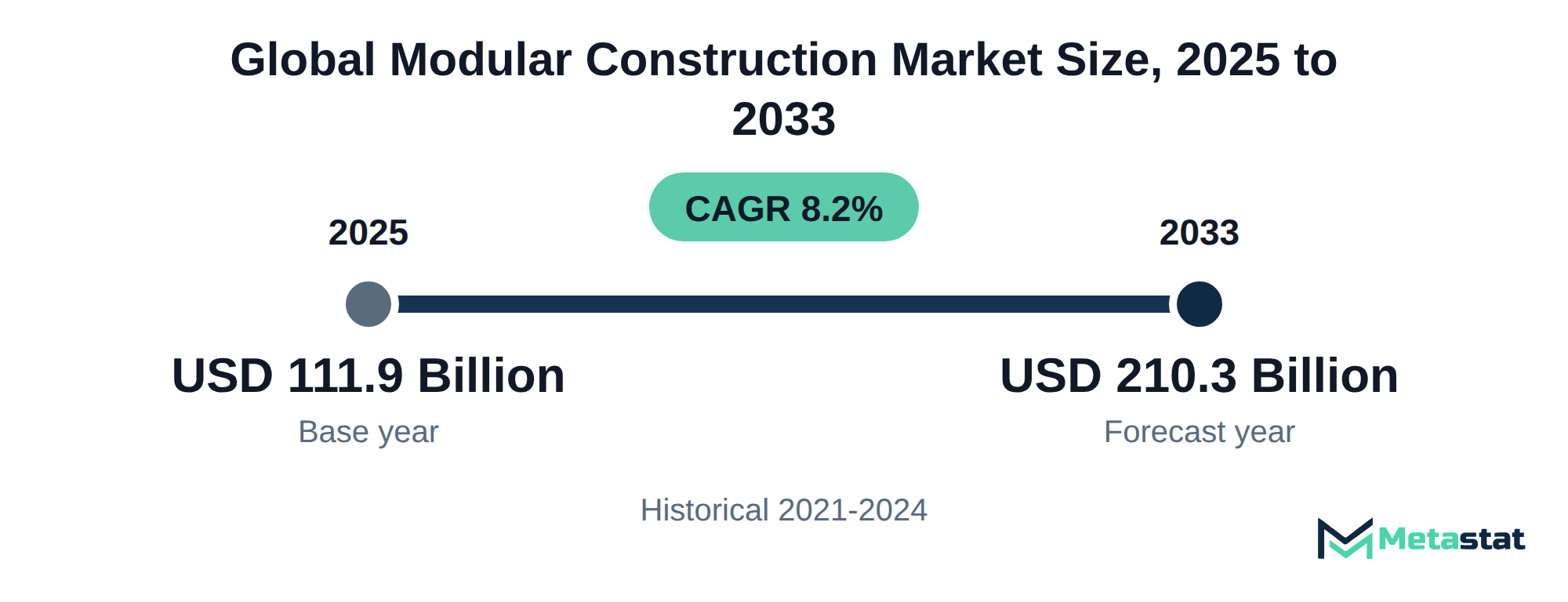
Market Valuation: Valued at $111.9 Billion in 2025, projected to reach $210.3 Billion by 2033 at a 8.2% CAGR.
Dominant Segment: Permanent Modular Construction leads the market, driven by its efficiency and cost-effectiveness, particularly in residential and healthcare applications.
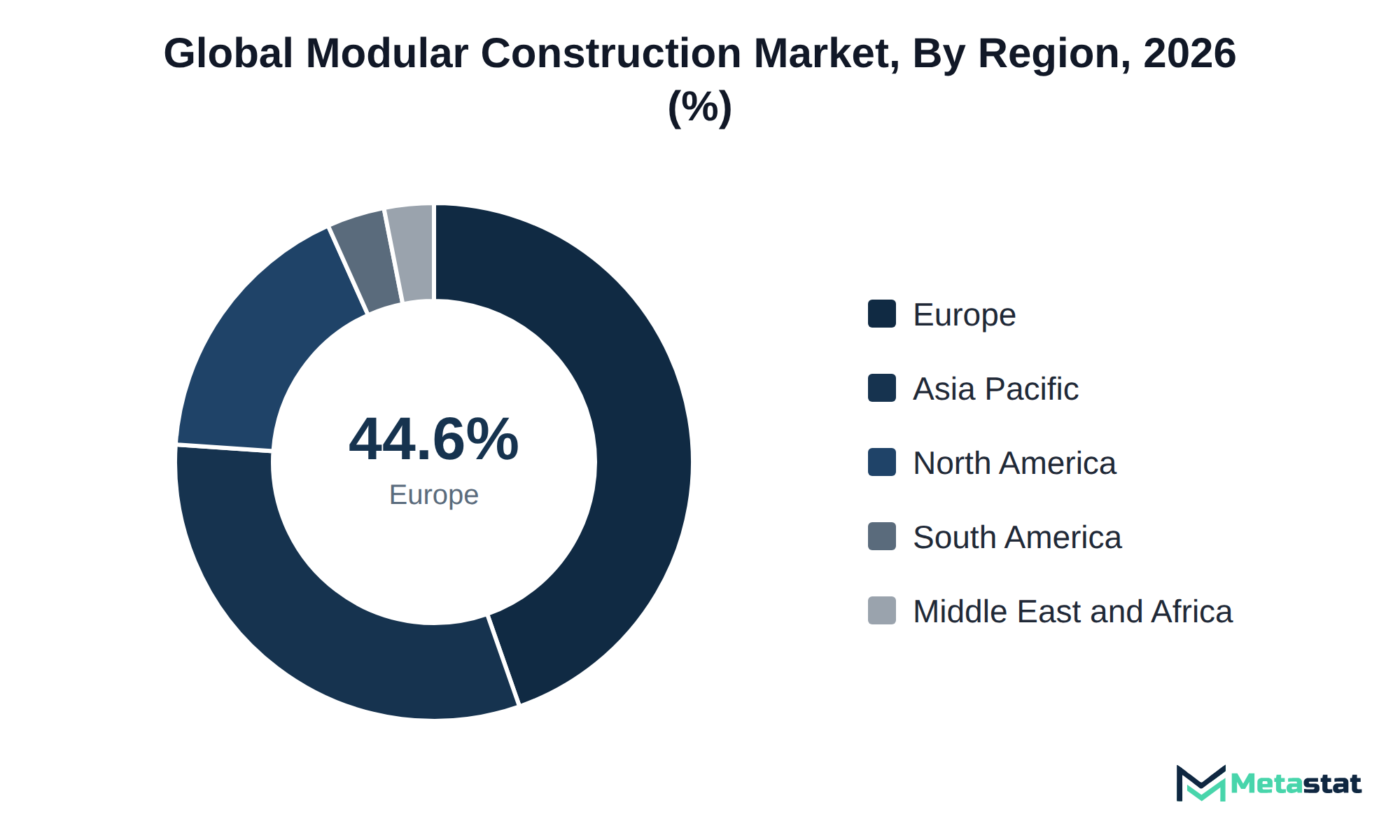
Geographic Lead: Europe dominates the market with a 44.6% share, supported by strong investments and regulatory frameworks favoring sustainable construction.
What's Inside: The report provides a comprehensive analysis of market dynamics, competitive landscape, and forecasts across various segments, including construction types and materials.
Increased Adoption of Modular Materials: The shift towards innovative materials like timber and lightweight steel is driving growth, appealing to environmentally conscious builders and enhancing design versatility.
Relocatable Modular Construction Growth: This segment is projected to grow at a CAGR of 9.2%, fueled by demand for flexible and rapid deployment solutions in education and healthcare sectors.
Choose Your License
Global Modular Construction Market
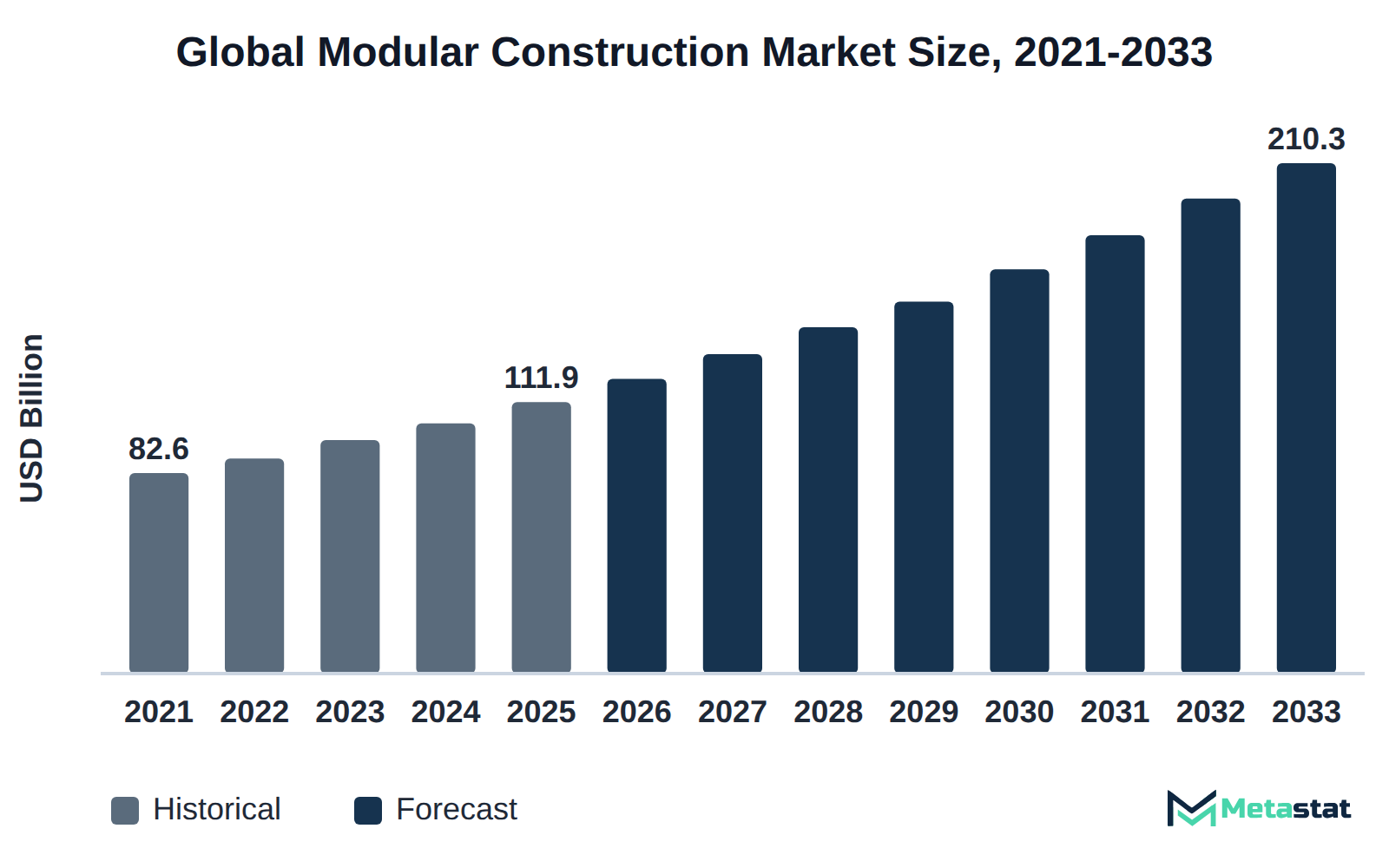
The global Modular Construction market was valued at USD 111.9 billion in 2025 and is projected to reach USD 210.3 billion by 2033, growing at a CAGR of 8.2% over the forecast period.
The Modular Construction market encompasses various methods, materials, and applications for constructing buildings efficiently and cost-effectively. Buyers invest in this market due to increasing demand for sustainable construction solutions and the need for faster project completion times. This trend is particularly evident among developers, government entities, and private sector clients seeking to optimize construction processes while minimizing environmental impact.
Growth in the market is driven by the rising preference for Permanent Modular Construction, which accounts for the largest share of revenue. In terms of regional performance, Europe leads with a 44.6% market share, reflecting strong investment in modular solutions across multiple industries. North America holds 17.2% of the market in 2025, with the US leading in 2026. The need for efficient building solutions continues to support expansion opportunities within this sector.
Forecasts indicate significant growth in various segments, particularly in residential buildings, projected to reach USD 99.7 billion by 2033. Increased adoption of modern construction practices supports this upward trajectory, with stakeholders recognizing the benefits of modular techniques in reducing costs and enhancing project timelines. The market is projected to experience further development, driven by advancements in technology and evolving consumer preferences.
The Modular Construction market addresses the growing demand for efficient building solutions, providing a range of services that enable quicker project completion and enhanced quality. Buyers invest in this market to gain time savings and cost efficiency, which are essential for meeting increasing urbanization and housing needs. The sector caters to diverse applications, including residential, commercial, and industrial buildings, reflecting the versatility and adaptability of modular solutions.
Growth in the market is driven primarily by the rising demand for permanent modular construction, which accounts for the largest segment in terms of value. This construction type offers advantages in speed and affordability and attracts investment from both private and public sectors. Europe stands out with the largest share at 44.6%, driven by supportive regulatory frameworks and a strong focus on sustainability. North America holds 17.2% of the market in 2025, with the US leading in 2026.
Technological advancements in construction methods and materials further support market expansion, enabling firms to enhance operational efficiency and reduce waste. Continuous development of innovative modular solutions attracts a growing number of buyers from various industries, reinforcing the market's relevance in addressing modern construction challenges.
The integration of mass timber in modular construction represents a significant shift towards sustainability and reduced embodied carbon in building practices. The use of timber, a renewable resource, is essential in lowering carbon emissions associated with construction. By substituting traditional materials including concrete and steel with mass timber, builders significantly decrease the carbon footprint of their projects. This transition is evident in the anticipated growth of timber use, where projections indicate that timber will reach a value of USD 74.5 billion by 2033 within the modular construction market.
Timber structures support environmental sustainability and offer advantages in construction speed and efficiency. The lightweight nature of timber in timber frame construction reduces transportation costs and time, enhancing the overall project timeline. The aesthetic appeal of mass timber installations attracts a growing segment of buyers in the market. The commercial benefits of adopting mass timber extend beyond mere compliance with sustainability standards; they create opportunities for firms to market their projects as environmentally friendly, appealing to eco-conscious consumers.
This shift towards mass timber utilization aligns with broader trends in the modular construction market focused on innovation and sustainability. Developers and builders that embrace this technology position themselves competitively, addressing the increasing demand for green building solutions and meeting regulatory requirements aimed at reducing carbon emissions in construction.
Strategic procurement practices in the modular construction market significantly influence the cost and efficiency of hospital expansion projects. Many buyers prefer fixed-price contracts, allowing for predictable budgeting and reduced financial risk. This model supports clear cost expectations, especially in a sector where budget overruns severely impact project viability. The projected value of healthcare buildings constructed using modular methods is expected to grow at a compound annual growth rate of 10.1%, which reflects increasing reliance on modular solutions within healthcare infrastructure.
Another prevalent approach involves design-build contracts, encouraging collaboration between architects and contractors from project inception. Engineering, procurement and construction management (EPCM) arrangements address a similar need by coordinating design, sourcing and site delivery. This method streamlines communication, enhancing design outcomes while minimizing delays and conflicts, ultimately leading to more efficient hospital expansions. The commercial implication of adopting such contracts reflects in lower overall project costs and faster completion times. Buyers using modular construction for hospital projects benefit from understanding these procurement models and aligning their purchasing strategies with market dynamics and operational needs.
Factory automation represents a critical element for firms operating within the Modular Construction market, influencing production efficiency and cost-effectiveness. The projected growth for Permanent Modular Construction highlights this significance. It is expected to rise from USD 77.7 billion in 2026 to USD 129.3 billion by 2033, a compound annual growth rate (CAGR) of 7.6%. This growth necessitates advanced manufacturing processes that enhance productivity while maintaining quality standards.
Key buyer groups, particularly in the residential and healthcare sectors, express distinct needs regarding rapid project timelines and flexible design options. Automation in production, such as flexible manufacturing systems, addresses these requirements, allowing for the customization of modular units and faster turnaround times, which aligns with the increasing demand for efficient construction solutions. Investments in automated systems enable manufacturers to optimize workflows, reduce labor costs, and improve the overall quality of modular units.
The strategic implementation of automation directly impacts competitive positioning within the market. Companies that adopt advanced technologies within their production facilities achieve significant operational advantages, ultimately supporting market expansion and meeting the rising expectations of diverse buyer groups.
Modular construction offers significant cost advantages over traditional building methods, primarily due to reduced labor and construction time. The base value of the modular construction market stands at USD 111.9 billion, reflecting the growing trend towards efficiency and cost-effectiveness in construction. Traditional building incurs higher labor costs due to longer project timelines and higher overheads.
This segment demonstrates how modular and volumetric building provides cost savings through prefabrication, where components are built off-site and assembled quickly on-site, significantly shortening project timelines. The reduction in time lowers labor costs and minimizes the duration of site disruption, which is particularly beneficial for urban developments.
The increased adoption of modular construction practices is expected to influence purchasing decisions among developers and contractors, further driving demand in the modular construction market. Using these cost efficiencies strengthens competitive positioning and makes project delivery more economical.
The rise in demand for residential buildings drives significant growth in spending within the Modular Construction market. Buyers, particularly in the housing sector, prioritize quicker construction timelines and cost efficiency, leading to greater adoption of modular solutions. This shift reflects changing consumer preferences for affordable housing solutions and increasing urbanization and population growth. In this context, the residential buildings segment is projected to expand from USD 56.8 billion in 2026 to USD 99.7 billion by 2033, indicating a compound annual growth rate of 8.4%. The enhanced efficiency and flexibility provided by modular construction methods align well with current market needs, facilitating more efficient project completions that appeal to both developers and buyers. This increased financial commitment towards modular approaches strengthens the overall market trajectory, ensuring ongoing investment and innovation in construction methodologies.
Growing interest in sustainable building practices further influences this trend, encouraging buyers to explore modular options that offer reduced waste and improved energy efficiency. Together, these factors support market growth and enable deeper penetration into the residential sector.
The emergence of innovative materials in construction significantly influences the growth of the Modular Construction market. Steel, concrete, and timber are among the primary materials, each contributing unique properties that enhance structural integrity and design versatility. For instance, advancements in light-gauge steel framing systems reduce the overall burden on foundational systems, allowing for larger and taller modular structures. The use of engineered timber has gained traction due to its sustainability profile, appealing to environmentally conscious builders and developers. This shift towards modern materials supports a wider array of applications, including residential, educational, and healthcare buildings.
The ongoing trend towards sustainability drives the market's evolution, encouraging suppliers to explore more eco-friendly material options. Increasing regulatory pressures regarding carbon footprints prompt construction firms to adopt materials with lower environmental impacts. This trend accelerates growth in the market, with enhanced demand for modular solutions that incorporate these advanced materials. This growing focus on material innovation helps suppliers meet changing consumer preferences and regulatory requirements, which expands market opportunities.
Price sensitivity significantly influences decision-making among project developers within the Modular Construction market. High construction costs, driven by fluctuating material prices and labor expenses, lead to careful budgeting and evaluation of investment returns. This caution results in slower uptake of modular solutions, particularly in regions with limited awareness regarding the long-term benefits of modular construction. Developers often postpone projects or opt for smaller orders to mitigate financial risks associated with larger investments.
The residential and commercial building segments experience more pronounced effects from this price sensitivity. Delays in project initiation stem from the higher upfront costs compared to traditional construction methods, despite the potential for long-term savings. These dynamics restrict market growth, with developers hesitating to embrace modular construction, impacting overall adoption rates and hindering revenue generation for market participants.
Fluctuations in the prices of materials used in modular construction challenge suppliers' profitability. The volatility in prices for essential inputs including steel and timber influences the overall cost structure, impacting project budgets and timelines. Suppliers respond by enhancing supply chain management and sourcing strategies, seeking to lock in prices through long-term contracts or establishing partnerships with key material providers. Such strategies reduce reliance on spot market pricing, which often fluctuates dramatically. By implementing more efficient procurement methods and adopting alternative materials, suppliers position themselves to mitigate risks related to price volatility. This dynamic affects the overall market, shaping project feasibility and investment decisions while influencing competition among suppliers. Maintaining profitability becomes critical in a situation where project margins frequently face pressure, compelling companies to innovate and streamline operations in an unpredictable cost environment.
The Relocatable Modular Construction segment exhibits a significant growth trajectory, with a projected CAGR of 9.2% through 2033. This segment provides flexibility for users, allowing for rapid deployment in diverse applications, including temporary facilities and emergency housing such as foldable houses. Increased demand from sectors including education and healthcare fuels interest in these solutions, particularly in response to unforeseen circumstances that require quick infrastructure solutions. The Modular Construction market benefits from advancements in design and building technologies, enhancing the appeal of relocatable options. With a focus on sustainability and cost-effectiveness, this segment attracts stakeholders seeking efficient alternatives. The forecast indicates that the value of relocatable modular construction will reach USD 81 billion by 2033. The strategic positioning of suppliers in this space captures substantial market share while addressing evolving consumer needs and preferences.
The Global Modular Construction market is segmented based on Construction Type, Material, Module, and Application.
This construction type primarily serves the needs of residential buildings, educational institutions, and healthcare facilities, aiming to expedite construction timelines while maintaining quality and lowering costs. Demand for this segment is driven by the increasing urgency for rapid project delivery alongside rising labor costs affecting traditional construction methods. In contrast to Relocatable Modular Construction, which features a higher projected CAGR of 9.2% through 2033, Permanent Modular Construction focuses on long-term installations. This differentiation positions it for steady growth within the market, catering to clients seeking permanent solutions rather than temporary structures.
Relocatable Modular Construction segment is estimated to reach USD 81 billion by 2033, at a CAGR of 9.2% during the forecast period. This approach involves constructing buildings that are easily relocated to different sites. Various industries, including education, healthcare, and temporary housing, use these structures for their flexibility and reduced timeframes for completion. The growth of this segment is driven by increasing demand for adaptable and cost-effective construction solutions. Compared to Permanent Modular Construction, this segment experiences faster growth, appealing to buyers who prioritize mobility and lower initial investments. The market benefits from the ongoing trend toward flexible living and working spaces, further supporting its expansion.
Steel segment is valued at USD 49.6 billion in 2026 and is projected to reach USD 83 billion by 2033, at a CAGR of 7.6% during the forecast period. This material finds extensive application in the construction of both permanent and relocatable structures, supporting various industries including residential and commercial development. The increasing focus on durability and structural integrity in building projects drives demand for steel, particularly in regions prioritizing robust construction standards. Compared to other materials like concrete and timber, steel maintains a competitive edge due to its higher strength-to-weight ratio, although its growth rate is slower than that of timber, which is projected to experience rapid adoption. Overall, the steel segment's consistent performance reflects its essential role in enhancing the structural framework of modular buildings, contributing to the overall expansion of the market.
Concrete is estimated to reach USD 40.7 billion by 2033, at a CAGR of 8.4% during the forecast period. This material is primarily used in constructing various types of buildings, including residential, commercial, and educational facilities. Demand for concrete is driven by its durability and versatility, appealing to a diverse range of buyers, including developers and contractors. This segment experiences robust competition from other materials including steel and timber, with concrete exhibiting stable growth compared to timber, which has a higher projected CAGR. Project costs and construction timelines often influence material selection, making concrete a preferred option for many large-scale projects. The unique properties of concrete, including fire resistance and thermal mass, further enhance its attractiveness to builders focused on long-term performance, distinguishing it from other materials in the market.
Timber segment is expected to reach USD 74.5 billion by 2033. This material serves multiple applications, particularly in residential and commercial buildings, appealing to developers prioritizing sustainability and aesthetics. Demand for timber is driven by a shift towards environmentally friendly construction practices, reflecting consumer preferences for renewable resources. The segment's growth trajectory exhibits a CAGR of 8.4%, making it an attractive alternative to steel and concrete, which have slower growth rates in comparison. Timber presents opportunities for unique design elements that other materials cannot offer, appealing to architects and builders seeking innovative solutions. These characteristics position the timber segment as a key player in the evolving Modular Construction market.
Others (Aluminium, Fibre-Reinforced Polymers) segment is projected to grow at a CAGR of 8.8% during the forecast period. This segment includes materials that provide lightweight and durable construction solutions, appealing to various sectors including residential and commercial construction. Demand for these materials arises from their cost-effectiveness and environmental advantages, allowing for rapid construction with reduced waste. Compared to other materials, including steel and concrete, this segment offers unique benefits, including lower transportation costs and easier handling. Buyers include project developers and construction firms focused on innovation and efficiency. This segment's growth trajectory positions it as a notable contributor to advancements within the market.
Four-sided segment is valued at USD 44.4 billion in 2026 and is projected to reach USD 71 billion by 2033, at a CAGR of 6.9% during the forecast period. This segment serves various applications, including residential and commercial construction projects, typically employed by developers looking for efficient building solutions. Demand for Four-sided modules is driven by growth in the residential sector and increasing focus on sustainability, which emphasizes energy-efficient designs. Compared to other modules, including Open-sided and Partially Open-sided, the Four-sided segment exhibits a lower growth rate. Open-sided modules, for instance, are anticipated to expand at a CAGR of 8.6%, highlighting competitive dynamics within the market. The balancing act between cost-effectiveness and functionality positions this segment strategically among developers seeking reliability in modular construction solutions.
Open-sided modules are projected to reach USD 54.8 billion by 2033, at a CAGR of 8.6% during the forecast period. These modules find application in various construction projects, including temporary structures and extensions of existing buildings, frequently used by commercial and educational institutions. Demand for open-sided modules is driven by the need for flexible space solutions that adapt to changing project requirements. This segment distinguishes itself from others by offering a higher degree of versatility and ease of assembly compared to four-sided options. Growth in this segment reflects trends toward rapid deployment and customization in construction, appealing to a diverse range of buyers seeking efficient and cost-effective solutions. By prioritizing speed and adaptability, open-sided modules support construction efforts in urban areas and sectors with fluctuating space demands, positioning themselves as a competitive choice in the modular construction market.
Partially Open-sided segment is expected to reach USD 44.2 billion by 2033. This segment primarily serves the need for versatile construction solutions in various applications, including residential and commercial buildings. Developers favor this option due to its cost-effectiveness and adaptability. The driving force behind this segment's growth stems from increasing demand for innovative building designs that optimize space usage. Compared to other modules, the Partially Open-sided segment exhibits a moderate growth rate, with a projected CAGR of 8.6%. This growth aligns with overall trends in the Modular Construction market, highlighting a growing acceptance of modular solutions among builders and stakeholders.
Mixed Modules & Floor Cassettes segment is projected to grow at a CAGR of 8.9% during the forecast period. This segment finds application in constructing various building types, appealing to developers seeking flexibility and efficiency. Enhanced design versatility and reduced construction times drive demand among commercial and residential builders. The segment benefits from a trend toward modular designs, appealing to buyers aiming for quick turnaround times on projects. Compared to Four-sided or Open-sided modules, Mixed Modules & Floor Cassettes offer unique advantages in adaptability, positioning themselves favorably within the market. Developers prioritize these options when project specifications require both structural integrity and efficient assembly. The trend of sustainable building practices supports the segment's expansion, aligning with increasing regulations on energy efficiency and environmental impact. Major players focus on this segment to meet evolving market demands and regulatory standards.
Modules supported by a primary structure involve designs that integrate with existing architectural elements, providing flexibility in construction projects. This segment finds utility in various applications, particularly in residential, educational, and healthcare settings, where adaptable and efficient solutions are essential. Demand for this type of module is driven by the increasing focus on sustainability and efficient use of resources. The integration of advanced construction technologies enhances its appeal, making it attractive to developers seeking innovative solutions. Unlike other module types, this segment experiences slower growth due to higher initial costs and specific buyer preferences, which limit widespread adoption compared to more standardized module options. The unique characteristics of modules supported by a primary structure allow for customized projects while addressing the growing needs of the Modular Construction market.
This segment serves various buyers, including individual homeowners, property developers, and real estate investors, seeking efficient and timely construction solutions. Increasing urbanization and housing shortages drive demand for modular residential solutions, enhancing the speed of construction and reducing costs. Compared to other segments including Office and Educational Buildings, the Residential Buildings segment exhibits a stronger growth trajectory, reflecting the heightened focus on housing needs. The market experiences a significant influence from ongoing shifts toward sustainable construction practices, with buyers increasingly favoring eco-friendly materials and energy-efficient designs in their residential projects.
Office Buildings segment is estimated to reach USD 25.1 billion by 2033, at a CAGR of 7% during the forecast period. This segment provides functional workspaces for various businesses, encompassing corporate offices, co-working spaces, and administrative facilities. Demand for these buildings is driven by the increasing need for efficient work environments and the expansion of businesses across sectors. The Office Buildings segment experiences slower growth compared to other applications including Residential Buildings, which is projected to grow at a CAGR of 8.4%. This difference reflects distinct buyer dynamics, with office developers focusing on urban locations and adaptability to changing work patterns, while residential demand capitalizes on the housing market's trends. This segment contributes significantly to the overall growth of the market, responding to evolving workplace designs and the desire for sustainable building solutions.
Educational Buildings segment is expected to reach USD 19.6 billion by 2033. This segment primarily serves educational institutions, including schools and higher education campuses, aiming to enhance their infrastructure efficiently and cost-effectively. Growing enrollment rates and increased focus on modern learning environments drive demand for modular educational buildings. Compared to other applications, this segment experiences a relatively high growth rate, reflecting a unique combination of urgency for timely construction and budget constraints. With a projected CAGR of 10.1%, modular solutions in educational settings offer a more flexible and expedited approach compared to traditional construction methods. The Modular Construction market adapts to the specific needs of educational buyers, highlighting innovation and customization in designs to create better learning spaces.
Healthcare Buildings segment is projected to grow at a CAGR of 10.1% during the forecast period. This segment focuses on constructing healthcare facilities, serving hospitals, clinics, and other medical institutions. Demand for innovative healthcare solutions drives this segment, with an emphasis on quicker construction times to meet urgent health needs. Increasing investments in healthcare infrastructure across various regions contribute to this growth, making it one of the fastest-growing segments in the market. Compared to other applications, including Educational Buildings, which experience slower growth, Healthcare Buildings stand out due to their critical need for timely delivery and adaptability in design. This segment's higher growth rate highlights the ongoing transformation in healthcare delivery and the shift towards modular solutions to address evolving requirements in the healthcare sector.
Workforce Accommodation Buildings serve critical purposes in providing temporary housing solutions for workers engaged in various projects, particularly in remote areas or during peak construction periods. This segment attracts interest from construction companies, oil and gas firms, and large-scale event organizers. The demand for these buildings is driven by the need for quick and flexible housing options that cater to fluctuating workforce sizes. Factors including labor shortages and health and safety regulations contribute to increasing demand for this segment. Unlike other applications, Workforce Accommodation Buildings typically face unique design requirements and shorter lifecycles, potentially influencing pricing structures. The market is expected to expand steadily, reflecting ongoing infrastructure development and investment in projects that require temporary housing solutions.
Hospitality Buildings encompass structures designed for lodging and accommodation, catering to the needs of travelers and tourists. This sub-segment attracts various stakeholders, including hotel chains, resort developers, and investors seeking to capitalize on the growing demand for temporary and permanent lodging solutions. Demand for such buildings is driven by increasing global travel and tourism trends, which continuously reshape the hospitality landscape. This segment differs from others, including residential or office buildings, primarily in its focus on transient occupancy rather than long-term residence. The cost of construction in the hospitality sector typically reflects higher standards of design and amenities, which sets it apart from other applications in the market.
Retail buildings serve commercial spaces designed for selling goods and services, catering to various businesses from small shops to large retail chains. This segment attracts retailers seeking quick and efficient construction solutions to accommodate consumer demand. Growth in e-commerce and the necessity for physical retail spaces drive demand in this sector, while increasing land costs and construction timelines hinder several projects. Compared to other applications, retail buildings face unique challenges, including the need for flexibility in design and layout to adapt to changing consumer preferences. This segment experiences a different pace of development than others, with retail construction prioritizing speed and cost-effectiveness to meet market trends and competition. This strategic focus positions retail buildings distinctly within the broader Modular Construction market.
Industrial Buildings focus on the construction of industrial and logistics real estate that supports manufacturing, warehousing, and distribution activities. Industries including logistics, automotive, and electronics frequently employ these structures for their operations. Key drivers for this segment include the increasing demand for efficient supply chain management and the need for flexible production facilities. Compared to other applications, the growth in Industrial Buildings occurs at a slower pace due to higher initial investment costs and longer construction timelines associated with larger facilities. Nonetheless, the modular construction approach allows for quicker assembly and adaptability, supporting businesses aiming to scale operations in response to market conditions. This segment holds a notable share of the Modular Construction market and remains important within the broader construction sector.
Structures classified in the "Others" segment encompass military facilities, correctional facilities, and community facilities. These types of buildings serve specific functions, addressing the needs of government entities and organizations focused on public safety and welfare. Demand for these facilities stems from the increasing emphasis on security and the necessity for efficient, deployable solutions in various regions. Factors influencing this segment include stringent regulatory requirements and the need for adaptable designs that are rapidly constructed. Compared to other segments, this sub-segment typically experiences slower growth, driven by the specialized nature of its applications and the involvement of government funding, which leads to longer project timelines and approval processes. The Modular Construction market reflects a diverse array of applications and demands, with these facilities requiring unique considerations that differentiate them from general residential or commercial building projects.
Based on geography, the Global Modular Construction market is divided into North America, Europe, Asia-Pacific, South America, Middle East, and Africa.
Factors driving growth in the Modular Construction market within North America include strong demand from the residential and commercial construction sectors. The region exhibits a shift towards efficient building practices, influenced by increasing labor costs and a shortage of skilled workers. Regulatory frameworks encourage sustainable building practices, improving energy efficiency in construction projects. The United States, Canada, and Mexico benefit from advancements in technology that enhance modular construction methods, resulting in faster project delivery and reduced waste. Components such as prefabricated wall panels form part of the same off-site supply chain across the region. North America is projected to reach USD 32.3 billion by the end of 2033. A focus on permanent modular construction, particularly for residential buildings, highlights changing preferences among builders and developers in the market.
In Europe, the Modular Construction market is driven by a strong emphasis on sustainability and cost-efficiency in building practices. Factors including increasing urbanization and a growing population enhance the need for rapid construction solutions. Countries including Germany, France, and the UK experience significant demand from the residential and commercial sectors. Robust regulations regarding energy efficiency and sustainability in construction influence material selection and design choices. For example, construction projects in Germany prioritize eco-friendly materials, aligning with broader European Union environmental goals. By 2025, Europe captures 44.6% of the global market share, indicating a substantial presence in the Modular Construction market. The anticipated growth is supported by ongoing investments in infrastructure projects across the region, further enhancing market expansion.
In the Asia-Pacific region, the Modular Construction market demonstrates significant potential, driven by rapid urbanization and a growing demand for affordable housing solutions. Major countries including China and India lead in construction activities, emphasizing sustainable building practices. Government initiatives focused on infrastructure development further support growth, particularly through investments in residential and commercial projects. The market benefits from increasing adoption of steel and timber materials, which align with sustainability goals while providing cost-effective solutions. By 2025, the region is projected to account for 31.4% of the global market, reflecting strong regional interest and investment in modular construction methodologies. Countries like South Korea and Japan contribute through advanced technological integration in construction, enhancing productivity and efficiency.
In South America, the Modular Construction market experiences growth driven by increasing urbanization and infrastructure development, primarily in Brazil and Argentina. The demand for affordable housing solutions spurs investment in modular technologies within these countries. Brazil's ongoing initiatives to improve housing accessibility enhance market potential through innovative construction methodologies. Argentina exhibits similar trends, focusing on sustainable building practices that promote resource efficiency. The market share for South America is projected at 3.6% in 2025, reflecting the region's gradual adoption of modular solutions. Growth expectations in the market remain strong, particularly within residential and healthcare applications, where modular construction offers rapid deployment and cost efficiency.
Investments in infrastructure development and urbanization initiatives drive the Modular Construction market in the Middle East and Africa region. Countries including Saudi Arabia and the UAE focus on diversifying their economies, which supports the demand for modular solutions across various sectors, including commercial and residential construction. The South African construction industry experiences a growing interest in modular techniques due to the need for efficient building practices and reduced lead times. Government efforts to enhance affordable housing solutions and sustainability in construction further position the market for future growth. The Middle East and Africa region holds a share of 3.1% of the global market in 2025, reflecting increasing adoption of innovative construction methods.
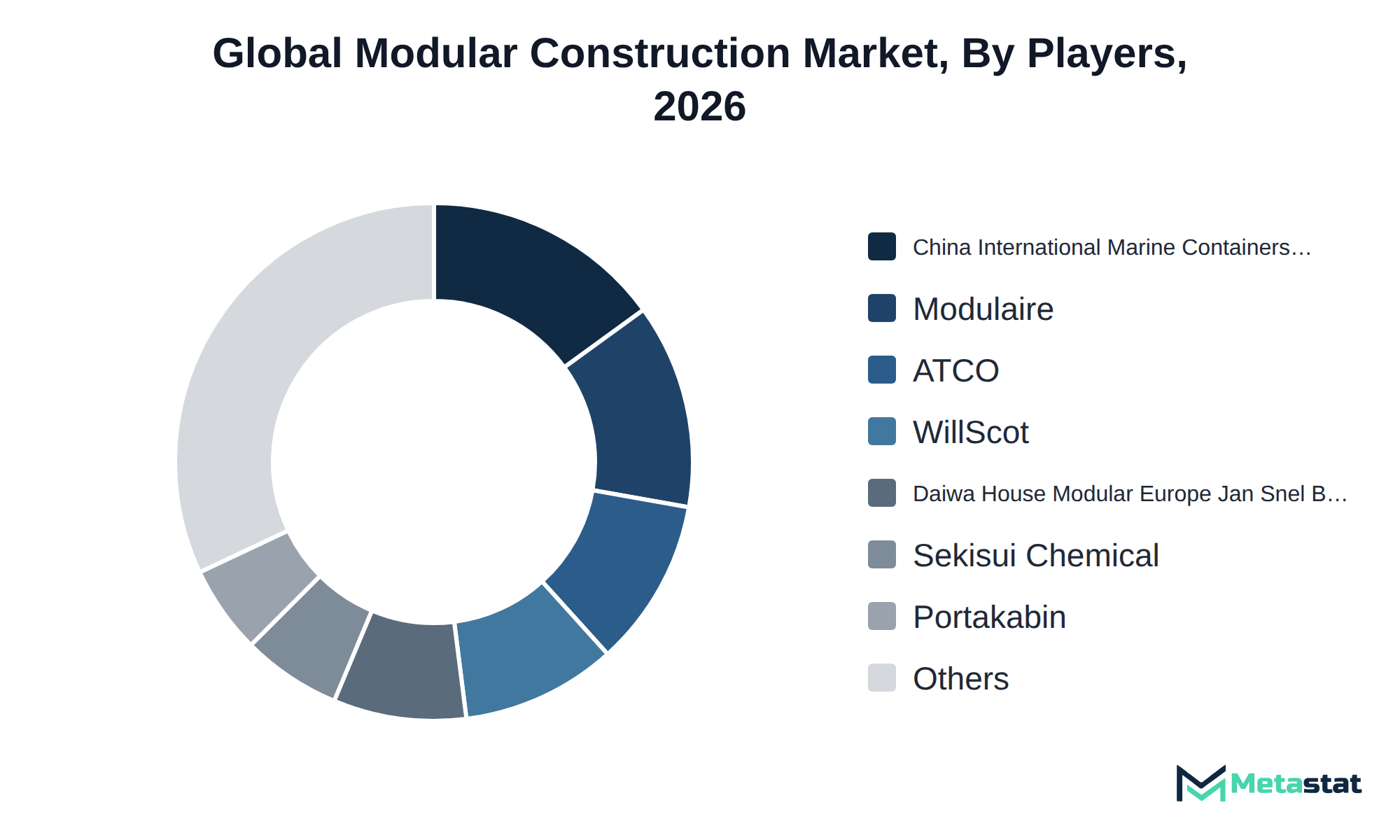
Companies in the Modular Construction market compete primarily on factors including price, customization, certification, and service. Buyers prioritize providers offering tailored solutions that meet specific project requirements while ensuring compliance with regulatory standards. Companies like Modulaire Group and ATCO Ltd. emphasize their ability to deliver customizable modular solutions, catering to diverse customer needs across various applications.
Segmentation within the market highlights varying strategic orientations among companies. For instance, China International Marine Containers (Group) Co., Ltd. and Portakabin Limited focus on permanent modular construction, providing long-term investments in projects. Meanwhile, Red Sea International Company and Daiwa House Modular Europe Jan Snel B.V. emphasize relocatable modular construction, targeting clients seeking flexibility and adaptability in their building solutions. This differentiation allows companies to align their offerings with the evolving demands of the market.
Achieving this growth relies on several key developments within the Modular Construction market. First, the ongoing shift towards Permanent Modular Construction is expected to enhance efficiency and reduce project timelines, contributing to an estimated rise from USD 77.7 billion in 2026 to USD 129.3 billion by 2033, representing a CAGR of 7.6%. Third, the expansion of the Asia Pacific region presents opportunities, particularly in countries like China and India, where urbanization and infrastructure development require innovative construction solutions.
However, potential risks impede this growth trajectory. Rising material costs, particularly for Steel and Timber, pose a challenge to profitability. The Relocatable Modular Construction segment, which is projected to reach USD 81 billion by 2033 with a CAGR of 9.2%, is especially affected. Effective supply chain management and cost control will be important for addressing these concerns and sustaining the market's progress.
By Material: Steel, Concrete, Timber, Others (Aluminium, Fibre-Reinforced Polymers)
By Module: Four-sided, Open-sided, Partially Open-sided, Mixed Modules & Floor Cassettes, Others (Modules Supported by a Primary Structure)
By Application: Residential Buildings, Office Buildings, Educational Buildings, Healthcare Buildings, Workforce Accommodation Buildings, Hospitality Buildings, Retail Buildings, Industrial Buildings, Others (Military Facilities, Correctional Facilities, Community Facilities)
The report strategically identifies and profiles the key market players and analyses their core competencies in each sub-segment of the Modular Construction market.
Report Attributes | Details |
Study Period | 2021-2033 |
Base Year | 2025 |
Estimated Year | 2026 |
Forecast Period | 2026-2033 |
Historical Period | 2021-2025 |
Growth Rate | CAGR 8.2% from 2026 to 2033 |
Revenue Unit | USD billion |
Segmentation | By Construction Type, Material, Module, Application, and Region |
By Region | North America (By Construction Type, Material, Module, Application, and Country)
|
Europe (By Construction Type, Material, Module, Application, and Country)
| |
Asia Pacific (By Construction Type, Material, Module, Application, and Country)
| |
South America (By Construction Type, Material, Module, Application, and Country)
| |
Middle East and Africa (By Construction Type, Material, Module, Application, and Country)
|
Find answers to common questions about this report
The Modular Construction market size was valued at USD 111.9 billion in 2025.
The market is projected to grow at a CAGR of 8.2% during the forecast period from 2026 to 2033.
The North America Modular Construction market size is estimated to reach USD 32.3 billion by 2033.
Permanent Modular Construction leads the Modular Construction market with a projected value of USD 129.3 billion in 2033. This segment outpaces Relocatable Modular Construction, which is expected to reach USD 81 billion in the same year.
The rise in demand for residential buildings drives significant growth in spending, with buyers prioritizing quicker construction timelines and cost efficiency. The emergence of innovative materials enhances structural integrity and design versatility, supporting a wider array of applications and encouraging sustainable building practices.
Europe holds the dominant share of the Modular Construction market, accounting for 44.6 percent in 2025. This significant share surpasses that of other regions, including North America at 17.2 percent and Asia Pacific at 31.4 percent.
Price sensitivity significantly influences decision-making among project developers, leading to careful budgeting and evaluation of investment returns. High construction costs and fluctuating material prices result in slower uptake of modular solutions, particularly in regions with limited awareness regarding their long-term benefits.
The increasing demand for sustainable building practices and innovative materials drives adoption in the Modular Construction market. Enhanced efficiency, flexibility, and reduced waste associated with modular solutions appeal to buyers, particularly in the residential sector, facilitating deeper penetration and ongoing investment.
The Modular Construction market is estimated to reach a valuation of USD 210.3 billion by 2033.
Key players operating in the Modular Construction market include Modulaire Group, ATCO Ltd., China International Marine Containers (Group) Co., Ltd., Portakabin Limited, Red Sea International Company, and Bechtel Corporation.
The analysts below cover Machinery & Equipment research at Metastat Insights.
LEAD ANALYST
Utkarsh Khirodkar is a Lead Market Research Analyst at MetaStat Insight, specializing in market intelligence, technology sector assessments, and competitive strategy.

INDUSTRY CONSULTANT - CHEMICALS & ADVANCED MATERIALS
Chemicals and Materials · Machinery & Equipment · Packaging
Amit Gadhekar Consultant for Chemicals and Materials at MetaStat Insight, directing sector-specific intelligence, research, and strategic consulting across global chemical and processing markets.

PRINCIPAL CONSULTANT - QUALITY SYSTEMS & COMPLIANCE
Electronics and Semiconductor · Machinery & Equipment · Professional Services
Omkar Phadtare is an Industry Consultant at MetaStat Insight, specializing in quality systems, regulatory compliance, and standards benchmarking to drive data-driven market intelligence and strategic industry research.

ENERGY & INFRASTRUCTURE INDUSTRY CONSULTANT
Automotive and Transportation · Electronics and Semiconductor · Energy and Power · Machinery & Equipment
Saurabh Vasant Ganvir consults for Energy & Infrastructure Industry at MetaStat Insight, specializing in renewable energy, solar EPC, and electric vehicle (EV) infrastructure markets.

LEAD CONSULTANT - COMMUNICATION, TELECOM, AND IT
Electronics and Semiconductor · Information & Technology · Machinery & Equipment · Professional Services
Ravindra Sathe Consultants for Communication, Telecom, and IT at MetaStat Insight. He leads the firm's industry research initiatives across telecommunications infrastructure, digital connectivity, enterprise networking, and emerging information technology domains.
Tracking capacity expansion in single-use bioprocessing requires dependable data on raw material availability and cleanroom-grade polymer supply chains. The competitive landscape chapter gave a grounded evaluation of secondary component suppliers across North America and Asia-Pacific rather than simply reprinting press releases. Having that level of supplier benchmarking helped clarify dual-sourcing considerations for our clinical pipeline planning.
When evaluating distributed energy resource management systems, standard research summaries tend to gloss over the operational differences between front-of-the-meter utility deployments and behind-the-meter industrial sites. The MetaStat Insight report addressed those distinctions directly, especially regarding software interoperability standards and grid interconnection backlogs. The five-year market sizing across regional transmission organizations provided actionable context for our grid modernization strategy.
Most industry reports on warehouse automation bundle autonomous mobile robots and fixed conveyor installations into the same top-level numbers, which complicates advisory work. This study split the market cleanly by payload tiers, navigation technology, and fleet management software layers. The regional forecast for Western Europe gave our team defensible adoption benchmarks when evaluating capital allocation for logistics clients, saving us days of secondary data scrubbing.
Explore related market intelligence reports worth reading alongside this one.