
LEAD ANALYST
Utkarsh Khirodkar is a Lead Market Research Analyst at MetaStat Insight, specializing in market intelligence, technology sector assessments, and competitive strategy.

Global Forklift and Industrial Lift Truck Market Size, Share, By Equipment Type (Counterbalance Forklifts, Reach Trucks, Powered Pallet Stackers, Order Pickers, Very Narrow Aisle (VNA) Turret Trucks, Articulated Forklifts, Sideloaders and Multidirectional Forklifts, Rough-Terrain Forklifts, Powered Pallet Trucks), By Power Source (Lead-Acid Battery Electric, Lithium-Ion Battery Electric, Diesel, Liquefied Petroleum Gas (LPG), Gasoline and Compressed Natural Gas (CNG)), By Load Capacity (Up to 1.5 Tonnes, Above 1.5 to 3 Tonnes, Above 3 to 5 Tonnes, Above 5 to 10 Tonnes, Above 10 Tonnes), By End-Use Industry (Manufacturing and Industrial Production, Logistics, Warehousing and Distribution, Retail and E-Commerce, Food and Beverage, Construction and Building Materials, Ports and Shipping, Agriculture and Forestry), Industry Analysis, Growth, Trends, and Forecast, 2026-2033
Report ID
MSI-5483
Published
October, 2026
Pages
270 Pages
Format
Historical
Base year
Forecast
Forecast period
Report Details
Market Valuation: Valued at $100.7 Billion in 2025, projected to reach $269.6 Billion by 2033 at a 13.1% CAGR.
Dominant Segment: Counterbalance Forklifts lead the market, driven by their versatility and efficiency in various applications, particularly in manufacturing and logistics.
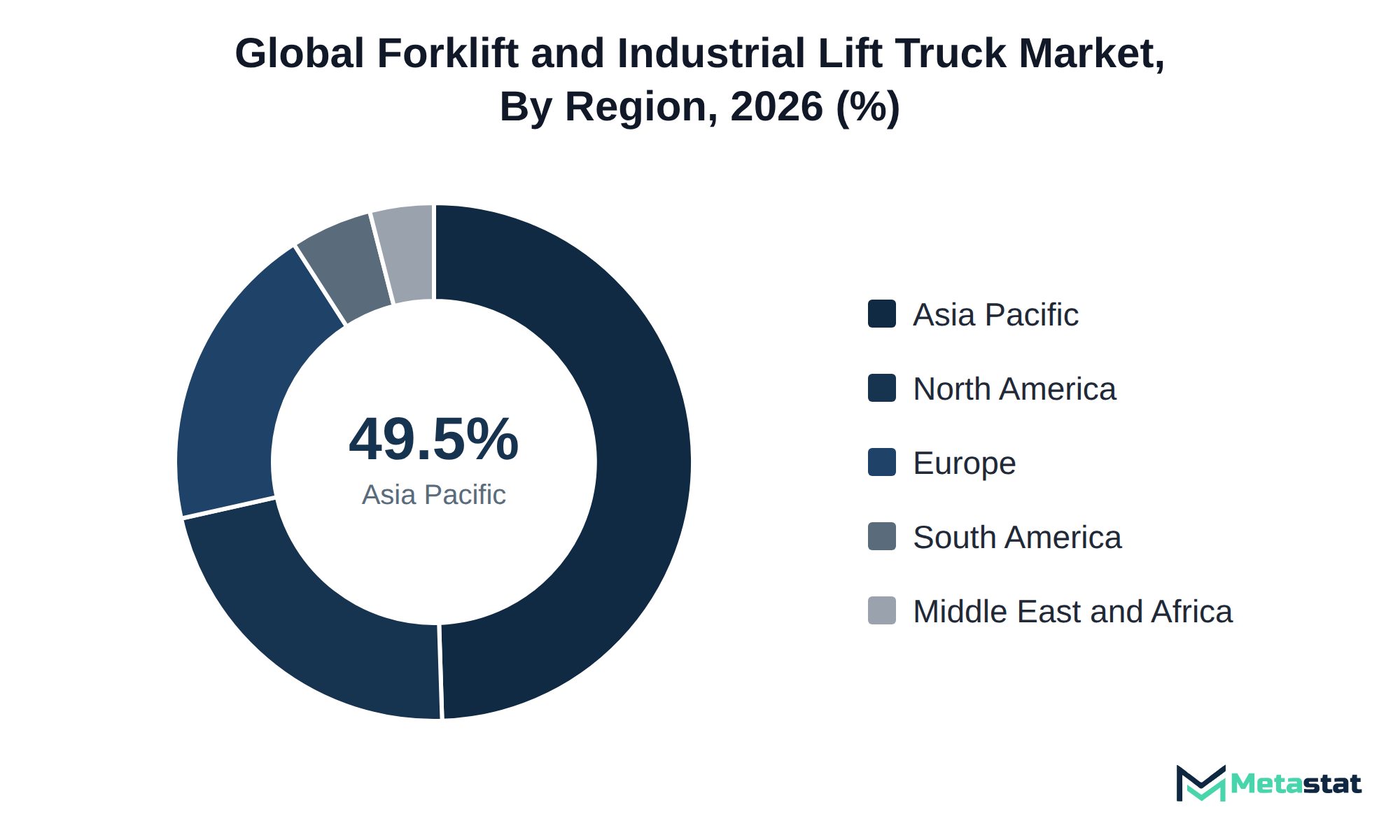
Geographic Lead: The Asia Pacific region captures the largest market share at 49.5% in 2025, fueled by rapid industrialization and urbanization in key countries.
What's Inside: The report provides a comprehensive analysis of market dynamics, competitive landscape, and detailed forecasts from 2026 to 2033, covering various equipment types and power sources.
High Growth Areas: The lithium-ion battery electric segment is projected to grow significantly, reaching USD 126.5 billion by 2033, reflecting a strong shift towards energy-efficient material handling solutions.
Emerging Trends: Increasing demand for automation in logistics and warehousing is reshaping procurement strategies, with rental and leasing models gaining traction among businesses.
Choose Your License
Global Forklift and Industrial Lift Truck Market
The global Forklift and Industrial Lift Truck market was valued at USD 100.7 billion in 2025 and is projected to reach USD 269.6 billion by 2033, growing at a CAGR of 13.1% over the forecast period.
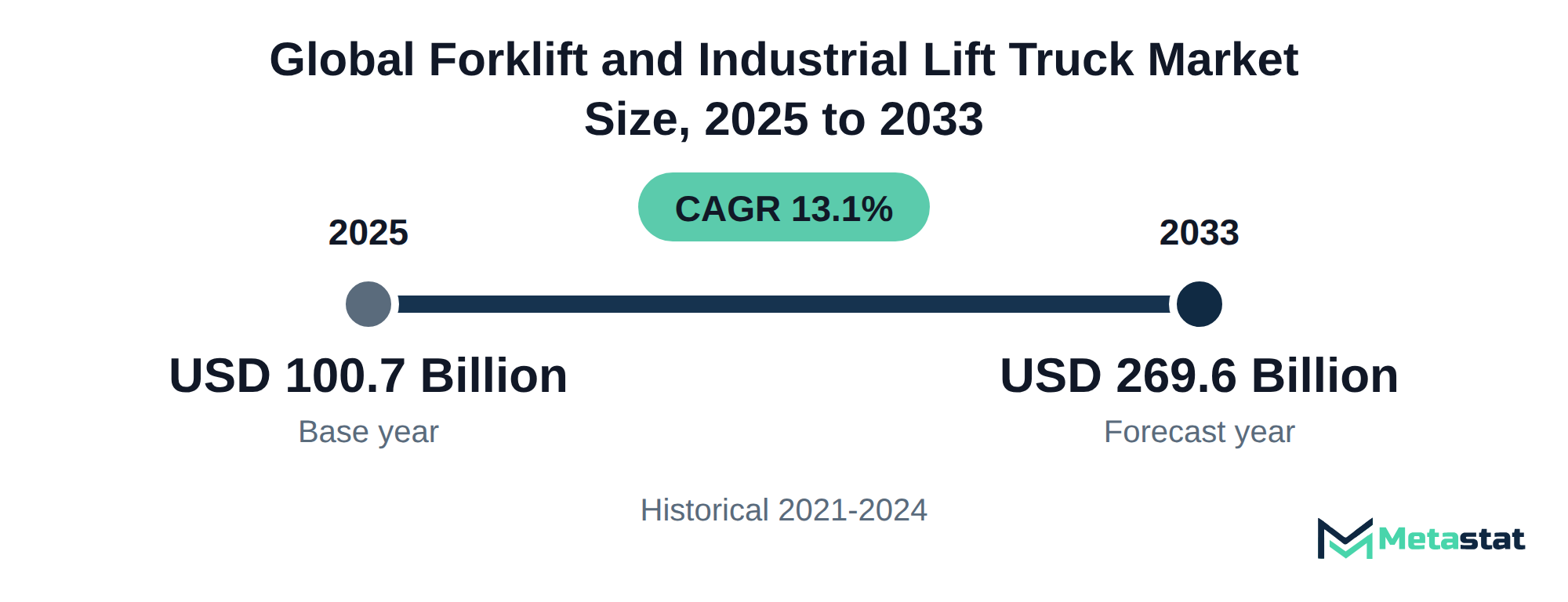
The Forklift and Industrial Lift Truck market encompasses a diverse range of equipment designed for material handling in various industries. Buyers invest in this market primarily to enhance operational efficiency and improve productivity in warehouses, manufacturing facilities, and distribution centers. Adoption of advanced technologies and the need for reliable handling and lifting equipment contribute to spending in this sector.
Growth in the market is driven by increasing demand for automation in material handling processes, particularly in logistics and warehousing sectors. Among the segments, Counterbalance Forklifts represent the highest value, reflecting their widespread use in various applications. North America holds 22.0% of the market in 2025, with the US leading in 2026. This substantial share indicates a well-established industrial infrastructure and a robust logistics network.
Investment in electric lift trucks continues to rise, driven by the need for sustainable operations and lower operating costs. The Lithium-Ion Battery Electric segment shows significant potential, reflecting a shift toward cleaner energy solutions. Such advancements enhance operational capabilities and align with global sustainability goals.
The Forklift and Industrial Lift Truck market plays a critical role in facilitating the efficient movement of goods across various sectors. Buyers invest in this market due to the increasing necessity for optimized logistics and material handling processes, which enhances operational productivity. The demand for advanced equipment aligns with the growth strategies of industries including manufacturing, logistics, and retail, where the effective handling of materials is vital for maintaining competitive advantages.
Growth within the market is propelled by technological advancements that improve the efficiency and reliability of equipment. In terms of value, Counterbalance Forklifts represent the largest segment, demonstrating significant adoption across different industries. The Asia Pacific region captures 49.5% of the market share in 2025, driven by rapid industrialization and urbanization in key countries. North America follows closely, with the US leading in 2026.
Rising demand for automation in material handling acts as a primary growth driver, pushing manufacturers to innovate and upgrade their fleets. This trend reflects a broader shift toward efficiency and sustainability within the sector, influencing investment strategies among key players. The Forklift and Industrial Lift Truck market stands poised for growth, aligning with global trends in logistics and supply chain management.
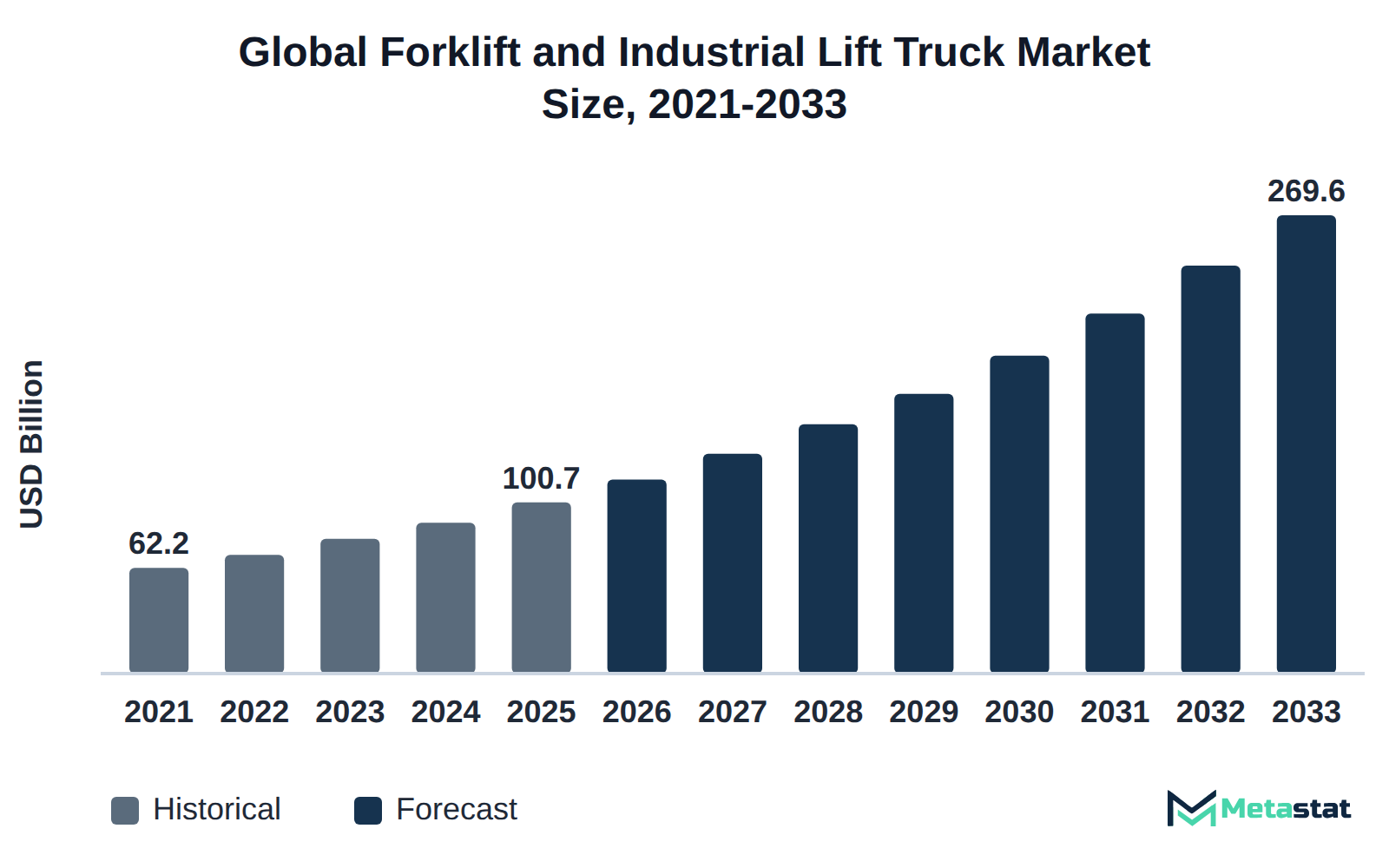
The adoption of lithium-ion battery technology in the Forklift and Industrial Lift Truck market is rapidly increasing, driven by its advantages over traditional diesel and lead-acid power systems. Lithium-ion batteries offer higher energy density, faster charging times, and longer operational life compared to lead-acid counterparts. By 2033, the segment for lithium-ion battery electric forklifts is anticipated to reach USD 126.5 billion, reflecting a compound annual growth rate of 19%.
Manufacturers and warehouse operators increasingly prioritize efficiency and sustainability in their operations. The switch from diesel engines to lithium-ion powered forklifts aligns with these goals by significantly lowering emissions and reducing operational costs associated with fuel and maintenance. The market for lead-acid battery electric forklifts is projected to grow from USD 43.6 billion in 2026 to USD 81.2 billion by 2033, demonstrating a shift in preferences among buyers.
This transition impacts operational practices, encouraging businesses to invest in more advanced equipment that enhances productivity while reducing environmental footprints. The overall market benefits from this technological shift, with increased adoption of lithium-ion technology supporting a more sustainable future for industries reliant on forklifts and industrial lift trucks.
High-density warehousing significantly influences purchasing decisions in the Forklift and Industrial Lift Truck market, particularly for reach trucks and very narrow aisle (VNA) equipment. Buyers engage in this segment due to the necessity for maximizing storage efficiency within limited spaces. The rise in e-commerce and the demand for quick inventory turnover further drive this trend, leading to greater investments in specialized forklifts that offer enhanced maneuverability and reach.
Market dynamics indicate that reach trucks are projected to reach a value of USD 32.8 billion by 2033, indicating a robust interest from businesses aiming to optimize their warehousing strategies. Buyers typically explore various pricing models when acquiring such equipment. Options include outright purchases, leasing arrangements, and rental contracts, allowing flexibility based on operational needs and financial capabilities. Many companies prefer leasing for short-term projects or during peak seasons, while others opt for purchases for long-term ownership and investment.
Understanding these purchasing trends and the associated pricing strategies equips buyers with valuable insights for effective decision-making. The growth in demand for reach trucks and VNA equipment directly aligns with evolving warehouse management practices, enhancing operational efficiency in the market. Sustained investments occur as companies prioritize optimizing their logistics operations.
Demand for forklift rental and fleet leasing models has surged in response to fluctuating market conditions and evolving buyer needs. Many businesses, particularly in the logistics and warehousing sector, prefer these models to manage operating costs and optimize equipment usage. The Forklift and Industrial Lift Truck market reflects this shift, with the logistics, warehousing, and distribution segment projected to reach USD 80.8 billion by 2033, growing at a CAGR of 14.4%. This growth indicates a strong inclination towards flexible procurement solutions, enabling companies to adjust their fleets based on real-time requirements.
These rental and leasing models allow companies to maintain a modern fleet without the capital expenditure associated with outright purchases. By adopting such strategies, organizations allocate funds toward core business functions, enhancing overall operational efficiency. The ability to scale equipment availability quickly aligns with the dynamic nature of logistics, where speed and adaptability drive competitive advantage. These models often include maintenance and support services, reducing the total cost of ownership and allowing companies to focus on growth and operational excellence within the market.
Electric forklifts demonstrate a lower total cost of ownership compared to diesel models. For instance, the total cost of ownership for lead-acid battery electric forklifts is USD 43.6 billion in 2026 and USD 81.2 billion by 2033, reflecting a compound annual growth rate of 9.3%. This efficiency results from reduced maintenance costs and lower energy expenditures associated with electric models. In contrast, diesel forklifts typically incur higher operational costs due to fuel expenses and maintenance needs, impacting their overall cost-effectiveness.
Operational efficiency further distinguishes electric forklifts, which offer significant advantages in indoor environments where ventilation is limited. This aspect enhances their appeal in sectors including manufacturing and logistics, where safety and air quality are critical. The growing emphasis on sustainability boosts adoption rates for electric forklifts within the Forklift and Industrial Lift Truck market. Buyers seeking to optimize operational costs and improve sustainability metrics favor electric options, driving demand and altering competitive dynamics among suppliers.
Investment in logistics infrastructure drives demand for forklifts and industrial lift trucks, particularly among logistics, warehousing, and distribution companies. Expanding e-commerce activities necessitate efficient material handling solutions, leading to increased purchases of forklifts that enhance operational efficiency. The shift toward automation and advanced inventory management systems further contributes to growth in this sector. By 2033, the logistics and warehousing segment is projected to reach a value of USD 80.8 billion, reflecting significant spending growth in this area. Buyers prioritize equipment that reduces operational delays and improves throughput, resulting in higher volume purchases in the market.
The manufacturing and industrial production sector contributes to demand through ongoing growth and modernization efforts. Companies seek modern material handling solutions to streamline processes and reduce labor costs. The expected value increase from USD 36.4 billion in 2026 to USD 79.1 billion in 2033 indicates robust investment in advanced equipment, which aligns with strategic efforts to enhance productivity and profitability.
Technological advancements in electric forklift systems significantly enhance operational efficiency across various industries. Innovations in lithium-ion battery technology enable longer operating hours, reducing downtime for charging. This shift supports end-user demand for more productive material handling solutions, particularly in logistics, warehousing, and manufacturing sectors. The rising cost of traditional fuel sources, combined with environmental concerns, drives a preference for electric-powered equipment, recognized for lower emissions and operating costs. Consequently, the Forklift and Industrial Lift Truck market experiences a transition toward electric models, particularly among companies focused on sustainability and cost-effectiveness.
Suppliers actively invest in research and development to improve battery life, charging speed, and overall performance of electric forklifts. This focus on innovation enhances the competitive landscape, enabling suppliers to expand their offerings and meet growing customer demands for efficiency. Operational costs for electric power continue to decrease, leading to rising adoption rates of electric forklifts. This trend influences purchasing decisions and reshapes the overall dynamics of the Forklift and Industrial Lift Truck market.
High equipment costs significantly impact purchasing decisions, particularly for small and mid-sized enterprises. These buyers face budget constraints, leading to slower uptake and smaller orders in the Forklift and Industrial Lift Truck market. The necessity for substantial capital investment results in delayed equipment replacement cycles, affecting operational efficiency and productivity. Fluctuating material costs contribute to price sensitivity, further discouraging investment in new forklift technology. Buyers in the logistics and warehousing sectors exhibit caution, leading to a preference for used or refurbished models over new equipment. This trend restricts market growth potential and places pressure on manufacturers to offer competitive pricing strategies and financing options. Price sensitivity remains a critical factor, influencing demand dynamics and shaping the competitive landscape within the market.
Rising input costs present significant challenges for suppliers in the Forklift and Industrial Lift Truck market. Increased prices for raw materials, including steel and industrial batteries, directly impact manufacturing expenses. This situation creates margin pressure, requiring suppliers to adjust pricing strategies to maintain profitability without alienating customers. In response, many suppliers explore alternative sourcing strategies, including local suppliers and long-term contracts to stabilize input costs. Several manufacturers invest in automation and efficiency improvements within their production processes to offset increased expenditures. This shift focuses on enhancing operational efficiency while ensuring competitive pricing. The ability to adapt to fluctuating input costs determines market positions among suppliers, influencing their capacity to offer innovative solutions while maintaining profitability. Such adjustments shape competitive dynamics across the market, emphasizing the necessity for suppliers to remain agile amid rising operational costs.
The rapid adoption of lithium-ion battery electric forklifts presents a significant growth opportunity within the market. This segment is projected to achieve a compound annual growth rate (CAGR) of 19.0% by 2033, reaching a value of USD 126.5 billion. Factors driving this trend include increasing demand for energy-efficient and environmentally friendly material handling solutions, alongside the superior performance characteristics of lithium-ion technology compared to traditional power sources. Industries including logistics and warehousing actively seek to enhance operational efficiency and reduce downtime, aligning with the adoption of these advanced forklifts. The emphasis on sustainability within corporate strategies further supports the transition from conventional diesel and lead-acid battery systems, positioning lithium-ion forklifts as a preferred choice for many buyers. This segment highlights a shift in priorities within the forklift and industrial lift truck market, reflecting broader trends toward enhanced productivity and sustainability.
The Global Forklift and Industrial Lift Truck market is segmented based on Equipment Type, Power Source, Load Capacity, and End-Use Industry.
Counterbalance Forklifts segment is valued at USD 67.9 billion in 2026 and is projected to reach USD 151.3 billion by 2033, at a CAGR of 12.1% during the forecast period. These forklifts serve a vital role in lifting and transporting heavy loads across various sectors, including manufacturing and logistics. The strong demand for counterbalance forklifts stems from their versatility and efficiency in loading and unloading operations. Factors including increasing automation in warehouses and the need for improved operational efficiency contribute to segment growth. In comparison to powered pallet stackers and reach trucks, which exhibit CAGRs of 15.1% and 14.5%, respectively, counterbalance forklifts experience moderate growth. Their widespread application in diverse environments results in steady demand, while competing segments attract higher growth rates due to technological advancements and specific operational requirements.
Reach Trucks segment is estimated to reach USD 32.8 billion by 2033, at a CAGR of 14.5% during the forecast period. These trucks are used in narrow aisles for handling pallets and other materials in warehouses and distribution centers, primarily by logistics and warehousing companies. The ongoing expansion of e-commerce drives demand for efficient material handling solutions, enhancing uptake. A distinguishing feature of Reach Trucks lies in their ability to extend their forks, allowing for effective storage in high-density environments. Compared to other equipment types, this segment exhibits a higher growth rate, reflecting the increasing need for optimized space utilization in warehouses. The focus on automation and advanced technology in material handling continues to influence investment in Reach Trucks, further establishing them as significant in the market.
Powered Pallet Stackers segment is expected to reach USD 20.6 billion by 2033. These stackers are essential for efficiently transporting and stacking pallets in warehouses, distribution centers, and retail environments. Demand for this segment is driven by the growing emphasis on automation and space optimization in material handling operations. The segment targets logistics, warehousing, and distribution companies seeking to enhance operational efficiency. Unlike other equipment types, Powered Pallet Stackers experience a faster growth rate with a projected CAGR of 15.1%, driven by their versatility and effectiveness in high-density storage settings. Increased focus on e-commerce and rapid fulfillment processes contributes to this demand, positioning powered pallet stackers as a preferred choice for a wide range of buyers. The market for Powered Pallet Stackers continues to expand as businesses prioritize material handling solutions that offer flexibility and efficiency.
Order Pickers segment is projected to grow at a CAGR of 15.1% during the forecast period. This equipment type specializes in picking orders in warehouses and distribution centers, allowing operators to lift themselves to the height needed to retrieve items. Primarily used in logistics and e-commerce sectors, Order Pickers enhance the efficiency of material handling by enabling quick access to products stored at various heights. The rapid growth in online shopping drives demand in this segment, reflecting a shift toward automation and enhanced productivity strategies among retailers. Unlike other equipment types, including Counterbalance Forklifts, which serve a broader range of functions, Order Pickers focus specifically on order fulfillment. This specialization contributes to a higher growth rate compared to segments like Powered Pallet Stackers, which have a lower projected CAGR.
Very Narrow Aisle (VNA) Turret Trucks serve crucial functions in high-density storage environments, where maximizing vertical space is essential. These specialized trucks operate efficiently in narrow aisles, allowing for optimal space utilization in warehouses and distribution centers. End-users primarily include logistics, warehousing, and retail sectors seeking to improve storage efficiency and product accessibility. Demand for this equipment grows due to the increasing focus on warehouse optimization and the need for rapid inventory turnover. This segment typically experiences faster growth than traditional forklift segments, driven by the shift toward automation and the integration of advanced technologies. Automated storage and retrieval systems are a related application of automation in high-density storage. Automated storage and retrieval systems are a related application of automation in high-density storage. The competitive landscape for VNA Turret Trucks differs in pricing and capabilities, appealing to buyers seeking specific solutions for compact spaces, contrasting with broader equipment types aimed at general material handling tasks.
Articulated Forklifts are specialized vehicles designed for maneuverability in tight spaces, making them ideal for handling materials in warehouses and distribution centers. Known for their ability to navigate narrow aisles while carrying heavy loads, these forklifts serve various applications across sectors including logistics and manufacturing. Demand for articulated forklifts stems from the growing emphasis on optimizing storage space and increasing operational efficiency. This segment differentiates itself through its unique design, tailored for environments where traditional forklifts struggle. Compared to other equipment types, articulated forklifts often command higher price points, reflecting their advanced engineering and capabilities. The rising trend toward automation in material handling further supports growth in this segment, with businesses seeking innovative solutions to enhance productivity and reduce labor costs.
Sideloaders and Multidirectional Forklifts are designed for versatile handling of materials in diverse environments, particularly in warehouses and distribution centers. Their unique design allows for efficient lateral movement, which is essential for maximizing space efficiency. Buyers in manufacturing, logistics, and retail sectors frequently employ these forklifts for tasks requiring agility in tight spaces. The adoption of advanced technologies, including improved safety features and automation, significantly drives demand for this equipment. Unlike other segments that experience higher growth rates, Sideloaders and Multidirectional Forklifts position themselves uniquely, appealing to specific operational needs, which influences their pricing and market penetration compared to segments including Counterbalance Forklifts or Reach Trucks. The focus on enhancing productivity and safety through technology continues to shape the market, creating opportunities for innovation and competitive differentiation.
Rough-terrain forklifts serve specialized material handling needs in outdoor and rugged environments. Commonly used in construction, agriculture, and forestry applications, these forklifts offer enhanced stability and maneuverability on uneven ground. The demand for this segment is driven by increasing investments in infrastructure projects, which require reliable construction equipment for transporting materials across challenging terrains. Unlike other forklift segments, rough-terrain forklifts typically attract buyers focused on durability and off-road capabilities, distinguishing them from electric and indoor models that prioritize efficiency and compact design. The growth trajectory of this segment aligns with overall market trends, influenced by the rising need for versatile equipment to meet diverse operational requirements.
Powered pallet trucks excel in moving heavy materials efficiently within warehouses and distribution centers. These trucks serve various industries, including manufacturing, logistics, and retail, facilitating the transportation of goods across short distances. Demand for powered pallet trucks rises due to increasing automation in material handling processes, reflecting a trend towards greater efficiency and productivity. This segment distinguishes itself from others, including counterbalance forklifts, by focusing on lower lifting capacities and cost-effectiveness, making them accessible for small to mid-sized operations. While the overall market shows steady growth, powered pallet trucks experience steady demand driven by their operational simplicity and versatility, appealing particularly to businesses seeking efficient solutions in space-constrained environments. The market continues to evolve, adapting to technological advancements and shifting buyer preferences, ensuring powered pallet trucks remain integral to material handling strategies.
This segment is essential to the operations of businesses across manufacturing, logistics, and warehousing sectors. Increasing environmental regulations drive demand for electric options, particularly from companies seeking sustainable solutions. The price point of lead-acid battery forklifts typically remains lower than that of lithium-ion models, making them an attractive option for several price-sensitive buyers. This positioning in the market highlights the balance between cost and performance that businesses evaluate when selecting their material handling solutions.
This technology is increasingly adopted in various sectors, including logistics and manufacturing, due to its efficiency and lower operational costs compared to traditional power sources. Rising awareness of sustainability and environmental regulations drives demand for electric solutions, particularly among companies focused on reducing their carbon footprint. This segment distinguishes itself through superior growth rates, outpacing other power source categories. The ability to offer faster charging times and longer lifespans compared to lead-acid batteries further enhances its attractiveness to end-users, resulting in increased market penetration for lithium-ion battery electric forklifts. The market anticipates that the shift towards electric power sources will continue to influence purchasing decisions, aligning with broader trends in warehouse automation and material handling efficiency.
Diesel-powered forklifts serve crucial roles in various heavy-duty operations, particularly in industries including construction and manufacturing that require robust material handling solutions. This segment is projected to reach USD 41.1 billion by 2033. Demand for diesel forklifts is driven by their ability to operate efficiently in outdoor environments and on rough terrains, making them a preferred choice for construction sites and large warehouses. In contrast to electric-powered options, diesel forklifts often deliver higher power output and longer operational times without the need for frequent recharging. However, the segment faces challenges regarding emissions regulations that encourage a shift toward cleaner alternatives, impacting adoption rates in certain markets. While diesel options exhibit steady growth, the market anticipates faster expansion in electric categories, driven by technological advancements and sustainability initiatives.
Liquefied Petroleum Gas (LPG) segment is projected to grow at a CAGR of 9.4% during the forecast period. This power source is widely applied in various industrial applications, particularly in sectors requiring efficient and reliable lifting solutions. Industries including logistics and warehousing incorporate LPG-powered forklifts for their optimal energy efficiency and lower emissions compared to traditional diesel models. However, the segment faces challenges due to regulatory pressures aimed at reducing carbon emissions, which influence purchasing decisions. Compared to other power sources like lithium-ion battery electric, which is expected to achieve a CAGR of 19%, LPG experiences slower growth. The market's movement towards more sustainable options significantly impacts the adoption rate of LPG-powered forklifts, emphasizing the need for innovation in this field to enhance competitiveness.
Gasoline and Compressed Natural Gas (CNG) serve as alternative power sources for forklifts and industrial lift trucks, attracting interest due to increasing environmental regulations and the push for sustainable practices. This segment finds applications in various sectors including logistics and warehousing, where operational flexibility and reduced emissions drive adoption. The growing emphasis on sustainability drives organizations to explore cleaner fuel alternatives, enhancing demand for CNG-powered equipment. Compared to electric-powered options, CNG systems often present lower initial costs, making them appealing in settings where charging infrastructure is not fully developed. Their unique positioning within the market caters to clients seeking efficient solutions without fully transitioning to electric power, providing an intermediate step toward broader sustainability goals.
Hydrogen Fuel Cells constitute an emerging power source option in the Forklift and Industrial Lift Truck market, appealing particularly to sectors focused on sustainability and environmental impact. This segment finds application among businesses aiming to reduce carbon footprints and enhance operational efficiency. Key drivers include increasing regulatory pressures favoring low-emission technologies and advancements in hydrogen fuel cell technology, which enhance performance and reduce operational costs. Compared to traditional power sources, hydrogen fuel cells present distinct advantages, including quicker refueling times and longer operational ranges. The growing emphasis on sustainable practices drives interest in this innovation, although initial investment costs remain a barrier for potential adopters. In terms of growth dynamics, this segment is expected to experience a different trajectory versus established power source options due to ongoing technological improvements and policy support for clean energy solutions. Adoption trends indicate a gradual shift toward hydrogen-powered equipment among industries looking to align with future sustainability goals.
Valued at USD 23 billion in 2026, this segment is projected to reach USD 57.1 billion by 2033, at a CAGR of 13.8% during the forecast period. Forklifts in the Up to 1.5 Tonnes category primarily serve applications in warehouses, retail environments, and small-scale manufacturing facilities, where lighter loads require efficient handling. Demand in this segment is driven by the growing emphasis on optimizing warehouse operations and space utilization, particularly in e-commerce, logistics, and retail sectors. The Up to 1.5 Tonnes segment exhibits significant growth compared to segments catering to heavier loads, which involve different buyer profiles and operational requirements. Higher agility and maneuverability in tight spaces differentiate these forklifts, allowing them to excel in environments where larger equipment struggles. This adaptability contributes to the increasing adoption of lighter-weight forklifts across multiple industries, ensuring that the market expands.
Above 1.5 to 3 Tonnes segment is estimated to reach USD 123.3 billion by 2033, at a CAGR of 13.5% during the forecast period. This segment is significant in industries including manufacturing and logistics, where medium-weight materials require efficient handling solutions. Demand in this segment is driven by increasing automation in warehouses and distribution centers, enhancing operational efficiency and productivity. Compared to other load capacity segments, including those below 1.5 Tonnes, this segment exhibits strong growth due to its ability to cater to a broader range of applications and heavier loads. The market benefits from ongoing advancements in lifting technology and safety features, which further enhance buyer confidence and adoption rates across various sectors.
The Above 3 to 5 Tonnes segment is expected to reach USD 59.4 billion by 2033. This segment primarily serves industries requiring robust material handling solutions for heavier loads, including construction, manufacturing, and logistics. Demand for this segment is driven by the increasing need for efficient handling of bulky materials in various applications, pushing companies to invest in more capable lift trucks. Compared to other load capacity segments, this category operates at a competitive price point while experiencing a steady growth trajectory. The compound annual growth rate (CAGR) for this segment reflects moderate expansion, benefiting from advancements in lift truck technology and a growing emphasis on productivity in the market.
Above 5 to 10 Tonnes segment is projected to grow at a CAGR of 12.4% during the forecast period. This segment serves industries requiring heavy lifting capabilities in environments including shipping, construction, and manufacturing. The demand arises from the need for efficient handling of heavier loads, which is critical in sectors relying on bulk material movement. Differentiation within the load capacity segments highlights that this sub-segment commands higher prices, reflecting its specialized applications. Growth in this segment is driven by increasing industrial activities and the expansion of warehouses, which require robust lifting solutions. In contrast to smaller capacity segments, which experience faster growth rates, the above 5 to 10 Tonnes segment focuses on fulfilling the demands of larger-scale operations that emphasize durability and power in their equipment choices. The overall pricing strategy reflects these operational needs, promoting investment in more robust machinery.
Above 10 Tonnes forklifts cater to heavy lifting requirements across multiple sectors, including construction and large-scale manufacturing. These machines handle substantial loads that lighter segments cannot, offering enhanced stability and strength. The primary users of this equipment include large industrial facilities and construction sites, where heavy materials frequently undergo transportation. Demand for this segment is driven by growth in construction activities and infrastructure development globally. Compared to lighter capacity segments, demand in this category experiences slower growth due to higher costs associated with manufacturing and maintenance. Competition from alternative lifting solutions and developments in technology influence market dynamics, with newer models offering improved efficiency and safety features. Differentiation from other load capacity segments occurs through specialized engineering, often leading to higher pricing structures.
Manufacturing and Industrial Production segment is valued at USD 36.4 billion in 2026 and is projected to reach USD 79.1 billion by 2033, at a CAGR of 11.7% during the forecast period. This segment predominantly serves manufacturers and industrial operations, facilitating the movement and handling of materials necessary for production processes. Rapid industrialization and growing demand for automation drive this segment, promoting investment in advanced handling equipment. Compared to the Logistics, Warehousing and Distribution segment, which is projected to grow at a CAGR of 14.4%, the Manufacturing and Industrial Production segment displays slower growth, reflecting its maturity within the market. However, ongoing improvements in manufacturing efficiency and the adoption of new technologies enhance its appeal, positioning it for sustained demand throughout the forecast period.
This segment plays a critical role in the supply chain, serving companies for efficient inventory management and timely deliveries. Increased e-commerce activities drive demand significantly, with businesses requiring advanced material handling solutions to cope with rising order volumes. The growing focus on automation within warehouses enhances the uptake of forklifts and industrial lift trucks for streamlined operations. Compared to other segments, this segment exhibits a faster growth profile, fueled by technological advancements and the shift toward just-in-time inventory systems. In contrast, the Manufacturing and Industrial Production segment, while substantial, faces a slower growth rate of 11.7% due to market saturation and limited technological innovation.
The Retail and E-Commerce segment is expected to reach USD 39.8 billion by 2033. This segment primarily serves businesses involved in online sales and retail operations, where efficient material handling equipment is crucial for inventory management and order fulfillment. The growth of e-commerce drives increased demand for forklifts and industrial lift trucks, reflecting a shift towards automation and optimization in warehouses. A notable force impacting this segment includes the rapid expansion of online shopping, necessitating advanced logistics solutions. With a CAGR of 14.4%, this segment outpaces others, demonstrating a strong growth trajectory compared to manufacturing and industrial production, which has a CAGR of 11.7%. Investments in technology and infrastructure further enhance operational efficiency, distinguishing this segment from others in the market.
The Food and Beverage segment is projected to grow at a CAGR of 12.6% during the forecast period. This segment involves the use of forklifts and industrial lift trucks to handle products ranging from raw ingredients to packaged goods, serving manufacturers, distributors, and retailers in the food supply chain. Growth in this segment is driven by increasing consumer demand for processed food and beverage products, which requires efficient material handling solutions to optimize production and distribution processes. Compared to other segments like Manufacturing and Industrial Production, which has a CAGR of 11.7%, the Food and Beverage segment exhibits a higher growth rate, reflecting its adaptation to changing consumer preferences and the ongoing expansion of the e-commerce sector. The market benefits from technological advancements in lift truck capabilities, enhancing operational efficiency in demanding environments.
Construction and Building Materials involve activities related to the creation and maintenance of structures, including residential and commercial buildings. This segment is essential for construction companies, which use forklifts and industrial lift trucks for efficient transportation and handling of heavy materials on-site. Demand for these vehicles is significantly driven by ongoing infrastructure projects and urban development initiatives worldwide. Unlike segments focusing on logistics or manufacturing, this sector experiences unique pricing pressures linked to the cost of raw materials and labor in construction. Fluctuations in these costs influence the purchasing behavior of construction firms, often leading to strategic changes in equipment acquisition plans. The Forklift and Industrial Lift Truck market finds this segment crucial for meeting the specific needs of construction operations, characterized by distinct operational conditions and requirements that differ from other end-use industries.
Ports and Shipping is an essential component of global trade and logistics. This segment supports the movement of goods through various shipping channels, serving industries focused on transportation and distribution. Increasing international trade activities drive demand for efficient material handling solutions within ports. Automation and advanced technologies enhance productivity and safety, presenting a significant shift in operations. Compared to other segments, Ports and Shipping experiences unique pressures related to shipping regulations and environmental standards, influencing equipment selection and operational procedures. The market for forklifts and industrial lift trucks in this sector adapts to higher demands for efficiency and capacity while maintaining safety protocols. These factors collectively position the segment as a key contributor to the broader growth trends observed in the market.
Agriculture and Forestry focuses on the use of forklifts and industrial lift trucks within farming and forestry operations. These vehicles facilitate tasks including transporting materials, loading and unloading goods, and aiding in various agricultural processes. Key drivers for growth in this segment include increasing adoption of agricultural machinery and the rising demand for efficient material handling solutions. This segment experiences slower growth due to the seasonal nature of agricultural activities, which leads to fluctuating demand. Farmers and forestry professionals increasingly seek reliable and durable equipment tailored for rugged environments, differentiating their requirements from industries like manufacturing, where continuous operation is typical. The Forklift and Industrial Lift Truck market reflects a growing interest in sustainable practices, prompting innovations including electrically powered options tailored for agricultural use.
This segment includes applications in mining, utilities, and waste management. Industries employing forklifts and industrial lift trucks in these areas focus on material handling, equipment transportation, and site operations. The segment experiences growth driven by increasing demands for efficiency and safety standards in hazardous environments. Unlike other segments, this category features a more specialized buyer profile, often involving governmental and industrial organizations that require robust solutions for diverse terrains and conditions. The complexity of operations in mining and waste management necessitates advanced technology and equipment designed for unique challenges, differentiating it from more conventional sectors. While general demand trends influence the market, the specific operational needs of this segment dictate purchasing decisions and technology adoption, positioning it uniquely in the broader market.
Based on geography, the Global Forklift and Industrial Lift Truck market is divided into North America, Europe, Asia-Pacific, South America, Middle East, and Africa.
Industries including manufacturing, logistics, and e-commerce drive strong demand for the forklift and industrial lift truck market in North America. The region's focus on automation and efficiency within supply chains supports the expansion of advanced material handling solutions. The market benefits from significant investments in infrastructure, particularly in the United States, aimed at enhancing distribution and warehouse operations. Increased demand for electric lift trucks aligns with sustainability initiatives across various sectors. North America is expected to reach USD 55.2 billion by the end of 2033, reflecting a strong growth trajectory. The commitment to modernizing fleet capabilities across industries will support continued adoption and innovation in the market.
Demand in Europe for the Forklift and Industrial Lift Truck market is driven by robust manufacturing and logistics sectors. Germany and France stand out due to their substantial industrial bases, particularly in automotive and heavy machinery. Initiatives aimed at enhancing warehouse automation directly influence the demand for advanced forklifts and lift trucks. The region's infrastructure improvements, including logistics hubs and transportation networks, facilitate efficient supply chain management. Countries including the UK and Italy contribute significantly to the market, with a growing focus on sustainability prompting investments in electric-powered lift trucks. Europe holds a 19.4% share of the global market in 2025, reflecting its importance in the overall landscape of industrial lift solutions.
The Asia-Pacific region stands out as a significant contributor to the Forklift and Industrial Lift Truck market, driven by its robust industrial base and increasing demand from diverse sectors. Key drivers include rapid industrialization and the expansion of logistics and warehousing capabilities in countries including China and India. Investments in infrastructure enhance the operational efficiency of supply chains, particularly in urban areas. The adoption of advanced technologies, including automation and electric power sources, aligns with sustainability goals, driving further demand. Forecasts indicate that this region will hold a market share of 49.5% in 2025, reflecting its important role in the global market. The market is expected to benefit from ongoing projects that enhance transportation and distribution networks across Southeast Asia and Australia.
In South America, the forklift and industrial lift truck market experiences significant demand driven by industries including manufacturing and logistics. Brazil and Argentina serve key players, with demand influenced by a growing focus on efficiency and modernization within these sectors. Investments in infrastructure enhancements, including the development of distribution centers and industrial parks, further stimulate market growth. Brazil's expanding manufacturing base and Argentina's logistics capabilities contribute to a robust market environment. The region's share of the global market stands at 5.1% in 2025, reflecting its importance in the broader context of the forklift and industrial lift truck market. Innovations in technology and power sources, including lithium-ion battery electric forklifts, support the evolution of equipment used in various applications.
With a share of 4.00% in the global market in 2025, the Middle East and Africa present unique characteristics influencing the forklift and industrial lift truck market. Demand arises primarily from the logistics and warehousing sectors, where the expansion of supply chain networks drives investment in material handling equipment. In Saudi Arabia, significant infrastructure development initiatives, including the National Industrial Development and Logistics Program, enhance logistics capabilities and promote the adoption of advanced lifting technologies. The UAE's focus on diversifying its economy through increased manufacturing activities further supports growth in the market. South Africa's mining industry, a major economic contributor, relies on forklifts for efficient operations. These regional dynamics contribute to a situation where demand for forklifts and industrial lift trucks reflects ongoing industrialization efforts and infrastructural advancements.
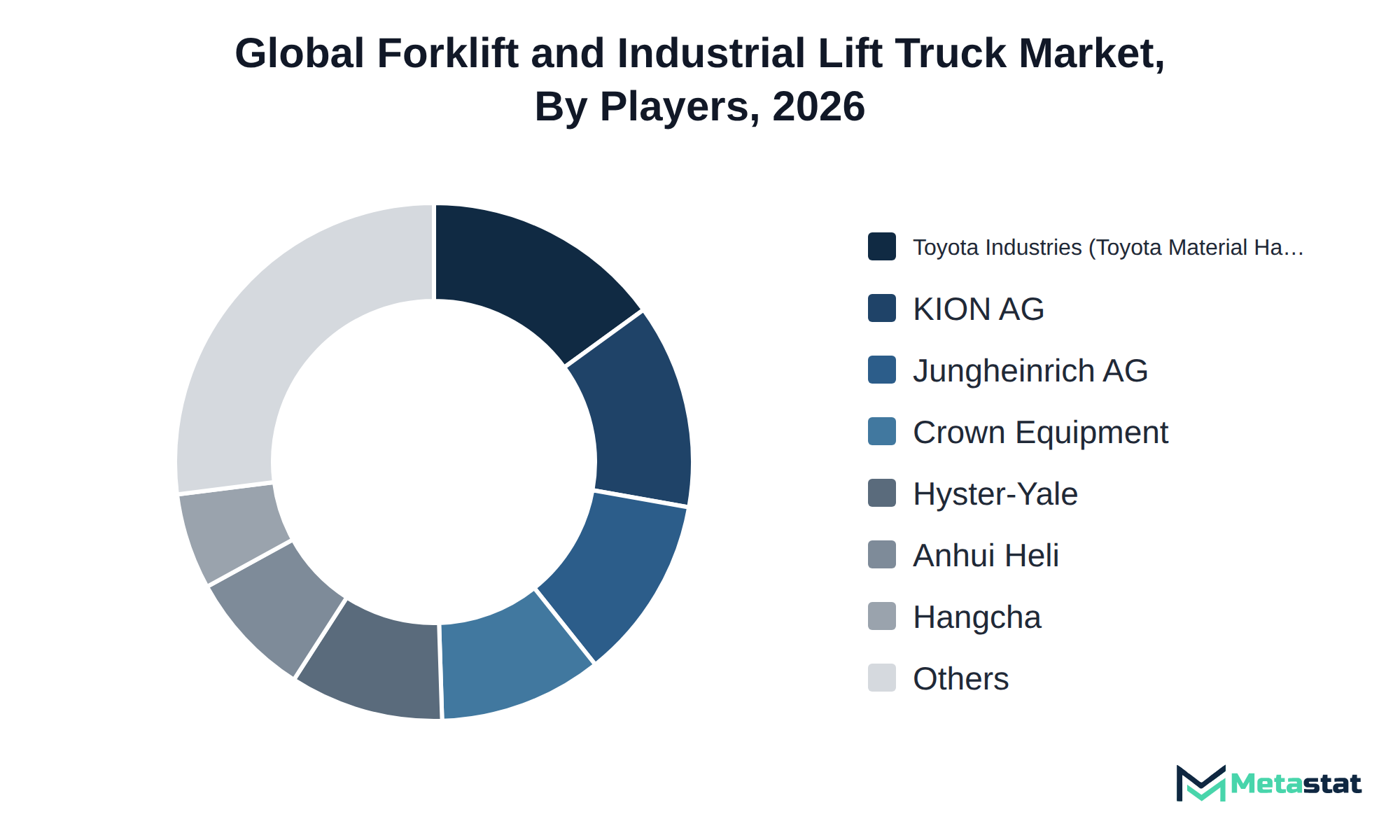
The competitive dynamics of the Forklift and Industrial Lift Truck market illustrate a landscape characterized by various strategic behaviors among key players. Companies compete on factors including price, certification, customization, service, and ecosystem offerings. Buyers increasingly prioritize these attributes when selecting suppliers to meet their operational requirements.
Toyota Industries Corporation (Toyota Material Handling) emphasizes the development of advanced technologies, including automation and smart systems. KION GROUP AG concentrates on enhancing operational efficiency through integrated solutions tailored for specific applications. Jungheinrich AG prioritizes sustainability, focusing on energy-efficient products and services to align with growing market demands.
Logisnext Co., Ltd. distinguishes itself through a wide range of equipment types, catering to various end-use industries. Crown Equipment Corporation highlights its customization capabilities, enabling tailored solutions that meet unique customer needs. Hyster-Yale, Inc. positions itself by offering strong support and service networks, ensuring customers receive comprehensive assistance throughout the lifecycle of their equipment.
Achieving this growth relies on several developments within the Forklift and Industrial Lift Truck market. First, increasing adoption of lithium-ion battery electric forklifts is expected to drive substantial market expansion. This technology provides enhanced efficiency and lower operational costs, particularly benefiting the logistics and warehousing segment, which is projected to reach USD 80.8 billion by 2033. Second, growth within the manufacturing and industrial production sector requires significant investment in counterbalance forklifts, which are anticipated to increase from USD 67.9 billion in 2026 to USD 151.3 billion by 2033. Potential supply chain disruptions pose a risk that could hinder growth. Geopolitical tensions and fluctuating raw material costs affect production capabilities, particularly in regions reliant on imports. The market's ability to navigate these challenges will determine whether it reaches the anticipated USD 269.6 billion by 2033. Continued innovation and strategic partnerships within the industry are crucial to mitigating these risks and sustaining growth momentum.
By Equipment Type: Counterbalance Forklifts, Reach Trucks, Powered Pallet Stackers, Order Pickers, Very Narrow Aisle (VNA) Turret Trucks, Articulated Forklifts, Sideloaders and Multidirectional Forklifts, Rough-Terrain Forklifts, Powered Pallet Trucks
By Power Source: Lead-Acid Battery Electric, Lithium-Ion Battery Electric, Diesel, Liquefied Petroleum Gas (LPG), Gasoline and Compressed Natural Gas (CNG), Others (Hydrogen Fuel Cell, etc.)
By End-Use Industry: Manufacturing and Industrial Production, Logistics, Warehousing and Distribution, Retail and E-Commerce, Food and Beverage, Construction and Building Materials, Ports and Shipping, Agriculture and Forestry, Others (Mining, Utilities, Waste Management)
The report strategically identifies and profiles the key market players and analyses their core competencies in each sub-segment of the Forklift and Industrial Lift Truck market.
Report Attributes | Details |
Study Period | 2021-2033 |
Base Year | 2025 |
Estimated Year | 2026 |
Forecast Period | 2026-2033 |
Historical Period | 2021-2025 |
Growth Rate | CAGR 13.1% from 2026 to 2033 |
Revenue Unit | USD billion |
Segmentation | By Equipment Type, Power Source, Load Capacity, End-Use Industry, and Region |
By Region | North America (By Equipment Type, Power Source, Load Capacity, End-Use Industry, and Country)
|
Europe (By Equipment Type, Power Source, Load Capacity, End-Use Industry, and Country)
| |
Asia Pacific (By Equipment Type, Power Source, Load Capacity, End-Use Industry, and Country)
| |
South America (By Equipment Type, Power Source, Load Capacity, End-Use Industry, and Country)
| |
Middle East and Africa (By Equipment Type, Power Source, Load Capacity, End-Use Industry, and Country)
|
Find answers to common questions about this report
The Forklift and Industrial Lift Truck market size was valued at USD 100.7 billion in 2025.
The market is projected to grow at a CAGR of 13.1% during the forecast period from 2026 to 2033.
The North America Forklift and Industrial Lift Truck market size is estimated to reach USD 55.2 billion by 2033.
Counterbalance Forklifts lead the market with a projected value of USD 151.3 billion by 2033, reflecting the highest growth among the equipment types.
Investment in logistics infrastructure drives demand for forklifts and industrial lift trucks, particularly among logistics, warehousing, and distribution companies. The rapid adoption of lithium-ion battery electric forklifts presents a significant growth opportunity, projected to achieve a compound annual growth rate of 19.0 percent by 2033.
High equipment costs restrain the Forklift and Industrial Lift Truck market growth, particularly affecting small and mid-sized enterprises, leading to slower uptake and smaller orders. Rising input costs, including increased prices for raw materials, create margin pressure for suppliers, necessitating adjustments in pricing strategies to maintain profitability.
Rapid adoption of lithium-ion battery electric forklifts is driven by the demand for energy-efficient and environmentally friendly material handling solutions. This segment is projected to achieve a compound annual growth rate of 19.0 percent, reflecting a shift toward enhanced productivity and sustainability in the industry.
The Forklift and Industrial Lift Truck market is estimated to reach a valuation of USD 269.6 billion by 2033.
Key players operating in the Forklift and Industrial Lift Truck market include Toyota Industries Corporation (Toyota Material Handling), KION GROUP AG, Jungheinrich AG, Logisnext Co., Ltd., Crown Equipment Corporation, Hyster-Yale, Inc., and Komatsu Ltd.
The manufacturing and industrial production segment is projected to reach a value of USD 79.1 billion by 2033.
The analysts below cover Machinery & Equipment research at Metastat Insights.
LEAD ANALYST
Utkarsh Khirodkar is a Lead Market Research Analyst at MetaStat Insight, specializing in market intelligence, technology sector assessments, and competitive strategy.

INDUSTRY CONSULTANT - CHEMICALS & ADVANCED MATERIALS
Chemicals and Materials · Machinery & Equipment · Packaging
Amit Gadhekar Consultant for Chemicals and Materials at MetaStat Insight, directing sector-specific intelligence, research, and strategic consulting across global chemical and processing markets.

PRINCIPAL CONSULTANT - QUALITY SYSTEMS & COMPLIANCE
Electronics and Semiconductor · Machinery & Equipment · Professional Services
Omkar Phadtare is an Industry Consultant at MetaStat Insight, specializing in quality systems, regulatory compliance, and standards benchmarking to drive data-driven market intelligence and strategic industry research.

ENERGY & INFRASTRUCTURE INDUSTRY CONSULTANT
Automotive and Transportation · Electronics and Semiconductor · Energy and Power · Machinery & Equipment
Saurabh Vasant Ganvir consults for Energy & Infrastructure Industry at MetaStat Insight, specializing in renewable energy, solar EPC, and electric vehicle (EV) infrastructure markets.

LEAD CONSULTANT - COMMUNICATION, TELECOM, AND IT
Electronics and Semiconductor · Information & Technology · Machinery & Equipment · Professional Services
Ravindra Sathe Consultants for Communication, Telecom, and IT at MetaStat Insight. He leads the firm's industry research initiatives across telecommunications infrastructure, digital connectivity, enterprise networking, and emerging information technology domains.
Ambulatory surgical centers have very different purchasing cycles for robotic-assisted surgery platforms than major hospital networks. The MetaStat Insight study focused squarely on capital expenditure depreciation, procedural reimbursement pathways, and surgeon training overhead. That operational clarity made it much simpler to validate multi-year procedure growth forecasts against actual ambulatory center adoption patterns.
When planning edge sensor rollouts across refinery environments, generic IoT reports typically miss the harsh-environment certification bottlenecks. MetaStat Insight gave an objective evaluation of ATEX and Class 1 Division 2 hardware availability, along with realistic five-year maintenance cycle cost projections. The comparison of wireless mesh versus private cellular backhaul helped our team pressure-test network reliability models for remote processing facilities.
In the biological seed treatment space, registration timelines vary drastically between the European Union, Brazil, and North America. The MetaStat Insight research handled these cross-border regulatory barriers with genuine nuance, mapping commercialization pathways alongside historical field adoption rates. The segmentation between microbial strains and biochemical active ingredients was particularly well structured.
Explore related market intelligence reports worth reading alongside this one.