
The Europe Courier, Express and Parcel (CEP) market is expected to expand significantly due to increasing e-commerce activities and technological advancements. This blog explores key drivers and trends.
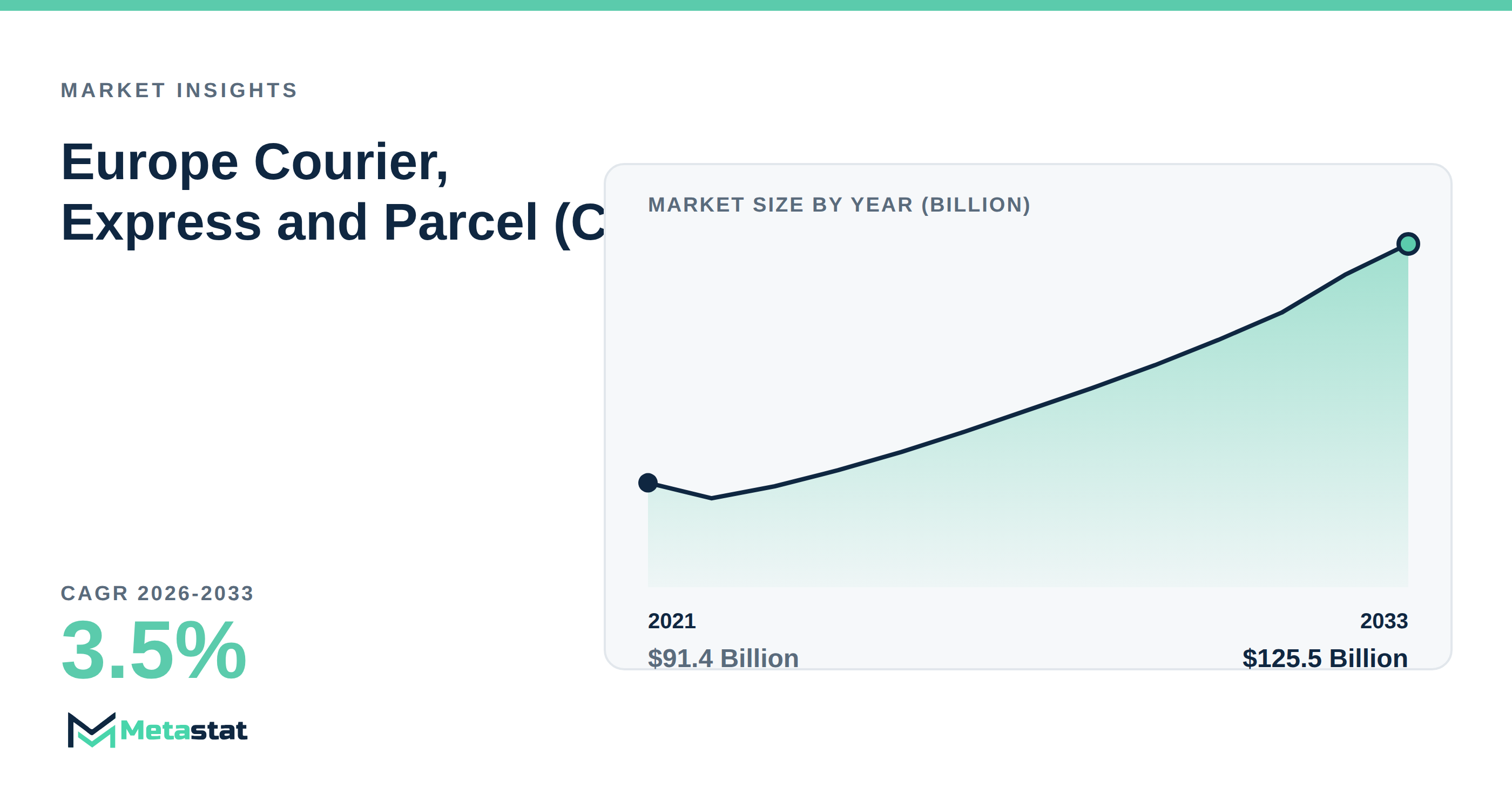
The Europe Courier, Express and Parcel (CEP) market is experiencing notable growth, with estimates indicating an increase in market value from USD 95.8 billion in 2025 to USD 125.5 billion by 2033, reflecting a compound annual growth rate (CAGR) of 3.5%. A significant factor contributing to this expansion is the rise of e-commerce, which continues to reshape the logistics landscape. Understanding the dynamics behind this growth provides valuable insights for stakeholders in the sector.
Why is e-commerce a major force in the Europe Courier, Express and Parcel (CEP) market?
The increasing shift towards online shopping is a key driver of demand in the Europe Courier, Express and Parcel (CEP) market. While consumers increasingly prefer digital purchasing, expectations for swift and dependable delivery services have intensified. Businesses, especially those in the business-to-consumer (B2C) space, must adapt to these evolving preferences by enhancing their logistics capabilities. Forecasts suggest that the B2C segment is set to reach USD 31.8 billion by 2033, demonstrating a robust CAGR of 4.2%.
The business-to-business (B2B) segment is flourishing, reflecting the overall demand dynamics. Valued at USD 66.2 billion in 2026, this segment is expected to climb to USD 82.6 billion by 2033, with a CAGR of 3.2%. The growth in both segments underscores the necessity for logistics providers to develop effective and efficient solutions capable of meeting the rising volume of shipment demands driven by e-commerce.
What impact do technological advancements have on the market?
Technological innovation is a fundamental component reshaping the operational landscape of the CEP market. Automation in order fulfillment and sorting processes significantly enhances operational efficiency and customer service levels. By implementing advanced tracking systems and data analytics, logistics companies respond more effectively to the shifting needs of their clientele, leading to improved accuracy and speed in deliveries.
Logistics providers are increasingly harnessing the power of automation to streamline their operations, resulting in better service delivery. These technological advancements foster greater visibility for clients over their shipments, instilling confidence through improved tracking capabilities. This focus on innovation enables companies to align their services with evolving consumer demands, solidifying their competitive edge in the market.
How do regulatory challenges affect the Europe Courier, Express and Parcel (CEP) market?
Regulatory compliance is another critical factor influencing operations within the Europe Courier, Express and Parcel (CEP) market. Stringent regulations often lead to increased operational costs, challenging logistics providers to maintain competitiveness while adhering to complex compliance requirements. This is particularly pronounced in international shipping, where diverse regulations across regions hinder operational efficiency.
Macroeconomic variables, including inflation and rising fuel prices, exert additional pressure on profit margins. Logistics companies navigate these economic factors while adhering to strict regulatory standards, which directly affect pricing strategies and operational planning. Effective management of compliance costs is essential for maintaining service quality and ensuring profitability in a competitive marketplace.
What emerging trends should stakeholders in the CEP market be aware of?
Several emerging trends are prominent within the Europe Courier, Express and Parcel (CEP) market that warrant close attention. The expansion of cross-border e-commerce creates both challenges and opportunities for logistics providers, who navigate fluctuating trade regulations and geopolitical situations that impact logistics networks and delivery timelines.
Sustainability initiatives are gaining traction, driven by consumer demand for more eco-friendly practices from logistics providers. Companies focusing on green logistics solutions, including electric vehicle utilization and sustainable packaging options, enhance their appeal to environmentally conscious consumers. This shift toward sustainable delivery models signifies a transformative trend that logistics firms consider in their strategic planning.
In summary, the Europe Courier, Express and Parcel (CEP) market is on a path of significant growth primarily fueled by the surge in e-commerce activity. Companies that prioritize technological investments, effectively navigate regulatory challenges, and embrace sustainable practices will likely enhance their competitive positioning. For a comprehensive analysis of the trends and forecasts impacting this market, refer to the Europe Courier, Express and Parcel (CEP) Market report, which provides valuable insights into the dynamics at play.
Tags
About the Authors

LEAD ANALYST
Utkarsh Khirodkar is a Lead Market Research Analyst at MetaStat Insight, specializing in market intelligence, technology sector assessments, and competitive strategy.

ENERGY & INFRASTRUCTURE INDUSTRY CONSULTANT
Automotive and Transportation · Electronics and Semiconductor · Energy and Power · Machinery & Equipment
Saurabh Vasant Ganvir consults for Energy & Infrastructure Industry at MetaStat Insight, specializing in renewable energy, solar EPC, and electric vehicle (EV) infrastructure markets.