
LEAD ANALYST
Utkarsh Khirodkar is a Lead Market Research Analyst at MetaStat Insight, specializing in market intelligence, technology sector assessments, and competitive strategy.

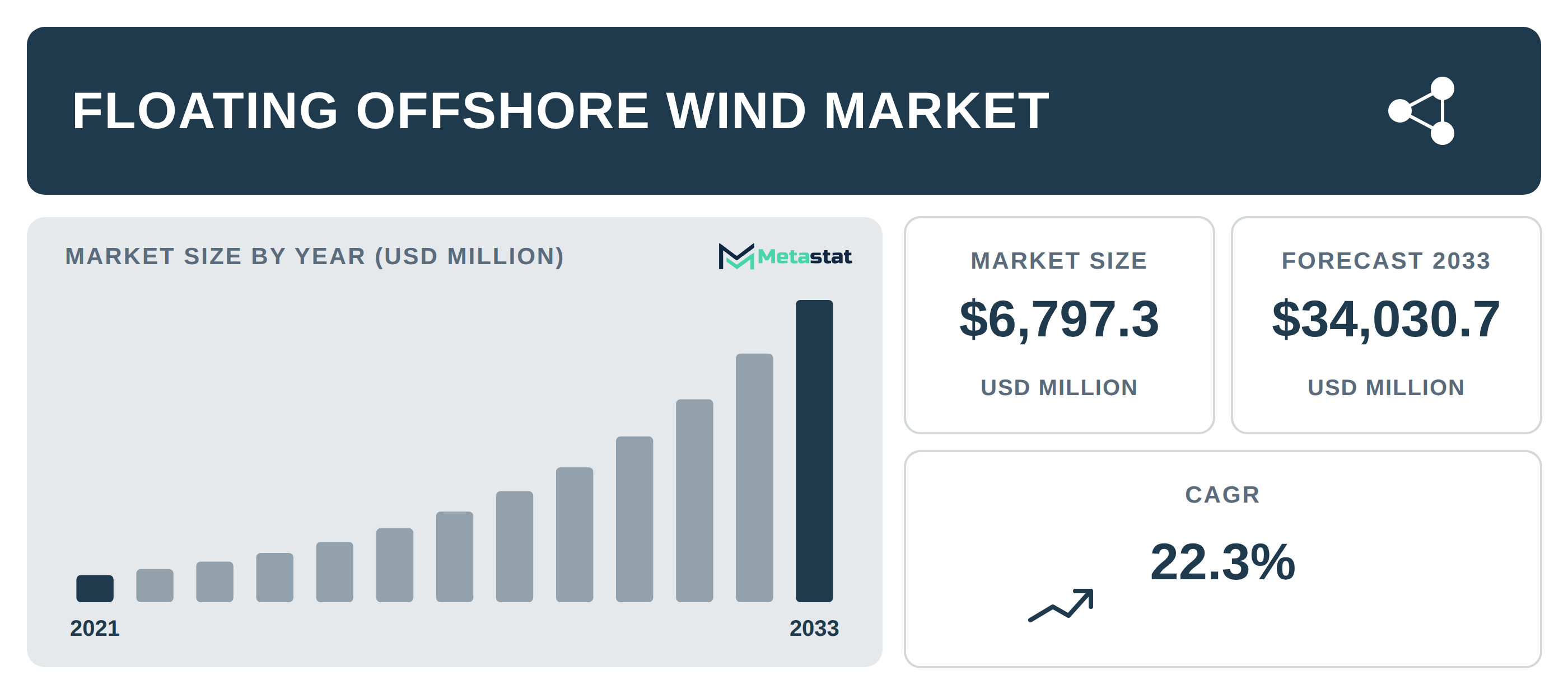
Metastat Insights has released a comprehensive report on the Floating Offshore Wind market, highlighting its growth from USD 6,797.3 million in 2025 to USD 34,030.7 million by 2033. The report covers market drivers, challenges, segmentation, and key players in the industry.
Metastat Insights has published "Global Floating Offshore Wind Market Size, Share, By Turbine Rating (Up to 5 MW, 5-10 MW, 11-15 MW, Above 15 MW), By Floating Platform (Semi-Submersible Platforms, Spar-Buoy Platforms, Tension-Leg Platforms, Barge-Type Platforms), By Depth (Up to 30 M, 30-60 M, Above 60 M), By Construction Material (Steel, Concrete, Hybrid Steel-Concrete), Industry Analysis, Growth, Trends, and Forecast, 2026-2033", highlighting a market valuation of USD 6,797.3 million in 2025 and a projected increase to USD 34,030.7 million by 2033, indicating a compound annual growth rate (CAGR) of 22.3%.
Significant demand for the Floating Offshore Wind market arises from the global commitment to renewable energy sources. This transition is fueled by increasing investments and technological advancements in floating wind technologies. Regions including Europe, North America, and Asia Pacific allocate substantial capital, motivated by favorable government policies and the need for sustainable energy solutions. Technological innovations in turbine designs and platform capabilities expand operational possibilities, further driving growth in the sector.
Challenges in regulatory compliance pose hurdles for the Floating Offshore Wind market, because stringent environmental standards and permitting processes often increase operational costs and delay project timelines. Macroeconomic factors, including inflation and currency fluctuations, influence capital allocation, affecting investment capacity for new projects. Geopolitical tensions disrupt supply chains and project execution, adding complexity to the market landscape.
The Floating Offshore Wind market segments into turbine rating, floating platform type, water depth, and construction material. By turbine rating, categories include up to 5 MW, between 5 and 10 MW, from 11 to 15 MW, and above 15 MW, with the largest category of above 15 MW expected to experience the highest growth rate. Floating platforms are categorized into semi-submersible, spar-buoy, tension-leg, and barge-type platforms, each catering to various operational environments and project requirements. The market analyzes depth categories, focusing on installations up to 30 M, ranging from 30 to 60 M, and exceeding 60 M, optimizing solutions for diverse marine conditions.
Notable participants in the Floating Offshore Wind market include Principle Power, Inc., BW Ideol, Ocergy, Inc., Equinor ASA, and Stiesdal Offshore. These companies actively invest in research and development to enhance turbine efficiency and platform capabilities, positioning themselves favorably within the competitive landscape. Their collaborative efforts contribute to innovation and the overall expansion of the market.
For further insights, readers access the full report at Global Floating Offshore Wind Market.
Related Report
Global Floating Offshore Wind MarketLEAD ANALYST
Utkarsh Khirodkar is a Lead Market Research Analyst at MetaStat Insight, specializing in market intelligence, technology sector assessments, and competitive strategy.

PRINCIPAL CONSULTANT - ENTERPRISE AI & EMERGING TECHNOLOGIES
Banking & Finance · Electronics and Semiconductor · Energy and Power · Healthcare IT · Information & Technology · Professional Services
Vijay Gunti is a Principal Consultant at MetaStat Insight, bringing over two decades of experience across enterprise digital transformation, technology strategy, and intelligent systems.

ENERGY & INFRASTRUCTURE INDUSTRY CONSULTANT
Automotive and Transportation · Electronics and Semiconductor · Energy and Power · Machinery & Equipment
Saurabh Vasant Ganvir consults for Energy & Infrastructure Industry at MetaStat Insight, specializing in renewable energy, solar EPC, and electric vehicle (EV) infrastructure markets.