
LEAD ANALYST
Utkarsh Khirodkar is a Lead Market Research Analyst at MetaStat Insight, specializing in market intelligence, technology sector assessments, and competitive strategy.

Metastat Insights announces the release of its report on the Port Services market, detailing growth from USD 63.1 billion in 2025 to USD 98.3 billion by 2033 with a CAGR of 5.7%. The report covers key segments, regional dynamics, and competitive landscape.
Metastat Insights has published "Global Port Services Market Size, Share, By Port Service Type (including Cargo Handling, Ship and Vessel Services, Port Equipment and Machinery Services, Marine and Navigation Services, Warehousing and Storage Services, Supply Chain and Logistics Services, Port Security and Safety Services, Engineering, Maintenance and Repair Services, Port Environmental and Waste Management Services, and Other Port Services), By Port Type (covering Seaports, Inland Ports, River Ports, Dry Ports, Container Terminals, and Bulk and Multipurpose Ports), By Cargo Type (comprising Containerized Cargo, Dry Bulk Cargo, Liquid Bulk Cargo, Breakbulk and General Cargo, Vehicle Cargo, and Project and Heavy-Lift Cargo), By Ownership and Governance (including State-Owned Ports, Private Ports, Public-Private Partnership / Concession Ports, and Port Authority-Operated Ports), Industry Analysis, Growth, Trends, and Forecast, 2026-2033", followed by the headline figures (USD 63.1 billion in 2025, USD 98.3 billion by 2033, 5.7% CAGR).
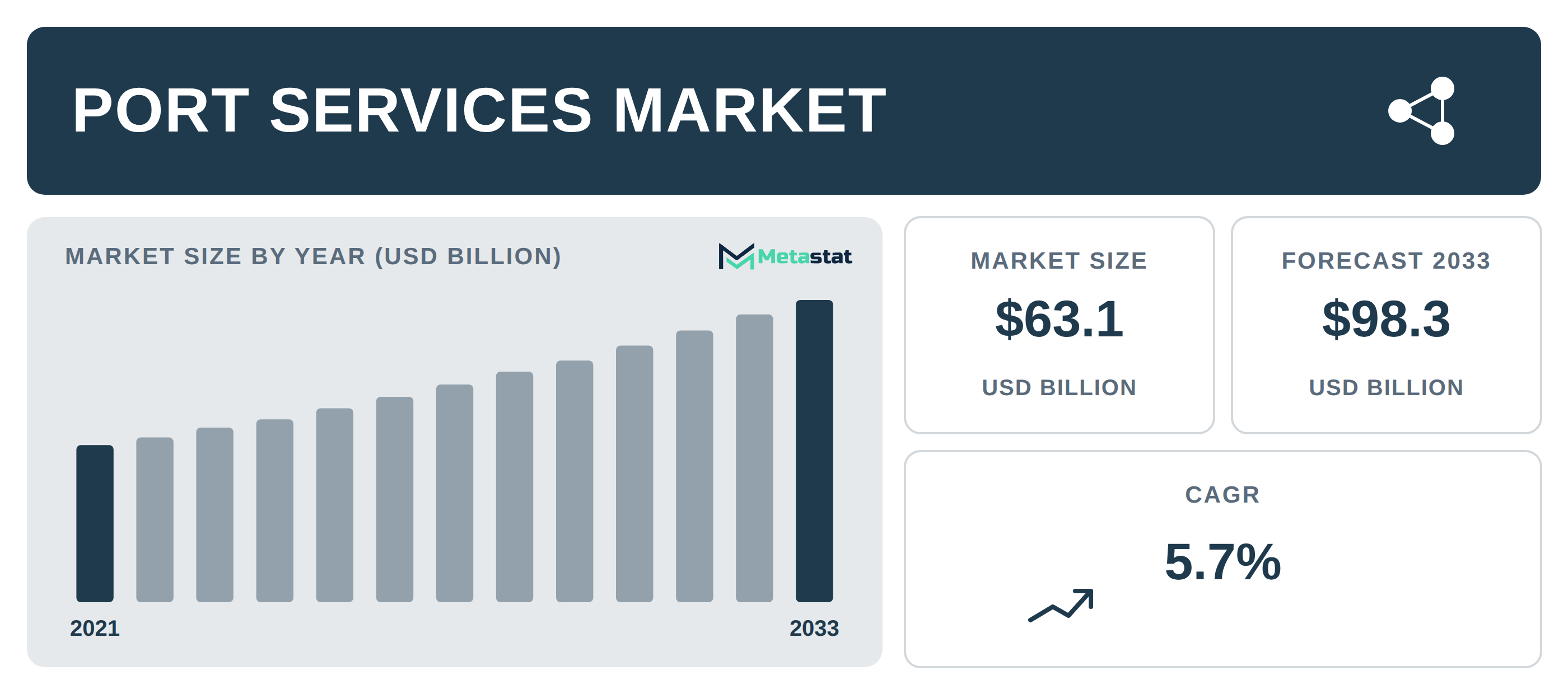
The growth of the Port Services market is supported by increasing global trade and the demand for efficient logistics solutions. Technological integration, particularly automation and digital tracking systems, enhances operational efficiency and service reliability. Ports are investing significantly in modern infrastructure and advanced technologies to streamline operations, which drives the market’s expansion. The focus on sustainability and compliance with stringent regulations further influences investment decisions, compelling ports to adopt eco-friendly practices and innovative solutions.
Challenges within the Port Services market include stringent regulatory compliance requirements that raise operational costs. Companies face financial pressures due to adherence to environmental and safety standards, which deter investment in new technologies and infrastructure. Macroeconomic factors including inflation and currency volatility introduce complexities that affect pricing strategies and operational costs. Gaps in infrastructure and workforce skills create obstacles to meeting current demands, potentially limiting growth opportunities.
The Port Services market is segmented into various service types, including Cargo Handling Services, Ship and Vessel Services, and Port Equipment and Machinery Services. Each segment shows distinct growth trajectories, with Cargo Handling Services projected to rise from USD 20 billion in 2026 to USD 29.2 billion by 2033. Regionally, the Asia Pacific region commands the largest market share at 45.3%, driven by rapid industrialization and urbanization. Europe and North America follow with shares of 21.9% and 16.9%, respectively, indicating diverse opportunities across different markets.
Significant players operating within the Port Services market include Detia Degesch Group, Hapag-Lloyd AG, Port of Rotterdam Authority, Ecolab Inc., and DP World Limited, among others. These companies focus on enhancing service offerings through technological advancements and strategic partnerships, thereby improving their competitive positions. The market's competitive environment encourages innovation and investment in next-generation services, providing a platform for sustained growth.
Readers interested in a comprehensive analysis of the Port Services market accesses the full report here: Global Port Services Market.
Related Report
Global Port Services MarketLEAD ANALYST
Utkarsh Khirodkar is a Lead Market Research Analyst at MetaStat Insight, specializing in market intelligence, technology sector assessments, and competitive strategy.

ENERGY & INFRASTRUCTURE INDUSTRY CONSULTANT
Automotive and Transportation · Electronics and Semiconductor · Energy and Power · Machinery & Equipment
Saurabh Vasant Ganvir consults for Energy & Infrastructure Industry at MetaStat Insight, specializing in renewable energy, solar EPC, and electric vehicle (EV) infrastructure markets.